A couple of weeks ago, my friend and colleague Ruth Ann Nordin wrote about why she enjoys horror and romance stories (you can read her full post here). Midway through her post, she mentioned how she doesn’t like open endings or where things are left up to the reader’s interpretation. After reading her post, I commented on her post, “Ironically enough, a lot of horror stories have open endings, which only helps accentuate the feelings of horror and dread.”
I’ve been thinking about that conversation since then, and now I want to write about ambiguity in fiction. Especially in horror. And how that, as frustrating as it can be to some readers, that ambiguity can be helpful to stories at times.
Now, I’m not writing this to trash anyone who doesn’t like open endings or stories that leave unanswered questions. People have different preferences, and that’s okay. And honestly, at one point, I felt the same way…until someone pointed out that I’ve written stories like that in the past. I’m just writing about the open endings and the unanswered questions sometimes help a story more than wrapping everything up in a neat little bow.
So, why would writers create open endings? Or leave questions unanswered? Well, barring cases where extenuating circumstances keep the creator from tying up all the loose ends (*cough* Disney canceled The Owl House way too early *cough*), there could be a variety of reasons. In horror, it could be for a very simple reason: doing so makes the story that much scarier.

Let’s take Hell House LLC. This horror film, while not in my top six, is a favorite of mine. The film is a found-footage mockumentary revolving around a horrific tragedy at a haunted attraction, and what happened to the team behind the attraction. While, over the course of events in this movie, what caused the tragedy in the first place is explained, a lot of things are left unanswered. Things are further explained in the sequels, but if you only see the original film, the things that are left unexplained lend this air of mystery to the story. And the fact that, at least for that film, we’re left to question what we don’t know, can be terrifying.
Another great example: Perfect Blue, one of my top six horror films and one of my favorites ever. I’ve discussed it here before, but if you’re unfamiliar, it’s an anime film about a celebrity who is hunted by a violent stalker, leading her to spiral into paranoia and madness. While the first third is straightforward, and the final third wraps things up nicely, the second third does a damned fine job of making it hard to tell what’s real and what’s delusion. You really feel the protagonist’s terror as she tries to figure out what’s real and what’s not, only to be swept along and finally stop fighting against the current.
Speaking of paranoia and madness, cosmic horror, especially Lovecraftian horror, thrives on ambiguity. The Great Old Ones and other ancient beings often have forms that are undefined by the writers. The most we can say is, “it’s so scary, even thinking about what it looks like is too terrifying! Also, it’s so unlike anything I know, my mind is having trouble defining any particular portion. That being said, it’s so scary, I can’t write it down to tell you about it.”
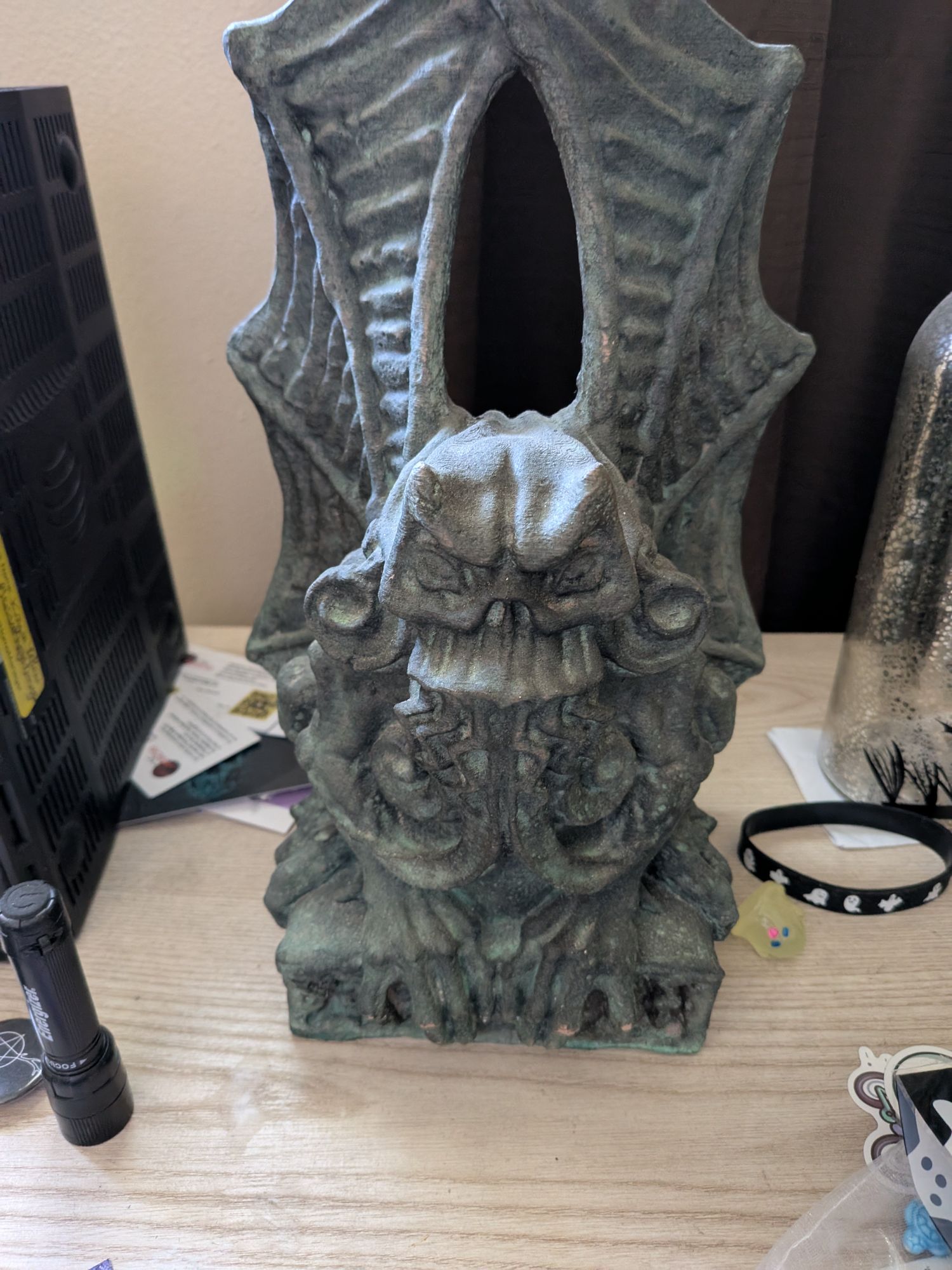
Even Cthulhu, who is the most well-known and most defined of the Great Old Ones, is somewhat undefined. Technically speaking, his whole man/dragon/octopus thing is what people are able to recall he looked like. He’s still somewhat difficult to describe.
And that’s scary. We fear the unknown, and when we can’t fully define what we’re dealing with, it’s frightening.
So, yeah, ambiguity can be frustrating. But it does have its uses. And in the horror genre, it can help us horror writers do what we do best: scare people silly. Hell, at times, it helps the stories become that much more notable. And if a story can be made better by a bit of ambiguity, then a little bit of frustration is well worth the cost.
That’s all for now, my Followers of Fear. I’m off to make dinner and figure out what I’m doing with the rest of my evening. Until next time, good night, pleasant nightmares, and 82 days till Halloween. Thankfully, there’s nothing ambiguous about that!
 Rami Ungar The Writer