Posts Tagged ‘authors’

Peter Pan is a character/story that every child loves growing up. However, as we actually grow up, not only do we see the tragedy of the character, but you also realize he’s kind of creepy. I mean, he hides outside a window to listen to a girl tell her brothers stories. And in the books, he’s a tyrant who kills the Lost Boys when they get too old, among other things. It’s not surprising that, as the years have gone by, more and more stories have delved into the dark side of Peter Pan.

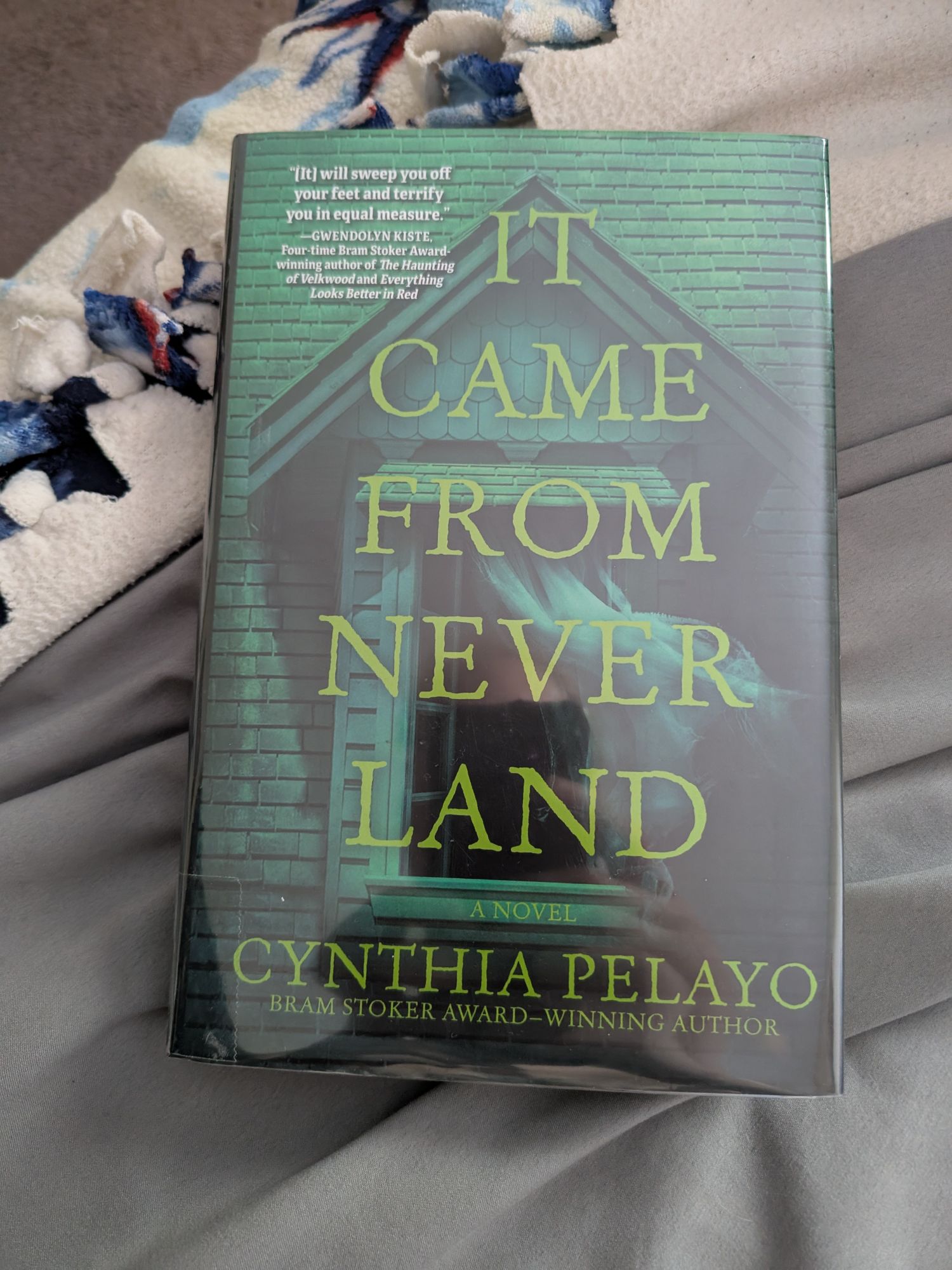
In Cynthia Pelayo’s take on a dark Peter Pan story, It Came From Neverland, we meet a very different Wendy from the one who appears in J.M. Barrie’s book.* Now in her twenties, the adult Wendy is scarred from her experiences with Peter. She tries her best to move on, teaching at the children’s home that took her in after she and her brothers returned, and reads to soldiers returning from fighting in WWI. But then strange events happen around London. Children get injured or go missing. Mysterious fogs and crows feathers appear all over the place. And Wendy hears a whisper from her past. A whisper belonging to a boy who’s not a boy, whom she thought was dead after he killed so many. And he’s come back for her.

Cynthia Pelayo writes a lot of stories that are reinterpreted fairy tales (I loved her take on the Sleeping Beauty story, Vanishing Daughters), and with It Came From Neverland, that talent is on full display. With strong and concise language, she crafts a suspenseful tale that really lets us get into the head of Wendy Darling, aged into adulthood long before she hit her teen years and trying to survive when the past haunts her everyday. You really get to know her as we see her deal with the return of Peter Pan.

Speaking of which, the relationship between her and Peter was chilling! It’s the definition of an abusive and toxic relationship, with Peter being nice before lying, manipulating, gaslighting, and finding all sorts of ways to belittle Wendy. Just from the short episodes we see, it’s enough to make you shudder from how horrible he is to her.

And like I said, this book is suspenseful. A lot of time is spent showing Peter’s encroachment on Wendy’s life, as well as the life of her brothers. And it is frightening! It reminds me of what Stephen King said about the three types of horror, and how terror is the one that’s hardest to do, because it leaves you with that sense of unease that refuses to go. That terror is put on full display here, creating a frightening atmosphere that lingers long after you put the book down.

My only major criticism is that the parts exploring Wendy’s past with Peter are too short. I didn’t mind that they were out of order, but for a book that was marketed as Peter Pan meets IT, I expected more time spent in the past. To really feel like I was in Neverland with those characters when they were children. What we got was more like short vignettes, and while those were great, I felt like they weren’t enough for me.

However, on the whole, it is a great novel that I practically flew through each time I picked it up. On a scale of 1 to 5, I give It Came From Neverland by Cynthia Pelayo a 4.8 out of 5. This is definitely one to settle down with. Just be careful, though. You might end up hooked!

*By the way, Barrie’s mentioned in the book as someone who heard Wendy’s story and twisted it into the child-friendly version we know today. And can I just say, I love that he’s as much a hack in the book as I’ve always thought he was? I got a laugh out of that.

You might have heard of this novel, even if you haven’t read it or even if you don’t read horror. That’s because it recently won the Pulitzer Prize, the first horror novel to ever do so. And given the stature of the Pulitzer Prize, that’s quite the accomplishment (though as my friend and colleague Kevin Wetmore noted while hosting the Bram Stoker Awards last month, “a horror novel wins the Bram Stoker award every year”). Recognizing what a big deal this is, I decided to check it out and got the audio book. After all, what kind of horror novel wins the Pulitzer Prize?

Well, a rather unusual novel, as it turns out.

Taking place during the Meuse-Argonne offensive in WWI, Angel Down follows Private Cyril Bagger, a con artist who was tricked into enlisting and can’t wait to rooking inexperienced gamblers back in the States. He is commanded by Major General Reis, the commander in the offensive, to go and find the source of an unearthly shrieking that is causing the men to go insane. If it turns out to be a soldier dying slowly, they are to put him out of his misery. Bagger is joined by four other soldiers; Private Louis Arno, an illiterate teenager who lied about his age to enlist and has attached himself to Bagger like a koala to its mother; Private Hugh Popkin, a violent meathead with no brains, a raging case of the clap, and an even stronger raging case for a girl back home; Private Vincent Goodspeed, a twitchy graverobber who steals from the bodies of the dead to sell to both sides; and Private Ben Veck, the group’s only black soldier, who is suffering from PTSD and wants to believe he’s been chosen for a greater purpose.

Upon finding the source of the shrieking, they discover it’s an angel in the form of a human woman. One that resembles someone each of the men know. Realizing that the ambitious Reis would use the angel for his own purposes, they go AWOL and take the angel with them, leading to an unavoidable chain of events that will not only change their lives, but maybe even change the world.

So, like I said, this is a rather unusual novel. Angel Down is apparently written in the style of a single, continuous sentence (as I had the audio book, I could only half tell), so every tenth word is an “and” or a “so.” This is nothing new in literature, as plenty of novels, most famously The Waves by Virginia Woolf, has been written this way. I’m assuming Kraus wrote it this way because stream-of-consciousness style writing like this was popular among Modernist writers post-WWI, and he’s paying tribute to that. Plus, it makes the novel stand out.

However, I did hear from plenty of fellow horror fans who find the writing style grating. And honestly, I understood; I could only listen to the audio book during certain moods, like when I was driving or cooking. Otherwise, the style would get under my skin in a bad way. (And the narrator, bless him, narrated the book so that it at least sounded like it had normal sentences.)

All that aside, most of the characters are fully realized, especially Bagger. He’s the son of a preacher who doesn’t believe in anything except himself and controlling his life. At the same time, he’s also perturbed that he likes Arno and protect the kid, and the events of the novel set him on a path of transformation. Arno and Veck are also quite sympathetic, especiallyt he latter after you learn more about him. And Reis and Popkin are easy to hate (especially Popkin).

As for the angel…she’s an enigma. She sets things in motion and for most of the novel is a MacGuffin that motivates the characters. However, later on, she does start to affect the story and the characters more, and it’s…it’s hard to tell how I should feel about her. To like her or hate her. To consider her hero or villain. Or maybe she’s just the bringer of revelations? I guess any and all of those opinions work, given that she’s an angel, and therefore beyond our ordinary comprehensions. But still, she’s a lot and it makes it hard to pin down your feelings about her.

Finally, I will say that the book does a great job of getting the horrors of war through to the reader. Just like All Quiet on the Western Front did nearly a full century ago, it does not hold back. From descriptions of the bodies covered in clay and blood, to the fear each soldier feels when German bullets or mortar fire flies overhead, to the abstract depictions of the “engines of war,” it is enough to dissuade some readers that any good can come of war. (Something some of our current crop of leaders could learn from.)

Overall, I think I will give Angel Down by Daniel Kraus a 3.8 out of 5. The narration style may not be to everyone’s tastes, but the story, characters, and themes are engaging and make you want to keep going. I can see why this book won the Pulitzer Prize. And if you decide to read it, perhaps you will, too.

Also, Happy Fourth of July, my Followers of Fear. Whatever you’re doing this Independence Day, stay safe and have fun!

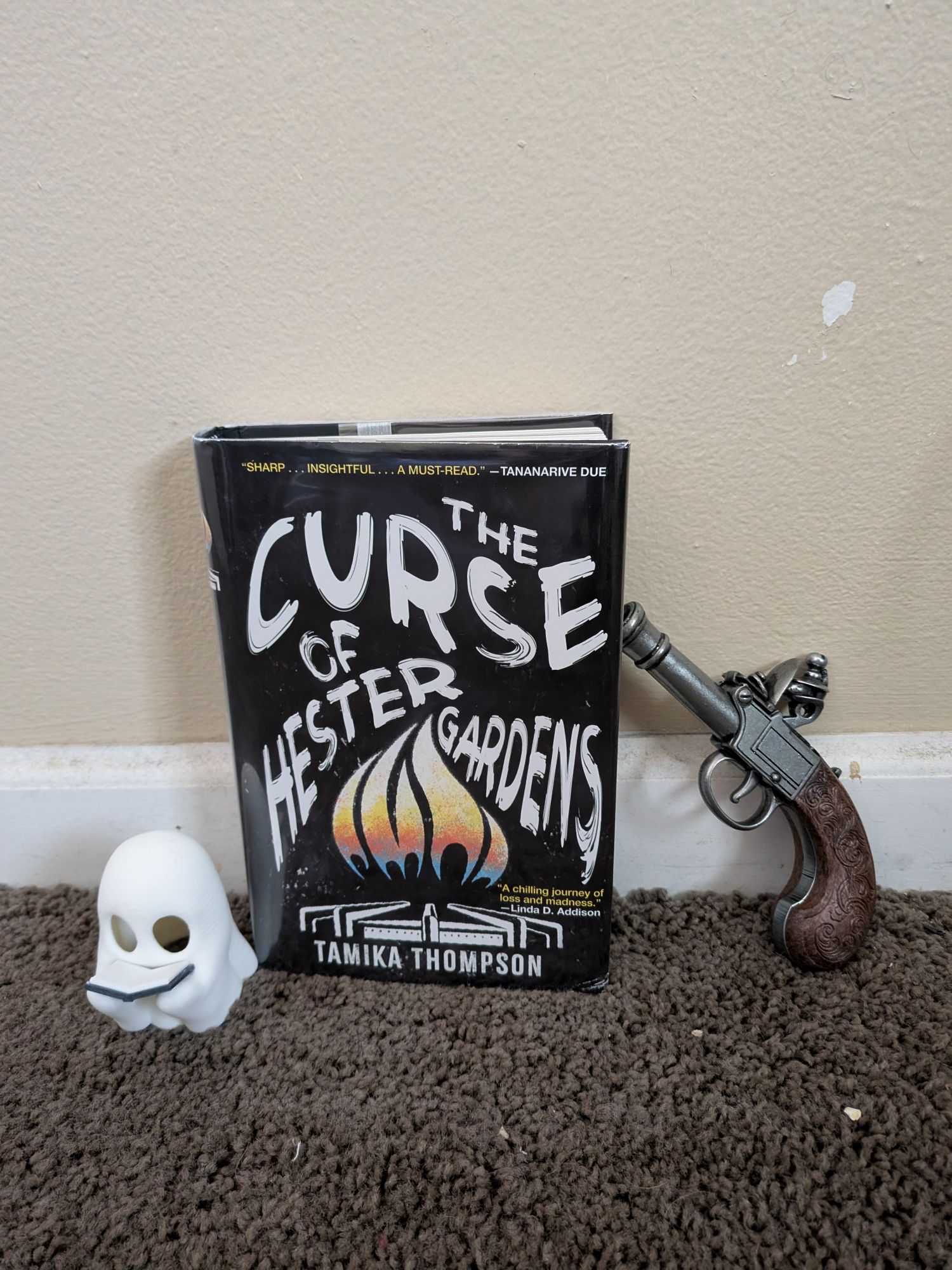
Earlier this month, I had the pleasure of reviewing The Curse of Hester Gardens by Tamika Thompson (see my review here). To say the least, it was quite the read. And since I’m lucky enough to be friends with its author, I thought I would pick her thoughts and see what she has to say about her book. So, ladies, gentlemen, and non-binary nobility, please welcome to the blog Tamika Thompson!

Rami Ungar: Welcome to my blog, Tamika. Tell us about yourself and your new novel, The Curse of Hester Gardens.

Tamika Thompson: I’m originally from Detroit, and I grew up about a mile away from a public housing project called Herman Gardens, which is a strong architectural inspiration for Hester Gardens. At eighteen, I left Detroit to attend Columbia University, where I studied Political Science. I went on to the University of Southern California to study journalism, and it was there that I reported on gang violence in Southern California. After graduation, I worked for several years as a journalist, and eventually spent two years researching gun violence in America. The lived experience, studies in global and national politics, and journalism background all came together in this debut novel.

The Curse of Hester Gardens is a gothic novel set in a public housing project that follows one mother, Nona McKinley, whose oldest son is shot to death and whose husband is in prison, as she faces the twin specters of a supernatural curse and gun violence while trying to keep her remaining sons alive in their high-crime neighborhood.

RU: Tell us about your main character Nona McKinley. I find her quite the compelling lead.

TT: I am the first to admit that Nona has flaws. Having grown up in a public housing project and then attempting to raise three boys in another public housing project on the other side of the fictional town of Medford, Michigan, she is parenting in the worst possible circumstances in a high-crime neighborhood. She still tries to find joy, pleasure, and some semblance of normalcy in a terrible system of oppression and predation. She is strong and God-fearing, but she’s also having an affair with the married church pastor!

I see her on a continuum with Peter, the leader of the local Hester Boys gang. Readers believe Peter to be a villain, and I believe both Nona and Peter are capable of tremendous love and tenderness and also tremendous hatred and violence.

RU: I would describe Hester Gardens as “unflinching,” especially in its exploration of gun violence, urban violence, and urban neglect. What was writing a novel that explored all of that, and was also a frightening supernatural novel, like?

TT: It was an emotional journey, and it was years in the making. This story was being written inside of me before I was even a writer. The book is dedicated to my late uncle, who was shot to death when I was young. I mine a lot of my personal experience to tell this story. I also spent two years researching the epidemic of gun violence in America. When I sat to write, it took me five years to bring it together before I ever let an agent read it.

I’m happy when a reader tells me the novel made them cry because I cried a lot when I wrote it. I love all of my characters. None of them are villains to me because they’ve all been traumatized and oppressed by this country.

Balancing the social with the supernatural was a manageable task because I stuck with Nona’s story, her grief over losing her oldest son and how that colored every experience she had and every decision she made after. Her panic about keeping her remaining boys safe drives the narrative, as well as her personal isolation and terror over not being believed by those around her. I let that carry the story, and I think that naturally creates the balance.

RU: You also explored gun violence as a theme in your short story, “The Creak in the Attic.” Which, coincidentally, was the first story I ever read by you. What was it like to work with that theme in a novel versus a short story?

TT: “The Creak on the Attic Stairs” appeared in The Rack Vol. 2, edited by Tom Deady, and it not only deals with the American gun violence epidemic, but it also is set in the same story world as The Curse of Hester Gardens. Tackling gun violence in a short horror story is in some ways harder because you have to showcase the haunting of grief, the perceived supernatural remnants of the dead, as well as let the reader in on the shock and outrage that gun violence creates with fewer words. Guns hurt people, and there is less space in a short piece to make that point and get around to the hope at the end. Because I believe the hope is necessary for the conversation on ending gun violence to continue.

RU: Can you tell us about some of your other works?

TT: Short stories are my first love. I’ve had works published in Interzone, Andromeda Spaceways, and Prairie Schooner, as well as turned into audio on the Creepy podcast and translated into Italian.

My first book-length publication was a multi-genre anthology that I co-edited called Graffiti. It included essays, fiction, and poetry, with works that were speculative and real. It won a Foreword INDIES Award for anthologies.

I also gathered my published short stories with original works and brought them together in a single-author collection called Unshod, Cackling, and Naked, which won the Next Generation Indie Book Award for Horror.

RU: What are you working on now? And what are your plans for the future?

TT: I am working on a standalone second novel, which is still squarely in the horror genre and tackles a social issue, but with a cast of characters and setting that couldn’t be more different from The Curse of Hester Gardens.

I am also working on a sci fi fantasy novella, and another all-speculative story collection.

I’m still also writing short stories. That part of my writing practice never goes away.

RU: What advice would you give other authors, regardless of background or experience?

TT: Persevere on behalf of your stories! I’ve met a lot of extremely talented authors who could write circles around me, and their work doesn’t make it into the world because they don’t make it to the finish line on their manuscripts. I believe the author’s first job is to persevere in completing a manuscript. Both drafting and revising. Revision is where the author earns readers, so keep going. Persevere!

RU: Final question: pretend you’re stuck on a desert island for a while and you can only bring three books with you till you’re picked up. What books are you bringing with you?

TT: Song of Solomon, Toni Morrison. It is arguable that Beloved is Morrison’s magnum opus, but I have always been drawn to the characters in Song of Solomon, particularly Pilate and Guitar. Morrison’s prose is intricate across all her books, but Milkman Dead’s journey of self-discovery is a powerful one, and the idea of Guitar’s Seven Days mission haunts me even now. Movements for civil and human rights by black people have only ever sought equity in America, but what if we decided to seek revenge? An eye for an eye? I shudder to think.

Middle Passage, Charles Johnson. I had the privilege of having a conversation with Johnson during a class I took early on in my writing practice and his tutelage on story and plot was foundational in my own practice. Middle Passage is not only brilliant, but a master class in creating work that is subversive.

Giovanni’s Room and The Fire Next Time by James Baldwin —I know I cheated on this one, but it is impossible to choose just one text by Baldwin. So, I went with my favorite of his fiction and non-fiction works. (To further cheat, may I suggest after reading The Fire Next Time to check out Between the World and Me by Ta-Nehisi Coates, as the latter is in conversation with the former?)

RU: I’ll allow it, since I remember Song of Solomon from college and considered it quite the powerful novel. Thank you for joining us, Tamika. I hope I can have you back here on the blog someday.

If you would like to find out more about Tamika, you can check out her website and social media, which I will link to below. And make sure to check out The Curse of Hester Gardens, which is definitely one of the best new novels of the year.

That’s all for now, my Followers of Fear. I hope you enjoyed this interview and will tune in for more. And until next time, good night and pleasant nightmares.

I first met Tamika Thompson last year on the Diversity in Horror panel at StokerCon. Later, I read a short story by her that I really enjoyed, and she told me her debut novel was coming out soon that explored similar themes as her short story. I was immediately intrigued and, as soon as I could, I made a reservation at the library. The book arrived at the same time as Japanese Gothic (see my review for that book here), and as soon as I finished that one, I got into The Curse of Hester Gardens.

I have to say, it’s nice when you get two excellent novels in a row.

Set in a public housing complex with a history of crime and violence, The Curse of Hester Gardens follows Nona McKinley, a woman who has been raising her sons on her own since her drug dealer husband was sent to prison. Sadly, her oldest son Kendall was murdered, money is always tight, and her younger son Lance is getting mixed into a bad crowd. Her only salvation is that her middle son Marcus is off to an Ivy League college in the fall.

Except…something terrifying is happening in Hester Gardens. Things are always weird there, as numerous spirits are said to haunt the place. But now, something new is making itself known. Nona is encountering what might be an angry spirit appearing in her home, Marcus is acting very much unlike himself, and the fragile life she’s constructed for her family seems to be crashing down around her. All of it may trace to a secret she’s been keeping. A secret covered in blood. And the residents of Hester Gardens may pay the price with Nona.

From the prologue, I was hooked. The story is written with a powerful realism, mixing in the real life tragedies of gun violence, urban decay and neglect, overincarceration, and others with the fictional narrative to add believability. Plus, the descriptions allowed me to really see and feel like I was in Hester Gardens (not a fun place to imagine yourself in, let me tell you). I could almost smell the garbage that is hardly ever picked up!

I also empathized with main character Nona. She’s had a really rough time and is trying her best, so it’s not hard to root for her. She’s also very human and makes mistakes, some of which are understandable given her situation, and that helped me like her more. The other characters whose POVs we look through also were written so that, even if we only spent maybe a chapter or two with them, they felt like well-rounded characters.

And the scares? Top notch! The concept of the curse and the spirits in Hester Gardens made for a freaky audience, and the human factor added to those scares as well. Plus, there were some scenes with the entities that had me gripping my book so tightly. (That hole-in-the-bathroom scene!)

Finally, the story kept me guessing throughout. I had trouble guessing where the story would go, especially in the last hundred pages or so. I read quite a few moments with wide eyes because I could not believe where the story had gone!

So yeah, I’m hard-pressed to pick out anything I didn’t like. On a scale of 1 to 5, I would give The Curse of Hester Gardens a 4.8 out of 5. Powerfully written, with strong emotions and realism. If this is Tamika Thompson’s first novel, I can’t wait to see what she does with her second.

In the meantime, grab a copy of The Curse of Hester Gardens and read it today. Trust me, you’ll be glad you did.

No, it’s not getting published. If it were, I would have announced that in the title of this post. But I am going to give you all updates on how that effort is coming along.

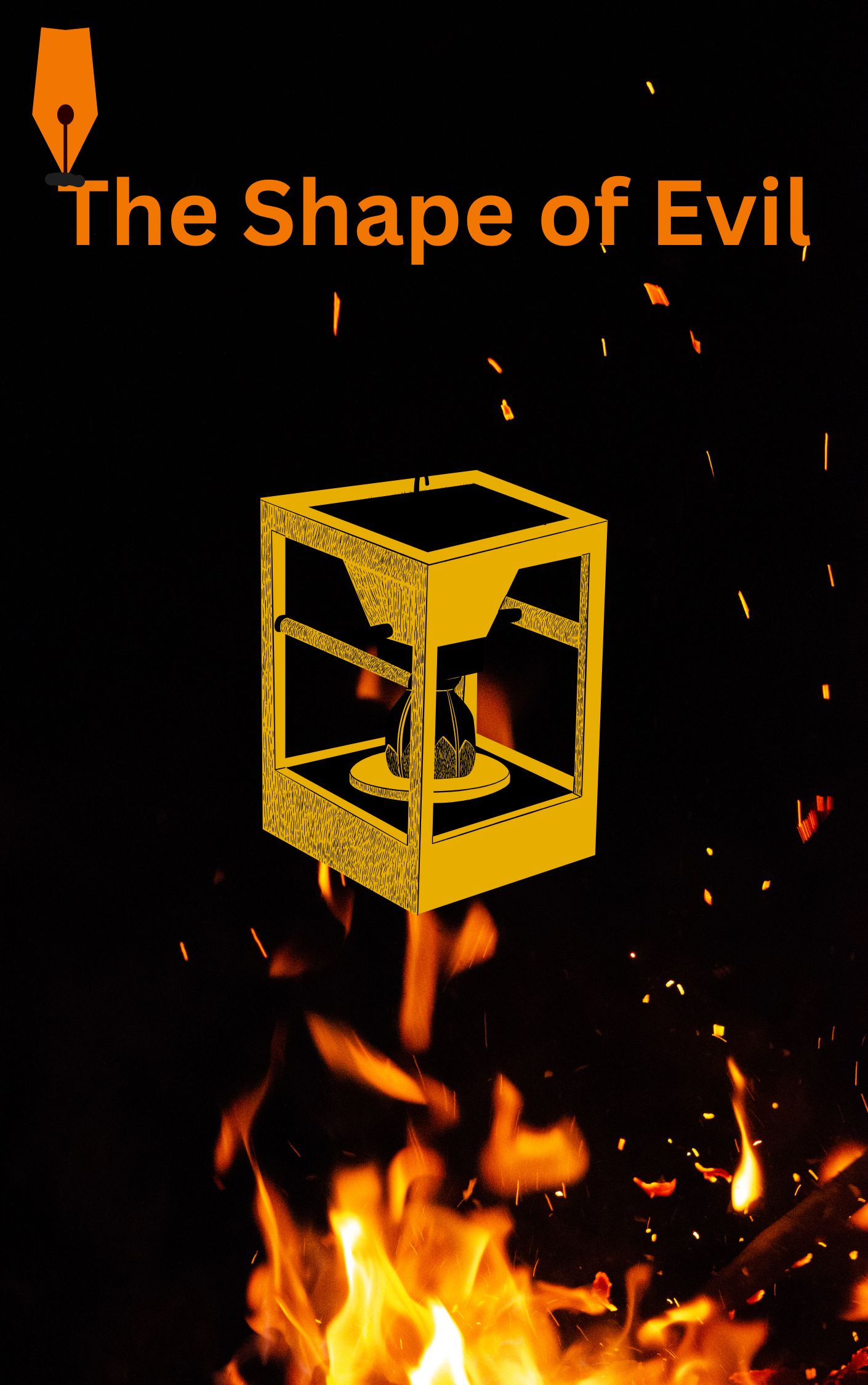
So, for those of you who don’t know, The Shape of Evil is a novel I wrote about a 3D printer from Hell. Think “Word Processor of the Gods” crossed with Gothic by Phillip Fracassi, but with lots of LGBT and disabled representation. I wrote it in 2024, and then prepared it for pitching at StokerCon last year. I even had sensitivty readers take a look at the second draft, just to make sure my portrayal of my protagonist, a non-binary trans individual, wasn’t offensive.

Since I pitched it to publishers and agent last year, I’ve continued trying to find the novel a home. And I’ve had a few rejections, which I expected. I wasn’t even too bummed about them. No, seriously, I wasn’t. They felt less like dead ends, and more like stops on the road for finding a home for this novel. And I still have prospects I’m looking into or waiting to hear back from, so I’m not feeling any despair right now. If I’m being honest, all I feel is anticipation. Like something is coming down the road, and it’s what I’ve been waiting for since that pitch session last year.

And in the meantime, I’ve kept busy. Not only have I worked on some new stories, but I’ve even done two new drafts of The Shape of Evil. And guess what? On the second draft, I had a revelation: this was a YA novel I was working on. Yeah, you would think I would notice, with teen protagonists, only one really bloody scene, and a few other factors. But you know what they say: artists and authors are often their own worst judges. And given that it took me two years to realize this, I prove that maxim to be true.

So, I went back to the beginning of the draft, and started editing with the goal of editing a YA novel instead of an adult novel. I even switched the book from third person point of view to first person point of view, because that’s a staple of the genre. (Also, with my protagonist Astrid Marsh being non-binary and using they/them pronouns, it cut down on the number of “theys” and “thems” in the manuscript. Much less confusing for readers.) And as of last night, the new draft is finished. Hopefully this is the one that catches an agent or publisher’s eye and makes them want to publish it.

For now, though, I plan on not doing anything with the new draft until after StokerCon. Gotta make time to relax and have fun, after all.

Also, I have other stories I plan to work on. There’s a science fiction story I have been excited to work on since I had the idea back in late March. And after that, I will finally get back to working on my mummy novel Crawler. And this time, I hope to finish it!

But in the meantime, I’m going to celebrate the end of the new draft with a quiet movie night and a bottle of wine. Gotta celebrate the wins, right? And finishing a fifth draft where I rewrote the novel to first person POV and made sure it fit the YA genre is definitely a win.

That’s all for now, my Followers of Fear. I’ll try to be in touch again as soon as possible, StokerCon and other things going on permitting. But until then, good night and pleasant nightmares, everybody!

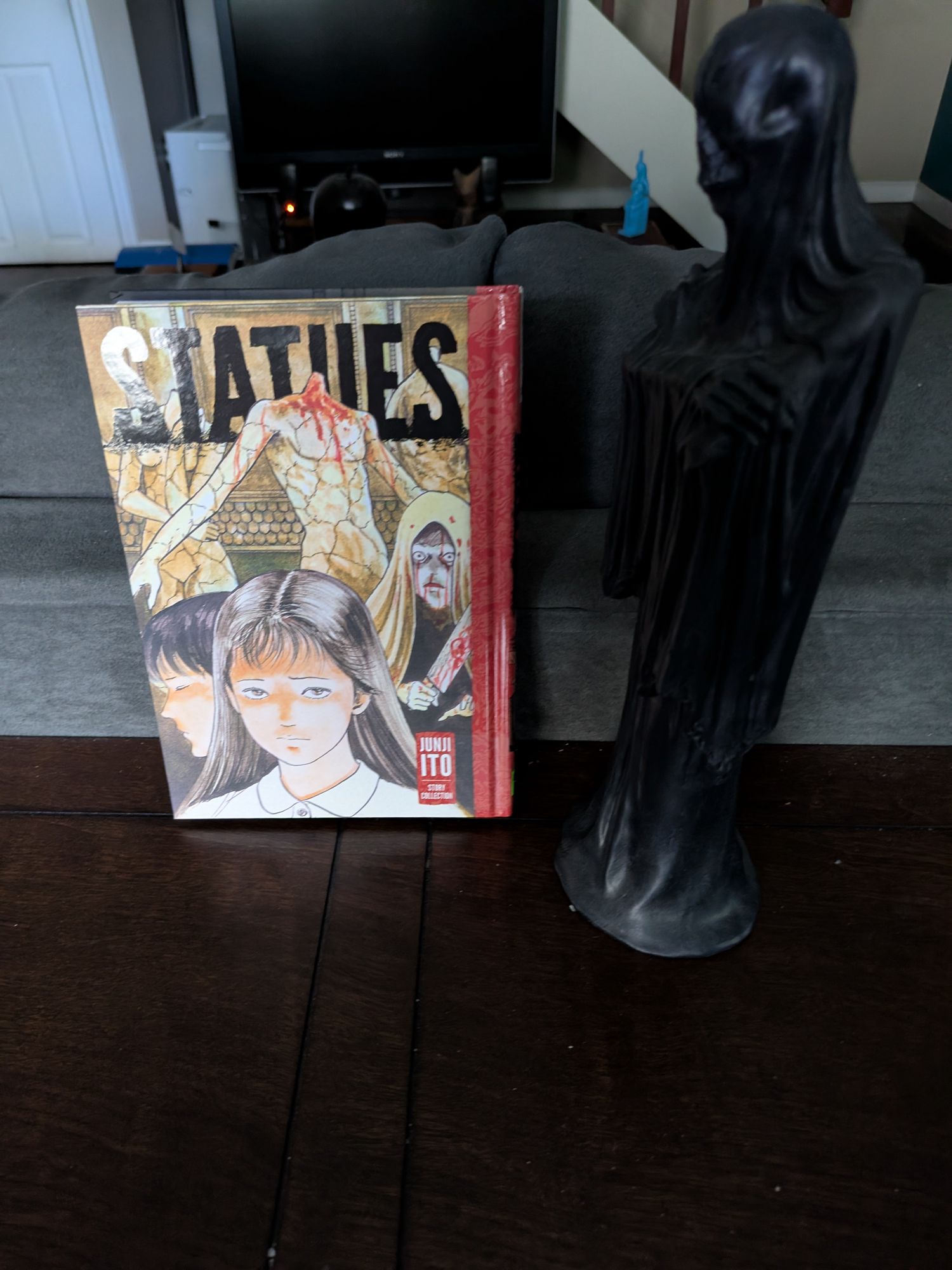
The more stories I read by Junji Ito, the more I think that the reason his stories can be so hit-or-miss with me may have something to do with page count. Like prose writers have word count limits when submitting stories to magazines and anthologies, manga artists have a page count limit they must adhere to. And for an artist like Ito, where he tells mostly self-contained stories rather than an ongoing series, that can have its disadvantages in telling the equivalent of a short story.

With his latest collection, Statues, Ito gives us ten stories that are mostly good or, at the very least, interesting. And yes, before I start, the artwork in each story is perfect. Like all Ito stories, it is extremely detailed and even capable of giving me a shiver or too.

Some of the stand out stories include “Red Thread,” which follows a teenage boy whose body becomes covered in red stitches following his break up with his girlfriend (in Japan, destined lovers are said to be tied together by a red thread). The story wavers between whether the lead’s red thread with his ex is now tangling around him, if his late grandmother is doing some old tradition to protect him, or if this is the beginning of some strange disease, and it’s honestly fascinating to watch. Another stand out is “The Circus Has Come to Town,” where an entire town’s men become obsessed with a beautiful circus performer, even as her costars die in horrible ways during the course of the show. Something about that story, and the lengths some people will go for a pretty girl, just stays with the reader. Another story, “Town of Maps,” has a very fun premise with a great ending, and “Scarecrow” takes a bonkers premise, runs with it, and makes it work.

As for some of the other stories, most of them weren’t bad. At least, not really. Some were just two short, and it shows. The titular story, “Statues,” as well as the final story, “Suicide Note,” both have great story ideas, and the scary imagery to match them. However, “Statues” seems to end rather abruptly, and “Suicide Note” ends with a twist in the last few pages that feels kind of forced. Like Ito knew he only had a few pages and couldn’t think of any other way to end it. They’re great stories, don’t get me wrong, but I feel like if Ito were given more pages to work with, they could be better.

Oh, and there’s one story, “Die Young,” that caught my attention, but not necessarily in a good way. Set in 1999, it tells of a strange phenomenon where girls considered ugly suddenly start getting pretty. However, their beauty comes with a price, and their health fails after a few days. It was published in 1991, and just feels really dated in 2026. There’s some speculation online Ito wrote the story with the theme of accepting oneself and your looks, as well as the consequences of pursuing beauty. However, it just comes off cringey to me in this day and age.

All in all, I give Statues by Junji Ito a 3.6 out of 5. While it’s not his best collection, there are some great stories in there, and some that would have shone even more if given more room. If you like Ito’s work, you’ll want to get a copy right away. If you’re just getting into him, then this is a decent enough collection to get a feel for his work, though there are better ones out there.

One thing’s for sure: as long as he keeps putting out collections, I’ll likely keep reading them and letting you know what I think. After all, with that artwork and some of these stories, how can I not?

I think this has been my most anticipated new book of 2026. I mean, a Gothic horror novel set in Japan and featuring Japanese history and culture (specifically samurai)? Be still my horror and Japanese culture loving heart! As soon as my library ordered copies, I was the first on the reservation list, and I started reading it almost as soon as I picked up my copy of Japanese Gothic.

So, here’s the plot:

In October 2026 (ooh, the future), Lee Turner stays with his American father and the latter’s Japanese girlfriend in a house hidden behind sword ferns in the historical town of Chiran in Kagoshima, Japan. Lee holds many secrets, some of which threaten to tear him and his life apart. As he struggles to figure out what to do, he sees a strange girl with a samurai sword outside his room.

Meanwhile, in October 1877, Sen is the daughter of a samurai, the last survivor of a failed rebellion. As she trains under her tyrant of a father for a new rebellion to reinstate the samurai, she feels the inevitable coming with both excitement and trepidation. That is, until she sees a strange foreign man in the window of her bedroom in a house hidden behind sword ferns in the former samurai town of Chiran in the Kagoshima domain of Japan.

Japanese Gothic was worth the wait.

First off, the language was so vivid and evocative. From the setting to abstract concepts to the characters, the way Baker uses words is powerful. And speaking of characters, wow! The main characters felt so damn real! Sen felt like she came right out of the best of anime, with a fully rounded and complex character, and Lee…well, Lee felt like he was less of a person and more of an amalgamation of problems and personality quirks. And at first, I really didn’t like him. In fact, I’m still not sure how I feel about him, though I have to admit, his own character arc is as compelling as Sen’s.

As for the story, freaking phenomenal! Reading as Lee and Sen encounter one another, then get to know each other, and then try to solve the mysteries that occupy their attentions, made the book hard to put down. It was also really touching to see them get to trust each other. They’re both very broken people, but watching them grow through their relationship and what they discover through it made my heart go out to them. And I did not see many of the twists coming, which was really welcome. The last fifty pages or so just kept me in shock and on the edge of my seat!

If I did have a criticism, I would have to say that when we finally do get explanations of what the hell’s been going on at the end, it was rather abstract and might be hard for some readers to understand. As someone used to understanding the wilder episodes of Doctor Who and who understood most of the science in the Godzilla anime series, I think I understood it well enough, but I can imagine the frustration another reader might experience.

Still, I am in love with this book and cannot wait to meet the author at StokerCon next month. It’s definitely not the sort of novel I could write (and I’ve written books with the same elements before). On a scale of 1 to 5, I’m giving Japanese Gothic by Kylie Lee Baker a 4.8 out of 5. Surprising, powerful, and enthralling. Grab your copy now, sit back, and prepare to be sucked in with the force of a hurricane. Preferably with some gagaku music played on the biwa in the background.*

*If you don’t know what those are, Google it. It’ll make all sorts of sense.

Run into all the creepy houses! Summon a lightning storm! Uncover terrible family secrets that will haunt you as much as any ghost! The Pure World Comes is officially four years old!

Well, technically it came out as a story on an app in 2021, but I always count May 10, 2022, when the paperback and ebook were released, as TPWC‘s real birthday/release day.

Now, for those of you who don’t know, The Pure World Comes is a Gothic horror novel I wrote in 2020. It was the very beginning of the pandemic, and I had had this idea for a novelette about a maid in Victorian England who goes to work for a mad scientist rolling around in the back of my head for a few years now. In fact, I’d spent several years just researching everything I could about the Victorian era just so I could bring the novel to life! And then suddenly, I was working from home and I had all this time to myself. I dove in, still thinking it would be a novella, and two months later, I came out with a novel that came to me in a frenzy.

A year later, the novel was published on the app, and another year later, it was out in paperback and ebook, followed a few months later by an audio book. A beautiful and creepy love letter to the Victorian era and all the scary stories that came out in that period.

Here is the blurb on the back cover:

Shirley Dobbins wants nothing more than to live a quiet life and become a head housekeeper at a prestigious house. So when she is invited to come work for the mysterious baronet Sir Joseph Hunting at his estate, she thinks it is the chance of a lifetime. However, from the moment she arrives, things are not what they seem. As she becomes wrapped up in more of the baronet’s radical science, she realizes something dark and otherworldly is loose within the estate. And if left unchecked, it’ll claim the lives of all she holds dear.

Funny story: last weekend, I was at Columbus Horror Con, and this young woman came up to check out my books. She picked up a copy of TPWC and let me know, not without some shock, that her last name was Dobbins, and her grandmother’s name was Shirley. Coincidence? Yes, but still a wild coincidence! Almost like fate. Anyway, she bought a copy, and when I signed it, I wrote that I hoped that she and her grandmother enjoyed the book.

And the nice thing is, lots of people have enjoyed The Pure World Comes since it came out. Here is what some people have said reading it:

This book kept you on the edge with its many twists and turns. Really haven’t read anything like it. I will follow this author 

Amazon Customer, Amazon

I love it when I’m pleasantly surprised by a book. Rami Ungar is not a debut author, (according to the back of the book, this is his fourth novel), but his work is new to me and so I went in not knowing what to expect.

What I got was a short novel so perfectly Victorian and utterly Gothic that it made my old-fashioned self giddy as a schoolgirl.

Heather Daughrity, author of Secrets My Grandmother Told Me, Goodreads

There were quite a few things I liked about this book – the attempt to make it historically accurate (required a lot of research), the author’s take on a possible Jack the Ripper scenario (no spoilers!), And the Big Reveal itself. I quite like the idea. I think it has many possibilities and potential uses as a plot device for future (possibly non related) stories…Exceptional work.

Ronald W. Gillepsie Jr., author of Inside My Nightmares, Amazon

I’m very glad that these people have loved this book so much. And there are several more reviews where that came from, if you care to look. (More on that below.)

So, what’s next for my little Gothic horror novel? Honestly, all I want is for more people to read it, so I’ll keep trying to make that happen. Thankfully, I’ll have plenty of opportunities in the future to find new readers. Hell, I managed to find a woman named Dobbins who’s grandmother’s name is Shirley just the other day. I’m sure there are other people who will want to read it. And if they do, I hope they let me know what they thought. Not only do I appreciate feedback from my readers, but leaving feedback in public spaces like Amazon or Goodreads helps other readers as well.

And if you would like to read TPWC, I’ll include links below. It’s one of the most widely available of my books, if not the most widely available, so I’m sure you’ll find a bookseller that you use. And if you like what you read…well, you know.

Anyway, that’s all for now, my Followers of Fear. I’m off to celebrate the anniversary and maybe get some more writing work done. Until next time, good night, pleasant nightmares, and is that the ghost of Jack the Ripper behind you? Careful, he’s got a knife!

Hello, my Followers of Fear! It’s been a minute since I’ve done an interview with a fellow author, hasn’t it? The last one was with Shaun Hamill in 2024. Well, I decided to bring it back, and I have a special interview to bring back this feature. Today’s guest is not only a fellow horror author, but a friend of mine whom I’ve worked with closely for the past several years in the Horror Writers Association. Ladies and gentlemen, please welcome my friend, Neil Sater.

Rami Ungar: Hello Neil, and welcome to the show. Tell us about yourself and what you write.

Neil Sater: Ever since I was a child, I’ve always been drawn to creepy things. Scary books, movies, houses, music, imagery, you name it, I love it all. I have also always enjoyed writing, but for my career, I followed my father into engineering and later, business. I was lucky to retire early, allowing me to write full-time. So, these days I’m having a blast writing creepy stories and learning a new business, which is completely different from what I spent my career doing. My stories involve the supernatural. My four books are stand-alone, but they are all set in Homer County, Ohio, a fictionalized place that reflects parts of Ohio’s Tuscarawas, Coshocton, and Holmes Counties. This is a beautiful region that I love to visit. It’s filled with history, interesting places, and genuine, salt-of-the-earth people. But as a guy who has always lived in the city and the suburbs, I sometimes feel a certain loneliness and eeriness when I visit the region. This is a very powerful feeling to me, and I try to capture that unsettling emotion in my stories.

RU: Tell us about your new novel, Ungodly, and why people might be attracted to this “Amish horror” story.

NS: In a nutshell, The Ungodly: The Curse of Forgotten Valley is about an Amish Witch. A teenage girl named Emma takes her brothers backpacking on the Buckeye Trail, and they unwittingly stray into the wrong place, where crazy stuff soon starts to happen. Readers say it’s a unique story with plenty of twists and high tension. Although I’ve been calling my books supernatural mysteries, my editor, who writes thrillers, said I should call this one a supernatural thriller.

RU: The book sounds fascinating. What inspired this story? And what research did you do before you wrote it?

NS: I took my nephews backpacking on the Buckeye Trail when they were teenagers, and we experienced some spooky things that stuck with me. So that adventure planted the first seed of inspiration for the story, and I wove some memories of our trip into it. (As a side note, the main character of this story is named after Emma ‘Grandma’ Gatewood, a legendary founder of the Buckeye Trail. I recommend reading her fascinating story, well-documented in several biographies!)More recently, I read a few non-fiction books about corruption in Amish communities, and found them all riveting. These books were about Amish men who built a cult within their Amish community and started doing bad things. I found it fascinating to see how the broader Amish society responded, which sparked my imagination. The even darker scenario I conjured up became the main storyline for The Ungodly.

I always try to do a lot of research for my stories. For this book, most of my research focused on two areas: witch folklore and Amish culture and practices. Although I have some familiarity with Amish culture and practices, some further research helped me fill in the blanks. Katherine Kerestman, one of our Ohio horror-writing colleagues, shared an article she wrote on the history of witch folklore, which I found to be a helpful complement to other material I read.

RU: Yeah, witch history, folklore, and culture is always fascinating. Speaking of which, your antagonist is an Amish witch. Why did you choose a witch from an Amish community, instead of a traditional witch? Or maybe a witch from a different sect, like the Puritans?

NS: It started with the setting I use for my books. As depicted in my previous books, the rural Homer County is in Amish country. Since the setting of my books was already established in Amish country, I thought, Why not?

When I came up with the idea of an Amish witch, I thought it was a novel notion. But a few weeks after the book’s release, a reader told me that she practices witchcraft and she knows some Amish women who do, too. I was a bit taken aback to hear a reader practices witchcraft, and a bit disappointed to hear my idea might not have been as novel as I thought! <belly laugh> Oh well, there are other original elements to this story.

Now, I don’t know anything about real-life people who practice witchcraft in this day and age, but obviously, that’s a real thing. Regardless, the story I wrote leans more toward the historical folklore of witchcraft.

There was something else at play, as well. Many people are curious about the Amish. The Amish live in very close-knit communities and choose to forgo many of the modern conveniences that the rest of us center our lives around. Some find the Amish culture and practices mysterious, and perhaps people are intrigued by them because, in many ways, they live as our own forebearers did. Regardless, I thought that if I could portray this culture with some degree of authenticity, readers might find the idea interesting and perhaps somewhat informative. So, I went with it.

RU: Speaking of your other novels, why not tell us about them?

NS: My books are all stand-alone stories, but because they’re all set in the same fictional Ohio county, there are some loose interconnections between them.

Phantom Realm: The Haunting of Misery Mansion is a ghost story, but it’s a different kind of ghost story that includes a time-travel twist.

Mercy Killing: The Haunting of Ghoul House leans a bit more into psychological horror, involving terminal illness.

And Atrocity: The Haunting of Moravian Village is inspired by true events involving Native Americans. The story centers around a haunting related to the tragic Moravian Massacre, which occurred during the Revolutionary War, in what is now Ohio.

RU: Your books tend to be geared towards the Young Adult crowd. What is it about YA horror that makes you gravitate towards those stories?

NS: I’m glad you asked this. The reality is, I try to write my stories for both adult and teen/young adult readers. My stories are what I call “soft-core” horror. Sometimes people use the terms “gentle horror” or “cozy horror.” I avoid explicit sexual content and heavy gore, and I consciously seek to close my stories with an uplifting ending, which isn’t all that common in the horror genre.

My books also tend to be shorter than many novels, and my stories usually feature teen/young adult characters. These things all add up to making them well-suited for young adult readers, but I’m not intentionally targeting this demographic. In fact, as far as I can tell, the vast majority of my readers are adults, not young adults. Either way, I’m just thrilled people are reading my books, because there’s no greater satisfaction to an author!

RU: Tell us what you’re working on now and if you have any future plans.

NS: I’m already working on my next supernatural mystery, which will also be set in Homer County, Ohio. I expect to have it published by early 2027.

It’s anybody’s guess what happens after that. I’ve never been much of a long-term planner!

RU: Time for some questions I ask every author I interview. What is some advice you would give some other authors, regardless of experience, genre or background?

NS: Get to know other writers through writers’ groups and other organizations. For me, joining the Horror Writers Association helped me build my network. I’ve gained new, valued friendships, including you, Rami!

Work with other writers to improve your writing skills through critique partnerships and critique groups. Don’t approach these things seeking affirmation; instead, seek out all the constructive criticism you can get from others and always err on the side of following their advice rather than ignoring it. Building this network will also help teach the business practices that help establish authors for success. Writing is a solitary endeavor, but learning how to become a writer is not.

RU: Aw shucks, you’re making me blush! Now, final question: if you were stuck on a desert island for a while and could only bring three books with you, what books would you take?

NS: For some reason, I shy away from long books, so I’ve never read Stephen King’s IT. Yeah, I know, I should be ashamed of myself, but I’ve seen the movies; does that count? Stranded on a desert island, I would finally have plenty of idle time to read IT!

I seldom read books more than once, but I’ve read Lord of the Flies by William Golding many times over the years. So, I’d have to include that one.

Stephen Graham Jones is one of my favorite authors, and his recent book, The Buffalo Hunter Hunter, unseated my previous favorite among his books, which was Mapping the Interior.

So, those would be my three choices: IT, Lord of the Flies, and The Buffalo Hunter Hunter.

RU: All great choices, Neil. And thank you for joining me here on the blog.

If you would like to check out Ungodly or any of Neil’s other books, you can find them on Amazon. And if you would like to follow Neil and find out more about his writing endeavors, you can find him on his website and his Facebook page. I’ll include links below.

That’s all for now, my Followers of Fear. I hope you have a good night, pleasant nightmares, and watch out for Amish witches in Homer County, Ohio. From the sound of things, they can be totally freaky.

I already announced this over on my social media, but I wanted to make sure you guys heard about it here as well. So, as you know, I’ll be at StokerCon in June. And earlier this week, they announced the Horror University classes that will occur during the con. For those of you who don’t know, Horror University is a series of classes taught by members of the Horror Writers Association on the art of writing and horror. The subjects can range from Disability in Horror, to Scripting a Haunted House (yes, those attractions have scripts), to tone and word choice in your horror poetry. These classes can be held throughout the year, but many of them are held at StokerCon each year.

If you can’t tell from the title and preamble, I am teaching one of those classes. One of nine classes that will be occurring at StokerCon this year. And I will be teaching “Vending 101; Or, How to Successfully Vend at a Convention.” As you all know, I do several events a year, and have been doing so since 2020. Through trial and error, I’ve picked up a lot of experience and have figured out what works and what doesn’t work with these conventions, as well as how to find them.

With that in mind, I will be imparting my years of wisdom and experience to whoever decides to take the class. I’m sure many horror authors would like to try vending at a con or an expo but aren’t sure where to start or what they need to succeed in their goals. Perhaps I can help them with that and have successful experiences as con vendors without making the same mistakes I did.

So, what’s next? Well, I will put together a slideshow and some worksheets. I’ll also talk about this topic with a friend/colleague who is working on something similar. And I’ll see about practicing with one or more friends so I can be prepared for the actual class. And when the class date and time are set in stone, I’ll be sure to let people know so they can sign up. Hopefully a lot of people will show up. I’ll make sure to let you guys know when I know.

Oh, and just so you know, the classes aren’t included with the StokerCon tickets. You will have to pay extra for it. However, I like to think that price will be worth it. Also, I’m one of three horror authors from Ohio teaching Horror University classes this year, meaning a third of the classes will be taught by Ohio authors! I wonder if there’s something in the water that makes us Ohio horror authors both very scary and very good teachers?

Anyway, that’s all for now, my Followers of Fear. I’ll be back with another blog post very soon, believe me. So, until next time, good night and pleasant nightmares.