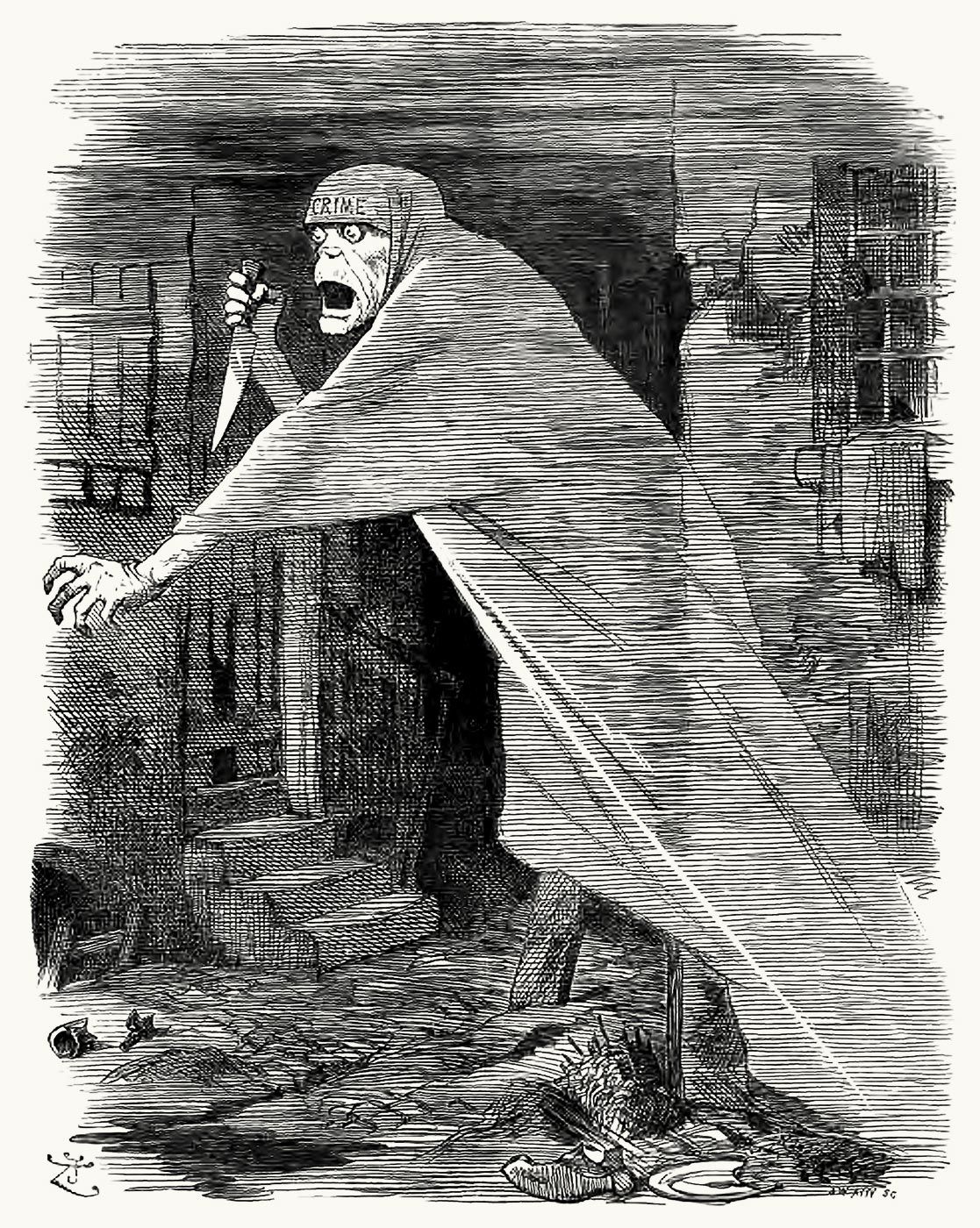
You may have seen some news reports that Jack the Ripper’s identity has been solved. A lot of those reports include mentions of DNA evidence, which gives the claim an air of legitimacy. However, that raises the question: has Jack the Ripper’s identity been found? And if so, who is it?
First, for those of you who don’t know (thought at this point, I’d be surprised if you didn’t know), Jack the Ripper is the name given to a serial killer who murdered five women in London’s Whitechapel and Spitalfields neighborhoods in 1888, though it’s possible many more died. The women killed by the Ripper were supposedly prostitutes, though in recent years, doubt has been cast on that (check out The Five by Hallie Rubenhold for more on that).
As for the killer’s name, it comes from a letter sent to a local newspaper supposedly by the killer where the “killer” identifies himself as such. Jack, however, was never caught, leading to over a century of speculation as to whom the killer is.
As to this latest news story, historian Russell Edwards has claimed that DNA found on a shawl supposedly belonging to Catherine Eddowes, one of the Ripper’s victims, matches both Eddowes’ living descendants, as well as DNA belonging to descendants of the older brother of Aaron Kosminski, one of the top Ripper suspects. Based on this, Edwards believes that Aaron Kosminski was the Ripper, beyond the shadow of a doubt.
This leads to the question: was Kosminski really Jack the Ripper?
Honestly, I have my doubts. This isn’t because I have my own suspect I believe was the Ripper (though I do believe it was this person to the point I made him a character in my Victorian Gothic novel The Pure World Comes). It’s just that there are some serious problems with Edwards’ claims, and I shall try to go over all of them here.
First, who was Aaron Kosminski? He was a Polish Jewish immigrant who worked as a barber/hairdresser in Whitechapel in 1888 and who was one of the original suspects of being the Ripper owing to a violent mental disorder. He was committed to an asylum a few years later and died in custody in 1919. To this day, he’s still one of the most popular picks for the Ripper’s true identity.
First, there’s the DNA. While this method is a lot more reliable than other methods of forensic crime solving (you would not believe how unreliable fingerprinting actually is), DNA isn’t infallible. In fact, DNA is subject to contamination, incomplete samples, and degradation over time. It would take incredible luck for both samples to remain intact and uncontaminated enough so that they could be used to match with the victim and suspect’s descendants.
But sure, let’s say the DNA found on the shawl, which Edwards bought from an auction house and which passed through a few hands before then, really did have enough intact DNA for the scientists to do their work. While Eddowes’ DNA probably came from bloodstains, the DNA linked to Kosminski was mitochondrial DNA from semen. Mitochondrial DNA is a lot smaller than regular DNA found in cell nuclei and isn’t as handy in identifying people as is regular DNA. (See this YouTube video where a DNA expert explains it much better than I ever could).
Also, semen being present on the shawl only proves that someone had sexual contact with Eddowes (if it was her shawl). As I said, whether the Ripper’s victims did or did not engage in sex work regularly has been called into question in recent years, but whatever the truth, it doesn’t prove that Kosminski killed her. All it really says that he may have had some sort of sexual contact with her.
All of these factors might be why the study in which Edwards makes his claims hasn’t been published in a peer-reviewed journal, and that’s a problem. “Peer-reviewed” means that the experiments and the results can be reliably replicated, and the fact that no peer-reviewed journal has published Edwards’ study is concerning.

Finally, there’s the issue of whether Aaron Kosminski was actually the suspect the police were referring to! You see, Kosminski’s name came to prominence because the name “Kosminski” was mentioned in police memos and in the diaries of investigators from the original case, and that eventually led to the identification of Aaron Kosminski. However, these same policemen may have been referring to one Nathan Kaminsky, also known as Aaron or David Cohen, another Polish Jew with mental issues and a violent personality and who was held in the same asylum as Kosminski before his death in 1889. The police may have confused one man for another, and the asylum may have named him Aaron Cohen because Kaminsky or Kosminski was too difficult to spell or understand. Whatever the case, we can’t be sure which man the police were referring to, given the similarities and lack of reliable records.
So perhaps Aaron Kosminski did have a sexual encounter with Catherine Eddowes, but Nathan Kaminsky was the real Ripper. Or maybe he wasn’t. There’s no way to tell.
And that’s the main problem. Even if the DNA results aren’t problematic, there’s no way to know 100% for sure who Jack the Ripper was without a time machine. I’m sure we would all love to put to bed who the Ripper was, even if our personal choice of suspect was wrong. But it’ll take a lot more than sketchy DNA results to do so. And, like many infamous cold cases, it may never be truly solved.
Thanks for reading through my rant on this subject, Followers of Fear. I just really disliked how many publications were taking Edwards’ announcement like the gospel. Hopefully this put the whole matter into perspective for some of you.

If you’re at all curious whom I think is the Ripper, you can find out by reading The Pure World Comes. As I said, I included him as a character in the novel, and I included some of the historical knowledge I found on the guy in the story. Plus, it’s a great Victorian Gothic horror novel, if I do say so myself. I’ll leave links below if you’re curious. And be sure to leave a review if you read it!
I also highly recommend if you’re curious to check out The Five: The Untold Lives of the Women Killed by Jack the Ripper by Hallie Rubenhold. Ms. Rubenhold does an excellent job exploring both the lives of the five canonical Ripper victims and the contemporary attitudes that may have unfairly led to them being labeled prostitutes. Reading it made me look at the Ripper case in a whole new light and helped me ultimately come to whom I believe the Ripper is. (See my article on it here.)
That’s all for now, my Followers of Fear. Until next time, good night and pleasant nightmares!


 Rami Ungar The Writer