Posts Tagged ‘The Lord of the Rings’

Took a little longer than I expected, but I finally finished this book tonight and, as promised, I’m writing a review.

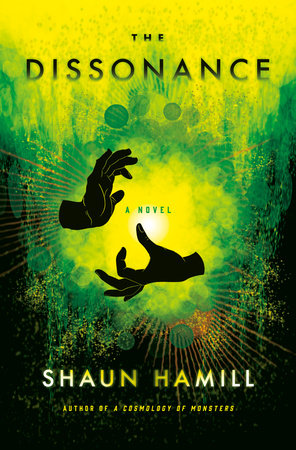
Jumping back and forth between the late 1990s and 2019, The Dissonance follows Hal, Athena, and Erin, who, along with their friend Peter, discover that they have mysterious powers. Powers that, according to Peter’s grandfather, stems from the Dissonance, a magical energy that stems from the gap between our broken world and the world as it should be. They start learning how to harness their powers, but tragedy strikes during their senior year of high school. Twenty years later, they return to their old stomping grounds as forces begin to throw the world out of whack. And in the midst of it all, a great evil descends on their hometown, dragging a closeted gay teen in tow…

I’ve heard this book called a cross between The Magicians and IT, and while I’m only vaguely familiar with the first one, I have to say, the comparison to IT is apt. Not only does it hop back and forth between past and present, but Hamill does a great job showing the characters as hormonal teens trying to navigate friendship and their lives in the past, and trying to deal with cosmic shift and their broken lives and relationships in the present.

As for the story, it’s definitely more in line with dark fantasy than horror. For example, the Dissonants conference feels more Harry Potter than The Craft. Still, it’s got some horror elements. The magic itself, which requires tapping into the pain and misery of life, is pretty dark in and of itself, and plenty of aspects of the novel are of the cosmic horror vein.

If there’s one thing I would have liked to see more of, it might have been more of the character Owen. I get that the focus was more on Athena, Hal, and Erin, but Owen was a relatable character and I would have liked to see the kid have a bigger role.

Well, if there’s a sequel, that might be a possibility. The book does present the possibility of being the jumping off point for a shared universe, like The Hobbit was for Lord of the Rings, but with more in common with the Cthulhu Mythos than Tolkien.

But getting back to the review, I award The Dissonance by Shaun Hamill a 4.5 out of 5. It’s an engaging dark fantasy novel with great characters and worldbuilding and a magic system that feels right for this wrong world. Grab a copy, tap into your deep well of inner pain, and prepare for a twisty, magical ride through hell.

That’s all for now, my Followers of Fear. Until next time, good night, pleasant nightmares, and only 61 days and one hour till Halloween!
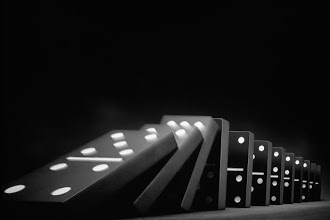
Catalyst: like a line of dominoes.

According to Wiktionary.org, a catalyst is, when used in literature, “an inciting incident which that sets the successive conflict into motion.” In other words, fiction, which is reliant on a conflict of some sort for the story to occur, cannot exist without the catalyst that starts it all.

I’ve been thinking about the catalyst for a while now, and I’ve come to believe that the catalyst is actually a pretty interesting and underappreciated element in fiction writing. Imagine what would happen if Katniss Everdeen had never volunteered to take her sister’s place in the 74th Annual Hunger Games and instead of Peeta, Gale had gone to the Capitol? There would be no story. Katniss would somehow go on with her life after a period of depression, and maybe even still get together with Peeta at some point, but would anyone really want to read that? That single catalyst, Katniss volunteering to save her sister and Peeta being selected to go with her to the Capitol, is what makes the story interesting, that draws us in and makes us want to see how events unfold.

And the catalyst for a story can take many forms. It’s usually the first thing you learn in writing any story. In a romance story, it’s usually boy and girl meet for the first time. In a mystery, it’s the occurence of a crime that needs to be solved. In stories like The Adventures of Huckleberry Finn or The Hobbit, where a journey is prevalent in the story, it’s that inciting incident that causes the need to go on a journey that gets things going. In a zombie novel, the catalyst is (obviously) the appearance of zombies.

You look at any story, you’ll identify a catalyst. Heck, my own stories all rely on the catalyst. In my WIP Laura Horn, the catalyst is the titular character recieving a particular item that causes her to be the target of a government conspiracy. In Snake, the loss of something important to the main character is what causes him to beocme the Snake. And in Reborn City, events that happen to the founders of the Hydras about a year and a half before the story even starts serve as the catalyst.

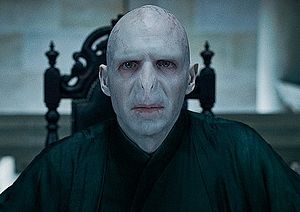
And speaking of RC‘s catalyst occuring a year and a half before the story starts, you can find plenty of stories where the catalyst to the story occurs a long time before the story starts. For example, for years Harry Potter fans couldn’t identify why Voldemort wanted to kill Harry, thus causing the whole story that would be Harry’s life, but after Book Five, they realized the catalyst for all of Harry’s life was Professor Trelawney’s prophecy being leaked to Voldemort, thus setting his sights on killing Harry.

“Freud was half-right: the causes of all problems are mothers and prophecies.”

Of course if you want to get technical with it, the story began in 1925 when Voldemort’s mother used love potion on Tom Riddle Sr, leading to their elopement, Voldemort’s conception, and his birth. But I digress. The point is, a story can rely on events that occurred years, decades, or in some cases centuries before the start of the actual story to act as the catalyst (I’m thinking of The Lord of the Rings trilogy when I say centuries, by the way). It’s actually a little mind-boggling, if you think about it.

So what more can be said about literary catalysts? Probably a lot more than I could probably come up with, especailly in a blog post. But to finish this post, I’d like to say that without the catalyst, the fictional stories we love so much, despise so much, debate so much, examine so much, and write fanfics to so much, just wouldn’t exist, and I think our world would be a lot less interesting to be in.