Posts Tagged ‘Social Activism’

Photo by Juan Pablo Serrano on Pexels.com

All you need to do is turn on the TV or go online to see that, particularly in the US, we’re in scary times. This is the first year in several years where the White House or the federal government as a whole haven’t acknowledged Pride Month, and governments around the world are rolling back rights for the LGBT community, especially for trans people. In the past two months, there has been a huge rise in the number of violent attacks against Jews and Jewish institutions, with the most recent being the attack on a run to bring awareness to hostages held captive in Gaza a week ago today.

And at the time I’m writing this, National Guardsmen and Marines are being forced at the direction of the President to attack people in LA protesting the ICE raids on immigrant communities.

And this is just a fraction of all the horrible things that have been happening to marginalized communities lately. Honestly, it’s not hard to feel afraid. I’ve certainly felt quite nervous on more days than one, especially after the attack at the Jewish Capital Museum last month. It doesn’t help that some of these actions seem to come from national governments, like the rollback of federal protections and celebrations on marginalized communities, or the UK Supreme Court ruling on sex and gender identity in April.

And I know that, with how scary it is lately, it feels very easy and somewhat natural to retreat into yourself and distract yourself with only books and TV and things that make you feel good. And I totally get that; there are days when I want to do nothing but watch anime or read books. And if you need to take care of your mental health, you should totally do that. DO NOT ignore your own well-being.

But if writing horror has taught me anything (and it’s taught me many things), it’s that we have to stand up to what scares us if we want to not only fight back but move forward. In fact, horror often teaches me and my fellow horror fans how to deal with current events, because what scares us, including in current events, often makes it into our stories. So, we need to stand up to what’s happening right now and for what we believe in.
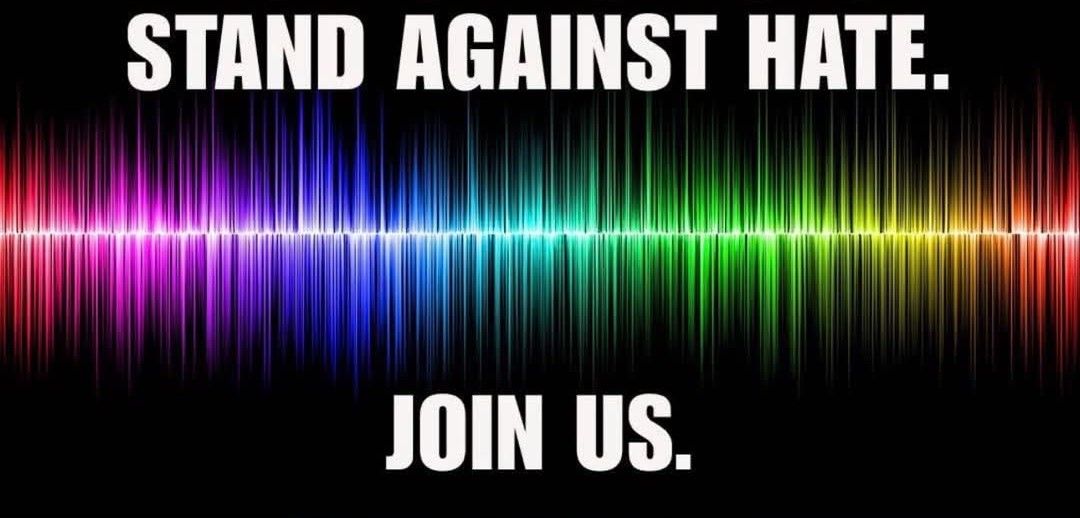
So, what can we do? Well, some years ago, I heard a Christian minister say this during an event to commemorate Martin Luther King day: “Sometimes, the least you can do, and often what can say the most, in hard and scary times, is to be there and to ask if someone needs a hand.” Those words have stuck with me through the years, and I think that, right now, that’s a good place to start. Sometimes, just showing up and saying you support them and want to help can do wonders!

In fact, I know this from personal experience. Last week, after the attack in Boulder, some of my non-Jewish friends posted on social media their condemnation of the attacks, and how committing violence, especially against innocent people, was never okay. After hearing condemnations from mainly my fellow Jews and not enough from outside the community, seeing that support helped alleviate so much of my negative feelings.

So, at the very least, show up. Whether that be by showing up at an event or making your voice known online, asking how you can help can help those in marginalized communities feel that much safer and supported, and give them the strength to fight back against oppression. And if you feel safe enough to, please show up to events, reach out to your elected representatives, or sign your name to petitions. And,, of course, donate to organizations that help out with these causes. Doing so may feel like small gestures, but they can have huge impacts. Hell, during the first Trump administration, lawyers at the DOJ did confirm that the protests against certain policies did have an effect on what actions the administration took during the rest of the term.

So, don’t be afraid to show up and to ask what people need. Your little act may end up having the greatest impact on both someone else’s life, and on the world as a whole.


That’s all for now, my Followers of Fear. I’ve been wanting to post something like this for a while now, but what’s happening now really made it a priority. Honestly, I wish I could do more, like that nationwide protest on Saturday against the military parade and a certain someone acting like a king. But as you know, I’ll be at StokerCon during that time. At the very least, I’ll be on a panel about including marginalized communities in horror and pitching a novel that puts my money where my mouth is. So, at the very least, I’m helping out in that way.

Anyway, until next time, my Followers of Fear. I hope you’ll take the message of this post to heart. Stay safe out there while still helping where and when you can. And until next time, good night and pleasant nightmares.


Audible company logo.

If you’re not familiar with Audible and Audiobook Creation Exchange (aka ACX), let me fill you in. Audible is Amazon’s audio book wing. They distribute thousands of audio books and have just as many subscribers (I’ve been one since 2015). ACX is part of Audible: it’s a places where authors and publishers can hook up with narrators, produce audio books, and then upload them to Audible.

With me so far?

Recently, Audible and ACX have been in a bit of hot water. It’s come to the attention of several authors that Audible has a rather questionable policy on the books. Audible Premium Plus subscribers have the option to exchange an audio book they’ve bought through their subscription within 365 days of purchase! And get this: if an audio book is exchanged within that time frame, the authors or publishers get their royalties deducted for it!

You read that right: somebody can exchange any audio book they buy within a year of purchasing, and the author gets punished for it.

Most people’s reactions to the exchange policy abuse. Photo by Andrea Piacquadio on Pexels.com

And lately, this has become a huge problem. Many authors, mostly indie authors, have noticed an increase in exchanges and deducted royalties over the past several months, In fact, some have speculated that use of the exchange policy–or should I say abuse of the exchange policy?–has boomed because Audible’s been using the policy in some of their advertising to attract new members.

Spurred by reports of this, the Authors Guild, along with a whole bunch of other author organizations, have drafted a letter to Audible and ACX to get them to, among other things, change the policy and create a more reasonable exchange policy. At the time I’m writing this, the letter has over twelve thousand signatures, and it’s still growing. To quote the letter,

This policy is in clear breach of the duty of good faith and fair dealing implied in the authors’ agreements with Audible and ACX as it allows books to be purchased and listened to without paying the authors and narrators their royalties.

Authors Guild Letter to Audible and ACX

Now, I have only have Rose‘s audio book on Audible, and so far as I know, it hasn’t suffered from this exchange policy much. However, I have heard from a couple of colleagues, including some I consider good friends, who are upset by the policy and are considering pulling their works from Audible and ACX because of the policy.

And even if I didn’t know anyone affected by this policy, once I learned about it, it was hard for me to sit still. This is a terrible policy that hurts authors and publishers alike! These are the people that Amazon needs to continue selling through Audible, and yet they treat them this way?

And why is the exchange window a year long to begin with? That’s a terrible business strategy. Can you imagine if a hardware store allowed you to exchange a tool within a year, even if it’s likely been used? Or a shoe store? Or a computer business? They’d be out of business within a year with a policy like that! What the hell, Amazon?

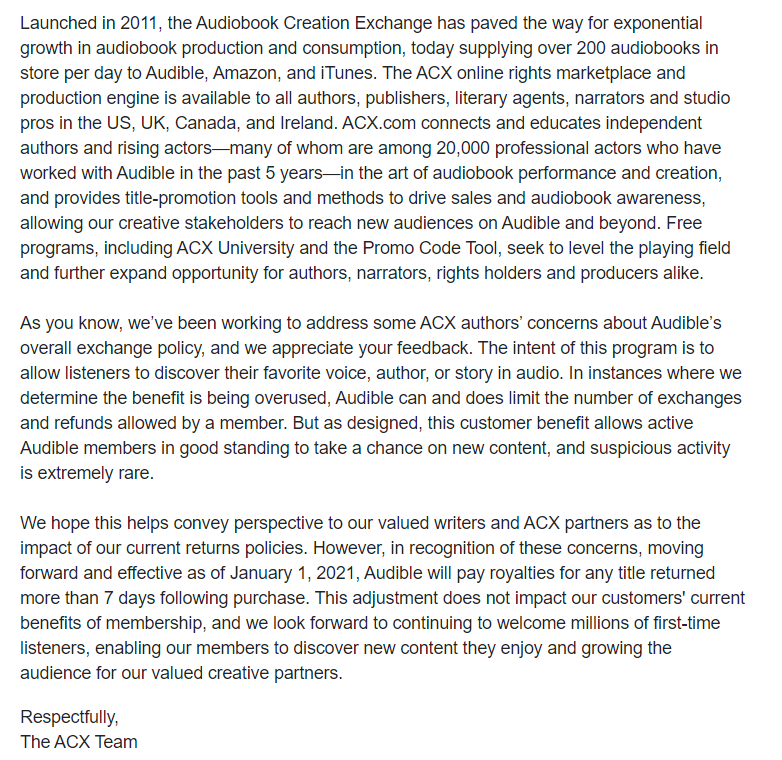
The letter I received from Audible about the change in the exchange policy. Feel free to enlarge and read it in full.

Thankfully, it seems that news of the abuse and the letter made Audible realize their mistake. While they’ve defended the policy, saying that they do monitor for abuse and that such abuse is rare, they are changing the policy effective January 1st. After that, the exchange window is limited to 7 days, and Audible will pay for any exchanges made after that timeframe. They later confirmed this in an email to ACX creators, which I got as well.

And that is good. That is a good change. It’s harder to abuse an exchange policy limited to only a week instead of a year. Still, some aren’t satisfied. In fact, the Authors Guild letter suggests shortening the window to 48 hours. And I like that idea: not only is it even harder to listen to multiple audio books over the course of two days than it is to do over a week, but it should be easier to spot abuse when an account is making multiple exchanges within a two day period.

So, what can you do? Well, you can sign the letter, which at the time of writing is only 440 signatures away from the Authors Guild’s goal. Even if Audible has changed the policy, every signature is a reminder to the company that this sort of malarkey won’t be tolerated by the very people the company needs for products if it continues.

You can also share with other authors and readers. The more people who are informed about the issue, the more people who will be weary and on the lookout for policies and abuse like this. People, and companies, are more likely to be better behaved if they know they’re being watched and kept under pressure.

And finally, if you have or plan on getting an Audible subscription, don’t be the kind of subscriber who does this sort of crap. I’ve only exchanged a book on Audible once, and that was because I thought it was one kind of story, and it turned out to be another. Otherwise, I would never rob another writer of royalties! Instead, keep the book once you buy it, and wait for your next credit. Don’t make someone else lose money just because you want more listening material!

And if Audible doesn’t address the problem, maybe consider giving up your membership. Yeah, it’ll suck to not get that credit for an audio book each month, but it’ll sure send a message to Audible.

And if you do enjoy an audio book purchased through Audible, make sure to review or at least rate it afterwards. Trust me, ratings and reviews left by readers help both new readers and the writers who put their books on the site. I speak from personal experience on that!

That’s all for now, my Followers of Fear. Thank you for reading this far and giving a damn about this problem. I hope you’ll consider helping out authors and stopping abuse of Audible’s exchange policy.

Until next time, Happy Thanksgiving and pleasant nightmares!