Posts Tagged ‘editing’

I’ve always considered myself someone who’s not very good with computers beyond the Internet, Microsoft Word, Powerpoint, and the basic Excel spreadsheet. However, today in class, I realized that might not really be the case:

In my documentary class, we’re making documentaries in various forms on the Macs in our classroom. What are those documentaries about, you might be asking yourself? Well, they’re about us, each and every one of us in the class, and how we go about creating various works of literary greatness. I’ve already completed one project, using GarageBand to make an audio essay, and got an A on that. The project we’re working on now is a short video that we will create using Zoom cameras and iMovie, and to prepare we’re learning all the ins and outs of iMovie by creating short practice videos.

Now, normally I’m a little leery about using new programs and I usually need someone to hold my hand throughout most of the learning process. However today I was able to create a short, two-minute video commemorating the one-year anniversary of the Occupy protests with an old film clip of 1950s fashionable wear, several pictures of the Occupy protests, and a song by Bing Cosby. It wasn’t half-bad, and I was able to use a few special effects we hadn’t covered yet in class because I had the gall to check out the homework for today before class. Let me tell you, the sense of pride I felt by the end of the class was immense, and I could not wait to make the short film about my writing process (expect it to have a certain factor of creepy).

So this got me thinking. When I do consider going the self-publishing route (something I consider a lot, especially after I hear back from an agent or publisher saying they’re not interested in my work), I usually think the best way to get started would be by creating an e-book. And when I think of that, I usually consider using a service to create the e-book, because I’m not exactly a Bill Gates or Steve Jobs when it comes to technology.

But today I was able to use iMovie, and before that GarageBand, something that before the start of the semester I thought impossible for me. If I can learn to use those programs, then what’s to stop me from making the e-book myself on my laptop or on a school Mac and then upload it onto Amazon for a cheap $2.99 download price tag? Not only would it probably be cheaper and give me more control over my work, but it would show how serious I am about being a writer, that I would learn to use scary programs and ask for help with them just to get my work out there.

So if I do go the self-publishing route with my novels, you can expect that I’l try to do all the work myself in making the e-book (a regular book is a whole other story though, and much more expensive, so let me think on it before I come to any conclusions or decisions). And if you have any tips, let me know. I’d love your advice and help.

Creepy Mayan snake god gobbling someone up. I have a feeling my character would find some connection to this image.

Well, I finally did it! I finished Part II of Snake, though truthfully it’s coming about four days later than I expected.

Part II deals a lot not only with the main character’s quest for revenge, but also with the circumstances that caused him to take up serial killing. It totaled about twenty-one chapters, eighty-six pages, and twenty-two thousand and thirty-three words. Add that to the prologue and Part I, and you have a total of thirty-four chapters, one-hundred and thirty-eight pages, and twenty-five thousand, three-hundred forty-six words for the rough draft of Snake. Several times chapters were added together and split in two in order to keep the story flowing and the tension high. I have to say, at certain points it was an arduous process writing out this section of the novel.

Now that I’ve got Part II done, I’m going to wait a little while before I start Part III, which is probably the longest of the parts in Snake, take some time to finish a short story and edit a couple more. I also plan on going over the outline of Snake and see what I can do to make the plot more exciting, because as it is it’s a good story, but I want to make it great. I plan on doing some more character development with the Snake and some of the people close to him, which will probably mean going back to previous chapters and doing a few additions. I also plan to add some scenes showing the fallout of what happens when a serial killer goes after a mafia family and not only evades the family but the police itself. And lastly, I want to change the climax, see if I can change the setting so that not only does the Snake face off against the mafia, he faces off with the police too, and does it in front of everyone.

Sounds more exciting that way, anyway.

I’ll let you know when I begin Part III. Wish me luck.

I have an assignment for my creative-writing class: to write a short story and then turn it in at the end of the semester. For the past couple of weeks, I’ve been writing about an orphan girl who finds out she’s not who she thought she was (and for those of you who think it’s a short story I started writing in May that I thought of during meditation, this is a different story, the one I thought of while out at a club one night). For a while now, it’s been slow-going, mostly because it’s less horror/sci-fi/fantasy and more along the lines of literary writing, which I’m not too fond of.

However, today I had an idea of where the plot would go, and what the actions taken by this girl and the places she would go could symbolically mean. Like that, I felt my writer’s block dissolve, the story forming for me in my head. So throughout the day, I’ve been working on this story, passing the minimum number of words required and getting well beyond.

Other stories I am working on that have been plot problems, I’ve been thinking of ways to improve them, and today I thought of ways to fix those too. One story, one involving a psychic girl who’s life is very unlike Carrie’s, I got an idea from an acquaintance on how to make the plot better, involving the girl leaving her home for the first time in her entire life. It should be an interesting story.

And another story, involving a school shooting, I’ve been working with on and off throughout the years. However, the story never gets any better. Today, I saw how it could be fixed. It’ll be a radical change for the story, but it might just work for the better.

Even after publishing a few short stories, I’m still learning about the importance of plot, among other things. Hopefully someday, I’ll be able to teach others the things I have learned. But for now, I’ve got a girl in a short story who is not psychic in the least who needs to realize her life needs a radical change. Talk to you later.

“We must make certain this Declaration of Independence is well-written and professional, since we’re submitting it to the King of England. Oh, and Mr. Hancock, please make your signature a little smaller this time.”

Today, I was asked what it would take to make an excellent submission to a magazine like The Writing Disorder. My first thought was, “They’re asking me for advice? I’m so flattered; usually I’m the one asking for the advice!” So I gave a reply back, giving a few tidbits of advice, but I also told this person I’d write up a post that gave some more tips and advice for submitting to magazines. So Anthony, here’s the post that I promised.

I write down these tips because they’ve been helpful to me in the past. I don’t know if others who read this, especially more experienced writers, will also find this helpful, but if anyone does, that makes me very happy. Also, I will try to stay away from sounding preachy or making it seem like I have all the answers and the reader does not. If I fail in this task, please let me know so I can feel embarassed about it.

Here are my tips for making a successful submission to a magazine:

1. Write, then edit. The basic thing to do is write a good piece of literature, whether it be fiction, creative non-fiction, or poetry. This is the most basic step and without it you can’t do anything else. How to write I won’t get into; all I’ll say is that it takes years of practicing writing and a whole ton of reading to get good at. Editing is also important; you can compare it to finding a geode, and refining the crystals inside so that they’d look nice as pieces of jewelry. It also helps to space some time between writing and editing a draft; I usually wait a couple of weeks or a month to edit a story, because then I can look at it with fresh eyes.

2. Find an appropriate magazine. As you can imagine, there are a plethora of magazines out there for budding and aspiring writers to submit to, especially on the internet. Before submitting though, make sure that the magazine is the right fit for you and your story. For example, a magazine may be a fantasy magazine, but they may be looking for a specific type of fantasy, such as children’s fairy tales involving creatures living alongside people in urban and suburban settings. If you send them a Lord of the Rings-esque adventure story, they won’t publish it and you’ll wonder what they didn’t like about it.

Most magazine websites have guidelines posted on their sites about what they’re looking for in submissions, so read those carefully before submitting. You can also read the guidelines first and then write a story that is meant to comform to those guidelines; I’ve done that before, and have had very surprising results with those sorts of stories.

3. Format professionally. This goes beyond having a nice-looking font and the correct sort of margin-space, though that is important. You want to make a magazine look at your story and say, “This looks so professional; the author must be an experienced writing.” I do this by creating a header before I even start the story: I begin by indicating my first page’s header is different from the other pages’ headers. I then put the words “Word Count” followed by a colon in the top left corner, before skipping to the next line and putting my contact information on the right side of the header. I then exit out of the header and skip down until I’m about a third of the way down from the page before putting the title of my story. On the next page, I re-open the header, write my last name, then a comma and put the page number.

After I finish the story, I put the word count for the entire story on the first page in the header after “Word Count:”. This tends to look good to editors, and has served me well in the past.

If you’re asked to send along a brief bio or even a photo, those can be a little more relaxed. Just tell people what you think they ought to know about you, and then put it down. As for the photo, try and take a photo that gives people an impression of who you really are, but remember, this will be in a magazine, possibly forver, so don’t take any photos you’ll regret.

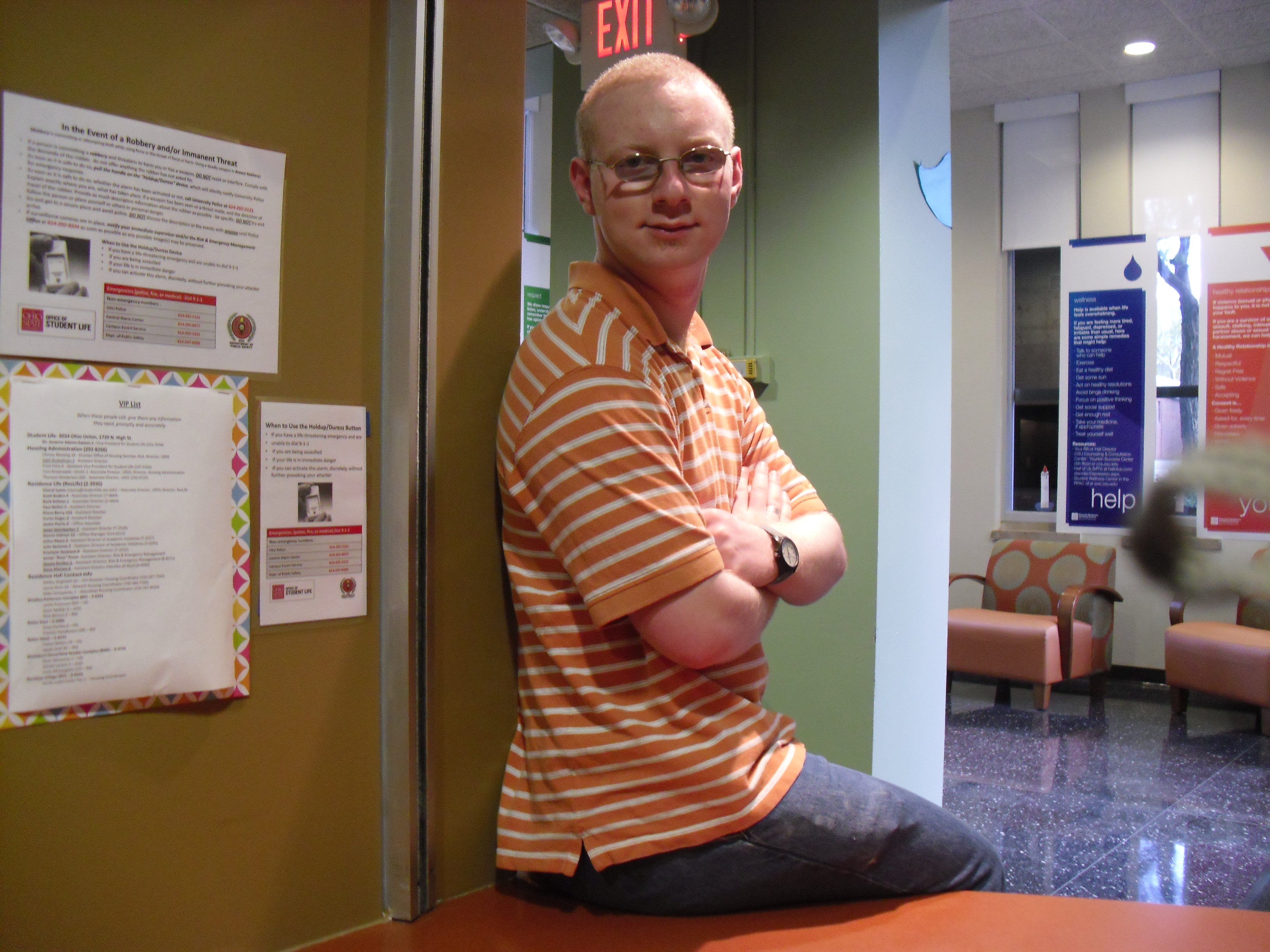
A photo of me at my dorm, and one of severl I had taken of me. I think it gives a cool, writer look, but that’s up for interpretation.

4. Write a good query letter. I cannot stress enough the importance of a good query letter, which is essentially the letter you send the editor saying you are submitting a story for their consideration. It’s basically your first impression, and if your query letter sucks, the editor won’t even look at your story. There are plenty of books and websites that can give you pointers on writing excellent query letters, but I won’t mention them here; I’ll just say, you should write a query letter as if you’re writing what you believe will be the most important work of your life.

5. Expect long waits. Magazine websites and their editors will say they can get back to you on a story within a certain amount of time, but often they’ll be behind schedule on their work, so if the time they say they’ll get back to you passes by and you don’t hear from them, write a letter or email to them. If they don’t respond, write them again until they do. I’ve gotten a few acceptances and plenty of rejections from writing editors, but I’ve gotten them faster than if I’d kept my mouth shut.

6. Don’t give up. If one magazine rejects you, don’t take it that your story is worthless. Take another look at it, edit where you see there could be improvement, and then send it somewhere else. You never know what might happen. After all, that’s how my short story “Ripple” got published, and I despaired for a while that it would ever find a home.

That’s all I can think of at the moment. If you have any questions or need clarification, let me know. I also would like to take this oppurtunity to reccommend “The Short Story & Novel Writer’s Market”, an annual publication from Writer’s Digest that has all these tips and more, shows you how to write a query letter, and most importantly, has a catalog of agencies, magazines, and publishers you can submit your work to. I’ve found it a wonderful resource, and highly recommend it to anyone who wants to find places to submit their work.

All for now. Write to you later.

Believable Stories

Posted: August 22, 2012 in Reflections, Writing
Tags: , ,

Today for my homework from my creative writing class, I had to read some analyses on story-writing, and one of the topics brought up was that one cannot tell a story that is not believable, and if the story isn’t believable, it’s your own fault. This made me think of three things: one, it made me think of several examples of stories I’ve read where the stories have not made any sense to me because some aspect of the story was utter nonsense. Another was my favorite line of advice about creating fantastic worlds: “You can’t go and say, ‘I’m going to write a story where everybody has guns but nobody uses them.’ Under what circumstances could such a world exist?”

And most importantly, it made me think of a story that I’ve struggled with over the past couple of years, a story about a school shooting. I’ve had plenty of problems with creating a story under five-thousand words involving a bunch of bullied teens lashing out against their oppressors but later regretting it. The latest incarnation of the story, titled “Frye Day”, I thought I might have actually fixed that problem. But did I? Nope; a friend of mine looked it over and said the ending just didn’t mesh with him. Funny, the ending is always the part where the meshing has the most trouble meshing right.

I’ll probably return again to this story, and end up rewriting the entire thing to work, though I won’t do it for a while. However, as much as I like the idea behind the story–that violence doesn’t solve problems, especially violent problems such as intense bullying–I keep thinking to myself that while although I know it’s making me a better writer if I create a story every now and then that just doesn’t seem believable, I always think to myself that I’ve failed somehow, like my textbook says I did, in writing this story that couldn’t possibly happen. I’m sorry, I seem to be rambling in that last sentence, did I lose anyone there?

Anyway, I strive to make a story people think is believable, and it would make me feel better if you’ve struggled with this problem too. Let me know.

Every character we meet in a story has a backstory, even if it’s not always elaborated on at first. Voldemort has a history, though we don’t get the full grasp of it until around the sixth book or so of Harry Potter. Han Solo had an entire career and a few debts to Jabba the Hutt before he and Chewbacca met Luke and Obi-Wan, though we only find out about it in the Expanded Universe. And before Alex Cross battled his first psychopath, he had lived in Virginia, grown up in DC, and gone to college to study psychology and psychiatry. Heck, James Bond probably has a full history, though I’m not sure if Ian Fleming ever went into great detail about it.

This evening I wrapped up a major part of the Snake’s history, and how he went from a regular–okay, not-so-much regular, but still relatively regular compared to what he became–teen into a serial killer who hunts members of a certain powerful mafia family. It was probably the longest chapter yet in Snake (which is saying something, seeing as thrillers have very short chapters), and I had a lot of fun writing it and exploring the Snake’s disturbed psyche. I’ll probably go over it again before I move onto the next chapter, but it’s still a chapter that’s very important to the story and a chapter that, if all my dreams ever come true, will be reviewed by future generations as a memorable scene in the development of the Snake.

Now that I think about it, the Snake’s modus operandi was the first thing that I created for the Snake and his backstory, including why he’s kiling (which is the major driving force of the plot, if truth be told), came afterwards. At first he was nothing more than the archetypal bloodthirsty killer, but when I gave him backstory he seemed almost like a character that, while most people would condemn his actions if he were a real person, would identify with him on an emotional level. Maybe that’s why I enjoyed writing his character so much, and why I think as people read more and more about the Snake and the mystery of his is peeled away, they may come to enjoy the character more.

That’s the hope anyway.

For my fellow writers out there, how do you develop character backstory? Do you create the character first and then create a history to match? Do you think the backstory influences the character, or the character decides the backstory? And what sort of backstories do you like to create? Let me know if you don’t mind sharing.

Snake Ch. 20

Posted: August 15, 2012 in Novel, Progress Report, Writing
Tags: , , ,

Well, I finished chapter twenty of Snake, and let me tell you, it was different writing this chapter than previous chapters. For one thing, I had started writing the chapter with a scene of Angela Murtz, my forensic psychologist/federal investigator (you might remember her from a previous post in which she was included in an exerpt) interviews the mistress of the latest victim, Thomas Luiso.

I had this whole interview set up, created how Murtz gained the woman’s trust, and even had an emotional revelation that Mr. Luiso wasn’t all his mistress thought he was. But as I was writing that, I thought to myself, Hey wait a minute, what exactly does this add to the story? I can some up all this information that’s needed in a few words, and can have another character fill Murtz in. So I went back and deleted the whole interview and instead skipped ahead to where Murtz goes upstairs with her partner, Blake Harnist, to check out Luiso’s body. If you ask me, I made the right decision; the chapter looks better without the interview with Murtz and Luiso’s mistress.

I also realized that in the chapters featuring Murtz and Harnist, four in total, three have been from Murtz’s POV, while only 1 has been from Harnist’s POV. I think I’ll change that for the next chapter featuring the duo and have the reader see things from Harnist’s POV. It only seems fair, since the characters are partners and work together to stop the Snake.

Now, I wasn’t able to do a Lucky 7 meme, because page 77 of the story only has 5 lines on it. However, I’m pretty sure the next chapter, which has the Snake himself in it, doesn’t reveal too much about the character, so I’ll include as much of that as I can. Hope you like that.

See you next post.

I’m taking a break from  Snake while I wait for an expert I’ve made an acquaintance with to get back to me on a couple of details. I’m also still searching for an agent for my other novel Reborn City, so I have a bit of time on my hands. So, what does a writer do when he has one novel he’s trying to find an agent for, he’s taking a break from the other novel, and a bit of free time on his hands that he wants to fill with some good writing?

Well in my case, I blog and work on short stories. The fact that you’re reading this is proof that I’m doing the former. As for the latter, there are a few projects I want to devote myself to in the next few days. One of those projects is a short story I wrote back in June. As I believe you should let a piece of fiction sit for a little while before editing it as a way to look at it with fresh eyes, I think it’s time to take a look and see what needs to be cut, changed and added in. You might remember this short story; it’s the one where I had trouble with this concept I wanted to work with but after meditating I had a few new ideas that made it easier to write the story with that concept. I’ll get to work on that after I finish this post.

The other project, I really have to thank my friend and fellow blogger Jason Alan, whose website you can check out here (http://jasonalanwriter.wordpress.com/). Anyway, a while back he posted a photo of a doll he found on the ground while roaming through France and it inspired me to write a story involving an evil/cursed doll. Now, I know what you’re thinking: there are so many knock-offs of Child’s Play out there, so can you really make an original story involving an evil doll?

I’m hoping; I added in a few things while coming up with the story that I think will make this story original enough that it won’t annoy or disappoint any readers of horror who are hard to please (speaking of which, am I the only guy who liked Dead Silence? It had the ghosts, the theme music, the living dolls…yet it got such bad reviews and I’m not sure why). I’ll probably get to work on this doll idea after the editing, and hopefully tonight.

Oh, and in case any of you want to know what this picture Jason took that’s so captivated my imagination is like but don’t want to go on his site (can’t understand why you wouldn’t), here’s the photo:

Creepy, huh? Are you surprised it’s stirring the warped imagination I have?


Have a nice day; I’m off to edit and write.

Helpful Feedback

Posted: May 21, 2012 in Writing
Tags: , ,

As a writer hoping to be a professional, there’s one thing you must absolutely have, and that is feedback. We all hate it, we never like it when someone takes something we have poured our hearts and souls into get torn apart by someone else, usually someone who doesn’t have the same kind of experience with the art of storytelling we do. However, when you can find the right person to critique you, they can be a gold mine of help.

I have a few people whom I rely on for help with my stories. Just today I was talking to one of them on the phone about a thriller story I’d written and he pointed out things that I’d forgotten, hadn’t considered, or suspected about the story that kept it form being the best it could be. Regardless to say, in just those few short sentences, my eyes had opened up and I thought of things that could be done to improve the story. So tonight, if I can find the time, I will edit the story and hopefully have it in better shape than the rough draft.

After all, I enjoyed writing this story and I have high hopes for it. Perhaps then it’ll be ready for publication.

Oh, and to all of you whom I regularly rely on for feedback, thanks for the help. I can’t say it enough times, how your critiques are essential to my writing craft and how much they improve the plot of the stories I write, My metaphorical hat is off to you.

Well, this is my fiftieth post. A milestone by anyone’s considerations. And like all milestones, this is a time to look both back and forth. Which is what I’ve been doing lately:

These past two weeks or so, I took a look at some old short stories back in high school, one of which happened to be inspired by a very creepy dream I had. Neither one got accepted for publication, and after so long I could see some of the reasons why they were rejected. So in the meantime, I thought I’d edit them and maybe see if they were any better after a good editorial bath and polish. So far, I’m thinking they may be more appealing to publications, but I’ll have to wait and see if they actually get published, because I may just be taking too much pride in my own work. Anyway, fingers crossed.

Also, after I’ve finished editing these old stories and have found time in my busy collegiate schedule to sit down in front of the computer, I plan to pen (or type, actually) some new stories. One will be based on that Law & Order: SVU dream I had a week and  a half ago, though it’ll probably end up being more of a thriller story involving events after the key evidence has been collected than your typical police procedural (I’m not sure I could write that sort of story in under 20 pages anyway without making the story too complex or full of technical details).

The other story will be based on the concept of kotodama, which is a Japanese belief that words have power and can affect the lives of people around us. This belief is found in many other cultures besides Japan, and we can see throughout history and up to today how accurate a belief it is (I tend to think that what happened to Rush Limbaugh and Sandra Fluke after Limbaugh said some very nasty things about Fluke is an example of kotodama on a large scale). I will be blending this concept with a very dark event that happened in my life recently, though I haven’t figured out how this will blend yet or how it will end up coming out. But I’ll figure that out when I get to it.

Thanks for sticking with me up till the fiftieth post. I’m so glad that people are reading Rami Ungar The Writer and I hope to bring only good news to you in the future. (wouldn’t it be nice if kotodama could take effect with that last part, huh?)