Posts Tagged ‘horror manga’

Junji Ito collections, with the exceptions of masterpieces like Remina or Uzumaki, usually rate a 3.8 out of 5 from me. There’s usually some good ones, but the bad ones can really bring down the score of the collection. And with Ito himself admitting in his last collection that as more time goes on, the more he’s scraping the bottom of the imagination barrel, I was braced for a collection full of duds.

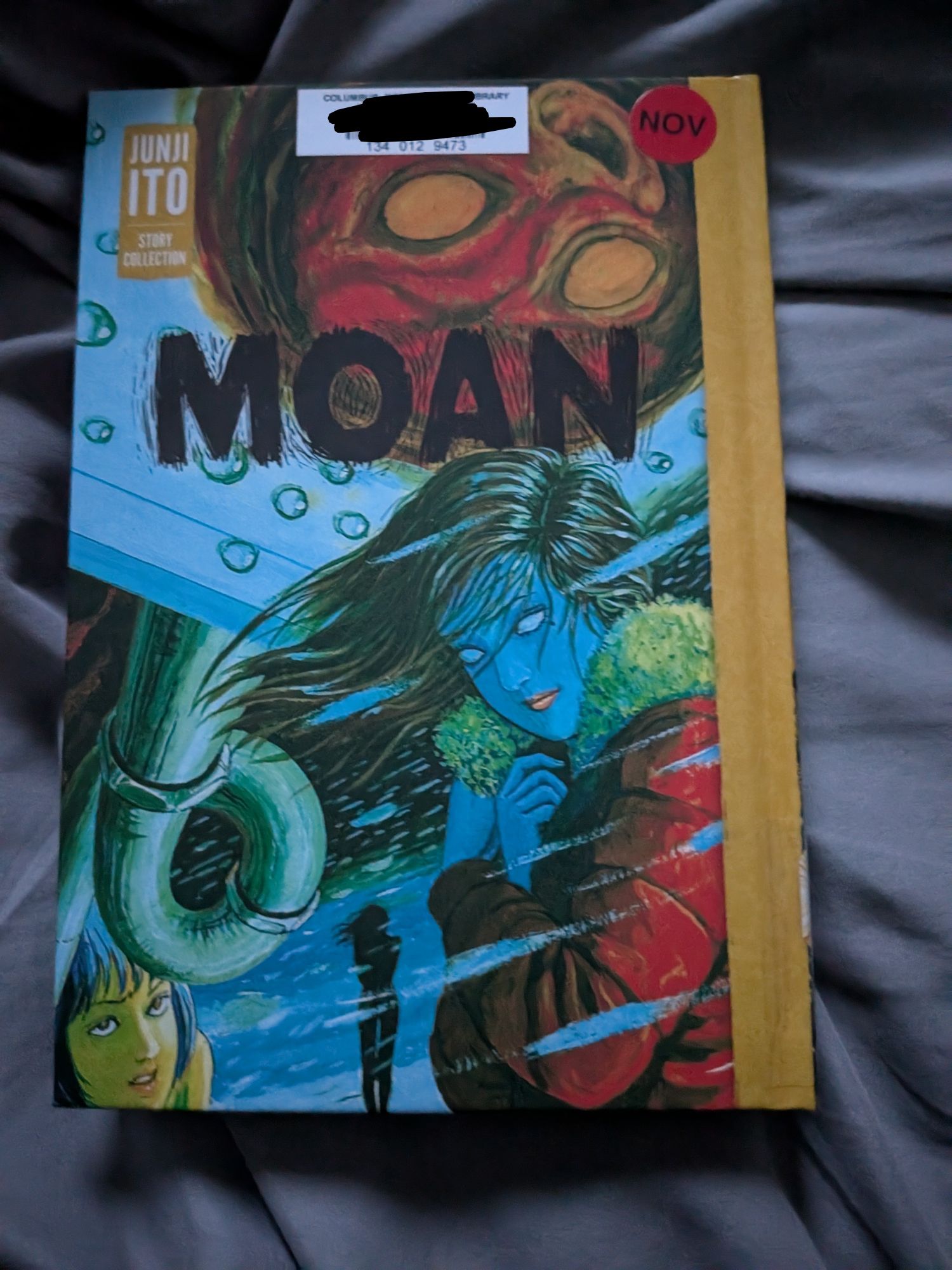
In Moan, Ito-sensei gives us four stories of around 60 pages or so, and two shorter ones of about 10-15. And what do you know? This time around, the majority of the stories worked for me.

The first story, “Supernatural Transfer Student,” is fun and imaginative. A small town high school gets a new transfer student, who immediately joins the Supernatural Studies club, which has some possibly-real, possibly-fake psychics. Suddenly, the town is full of weird phenomena right up the club’s alley, and the new kid might be causing it. It’s visually enjoyable and escalates nicely, so I enjoyed it.

The titular story, “Moan,” is about a family whose mother is obsessed with cleanliness to the point of neurotic. When a murder occurs in their home, things start getting weird and a moaning noise comes out of the pipes. Is it the spirit of the murder victim? Or is something else going on here? There’s a sense of claustrophobia and spiraling madness in this story, and the climax is very terrifying. The story ends a bit too abruptly to me, but I attribute that to manga publishers having a limited page count (still would have liked ten more pages to give the story a proper ending). Other than that, the story is chef’s kiss levels of good.

“Blood Orb Grove” is a tale of vampirism that has an interesting twist on the lore of vampires. It’s good, but there’s a bit too much talking and needless info-dumping in the climax. Meanwhile, “Flesh-Colored Mystery” is a great and imaginative story about how much someone’s beauty standards can mess up the lives of others around them. It’s visually creepy and the themes of beauty and abuse really resonate. Perhaps the ending for this one is also a bit too abrupt, but I still enjoyed it.

The fifth story, “Near Miss,” is very short and unimaginative, and is honestly the low point of the collection. However, the last story, “Under the Ground,” makes up for it with an engaging story that has a predictable, but still very well done, twist at the end.

All in all, I really liked Junji Ito’s Moan. On a scale of 1 to 5, I’m giving it a 4.5, much higher than the usual score. There’s some great stories here, and they’re all done with Ito-sensei’s iconic art style. Hell, some like “Moan” or “Blood Orb Grove” might make for great movies, so long as they were live action (at this point, I’m convinced you can’t make a good animated Junji Ito adaptation). Just avoid the fifth story in the collection, and you won’t regret reading it.

You know the drill: Junji Ito releases a new collection in the States; I read it; I review it. And in his latest collection, The Liminal Zone 2, Ito-sensei once again gives us four stories that try to toe the line between the world of human-caused horror and the more supernatural kind. (Plus the complicated relationships between fathers and sons, now that I think about it.)

You may recall, but I was not impressed with half of the stories in the first Liminal Zone (see my full review here). And, as Ito-sensei himself says in the afterword of Liminal Zone 2, he feels he’s having fewer ideas for stories every year. Can what ideas he has work for me this time?

For the most part, yes.

The first story, “Demon King of Dust,” follows a young boy living in what remains of a hot springs inn with his increasingly unstable father and two servants. The father is paranoid about dust, claiming it’s part of a terrible demon that rules over the abandoned resort town where the inn is located. It’s a very freaky story, where every couple of pages reveals more and more strange and disturbing imagery and truths. I love how it just escalates and how you’re left guessing how much is real or how much is in the father’s head.

The second story, “Village of Ether,” is about four college students returning to the small town one of them grew up in, and where a pair of scientists were supposedly developing perpetual motion machines (machines that lack an external power source and are considered impossible by mainstream scientists). However, the town is very changed from when the one student was a kid, and the only remaining scientist is hiding secrets that are about to come to the surface. Again, the art here is imaginative and terrifying, especially the “automaton servants,” and it just keeps getting freakier up until the end, which I would define as “explosive.”

The third story, “The Strange Hikizuri Siblings, Chapter 3: Uncle Ketanosuke,” is the latest venture in the Hikizuri siblings, six strange and dysfunctional siblings who have appeared in previous, increasingly supernatural stories (don’t worry, you don’t have to have read the previous stories to enjoy this one). In this tale, a girl named Hotaru senses a strange aura from the Hikizuri family home and ends up staying with the siblings in the hope that it may explain why she’s always felt a heavy weight upon her soul from early childhood. Be careful what you wish for, because the truth is as freaky as these siblings, and I bet a live-action film on just this one tale would be both hilarious and creepy!

The fourth and final story, however, is the weakest of the bunch. “The Shells of Manjunuma” is about a young man living in an area where the local turtles and crows are considered evil and cursed, and the turtles’ belly plates can predict who will die under mysterious circumstances. Ito-sensei himself all but admits in the afterword that he was really scraping the bottom of the barrel with this one, and it shows. The story feels pretty pointless, which only detracts from some of the very gruesome art.

But all in all, this is a much better collection of Ito-sensei’s work. Whereas The Liminal Zone earned a 2.5 out of 5, I’m awarding The Liminal Zone 2 a 3.8 out of 5. Plenty of great storytelling and scary imagery to match! Just skip the last story and you’ll be sufficiently creeped out.

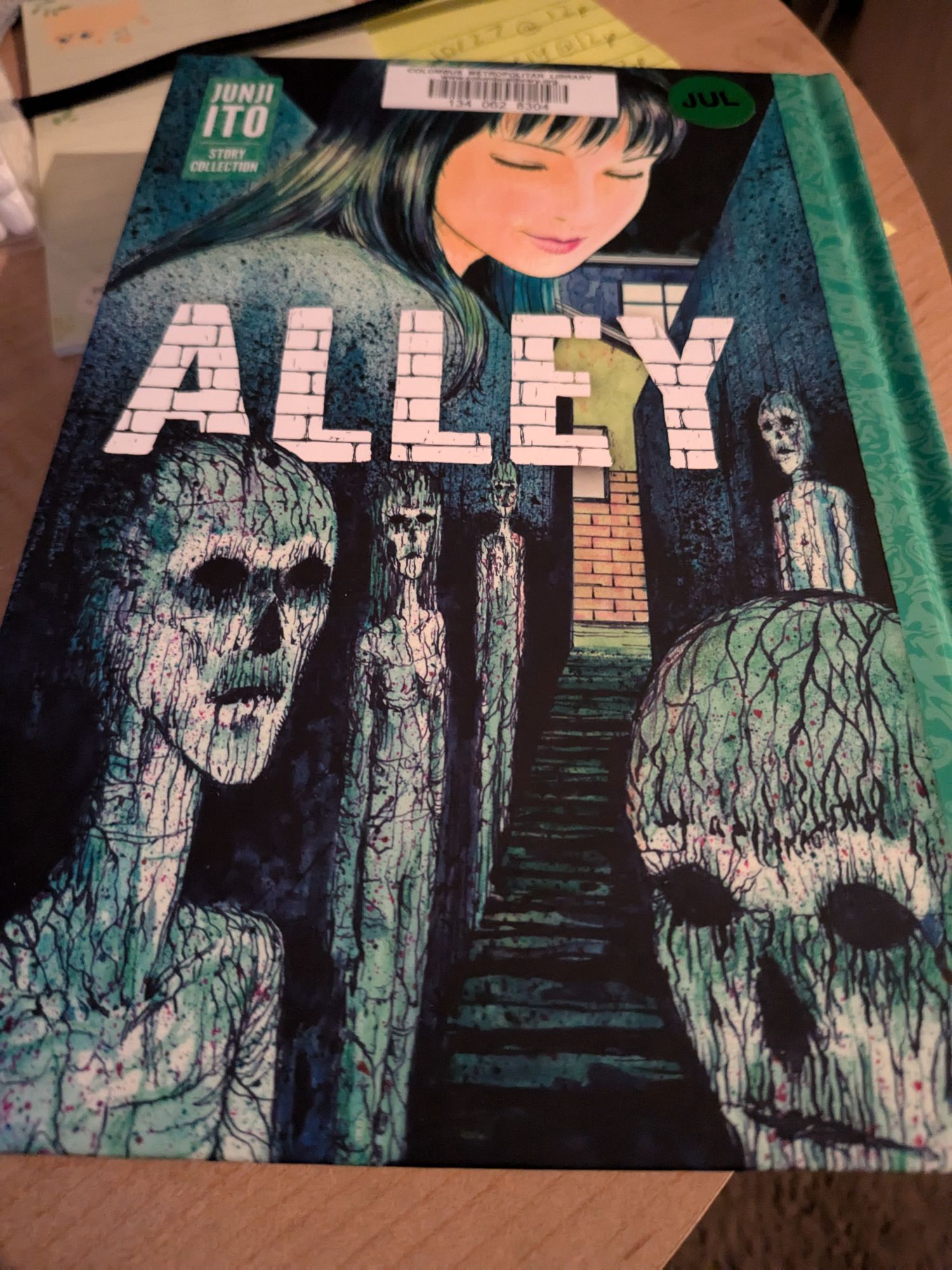
So, I just heard that Fangoria Entertainment is going to make a whole bunch of movies based on Junji Ito’s work. They mainly will adapt stories from his collection Smashed, but I hope Remina or Madonna get adaptations as well, as they are great stories (see my reviews for Remina and The Liminal Zone, respectively). In the meantime, a new collection of Junji Ito stories got translated, so I’m here to review it.

As I say, Junji Ito can be hit or miss with me, but this one was entertaining enough.

My favorite story was probably “Town of No Roads,” which follows a teen girl who goes to live with her aunt after her parents and brothers react the wrong way to a stalker breaking into her room. As if that’s not stressful enough, her aunt’s home has been swallowed up by a giant structure where nobody has any privacy. It’s weird, but you really start to empathize with the main character and the themes of the necessity for privacy really do resonate.

Other stories really struck a chord with me, which was nice. “”The Ward” is a creepy body horror story about several women in a hospital ward who start acting funny, while “Blessing” is a tragic love story with a great twist in the end. “Mold” just grossed me out (as a homeowner, I felt the main character’s pain, especially when it comes to cleaning one’s home). And “Descent” was a weird but engrossing story with a great hook and a mysterious resolution.

Of the rest, they were mostly decent. The titular story, “Alley,” has a great idea, but I feel like there’s too much exposition, which is followed by an ending that could have been a few pages longer. “The Inn” has a great idea and some terrifying art, though the ending kind of puttered out on me, and “Smoker’s Club” has a great idea about tobacco and smoking that would put anyone off cigarettes, though it also could have used more pages for its story. And “Memory” has a great story, though not enough scary art for me (it still would make a great movie).

The only bad story was “Ice Cream Bus,” which other than a reminder about why stranger danger exists, wasn’t much better than its animated Netflix adaptation.

Overall, I think I would give Alley by Junji Ito a 3.8 out of 5. There’s some decent horror in there, so if you’re looking to get into his work, this might be a good choice for your second or third read of his (I recommend picking between Remina, Uzumaki and Tombs for your first and second reads).

That’s all for now, my Followers of Fear. Until next time, good night and pleasant nightmares!

You know the drill: new Ito comes out, I read it, I write a review.

Mimi’s Tales of Terror follows Mimi, a college student who has a bad habit of encountering supernatural or strange phenomena in the course of her everyday life. The stories are adapted from Shin Mimibukuro, which from what I’ve been able to gather is some sort of anthology of urban legends and spooky stories that may or may not be connected to a series of movies and TV specials. In this volume, Ito takes those random tales and centers them around one girl, who should honestly learn how to be like the Winchesters of Supernatural.

Anyway, Ito’s work can go either way for me. Some of it is awesome, some of it is terrible, and a lot of it is average. Where did Mimi fall? I’d say above average.

Granted, the first three stories are definitely below average. Two of those stories are only a few pages long, so you wonder why they’re included or not fleshed out more. The third, about a woman in black whose height seems to change every time she leaves her apartment, had a good premise but ultimately left me unfulfilled and disappointed.

However, the rest were quite spooky. In one, Mimi moves to an apartment building next to a graveyard and witnesses some stuff that I found a little unsettling. In another, a little girl clings to her because a strange phantom follows her around and leaves ash everywhere. And then, after she and her boyfriend have a fight, Mimi joins a friend in a secret basement with a red spot on the wall that changes appearance over time. It’s all quite freaky and showcases Ito’s love of strange and macabre.

I also got a kick out of Mimi and her friends’ speech patterns. They’re written like they have American southern accents, which probably means they’re from the Kansai area of Japan. (I wouldn’t call it the Japanese equivalent of the south, even if it is in the southern part of the country, but generally people from the Kansai area in anime and manga are given southern accents when the work is brought to North America to differentiate them from folks who speak with a more Tokyo-ish/General American pattern.)

The most unsettling tale, however, is an extra at the end of the volume called “Monster Prop.” In this story, a young woman working for a haunted attraction tries to recreate a scary experience she had as a kid as a prop for the haunted house. However, doing so has some unintended and unforeseen consequences. It’s truly freaky stuff.

On a scale of 1 to 5, I would give Mimi’s Tales of Terror a 3.8 out of 5. If you avoid the stories that are under six pages and the one with the woman in black, you’ll probably enjoy the old school psychological horror vibe of the volume. Give it a shot and see what you think.

You know the drill. Junji Ito, currently the biggest name in horror manga right now, released a new collection of short manga in North America. I got my hands on a copy from the library, read it, and now I’m reviewing it.

In Tombs, Ito brings together some old and some new stories to terrify us. From a town where tombstones show up wherever someone dies, to a strange neighbor who calls to a young man at night and a town where everyone appears to be anemic, there’s something for everyone in this collection. And all of it is guaranteed to stick in your mind.

This was probably the most solid collection of Ito’s shorts that I’ve read. Not a bad one among the group. Obviously, Ito’s art is always well-done and extremely evocative, with every line made to scare the ever-living daylights to you. And the ideas of these stories are all very inventive. I often found myself envying some of the ideas he had to come up with these stories, my favorites being the titular story “Tombs,” as well as “The Bloody Story of Shirosuna.” The former story is the one I mentioned where tombstones show up whenever someone dies, while the latter is the one about the town being anemic.

Close runner-ups were “Floaters,” a story where people’s inner thoughts manifest physically as these little hairballs that float in the air and speak your thoughts when you touch them, and “Bronze Statue,” which follows an old woman’s obsession with her youth and commemorating it in bronze.

It was also great to finally read “The Window Next Door,” which I’ve only heard about and have never read (I didn’t want to read it illegally online). That particular story has some of the most disgusting and off-putting art I’ve seen from Ito, all without using blood or gore.

The only issue I really had with the collection was that the story “Clubhouse,” which is a ghost story with a fun and clever concept, ended a bit too abruptly for my tastes. I honestly felt like it could have had a better resolution if it had a few more pages. That being said, the story is still pretty awesome as it is.

All in all, Tombs by Junji Ito is a great collection with some amazing and creepy stories worth reading. On a scale of 1 to 5, I’m going to give it an even 5, a top score. Definitely go out and read a copy if you can get your hands on it. Hell, I might buy myself a copy to own if the opportunity presents itself. It’s that good.

Also, I think “The Bloody Story of Shirosuna” would make a great live-action movie. Can someone please get on it? And yes, please do live action, not anime. I’ve sort of given up on anime adapting Junji Ito well (two series have been really sub-par and the Uzumaki adaptation has been delayed forever, so what does that tell you?). And don’t make an American version of it, I’m sure that would ruin it by adding all the wrong elements to make it more local. But yes, please make a live-action adaptation of it.

Alright, that’s all for now, my Followers of Fear. Until next time, good night and pleasant nightmares!