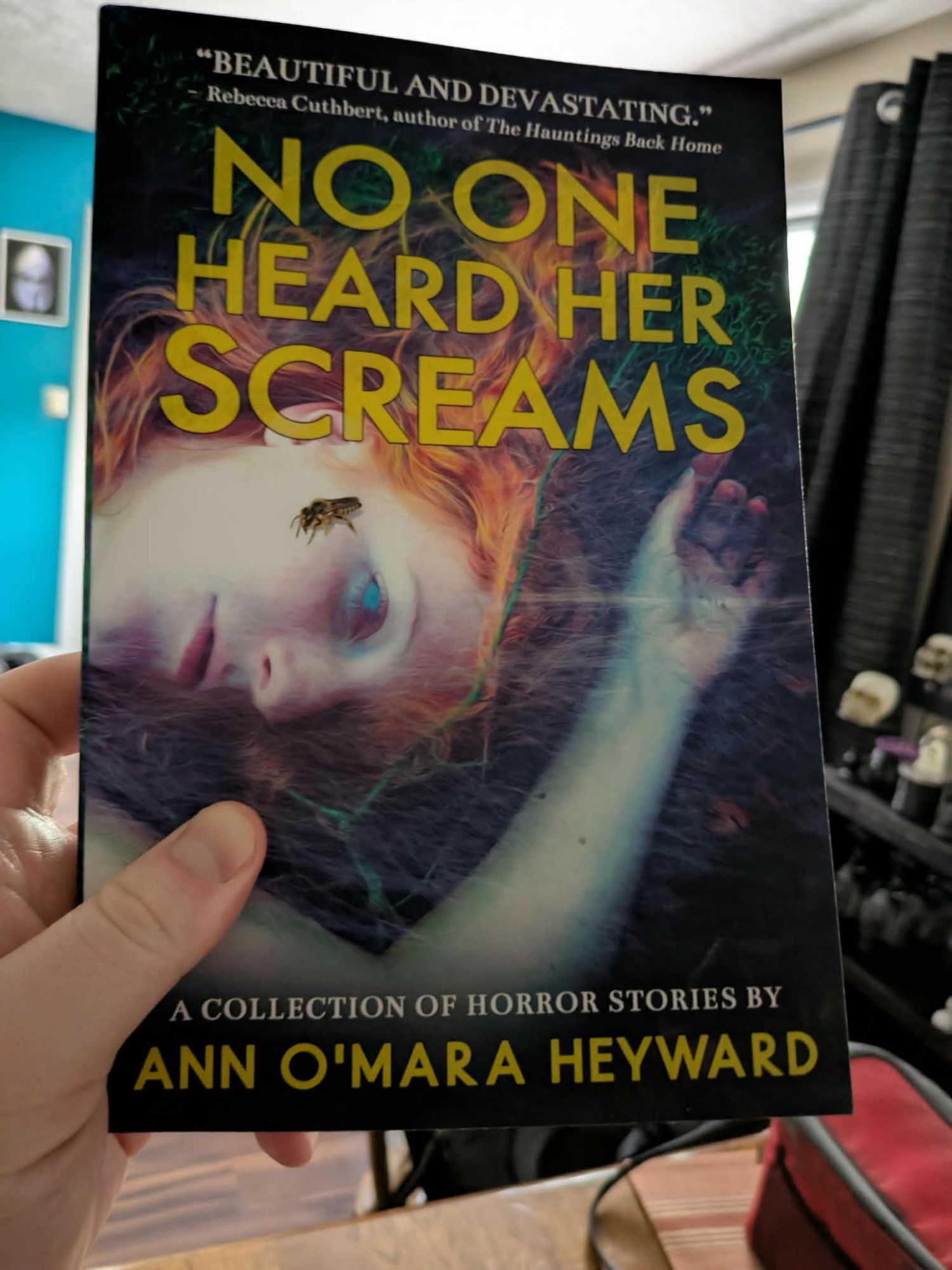
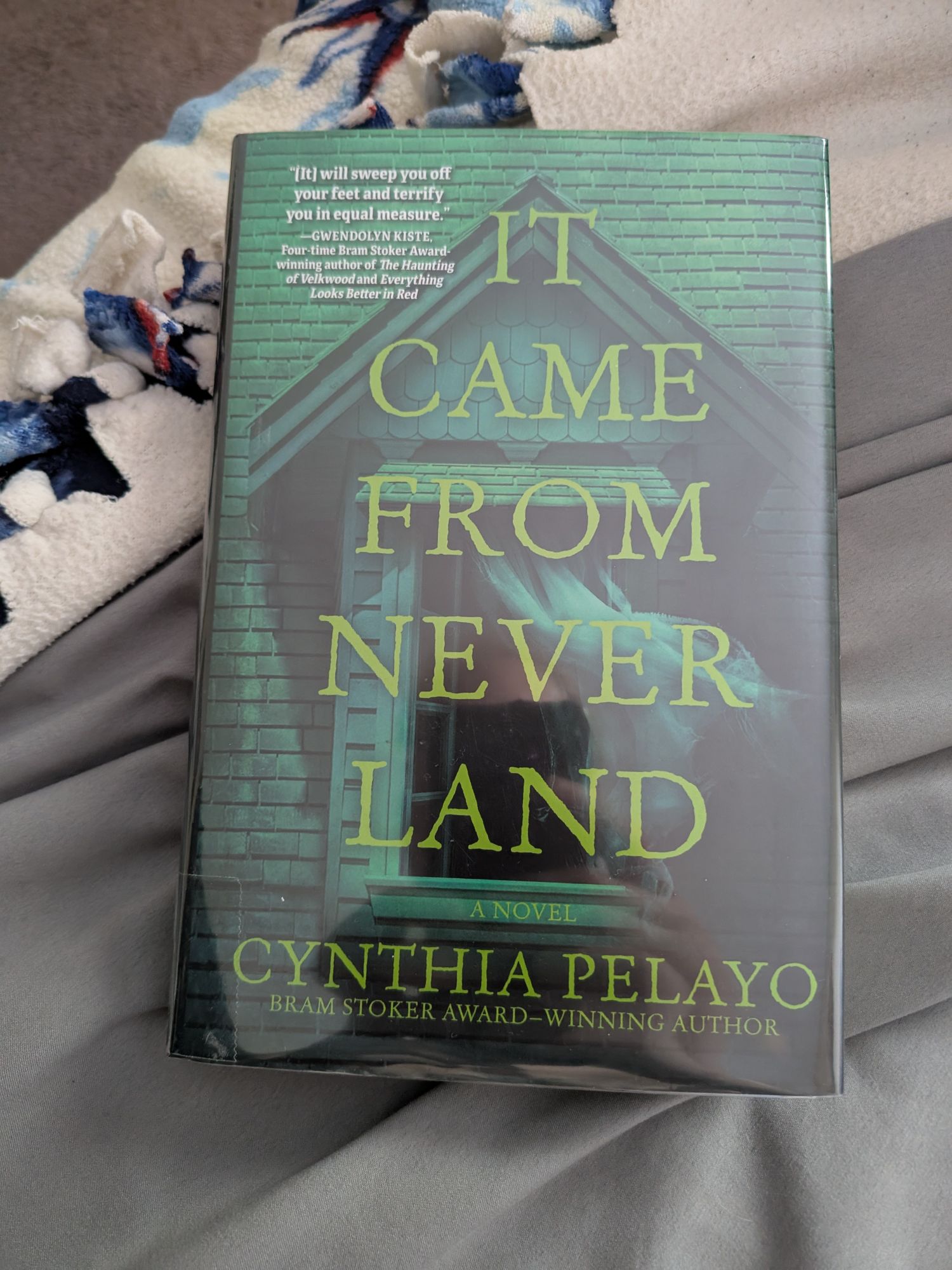
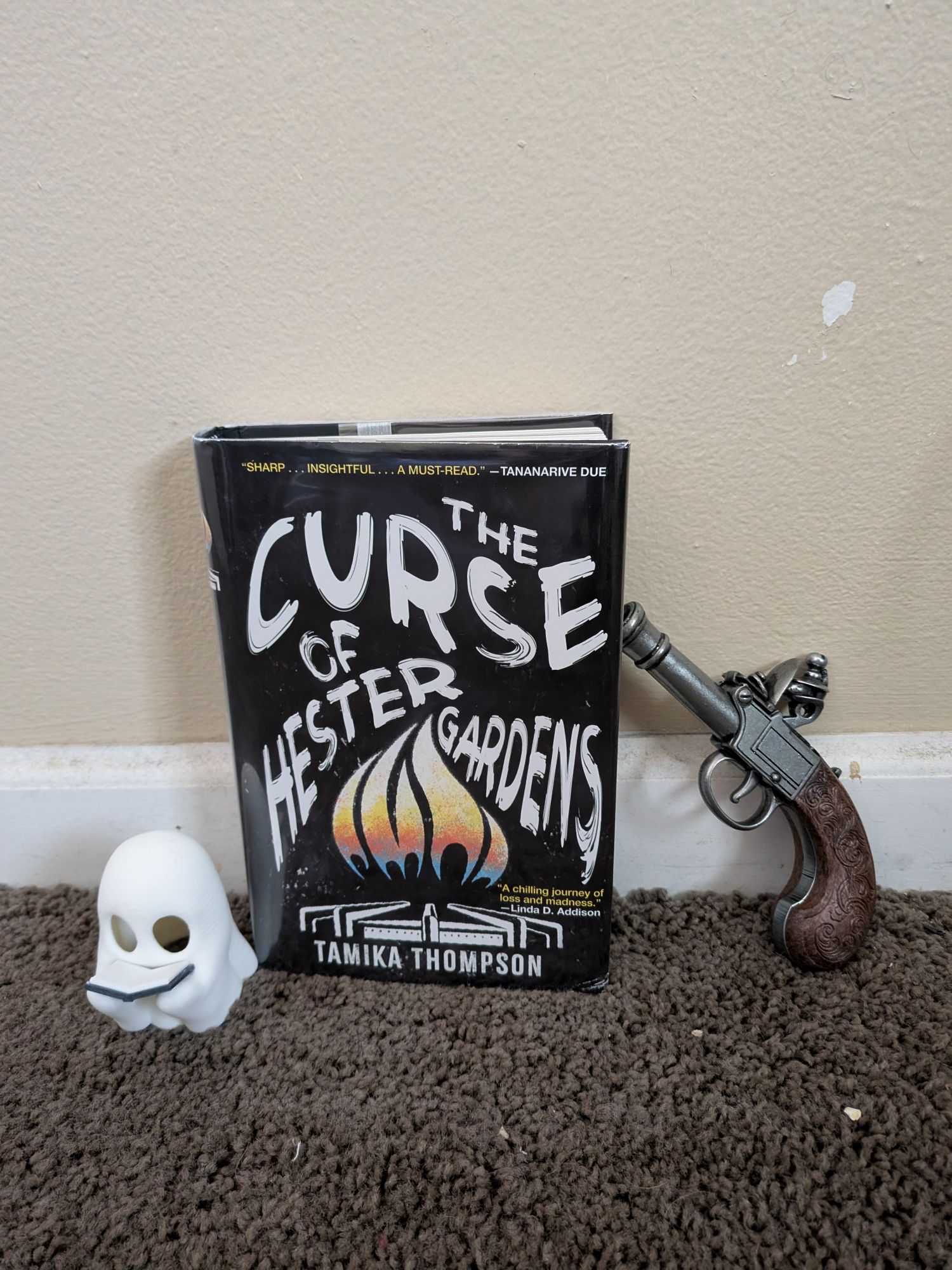
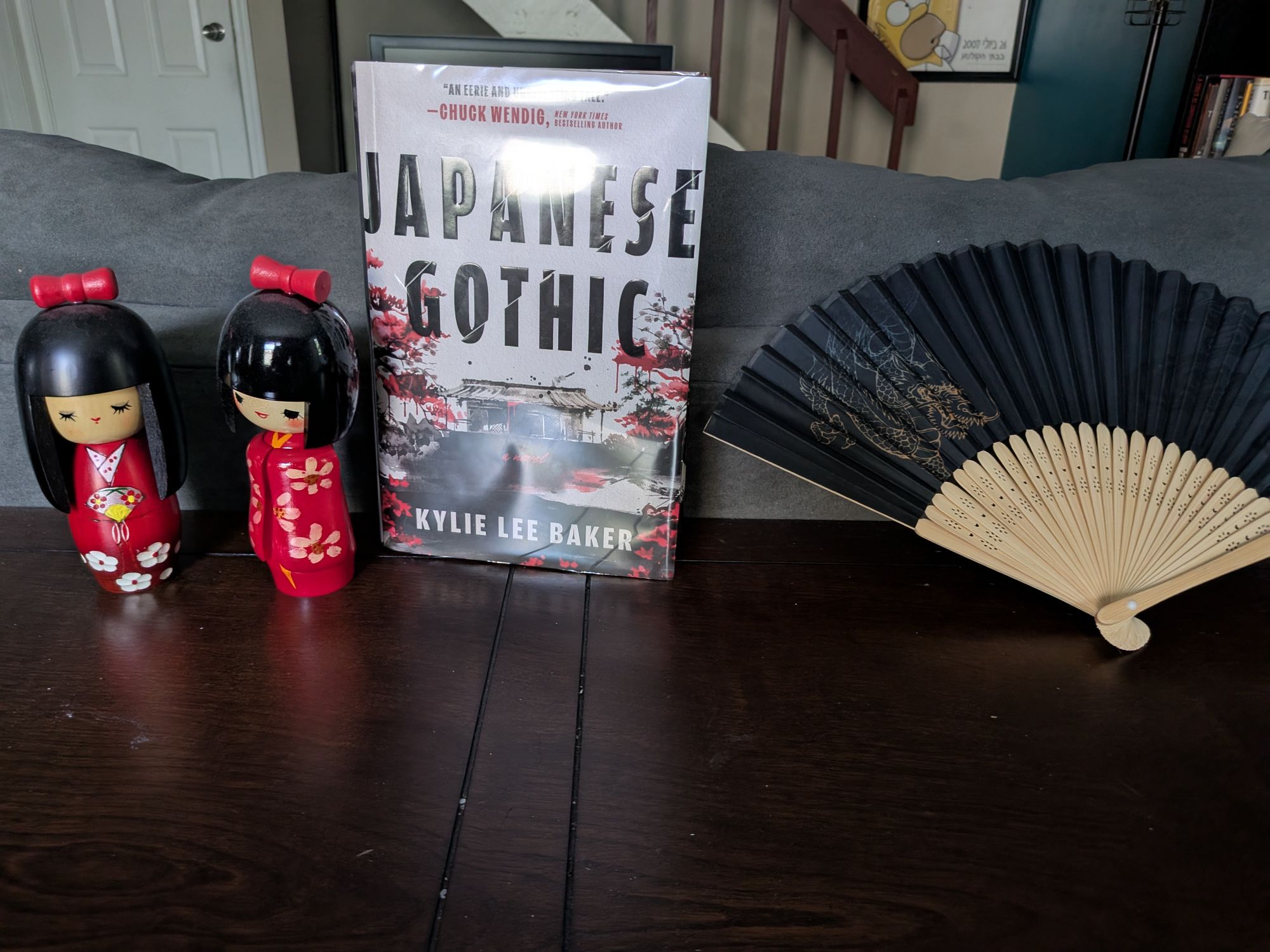
Me holding my copy of “No One Heard Her Screams” after receiving it in the mail.
One of the best parts of being a writer is that I have gotten to meet and make friends out of many of my colleagues. For some of them, I’ve even been able to see them early in their careers and watch them grow and get their early successes. Ann O’Mara Heyward is one of those authors. Since the moment she joined HWA Ohio (which I run), I’ve had the pleasure of seeing her break out into the horror scene and even read early drafts of her stories.
Earlier this year, Ann published her first collection, No One Heard Her Screams, a collection of eighteen tales she’s published. And because I read some of the stories in the earlier drafts, Ann sent me a free, signed copy. Earlier this month, I finally got around to reading it. And what did I think?
To say the least, this is an excellent collection.
Ann has a strong voice and an excellent handling on what’s scary. Not to mention, she often knows how to tell a story in under seven-thousand words, or even five-thousands, and still give it a good beginning, middle, and payoff. I am in awe of authors who manage to consistently keep their stories that short!
My personal favorite was “Gehenna,” a story about a woman in a small town who chronicles the horrors that occurred in her community during a tent revival. Even with the supernatural elements, the events of the story felt very believable. Other highlights of the anthology, which kept me reading through to the end of each story despite my lunch break ending, included “The Monster Maker,” about a mortician who gets a rather unusual client; “The Rookery,” about a local swamp monster living near a condo community in Florida (sounds more interesting than my condo community); and “Zeke Street,” about what happens when you try to monetize the zombie apocalypse.
Actually, that last one would make a great movie. Zombies may have been used back to death, but it’s always great to see a new take on the trope. And “Zeke Street” is definitely a different take.
Now, not all of the stories worked for me. “The Waiting Room” and “The Dog” both felt like they had letdowns for endings.
But the rest were very good and had interesting concepts. “Missing Lula” involved a real life serial killer, and was fairly spooky; “Consignment” executed its concept with a lot of fun; and stories like “Cleveland,” “The Kitchen Window,” and “The Guests” were wonderfully nihilistic.
On a scale of 1 to 5, I am giving No One Heard Her Screams by Ann O’Mara Heyward a 4.8 out of 5. Full of creepy and perfectly dark stories. If you’re in the mood for something to spooky to read in short bursts this Halloween season, this is a good collection to go with it.
We’re under a hundred days till Halloween, so I think we can safely say it’s spooky season. And that means it’s time to start putting together our viewing lists for spooky season. So, as I’ve done for the past several years, I’ve made a list of films to check out in the lead up to Halloween. There’s a mix of old and new, well-known and lesser-known, on this list, and in no particular order (except for maybe the first three). Hopefully you find something here worth watching this Halloween season.
Caveat (2020) Damian McCarthy has made a name for himself with his horror movies, which are all original stories set in a shared universe where, as YouTuber Ryan Hollinger puts it, “the supernatural intrudes on the natural world.” This was the first of his feature films. Caveat follows an amnesiac man who is hired to watch a man’s adult niece for a few days. The only problem is, the niece lives on a deserted island, and the amnesiac man has to wear a harness keeping him in the house and from getting too close to the niece, who has some serious mental health issues. Against his better judgment, he puts on the harness, knowing he won’t be able to take it off by himself. And soon he learns that he and the nurse aren’t alone in the house.
The story does take some suspension of disbelief (especially considering the thing with the harness). However, it is a moody and atmospheric Gothic horror piece with a spooky mystery and some really good scares. Plus, it begins McCarthy’s shared universe, with its set of tropes that can be seen in each of the movies he’s put out since. Watching them in order, you really see the polishing of his style and storytelling prowess, and you get to enjoy some good horror films while you’re at it.
Speaking of which…
Oddity (2024) The follow up to Caveat, Damian McCarthy’s sophomore venture follows a blind medium. One year after her sister was brutally murdered, the medium goes to stay with her sister’s husband. With his girlfriend. At the house where the medium’s sister was horribly murdered. But she’s not coming alone. She’s coming with a strange, wooden golem which her mother supposedly got from a witch. And a dark secret given to her by her powers.
To say the least, you can see how McCarthy has grown as a writer and filmmaker through this film. Not only is the story smoother and easier to believe, but it is just frightening throughout. The golem makes for a terrifying image, and the constant game of cat-and-mouse the medium has going on with those around her as she really makes you think about what happened the night her sister was killed. I am so looking forward to watching this one again, and that should be enough to tell you how good it is.
Hokum (2026) The final and most recent Damian McCarthy film, Hokum takes all the hallmarks and horror of his style and ramps it up to 11. In this film, an American writer goes to an inn deep within the Irish woods to spread his parents’ ashes. However, after someone he’s indebted to goes missing at the hotel, the writer returns to solve the mystery behind their disappearance…and gets a lot more in the bargain.
I went into the theater with high expectations for this one, and I came away more than satisfied. And while the tropes and Easter eggs that McCarthy is known for show up everywhere and are expected, they do not diminish the terror or immersion at all. Plus, there are still plenty of twists I did not see coming. Oh, and Adam Scott does an amazing job as the acerbic, misanthropic writer, who is carrying way more baggage than he lets on. Definitely put this one at the top of your list.
Good Boy (2025) You’ve probably heard of this one. The film told through the point-of-view of a dog?
Indy, a Novia Scotia Duck Tolling Retriever, moves with his sickly owner to the latter’s grandfather’s old house in the country. There, he becomes aware of a presence in the house. A dark phantom that seems to have it out for his owner. But Indy is just a dog. Will he be able to save them both?
Director Ben Leonberg spent three years making this film with Indy, who is his real life dog. Because, obviously, you have to approach working with a regular dog differently than you would with an actor. However, the results paid off. Using all sorts of mood-setting filmmaking techniques, we get not only a very atmospheric and frightening horror film, but an emotive character in Indy. I saw it in theaters, and was struck by how much it hit me in the feels. It’s a definitely a film, even if you’re just curious, that I encourage you to check out.
Starry Eyes (2014) An aspiring actress who is having the worst luck finding roles auditions for a part in a horror movie by a storied and powerful production company. She thinks this role could lead to her getting the fame she has always desired, but that fame may come at a price. One that may be too much for her to pay.
When I first saw this movie several years ago, I wasn’t sure what to make of it. However, in the years since, I’ve thought about it a lot and how it explored the dark side of Hollywood and the Hollywood dream. I will warn you, it does go into topics of self-harm and the “casting couch,” so you may not want to watch if that triggers you. However, I think in the wake of #MeToo and further exposure of the toxic side of Hollywood, it remains relevant and should be worth a watch. I know I’ll see it this spooky season.
The Ugly Stepsister (2025) In this dark, updated take on Cinderella from Norway, we focus on Elvira, the eldest of the two stepsisters in the original fairy tale. After Cinderella’s father dies and the family is left impoverished, Elvira’s does the usual thing of making Cinderella a servant…and then starts putting Elvira through primitive and ghastly beauty treatments to get her ready for the prince’s ball. How far will Elvira go for the prince? And, in the end, will the price be too much to pay?
The cult reputation this film has received since it released is well-deserved. I saw it in theaters at the only local theater that seemed to be playing it, and I have not squirmed in my seat like that in a long, long time. The body horror was par excellence, and the production values were incredible, making you feel truly immersed in the world of the story. I will caution you, this is the kind of thing you would not want to watch if you’re very squeamish. However, if that’s not an issue, you’ll probably recognize The Ugly Stepsister as the genius it is.
Coherence (2013) A dinner between friends gets weird. And at first, it’s the normal weird. There’s tensions between them, unspoken grudges, and sleeping dogs that won’t be left to sleep. But then a passing comet changes things. Suddenly, alternate realities appear all over the place. Doubles show up. And soon, no one is sure where their home is or who they’re talking with as they deal with all the possibilities of the multiverse.
This ambitious film was made on only fifty thousand dollars, but you wouldn’t know it if you saw it. It feels very professional, and is incredibly well told for such a bizarre story. A very Twilight Zone-esque tale about alternate realities and what happens when they collide.
Speaking of which, I have a very distinct memory of this film starring Natalie Dormer as the lead. However, the last I looked up this film, an actress named Emily Foxler (now Baldoni, since she married) was playing the lead. Did I slide into another universe? The universe may never know.
Odd Thomas (2013) Based on the first book in Dean Koontz’s beloved book series and starring the late and great Anton Yelchin, the movie follows Odd Thomas, a fry cook in a small town who happens to see ghosts. When he does, he tries to help…even if it means going up against dangerous criminals in his small town. Which happens a lot.
One day, however, Odd gets a premonition of something terrible about to happen. Something worse than anything Odd has come up against. Something that threatens not just him, but all his loved ones. And he’s going to have to work hard to save them.
I loved the original books when I read them, and the movie, which faithfully adapts the first book, is fantastic. Yelchin is great as Odd, and everyone’s clearly having a great time making and putting their all into the film. Plus, the thrills are great and the special effects are well done. I’m looking forward to watching this one again this spooky season.
Glorious (2022) A man on the verge of a breakdown stops at a rest stop to get drunk and cry over recent troubles in his relationship. However, when he goes into the men’s room, he not only gets stuck in there, he finds himself stuck in there with another person. Well, not another person. More like a cosmic entity hiding inside one of the stalls. And now, the man is about to get up in an event of cosmic proportions. All while trapped in a men’s room at a rest stop on the highway!
Oh God, this film was bizarre in all the best ways! A great balance between cosmic horror and horror comedy, watching it felt like being on a rollercoaster in some of the best ways. Great twists, terrifying visuals, lots of laughs, and JK Simmons as the voice of the cosmic entity. If you watch it, I’m sure you’ll be pleasantly surprised.
Undertone (2025) Evy Babic is a podcaster currently caring for her comatose mother. She and her friend Justin run the undertone podcast, a horror podcast exploring all sorts of spooky phenomenon. Evy tends to be the skeptic, while Justin is the big believer. One day, Justin is sent a strange email containing a series of cryptic recordings. As they listen to the recordings, they find themselves trapped in something supernatural. And it’s coming for Evy.
This film first started getting attention due to a very effective marketing campaign. However, when I saw the film, it was the real deal! The use of sound, open spaces, light and darkness, and lack of other people in the film really show Evy’s isolation (literal and figurative), and that helps with the atmosphere. A feeling of paranoia builds as you watch the film and events unfold, making you wonder how much is real and how much is in Evy’s head. If you give it a watch, you should watch it on as large a screen as possible and in the dark. Trust me, it’s the most effective that way.
Poltergeist (1982) A classic of the genre, Poltergeist follows a family living in a recently-built California planned community. At first, everything seems fine. They’re living the American Dream. But then strange occurrences happen around the home. Chairs moving on their own, lights turning on and off, a tree coming to life and attacking the family’s son. It culminates with the family’s youngest daughter being taken hostage. And only with help will the family get her back.
Forty years later, this film is still as terrifying now as it was then. The special effects have aged well, the emotion the family members feel come across as genuine, and the climax is something to behold (especially considering those were real corpses). As for whether the curse on the movie is real…well, I’ll let you decide on that one.
Bugonia (2025) A pharmaceuticals CEO, played by Emma Stone, is kidnapped by a pair of cousins and held hostage on the family farm. The cousins believe the CEO is a representative of an alien race experimenting and controlling the human race. But not everything is as it seems. Neither with the cousins, or with the pharmaceutical exec. And the result of this kidnapping plot will have implications for the whole human race.
This Oscar-nominated film, which is based on a South Korean sci-fi film, has been marketed as a black comedy, but I disagree with that label. Yes, there are plenty of funny moments, but they are overshadowed by some seriously messed up moments. Plus, I have never seen a comedy where a full on torture scene was part of the plot. No, it’s a science fiction horror film with some comedic moments and plenty of cat-and-mouse psychological play. And once you watch it, it’ll stay with you for ages to come.
Prince of Darkness (1987) The Vatican becomes aware that a prophecy is about to come true: Satan, who has been trapped inside an ancient container for many thousands of years, is about to awaken, break out, and cause the Apocalypse. A priest goes to the local university’s science departments, asking them to help prove the prophecy is coming true. As one would expect, when they lock themselves inside the church to study the container, shit hits the fan.
One of John Carpenter’s underrated gems, Prince of Darkness isn’t perfect by any means. But it is a unique viewing experience. The films knows what kind of horror movie it wants to be and goes into it whole hog. Plus, how it explores religion, science, and cosmology is just really interesting to me. It gets you to think, which I love. Honestly, it’s one of my favorite horror films, despite its flaws. And if you see it, I think you’ll understand why.
So, there you are. My thirteen recommendations for spooky season in 2026. A mix of old and new, famous and not-so-famous. All will surely enhance your spooky season viewing this year.
But tell me, what movies are you going to watch this year? Are there any you’d add to this list? And what do you think of the movies on this list? Let’s discuss.
That’s all for now, my Followers of Fear. Until next time, good night, pleasant nightmares, and only 81 days till Halloween!
Peter Pan is a character/story that every child loves growing up. However, as we actually grow up, not only do we see the tragedy of the character, but you also realize he’s kind of creepy. I mean, he hides outside a window to listen to a girl tell her brothers stories. And in the books, he’s a tyrant who kills the Lost Boys when they get too old, among other things. It’s not surprising that, as the years have gone by, more and more stories have delved into the dark side of Peter Pan.
In Cynthia Pelayo’s take on a dark Peter Pan story, It Came From Neverland, we meet a very different Wendy from the one who appears in J.M. Barrie’s book.* Now in her twenties, the adult Wendy is scarred from her experiences with Peter. She tries her best to move on, teaching at the children’s home that took her in after she and her brothers returned, and reads to soldiers returning from fighting in WWI. But then strange events happen around London. Children get injured or go missing. Mysterious fogs and crows feathers appear all over the place. And Wendy hears a whisper from her past. A whisper belonging to a boy who’s not a boy, whom she thought was dead after he killed so many. And he’s come back for her.
Cynthia Pelayo writes a lot of stories that are reinterpreted fairy tales (I loved her take on the Sleeping Beauty story, Vanishing Daughters), and with It Came From Neverland, that talent is on full display. With strong and concise language, she crafts a suspenseful tale that really lets us get into the head of Wendy Darling, aged into adulthood long before she hit her teen years and trying to survive when the past haunts her everyday. You really get to know her as we see her deal with the return of Peter Pan.
Speaking of which, the relationship between her and Peter was chilling! It’s the definition of an abusive and toxic relationship, with Peter being nice before lying, manipulating, gaslighting, and finding all sorts of ways to belittle Wendy. Just from the short episodes we see, it’s enough to make you shudder from how horrible he is to her.
And like I said, this book is suspenseful. A lot of time is spent showing Peter’s encroachment on Wendy’s life, as well as the life of her brothers. And it is frightening! It reminds me of what Stephen King said about the three types of horror, and how terror is the one that’s hardest to do, because it leaves you with that sense of unease that refuses to go. That terror is put on full display here, creating a frightening atmosphere that lingers long after you put the book down.
My only major criticism is that the parts exploring Wendy’s past with Peter are too short. I didn’t mind that they were out of order, but for a book that was marketed as Peter Pan meets IT, I expected more time spent in the past. To really feel like I was in Neverland with those characters when they were children. What we got was more like short vignettes, and while those were great, I felt like they weren’t enough for me.
However, on the whole, it is a great novel that I practically flew through each time I picked it up. On a scale of 1 to 5, I give It Came From Neverland by Cynthia Pelayo a 4.8 out of 5. This is definitely one to settle down with. Just be careful, though. You might end up hooked!
*By the way, Barrie’s mentioned in the book as someone who heard Wendy’s story and twisted it into the child-friendly version we know today. And can I just say, I love that he’s as much a hack in the book as I’ve always thought he was? I got a laugh out of that.
You might have heard of this novel, even if you haven’t read it or even if you don’t read horror. That’s because it recently won the Pulitzer Prize, the first horror novel to ever do so. And given the stature of the Pulitzer Prize, that’s quite the accomplishment (though as my friend and colleague Kevin Wetmore noted while hosting the Bram Stoker Awards last month, “a horror novel wins the Bram Stoker award every year”). Recognizing what a big deal this is, I decided to check it out and got the audio book. After all, what kind of horror novel wins the Pulitzer Prize?
Well, a rather unusual novel, as it turns out.
Taking place during the Meuse-Argonne offensive in WWI, Angel Down follows Private Cyril Bagger, a con artist who was tricked into enlisting and can’t wait to rooking inexperienced gamblers back in the States. He is commanded by Major General Reis, the commander in the offensive, to go and find the source of an unearthly shrieking that is causing the men to go insane. If it turns out to be a soldier dying slowly, they are to put him out of his misery. Bagger is joined by four other soldiers; Private Louis Arno, an illiterate teenager who lied about his age to enlist and has attached himself to Bagger like a koala to its mother; Private Hugh Popkin, a violent meathead with no brains, a raging case of the clap, and an even stronger raging case for a girl back home; Private Vincent Goodspeed, a twitchy graverobber who steals from the bodies of the dead to sell to both sides; and Private Ben Veck, the group’s only black soldier, who is suffering from PTSD and wants to believe he’s been chosen for a greater purpose.
Upon finding the source of the shrieking, they discover it’s an angel in the form of a human woman. One that resembles someone each of the men know. Realizing that the ambitious Reis would use the angel for his own purposes, they go AWOL and take the angel with them, leading to an unavoidable chain of events that will not only change their lives, but maybe even change the world.
So, like I said, this is a rather unusual novel. Angel Down is apparently written in the style of a single, continuous sentence (as I had the audio book, I could only half tell), so every tenth word is an “and” or a “so.” This is nothing new in literature, as plenty of novels, most famously The Waves by Virginia Woolf, has been written this way. I’m assuming Kraus wrote it this way because stream-of-consciousness style writing like this was popular among Modernist writers post-WWI, and he’s paying tribute to that. Plus, it makes the novel stand out.
However, I did hear from plenty of fellow horror fans who find the writing style grating. And honestly, I understood; I could only listen to the audio book during certain moods, like when I was driving or cooking. Otherwise, the style would get under my skin in a bad way. (And the narrator, bless him, narrated the book so that it at least sounded like it had normal sentences.)
All that aside, most of the characters are fully realized, especially Bagger. He’s the son of a preacher who doesn’t believe in anything except himself and controlling his life. At the same time, he’s also perturbed that he likes Arno and protect the kid, and the events of the novel set him on a path of transformation. Arno and Veck are also quite sympathetic, especiallyt he latter after you learn more about him. And Reis and Popkin are easy to hate (especially Popkin).
As for the angel…she’s an enigma. She sets things in motion and for most of the novel is a MacGuffin that motivates the characters. However, later on, she does start to affect the story and the characters more, and it’s…it’s hard to tell how I should feel about her. To like her or hate her. To consider her hero or villain. Or maybe she’s just the bringer of revelations? I guess any and all of those opinions work, given that she’s an angel, and therefore beyond our ordinary comprehensions. But still, she’s a lot and it makes it hard to pin down your feelings about her.
Finally, I will say that the book does a great job of getting the horrors of war through to the reader. Just like All Quiet on the Western Front did nearly a full century ago, it does not hold back. From descriptions of the bodies covered in clay and blood, to the fear each soldier feels when German bullets or mortar fire flies overhead, to the abstract depictions of the “engines of war,” it is enough to dissuade some readers that any good can come of war. (Something some of our current crop of leaders could learn from.)
Overall, I think I will give Angel Down by Daniel Kraus a 3.8 out of 5. The narration style may not be to everyone’s tastes, but the story, characters, and themes are engaging and make you want to keep going. I can see why this book won the Pulitzer Prize. And if you decide to read it, perhaps you will, too.
Also, Happy Fourth of July, my Followers of Fear. Whatever you’re doing this Independence Day, stay safe and have fun!
I first met Tamika Thompson last year on the Diversity in Horror panel at StokerCon. Later, I read a short story by her that I really enjoyed, and she told me her debut novel was coming out soon that explored similar themes as her short story. I was immediately intrigued and, as soon as I could, I made a reservation at the library. The book arrived at the same time as Japanese Gothic (see my review for that book here), and as soon as I finished that one, I got into The Curse of Hester Gardens.
I have to say, it’s nice when you get two excellent novels in a row.
Set in a public housing complex with a history of crime and violence, The Curse of Hester Gardens follows Nona McKinley, a woman who has been raising her sons on her own since her drug dealer husband was sent to prison. Sadly, her oldest son Kendall was murdered, money is always tight, and her younger son Lance is getting mixed into a bad crowd. Her only salvation is that her middle son Marcus is off to an Ivy League college in the fall.
Except…something terrifying is happening in Hester Gardens. Things are always weird there, as numerous spirits are said to haunt the place. But now, something new is making itself known. Nona is encountering what might be an angry spirit appearing in her home, Marcus is acting very much unlike himself, and the fragile life she’s constructed for her family seems to be crashing down around her. All of it may trace to a secret she’s been keeping. A secret covered in blood. And the residents of Hester Gardens may pay the price with Nona.
From the prologue, I was hooked. The story is written with a powerful realism, mixing in the real life tragedies of gun violence, urban decay and neglect, overincarceration, and others with the fictional narrative to add believability. Plus, the descriptions allowed me to really see and feel like I was in Hester Gardens (not a fun place to imagine yourself in, let me tell you). I could almost smell the garbage that is hardly ever picked up!
I also empathized with main character Nona. She’s had a really rough time and is trying her best, so it’s not hard to root for her. She’s also very human and makes mistakes, some of which are understandable given her situation, and that helped me like her more. The other characters whose POVs we look through also were written so that, even if we only spent maybe a chapter or two with them, they felt like well-rounded characters.
And the scares? Top notch! The concept of the curse and the spirits in Hester Gardens made for a freaky audience, and the human factor added to those scares as well. Plus, there were some scenes with the entities that had me gripping my book so tightly. (That hole-in-the-bathroom scene!)
Finally, the story kept me guessing throughout. I had trouble guessing where the story would go, especially in the last hundred pages or so. I read quite a few moments with wide eyes because I could not believe where the story had gone!
So yeah, I’m hard-pressed to pick out anything I didn’t like. On a scale of 1 to 5, I would give The Curse of Hester Gardens a 4.8 out of 5. Powerfully written, with strong emotions and realism. If this is Tamika Thompson’s first novel, I can’t wait to see what she does with her second.
In the meantime, grab a copy of The Curse of Hester Gardens and read it today. Trust me, you’ll be glad you did.
I think this has been my most anticipated new book of 2026. I mean, a Gothic horror novel set in Japan and featuring Japanese history and culture (specifically samurai)? Be still my horror and Japanese culture loving heart! As soon as my library ordered copies, I was the first on the reservation list, and I started reading it almost as soon as I picked up my copy of Japanese Gothic.
So, here’s the plot:
In October 2026 (ooh, the future), Lee Turner stays with his American father and the latter’s Japanese girlfriend in a house hidden behind sword ferns in the historical town of Chiran in Kagoshima, Japan. Lee holds many secrets, some of which threaten to tear him and his life apart. As he struggles to figure out what to do, he sees a strange girl with a samurai sword outside his room.
Meanwhile, in October 1877, Sen is the daughter of a samurai, the last survivor of a failed rebellion. As she trains under her tyrant of a father for a new rebellion to reinstate the samurai, she feels the inevitable coming with both excitement and trepidation. That is, until she sees a strange foreign man in the window of her bedroom in a house hidden behind sword ferns in the former samurai town of Chiran in the Kagoshima domain of Japan.
Japanese Gothic was worth the wait.
First off, the language was so vivid and evocative. From the setting to abstract concepts to the characters, the way Baker uses words is powerful. And speaking of characters, wow! The main characters felt so damn real! Sen felt like she came right out of the best of anime, with a fully rounded and complex character, and Lee…well, Lee felt like he was less of a person and more of an amalgamation of problems and personality quirks. And at first, I really didn’t like him. In fact, I’m still not sure how I feel about him, though I have to admit, his own character arc is as compelling as Sen’s.
As for the story, freaking phenomenal! Reading as Lee and Sen encounter one another, then get to know each other, and then try to solve the mysteries that occupy their attentions, made the book hard to put down. It was also really touching to see them get to trust each other. They’re both very broken people, but watching them grow through their relationship and what they discover through it made my heart go out to them. And I did not see many of the twists coming, which was really welcome. The last fifty pages or so just kept me in shock and on the edge of my seat!
If I did have a criticism, I would have to say that when we finally do get explanations of what the hell’s been going on at the end, it was rather abstract and might be hard for some readers to understand. As someone used to understanding the wilder episodes of Doctor Who and who understood most of the science in the Godzilla anime series, I think I understood it well enough, but I can imagine the frustration another reader might experience.
Still, I am in love with this book and cannot wait to meet the author at StokerCon next month. It’s definitely not the sort of novel I could write (and I’ve written books with the same elements before). On a scale of 1 to 5, I’m giving Japanese Gothic by Kylie Lee Baker a 4.8 out of 5. Surprising, powerful, and enthralling. Grab your copy now, sit back, and prepare to be sucked in with the force of a hurricane. Preferably with some gagaku music played on the biwa in the background.*
*If you don’t know what those are, Google it. It’ll make all sorts of sense.
Recently, Coffin Moon has been getting A LOT of mentions in a Facebook group I’m part of. What I’d heard sounded very interesting. Like that movie Near Dark, but good. So, when I had some saved credits on Audible, I got the audio book. And boy, was I not prepared for what I got.
Set in the mid-to-late 1970s, Coffin Moon follows Dwayne Miner, a Vietnam veteran who is trying to stay sober despite both PTSD and working in the bar owned by his in-laws. He’s also trying to be a good guardian to his wife’s niece, who is living with them after her own family is torn apart. And he’s holding onto secrets that could ruin more lives than just his. All this changes, though, when a couple of bikers try selling drugs through the bar…with Miner’s mother-in-law’s permission! When he objects, it sets off a chain of events that will change the course of Miner’s destiny, and throw him headlong into a world he never knew existed.
So, if you’re familiar with Near Dark, you’re aware that this is about vampires. Though honestly, the vampires feel closer to the ones from Sinners than from that weird-ass film. The main vampire, John Varley, is pure evil. He’s impulsive, incredibly selfish, and enjoys the violence and the chaos he causes. Even when he feels love, it’s twisted on so many levels. You’re at once both fascinated by him and repulsed by him, which, from a writer’s perspective, I just admire.
I also like the other characters. You really come to feel for both Dwayne and his niece, Julia. Both have been through the ringer during their short lives, and the events of the novel do not help. It really helps you empathize and want to root for them.
As for the story, the best way to describe it is twisty and unexpected. Several times, especially during the first third of the novel, I was surprised by the directions the story took, which I did not see coming. I think at one point, while I was listening in the car, my mouth fell open and I literally shouted, “What?!” I was that surprised.
Plus, the worldbuilding is done very lightly but effectively, and the stakes remain epic in a number of scenes (pun not intended).
My only criticisms are that when we finally find out the full details of the dark secret Dwight’s been holding onto the whole book, it’s told more as a story than as a flashback, which I would have expected. That, and I thought the final battle could’ve been drawn out a bit more. It just went too quickly for me.
However, as far as vampire stories go, this is definitely one I’m glad I read. On a scale of 1 to 5, I’m giving Coffin Moon by Keith Rosson a 4.5. Unexpected, full of pathos and masterful storytelling. Grab your red wine or tomato juice, and sit down with it today. You might find yourself, like a vampire, staying up all night long with it.
“This book is perfect for your conservative relatives. Especially at Thanksgiving.” This is the description I got of Wake Up and Open Your Eyes by Clay McLeod Chapman, a satirical horror novel about a demonic apocalypse. With a description like that, I was intrigued. And this past Thanksgiving, I started the audio book.
To which I say, “Woo-boy? What did I get myself into?”
Wake Up and Open Your Eyes starts with Noah Fairchild, who goes from his home in Brooklyn to check on his estranged parents after his mother leaves a strange, conspiracy-filled message in his voicemail and then doesn’t pick up. When he gets down there, he finds his parents seemingly brainwashed into dementia by their conservative news shows. However, it’s actually the beginning of the apocalypse. And the demons are possessing people through their devices. And what they choose to consume through their devices.
As I said, this is a satirical horror novel, so there are plenty of funny moments that made me laugh out loud. One of the main sources of possession is a parody of Fox News, and it’s so thinly disguised, you can tell immediately which anchor is getting made fun of. In the final third of the novel, the story is actually narrated by a fictional version of a real life news anchor, only he’s a hallucination living in a character’s head to help them process these events!* And even in the apocalypse, people are posting videos to YouTube, Instagram, and TikTok, as if they need to share their most intimate moments to make them real.
However, this is a horror novel, and it gets horrifying! The demon-possessed do some seriously fucked up shit when they take over people, and a lot of it is described in excruciating detail. The amount of body horror and gross out elements even borders on extreme horror, so it can be uncomfortable at times (I just barely tolerated it).
Still, it is hard to put down. While at first I could only listen to it in small doses, over time I got so hooked, I listened whenever I could. And the ending, while some may hate it, is definitely quite fitting for such a bleak horror novel.
On a scale of 1 to 5, I’m giving Wake Up and Open Your Eyes by Clay McLeod Chapman a 4.5. It’s bleak, horrifying, and pokes plenty of fun at a nation/world/species that is willing to give up its thinking faculties and let a talking head on a screen do the thinking for you (not just conservatives; liberals and everyone else, too). If you have a strong stomach and are at all interested, give it a read. You may never be able to look at cable news, wellness gurus, or even “Baby Shark” the same ever again, but it might just be worth it.
*And can I say, I find it so bold to put real, living figures in your stories, using their real names? I’ve read a few stories like this, such as Shoeless Joe featuring JD Salinger, or a story by Jonathan Maberry where Kevin Hart and Kelly Clarkson, among others, make an appearance. And ever time, I marvel. I know it’s kind of allowed if they’re a public figure and it’s either parody or their fictional selves are acting in a way that would correlate with their real selves. But still, it’s not something I would consider doing (especially when I put real figures in my stories as a form of punishment for real life bad acts). I would be too worried about getting sued!
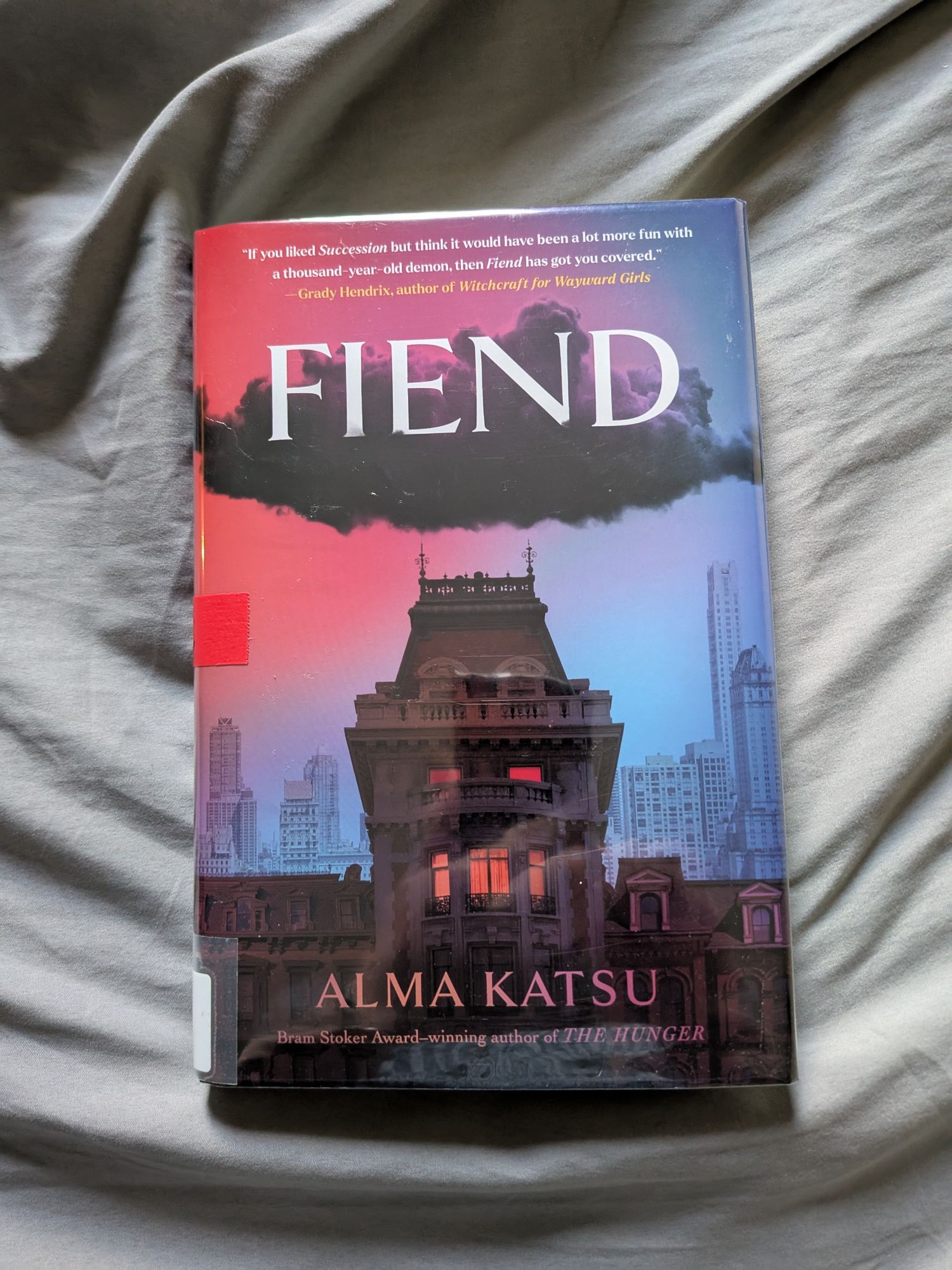
Alma Katsu’s become one of those authors for me that, when I hear they have something new coming out, I immediately want to scoop up a copy and read it. And when I heard that, for the first time, she was releasing a horror novel set in our modern era, I was intrigued. When Fiend finally came out, I immediately went to the library to grab my copy (support your local libraries, kids!) and started reading as soon as I could.
That was about a week ago. I finished the book today. And now, I’m reporting my thoughts.
Set in our modern times and with some flashbacks to the past (which, based on the characters’ ages and context clues, I assume is somewhere between 2004-2015), Fiend follows the Berishas, a powerful family hailing from Albania that rules over a wide business empire. Specifically, it follows the youngest generation of the Berishas: Dardan, an anxious young man being groomed to run the family empire; Maris, who rebels against her father’s patriarchal views and wants to rule while also wanting to please him; and Nora, a wildcard who’s more than she seems. They are well aware that their family, ruled over by the tyrannical Zef, is rumored to be aided by a demon that keeps them rich and untouchable. But after a particular incident, the dominoes start falling. Dominoes that will change the family, and possibly bring down the dynasty, forever.
So, while this book has been marketed or compared to “Succession with a demon” (not sure how accurate that is, having never seen Succession, though I know the basic pitch), I would compare it more with 2015’s The Witch. The focus is on these characters, showing an intimate portrait of a family that is breaking down due to isolation, clashing egos, and external pressures closing in. The demon itself, like the witch in the movie, is just one of the catalysts that hastens the breakdown of the family.
And the way Fiend is written, it is hard to put down or look away. I was breezing through each chapter, just wanting to find out what happened next and how each of these fascinating, unhappy, often terrible people would hurt each other next. We spend the most time with Maris, and you can see Alma Katsu having a ball writing her and showing her trying to achieve what she thinks she wants. After her, we spend the most time with Dardan, who is desperately struggling under the weight of his destiny but too scared to find a way out of it.
My two criticisms are this: one, I would have liked to have spent more time with Nora. As I said, she’s a wildcard who’s more than she seems, and I would’ve liked to get further below the surface than what we got with her. I get why she’s the sibling we spend the least amount of time with, but I still wanted to know her. And two, I honestly wanted to see more interactions with Olga, the Berisha matriarch. She’s mentioned more often than seen, and I think it would have been fascinating to see how she’s weathered being part of this screwy family for most of her adult life.
But beyond that, Fiend is an excellent family drama/horror story. On a scale of 1 to 5, I’m giving it a 4.5. An enthralling deep dive into the world of corporate intrigue and what can occur from generations of abuse and trauma (plus a little demonic magic). If this sounds like it might be up your alley, grab a copy and get ready for one hell of a ride.
No, you didn’t read that wrong. That’s not a misspelling on my part of “Halloween.” That is the name of the novel, and since I heard of it, I’ve wanted to read it. I mean, with a name like that, how could I not? And with the audio book just getting released recently, I decided to give it a listen and see if this would become a new classic for spooky season.
Taking place during the Halloween immediately following the September 11 attacks, several strange things are happening in the small town of Crook’s Corner, Massachusetts. A famous scream queen is kidnapped in town while filming a new horror film. A science teacher is putting together a machine that causes those near it to see strange shapes. A Goth teenager and her little sister use the latter’s psychic abilities to play pranks on their grandmother. All this and more herald the coming of something evil: a cosmic being who wishes to become a god over all humanity. And this Halloween, they may get their chance.
This book was so hard to put down (or should I say put on pause?). The first chapter, where the scream queen is kidnapped, is shocking enough, but then the novel jumps back several hours, showing what the main characters–a group of high schoolers filming a horror movie for a class–are up to. And with those opening chapters, you get several different plot threads and you wonder how they’re all going to wrap up into one neat little package.
Which, much to my delight, they did come together nicely, leading to a harrowing story with a strong atmosphere of dread and tension. In fact, that’s probably the book’s biggest strength: the atmosphere. Once the horror part really gets going in Helloween, it’s just nonstop threat to the characters. Even in the pauses to the horror, there’s so much tension, it’s hard to relax. Add in some of the events in the latter half of the book, and you start to wonder if the characters can even triumph over the great evil.
And that’s the book’s second biggest strength: it’s characters, particularly the antagonist Geth. Geth is an ancient entity who schemes to become a god, and when it–or they, I should say–gets the ball rolling on their plans, you better believe that shit will hit the fan! And the way Geth is written, this alien being who thinks differently than us but plans to become a god over us, just makes them fascinating to follow. Even as you fear their victory due to their overwhelming power and disregard for both human life and human autonomy.
The other characters are great, too. Ralston manages to make almost all of the supporting characters– from kooky science teacher Ernie Combs and the Catholic priest to would have been right at home during the Crusades, to scream queen Darla Knight and the annoying kid who annoys almost all the other characters–feel real and fleshed out. And yes, there are a lot of them, but at no point did I ever feel like I was overwhelmed with the number of characters I encountered in the book.
Of course, our six main characters were no exception. At first glance, they do feel like your typical high school stereotypes: Cody the jock; Britney the popular girl; Jay the computer geek; Walden the film buff; Cassandra the Goth and her sweet little sister Taylor. But early on, we see that they all have deep dimensions to them, and that only grows as we get deeper into the story. Before I knew it, I couldn’t help but root for and love these characters dearly.
All in all, Helloween by Duncan Ralston is scary AF and sure to become a Halloween classic in time. On a scale of 1 to 5, I’m awarding it a 4.8. Consider picking up a copy and adding it to your reading list this spooky season. If you’re a horror fan, you won’t regret it.