Posts Tagged ‘in media res’

The detective arrives at the crime scene and finds the body is nearly identical to another murder. A soldier is walking through a swamp, when they are warned by their sergeant that mines are buried underfoot. The bride leaves her groom at the altar, looking to find herself after years of being told what she should do with her life. The singer comes across Robert Johnson’s guitar, thought to be long lost, and finds there’s more than just history attached to it.

All of these could be the beginning of a story that starts in media res.

Latin for “in the middle of things,” a story that begins in media res is one that starts midway through the plot, rather than at the beginning. And believe it or not, a lot of stories start like this. Hell, you’re probably familiar with most of them. The Star Wars movies arguably all start in media res, as they all start when a conflict is well underway. The novel Gone Girl begins with the protagonist’s wife being discovered missing. Wicked, from novel to musical to movie adaptation (love those last two) always start with the Wicked Witch being a well known figure and with several events implied as having happened and being common knowledge.

That last example brings up something important: how do these stories start in the middle when there’s who knows how much backstory we’ve missed? Often, this is accomplished through dialogue, flashbacks, and exposition. Flashbacks are especially popular, with the majority of Wicked being flashbacks, and the Deadpool films using flashbacks to explain why the film starts off with Wade Wilson getting into some insane shit.

And in horror, in media res is also quite popular. From the classics like Dracula, Frankenstein and Jekyll & Hyde to modern entries like Firestarter and Nightmare on Elm Street. Many of my own stories also start this way: Rose begins with Rose Taggert waking up in a greenhouse with no memory of how she got there or of the past two years, “Queen Alice” begins with my main character Joshua Blumfield already giving his report on the urban legend, and “The Dedication of the High Priestess” begins with Annie Hummel going to a gallery after already serving as a model for three paintings.

Why do horror authors, as well as authors in other genres, begin their stories this way? Well, one thing is the immediate hook. Take Nightmare on Elm Street: it starts with Freddy crafting his claws and then chasing after a teenage girl, only to wake up right on time. We’re immediately left wondering what happened and why, and that keeps our interest.
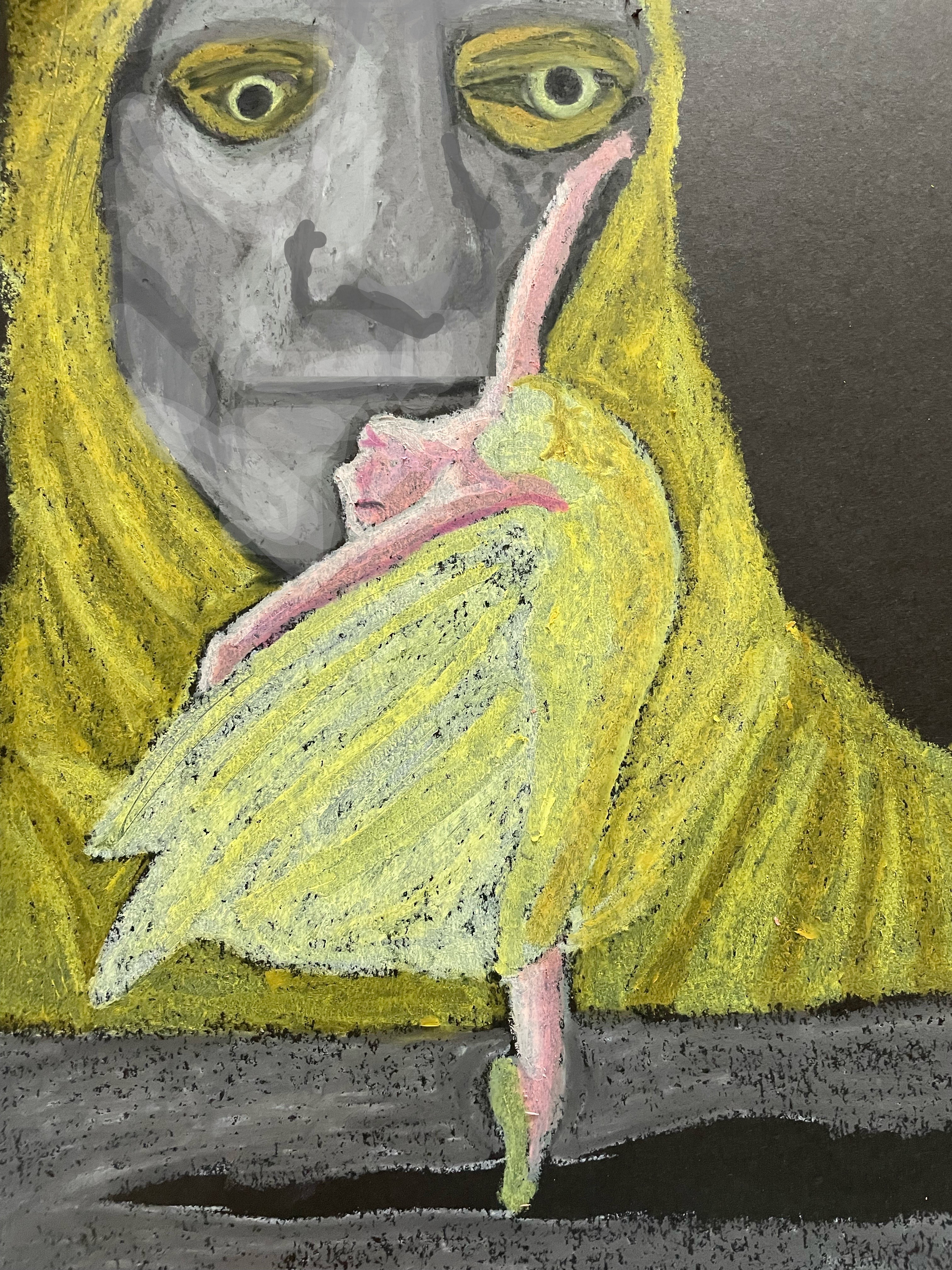
This oil painting by friend and colleague Iseult Murphy is based on “The Dedication of the High Priestess.” The story is an excellent example of a story starting in media res.

It also makes for great suspense. Take Nightmare again: we’ve already witnessed what Freddy’s capable of in the first scene, and so we wonder what else he can do. Would that have happened if we started with Freddy’s first murders and then getting killed by the parents? That opening violence builds up our expectations and keeps us enthralled.

Finally, you manage to get through a lot of exposition writing this way. Take Gone Girl, for example. Gillian Flynn could have started the story with Nick and Amy meeting, getting married, and the fracturing of their relationship before Amy’s disappearance, but would that have been as fun? It’s more interesting and suspenseful to read about the disappearance and then see how their relationship developed.

Another great example would be my story “The Dedication of the High Priestess” (spoilers for a story that came out in 2022). As I said, that story starts with my protagonist Annie already having modeled for a famous artist. She then goes through the gallery, which then causes her to be caught up in the King in Yellow’s plot to come to Earth. I could have started with Annie taking ballet classes, being scouted for the painter’s new series, doing the modeling gigs, and then going to the gallery, but that would have taken a lot of time and pages, and a lot of effort to keep readers interested. Starting with the gallery showing, using dialogue and exposition to explain how we got to this start, and then getting straight to the horror was very effective.

So, there’s a lot of reasons to use in media res to start a story, no matter the genre. It won’t work with all stories (looking at you The Hogfather, Die Hard, and Kill Creek), but if it works with your story, and you can do all the backstory parts without any issue, I see no reason not to use it. After all, I use it all the time. And look at me now!


Thanks for reading, my Followers of Fear. I’m about to start a new story, and it starts so in media res, some readers might need to read the start again. I thought about starting it from earlier in the events of the story, what I would normally reserve for flashbacks or exposition, but it felt like it would take too long and take up too much of a word count. Thinking about it and weighing my options made me want to write this blog post.

And now, if you need me, I’ll be busy writing what may be the most Halloween-y story I’ve written to date. Until next time, good night and pleasant nightmares!

About three years ago, I wrote a post on in media res, a plot device often utilized across various media of fiction. I’d like to revisit the subject, because I’ve had some thoughts on this particular writing tool since then and I wanted to write about them. And since I’m running this blog, talk about it I shall!

So if you’re not familiar with in media res (Latin for “into the middle things”), it’s a plot device in literature where the story opens in the middle of the action, rather than beginning with exposition. Background information is usually filled in through dialogue, flashbacks, or having a nonlinear narrative. An example of a story that starts in media res is Raiders of the Lost Ark: you don’t get a Star Wars screen crawl, or an opening narration, but you just hop into Indy heading into a temple to get a famous statue. Another great example of the usage of the plot device is A Game of Thrones by George RR Martin. No history on the Seven Kingdoms, just getting plopped into a patrol with three brothers of the Night’s Watch, and some Others attacking them.

I’v used this device in a lot of my works. Reborn City starts out with Zahara and her family going out to dinner, with backstory and world-building reserved for Chapter 2. Snake begins in a church, with information being dropped through exposition and flashbacks throughout the book. My short story Travelers of the Loneliest Roads literally starts on the road, and a lot of works that I’m working to get out to you, dear Followers, start out this way.

Overall, I feel it’s a good way to start a story. In fact, it might be my favorite way to start a story. Rather than doing a bunch of backstory, like “Forty years from now, the war on terror spirals into a chaotic Third World War that leads to a bunch of new countries and city-states. In one city-state, Reborn City, which is ruled by the Parthenon Company, there’s a powerful gang called the Hydras. Now onto the story of Zahara Bakur,” we start with Zahara and the events that lead her to becoming a Hydra.

However, in media res has to be done delicately. I realized this as I was editing a short story of mine last night.The story started out with the protagonist running for her life, then flashed back rather quickly to how she ended up running for her life, and then went back to her running her life. I was like, “Why did I think this was a good idea in the first draft?” I actually had to go back and rearrange the story so that everything goes into chronological order. The story moves much better now (though I may nix that beginning part and have it start in the meat of the story. We’ll see after the second draft’s done).

So with that in mind, I thought I’d list some tips to starting a story in media res and doing it well, with the hope other writers might avoid some of my mistakes with this plot device:

  • Make it easy to slide in for the reader. When I first read A Game of Thrones, I had to go over the first chapter twice just to make sure I understood what was happening. After a bit of examination, I understood what was happening a bit better, though I still was a bit confused. Not a good way to introduce me to Westeros, but the rest of the novel made up for that.
    Point is, when starting a story in media res, make sure that all readers, whether they’re expecting one thing or another thing or nothing at all, that they can dive into the story without wondering what the heck they’re reading or if they missed something. You don’t need to be overly-simplistic with your language or story, you just have to make it easy to follow so that readers have a good idea what is happening while they’re reading.
  • Don’t move too quickly into the information. Remember that short story I just mentioned? I had a quick beginning, and then I dived right into a flashback. Made no sense on a second look. Wait for a moment where it won’t throw people off, and then try and make the segue into the flashback make sense.
  • Whatever’s happening has to hook the reader. By definition, in media res starts a story in the middle of the action, so you want to make sure that the first line is catchy. It doesn’t have to start with running for your life, gunfights, or anything like that, but it has to be somewhat catchy. This could be something as ordinary as a girl walking into a classroom with soda in her hair (my own short story, Tigress Lizzy), as long as it’s interesting to read. How you do that depends on language and skill as much as what is happening in the story, though with practice you can get very good at it.

However you want to begin a story, the point is to hook your readers so that they’ll read the rest of the book. In media res is just one way to do that, but it’s a fun way to do it. And with time and experience, you can get better at it. You might even learn a thing or two in mid-edits.

How do you feel about in media res? What tips do you have for doing it well?