As of last night, I’m a little more than halfway through editing Video Rage, the sequel to my first novel Reborn City. It’s been a long and slow process, not helped by work, preparing for the new semester, and the general craziness of life itself. Still, I am making progress. And I have become a bit more cognizant of the fact that I like to make issues that are important to me part of the stories that I write.
I’ve mentioned this before, but RC and its sequel VR have a lot of themes in them that reflect societal problems we face today, including Islamophobia, racism, and drug addiction, among a few others. I thought that these were the only book I’ve written where these issues have become so embedded within the story’s narrative, but then I realized that wasn’t the case. Snake, my other novel, explores the trade in human beings and in flesh, albeit slightly less prominent due to the focus on a certain serial killer. And Laura Horn, the novel I finished last month, stars a main character who suffers from the trauma of sexual assault. Even Rose, the novel I’ll be writing for my thesis, has a lot of themes reflecting issues that I find important, including gender dynamics and women being viewed solely for their biology, domestic abuse in relationships, and even gun violence*.
*Speaking of which, I have a post about that. Remind me to write about it later this week.
I think I write in all these themes into my stories for a number of reasons. One is because a lot of what I write is taken from today’s world. You look around you, and you’ll see the world plagued by many issues that are not easy to solve and nowhere close to being solved. Often I will write a story and the problem can either be inserted into the story or it just evolves its way in, showing up throughout the story. Another reason is that, as an author, I have the potential to influence plenty of people through the words I write and the stories I tell. If I can do some good through that, then why shouldn’t I? Third, sometimes you feel so upset about the problems yourself you can only vent about them through words on paper, which is something I sometimes do. And fourth, because I can.
In any case, I look upon this habit of mine as beneficial. Like I said, inserting issues such as racism, gun violence, LGBT rights or whatever into my stories has the potential to perhaps do some good in the world and allow for discussion that sometimes is stifled out of fear or because of strong emotions (or because being politically correct can make you feel like you’re walking on eggshells). And besides, I think it makes the plots of my stories much better. Rose originally didn’t have the gun violence aspect to it, but when I realized that it could make things in the story more interesting and allow me to flesh out the main character more, I decided to go with it, and with fantastic results too.
And if the reviews I’ve gotten on my books are any indication, people like my books better because I add in these issues.
Do you insert issues important to you in your stories? What issues and how do you put them in? What have the reactions been like?
I know I’m a little late to this conversation (though I did post a lengthy message on my Facebook page when it first happened) and I would’ve written a blog post about this sooner, but I’ve been busy with other work. Well, better late than never. Besides, Jon Stewart managed to make some jokes on it last night, so I can do it tonight.
There used to be a time when religious liberty meant that you could go to church ro synagogue in peace and without fear of ridicule or attack. Where your religion didn’t bar you from certain neighborhoods or trades. Where you didn’t have to wear a yellow star, and you didn’t suddenly have to leave country or convert in order to avoid death and suffering.
When the hell did it change that a couple of people could make decisions about the health of thousands of women?
As noted above, a lot has already been said about the Hobby Lobby case. However, I’m going to go over it because I find the majority ruling of the Supreme Court simply infuriating.
First off, Hobby Lobby says that it doesn’t want the federal government to force them to hand women employees birth control. Um, the people who will be handing birth control over will be the pharmacist. The insurance company your company uses will actually be paying for it, drawing on the money every employee puts into the company insurance policy to pay for the birth control. So basically everyone who’s on Hobby Lobby’s health insurance policy would be paying for the birth control. The fact that only a few people at the top can decide what everyone is paying for in their health insurance worries me somewhat.
Second, the owners of Hobby Lobby are objecting to contraceptive pills that “cause abortion”. Most fertilized eggs actually self-abort and don’t embed themselves in the uterine wall, so maybe you want to protest whatever mechanism causes that? Also, the pills that “cause abortion” actually a bit of a mystery, as scientists aren’t sure how they prevent pregnancies. So maybe you might want to figure that out before you start a lawsuit? Especially since you still cover Viagra and vasectomies, the latter of which basically makes the testicles useless and gives seed nowhere to go to procreate. I think the Biblical term for that is “spilling seed”.
Continuing on with this, I’m not so sure Hobby Lobby actually objects to birth control pills, as some of the companies, trust funds, and other financial mechanisms its owners have fingers in actually hold stakes in pharmaceutical companies that produce these very pills that are being protested. Is it really protesting on religious grounds to provide abortion pills? Or is it something about not having to pay for a product you already own?
And I’m really worried about this decision, which opens up some serious floodgates for lawsuits. The term “closely-held corporation” is a pretty loose definition. Already we’ve seen evangelical colleges asking to be exempt, and other companies as well that one wouldn’t normally think of as “closely-held companies”. Under the loose definition though, they might.
And if religious liberty can be used as an excuse to get out of covering contraception or other “objectionable” medical practices, what’s next? Catholics are against all forms of contraception. Jehovah’s Witnesses are against blood transfusions. Scientologists are against psychiatry. Christian Scientists generally don’t like traditional medicine. And what about objecting to other things based on religious belief? Other laws? What if a family bakery that got incorporated decides not to make a wedding cake for a gay couple because they believe it’s a decadent lifestyle? What if a print shop refuses to print flyers for an event hosted by the local Wiccan community because they won’t “help witches and Satanists”? As Justice Ginsburg said in her dissent, it’s a slippery slope.
All in all, I’m really troubled by the implications of this decision, besides the fact that a few people, mostly older white men, are getting away with making medical decisions for thousands and thousands of women and thinking that is okay. It’s already hard enough to purchase safe, affordable birth control, and some people need the help of an insurance company to afford it. Some of these women aren’t even taking birth control medications to avoid getting pregnant! Birth control medication is good for regulating menstrual cycles, prevent endometriosis, reduce the pain of cramps or migraines, and even fight acne! Most women actually take the pill for multiple reasons, studies find.
And they can’t just go looking for another job that offers birth control on the insurance plan. Some women can’t afford to leave a job because it’s all they have. The job market is still rather difficult these days, and leaving a job to look for one that might offer the right insurance isn’t exactly like walking through a park. In fact, it could lead some families to financial ruin.
Now that I think about it, most of the women who will be most affected by this decision will be women in the lower-middle, working, and poverty-stricken classes. Meanwhile, the rich can still easily afford birth control should they desire it, or own the companies that produce birth control. This si not just starting to resemble a new battle in the war on women, but also a form of class warfare and keeping the lower classes in their place. And I’m sure I’m not the only person who’s thought this.
What say you on the Hobby Lobby case? Where do you see this going in terms of consequences?
(Be aware I will be screening comments. So if I get the kind of comments from people who can’t bear any opinion but their own, it won’t show up on this blog)
I’m going to tell everyone a midrash, a story that helps to explain aspects of Judaism, and which may or may not be true, depending on the story. This story, no matter how you look at it, is very interesting and helps to explain why I’m able to give these reinterpretations.
The story dates back to the writing of the Talmud. Several rabbis were trying to decide on an issue of kashrut, or dietary law. Eventually all the rabbis except one decided a certain way on the issue, with the remaining rabbi insisting he alone was right. This rabbi, who was apparently so learned that he could teach Harry Potter a thing or two (my own phrasing, not the story’s), said that if he was right, then the walls in the study house would cave in, a tree would move from one place to another, and that the river outside would flow backwards. Sure enough, the walls started to lean in, a tree walked across the ground, and the river started flowing backwards. With each occurrence the other rabbis would remind the rebellious rabbi that walls, trees, and rivers don’t decide matters of Jewish law (and they chided the walls for trying to bring themselves down when it wasn’t their conflict). Finally the rebellious rabbi said, “If I am right, let a heavenly voice confirm it!”
At that moment a great voice from above was heard saying, “Follow this rabbi’s opinion!” The other rabbis, instead of cowering and giving in, replied to the voice, “Matters of law are now on Earth, not in Heaven.” The heavenly voice replied, “My sons have bested me.”
What does this tale tell, besides the fact that apparently Talmudic rabbis were said to be quite powerful? Besides the teaching that a majority rule is stronger than a single zealot (and the rebellious rabbi later became a heretic and was excommunicated, interestingly enough), the story shows that once God gave the Jewish people the Torah at Mt. Sinai, it was in their hands, and therefore they had to decide how to interpret it. So basically while some may claim that LGBT people and their allies are going to hell and claim the Bible says so, I can claim just as much that that law no longer applies and that LGBT people and their allies are just as holy as anyone else. And guess what? We can both be right!
I tell this story because a lot of people’s arguments and opposition to LGBT rights are based on a singular interpretation of the Bible, so alternative interpretations of the Bible can be just as legitimate as traditional ones. I also tell this story because, while two opinions can both be right, sometimes one opinion may have more reason to be right than the other (as in the ruling of the majority in the story). For example, I can say that I believe both evolution and the Genesis story to be right. I can’t ignore that dinosaurs, the fossil record, and the distance travelled by the light of certain stars make evolution seem more right than Genesis (which I tend to view as a metaphor for the Big Bang and evolution that humanity is too stupid to understand at this point in our existence).
No denying it: gay people are born that way. It’s in their DNA.
Understanding this, let us look at what science has proven: that sexuality is a genetic trait, and that multiple genes make up sexuality, so multiple sexualities arise. Some people, like a pastor I had the displeasure of hearing speak out on the Oval at OSU this spring, claims that meant homosexuality is a genetic defect. But that would mean there would have to be a loss or impairment of quality of life for the affected. If anything, the scientific method has shown through studies that people who are open about their sexuality and accepted for it tend to live happier lives. It’s only when they try to deny, change, or hide their sexuality that there is some impairment.
Likewise, this also means that homosexuality isn’t a lifestyle, or something you can indoctrinate youth into. As I said, differing sexualities are genetic, and you can’t pray away, condition someone, or ban something so caught up in the very DNA in a person.
Now, some might ask about my previous post, where I said that homosexuality was commonplace in Greece in a ritualized form. I say that was a form of cultural homosexuality. It was done because it was part of the culture, everyone was doing it, and nobody could see any reason not to do it. Plus, having a male lover was a choice, not a requirement. You could almost compare it to video games: everyone seems to play video games these days, and most people don’t see a reason not to play them if you can. (I know that we’re talking about two very different things here, but you get the idea, right?)
In any case, I’ve said what I wanted to say about the Bible, religion, and homosexuality before Pride weekend here in Columbus. I hope you enjoyed the posts I’ve written and perhaps were given some food for thought. And if you’re in the Columbus area this weekend and are looking for some fun, come to Pride. Leave the picketing signs at home, and have a blast. I’ll see you there.
With the Columbus Pride Festival coming up this weekend, LGBT people from around the country (including George Takei as Grand Marshal for events this year) will be descending upon Columbus for a huge parade and festival to celebrate their sexual orientations, fight discrimination and injustice, and to push for same-sex marriage in Ohio, which is on the ballot this year. It’s sure to be a great time for many.
For some though, the Pride Festival will not be so welcome, and while Columbus may be one of the Midwest’s LGBT hotspots, there is the very real chance that protesters will show up and decry what they see as perversion, sin a horrible lifestyle, or some sort of disease/genetic defect/psychological disorder. Usually I ignore these sorts of people, but I figured that since I’ll most likely be attending the Pride Festival this year (my first), I thought it would be interesting to do a post on these protestors, most of whom have a Biblical basis for why they’re opposed to homosexuality, and show how the Bible could actually endorse homosexuality rather than outright ban it.
Before I do though, I wanted to post this video I found, which I think is very eye-opening, and gives some very good points on the Bible and homosexuality:
Interesting, isn’t it? And that thing about Sodom and Gomorrah mirrors pretty closely what I learned growing up about why those cities were destroyed. In fact, I remember a pretty graphic tale about how two girls met at a well, one realized the other’s family was very poor and gave her some flour for her family. When the town elders heard about it, they basically took the first girl and stoned her in public (I’m not sure what happened to the second girl, but she probably came away from that emotionally scarred and still hungry, if not dead). And if you want to know more about that book they talked about in the video, here’s a TIME magazine article on it.
I would like to add some points on to these, based on my own upbringing, experience, and understanding of the Old Testament (I’m not very familiar with the New Testament of course, being Jewish). First, that famous verse in Leviticus that anti-gay pastors love to quote, “Thou shall not sleep with a man as thou sleeps with a woman”. First off, what can women do? Second, this sounds like a prohibition against homosexuality, but it could have other meanings.
Of course, there’s the anatomical one: men can’t sleep with other men like they can with women, because men don’t have vaginas. But I’m pretty sure that argument, although obvious, won’t sway many people, so here’s two more that might. Firstly, there’s the patriarchal argument: women in the days when the Bible was written were expected to attend to their husband’s sexual needs, and most likely that meant they had no say in it unless they were impure and couldn’t have sex anyway. In an age where men were expected to be dominant in all matters, especially in the home, forcing one man to attend to another man’s sexual needs at the latter’s beck and call would be considered the ultimate emasculation, so therefore sex between men was forbidden.
The other reason (and the one I feel makes the most sense), is based on pagan idol worship. Many Near East and Mediterranean societies practiced homosexuality, not as a distinct orientation, but as an activity. The Greeks were famous for having relationships between other males before marriage, and there were other societies at the time that had cultures that permitted men to have relationships with each other before or after marriage. Some of these relationships were especially prevalent in military circles to increase unit cohesion, and a few were ritualized in the form of idol worship. God would have seen this latter act, worship of idols through sexual intercourse, as detestable, so He created a form of worship and sacrifice that did not involve sex, and forbade a form of sex that does not lead to procreation, as well as because it was used in idol worship.
There’s a pretty big difference between this and emasculation or idol worship, wouldn’t you say?
Since today there is no idol worship through sex (as far as I know), it would be permissible for same-sex relations to occur. Besides, these interpretations deal with a form of emasculation or idol worship. They do not apply to men, women, or other gender-types who are in loving, committed relationships like we see today.
There are other factors to consider here as well. For example, there is the belief that marriage should be as it is in the Bible. If that’s the case though, why do we outlaw polygamy and women can choose who they marry? Not to mention the definition of marriage and marriage roles have changed throughout the years, so it’s no surprise that it’s being changed in our day and age and “pro-marriage” activists shouldn’t be alarmed. And even if not always legally accepted or endorsed by religious establishments, same-sex relationships have been taking place for many, many years. There have been relationships between high-ranking clergymen and other men since the early days of the Church, but it was tolerated because of fear of worse sins, ones that at the time that were considered venereal.
Even during waves of religious upheaval, reformation, or resurgence, same-sex relationships flourished: Queen Elizabeth may have been a lesbian, and several members of her court were gay and able to get away with it due to their status. King James–of the Bible translation–actually had several relationships with men as well as women. And recently there was an article from The Boston Globe about two women who lived together and were treated as married…in 1807! So even if it’s not exactly legal, same-sex marriage is not exactly as new as cell phones.
This post is getting very long, so I’m going to continue this discussion in another one. I hope some of you who read this post found it informative and may have given you some food for thought. I don’t think it’ll sway anyone who’ll protest at Pride this weekend, but it may sway some people who are undecided on the issue. Or that it may prove helpful for those who want to try to reconcile homosexuality with religion.
Oh, and before you wonder what sort of religious authority I am, I can only say that I’m the son of two Conservative rabbis, I went to a Jewish day school from Grades 4-12, I’ve gone to synagogue for most of my life, and I still learn and keep in touch with my religion. So I may not be a rabbi or pastor, but I’ve done as much studying as some, and more than some others. I guess I can speak with some authority on these matters. What do you say?
*I will be screening the comments for offensive, inappropriate, or just plain rude comments. Be warned.*
It’s been a week since I decided to come out of the closet and reveal my sexuality. I’m happy to say that the response has been overwhelmingly positive. I’ve heard people tell me that they are proud of me for coming out, others have told me as long as I’m happy they don’t care. One friend said that while she found it incredible that we lived in a world where people had to make a big announcement in order to come out, but wished me luck nonetheless.
But I think my favorite reaction has been that of my close friends at school. They all saw my post on Facebook and gave it a Like (I can’t be sure, I got over 60 Likes on that one post), and when I saw them the next day in classes they just didn’t say a word. They didn’t need to. They just smiled, asked me how I was doing, and then we got to talking about the usual stuff. In a way, I think that’s what all LGBT people and those who support them wish for: a day when sexuality isn’t something that one has to hide or reveal. It’s just something that’s part of a person.
Now that I’ve come out though, I think I’ll be a bit more active in defending gay rights on my blog. A couple of gun-rights advocates had turned me off political issues for a while, but I think it’s time I resume ranting on what I feel matters, especially for gay rights. So get ready for a whole storm of political issues in between my updates on writing and school and my musings on writing and horror.
This year in Ohio, same-sex marriage is on the ballot. As someone who supports LGBT rights, I’m throwing my support in for anyone who wants to marry someone regardless of their sex. It’s only just right.
But besides that, there’s something else I want to share with you all. I’m bisexual. I’ve been bisexual for nearly 21 years (though I’ve only just recently realized it) and I’ll be bisexual for the rest of my life. And there is absolutely nothing wrong with that.
For those of you who aren’t very well-versed in bisexuality (or in the LGBT community at all, for that matter), this only means that I am attracted to men as well as women. I don’t really have a preference or a set type. All I care about is that I’m happy with the person I’m with and if they’re happy with me. I’m not confused or unsure of which one I really like, as some–even members of the LGBT community–might think. I also am not confused, living a horrid lifestyle, or have the Devil whispering in my ear (I think he’d rather whisper in the ears of Assad or Putin than in mine). It’s a biological trait based on a combination of several genes, and there could be a good argument that it runs in my family.
Also, I’m not oversexed or always looking at guys and girls in a sexual way. If I’m oversexed it’s because I’m a healthy young man in college, and we’re all oversexed to some degree. Also, don’t flatter yourself. I don’t look at every person hoping and praying for a hook-up, including you. I’m not even sure what my type is, so don’t assume you’re it. And I’m also not looking to molest kids or brainwash kids. The monsters who molest kids are only looking for power over victims or because they can’t rise to the occasion (so to speak) with adults, so they target kids. And you can’t brainwash kids to be LGBT: like I said before, it’s genetic. If you’re kid is LGBT, it’s because they were that way at conception. And the more you try to prove me wrong or pray away the gay or whatever, the more you’ll find I’m right.
And the LGBT community is not a cabal or a bunch of bullies. If there’s a cabal, gay marriage would already be legal in every nation on earth and anti-gay rhetoric would result in prison sentences. Also, calling us bullies is saying that a small minority, maybe 10-20% of the population at the most, is more powerful than the heterosexual majority and is able to beat up straight people on the streets. I really don’t think that’s the reality. Do you?
I also don’t let my sexuality define me. I’m not that kid from Glee who everybody identifies as “the gay guy” or “the gay guy with the really high voice”. I identify more with the fact that I’m a horror writer or that I’m Jewish than I do with my sexuality. So if you start calling me “the bisexual horror writer”, I’ll counter that with “I’m a writer that just happens to be attracted to both men and women.” And most people wouldn’t realize my sexuality if they looked at me. They might realize I’m eccentric or not your ordinary college student. But my sexuality? I’d need to reveal it or be detected by an actual gaydar for people to realize it.
How did this post become a testimony for the fallacies with most anti-gay arguments and how people should treat me? I’m not sure, but I want to say that I’m happy to let people know finally about who I am and not have to keep it to myself like a disgusting burp. It’s just who I am, like my being a writer or Jewish or that I can make a conversation amusing and strange with just one sentence. Just one part of being me.
And if you don’t like what I am, if you believe differently about my sexuality, then that’s your choice. Just don’t leave hateful comments or try to tell me I can be cured or that I’m going to Hell. I don’t even believe in Hell! Judaism has no set definition of the afterlife. We’re more likely to be plagued by acid reflux than by an afterlife of fire and brimstone for our transgressions, and I’m already on antacids. But if you want to try to change me or make me feel bad for being who I am, then I don’t think we should associate too much, online or offline.
Finally, I would like to close this post with a big, hearty thank you for all of you who’ve supported me and continue to support me. The love I’ve received and the acceptance of who I am is overwhelming, and I’m happy to be surrounded by so many understanding and loving people. It’s great to be who I am and not punished for it. So I bid you adieu till next time, my Followers of Fear (which might be later today, who knows?). And let me say to all those who are suffering from bigotry, it gets better. Don’t despair, because there are so many people like you and we all love you regardless of who you’re attracted to. All you have to do is reach out, and we’ll be there for you.
In the meantime, please enjoy this awesome video: Same Love by Macklemore and Ryan Lewis. It repeats a lot of what I’ve been saying here, and it is an anthem of love, truth, and hope for so many people out there. Please watch it with me. Thank you.
I do not tolerate negative language meant to denigrate a person because of their race, gender, orientation, or ability. So when I see someone using this sort of language flippantly or carelessly, I usually tend to avoid that person. If they’re a friend though, I’ll try to convince them not to use that language before I cut them off.
Last night I was forced to do just that. Someone I’m acquainted with at school was responding to people lamenting about Facebook buying some app or another. He thought it was hypocritical that they were complaining about it on Facebook and said they should reevaluate their lives (though he didn’t phrase it in such nice terms). Where I got upset was when he used the word “retard”. I’ve mentioned before that I have an autism spectrum disorder and I’d been called “retard” or “retarded” more than once by bullies because I didn’t understand certain social boundaries or conventions when I was younger. Not to mention that mental retardation (or intellectual disabilities, which seems to be the preferred term among medical professionals these days) is an actual medical condition, so using it as an insult hurts the people with actual mental retardation worse than it hurts the people having the insult hurled at them.
I asked my friend if he would not use that word because it has the potential to hurt people. He responded that he was using the word without negative connotations and that people should realize that (as if we’re mind-readers!). He also said he uses racial and other denigrating terms, including the N-word, and said he uses them without the negative connotations and that it’s my problem if I was insulted by it.
At that moment another friend of his, whom I’m acquainted with as well, joined the thread and started using the very same terms we’d just been discussing. At that point I decided to leave the conversation, unfriend the both of them, and go to bed (though not before coming up with an idea for a short story based on this experience). And it’s still on my mind, as this blog post makes evident.
The thing is, even if they think they’re not using the words with their negative connotations, it’s not so easy to disassociate a word or symbol from its negative meanings. Otherwise the swastika would still mean good luck and auspiciousness rather than Nazi Germany and the Holocaust as it does for many Westerners. And these sort of microaggressions can have terrible effects on the people being denigrated. If you’ve never heard the term “microaggression” before, there’s a great blog post on microaggressions that explains them in depth. If you don’t have the time to read it though, a microaggression is basically the everyday little forms of discrimination that minorities experience throughout their lives. An example is the continued use of saying “that’s so gay” as a way of saying something’s stupid. It is not only bringing down whatever is being called gay, but it is saying that there is something wrong with being gay in the first place. And while the basic definition of microaggressions means they are small, especially when compared to gay-bashings or other forms of assault and more obvious forms of discrimination, over time they can build up and cause stress, depression, or suicidal thoughts in the person being denigrated.
Personally I only ever use these sort of terms in stories in order to portray a character the way I want him or her to come across to an audience. Even then I hesitate to do it and seriously consider whether I should really use such negative terms and if there is another way to get across the full impression of the character. That’s why within all of Reborn City, a novel about gangs divided mostly on racial lines and with a white supremacist gang, you’ll only see one instance where I use the N-word and other racial terms (though I do have several characters call Zahara a “terrorist” in order to illustrate how ignorant and prejudiced the world of RC is against Muslims).
So when I see people using these sort of terms so flippantly, uncaring about the negative consequences of these words, I get pretty upset. These terms are attacks on people because they’re minorities, and because my former friends are white or deeply tanned and don’t receive discrimination for their skin color, gender, sexual orientation, or level of ability, they don’t necessarily realize the damage they’re doing by using these terms. And by calling the rest of us oversensitive for being upset that they’re using these words, they’re proving that they’re insensitive to the problems of others, not that we’re oversensitive.
So I finish this post urging people to really think about the terms they use. You’re not being cool or rebellious by using terms that bring down minorities. What you’re doing is hurting people and causing people to think you’re ignorant or bigoted. If you’re going to use them, use them in a way that won’t hurt anyone, such as using the N-word in Huckleberry Finn is used to illustrate the beliefs of that age towards African-Americans. Or these words can be used to fight discrimination: there is a growing body of literature, music and other media that uses these words to show how hurtful they are and possibly change the way people think. Slowly but surely, some people are changing the way that they think.
That is all for now. I hope my former friends learn that using these words has negative consequences. Especially the guy who actually happens to own an up-and-coming business. How many businesses have failed because of something the owner has done? I hope that doesn’t happen to him someday.
In a stunning reversal of traditional Catholic policy, Pope Francis I took a more positive approach to homosexuality than his predecessor, Pope Benedict XVI. While speaking with journalists on the plane ride back to Rome, the Pope was asked how he would react if he were to learn that there was a cleric in his ranks who was gay but not sexually active. His reply: “Who am I to judge a gay person of goodwill who seeks the Lord? You can’t marginalize these people.”
God bless the Pope!
I’ve always been a little wary of the Catholic Church as an entity, though I know and I am friendly with regular Catholics. There’s a deep-rooted history of animosity between the Church and Judaism, exacerbated over recent years when Holocaust-denying clergy were allowed to continue practicing in positions of power. That, plus their views on LGBT and women’s rights, mixed with pedophilia scandals have really made me and other people, if not detractors, then angry with it.
But with the election of Pope Francis, who sets out to be a reformer of the Church like his namesake St. Francis, I have had some new thoughts. This pope seems much more down-to-Earth and of the people, and he’s already instituted a number of reforms in Church policy. This latest change really makes me happy. Not only does it signal a possible change in the Church’s policy towards the LGBT community–which has regarded homosexuality as a disorder, and in recent years barred gay clerics from practicing–but it also signals a change for the Pope, who as a cardinal wrote a few papers condemning people who were LGBT.
If this is an indication of which direction the Pope might go in terms of the Vatican’s relationship with the LGBT community, it could signal a major change around the world. In several nations, from Iran and Russia to Uganda and Zimbabwe, there are laws in place or in process that would seek to rob the LGBT community of their human rights, and in countries where laws support the LGBT community, such as England, France, and certain areas of the United States, there is still an uphill battle to give the LGBT community the same rights as their straight neighbors. If the Pope’s statement signals a reversal in policy, several countries may face a rise in support for the rights of LGBTers.
And another thing that I’ve noticed is that the Pope said “You can’t exclude these people.” While I do note that calling an entire community that spans the globe “these people” sounds a little exclusionary in itself, to me the greater message sends out more powerful vibes. For years, exclusion of those unlike yourself or the main part of a group has been a too-widely accepted policy. It was believed that if you excluded someone unlike yourself–because of race, gender, religion, sexual orientation, ethnicity, etc.–they would either change their ways, learn their place, or go away. But nowadays most people don’t bow so easily to the majority, and everyone from women to gays to Hispanics to everyone in between is speaking up for their rights, and it is working for the most part.
Something like this in the future would be nice.
If the Church is going to end its exclusionary policies, then that could lead to better relations between them and gays, particularly those who want a relationship with God and the Church. And it also shows that those who want to exclude gays from society or outright ban them may have lost a powerful ally in the Church. Which if you ask me, can only be a good thing.
I look forward to seeing where the Pope goes with this. Hopefully it’ll lead to more pro-gay reforms in the Church policy, making Catholicism and possibly Christianity in general more accepting to the LGBT community, and to people in general.
In the meantime, I’d like to say a prayer from Judaism that is said when something that hasn’t happened before happens for the first time: Baruch atah Hashem, Elocheinu Melech Ha’olam, Shehechianu v’kiamanu v’higi’anu lazman hazeh. Blessed are You, Lord Our God, Ruler of the Universe, who has granted us life, sustained us, and enabled us to reach this occasion.
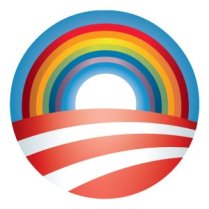
President Obama’s campaign logo with a rainbow added in. If that doesn’t signify support of gay rights, I don’t know what does.
Well, it’s official folks: President Barack Obama has fully endorsed gay marriage (correct me if I’m wrong, but I’m pretty sure he’s the first US president in history to do so). Can I just say, Hallelujah! As someone who has gay family members and who believes all people should be treated fairly and not discriminated against just because of something in their genetics, I think this has been long overdue, but hey, better late than never. Who knew that all it would take to get him to say “yes” to gay marriage and gay rights was Joe Biden saying he felt “comfortable” with people of the same sex getting married?
We’ve come a long way in the past two decades, longer than I’ve been around actually, on the subject of gay rights. In just a few short years, most Americans are supportive of the LGBT community, and as time goes on I think this support is only going to increase, while voices who oppose LGBTers will be marginalized in society. So to President Obama, thanks for finally giving the LGBT community your support. And to anyone reading this post who is LGBT or knows someone who is, let’s continue to fight for the rights of gays, lesbians, bisexuals, and transgenders everywhere until their rights can no longer be denied across the nation.
Oh, speaking of gay marriage, I just remembered something: tonight, there’s a new episode of Law & Order: SVU involving attacks on gays, and somehow Detective Fin Tutuola’s son, who is openly gay and supposed to be getting married, ties into it. Talk about great timing, huh?


 Rami Ungar The Writer