Posts Tagged ‘hypnosis’

Hurricane Debby. She made things very crazy.

You know how, when people go down to Florida during spring or summer break, they have all these wild stories to tell? Odd mishaps, hilarious misadventures, fascinating tales of self-discovery? Yeah, I never had any of those. When I was growing up, the few times I visited Florida was with family. And when I got old enough to go on spring or summer trips, I worked and stayed home because I couldn’t afford the trips. And when I could afford them, I had other things that required my attention.

So, when I learned I was going to be attending a conference related to my day job in Florida with several of my coworkers, I hoped I’d get something I could call my wild Florida story.

Hoo-boy, did I get what I wished for! Because, as I’m sure many of you know, we had a hurricane last week. Hurricane Debby. And she caused the conference to be canceled…while some of us were already in the air.

Yeah, I’m not kidding. Me and about four other coworkers, including my boss, were up at the crack of dawn to get on the plane and head to Florida. And when we got off the plane, about half an hour later than expected due to the rainy weather, and then my coworker Charlotte tells us all, “Hey, I just got an email from Headquarters. The conference is canceled!”

Well, you can imagine how upset and confused we were about that. Here we are, already in Florida, and the reason we paid company money to get here is now up in smoke! In the end, we confirmed our hotel rooms hadn’t been canceled and made our way to the hotel. After that, it was decided that we would all just spend the week working from Florida and try to get home when we could. Worst case scenario, we’d go home on the days we were originally scheduled to.

So yeah, that was pretty wild. But it gets wilder. You see, the hotel we were staying at is attached to a mall (begin Googling now to figure out which one we stayed at). And in that mall, there’s a tattoo parlor. And I went into that tattoo parlor. And when I came out, I had….a tattoo!
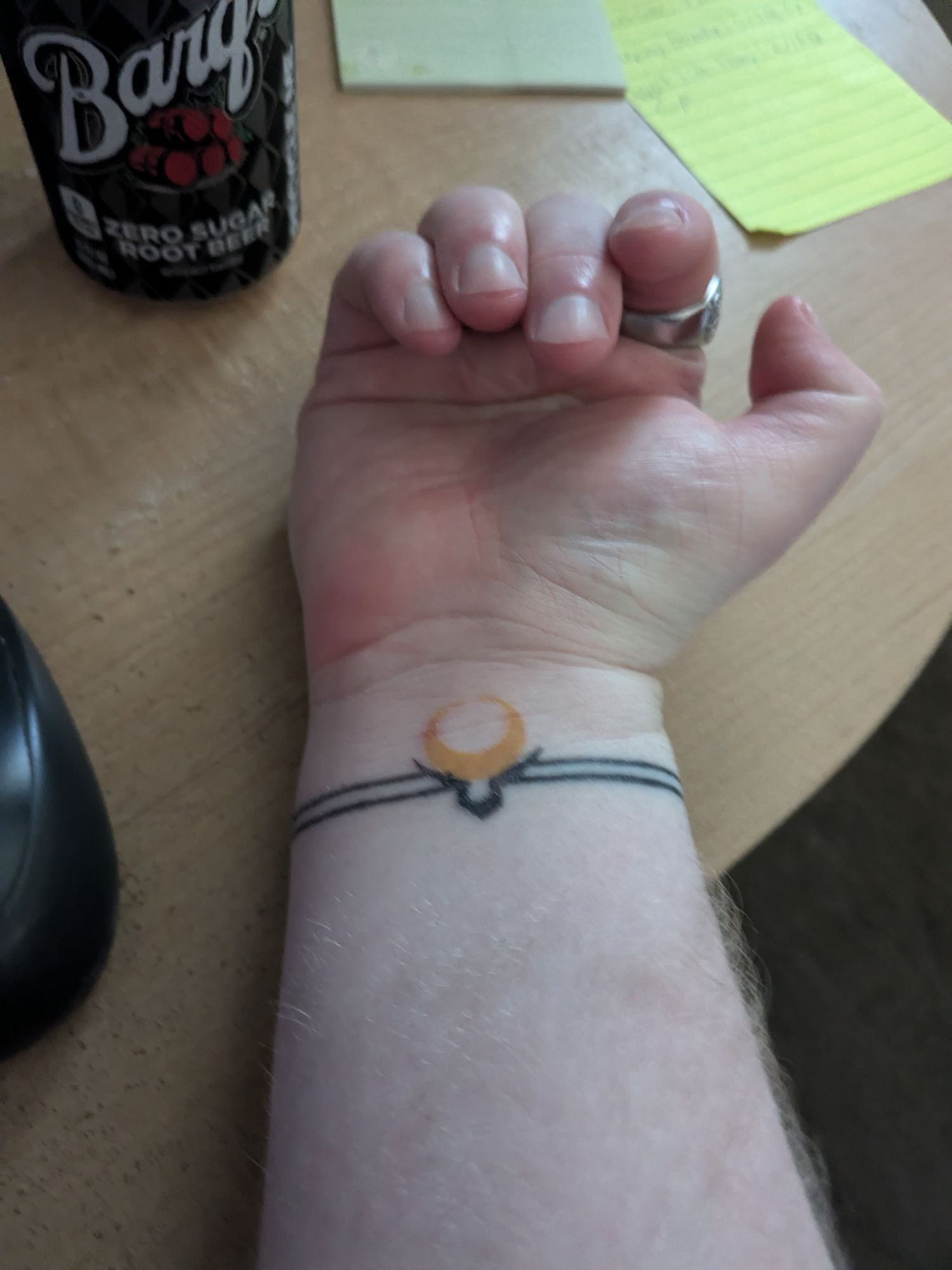
A pick of my tattoo taken on my desk at home.

Yeah, bet you didn’t see that coming. Still, going to Florida and returning with a tattoo from a local shop does feel like something that would happen on a wild Florida trip. And I’m quite satisfied with the result. The two symbols are from two anime I’m quite fond of, with two bands around my wrist like a bracelet.

And don’t worry, my workplace is generally tolerant of tattoos, depending on the placement and what they’re depicting.

After all that, my week was generally calm. During the days, we would work from our hotel rooms, and I think we all got a ton done from our hotel rooms (I know I did). In the evenings, we mostly stuck around the hotel, since only one of us had a rental car and rideshares are expensive. However, we did go out on Wednesday to a buffet restaurant that served Mexican and Chinese food for some reason. That was fun.

We also spent some time in the mall, which once you ignore the pounding noise and ton of people, could be fun. My favorite part of the mall was the revolving sushi bar, where you were able to grab sushi from a conveyer belt. If you haven’t tried that, it is a blast! See if any are in your area! In addition, there was a bar that served frozen cocktails. Let’s just say I had more than one of those during the week (though always on my own time).

Of course, it wasn’t all finishing work assignments and spiked slushies. For one thing, I found six ants over the course of the week in areas they shouldn’t be (AKA indoors with me!). Those ants are no longer among the living, believe me. And on Thursday, I helped one of my coworkers, who was nervous about flying the next day, with some hypnosis. And she even let me film it and post it to YouTube, which you can watch below! (I recommend putting in your earbuds and turning the volume up for this video.)

After that, it was pretty quiet. I had my last night in Florida, and then I flew home.

So yeah, I got my wild Florida story. Maybe, at 31, I got it a bit later than other people do, but damn, was it fun and unpredictable and I got some souvenirs out of it (including the utterly creepy tee from the mall’s Hot Topic that I’m wearing below). Whether or I not get a story out of any of it, I don’t know (though the idea of a Florida trip gone wrong is fertile ground for a horror story).
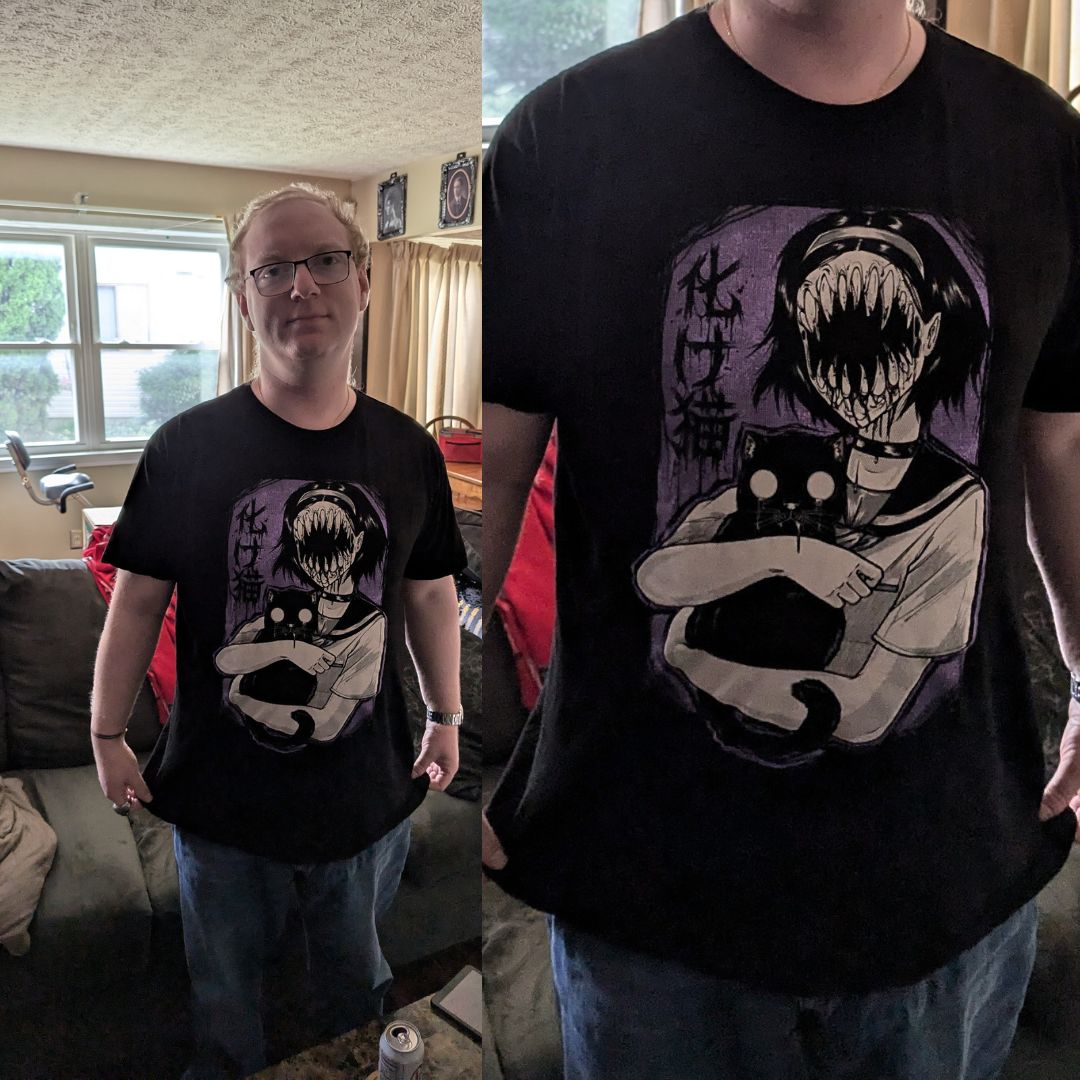
Terrifying tee, isn’t it?

But now, I’m home, and I’m enjoying being here for a good, long while.

And maybe it’s just me, but I think things are going to work out for me over the coming weeks. Here’s hoping that actually happens.

And in the meantime, until next time, good night and pleasant nightmares, my Followers of Fear.

The editing process can take a toll on authors’ mental health, no matter their experience.

As I’ve mentioned more than once (especially during the past few weeks), the publishing process for Rose was something of a roller coaster for me. At least, it was on the mental health scene. There were days and weeks I was feeling on top of the world, and then there were weeks where I was freaking out and wondering how the hell I would ever get this novel into a state fit for publishing.

It’s been nearly three years since Rose was released, and I’m older, wiser, and I want to say calmer. However, I know that roller coaster could start up again during the editing process of Hannah and Other Stories, so I’m writing this post. Both as a reminder to myself, and to help anyone who might go through something similar with their own upcoming books.

Here’s are some tips for getting through the editing of publishing of your upcoming book and the mental health rollercoaster that it is.

First off, remember that this is natural. There’s nothing wrong with you, you shouldn’t be expected to stay happy because you’ve got a book coming out (whether it’s your first or your 247th), and every author goes through difficult periods in life. We have human brains, and those brains, while being the most advanced supercomputers on Earth, have some quirks built in. Our neurochemicals don’t always act naturally, and life can upset those chemicals as much as genetics. So if you’re having a bad period, don’t heap further stress on yourself by being upset with yourself. Just remember that this will pass and good periods will happen as well.

Our brains. Great supercomputers, but they aren’t perfect. So these feelings are natural.

That being said, if your feelings become too much or last for prolonged periods, consult a licensed doctor/psychiatrist/therapist. They may be able to help you with medication, the talking cure, and strategies for coping with those wacky neurochemicals.

And that brings me to my next point: have a support network and coping methods in place if you can. I know everyone’s circumstances are different, but it really helps to have someone to talk to or multiple people who can come together when you’re feeling down. Having those people who will stand by you and help take your mind off of the craziness of the publishing process can make things all the more bearable.

Not to mention those coping strategies. Taking some time for self-care when you need it improves things immensely. I already have Sailor Moon DVDs awaiting me in my room and ice cream in the fridge. Those are my comfort foods and anime, and they got me through more than a few crazy nights. Not to mention that methods such as hypnosis and meditation, going for a run or dancing, a nice drive, a good book and so many other things, can really help when your mental health starts to spiral.

That being said, certain coping mechanisms should only be done sparingly. For example, I tend to eat more sugary foods and drink alcohol when I’m under stress. Not the healthiest way to deal with my feelings, so I have to be careful not to do it too much.

Okay, now that we’ve gone over the self-care stuff, here are some practical tips when it comes to the editing and publishing of the book:

  • Edit in chunks or manageable blocks. This is something BSC Publishing Group, which is publishing Hannah, is doing with their clients. Rather than sending notes for the entire book all at once, they send notes for a few chapters or a single story at a time. That way, neither author nor editor is overwhelmed by the process and it feels more collaborative.
    I kind of like it, as it means I have less of a giant workload to get through, and I can work on other projects in-between chapters. And if you like it, maybe talk to your editor or publisher to see if you can do something similar.
  • Expect big gaps without activity. You know how you have to wait several weeks or months to hear if a short story is accepted or rejected by a publisher? It’s even worse with a book. Case in point, three months would often go by between submission of a new draft of Rose and getting new notes. And the time between acceptance of Hannah and the first round of notes was about six months.
    So no, you didn’t do anything wrong. And no, the publisher isn’t ignoring you. They’re just juggling a lot of projects, and they have to devote time to all of them.
  • Approach each issue/suggestion individually. Finding out your stories has issues, such as a plot hole or a character that doesn’t make sense, or a scene that doesn’t work like you thought it would, can seem insurmountable. Just know that every novel and collection has issues that need work on, including great ones. For Rose (which I like to think is great), after I got my anxiety under control, I went after each problem individually. First I handled the main problem with the antagonist, then the issue presented with the amnesia, and then the monumental problem with the flashbacks, which led to two-thirds of the book getting rewritten.
    Hopefully that won’t happen to you (though on the plus side, it did rid the book of some problems later in the draft). But taking it one problem at a time does yield results over trying to tackle, and agonizing over, all of them at once.
  • Remember, the publisher believes in your book enough to publish it. Sometimes, editing the book and guessing what people will think of it, we tend to doubt our own abilities. But remember this: the publisher believes your book is not only good, but it’s good enough that it’ll sell copies and they won’t take a loss on it. And that’s in an unedited state with issues!
    So if you could write something that good in that state, you’re more than capable of getting it up to scratch for publication. Just keep reminding yourself that and it might boost your spirits a bit.
  • Finally, keep reading and writing. During the quiet periods in-between drafts or before you go to bed. When you’re wondering how to tackle a problem with your book or when you’re just looking for some down time. When inspiration strikes you or when the new book by your favorite author comes out. Just keep reading and writing. Do it because you love it. Because it’s nice to get lost in imaginary worlds with imaginary problems and imaginary people. Because it’s relaxing and a great way to let the problems of the world slip away.
    Plus you occasionally get insights from the stories of others to improve your own stories. But that’s not important. It’s important to just sit down and enjoy these activities, because they’re what got you into the storytelling business in the first place and have led you here. And they will lead you onwards from here too.
Rose had plenty of issues before publication, and Hannah still has its share. Still, the publishers for both believe/believed in them to publish them, and that’s an important thing to keep in mind.

Well, those are my thoughts on mental health and the publishing process. I’d include some stuff on marketing, but then we’d be here all night. Anyway, I hope you found these tips helpful. If you think of anything I missed, feel free to put it in the comments. And if you have a book you’re working to get up to snuff for publishing, I wish you the best of luck. You’re in the middle of a tough journey, but you can get through it. And if you managed to get through the trials of writing and editing the book in the first place, you can get through the trials of getting it in shape for the publisher.

Until next time, my Followers of Fear, good night and pleasant nightmares.

Some of you know I go to a weekly meditation class on Sundays. Today at the class we had an interesting discussion about the differences between meditation and hypnosis. The discussion started while going over some of the aspects of a particular chakra. One suggestion for clearing this chakra of impurities or of other problems is to abstain from activities such as hypnosis. Because I use hypnosis a lot in my life as well as meditation and because I know how to perform hypnosis, I had to ask why one should avoid it, especially since hypnosis and meditation are very similar and have similar aims when performed (unless you’re a stage hypnotist, in which case your goal may just be to do some interesting trick).

Ultimately, the problem comes down to relying on yourself vs. relying on others. The form of meditation I do, called Sahaja Yoga, has a great emphasis on practitioners being able to do Sahaja Yoga on their own and become their own guru in order to find the answers they are looking for or to resolve the problems they are experiencing. Hypnosis, on the other hand, relies heavily on the hypnotist to help a subject, and because hypnosis is largely dependent on the hypnotist’s suggestions, there is an opportunity for abuse on the part of the hypnotist to hurt the subject or cause them to do harm onto others. For this reason, some Sahaja Yogis are very against hypnosis.

As someone who has positive associations for both practices, I saw it as almost like the science vs. religion debate: while they may seem at odds, that doesn’t necessarily mean that they can’t work together. For example, many people are able to believe in both the Genesis story and the theory of evolution, and that’s just one example of how people have learned to reconcile religion to scientific beliefs or theories that seem to contradict each other. Also, both disciplines can be abused by those who are trained in them: a preacher could abuse his followers’ trust in him to scam them or hurt them, while some scientists used to use pseudo-science to justify racist, sexist, anti-Semitic, or homophobic beliefs (a few still do, sadly).

Hypnosis and meditation can also be like this. While some may see the two as distinctly different and that they can’t work together, others see them as very similar and that they can work together. Many researchers have found that the hypnotic state is very similar to the state of consciousness achieved during meditation, and that they can both have positive effects on the physical, mental, and emotional self. For a personal example, last semester there were a couple of weeks where I was under intense stress and was constantly worried about finishing projects and homework, my finances, and other problems. It took a very powerful combination of meditation and hypnosis to be able to get back to my normal self and handle my schoolwork without having a breakdown of any sort.

Not only that, but both hypnosis and meditation can potentially be abused by those who practice it. A hypnotist may use a client’s suggestibility to cause harm to the client or to themselves, but someone who knows some meditation can easily create their own brand of meditation and charge through the roof for lessons or even start a cult based around them and their meditation brand (when I pointed this out to my class, my first thought was, “Hey, that could make a great short story”. Believe me, I will make it into one).

Whatever you feel about hypnosis and/or meditation, it’s important to keep in mind that both aim to help people, that they are very similar in several ways, and that there are people who will swear by one, the other, or both that they are helpful disciplines. I feel that my life is enhanced by both, and I’m glad to be able to know how to do both.

If you are interested in trying either in order to better understand the issue, I’ve embedded two videos below. The first features Shri Mataji Nirmala Devi, the founder of Sahaja Yoga, giving an introductory session in Sahaja Yoga to an audience in Sydney, Australia. The second video is a basic hypnotic relaxation video that gives you an idea of what a hypnotic state is like and what one can accomplish in it. All you have to do for either video is follow the instructions given (preferably while wearing headphones for best quality), and you’ll get a sense of what each is like.


What do you think of hypnosis and/or meditation? Do you think they’re incompatible or compatible? Or do you just think the whole discussion is silly?

A little bit back I wrote an article about the truths and myths of hypnosis. In that article I mentioned that you can’t use hypnosis to kill someone, because you can’t force someone to do something they wouldn’t normally do, such as murder someone.

Turns out I was wrong. Apparently it is technically possible to make people commit crimes, including kill someone, through hypnosis.

I found this out through a special by Derren Brown, a British entertainer who regularly uses hypnosis in his acts. His shows are usually devoted to testing the limits of the abilities and techniques he uses in his acts, including hypnosis. This special, along with the rest in The Experiments series, aimed to look at the limitations of hypnosis and tried to see what you could or couldn’t really do with hypnosis. The special in question, which I embedded below, was devoted to seeing if it was possible to brainwash someone to become a killer, like it’s said often in the chat rooms of conspiracy theorists.

If you don’t have the time to sit down and watch a fifty-minute video, I’ll summarize the video below.

Okay, for those of you who didn’t watch it, the video detailed how basic hypnosis works, followed by searching for the perfect subject to be a hypnotized assassin, and then trained him to assassinate a certain celebrity (who agreed to be part of the production as the target), and then watched to see if the subject would assassinate the target, who had a bulletproof vest on. The subject did fire the gun.

So I was wrong. As much as I hate to admit it, hypnosis can be used to get someone to kill, even if they don’t realize what they are doing. However, it is extremely difficult to pull  off, requiring months of training with the perfect subject and with the right hypnosis techniques. And even if you can pull this off, I wouldn’t recommend doing this sort of thing if you have any morals at all. Murder is murder, no matter what.

Now if you’ll need me, I’ll be writing and possibly thinking up some way to incorporate this terrible information into my views of hypnosis. With any luck I’ll be able to put this into a story I’ll write someday, which will most likely mean that I’ve accepted this new fact, and I’m not going to try to shut it out.

Until next time, Followers of Fear.

I was sitting on the couch this afternoon, getting in some much-needed reading. One of the books I was reading was a mystery manga involving mysteries al a Sherlock Holmes. I was enjoying the story…until one thing popped out of me as being really inaccurate. The story involved the protagonist taking on a loan shark who employed hypnotism in some of his more unsavory schemes. Now I can do hypnotism to some degree. And I’m always happy when it’s used in fiction…as long as the portrayal is accurate. And I’m sorry to say that the manga’s author was pretty far off on the portrayal of hypnotism’s accuracy.

Now I know that it’s a manga, taking place in a day when not a lot was known about hypnotism, and that the stories are modeled off actual Sherlock Holmes tales, so it could be based on a story that involved hypnotism, if rather inaccurately. And since this is a manga, I can’t very well tell how much research the author did for her manga, especially this particular chapter. But it kind of gets at me when hypnotism is used inaccurately. So let me take this opportunity while I have your attention to tell you some things about actual hypnosis. With any luck it’ll keep some other author from doing a grossly inaccurate interpretation of hypnosis in his/her next work.

1. Hypnotists can’t do anything unless the hypnotized person is okay with it. You ever see that movie where the hypnotist turns a teenager into a werewolf through hypnotism, whether he likes it or not? Neither have I, but I know of it and I know that’s not how it works. Hypnotized subjects are still conscious while they are hypnotized, and they can’t be forced to do anything unless they want to do so. Which means a subject can’t be forced to murder, do some really inappropriate act, or something along those lines unless they’d willingly do those acts while fully conscious. The only exception is magical hypnosis, and I’ve never seen an actual case of that outside of novels and manga, so forget I mentioned it, okay?

Okay, that just took out 95% of all hypnosis myths right there. And you at home or on your phone or at work or on a plane still reading this when the flight attendant has just told you to turn off your device (shame on you! They don’t tell you to turn off your device just to annoy you, you know), might just be wondering what hypnosis actually does if nefarious villains aren’t using hypnosis for evil schemes? Well, I’ll tell you:

2. Hypnosis is a form of therapy. Hypnotists will talk to a subject, gradually using verbal cues and commands to relax the subject to the point where they are in a state of consciousness somewhere between waking consciousness and sleep. They will then make suggestions that are designed to help a subject to some goal, whether that goal is to lose weight, quit smoking, cure insomnia, distress after a very long day, and everything in between. Sure, it doesn’t work for every person, and even for those whom it works for it doesn’t always work 100% of the time. But in essence, it is a form of therapy.

3. It can’t, however, be used to recall lost memories. You may have seen on TV once or twice someone having lost a crucial memory and going to a hypnotist to retrieve that memory, and then receive that memory, sometimes with aliens. Let me tell you now, memory regression through hypnosis is rarely successful. Sometimes an accidental suggestion from a hypnotist can cause a subject to create memories that never existed. And even if that doesn’t happen, memories brought up through this method may be tainted through outside sources, such as whatever you saw on TV last night or that story you read in high school that you really loved or the disappearance you read about in the news. I’m not saying that memory retrieval through hypnosis is never successful or impossible, I’m just saying it’s rare and difficult to do without unforeseen consequences. Still, it has happened before, so it could happen in a story you write. I just want you to be aware of the facts as they stand.

4. You also can’t claim hypnosis as a legal defense. The reason behind this is because most psychologists aren’t really sure what hypnosis is. Some aren’t even sure it exists, and a few are worried that hypnosis could be used in the wrong hands to cause all sorts of problems, from split personalities to causing more psychological problems. This, and the bit about the hypnotic regression is the reason why hypnosis hasn’t been used successfully in an American court for years.

5. Hypnosis is still being studied. Like I said, hypnosis is still a mystery to many psychologists. It’s not clear what causes hypnosis to work and how it works or why it works. There are studies being performed all the time and the body of literature is growing, but it’s still small. And while that’s still the case, hypnosis will still be controversial and mysterious, let alone something regulated by the American Psychological Association. Yeah, you read that right. Hypnosis isn’t regulated in the States. Better do your research before you go to see a hypnotist for something. You don’t want an actual quack, do you?

6. Hypnosis can’t be done in a single moment. At least, not always. Hypnosis is a process, and it usually takes several minutes to get someone in a hypnotic state the first time around. Sometimes a full hour, depending on the skill of the hypnotist and the goal of the session. There are only a few exceptions to this. First, you’ve experienced hypnotism enough times that a trigger has been implanted by the hypnotist (and with your permission) to put you in full hypnotic trance within a few minutes or even moments. Either that, or you know the hypnotist from a TV show or from shows in clubs, and you’re open to his/her suggestion, which makes it easier for the hypnotist to do his/her work. And finally, you may be used in a live hypnosis show, and you may be faking it for the audience. However, I’m not sure you can actually call that hypnotism, so forget I mentioned it, okay?

7. Only certain people can be hypnotized. This is one of the few things really known about how hypnotism works, and it works best for people who are easily suggestible or imaginative. So authors and artists who were very gullible in high school are at the most risk. Just kidding, but artists, children, and people who think outside the box are more likely than others to be hypnotized. It’s not exactly clear why, but it’s likely to do with how open to suggestion and trusting people without reason you may be.

8. Hypnosis is not an arcane art for an initiate few. In fact, it’s easy to learn. I learned it from a DIY book and watching several YouTube videos on hypnosis. You can learn it too, if you wish.

Well, that’s all I have to say on hypnosis right now. It actually turned out to be a few more things about hypnosis, didn’t it? Well, I said what I had to say and that’s that. I hope you found this information helpful and if you’re writing a story involving hypnotism, you can refer back to this list in order to accurately portray it. And if you’re curious in learning more about hypnotism, you can refer to a number of sources and websites for more information. I personally recommend HypnosisDownloads.com, HypnosisDownloads.org, and NLPmagic on YouTube.

Good night, everybody.