Posts Tagged ‘My Best Friend's Exorcism’

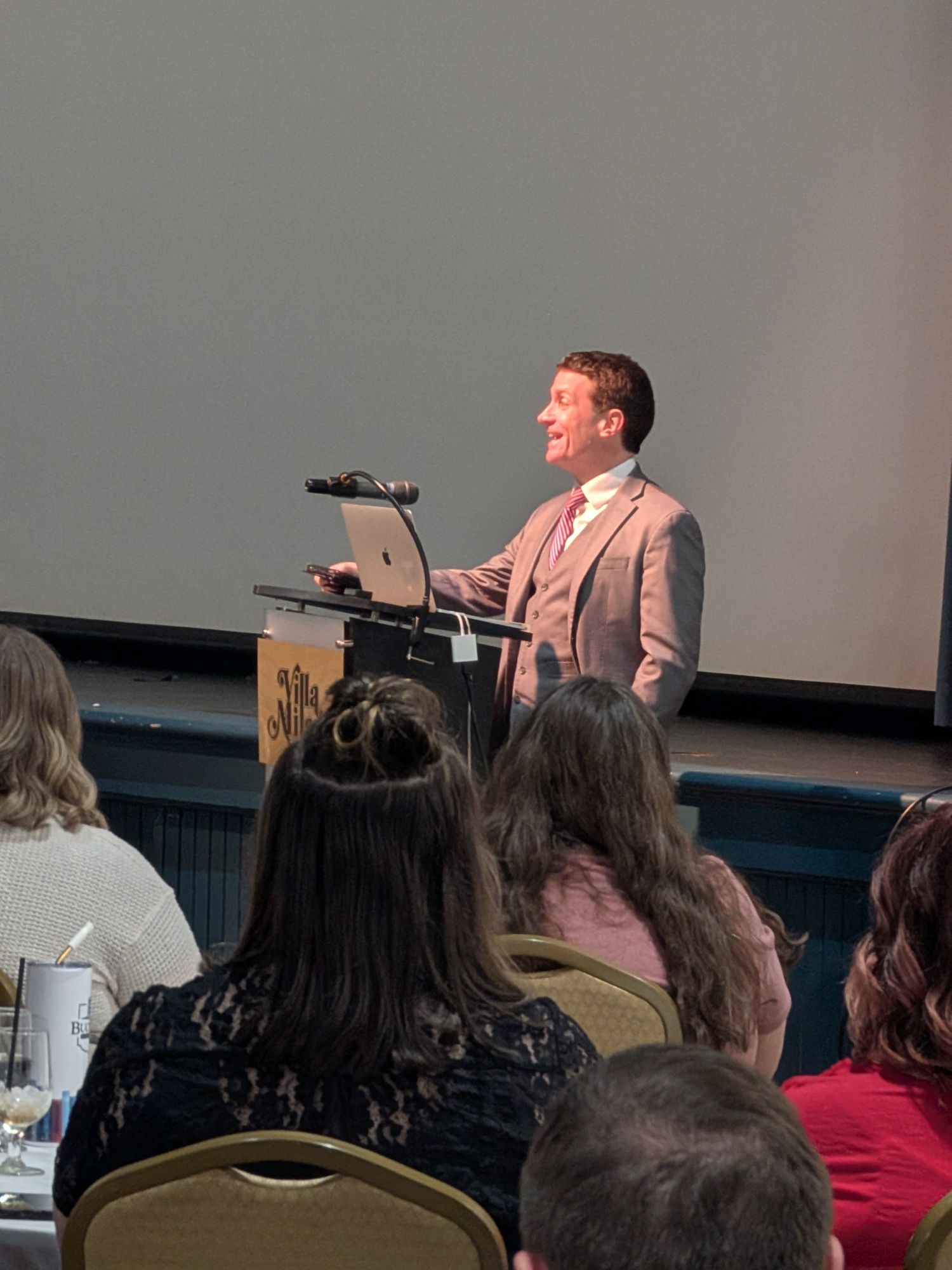
Grady Hendrix telling us about the history of witches and having us in stitches.

Recently, I went to see Grady Hendrix, author of Witchcraft for Wayward Girls and My Best Friend’s Exorcism, speak here in Columbus. It was an exciting event: the venue was an event space usually reserved for wedding receptions and the like, but it was packed, with possibly around 500 people inside the space! I was lucky just to find a table with a good vantage point.

And I’m glad I did: at 7 PM, Hendrix came out and spent the next hour using humor and a PowerPoint slideshow to tell us the history of witches as he saw it, as well as depictions of witches through history. It was hysterical! He made us laugh as he went through some of the ridiculous and not-so-ridiculous stuff that happened in witch trials, the plots of the wild books throughout the years revolving around witches, and why we keep having these witch scares. And I had a great seat to see it all.

It was an amazing night, and I could go on and on about it, but what I want to focus on is just how Hendrix, and other authors, use humor in their work.

I’ve written on this subject before, but horror and humor often go hand-in-hand, much to the surprise of some non-horror fans. You can see this quite prominently not just from Hendrix’s talk, but from his work, which is normally as funny as it is scary (Witchcraft is a rare exception, but then again, it doesn’t have much to laugh about). Not to mention, there’s a whole subgenre of horror called “horror comedy,” which is pretty self-explanatory. Some prominent examples include Clown in a Cornfield by Adam Cesare, where humor adds plenty to the slasher novel’s plot, and my friend D.M. Guay’s “24/7 Demon Mart” series, about a guy who works at a convenience mart with a talking cockroach for a manager and a portal to Hell in the beer cooler.
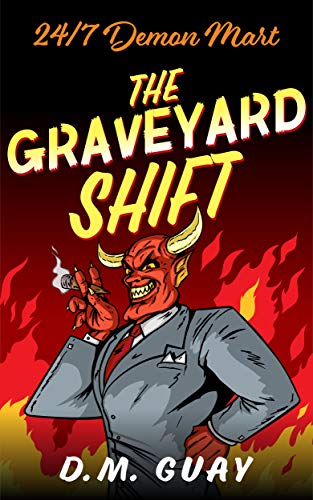
My friend D.M. Guay’s book. The series has quite a lot of followers.

And if you’ve seen a production of the musical Sweeney Todd (and I guess maybe the movie version), you’ll notice that despite the dark subject matter, there is plenty of humor. Hell, the musical’s most famous song is full of cannibalism puns! It’s almost sad how the movies cuts out most of those jokes.

Why is humor such a big part of horror at times? Well, part of it is for alleviating tension in the story, especially for non-horror fans who may not like stories that are so dark. But I think another part of it is that we need humor. Laughter is the best medicine, as they say, and it can help alleviate dark situations by shining a light on them. In fact, if you think about how horror is therapeutic for some readers (like me), the humor aspect really can pair well with the cathartic aspects of horror.

It also explains how a room of approximately 500 people could laugh so hard about stuff like witch trials, where people got murdered for bullshit reasons.

And it can’t be understated how helpful humor is in getting people to like each other. I certainly found myself liking Hendrix after an hour of his jokes.

Makes me wish I could put more humor into my own work. I love to laugh and joke around, but that doesn’t usually extend to my stories, where the stories I write are usually quite serious. Humor tends to pop up by accident or just evolves organically when I write it. In The Pure World Comes, for example, protagonist Shirley is practical and at times slightly condescending or sardonic, so humor kind of evolved naturally around her. And there’s a naughty joke appears in The Shape of Evil, but that’s because I’ve been in similar moments and made similar jokes.

Still, my style of writing tends to work for me. People like my stories for what they are, and I won’t force humor in when it doesn’t suit the story. And plenty of writers write amazing stories that have endured through time without a laugh. Who’s to say I have to add a laugh to join their ranks?
All that being said, if I find a place to put a bit of humor into one of my stories, and it doesn’t work against said story, I might add it. After all, a little laughter never killed anybody…as far as we know.

And in the meantime, I think I’ll just keep using humor as I have all my life: in my interactions with others, when appropriate and hopefully to great applause.

Do you use humor in the stories you write? Have you noticed any rules to writing humor or humorous passages? And what is your favorite horror story with comedic elements?

So, one thing that really surprised me about the editing process for Hannah was that I had to get rid of brand names from the stories. YouTube became WeTube, and Kroger and Meijer became Lundgren’s, etc.

But those weren’t the only things I had to take out. Ohio State University, which was featured in What Errour Awoke and which was mentioned in Hannah, has been renamed Aurelian University. And Disneyland is now Mueller Land. Yeah, Disneyland was in a story at one point, but now it’s Mueller Land. And I was really surprised I had to change those both.

As my publisher explained, we have to be careful, because if we use a real brand and the company that owns the brand thinks the depiction is negative, they can sue both me and the publisher. Which makes sense. I mean, Apple doesn’t allow its products to be used by bad guys in movies and TV shows. If you see someone in a movie using a generic android phone, chances are they’re bad guys. And in the TV show Chuck, the name of the store where the main character works is a Best Buy parody called Buy More. And given that the store is regularly depicted as being staffed by lazy, incompetent, and oftentimes creepy employees, or is the sight of shootouts and spy shenanigans, it makes sense that the creators would change the name.

Also explains why Subway, which was a sponsor for the show in later seasons, was only ever eaten by the good guys. As far as I can remember, I never once saw a bad guy in that show going for Subway.

Still, that show also depicted Stanford University as a major recruiting center for CIA operatives, and during the first season, the main character has negative feelings towards the school due to his being framed for cheating and getting kicked out while there. Did Stanford not care? And if it didn’t, would Ohio State really care that some characters in my collection were students there?

On the bright side, I was able to keep Slender Man in Queen Alice. Even though he’s a copyrighted character (I know, most people think he’s public domain as well), I was able to keep him as mentioned in Queen Alice because he illustrates an ongoing phenomena regarding Internet boogeymen. And in What Errour Awoke, I was able to keep a reference to Die Hard because, as my editor put it, Nakatomi Plaza is not a copyrighted name or actual location and everyone loves a Die Hard reference (truth).

I still find myself wondering about this, though. Some authors, especially big-name authors, can put references to brands, businesses and universities, among other things, into their work and don’t think twice about changing them. Occasionally, you even see song lyrics from famous songs! Gerald’s Game‘s antagonist draws his name from lyrics from “The Joker” by the Steve Miller Band, and My Best Friend’s Exorcism had lyrics to many popular songs from the 1980s, albeit sung with the wrong lyrics because that’s what the characters liked to do. Not sure if that counts as parody or fair use, but it doesn’t change the fact that We Got the Beat by the Go-Gos was used as an exorcism chant later in the book.

And how does Law & Order: SVU get away with using TikTok and TikTok stars in one episode? Yeah, season 23, episode 5. Even if the app isn’t portrayed as having any bearing on the bad guys in that episode, I can’t imagine TikTok was happy to have its name used in the show like that.

I guess what I’m saying is, there’s a lot to using real brands in fictional contexts that I don’t get. It’s incredibly nuanced, and you can’t get away with using a real brand by using it in a positive light and then pointing to the copyright text at the beginning of the book stating that all characters, settings, and whatever are fictional or used fictionally. In which case, more often than not, it might be better to just turn a popular brand or institution into a fictional version with a name that may or may not reference the real thing. YouTube becomes WeTube, Disneyland becomes Mueller Land, Ohio State University becomes Aurelian University, and…well, you get the idea.

Do you have any insight on this, my Followers of Fear? Please sound off in the comments below.

That’s all for now, my Followers of Fear. Just a reminder, though: this Saturday I’ll be at the Canal Town Book Festival in Dover, Ohio, selling books. If any of you are in the area, please stop by and visit. Also keep an eye out for some exciting news on the horizon regarding Hannah and Other Stories. Trust me, you won’t want to miss it.

Until next time, good night and pleasant nightmares!

(WARNING: Light spoilers ahead. You’ve been warned)

I’ve heard this book mentioned so many times in one of my Facebook groups. And when I heard earlier this year that a movie adaptation being made, I knew I would read it eventually. I downloaded the audio book from Audible and started listening over ParaPsyCon weekend. And I can see why it’s been mentioned so much.

Also, don’t let the goofy, Goosebumps-esque title fool you. This is a straight up horror story.

My Best Friend’s Exorcism chronicles the friendship of Abby Rivers and Gretchen Lang, two girls of very different backgrounds growing up in the 1980s. During their sophomore year, after a night of partying, Gretchen’s personality and health takes a change. Abby, frightened and confused, worries about what is happening to her best friend. Is it drugs? Mental illness? Or something else? Something very evil and dark? Something that has a dark purpose for Gretchen, and for everyone else.

Damn! What a horror novel! And definitely up there with Stranger Things when it comes to decent 80s nostalgia stories.

The strongest point of this novel is definitely the relationship between Abby and Gretchen. You see how it first formed during Abby’s tenth birthday party, the ups-and-downs of the early teen years, and finally into high school, when both girls are at the height of popularity but also at their closest. Like it says in the opening, they are friends when the word can draw blood. And even before anything scary happens, the strong phrases and emotional writing centered around their relationship is enough to engross the reader.

And that helps pack a huge punch when things start getting dark. You feel Abby’s concern as she notices Gretchen’s condition change and deteriorate. And as things continue to get worse, you really start to worry. Not just for Gretchen, but for Abby, who becomes almost obsessed with Gretchen’s condition.

Speaking of which, you’re just as confused as you are worried for Gretchen. There’s a lot of ambiguity around what’s causing all these changes, and it doesn’t really get resolved until close to the end of the book. Even when it starts throwing clues about what actually causes the change, there’s enough red herrings left to confuse you.

The scares are decent, as well. There are plenty of scenes that made me cringe while listening. Scarier than the horror, however, is the terror of growing up and of interacting with others. Abby learns throughout the novel just how difficult the real world is, as well as how little help adults can be. And then, during a particularly bad section of the novel, Abby finds herself socially isolated and it’s hard to listen to. Even curmudgeons hate to be isolated from the rest of the world, so it’s hard for Abby. And for us, the reader.

I also liked how the novel approached the topic of exorcism and divine power. It was a nice twist on an old trope, and not just for being outside the Roman Catholic tradition (do you know how rare that is in and of itself?).

And as for 80s references, they are everywhere and they are neither excessive nor done tastelessly.

If there are a few things I can criticize, I thought the opening chapter was a bit of a fake out. And then there were some things about the denouement I wish had been different.

Still, I did enjoy this novel. On a scale of 1 to 5, My Best Friend’s Exorcism by Grady Hendrix earns a solid 5. A dark and heart wrenching slow burn which will get you right in the feels, as well as the 80s nostalgia. I look forward to seeing how the movie adapts the novel, as well as reading Grady Hendrix’s other work (I just acquired his original novel Horrorstor). And in the meantime, I hope you’ll give it a read as well.

That’s all for now, my Followers of Fear. If nothing occurs between now and Friday, I’ll be back with a review of the next Conjuring film (lot of exorcism-themed stuff lately, isn’t there?). So until next time, pleasant nightmares!