Posts Tagged ‘proper decisions’

Today I woke up to some wonderful news: the Supreme Court of the United States had declared the Defense of Marriage Act unconstitutional and had struck down Proposition 8, both laws that had negative consequences for same-sex marriage. The former, signed into law in 1996 by Bill Clinton, prohibited the federal government from recognizing same-sex marriages, even when legalized by the states, while Proposition 8 was a ban on same-sex marriage in California that was overturned by the state courts.

At this point, it’s unknown what the exact ramifications of these rulings are. However at the very least, the government in Washington will have to recognize same-sex marriage when legalized by the states, whichwill mean a lot more people will be filing joint tax forms. I’m not sure what Prop 8’s ruling will mean exactly, but I think it may affect all gay marriage bans across the nation, of which there are more than a few.

As a long-time supporter of gay rights, let me just thank The Supreme Court for siding with liberty and the pursuit of happiness. It is unfair to so many when their marriages are recognized by the states but not by the government that’s supposed to have their best interests at heart. Your ruling has been a great success for gay rights, civil rights, and human rights everywhere. I can only hope that this leads to more tolerance and more good news as time goes on.

And to those who have worked tirelessly to see that these laws were struck down, the lawyers, the activists, and finally the people filing the suits in the first place, I cannot congratulate you enough. Your hard work has helped many people, and I salute you. Because of your efforts, I will be able to stand this Independence Day proudly and be glad I live in a nation moving towards tolerance for all.

Have a wonderful and hopefully colorful day, everybody.

With RC there weren’t many photos I could use. Not so with it’s sequel!

Recently, I read the novel Misery for the first time. At a certain point, Annie Wilkes says that when dealing with a cliffhanger, the resolution has to be “realistic” and “fair”, but she also wants this to apply to all literature. What does she mean? Well, if you’re on a plane and it’s about to crash, pull a parachute under the chair. Somewhat fair, pretty realistic. If a character with several broken bones suddenly is able to get a doctor and do experimental blood transfusions in the 19th century, then it’s not fair or realistic at all.

Paul Sheldon had a hell of a time getting the balance right, especially since he was being threatened with missing limbs if he didn’t deliver. And although I’m not in any danger of losing any limbs, I feel the pressure to make things realistic and fair with Video Rage, the sequel to Reborn City. My philosophy with sequels is that you have to build up, do something better than the first book. To do that though, I find myself having to think really hard about how I plot the story as I write the outline, and I’m wondering if what I’m writing down for each chapter is any good.

I’ve often preached about sequels and how people just don’t know how to make good ones, but I have to admit that it’s hard. Most of the action of VR takes place on the road, and besides normal conflict, there’s also the conflict of relationships which I’m trying to insert. And when I add certain elements–a hunting cabin to hide in, a Lakota village with a hospital–I wonder if people will buy this or if they’ll call BS. I’d have someone critique the outline, but there’s only one person in the world besides me who’s even read RC, and I don’t want to spoil it for him by having him critique the outline.

Well, this is why I advise taking a break after writing the outline to creatively recharge those batteries. Perhaps after the outline’s first draft, I’ll be able to figure out if things need to be changed. However at this point I don’t intend on changing much…except possibly making one of the antagonists much more involved with the fighting instead of using drones and soldiers.

Wish me luck. I’ve got more work to do in the morning, where I’ll try to finish this outline. Honestly, VR could potentially be longer than RC, the way I’ve been writing the outline.

If you haven’t heard, then here’s a news piece that’ll at least raise an eyebrow on your forehead: Amazon has announced their intentions to create a new publishing platform for Kindle called Kindle Worlds. The exact nature of this platform is for authors to publish fan-fiction and make money off of it. Yes, you read that right. People can now make money off of fan-fiction.

Naturally, this has set off a storm in the publishing and literary worlds, and a whole lot of discussion across blogs and Internet boards. Fan fiction is, by definition, fans of franchises making up their own stories based on these franchises and display it online or in writing groups for all to see. For many years, fan-fiction, or fanfics for short, have been hidden in the Internet closet. But with this announcement, fanfic writers can now post their stories–some trying to stay true to the original franchises they are based on, some showing unexplored romantic connections between characters, and some of those downright erotic in nature–on the Internet and make money on them.

Of course, there are a few catches. There’s no exact date as to when this platform will be available, and at this moment only certain franchises–The Vampire Diaries, Pretty Little Liars, etc.–are confirmed as allowing their work to be used by Kindle Worlds. In other words, unless the creators give the okay, you can’t publish a short story or novel based on a franchise unless the franchise owners are okay with it. The ones that are confirmed as allowed are franchises with already-large fan bases who write their work regularly in secret and in the Internet version of public. In addition, the owner of the original franchise gets a cut of the money, so they stand to gain too.

However, many authors are seething. Anne Rice is famous for being against fanfics of her work, and the same goes with George R.R. Martin (sorry GoT fans). I’m of this camp, simply because I feel that my stories and the characters within are like my babies, and I don’t want people taking my baby away and telling it what it should or shouldn’t do like it was theirs.

Yeah, he’s not allowing fanfic of his work. I’m not surprised.

Other authors however, have outwardly allowed fanfics of their work. Sci-fi franchises such as Star Trek and Star Wars have always had fanfics, the former at one point having an official fanfic magazine, and the latter creating a specific set of guidelines for fanfics based on the galaxy far, far away. JK Rowling was quoted as saying she was “flattered” that people wanted to write stories based on Harry Potter, while Stephanie Meyer has set up links from her website to fanfic websites where Twilight-esque works are featured.

There are arguments for both camps that each have valid points. For the sake of this post, I’m going to list a few points from both camps. For the pro-fanfic group, here is why they say fanfics are okay:

1. Fanfics encourage reading and writing and imagination. In this digital age when attention spans are short and people are reading less, fanfics allow people to return to reading and writing by giving them the opportunity to read and write things they already love, be it books, TV shows, or movies. If this is encouraging people to guess at what might happen if so-and-so happens to such-and-such character and they read about it or write it down, why should it be discouraged?
2. Good stories can evolve from fanfics. The famous (or infamous) 50 Shades of Grey started out as a BDSM Twilight fanfic. If such a crazy bestseller can result from fanfic, why can’t a best-selling YA series result from a kid in Omaha doing a Naruto fanfic, or a woman in Cardiff create a new type of espionage novel when she has James Bond take on villains with codenames based on The Wizard of Oz, or a new literary novel that has reviewers crying at the end arise from a teen in Johannesburg imagining himself having conversations with Captain Kirk, Darth Vader, and the Doctor and then writing them down?
3. Fanfics could be good source ideas. It is entirely possible–particularly for TV shows with ever-changing storylines and characters–that fanfics could be a source for new material. Perhaps fanfic writers will one day be commissioned to write scripts for new episodes based on a story they wrote when they were exploring a new possibility for a character in their favorite franchise. It could happen.

And now for the opposing camp:

1. Legally, this could be a crime. Many writers don’t approve of fanfics, and in the United States, you can sue a fanfic writer if they created a fanfic based on your work without permission, and the fanfic writer could pay dearly for it. And since most fanfics don’t constitute as fully original works or parodies, they can find themselves at the mercy of a very angry novelist or screenplay writer, especially if the fanfics were sold for money.
2. Fanfics may discourage writers from doing original work. There may be plenty of talent among fanfic writers, but if they spend too much time creating fanfics, how can they achieve their full potential by creating original stories? We may have the next Faulkner, Paolini, or Sparks on our hands, but they may be too busy writing stories based on Scandal or Harry Potter or Friday the 13th to create an original work. Heck, they may be too scared to do an original work, thinking no one will like a story with original characters or that fanfics are the best they can do.
3. Fanfics may create false expectations. You hear of shippers, those people who are rooting for two characters to get together on a show or in a series and talk about it online and write fanfics about it. What if by reading those fanfics, you come only to expect that somehow, some way or another, those characters will be in the relationship by the end of the show? And what if the creators of those characters have other plans? We’ve heard of how some fans were angry about how Charlaine Harris’s final Sookie Stackhouse novel ended and threatened her for it, and years ago when Books 6 and 7 of Harry Potter came out, Harry-Hermione shippers complained that JK Rowling had willfully ignored them or shot them down, particularly in that one scene with the locket Horcrux and Ron holding the Sword of Gryffindor. It’s entirely possible this could happen if fanfics become mainstream.

To do fanfics, or not to do fanfics? That is my question for you right now.

As the debate rages, we may see more and more authors joining the Kindle Worlds platform. Or we may see a retraction, as certain authors launch campaigns against Kindle Words (could happen, you know). I certainly know that I don’t want people making fanfics out of my work, but I can’t speak for other authors.

How do you feel about fanfics? Would you allow fanfics based on your work?

gordon-gee-12490a4fe36e00ab[1]

Earlier this week, it came to light that E. Gordon Gee, the President of Ohio State University, had said some things about the University of Notre Dame and Catholics in jest at an athletics meeting. Some took the comments as offensive,  He apologized for his comments and Notre Dame formally forgave him. Most of the Catholic students on campus and on Facebook have agreed that they didn’t find the comments offensive. Heck, I’ve heard more offensive comments from comedians on TV (Jeff Dunham and his dummies come to mind).

But today, President Gee announced his retirement, effective July 1st, because of the controversy his remarks led to.

Naturally, I and several other OSU students are devastated. President Gee was a positive influence on the campus. He brought a smile to us with his bowties and jovial nature and kind and quiet manner of speech. To many students, meeting President Gee was a milestone in their OSU careers. I even met one student who said she came to Ohio State just to meet President Gee, right before she took a photo with him at the student union. To us, losing him because of this little incident will be a big blow to the morale of the university and to the students.

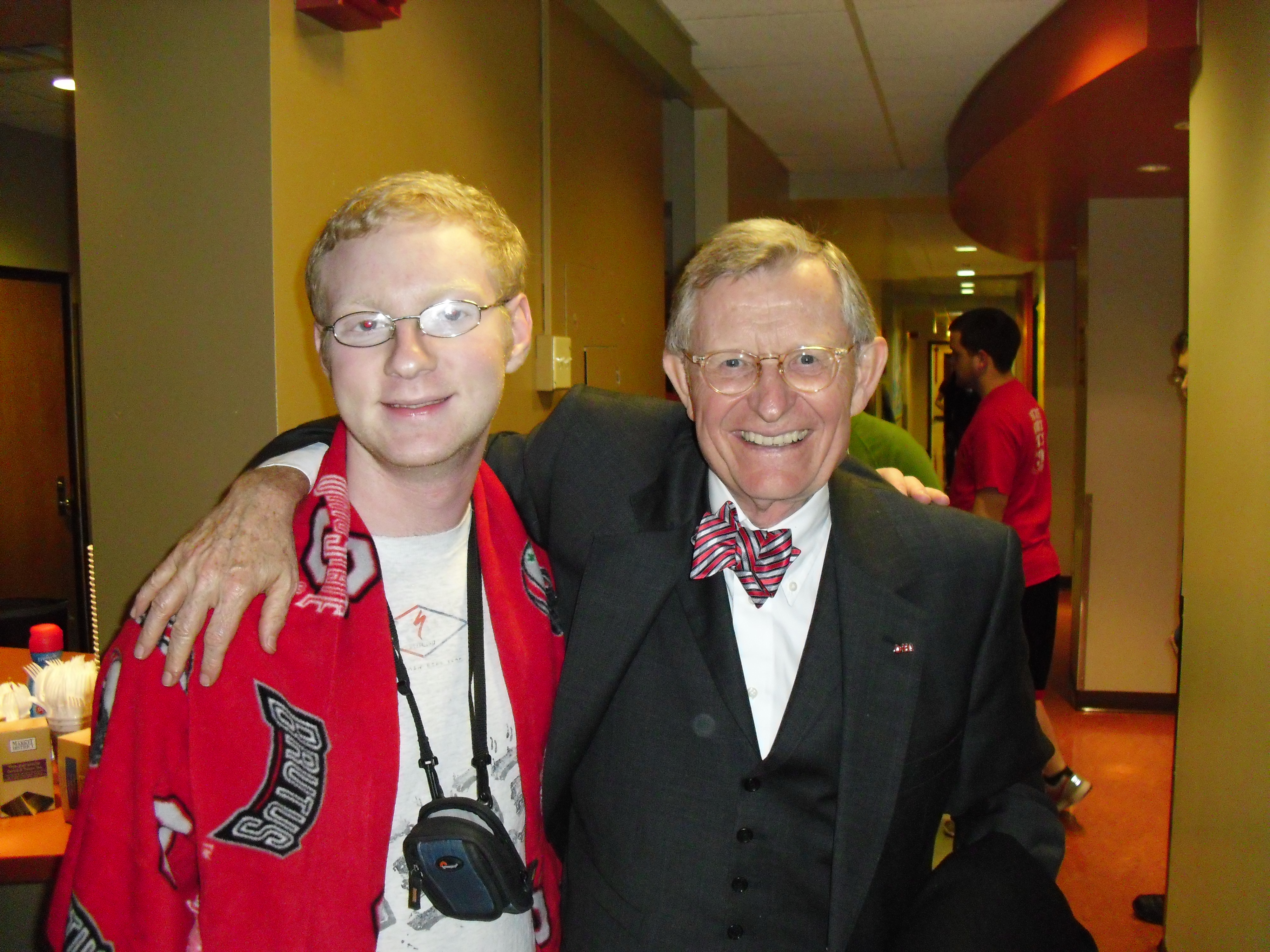
This is me with President Gee back in my freshman year. He was an inspiration. I hope he stays that way.

This is me with President Gee back in my freshman year. He was an inspiration. I hope he stays that way.

Which is why, after discussion with some other students and a lot of thought about the subject, I started a Change.org petition to get the Board of Trustees at Ohio State to let President Gee keep his position and continue to serve Ohio State as he’s done for several years. So far, 125 people have signed, and I’m hoping that I can get that number up to 10,000, or about one-sixth of the Ohio State student population.

I’d appreciate it if you signed the petition, and possibly shared it on your own blog or Facebook. This means a lot to me, and I’m trying to make a difference as best as I can. If I can, I want to see this petition reach the goal count. If you can help me, that’d be great.

If you decide not too though, that’s okay. I respect your opinion and your choice and I hope we can find other things to agree on. But if you feel like it, please do sign the petition. You don’t even have to donate money to do it! And the best part is, you’ll be making a difference for about sixty-thousand students.

That, my friends, will be the best part.

At the end of the 2012 presidential election, riots broke out at a Mississippi university where racial slurs were shouted by the mob, and over the ensuing months the White House was inundated with petitions asking for individual states to secede from the Union. All these and a few other interesting little acts of rebellion and political anger were the result of President Barack Obama nabbing a second term and, in the eyes of these people, sitting comfortably in a position to create a dictatorship.

I thought these people were being overdramatic and possibly a little unpatriotic. I mean, why not wait till the next election, like the Democrats were forced to do from 2000 to 2008? Why threaten leaving the Union? And until this past weekend, I thought nothing could match this overreaction.

I was wrong.

Author Charlaine Harris is receiving hate mail and death threats for wanting to end her vampire series and to end it a certain way. Seriously?

This past weekend, I read several articles, online and off, about how Charlaine Harris, author of the Sookie Stackhouse books, was receiving negative reviews, angry letters, and even a few death threats. Why, you ask? Because a small but extremely passionate legion of her fans are upset that the latest book, Dead Ever After, also happens to be the last Sookie Stackhouse book. Some were angry that Ms. Harris was ending the series. A few were threatening to do horrible things to themselves or to Ms. Harris if the ending doesn’t put their favorite couples together (and when a leaked copy of the novel appeared in Germany, some fans did what they threatened).

This isn’t the first time an author has received this sort of treatment from fans. Stephanie Meyer received some very angry letters when she said she didn’t want to write any more vampire stories, and even Sir Arthur Conan Doyle got his share of haters attacking him when he threw Sherlock Holmes over a cliff, seemingly killing him. For the latter, this led to Holmes’s resurrection, which can show how powerful fans can be, and in the age of the Internet, a few people can create a tidal wave of faceless anger and indignation.

But can I remind everyone of something? THESE ARE FICTIONAL STORIES! There’s no actual Sookie Stackhouse or Bella Swann, Sherlock Holmes doesn’t actually mysteries in London, there are no vampires or Hogwarts, Klingons are the creation of talented make-up artists working with patient actors in seats, and the fact that adults get so worked up by a show about talking animated ponies seems a little creepy! None of it is real, but the fact that so many people treat these things like life or death just seems to disturb me.

The new target: celebrities and artists. It’s ridiculous.

So why do people go all Annie Wilkes when their favorite author decides to do something that a few fans disagree with? Or to go a little broader, why do some fans threaten to boycott or do horrible things to a celebrity when that celebrity does one little thing that doesn’t fit with the image these fans create of certain idols? And yes, fans create the images of their idols, because it is only in their minds that Tom Cruise is truly a dashing, charismatic, very eccentric man, or that the super model is the cool, serious seductress of your dreams. Magazines and TV and movies may help perpetuate these images, but the fans are the ones who create these images in the first place.

But to return to my original point, I don’t know why certain fans act so crazy when an idol does something that doesn’t fit their image, be it a pure actress that cannot be anything other than the sweet girl from the country, or the author that wants to end a book series after so many years, or the bad-boy musician who keeps his marriage and family secret because “that does not fit his image”. I always look at what these people do as gifts: they give us a wonderful story or a performance or a song and we appreciate it because of all the work that went into creating such a beautiful present.

“Mr. Spock, please set fanatics to minimal. Their interference could jeopardize the smooth running of our operations and the lives of many civilians.”

Even more so, plenty of artists treat their work like their babies, children they create and give birth to inside themselves. What happens when someone else tells them how they should raise their own children, what those children should learn and who they should love? It’s a little freaky, to say the least.

But it seems that some fans don’t see things the same way. They love their idols while the idols do what the fans want, but as soon as the idol does the opposite, the fans become hostile, believing they are owed something. The truth is, the rabid fans are the ones who owe something to the artist, and that’s an apology. You don’t own the work, you didn’t create it, and you sure as heck can’t tell the creators of such work what they should do with it. And if you are willing to go to such lengths such as try to ruin an artist’s career like hurting yourself or go on a hate campaign, then I seriously worry about your mental state.

So people, the next time you want to do horrible things to an artist for doing something not remotely criminal but you still find yourself feeling really upset about it, take a step back and ask: Is this really worth going to war over?

I highly doubt it.

This week alone, several stories have surfaced in the news of American children being killed by guns in their homes. Two children, shot accidentally by their siblings. One child was killed by his uncle’s handgun hidden in a backpack. Another was shot in the crib while their 14-year-old brother was using his .22 rifle, which was given to him as a birthday gift.

The two cases listed above didn’t end in saved children. Instead, the children died en route to the hospital. The parents and siblings of these dead children, the rest of their families, the communities, and everyone who hears of these cases can only wonder, “Why?”

There are a million reasons why: negligence, misfires, simple intentions to see a gun, the belief that guns actually don’t kill, the crazy belief that giving a gun to a teenager is a good idea. However, debating the reasons why these tragedies happened won’t do any good. These children are wounded or dead, and it happened by weapons kept in the home.

Now I won’t try to argue the Second Amendment or the dangers of automatic rifles and machine guns this time. I believe that if it’s for legitimate reasons, people should have access to firearms like handguns or hunting rifles. However, when children are involved it’s a whole other issue. Children have a habit of getting into places they shouldn’t, and they think things that are dangerous are fun or sometimes cute. And even if a child seems mature, no child should be given something that’s main function is killing, be it animals or people.

The worst part of this is that these tragedies could’ve been totally preventable. The parents and adults could’ve locked up their guns better, or at least made attempts to lock them up. They could’ve waited until their kids were teenagers to teach them to use guns, and then only when they were 18 would they have been allowed their own guns. Or better yet, they could’ve never have bought the guns in the first place! After all, there’s a significantly higher chance that if you bring a gun into your home, it’ll do more damage to your family than any would-be intruder.

So the NRA may be having a party in Houston and saying that guns are here to stay, that taking away guns will lead to a dictatorship, and that the only thing protecting our children are guns. But they can’t shut out the facts, no matter how many senators they buy off. Guns are dangerous tools, and until we have some common-sense legislation, all this violence and death will only stay the same, or possibly get worse.

After this stressful week, I figured I should do something to commemorate that we all got through it. And since I’m still very upset with the Senate for its failure to pass sweeping gun control measures that would’ve benefited many people, I decided to write a poem, something I don’t do often but that I think for this situation can be very helpful to get the point across. So before I do, I’d like to remind people that you are free to agree or disagree with me, but please be civil and respectful in your comments.

So without further ado, I’d like to bring you Change For The Dead:

We say that I’m against our right to bear arms.
What about our right to feel safe on the streets?
We say after every massacre that more guns is the remedy.
Are we going to tell Boston that every citizen needs a bomb?

We say gun restrictions don’t work,
That there are people who won’t submit to them.
Tell me, if I decide not to follow our laws on stealing, drugs, or traffic,
Should the nation do away with those laws?

We say we fear a dictatorship if we change our ways.
How about the fear of children and the fear of their families?
We say this is the way of America,
But I thought that was life, liberty, and the pursuit of happiness.

Our constituents wanted action.
Why did we deny them that?
We won’t do anything for the living.
How about we bring change for the dead?

How about I do a séance on the Senate floor,
Summon the many who’ve died?
They are legions, they are many,
They want only that no more join them.

Can you hear their cries?
Can you listen to their complaints?
Many lost all potential before they could achieve it.
Are we going to let them down?

Listen to them, open your hearts.
Don’t let your fear keep us from helping them.
Something’s wrong with this world,
But now I hope we can make it right.

I tell you, it isn’t even blogging about this right now. I had to have a bowl of ice cream with a side of cherry cola, watch a crime show on my computer, and then listen to two hypnosis MP3s before I felt comfortable to write this blog post. After all, a lot has happened this week: Monday we had the bombing at the Boston Marathon. Tuesday showed only false news leads and a bomb threat at Ohio State that, while it turns out to be just a false alarm, freaked out the entire school. Wednesday we learned that the Senate had voted down gun restrictions that 90% of Americans had said in polls that they wanted, particularly when it came to universal background checks. And this morning, I heard about an explosion at an industrial plant in Texas. Luckily that one was just faulty equipment, but still it freaked me out. It didn’t help that Cal State LA had its own bomb threat today. And then there’s a million memes floating around the Internet, each with a thousand positive and negative comments.

You can see why I’m stressed. I see destruction, carnage, and fear everywhere and only so much being done about it (or in the case of the Senate, nothing being done). It makes me worry, it makes me stress. This sort of stuff, in my opinion, shouldn’t happen outside of books and movies. And yet it’s happening.

But after all my stress relief, I realize that when I look back on this years from now, I’ll realize that I survived this horrible week, that afterwards I did great on my finals (I’m assuming, at the very least), and it can be a story I can tell my kids (I’m assuming I have kids at this stage) about bad weeks and that they go away.

Still…that doesn’t excuse the fact that two men (they do have suspects now, says the FBI, and sorry Jon King, they’re not “dark-skinned” as you thought) caused three deaths and several injuries. And the Senate placed reelection ahead of common sense solutions to gun violence, only passing a “privacy clause” for firearms and funding for mental health services (only the latter I really agree with, though I have a feeling its help will be limited). And the NRA probably played a huge role in keeping those solutions from passing, all in the name of their paranoia. I’m very upset, but I’m not going to let it get in the way of my life and living happily.

Now if you don’t mind, I’m going to do some editing work that’s long overdue. I need to do it and it’ll relax me, I’m sure.

This week at Ohio State University is Holocaust Remembrance Week. Like last year, I am giving a small speech to commemorate this sad occasion at OSU’s Jewish organization, OSU Hillel, during the Friday night service. Since I know most of you won’t be at Hillel, I’m posting my thoughts on the subject here. If there are any grammatical errors or misspellings that I missed, please forgive me, it was not my intention to leave those there.

I hope you enjoy reading this and that it affects you positively. Thank you for reading.

***

It’s been nearly sixty-eight years since the Holocaust ended and Adolf Hitler committed suicide, signaling the end of the war in Europe. The war left millions dead, millions more displaced, and thousands of questions unanswered, many still unanswered. The most important question though, at least for those of us who commemorate the estimated thirteen million dead, is how could the Holocaust happen?

As one of my majors is History, and my focus is on the war in Europe, I could go into all sorts of reasons as to why the Holocaust happened. I could go over for hours on the “Stabbed-in-the-Back” legend, Germany’s political and economic conditions during the Weimar era, Hitler’s underlings meeting at the Wannsee to determine the Final Solution, quotations from Mein Kampf—but the one reason I’d like to focus on can be summarized in one simple word: dehumanization.

Hitler made numerous insinuations about the Jews of Germany and the rest of Europe. However one thing that remained true of every insinuation, and that was the Jews were less than human, as if they were monsters with barely human form. As more people came over to Hitler’s side, more and more people were willing to see the Jews and all those that Hitler deemed “sub-human”, as not a human being like them.

And once you see something as non-human, it becomes easier and easier to discriminate against it. First the Jews and all “sub-humans” were discriminated against. Then legal measures were taken to turn “sub-humans” into second-class citizens. And then the “sub-humans” were turned into slaves. And finally, cattle to be slaughtered and thrown out with the trash. Such is the value of things considered less than human. It took the efforts of many Righteous Gentiles, risking their very homes, security and lives, to see past this illusion of inhumanity and protect many thousands from the gas chambers Hitler had built for us. If more had thought like the Righteous Gentiles, perhaps more people would’ve survived the Holocaust.

We often think that the events of the war couldn’t possibly happen today. Sadly, we are so wrong. As we all too well know, minorities in this country such as African-Americans, Hispanic-Americans, and Asian-Americans were discriminated against for years, and even amendments to the Constitution haven’t totally brought those with darker skin to the same status as whites, whether it be educationally, economically, or socially. Stereotypes keep well-qualified workers away from jobs, and can even lead to them being imprisoned simply because of their race.

In addition, women the world over are given second-class status, and any actions to rise above that status can get them beaten, imprisoned, committed to insane asylums, or even executed, all in the name of “morality and modesty”. Even in countries where this is not the case, such as America, women still aren’t equal to men in the eyes of the Constitution, and their voices are often drowned out by government officials who do not represent their interests.

And we all know that many people in the LGBT community still lack the rights of straight people. In certain countries homosexual activity can get you jailed or killed, and even in today’s air of equality, there are those who will stop at no end to keep the LGBT community in the place they are now, simply because they are different.

One of the greatest teachers of Judaism, Hillel the Elder, taught that “what is distasteful to you, do not do unto others. That is the whole of the Torah; the rest is commentary. Go and learn it.” By “it”, Hillel does not refer to the Torah or commentary, but the lesson that we may derive from this main truth. So when you go out tonight, remember that you would not like to see happen to you, don’t wish it or perform it on others. And if you see someone less fortunate than you, don’t look down on them, but ask yourself, “How can I help this person whom I might be like if I were in a similar situation?” And then once you’ve thought about it, act upon your conclusion. That is the whole of Hillel’s teaching. It was applied by the Righteous Gentiles during the Holocuast, and it can still be applied today, by you and by me.

Thank you and Shabbat Shalom.

Today I’m checking the news on AOL and I see that France’s Senate has passed a bill allowing LGBT couples to get legally married. The bill was passed despite huge protests and opposition from conservatives and Roman Catholics wanting to preserve their definition of marriage. Yesterday I read how Uruguay had done the same thing, passing a bill allowing members of the LGBT community to marry and adopt. And quite recently, England voted to have same-sex marriage. So that’s three countries within the past three months that will allow same-sex marriage in their countires.

My question is, why hasn’t the United States jumped on board yet?

I know the Supreme Court is debating DOMA and Prop. 8 in its chambers these days, but even if the ruling is in favor of gay rights and same sex marriage, I’m a little worried aobout the outcome. First off, there are some justices on the Supreme Court who have called same-sex marriage “an experiment” that is “newer than cell phones” and may vote against gay marriage due to their conservative principles. And even if they don’t vote against it, I doubt the Supreme Court will mandate that same-sex marriage will be allowed nationwide, especially if they don’t want some states to sue the federal government for interfering in the states’ right to decide for themselves what legally constitutes as marriage.

Not to mention that in some areas the LGBT community still face horrible discrimination in the workplace, bullying is common for students who come out of the closet, and in Montana, a hospital forced a man out of his husband’s hospital room and treated him like just touching him could get them AIDS and later said they forced him out for being “loud and belligerent” (even though the patient’s brother was supposedly much worse than the husband). If we really want gay marriage to take hold in this country, first we need some serious attitude changes.

Luckily the gains made in the past four years for the LGBT community have been incredible, so I wouldn’t be surprised if in the next 10-15 years gay marriage became legal nationwide and discrimination against the LGBT community was sought out and abolished. But like I said, it’ll take time and attitude changes. So whatever the outcome of the Supreme Court’s ruling, I hope it brings some positive change in the years to come.