Posts Tagged ‘WWII/Holocaust’

F0r Passover, I received a gift from a friend of my mother’s as a thank-you for letting her come to our Passover Seder. Unusual for Passover to receive a gift, but I was extremely grateful to receive the gift, and heck, Kelly was grateful for the chance to attend a Passover Seder. The gift: signed copies of “From A Name To A Number: A Holocaust Survivor’s Autobiography” by Alter Weiner. As the focus of my History major is the Holocaust and yesterday I wrote a post about the dehumanization that occurred during the Nazi regime, I thought it’d be appropriate to finish the book over Shabbas and review it here. Later I’ll send it to Kelly (apparently she manages the author’s Facebook page for the book).

First, I’d like to say that this book is very touching (what do you expect?). But also, it’s very revealing. Covering the author’s entire life from his younger years, to the deportation and incarceration in five different concentration camps, to liberation and resettlement in Israel, and later life in America, where to this day Mr. Weiner goes to high schools, churches, and even prisons to tell his story and let people know what his life is like.

Some things came to me while I read this book. First, that the Holocaust left many of its victims with PTSD. I already knew this, but hearing it for the first time from a survivor, even if only in book format, made me realize how much Mr. Weiner was suffering years after the Holocaust. While many contemporaries of his and his own family brushed off his constant preoccupation with the Holocaust, the reader’s own emotions are stirred and we want to reach out and hug the author over the distance.

Second, how lucky we are. I have a loving family, a fairly liberal society, and I’m getting a great education. Mr. Weiner’s formal education ended at age 13, when the Nazis took over Poland. He lost most of his family shortly thereafter, and lived in slavery and horrifying conditions for three whole years. It’s affected his very person to this day, and it makes the reader appreciate his/her blessings.

And finally, we learn the evil of hate. “Hate hatred and shun violence”, Mr. Weiner implores several times throughout the book. Indeed, I find it hard to hate anyone on a daily basis, but now it’s even harder for me after reading this. I hope Mr. Weiner’s story affects all others similarly and that you treasure this book for years to come.

On a scale of 1 to 5, I give this book a well-deserved 5 out of 5, for reminding me to count all my blessings and to love my life no matter what. I hope you pick up a copy and read it yourself so you can see the magical effect of this autobiography by a living treasure.

This week at Ohio State University is Holocaust Remembrance Week. Like last year, I am giving a small speech to commemorate this sad occasion at OSU’s Jewish organization, OSU Hillel, during the Friday night service. Since I know most of you won’t be at Hillel, I’m posting my thoughts on the subject here. If there are any grammatical errors or misspellings that I missed, please forgive me, it was not my intention to leave those there.

I hope you enjoy reading this and that it affects you positively. Thank you for reading.

***

It’s been nearly sixty-eight years since the Holocaust ended and Adolf Hitler committed suicide, signaling the end of the war in Europe. The war left millions dead, millions more displaced, and thousands of questions unanswered, many still unanswered. The most important question though, at least for those of us who commemorate the estimated thirteen million dead, is how could the Holocaust happen?

As one of my majors is History, and my focus is on the war in Europe, I could go into all sorts of reasons as to why the Holocaust happened. I could go over for hours on the “Stabbed-in-the-Back” legend, Germany’s political and economic conditions during the Weimar era, Hitler’s underlings meeting at the Wannsee to determine the Final Solution, quotations from Mein Kampf—but the one reason I’d like to focus on can be summarized in one simple word: dehumanization.

Hitler made numerous insinuations about the Jews of Germany and the rest of Europe. However one thing that remained true of every insinuation, and that was the Jews were less than human, as if they were monsters with barely human form. As more people came over to Hitler’s side, more and more people were willing to see the Jews and all those that Hitler deemed “sub-human”, as not a human being like them.

And once you see something as non-human, it becomes easier and easier to discriminate against it. First the Jews and all “sub-humans” were discriminated against. Then legal measures were taken to turn “sub-humans” into second-class citizens. And then the “sub-humans” were turned into slaves. And finally, cattle to be slaughtered and thrown out with the trash. Such is the value of things considered less than human. It took the efforts of many Righteous Gentiles, risking their very homes, security and lives, to see past this illusion of inhumanity and protect many thousands from the gas chambers Hitler had built for us. If more had thought like the Righteous Gentiles, perhaps more people would’ve survived the Holocaust.

We often think that the events of the war couldn’t possibly happen today. Sadly, we are so wrong. As we all too well know, minorities in this country such as African-Americans, Hispanic-Americans, and Asian-Americans were discriminated against for years, and even amendments to the Constitution haven’t totally brought those with darker skin to the same status as whites, whether it be educationally, economically, or socially. Stereotypes keep well-qualified workers away from jobs, and can even lead to them being imprisoned simply because of their race.

In addition, women the world over are given second-class status, and any actions to rise above that status can get them beaten, imprisoned, committed to insane asylums, or even executed, all in the name of “morality and modesty”. Even in countries where this is not the case, such as America, women still aren’t equal to men in the eyes of the Constitution, and their voices are often drowned out by government officials who do not represent their interests.

And we all know that many people in the LGBT community still lack the rights of straight people. In certain countries homosexual activity can get you jailed or killed, and even in today’s air of equality, there are those who will stop at no end to keep the LGBT community in the place they are now, simply because they are different.

One of the greatest teachers of Judaism, Hillel the Elder, taught that “what is distasteful to you, do not do unto others. That is the whole of the Torah; the rest is commentary. Go and learn it.” By “it”, Hillel does not refer to the Torah or commentary, but the lesson that we may derive from this main truth. So when you go out tonight, remember that you would not like to see happen to you, don’t wish it or perform it on others. And if you see someone less fortunate than you, don’t look down on them, but ask yourself, “How can I help this person whom I might be like if I were in a similar situation?” And then once you’ve thought about it, act upon your conclusion. That is the whole of Hillel’s teaching. It was applied by the Righteous Gentiles during the Holocuast, and it can still be applied today, by you and by me.

Thank you and Shabbat Shalom.

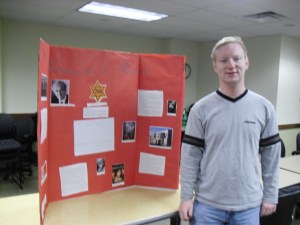
Me next to my project; I'm not wearing my glasses because they were still getting used to the lack of sunlight. How do you like my poster?

Me next to my project; I’m not wearing my glasses because they were still getting used to the lack of sunlight. How do you like my project?

Today, my history class met one last time to show our final projects gallery-style. The subject of my history class was an overview of the Historical Studies discipline, which involves the history of history (yes, that does exist); how history is gathered; how we classify different types of history; and other fun and interesting topics for historians and History majors to talk about. For our final project, each of us had to demonstrate the research and detective skills we were supposed to have developed over the past semester, and create our own poster detailing a subject of our choosing. I chose to do the history of Holocaust awareness in America, since the Holocaust is the focus of my History major, and I used a book by Peter Novick, The Holocaust in American Life, as my main source of information.

My project went very well; I learned a lot and put it all into an interesting and colorful tri-fold that looked at the Holocaust in America from 1945 to now, and how the Holocaust was at first ignored in the US before gaining prominence in the sixties and becoming a part of our culture in the latter years of the twentieth century. There were also some other projects that were pretty interesting: several posters involved the second World War, including Ohio’s contribution to the war effort, the experiences of soldiers who participated in D-Day, and the US propaganda for the war effort. One guy did the history of the jazz industry here in Columbus (I didn’t know Columbus even had a jazz industry), while one girl looked at the founding of Israel from the perspective of Israeli-Arab relations of the times. One girl looked at the growth of Columbus over the years, and another guy did the history of white-tailed deer in Ohio. Each project though, was well-researched and the student put a lot of effort into their project’s presentation, so they all definitely deserve A’s.

Now, my teacher had us all go around and grade our projects from 1-5, with 5 being a bad grade and 1 being an awesome grade (we also had some guests who helped in the grading). The person(s) with the best grades will recieve a prize or two, so here’s hoping people liked my project. We also have to turn in a 5-page paper on our research subjects. Since I didn’t want to just rehash what I put on my tri-fold, I asked my teacher if I could do the problems associated with teaching the Holocaust in public schools (yes, such problems exist). He said yes, so I’m in the middle of working on a kick-ass paper. I’m about 2 1/2 pages in, so hopefully I’ll be done by Monday, when the report is due.

So to Dr. Kobo and my classmates, thanks for an interesting semester. Let’s do well in the future and make our own history. Good luck to you all.

Today I check the news on AOL, and what do I find? Two stories where politicians and ministers have been comparing legislation to the Holocaust and Nazi Germany. My plea to all politicians, on both sides of the political spectrum: please stop! For the love of my family and my people, please stop making those comparisons! It’s trivializing the Holocaust and the memories of those who were victims of Hitler, turning a tragedy into a political cudgel akin to what socialism has become.

I know there are people out there who are passionate about the issues, but to compare the issues to what Hitler did is upsetting to a lot of people, and I think it’s an overreaction. You can’t take an issue, even one like laws regulating child labor on farms, and turn it into the Nuremburg laws. It’s taking both the former and the latter completely out of context and turning them into something they are not. Nor can you compare laws trying to protect the health of women to people getting loaded into cattle cars and sent to Auschwitz or Dachau, because it’s taking these two different things out of context. You wouldn’t want me comparing an issue or a piece of legislation to the terror attacks of 9/11, right? I didn’t think so.

So, to all those elected officials and to all those who try to guide people through faith, I ask you to stop with the Holocaust references. It’s offensive, it’s taking a very dark event in our past and marginalizing it, and it’s counterproductive, especially if you want to stay in office and a large part of your constituency is Jewish. Besides, people prefer leaders who unite other leaders and help their people, not politicians who divide other politicians and who offend their people, so not using the Holocaust is actually a pretty sound strategy.

On an unrelated topic, yesterday I reached one-thousand views on Rami Ungar the Writer. Thank you all who have been reading my blog and staying with me all this time. I hope we’re still together a thousand views later.

Deborah Lipstadt speaking in the auditorium of the Ohio State University Hillel on April 24, 2012

I had a wonderful evening tonight. Why, you ask? I got to hear Deborah Lipstadt speak! For those of you who don’t know, Deborah Lipstadt is the formost expert on Holocaust deniers and how to combat them. I read her book, Denying the Holocaust, and I found it very informative. It was amazing to hear her speak. 

During the course of the hour-long talk, Professor Lipstadt talked about some fo the methods of Holocaust deniers and their motivations, how she came to research and write about the topic, and, what I thought was most amazing, how she was sued by a henier from the United Kingdom named David Irving because she’d mentioned him in her book and he was accusing her of libel. 

That was pretty amazing in itself: with the help of Princess Diana’s lawyer, she ripped this guy to shreds on the stand, and all without putting the Holocaust and its truth on the stand! Now the guy’s a disgrace, forced to “verdict-deny”. 

What I took away from it though, besides the fact that I need to do some more studying of the Holocaust (it’s the focus of my history major, after all), is that, even ten years after the trial wrapped up, Deborah Lipstadt still considers herself very lucky that she won that trial. I find that very beautiful. 

Tomorrow, I’ll put this, and all the other events of Holocaust Awareness Week, into an article for the Pulse. I’ll let you guys know when it comes out. Should be an interesting read.

Okay, I’m a little confused. Why, in the name of God, are men the ones who seem to be the only ones we’re listening to on television about this? Men?! Just a reminder folks, men can’t have babies. I know it’s hard to believe, but men can’t have babies. So should they really be telling women how they should use their bodies or whether or not they can prevent themselves from getting pregnant? My answer: no! (And I’m saying all this as a guy. Then again, I’m a feminist and I grew up in a house full of women and girls, so I guess I’m an exception).

Also, the Catholic Church is making a huge fuss about the birth control option in Obama’s policy. Once again, the people getting upset are the male policy-makers of the Catholic Church, who cannot get pregnant, even if they wear gowns while praying at the altar. And apparently ninety-eight percent of Catholic women use birth control and feel guilty about it. Ladies, don’t feel guilty; feel enraged! I mean, you can’t get birth control but apparently guys can get Viagra. There’s something wrong about all that!

And to all those religious institutions who feel threatened by the birth control policy of the Obama administration, please stop using Nazi Germany references for your plight. The Obama administration is not preventing you from going to school, to public areas, taking away your property or forcing you to wear humiliating yellow patches on your clothes. They’re requiring your insurers to pay for birth control. When all the other stuff I listed starts happening, then you can start complaining about the government barring your religious liberties in a fashion similar to Hitler! The people who should really be complaining about having their religious liberties barred in front of Congress are the Muslims living in France. Have you seen the situation over there?!

Finally, I’d just like to mention that although you object to paying for women’s birth control, you should know that when you pay your employees, they can use that money for whatever they want, even condoms or strip clubs or stuff you guys find abhorrent. Just something to think about.

That’s it for my rant, talk to you later.