As I promised last night, I’ve published my twenty-first article for Self-Published Authors Helping Other Authors. This one is Business Cards and Bookmarks, and has some handy tips on designing and giving out business cards and bookmarks authors may design as part of their marketing strategy. I used my own business cards as examples (click here if you haven’t seen them yet). If you have a moment, head on over through the link and check out the article. Let me know if you find what’s there helpful in any way, shape, or form.
And if you enjoy reading the article, check out some of the other articles on Self-Published Authors Helping Other Authors. The blog is written for independent authors, by independent authors and is intended to help make writing, editing, publishing, and marketing as an independent author as easy and affordable as possible. I hope you enjoy the articles there should you decide to check them out, and reap wonderful benefits from them.
Well, that’s all for now. I’m probably going to get started on the last ten chapters of Laura Horn tonight. Anything could happen, so let’s see how far I can go. Until next time, my Followers of Fear.
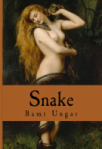
My friend and fellow author Pat Bertram just released this interview on Snake and what went into the writing of it. It’s a really great post, and I enjoyed reading it. And you should also check out Pat’s blogs as well. She’s an amazing author and woman, and you can learn a lot from reading her posts.
“Snake” is about a young man (and I mean young) whose girlfriend is kidnapped over the phone. Later events cause him to have a break with his sanity and he becomes a serial killer, determined to hunt down every member of the mafia family that has his girlfriend. It’s a very dark thriller, and it’s very unusual to have the serial killer as a protagonist. I’m hoping that will allow people to enjoy the story more, though. Fingers crossed, at any rate.
What inspired you to write this particular story?
I guess maybe it was the movie “Taken”. Yeah, there are plenty of similarities, but it’s definitely it’s own story. That’s actually what I wanted: I wanted to create a much darker story than “Taken” portrayed, though that was pretty dark in itself. I like to think I’ve succeeded in that respect. We’ll see what…
Three articles within a week. I’m impressed with myself. And this one marks my 20th post for Self-Published Authors Helping Other Authors, which apparently is quite the milestone, seeing as WordPress gave me a congratulatory notification this morning.
Anyway, today’s article is How To Write An Epilogue, a follow-up to yesterday’s post about writing prologues. I figured that since I’d already written one on prologues, I might as well do one on epilogues, which require different tools from writing prologues in order to write them effectively. So far it’s gotten a pretty good reception, which I’m happy about. I hope plenty of people find it useful.
And if you’ve liked my previous posts on Self-Pub Authors, you should seriously consider checking out the other articles on the site. It’s a wonderful website, filled with helpful articles by other independent writers for independent writers on learning to write, edit, publish, and market independently without spending a ton of cash. I’ve certainly found it very helpful, and that’s why I write for them.
Now that this article is out, I’ll take a short break from article writing and focus on my other work. I want to conduct a few author interviews and then get back to work on finishing Laura Horn and promoting Snake. My life never seems to get easier, though I kind of like it that way. I wonder what life will be like for me when I’m no longer in school and I (hopefully) have a full-time job?
All for now. I’ll write again later if I can, my Followers of Fear.
Yes, I wrote another article for Self-Published Authors Helping Other Authors. This one is How To Write A Prologue, which I found a little bit challenging to write. I’ve written prologues before, but I really struggled with what made a good prologue, and had to really examine all the ones I’ve read and all the ones I’ve written over the years to write a helpful argument.
Interesting enough, I originally didn’t intend to write this article. But while in France (in Paris, if I remember correctly), the site got a comment asking if we had any articles on writing prologues. We didn’t, and I was sad to report that. So this article was kind of to rectify that lack of prologue-related article. I hope that the reader who posted it is able to read the article and find some helpful advice in it.
And speaking of helpful advice, make sure to check out the rest of Self-Pub Authors. It’s written by independent authors for independent authors, and offers a variety of helpful articles on making writing, editing, publishing, and marketing independently easy and cost-effective. You never know what helpful articles you’ll find while reading this website.
All for now. I’ve got some other work to do, so I’m going to get on that. Have a good weekend and have a safe Friday the 13th (because it’s also a full moon. That can only mean trouble!).
I’m back on Self-Published Authors Helping Other Authors, and it’s good to be back. My latest article is Showing vs. Telling, which covers one of the most difficult aspects of learning to be a writer. Often we are told by our English teachers when learning creative writing to “show, don’t tell”, but rarely are we actually shown how to distinguish between the two. The purpose of this article is to do just that.
So if you have a moment, please go check out the article. And if you have a few more minutes, please check out the rest of the website. Self-Published Authors Helping Other Authors is one of the most helpful sites for independent authors, written by independent authors to help others write, edit, publish, and market their books for little-to-no cost. Take it from me, you never know what helpful article you’ll come across.
All for now. I’ve got a bit of work today to get done, so I’m going to get on it as soon as possible. Wish me luck, my Followers of Fear, and have a great day.
Dr. Angelou, reading her poem “On the Pulse of Morning” at President Clinton’s 1993 inauguration.
As I booted up my laptop today and logged onto the Internet from my hotel room in Germany, I was greeted by the most depressing news: author, poet, activist, and just plain wonderful human being Dr. Maya Angelou had passed away. Dr. Angelou, who had been teaching at Wake Forest University since 1982 and was a prolific writer and poet throughout her life, had been experiencing health problems recently and had had to cancel several scheduled events because of it. She was 86 years old at the time of her passing.
Immediately I felt a horrific sense of loss. I never met Dr. Angelou, nor have I read as much of her work as I’d have liked to. But I remembered very vividly reading I Know Why The Caged Bird Sings one summer for school a few years back, along with The Autobiography of Malcolm X. Both books impacted me very deeply and I remember feeling powerful emotions reading Dr. Angelou’s book as I read the events based on her early life experiences, sadness and sympathy and anger and several others depending on what story she was relating to me through her words. It left a very deep impression on me.
And so when I heard that Dr. Angelou had died, I immediately felt the loss that people around the world are probably feeling at this moment. I took to Facebook to write that the world has lost a guiding light in Dr. Angelou, that her passing was swift and painless, and that her memory, words and deeds will last for centuries. But somehow I felt it wasn’t enough, so I decided to write this post about her as soon as I could. Hence this post you are reading now.
Dr. Angelou was an influence for good throughout the world. She worked her way up from a variety of jobs, including a cook, prostitute and nightclub dancer, to become a writer and journalist. Active in the Civil Rights movement, she worked with both Dr. King and Malcolm X, and has also influenced the feminist movement. Her writing has been hailed as “a work of art that eludes description”, and helped bring memoirs from African-American women writers from the margins of literature to the forefront. She made on average eighty public appearances a year, even as she reached her eighties, and was given numerous doctorates and awards, including reciting a poem of hers at President Clinton’s inauguration in 1993, and she received the Presidential Medal of Freedom by President Obama in 2011. In addition to poetry and autobiographies, Dr. Angelou wrote plays, screenplays for TV and film, essays, cookbooks, children’s books, spoken word albums, and also did acting and directing work on stage and in film and TV.
But most importantly, she gave people a voice. Dr. Angelou gave voices to many African-Americans, women, and others who had been pushed to the margins of society. Caged Bird, probably Dr. Angelou’s most famous autobiography, has been translated into many different languages. This is not only a testament to the popularity of the book, but also to how relatable it is to people of other nations and cultures, how many different peoples can relate to Maya’s own struggles and see it in themselves, or in their people’s struggles. Some have even credited it with allowing black women writers to finally have center stage in the world of literature, instead of on the side where for far too long they’d been ignored and underappreciated.
President Obama said a few hours after the news came out of Dr. Angelou’s death that she reminded us “we all have something to offer”. Whether it be in words (written or oral), in action or just in being there for someone, we all have something to offer. Dr. Angelou offered many a voice, a way to speak about the struggles of the underappreciated and marginalized. Her words resonated with many throughout her lifetime, and I’m sure that they will continue to do so for years to come. And as the years go by, as Dr. Angelou’s works are read and dissected and discussed and debated by readers of all kinds and stripes, as movie adaptations and TV specials and new stories and poems recreate her for a new generation, and as the occasional politician or news commentator tries to appropriate her legacy for some political cause or another, I hope that one fact shines through it all, that she gave the world her voice, and allowed others to speak through it and with it.
And speaking of having something to offer, I decided on the spur of the moment to create a tribute video to Dr. Angelou. It’s not very good, and at the very most it showcases that I’m slowly getting more comfortable with video-making on computers (a valuable skill these days, it seems). But the song I put in, “Bye Bye” by Mariah Carey, is heartfelt and speaks to the emotions of many, and I think it shows my sincerity. What do you think?
You know. about five or six days ago, Dr. Angelou sent out this tweet:
Listen to yourself and in that quietude you might hear the voice of God.
I think this tweet says a lot about Dr. Angelou, because it seems that her words were definitely sent by somebody to make a difference in the world.
So to all those who were close to Dr. Angelou in life, I wish you my deepest condolences. To those who only knew her through her words, her reputation, or through her actions and influence in the world, you probably feel the same as I and many others do: like we’ve all lost someone important. And to the good Dr. Angelou herself, wherever you may be, I hope you’re doing well and that you know that your legacy will continue to influence and help us all for years to come. Thank you.
Some in the American government and in the media have made the proclamation that “racism is dead”, at least here in the United States. If you ask me, the people saying this are either overly idealistic and naïve or they’re willfully ignoring facts. Because the sad fact of the matter is, racism is far from dead. It’s just not as overt as it used to be, it’s become subtler so it can thrive without being reprimanded or outcasted by the majority of Americans who don’t believe in racism or think it’s immoral.
Need proof? The Southern Poverty Law Center estimates that there are over 200 known hate groups in the United States, with Ohio having 31, New York 42, and California 77. Other large states have many different hate groups, most having racist beliefs, and the states with fewer hate groups are more likely to have groups that can be categorized as Neo-Nazi, White Nationalist, KKK, Racist Skinhead, Black Separatist, and General Hate. And that’s just the tip of the iceberg! Just imagine how many small or new hate groups out there the SPLC has yet to document! The numbers are scary if you think about it.
And then there are recent episodes where racism has reared its ugly head and broadcast all over the media. Cliven Bundy recently remarked that he believes that blacks (or as he calls them, “negros”) were better off under slavery than they are now, because apparently not learning to pick cotton has lead to them being on government welfare, aborting kids, and sending their young men to jail (I could write an entire post on the meshuggas of this guy if I wanted to, but why bother? He’s obviously nuts and in the end the federal government will force him to pay the money or send him to jail, possibly with his militia friends in tow). And then he acts like the victim when reasonable people are offended by his words and says MLK Jr. didn’t finish his job.
First off, Mr. Bundy seems to forget that slavery was not a walk in the park. It was inhumane, cruel, and caused the deaths of untold millions. He also doesn’t seem to realize that there is much more to why some African Americans are on welfare, mostly because they are not afforded the economic, environmental, and social resources to help them get off welfare. Plus not all blacks are on welfare, aborting babies, or in jail. Our President identifies as black*, and he’s not on welfare (unless you count living in a government building and receiving your paycheck through taxpayer money welfare), has two beautiful daughters, and has never been to jail unless it’s been to talk to prisoners.
*Yes, he identifies as black. It’s not a biological thing, but a social construct. Amazing that we make such a big thing over a construct of our minds, but there you go. (see this post for more)
And is being on welfare necessarily a bad thing? Mr. Bundy’s ancestors were brought from Nevada on a welfare program, if I remember correctly. So don’t preach like you’re better than them, because your life is the result of welfare programs, Mr. Bundy. And by the way, don’t blame a dead man for what’s in your heart. You have only yourself to blame for your racist beliefs, and if people are offended, it’s because there is still reverberations in our own society resulting from the darkness in our past. No covering up will rid our nation of that darkness, and people are right to be offended by your remarks. At the very least, you can be considered callous, if not outright racist.
And then there’s Donald Sterling, who’s been banned from the NBA and forcibly relieved of the LA Clippers because he didn’t want his biracial mistress seen with black people. Some people say he may be senile, others say he’s worried about his performance, and others just say he’s a racist pig. I think that whatever he is, he is a hypocrite because his team is mostly black and he’s seeing a woman who is half-black, and that his hypocrisy, as we have seen, is his downfall.
It is nice to know that the same weekend we all started talking about Sterling, Family Guy had a wonderful episode that dealt with racism, not just from whites but from blacks as well. And it is nice to know that we are having a dialogue about this, that we are not trying to sweep racism under the rug or deny that it exists. That’s like trying to ignore a serious medical condition or disorder in the hopes that it goes away. Just doesn’t work out in the end.
You know, the Supreme Court is right: a lot has changed since the Civil Rights Acts were passed. We are now a more technological, global, connected society. We recycle in the hopes of not accelerating the destruction of the Earth, and the idea of a black man or a woman running for President is no longer ludicrous, but the former has become a successful reality (twice!) and the latter is welcomed by a huge majority of the country.
However racism is still a problem in this country, and it is something we will have to deal with if this country is to continue to grow and prosper. So denying racism and saying it’s dead isn’t the answer. Rather, open dialogue and a lot of love and understanding is. And we need to have more of it.
Oh, and to the KKK guy in that one news clip who says he has black friends but doesn’t believe in “racial mixing”, where are your black friends exactly? Do they know you wear a KKK robe? And could you bring me an article from an accredited medical journal published in the past ten years that says “racial mixing” is a bad thing? I would love to see it!
I thought this was coming out tomorrow, but it looks like it came out today. This is my final article on Self-Published Authors Helping Other Authors before I leave for my study abroad trip, What Makes A Strong Character? I wrote it because there seems to be an emphasis on creating a diverse array of strong protagonists in fiction, so I decided to write about what makes a strong character in the first place.
Honestly, it wasn’t an easy article to write. What makes or doesn’t make to be a strong character is a difficult thing to pin down. Several times writing this article I had to go back to the first paragraph and delete everything else because the definition I had just didn’t feel right to me. I’m still not sure if the definition I came up with in the end is the right one. Maybe that’s why I asked readers to give me their definitions of what constitutes a strong character.
And while you’re reading the article, make sure to check out my other articles from the past couple of weeks. I’m sure you’ll find them helpful in some way or another. In fact, check out all that Self-Published Authors Helping Other Authors has to offer. It’s a wonderful site with plenty of helpful articles on everything involving writing, editing, publishing, and marketing on a budget. So if you’re a self-published author or considering self-publishing, you should definitely check out this website.
That’s all for now. I’ve got some work to do, so I’m going to get on that. Once again, have a lovely day, my Followers of Fear.
My penultimate article on Self-Published Authors Helping Other Authors just went live this morning. Creating An Acknowledgements Section basically gives some useful tips on how to create a coherent acknowledgements section for your book. I thought it might be helpful to create an article on this because the acknowledgements section really isn’t talked about that much. I hope someone finds it useful!
And if you enjoy reading this article, check out my other recent articles as well. Doing an Excerpt came out April 7, When Trolls Attack! came out on the 13th, Creating Character Names came out on the 22nd, and What Makes A Strong Character will be out May 2nd. I hope you find them all fascinating reads, or at least helpful reads!
And if you get the chance, check out all of what Self-Published Authors have to offer. It’s a great blog with plenty of awesome articles on everything self-published authors need to know about writing, editing, publishing, and marketing. So if you’re a self-published author or you’re considering become a self-published author, this blog may be a valuable resource for you.
My latest article for Self-Published Authors Helping Other Authors just went live this morning. Today’s article is Creating Character Names, which is something I’ve seen plenty of authors (myself among them) struggle with. I thought it’d be fun to contribute something about the subject to the site, and thus this article came to be.
As you may remember, I mentioned a bit ago that I wrote about five articles for Self-Published Authors Helping Other Authors that I scheduled to come out before I leave for my study abroad trip (and if I have my way, there will be more on that later today). The first, Doing an Excerpt, came out on April 7th. The second, When Trolls Attack, came out on the 13th. Creating An Acknowledgements Section will be out on the 27th, and I believe What Makes A Strong Character? will be published May 2nd. So please do check them all out if you get the chance.
And if you are a self-published author or are considering going into self-publishing, I highly recommend checking out Self-Published Authors Helping Other Authors. It is a wonderful site full of very helpful articles on a variety of subjects related to writing, editing, publishing, and marketing, written by some really awesome indie authors (myself and yesterday’s interview, Ruth Ann Nordin, among them).
Well, that’s all for now. I’ve got to go to work, so I’ll write some more later. Have a wonderful day, everybody!

 What is your book about?
 Rami Ungar The Writer