
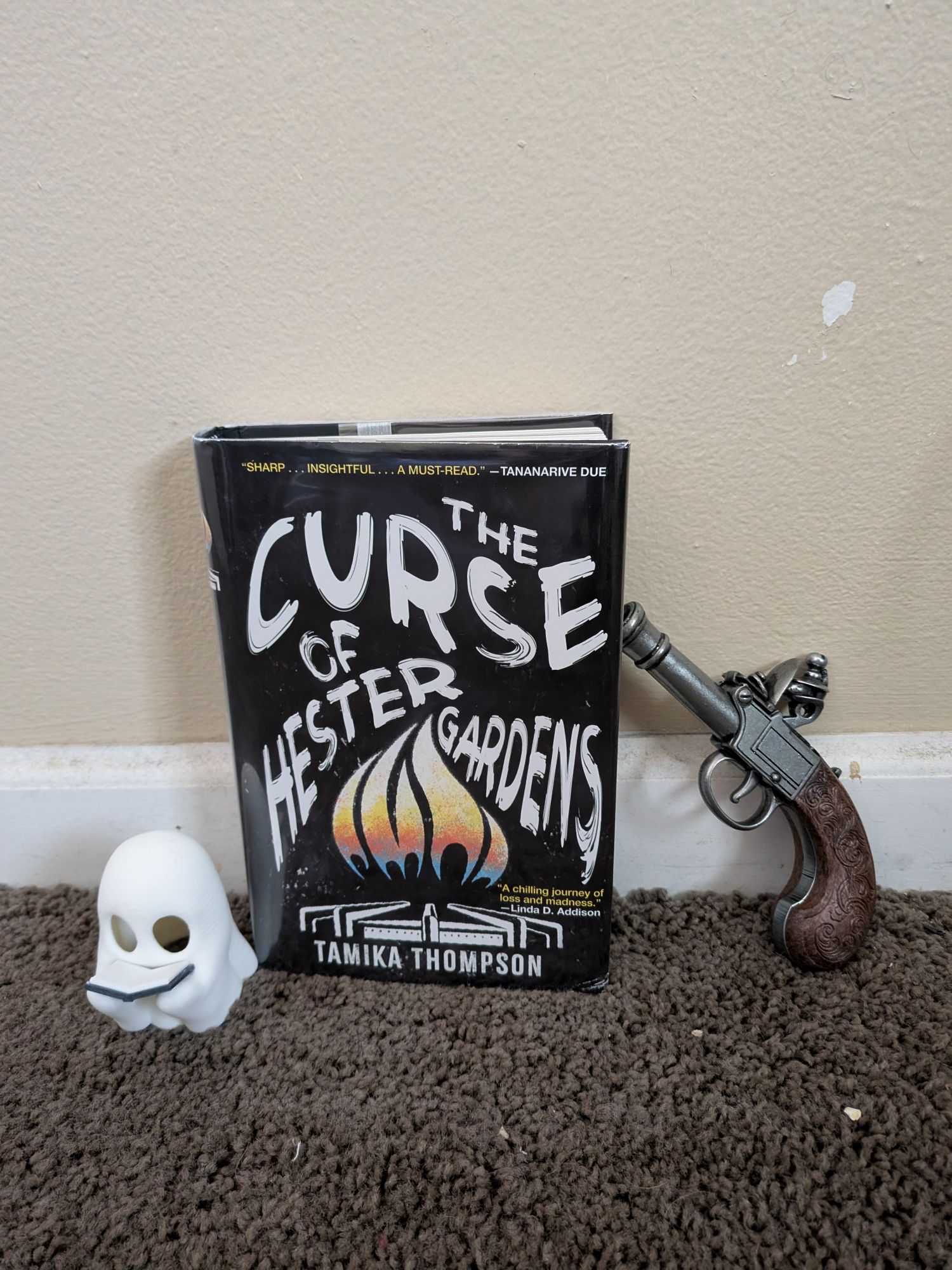
Earlier this month, I had the pleasure of reviewing The Curse of Hester Gardens by Tamika Thompson (see my review here). To say the least, it was quite the read. And since I’m lucky enough to be friends with its author, I thought I would pick her thoughts and see what she has to say about her book. So, ladies, gentlemen, and non-binary nobility, please welcome to the blog Tamika Thompson!
Rami Ungar: Welcome to my blog, Tamika. Tell us about yourself and your new novel, The Curse of Hester Gardens.
Tamika Thompson: I’m originally from Detroit, and I grew up about a mile away from a public housing project called Herman Gardens, which is a strong architectural inspiration for Hester Gardens. At eighteen, I left Detroit to attend Columbia University, where I studied Political Science. I went on to the University of Southern California to study journalism, and it was there that I reported on gang violence in Southern California. After graduation, I worked for several years as a journalist, and eventually spent two years researching gun violence in America. The lived experience, studies in global and national politics, and journalism background all came together in this debut novel.
The Curse of Hester Gardens is a gothic novel set in a public housing project that follows one mother, Nona McKinley, whose oldest son is shot to death and whose husband is in prison, as she faces the twin specters of a supernatural curse and gun violence while trying to keep her remaining sons alive in their high-crime neighborhood.
RU: Tell us about your main character Nona McKinley. I find her quite the compelling lead.
TT: I am the first to admit that Nona has flaws. Having grown up in a public housing project and then attempting to raise three boys in another public housing project on the other side of the fictional town of Medford, Michigan, she is parenting in the worst possible circumstances in a high-crime neighborhood. She still tries to find joy, pleasure, and some semblance of normalcy in a terrible system of oppression and predation. She is strong and God-fearing, but she’s also having an affair with the married church pastor!
I see her on a continuum with Peter, the leader of the local Hester Boys gang. Readers believe Peter to be a villain, and I believe both Nona and Peter are capable of tremendous love and tenderness and also tremendous hatred and violence.
RU: I would describe Hester Gardens as “unflinching,” especially in its exploration of gun violence, urban violence, and urban neglect. What was writing a novel that explored all of that, and was also a frightening supernatural novel, like?
TT: It was an emotional journey, and it was years in the making. This story was being written inside of me before I was even a writer. The book is dedicated to my late uncle, who was shot to death when I was young. I mine a lot of my personal experience to tell this story. I also spent two years researching the epidemic of gun violence in America. When I sat to write, it took me five years to bring it together before I ever let an agent read it.
I’m happy when a reader tells me the novel made them cry because I cried a lot when I wrote it. I love all of my characters. None of them are villains to me because they’ve all been traumatized and oppressed by this country.
Balancing the social with the supernatural was a manageable task because I stuck with Nona’s story, her grief over losing her oldest son and how that colored every experience she had and every decision she made after. Her panic about keeping her remaining boys safe drives the narrative, as well as her personal isolation and terror over not being believed by those around her. I let that carry the story, and I think that naturally creates the balance.
RU: You also explored gun violence as a theme in your short story, “The Creak in the Attic.” Which, coincidentally, was the first story I ever read by you. What was it like to work with that theme in a novel versus a short story?
TT: “The Creak on the Attic Stairs” appeared in The Rack Vol. 2, edited by Tom Deady, and it not only deals with the American gun violence epidemic, but it also is set in the same story world as The Curse of Hester Gardens. Tackling gun violence in a short horror story is in some ways harder because you have to showcase the haunting of grief, the perceived supernatural remnants of the dead, as well as let the reader in on the shock and outrage that gun violence creates with fewer words. Guns hurt people, and there is less space in a short piece to make that point and get around to the hope at the end. Because I believe the hope is necessary for the conversation on ending gun violence to continue.
RU: Can you tell us about some of your other works?
TT: Short stories are my first love. I’ve had works published in Interzone, Andromeda Spaceways, and Prairie Schooner, as well as turned into audio on the Creepy podcast and translated into Italian.
My first book-length publication was a multi-genre anthology that I co-edited called Graffiti. It included essays, fiction, and poetry, with works that were speculative and real. It won a Foreword INDIES Award for anthologies.
I also gathered my published short stories with original works and brought them together in a single-author collection called Unshod, Cackling, and Naked, which won the Next Generation Indie Book Award for Horror.
RU: What are you working on now? And what are your plans for the future?
TT: I am working on a standalone second novel, which is still squarely in the horror genre and tackles a social issue, but with a cast of characters and setting that couldn’t be more different from The Curse of Hester Gardens.
I am also working on a sci fi fantasy novella, and another all-speculative story collection.
I’m still also writing short stories. That part of my writing practice never goes away.
RU: What advice would you give other authors, regardless of background or experience?
TT: Persevere on behalf of your stories! I’ve met a lot of extremely talented authors who could write circles around me, and their work doesn’t make it into the world because they don’t make it to the finish line on their manuscripts. I believe the author’s first job is to persevere in completing a manuscript. Both drafting and revising. Revision is where the author earns readers, so keep going. Persevere!
RU: Final question: pretend you’re stuck on a desert island for a while and you can only bring three books with you till you’re picked up. What books are you bringing with you?
TT: Song of Solomon, Toni Morrison. It is arguable that Beloved is Morrison’s magnum opus, but I have always been drawn to the characters in Song of Solomon, particularly Pilate and Guitar. Morrison’s prose is intricate across all her books, but Milkman Dead’s journey of self-discovery is a powerful one, and the idea of Guitar’s Seven Days mission haunts me even now. Movements for civil and human rights by black people have only ever sought equity in America, but what if we decided to seek revenge? An eye for an eye? I shudder to think.
Middle Passage, Charles Johnson. I had the privilege of having a conversation with Johnson during a class I took early on in my writing practice and his tutelage on story and plot was foundational in my own practice. Middle Passage is not only brilliant, but a master class in creating work that is subversive.
Giovanni’s Room and The Fire Next Time by James Baldwin —I know I cheated on this one, but it is impossible to choose just one text by Baldwin. So, I went with my favorite of his fiction and non-fiction works. (To further cheat, may I suggest after reading The Fire Next Time to check out Between the World and Me by Ta-Nehisi Coates, as the latter is in conversation with the former?)
RU: I’ll allow it, since I remember Song of Solomon from college and considered it quite the powerful novel. Thank you for joining us, Tamika. I hope I can have you back here on the blog someday.
If you would like to find out more about Tamika, you can check out her website and social media, which I will link to below. And make sure to check out The Curse of Hester Gardens, which is definitely one of the best new novels of the year.
That’s all for now, my Followers of Fear. I hope you enjoyed this interview and will tune in for more. And until next time, good night and pleasant nightmares.


