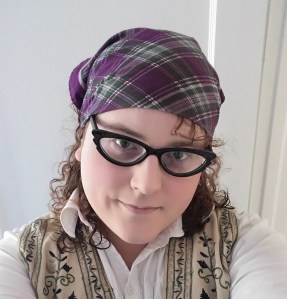
Well, looks like I’m not the only one who’s having a dream come true. And I’m very excited about this interview. She’s a rather unique voice I’ve come to know recently.
I first met Rabbi Leiah Moser back in December, when I ran across one of her posts on her blog, Dag Gadol (Hebrew for “big fish”). Her post was about why, as a rabbi, she was writing a fantasy novel. I read through it, and I found that not only did she have some good points, but there was something about this blog and its writer’s voice I found compelling. As I read further, I found out that not only was she a Member of the Tribe, a rabbi, and a writer, but a member of the LGBT community. And here’s me, not just a writer, a Member of the Tribe and of the LGBT community, but the son of two rabbis, one of whom is also LGBT. I think the first line of my first comment on her blog was something like, “An LGBT female rabbi who writes fiction. Where has this blog been my whole blogging life?” Thus started our acquaintanceship.
Recently, Rabbi Moser announced that her YA fantasy novel, Magical Princess Harriet, had been published and was live on Amazon. Me being me, I offered to give her an interview here on my blog. Thus are we here today to here about Rabbi Moser and Magical Princess Harriet. Enjoy!
Rami Ungar: Welcome to my blog, Rabbi Moser. Tell us a bit about yourself and how you got into writing.
Rabbi Moser: I think I’ve wanted to write a fantasy novel since I was in the sixth grade, but the road to actually achieving that ambition has been a long and convoluted one. Throughout my teenage years and into adulthood I tried my hand at writing fiction from time to time, but never managed to actually finish anything to my satisfaction, partially I think because I still hadn’t managed to get the whole identity thing nailed down. Trying to write without really knowing who you are is like trying to run on loose sand — the ground keeps shifting beneath you and you never seem to make any progress. After a while I kind of gave up on the dream of being a writer. I tried to find other dreams to pursue, but in a lot of ways I was just drifting.
Then while I was living in Japan I had this really intense religious experience. It’s kind of hard to explain, but the practical upshot was that afterwards I had this absolutely unshakeable conviction that God was real and that I needed to be Jewish. When I got back to the United States I found a synagogue and began attending, and after a while converted to Judaism. Later on, I decided I wanted to deepen my Jewish learning so I could do more work in the Jewish community, and that’s how I ended up moving out to Philadelphia to go to rabbinical school.
Rabbinical school was amazing, but before too long I was running into the same problem there that I’d had with my writing, namely that to do this kind of work you really have to bring your authentic self, whereas I’d been doing my best to hide from my authentic self ever since I was in middle school. After a great deal of soul searching I decided to come out as transgender and start my process of transitioning, and that, of all times, was when I finally realized that I had an idea for a book that I wanted to write. It was really that closely connected — converted to Judaism, came out as trans, and then the idea for Magical Princess Harriet popped up out of nowhere begging to be written.
If anything what I’ve learned from all this is that in this life things sometimes have to happen in a certain order and I am in no way the one who gets to decide what that order is. As they say in Yiddish, a mensch tracht un got lacht (a person plans and God laughs).

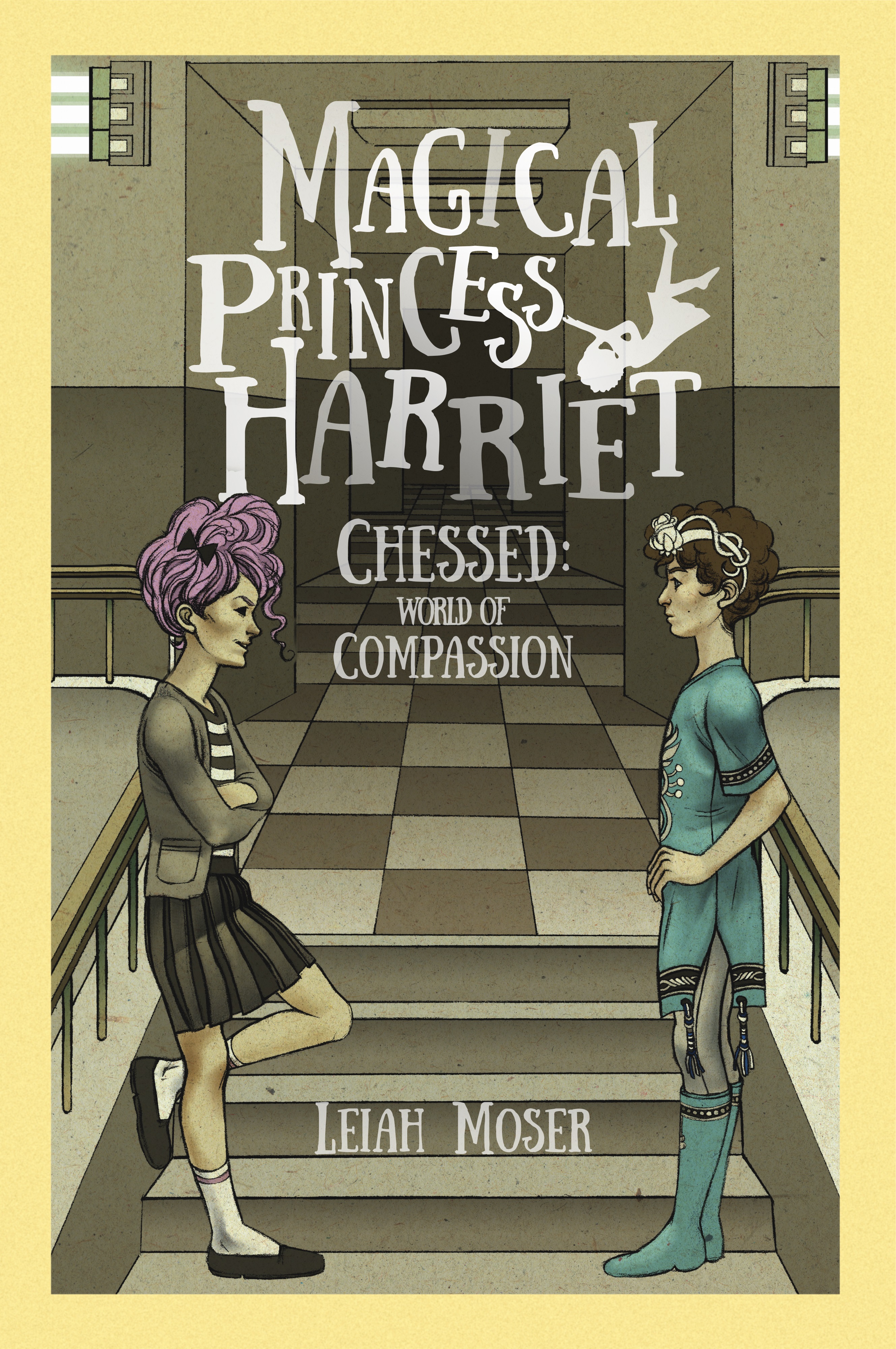
The cover of Magical Princess Harriet.
RU: Reminds me of the old country. So tell us about your new book, Magical Princess Harriet. I’ve heard some good things.
RM: Magical Princess Harriet is a young adult fantasy novel that draws its inspiration in roughly equal amounts from the “magical girl” genre of anime, Jewish mysticism, and my own strong feelings about LGBT inclusion and neurodiversity in Judaism. It’s about a young trans girl named Harriet Baumgartner who is doing her best to avoid having to think about the persistent feeling she has that she’s not supposed to be a boy, when a pushy angel named Nuriel shows up and tells her that she’s a magical princess now and that it’s her job to protect her town from the forces of darkness. (A quick side note: You have no idea how difficult it is to figure out how to talk about a book in which the main character changes their name and pronouns a third of the way in without misgendering them. Of all the challenges I’ve faced in figuring out how to explain this book to people, that has been the most difficult!)
RU: Tell us about some of the characters, and why we might like (or if applicable, hate) them.
RM: Harriet I’ve talked about a little already, so let me talk about her friend Frances.
Frances and Harriet have been best friends for years, ever since they met in Hebrew school. When Frances was six years old she was diagnosed with Autism Spectrum Disorder (ASD), and ever since she’s been pushing back against peoples’ tendency to regard her as stupid or crazy because she sometimes has trouble speaking. Obsessed with architecture, she has an inherent talent for understanding spatial relationships, which serves the kids well in the labyrinthine corridors of Arbory Middle School where the ordinary laws of space and geometry tend to break down.
The girl on the cover with the lavender hair and the dark holes where her eyes ought to be is Kasadya. She looks like that because she’s one of the nephilim, a group of creatures who got their start as angels unwilling to devote their existences to service. As a nephil-girl, she has the power to influence human minds, and she has used this ability to turn the middle school into her own private domain… well, private except for her brother Azrael, that is, but as far as she’s concerned she is the one in charge. Kasadya likes to think of herself as an epic villain from a TV show or comic book, and she’s been waiting for a hero to come along to challenge her. When Harriet shows up, glowing like a disco ball, it occurs to Kasadya that she might fit the bill — much to Harriet’s chagrin.
RU: What was the inspiration for MPH? Did any of your own life experiences make their way into or influence your writing of the story?
RM: I think all of my life experiences made it into the book in one way or another. This was an intensely personal project for me.
RU: MPH had an illustrator, Magdalena Zwierzchowska. How did you two meet and what was it like working with her on the book?
RM: When I got to the point where I was thinking seriously about publishing this book for real I knew I wanted to find an illustrator. I’ve always been a very visual person myself, and know how helpful illustrations can be in solidifying one’s sense of the world an author is presenting. How we met was fairly prosaic — I posted an ad on DeviantArt indicating that I was looking for someone to illustrate this book, and she was one of nine or ten people who responded. I was totally charmed by her work, by the gorgeous, surreal creepiness of it, and so she got the job.
Working with her was easy in some ways, difficult in others. She was extremely professional and always willing to listen to my input and feedback regarding how the characters and setting elements should look. The tough part was figuring out how to translate the images I had in my head into concrete instructions she could use. In the end I was very pleased with how it all turned out. I think it has a very unique look.

An illustration of a seraph by Magdalena Zweirczkowska.
RU: You address several issues in the pages of MPH: autism spectrum disorder, Jewish identity, gender identity, intersectionality, etc. Was it hard to talk about those subjects in the book?
RM: Yes. Not because I normally find it difficult to talk about these topics (on the contrary, most of the time I can’t shut up about them!) but because I didn’t want to address them in a way that would come across as preachy. That may sound a bit weird, coming from someone whose job literally involves preaching, but I was writing with the assumption that these were things my target audience, middle schoolers and teens, are dealing with every day, and the awareness of that fact demanded that I approach what I was doing with a self-critical eye.
RU: MPH is a crowdfunded, self-published book. What made you decide not only to self-publish, but to crowdfund your story?
RM: While it is theoretically possible that I could have found a publisher for a book like this, my hopes were not high. That has nothing to do with the quality of the book, mind you, but rather its subject matter. MPH in many ways defies categorization. I mean, Jewish fantasy is not exactly a well-represented subgenre, is it? Add on top of that the transgender element and… well, I felt like I might be able to find a publisher for a Jewish fantasy book, and I might be able to find a publisher for a queer fantasy book, but a queer, Jewish fantasy book with a transgender protagonist? That’s where I wasn’t so sure.
Also, I’ll admit, there was a part of the decision that was about actively wanting to do it myself. I’ve always been fascinated with every aspect of the publishing process, and with print-on-demand and online sales venues making it so easy to self-publish these days, it seemed like a waste to write the book and then turn it over to someone else to produce. I probably bit off more than I could chew, and I had to spend a lot of time learning about things like layout and formatting for print, but in the end I’m really happy with the way it turned out.
RU: What has the reception for MPH been like so far (from congregants, friends and family, random Internet people, etc.)?
RM: It’s still early days, but so far all the feedback I’ve been getting has been very positive. The first question of everyone who’s actually finished the book has been, “When is the next one coming out?”, so that’s pretty great to hear. My one thing is that because my Kickstarter backers are obviously all adults, I haven’t yet received any feedback from the young people who are the primary audience of the book. I’m really looking forward to that.
RU: Are you working on anything new? And what are your plans for the future?
RM: Right now I’m mainly focusing on getting the word out about Magical Princess Harriet, but I have plans for at least two more books in the series. After that… well, who knows? It all depends on what kind of response I get, I guess. I really loved writing this book, and now that I know I can, I feel like there’s very little stopping me from writing another, and another, and…
RU: What advice would you give another writer, regardless of background or experience?
RM: Write! But that’s ridiculously obvious and patronizing, so I take it back. Here’s the best piece of advice I can give: Take the time to figure out who you are and to learn how to be okay with that. Writing can be this incredibly daunting thing because those ideas and feelings on the page you just handed to someone else to read are basically you. It’s hard not to get intimidated by that and start pulling back, to restrain the words, force them into a mold that’s more about what you think others are expecting than it is about what you have to write. Edit your writing, not yourself.
And also: It is ridiculously easy to publish a book these days. Give it a try, you’ll see what I mean.
RU: Final question: if you were stuck on a desert island for a little while and could only take three books with you, which ones would you picks?
RM: Ack! That’s so hard! Assuming that “three books” refers to three actual bound volumes and that bringing an entire set would be cheating, I have to go with:
- Volume 2 of my portable Talmud set (the one with massechet Chagigah)
- 1Q84 by Haruki Murakami
- A copy of The Star of Redemption by Franz Rosenzweig, because then I might be able to actually finish the darn thing.
RU: Thanks for being on the show, Rabbi Moser. We all hope the book does well.
If you’re interested in checking out Magical Princess Harriet, you can check it out on Amazon. And I highly recommend checking out her website Dag Gadol. Trust me, it’s a great site and I always enjoy seeing new posts in my inbox.
And if you would like to have an interview for your new book, hit me up on my Interviews page or email me at ramiungar@ramiungarthewriter.com, and we’ll see if we can make some magic happen.




 Rami Ungar The Writer