Archive for the ‘Reflections’ Category

Is that the creepiest title I’ve ever written for a post or what?

Today while editing Snake, I thought I’d listen to some music off of YouTube (I’ve still no handle on Pandora or Spotify, if that’s what you’re wondering) when one of those three-minute ads came up. Normally I skip those ads, but I decided to check it out once I heard that the man speaking in the beginning of the ad was a forensic sketch artist for the FBI (guaranteed to get my attention, right?). The ad is below, and I strongly encourage you to watch it before going any further.

Let’s go over something very interesting about this ad: when the women in the ad described themselves to the artist, they tended to focus on the features they disliked about themselves. The resulting sketches then embodied those aspects and didn’t really match the actual women. But the people they’d become friendly with prior to the sketching, when they described these women to the sketch artist, they tended to focus on what made these women beautiful, what these newly-made acquaintances liked about these women. The portraits therefore were very beautiful and more closely resembled the women.

This is the guy who talks to his mirror image. If you’re familiar with his anime, you know he’s got a lot of work to do on himself.

Now despite being a Dove commercial (and not even Dove chocolate), I found myself really liking this commercial. I also found myself remembering something from an anime I’d watched years ago, where a character had a discussion with a mirror image of himself while trapped in another world (typical of anime, right?). The character was told that he represented how he saw himself, while his mirror-image was how others saw him. They were very different representations of the same character, but they were still the same person.

And that got me to thinking. Yes, dangerous activity, but I think anyway. We all focus on different aspects of ourselves and aspects of others. When we focus inward and look at ourselves, we often see what we don’t like about ourselves. For me, it’s my constant battle with zits and keeping off the weight I gain because I can’t resist those sweets. However when we focus on others however, we tend to focus on what we like about them, especially when we like them. When I think of a couple of friends of mine, I usually think about their height that I’m so jealous of or their smiles, and that twinkle they get in their eyes when they do smile.

So what does that tell us? Perhaps that we focus on ourselves and point out what keeps us from attaining some measure of perfection that society expects from us, and that we look for the good in others because that’s what we want for ourselves. It’s a possibility, although it’s not a nice one. Perhaps it also tells us that while we’re critical of ourselves, we love seeing the good in others, because it reminds us of the good in others, or the good we’re working to attain. That’s certainly a better take on things, right?

It’s also very true of some of the characters in my stories. Take Reborn City, for example: my heroine Zahara Bakur sees herself as a timid girl who gets easily scared when violence rears its head and can’t be relied upon when the chips are down. Her friends however see her as a very innocent but very strong girl, close to her faith and resourceful when the chips are down. Who’s right? Both actually: Zahara is nonviolent and doesn’t like to get herself into conflict, but she’s also quick-thinking and her faith supports her when times get bad. In addition, she likes to see the good in everyone, which can be a real comfort when you’re in a gang and people tell you that you’re a waste of space. In her own way, she’s helping people, all without a gun.

In addition, the titular character of Snake is also very multifaceted, though he and the people around him are more aware of that than Zahara is. The Snake is certainly gentle to those he cares about and is capable of compassion, but to those who pose a threat to him or those he loves he can be very dangerous. He’s also aware that he’s mentally unbalanced and that he’s also quite possibly evil, but at the same time he wants to at least use his evil for a good purpose. My heroine Allison Langland, who knows the Snake very well, is aware of his evil, but is also aware that he’s actually a very good guy. He’s sociable, he’s self-deprecating, and he’s responsible. She has to reconcile this with the fact that the main character is also a vicious killer capable of torture and murder, but she prefers his good side, because that’s the side she sees as the real Snake, and it’s the side that she thinks is the true hero.

To put my metaphor better, we are all something like this. Good or bad, our own perceptions or other perceptions. We just have to act on those to really get to know who we are.

So what does this say about all of us? For starters, we are not the sum of our features or our flaws, and we are not the sum of what others see in us. We are a combination of those ideas of ourselves, and we are what we use all those ideas about us for. For Zahara, she is the girl who can bring light to people living in the dark, even if she hates anything involving violence; for the Snake, he’s a monster doing good in the only way he knows how, even if it damns him; and for me, I’m trying to lose the weight, wash my face at least once a day, and write stories that people empathize with. We’re all combinations of our own perceptions, the perceptions of others, and what we use those perceptions for. Once we figure all that out, I think we can achieve a level of peace and live our lives in a way that’s conducive to us and those around us.

I’ll try to keep that in mind the next time I’m getting ready for bed and I see that one zit on my nose or how much weight I’ve gained this semester.

“Film is powerful and powerful is film. Hover on the TV and silver screen. Mwha ha ha ha!”

We’ve had the vampires, cool, collected, tortured, ferocious and merciless while elegant and noble. With so many Twilight knock-offs, they’re out the door, though a few want to stick around.

Ladies and gentlemen, possibly the new face of supernatural fiction, played by Sheri Moon Zombie (Rob Zombie often includes his wife in his work. I bet it does wonders for their marriage).

We have zombies at the moment, metaphors for the numbing effects of society on man and creepy cannibals without brains (fast or slow depends on which adaptation you’re watching/reading). Not sure if this fad is peaked yet, but I think you could make an argument for affirmative and negative on this.

And werewolves, with Teen Wolf and The Wolf Gift rocking critics and bringing in the money, might still get their own fad (I’m hopeful they will, anyway). And why not? They can go from calm, human, and even meek to large, ferocious, and virile in a space of seconds and then back again. There’s something magnetic about that.

However quickly beating the werewolves to the popularity stage and joining the zombies are some ladies I didn’t see coming: witches. Double double, boil and trouble.

With Oz, The Great and Powerful making millions at the box office, a reboot of Sleeping Beauty based around Maleficent by Disney coming out next year, the Rob Zombie movie Lords of Salem starring his brilliant wife Sheri Moon Zombie coming out this coming this weekend, plus a whole slew of other works that I can’t list here and more that I don’t even know about, it’s safe to say that witches are getting their own turn in the supernatural spotlight.

Why witches? it can’t be the Harry Potter fandom looking for something to keep them occupied now that there are no more books or movies, is it? I seriously doubt it. In fact, I think it’s the idea of a woman taking power and fighting back against the cruel world with a tool all her own. Witches–or Wiccans, as they were first called–were seen as mediators between the physical world and and the spiritual worlds, making them objects of both admiration and fear. With the later demonisation of Wiccans, witches gained an official position of being for good or evil. And in the past hundred years, witches have taken a center status in the scale of good and evil, with the evil including the Evil Queen, The Wicked Witch of the West, and Maleficent, while the good include Glinda, Hermione, and Willow Rosenberg (that’s a Buffy the Vampire Slayer reference if you didn’t get it).

Until now, portrayals of witches has been somewhat sporadic. But I think now, with the women’s rights movement gaining a new prominence in our world and women showing men that yes, they can do many of the same things that men can do and sometimes even better, studios and authors are using witches to portray women in roles of leadership and power and able to do things that some say only men should do, including saving the free world, and are not usually desperate for love, though they don’t mind companionship in their lives. It’s a stunning archetype compared to women in zombie or vampire films, who are often damsels in need of saving and often only become warriors after a lot of prodding and are constantly looking for love.

I’m looking forward to seeing more of this in the future.

So what can we expect? Perhaps a resurgence in older works centering around witches, like The Wizard of Oz and perhaps Anne Rice’s Lives of the Mayfair Wtiches trilogy. There might be a wave of magic-centric books with female protagonists (I know I’ve got one tucked away that I might pull out one of these days), plus movies and TV shows that remind us of Once Upon a Time while they try to be better than that show. And of course, as with vampires and zombies, there will be the detractors and parodies that always acoompany fads in fiction with this.

It’ll be interesting to see what materializes in the next couple of years if this fad takes hold, won’t it?

And as for my own stories about witches (and there are a couple, though only one features a magic that can be used only by women under normal circumstances), I’ll probably wait for a while. I don’t like to follow fads in fiction, which is why I haven’t written a zombie novel yet or released my previous vampire novel (which I’ll rewrite at some point in the future, I’m sure). But hey, look on the bright side: when I do write these stories, you won’t have to worry about my stories being the same as everyone else’s.

Do you think witches will be the new zombies or vampires? How do you feel about that?
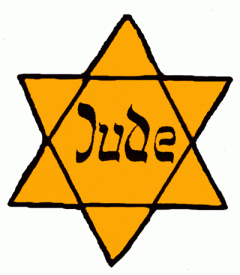
This week at Ohio State University is Holocaust Remembrance Week. Like last year, I am giving a small speech to commemorate this sad occasion at OSU’s Jewish organization, OSU Hillel, during the Friday night service. Since I know most of you won’t be at Hillel, I’m posting my thoughts on the subject here. If there are any grammatical errors or misspellings that I missed, please forgive me, it was not my intention to leave those there.

I hope you enjoy reading this and that it affects you positively. Thank you for reading.

***

It’s been nearly sixty-eight years since the Holocaust ended and Adolf Hitler committed suicide, signaling the end of the war in Europe. The war left millions dead, millions more displaced, and thousands of questions unanswered, many still unanswered. The most important question though, at least for those of us who commemorate the estimated thirteen million dead, is how could the Holocaust happen?

As one of my majors is History, and my focus is on the war in Europe, I could go into all sorts of reasons as to why the Holocaust happened. I could go over for hours on the “Stabbed-in-the-Back” legend, Germany’s political and economic conditions during the Weimar era, Hitler’s underlings meeting at the Wannsee to determine the Final Solution, quotations from Mein Kampf—but the one reason I’d like to focus on can be summarized in one simple word: dehumanization.

Hitler made numerous insinuations about the Jews of Germany and the rest of Europe. However one thing that remained true of every insinuation, and that was the Jews were less than human, as if they were monsters with barely human form. As more people came over to Hitler’s side, more and more people were willing to see the Jews and all those that Hitler deemed “sub-human”, as not a human being like them.

And once you see something as non-human, it becomes easier and easier to discriminate against it. First the Jews and all “sub-humans” were discriminated against. Then legal measures were taken to turn “sub-humans” into second-class citizens. And then the “sub-humans” were turned into slaves. And finally, cattle to be slaughtered and thrown out with the trash. Such is the value of things considered less than human. It took the efforts of many Righteous Gentiles, risking their very homes, security and lives, to see past this illusion of inhumanity and protect many thousands from the gas chambers Hitler had built for us. If more had thought like the Righteous Gentiles, perhaps more people would’ve survived the Holocaust.

We often think that the events of the war couldn’t possibly happen today. Sadly, we are so wrong. As we all too well know, minorities in this country such as African-Americans, Hispanic-Americans, and Asian-Americans were discriminated against for years, and even amendments to the Constitution haven’t totally brought those with darker skin to the same status as whites, whether it be educationally, economically, or socially. Stereotypes keep well-qualified workers away from jobs, and can even lead to them being imprisoned simply because of their race.

In addition, women the world over are given second-class status, and any actions to rise above that status can get them beaten, imprisoned, committed to insane asylums, or even executed, all in the name of “morality and modesty”. Even in countries where this is not the case, such as America, women still aren’t equal to men in the eyes of the Constitution, and their voices are often drowned out by government officials who do not represent their interests.

And we all know that many people in the LGBT community still lack the rights of straight people. In certain countries homosexual activity can get you jailed or killed, and even in today’s air of equality, there are those who will stop at no end to keep the LGBT community in the place they are now, simply because they are different.

One of the greatest teachers of Judaism, Hillel the Elder, taught that “what is distasteful to you, do not do unto others. That is the whole of the Torah; the rest is commentary. Go and learn it.” By “it”, Hillel does not refer to the Torah or commentary, but the lesson that we may derive from this main truth. So when you go out tonight, remember that you would not like to see happen to you, don’t wish it or perform it on others. And if you see someone less fortunate than you, don’t look down on them, but ask yourself, “How can I help this person whom I might be like if I were in a similar situation?” And then once you’ve thought about it, act upon your conclusion. That is the whole of Hillel’s teaching. It was applied by the Righteous Gentiles during the Holocuast, and it can still be applied today, by you and by me.

Thank you and Shabbat Shalom.

Not too long ago I wrote a post about how some people, while passionate about their beliefs, get too passionate and end up being divisive and rude to others whose beliefs may not match theirs. Since that post, I’ve gotten several commetns from people explaining why they feel circumcision for males is mutilation, due to the fact that I listed a recent experience of mine in the post involving an online controversy about female circumcision vs. all forms of circumcision.

Look, I’m happy that people are passionate about their beliefs, and I respect all veiwpoints, provided they are not racist/sexist/homophobic/anti-Semitic or anything of that nature. However, I wrote that post to draw attention to people who take an attitude that says “It’s my way or the highway, and if you disagree, then I’ll outshout you until nobody can hear you”. It’s rude, it’s upsetting, and in the end it’s more likely to get people against you than with you. That was the point of that post, not to debate about male circumcision.

I’m also appreciative of all the comments I’m getting, I like to hear from people reading my blog, but I’d be happier if people would please refer to the real issue of that post, which is certain attitudes do more to hurt than help your cause and by adopting athe right attitude, perhaps you can at least have a meaningful discussion, if not exact positive change and compromise. The fact that so many people saw only the part about male circumcision worries me and I’d like to remind them about the issue stated in that post, not the examples I gave.

Thanks for reading, and please send hate mail/hate comments to Westboro Baptist Church in Westboro, Kansas. They’ll be much more lively in a debate than I’ll ever be.

I woke up yesterday morning and was filled with memories of some of my old attempts at writing, the first fiction stories I ever wrote, and how they shaped and defined me over the years, and how I got to this point in my writing.. I wanted to write a post about them, but with all that was going on yesterday, I didn’t have the time. Well, better now than never, right?

The first time I tried to write anything, I must’ve been five or six, eight at the most. I had just seen Harry Potter and the Philosopher’s Stone for the first time and then read the book, which was infinitely better. My mind was blown, and I could only think to myself, “I want to write something like that”. So I did, creating a similar story to HP1 except with the genders of the characters switched (even then, I had a thing for strong female leads, I guess). I called this obvious copyright violation Amanda Robinson, I gave her a cat instead of an owl, and I planned that the cat was a prince in cat form who would be my main character’s love interest at the end of the book, but beyond that same basic plot as HP1. I didn’t finish this work, either because I had the good sense to stop before I got sued or because at that point in my life I couldn’t keep my focus on any one project for very long. But it did spark my interest in writing, which only grew as time went by.

My next major project was a pirate adventure story called Bane Nycroft and the Maelstrom Pirates (I’m not sure if this one was inspired in any way by Pirates of the Caribbean, but it’s a possibility). That story featured a lycanthropic teenage pirate with a stolen Navy ship, leading a band of fellow orphans on the high seas and stealing from rich government banks and fighting monsters and demons. Along the way the pirate picks up a rebellious princess and they discover an island where all sorts of strange and magical creatures reside, and eventually they take on a prince who’s actually a demon in disguise. This one went through several rewrites, each rewrite growing more supernatural as time went by. Eventually I lost interest, but more than Amanda Robinson, Bane Nycroft gave me a taste of what professional fiction writing was like.

After that came the Davis trilogy, a couple of vampire novels that were inspired by the movie Van Helsing. In those novels, which fused a lot of the Buffy mythology to Van Helsing and my own twisted imagination, a teenager commits suicide after seeing his crush with her boyfriend. The teenager makes a deal with the Devil to become a vampire and take over the world and make the girl his vampiric bride. The girl, on her way to becoming a vampire, must band with her boyfriend, her older brother, and her best friend, who happens to be a witch, to stop this horrible vampire from turning the world into permanent darkness. I actually got to the third book with this one, but at that time the slow realization that nobody would want to publish such a confusing story that ripped off so many works came over me. Plus as I got further along the story got more and more sexualized, which sort of corresponded with where I was at that point in my teenage years.

I wasn’t entirely finished with the vampire mythology though, and almost immediately afterward I began work on Mahiro, which in my opinion had the first inklings of the style of writing I have today. In it a teenage boy travels to an alternate universe inhabited by vampires. While there, he is found by Mahiro, the queen of vampires, who takes a liking to him and turns him into a vampire. But before she can finish the ritual and take his soul, he escapes and finds the human resistance, where he assembles a team of crack fighters to help him take on Mahiro and perhaps find a cure for vampirism. At the same time, he must deal with a romantic triangle, being drawn both to his girlfriend, whom he left on the other side of a dimensional portal, and an equipment tech with some terrific sharp-shooting skills. It was promising, but at that point Twilight was hugely popular and was gaining more fans everyday. As a consequence the number of vampire books out there was astronomical, and I didn’t want to compete with that. With that in mind, I shelved Mahiro until a time I could bring out the characters again and rewrite the story. Until then, no vampires for me.

There was also a poorly-researched caveman story and a Frankenstein-esque horror story I wrote in between Bane Nycroft and the Davis trilogy, plus some attempts at zombie literature. Other than that, those were the main works that preceded the creation of Reborn City, which I’ve stuck with up until now and I’m happy to say will be published as soon as the beta reading period is over, I can create a cover, format the whole darn thing, and get a copyright.

Over the years, I’ve written a lot. My writing style’s changed drastically since I started writing fiction, and I’ve incorporated new elements to my work with every author I’ve read and every experience I’ve gone through. I wonder what the kid who sat in front of the old Windows 97 computer hen-pecking out a Harry Potter rip-off would say if he saw me now and what my writing’s like (probably “Why aren’t you living in a mansion yet?”). I hope to continue to grow in my writing and to create awesome and scary works. And perhaps, unlike my previous work, the characters will be college students or even full adults instead of teenagers. That’d be a break from the past!

I’ve been so busy lately, that the ideas for blog posts have been piling up. I wanted to write two or three yesterday, but Shabbat came in before I could, and I had to put any post-writing plans on hold. Now that Shabbat is over and I’ve done some homework and I’ve watched last night’s episode of Grimm, so I’m good to start writing a few posts. And to start with, I’d like to bring up a topic that’s been on my mind for the past couple of days:

I’m one of the few horror fans I know. In fact, I only know one other fan of scary movies on campus, but his schedule is so different from mine that we can’t always just sit down and talk to each other about horror movies and the qualities of originals versus remakes…or in fact, talk about anything. In fact, I only found out about his love for horror films tonight! How whack is that?!

Thing is, I feel a little lonely sometimes. I can’t help but feel a little down when I see people debating the Game of Thrones‘ books versus the TV show or see Trekkies go crazy over the new movie coming out. But are there a ton of people going crazy over Stephen King adaptations coming out soon? Um…me and quite possibly my mother, I know that much. Anyone getting nuts for the third season of AHS, American Horror Story: Coven? Me and…the sister who lives on the other end of campus and whom I only see on vacations or at family or holiday events. You see how sad this is?

The thing is, I want to have conversations that are like comic book fans debating how to beat the Hulk if you don’t have superpowers or debates about whether Kirk or Picard is the better captain, only in more of the vein of horror. But there’s not a lot of people who are into that sort of stuff, at least not on my blog. The posts I do write that are devoted to horror subjects don’t always get a lot of reads or likes and rarely any comments, so I don’t always write them. And it…it makes me wish more fans of horror were on my blog.

I’m not complaining or anything about the conversations  I’ve had up to this point or the friends I’ve made not being fans of scary stuff. But I do wish that I could find some more people interested in the horror scene, who go crazy for the same things I’m into or at least show some enthusiasm for those things.

Well, it’s the Internet age. I may just not be looking hard enough. Does anyone know any Facebook groups? I’m on that now, so I better get to work searching. And I’d like to say, if you ever want to discuss horror subjects, I’m always game. I love to talk about horror. So much that I scare normal people.

Okay, I’m going to stop ranting now. I just want to say, I’m going to start writing more horror posts from now on. I’m sorry if that scares you. But I must say, I want to talk about horror more often, so that’s what I’m going to do. Hope you’re okay with that. Maybe I’ll meet a few people who go crazy for ghosts and slashers like I do.

One can only hope.

As you all know, I’m a huge fan of Anne Rice, so when I got my Facebook back in December, I immediately subscribed to her page. As I quickly learned, Ms. Rice likes to use her page to talk about issues important to her, especially LGBT and women’s rights. Earlier this week though, something happened on the page that caused quite the cyber-ruckus: Ms. Rice posted about how female genital mutilation–sometimes euphemistically called “circumcision for girls”–is still practiced openly in many nations and secretly in some such as the US and Great Britain. The reason behind this practice, which causes women to have very painful sexual intercourse and in some cases can cause medical complications and infections? Not consecrating them to any sort of higher being or health reasons like male circumcision, but in order to ensure chastity and virginity. In other words, the sexist belief that women have uncontrollable sexual urges and unless men do something about it, they will have sex left, right, and center.

You wouldn’t believe the meshuggas that happened on her FB page.

When Ms. Rice posts about an issue on her Facebook, she usually does it to bring attention to the issue and cause discussion, hopefully to enact positive change. The unexpected effect though, was that several people on the page began railing against male circumcision and making it impossible to have any rational discussion unless all visitors to the page include male circumcision to their disgust to female circumcision. Some of these people went a step further, insulting anyone who tried to stick to the topic at hand or tried to defend male circumcision for religious and/or health reasons. My own parents, rabbis with many years of experience, were insulted and called nasty words after I tried to defend my religious beliefs against them.

The next day Ms. Rice said that the issue should’ve stuck to female genital mutilation, that she had no idea how the topic got so out of hand, and that those who had been especially insulting would be banned from her page forevermore (apparently she has the power to do that). Many of us, including myself, gave the woman a huge “THANK YOU!” and then started a rational discussion on female genital mutilation.

Now, this was an isolated incident, but it got me thinking on past incidents where people were loud and then incredibly rude. Foremost in my mind was when President Obama came to campus in October, and pro-life advocates showed up to protest with signs that were clearly Photoshopped. Whenever those there for the event tried to be reasonable with them, they jsut seemed to get louder, interrupting every sentence, and getting up in their faces.

And there are other incidents in mind, ones I’ve attended and others I’m happy to have been far away from. There are people on both sides of the Israeli-Palestinian debate who will say the worst things about whatever side isn’t their own. Gun advocates will often scream at the government trying to take away their Second Amendment rights. And just so I don’t sound like the liberal I probably am and turn off more conservative readers, there are advocates of environmentalism who are so aggressive with their beliefs that it can get out of hand and they will scare people with it. All of these things have a common thread: loud people being incredibly uncaring and callous in their treatment of those who don’t think like them.

Unfortunately, these sort of debates can bring out the worst in people. It’s not pretty, but it’s the truth.

Now, I don’t see anything wrong with being passionate in your beliefs. There’s nothing wrong with that. However I draw the line when those who are loud start to swear and call people who believe differently than them horrible names and blame them for the ills of society. That’s not the way to get people on your side, especially if people who are undecided one way or another on an issue. In fact, if I had to summarize what’s the way to get people on your side of the debate, it’s not to be virulent, angry and inflammatory. No, it’s to be calm, respectful, and only armed with facts. I believe that’s the way famous saints and leaders have won the masses to them and made great impressions on history.

And the people who are loud, rude and imflammatory…well, I hesistate to say anything about them, lest I get called nasty names by these exact same people for the examples I might bring up of people who were like them. But you see the effect these sort of people have on others. They thrive on anger and use fear as their weapon, hoping that fear will make those opposed to them at least quiet down for fear of their wrath (we sometimes see this with lobbyists and Congress, unfortunately).

The lesson here is not to let your anger get the best of you, but let it drive you to enact better change, no matter what your beliefs on any issue may be. That’s the only way to make change, and to try doing the opposite will only cause you and your cause problems that may not be overcome. And no cause wants that, right?

What is in that fog? Something wicked this way comes.

I’ve often used this blog to rail against horror movies where filmmakers have spent a ton of money on CGI and making a top-notch movie, and yet the most exciting aspect of the movie is the trailer. I’ve even done lists of what you should and shouldn’t do when making a horror movie (for that post, please refer here: https://ramiungarthewriter.wordpress.com/2012/07/11/what-not-to-do-when-making-a-horror-movie/). Now I think I’ve identified two more factors in horror films that could separate a good scare from a boring waste of $6.50. Those factors are build-up and mystery.

For the first one, I’d like to call attention to the beter films in the Friday the 13th franchise versus the remake, the latter of hich I never get tired of ripping for how really bad it was. In the better films, the filmmakers had a way with building suspense that terrified audiences and made them want more at the same time. The best way to illustrate this technique, if you ask me (and I’m assuming you are, you’re reading this blog post after all), is through stream-of-consciousness from the POV of a moviegoer:

“Oh, she’s going out to that shed. Will Jason kill her there? She’s in and the light’s on. She bends over–I can’t see what’s behind her! Oh, Jason’s not there. Good. Oh, she’s bending over again! I can’t see behind her! Oh, Jason’s not there. Oh, how many lightbulbs does she need? Oh, Jason’s still not there. Okay, she’s heading back to the house. Will Jason get her now? Opening the door…OMG! What was that? Oh, it was just the cat. God, I feel as silly as the actress in that close-up–OMG there’s a machete poking out her front! She’s being lifted up! Yikes it’s Jason! AAAH!”

Somedays his writers do great with him. Other days…you know. All depends on how the suspense is added to the story.

You see there? Through visual dynamics and waiting until the least expected moment, they get the tension really high, make us think that we’ve seen everything to get scared of, and then WHAM! They scare us when we least expect it. In the better Friday the 13th films, this technique would scare the bejeezus out of people, and made the films famous and box-office smashes. Now contrast this with the reaction of me when I watched the remake:

“Okay, the naked chick with the bump on the head is hidden under the dock on the bad side of the lake. Jason’s probably seen her. She’s so dead. He’s on the dock. She’s looking up like he might get her. He steps away from her. Machete through the roof of her head! We see her bare breasts. She’s dead and in the water. Wow, so scary. NOT!”

No surprises in that film. We knew when a character was going to die, and there was no build-up of suspense to make us terrified. There was a reason that fans and critics hated that film. The only reason it did well was because people went hoping that the reviews were just by people who were overly critical and hard to please.

This is why it’s important to get a feel for building suspense like in the better of the Friday the 13th films. it makes the movies that much better, and if you’re really good at it you can keep it going throughout an entire film and even afterwards without letting the suspense and terror abate. And if you do become good at it, you can hopefully become someone in the horror movie industry.

Another aspect of making horor movies that can make a horror movie great is mystery. To illustrate that, I’d like to use The Amityville Horror and its remake (I love showing how bad remakes can be. Maybe people will learn something from it). In the original Amityville Horror, we never get a sense of what exactly is haunting the house. We see flies and hear masculine voices shouting “GET OUT” at priests. Things move on their own, and anyone of a religious nature gets horribly sick near the house. We know the little girl is playing with an imaginary friend named Jodie, who somehow locks the babysitter in a closet (that’s scary as it is), and there’s a room painted red under the basement stairs that causes the very-spiritual family friend to go into hysterics and scream “It’s the gateway to hell!” Later, the male lead sees a pig with glowing eyes in the window, which we assume tells him to kill his family, and later the same guy falls through the stairs into the hidden room and falls through the floor of that into a pit of blood.

Beware this room: its darkness is only rivaled by so little we know about it.

But do we really understand what’s haunting the house? NO! We know that the murder of the preivious residents of the house were killed by their crazy son, but we’re not sure if they’re causing the haunting or if they’re just one small piece of the puzzle. We also hear something of a satanic preacher living on that land many years ago, but it’s not assumed that he’s behind it in any way. At the end of the movie, we’re left thinking: “Oh mygod, I’m so scared! What was with that house? What was in it? And where did all that blood come from? And the pig in the window…what the f*** was with the pig in the window!” You see how awesome the amount of mystery in that movie makes it?

Contrast that with the remake, which is utilizing the whole mythology from all the films based on The Amityville Horror. Right away, we’re made very aware of what’s causing everything. Messages through TV, little ghost girls that manifest themselves in front of everyone and are held by mysterious arms against the ceiling. Messages in blood on the mirror…need I go on? There’s no mystery, except for a supposed-to-be startling revelation about the satanic preacher. At the end, we understand too well what’s causing the haunting, and we’re left very not scared. The mystery of the first film made it awesome, while the lack of mystery stripped the second film of any scariness.

At least that’s what’s happening with this film.

Is that all that is needed to make a scary film? Heck no! A lot goes into scaring anyone with anything, be it a story, a movie, or even a silly prank for Halloween or April Fool’s Day (I speak from personal experience on all but one of these). But these two factors–a build-up of suspense and an air of ever-present mystery–can create a terrifying experience that leaves those doing the experiencing chilled for the rest of the night. So keep these factors in mind when creating your own story (and it doesn’t necessarily need to be a scary story). You might end up creating a wonderful work of art that’ll be remade in thirty years by a high-powered team of filmmakers and debated about by fans in chat rooms for years to come.

Two posts I read recently got me thinking about something that many people talk about or wish they had: luck. Some people say there is no luck or if there is you make your own. Some say luck is something where a strange series of random events play out in your favor. And others say there’s a strange system or algorithm to luck that sometimes you can tap into, especially when you have a rabbit’s foot or some talisman like that. But how does luck work in the writing business, especially in these turbulent times when the author has to do so much themselves just to get their work into the hands readers, even the interested ones?

Well, that depends on who you ask: my friend and fellow author Pat Bertram (you might remember her as the person who did that wonderful interview a while back) mused in her article on the nature of luck and quoted a professor who believed that luck was the result of a consistently positive outlook on life (for the article look here: http://ptbertram.wordpress.com/2013/03/13/can-you-change-your-luck/). And today, I read another author by the name of Richard Levesque, who concluded that no matter how much work you do on your own to advertise your book, luck still plays a big part in your success (for his post read here: http://richardlevesqueauthor.wordpress.com/2013/04/01/how-much-does-random-chance-account-for-a-writers-success/).

What’s my take? Well…it’s a little bit of both, with some of my own spiritual beliefs mixed in. First, I think having a positive outlook helps everyone on the road of life. You can be in a wrestling match and feel discouraged that the guy you’re facing is bigger and weights much more than you and let him beat you…or you can let yourself stay positive, notice that his weight is great but his stance is sloppy, and tackle him that way. You’l think “Lucky I noticed that”, but truth is, you were able to do that because you didn’t let yourself admit defeat and kept fighting, not just physically but mentally and psychologically, which allowed you to see that winning move.

At the same time, sometimes luck comes in random coincidences and events. Some of you remember nearly a year ago that I wrote a review for Anne Rice’s The Wolf Gift, then I sent her a letter telling her I enjoyed the book and including a link to the review, should she ever get bored. Well, either Ms. Rice reads a lot of her mail and all reviews she can find or she was bored, because the next Friday she linked my review to her Facebook page, causing my stats to explode. Never expected that to happen, and to think that Ms. Rice read my letter, let alone my review, still amazes me.

Still, I think that those random events and coincidences might be sometimes manipulated by The Big Guy Upstairs. Why do so many people thank God after they’ve won or achieved something so important in their lives? Maybe becuase on some level they realize that a certain Some Being helped them achieve that goal. At least, that’s what it seems to me, and it’s the reason why I thank Him for so many good things that happen in my life.

However luck works, it’s undeniable that it does act in a writer’s life. JK Rowling was lucky that her books were such successes, and Psy was lucky that his video, out of so many, became such a viral hit. In essence, luck is something that gives artists of all types boosts so that they become great. I don’t know if this great luck will ever come to me, but that doesn’t stop me from hoping that it will. But until that luck comes to me, I’ll keep fighting and working so that my success can come that much more easily.

This morning I woke up with a memory and an idea: I remembered one time I let a friend of mine, whom I knew would not steal any of my ideas, look at the list of ideas for novels and other assorted creative endeavors. This was midway through high school and I’d probably just started the first draft of Reborn City. He sent it back to me with one note: Interesting.  A lot of ideas using magic here.

That was several years ago, like I said, and that Ideas List couldn’t have had more than 15 ideas on it at the time. Now it’s at 51 ideas and counting, and I thought I’d take inventory again. I went over the ideas, and I found some interesting numbers here. I share them with you now because they give insight into not only the sort of stories I like to write and create, but also gives an idea of who I am, and what my imagination gives birth to.

I’ll list these ideas, occasionally giving some information on why I gave these stats, and then I’ll tell you what I think of all these sorts of story ideas. You’re welcome to draw your own conclusions as well and tell me what you think. Also, please excuse the randomness of some of these stats. I listed them as they came to me. Also be aware that several of these ideas cross over with each other in terms of elements, such as serial killers crossing over with demons, science gone wrong featuring monsters, and so on and so forth.

Number of stories dealing with the supernatural: 29
–Number with ghosts: 6
–Number with monsters/demons: 26
–Number with magic: 24
–Number featuring God(s): 9

Trust me, plenty of stories featuring this sort of creepy stuff.

Number of science fiction stories: 9
–Number with science gone wrong as the main theme/driving force: 7

Number of crime/thriller stories: 17

Number featuring human antagonists: 33
–Number featuring serial killers/rapists/etc.: 25

Number of stories with strong female protagonists: 25

Number of ideas that aren’t for novels: 13
–Number of films: 3
–Number of TV shows: 2
–Number of comic books/mangas: 7
–Number of video games: 1

Number of ideas that are suitable for younger audiences: 1

As I said, I’d provide a little feedback on some of the numbers listed above. The first I’d like to draw your attention to is that most of my science-fiction ideas feature science gone wrong. Why? Maybe it’s got something to do with the fact that I sometimes wonder that our society, which is getting more technologically dependent with every passing day is going to find itself in a lot of trouble because of how much we rely on our technology. Although none of these stories feature Terminator-like elements, where the tech actually rises up to get us, I do think the stories do illustrate just how dangerous technology can be if we let it be the center of our existences, and shows just how paranoid I am about that happening. It may also explain why I always wait to try out new technology and social media until everybody else is using it. Makes it safer, I guess, at least in my strange mind.

Also, why did I emphasize stories with strong female protagonists? Because even in the year 2013, there are many novels/TV shows/movies/whatever where the female characters just fill a postition, often times to draw in male readers. And there are plenty of times when the female characters could be replaced by male characters and there wouldn’t be much change to the overall story. Imagine for one second that Hermione Granger from Harry Potter was a boy. How much would it change? The Ron/Hermione subplot would be taken out, but beyond that, there’d still be a smarty-pants character helping Harry figure out important stuff that’ll save his life later. Perhaps the readership, particularly the female readership, would be less, but it might still be a popular story.

Imagine how different this story would be if Katniss were a normal girl or if she were even a bad-ass boy? Not too fun to think about, is it?

So I write a lot of stories where female protagonists are like Katniss Everdeen: they’re indispensable to the plot. Change their gender or make them more meek or in a more traditional role, and you have by far a much less interesting story. Katniss is so popular not because she has two dreamy guys after her affections, but because she’s a kick-ass female with sharp-shooting skills and the determination to fight against a very corrupt system. All without showing off her boobs and butt as well. She’s something female readers want to be, and something male readers can fall for because of how different she is. So many of my female characters become like that, indispensable and not allowed to change or they would change the story for the worse.

By the way, I think that part of me that likes those characters might be due to my childhood, where I had a lot of women and girls around me all the time and where I had a lot of strong female role models in my life, including but not limited to my mother. In addition, a lot of the shows I watched when I was younger involved strong female main characters, most notably Sailor Moon (not afraid to put that out there, by the way). It’s no wonder i have so many strong female characters.

And finally, there’s the fact that one of my ideas is suitable for children. Unusual for a horror writer, right? But I recently discovered some of the old cartoons I used to watch when I was younger, and one of them I relly enjoyed watching again. I hope someday to reboot that as a movie, if I should ever have the money, power and influence to be able to do that. So I list it there, with the hope that I can someday be able to create a fun little movie reboot with jokes for both kids and adults and a plot that’ll draw in any viewer.

I sometimes think my subconscious looks a little something like this. Eerie to behold, right?

So what does all this say about me? Well, without the actual list it’s difficult to pull up any sort of psychological profile about me. But I think it does give you an idea of what sort of stories I’ll put out in the future, and what you can expect from some of them. So either you are either very psyched to read my work or you’ll never pick up a Rami Ungar book as long as you live. Either way, it gives you some idea of who I am and what I like to write. And I think that’s what I want people to get from this post.

Got any questions? Feel free to ask, and I’ll make up an answer as best I can.