Posts Tagged ‘HBO Max’

I first read IT by Stephen King when I was eleven or twelve: the same age as the characters in the flashbacks. And while I had been reading The Vampire Chronicles and most of Anne Rice’s books up till that point, I didn’t exactly classify it as horror (Anne Rice herself preferred the term “Gothic saga”). So, for me, IT was my first jump into horror since outgrowing Goosebumps.

And it expanded my world. Not only did the novel terrify me, but it showed me just what great, mature horror storytelling looked like. From the terrifying and insidious nature of Pennywise and It’s many forms, to how the novel took the time to let us get to know characters both major and minor. I was entranced and enthralled, even as I was terrified, diving deep into the book every opportunity I could get and learning as much as I could.

By the time I finished the book that summer, I knew what sort of stories I wanted to write in the future.
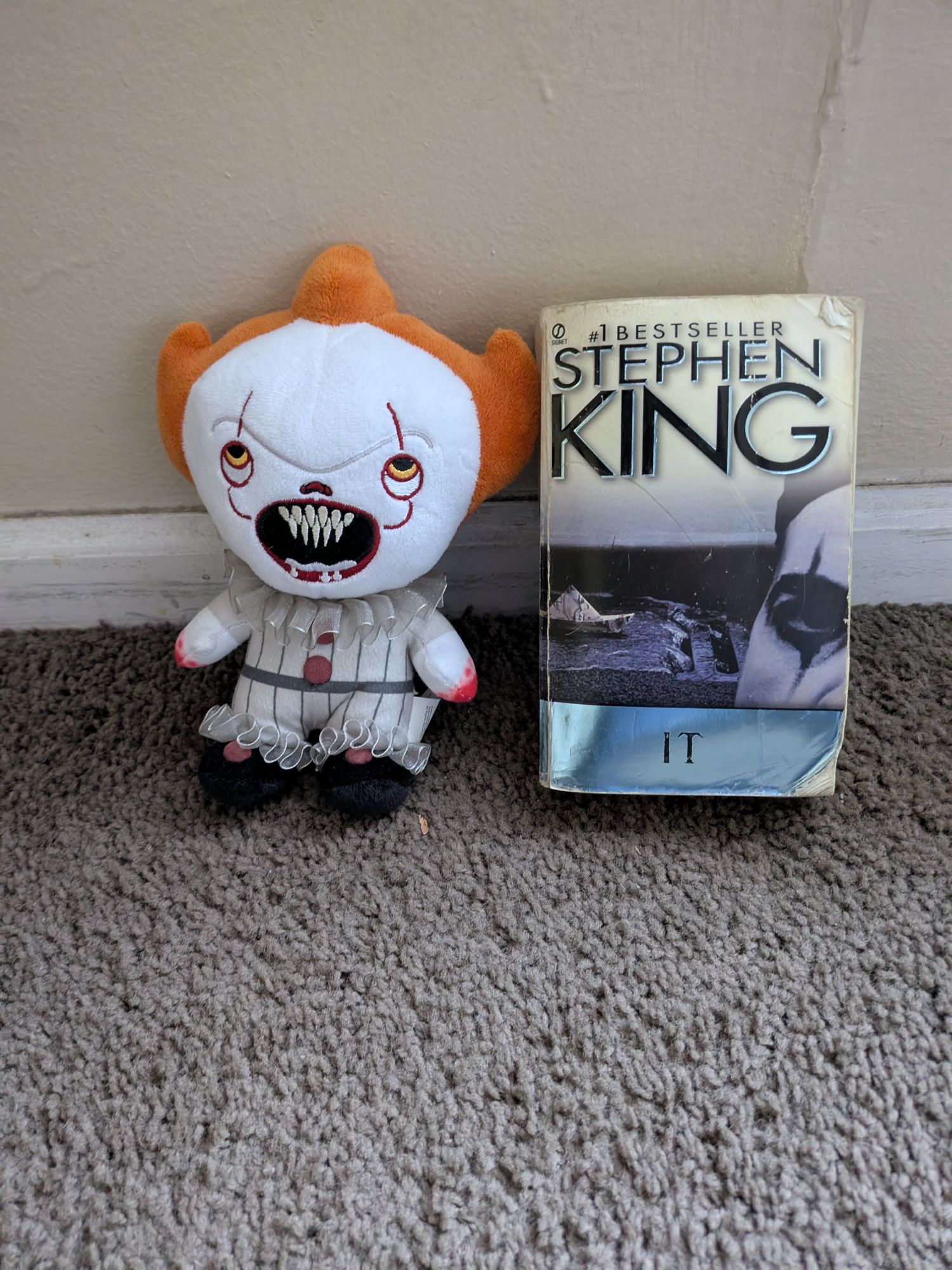
Without IT, I would not be the writer I am today. Or the person. I might not even be blogging to you right now, now that I think about it!

I bring this all up because, if you weren’t aware, there’s a TV show airing on HBO Max called Welcome to Derry. Taking place in the same universe as the movies, the show goes into events during the 1962 cycle, which was the cycle before the first movie. And unlike the movies, which focused on a core group of characters first during their early teenage years and then during their adult years, Welcome to Derry focuses on a wide variety of characters, including school kids, military personnel at the local Air Force base, and the nearby Native American population.

It’s very Stranger Things in its character development and methods of storytelling. And since the creators of Stranger Things were heavily influenced by IT, among other things, I guess it’s coming full circle?

Well, it feels full circle to me, because while watching the show, I feel like I’m getting a reintroduction to the horror genre. Just like I did when I was a preteen and dove into King’s book. It feels like I’m getting lessons in how to do creative and powerful scares, storytelling with large casts, and character development every time I sit down to watch the show.

Which, while being told through a visual medium instead of a literary one, I’m grateful for. While I’ve made strides in becoming a horror author, I still feel like I have a long way to go before I can be at the same level as the authors I admire and regularly read. And while I learn something about good storytelling every time I enjoy a good book, show, or movie, I feel I’m getting a Master Class in the subject from this show.

Hell, I think in the short story I wrote most recently, some of what I gleaned from Welcome to Derry made it into the story. I wasn’t originally going to apply what I learned, but it occurred to me while I was writing, and I was like, “Oh. That’s good. That’s very good. Let’s try it.” And while I haven’t heard back from the alpha reader yet (I only sent them the story last night, after all), I feel like adding those elements gave the story an extra bit of excitement and terror.

So, with only four episodes of the show left (I have my doubts they’ll do a second season, though I would likely welcome one), I’m looking forward to seeing what happens next. And to seeing what I can glean for use in my own storytelling.

In the meantime, I’m going to get to work on some of that storytelling. I have stories to edit and send to the beta readers, after all. Wish me luck!

And in the meantime, good night and pleasant nightmares.
Me writing and editing under the influences of good storytelling teachers.

I first heard of this film earlier this year. And I heard a lot of back and forth on it. Some people loved it, other people hated it. It got a terrible response when it was released. However, there’s a cult following around it, and I recently found it on HBO Max. So, unsure of what I was getting into, I watched it.

Based on the graphic novel from Boom Studios (which I may need to read now), The Empty Man follows James Lasombra, a former cop with a past. When his friend’s daughter Amanda goes missing and the police show little interest in finding her, he does some investigating himself. This leads him not only to a strange cult with connections to a spirit in Bhutan, but to a rabbit hole that will not only change him, but the world.

Well, that was something else. And I have to say, I’m glad I watched it.

For one thing, the main part of the film is very atmospheric. There’s this somber air around the whole film which pairs well with the story and the characters. Add in some decent jump scares and some even better creepy sequences, and you actually have a film that’s hard to look away from. I especially like the sequences involving the cult, which is just freaky as all get out. Especially that bonfire scene.

Oh, and the sequences with the titular Empty Man is quite creepy to watch when they’re onscreen.

That being said, it’s not perfect. The main issue is the film’s opening. Remember two paragraphs ago where I said “main film?” The first twenty minutes are kind of a prologue to the rest of the movie, but it feels like its own short film rather than part of a cohesive story. And I’m sure the difference between those first twenty minutes and the rest of the film is part of why this film got negative reviews after its release.

In addition, there were never any moments where I felt a huge surge of terror; Lasombra’s personal trauma is supposed to be very important but is only really explored near the end of the film when its impact on the audience won’t be that strong; and I’m sure there are people who won’t like the final twist, or get the philosophical mumbo-jumbo from the cult.

That last part wasn’t a big turn off for me, but I can see it being a turn off for others.

All in all, though, I can see how The Empty Man could receive a cult following and has been doing so much better since being released to streaming and home media. On a scale of 1 to 5, I’ll give it a 4.2. It’s strange, creepy and compelling. It won’t be everyone’s cup of tea, but I think you should check it out and find out if it’s yours.

Don’t let nothing stop you from watching it.*

*That makes plenty of sense if you’ve seen the movie.

It’s a James Wan horror film. He’s the guy behind Saw, Insidious and the Conjuring films. Nuff said.

Malignant follows Madison Mitchell, a woman who becomes connected to several murders in the Seattle area, starting when her abusive husband is murdered by a mysterious intruder. Not only that, but Madison becomes witness to the murders in dreams, committed by a mysterious figure named Gabriel. As the police attempt to figure out the connection, Madison’s sister learns a secret from the former’s past. A rather disturbing and deadly secret.

This film started out rather slow and kinda typical for an average horror film, but it got better with time. And honestly, it was really interesting.

Malignant is rather atypical of a horror film. James Wan made it more of a giallo film, which is an Italian genre mixing mystery-thriller with suspense and horror (they were quite influential on slashers). The result is a mostly well-done balance between a crazy crime thriller and a strange horror film, especially in scenes like in the Seattle Underground. And the final reveal is rather ingenious, with some very nice body horror that made me shout in my own living room in shock.

Also, what a film score! It was kind of all over the place, but it was still interesting to listen to.

However, the film’s first twenty minutes or so did feel a little cliched and below-average for a horror film. And the ending was kind of a let down for me. Something much darker would’ve worked better for me. And they do bring down the film’s score for me.

On a scale of 1 to 5, I’ll give Malignant a 3.4. Yeah, there’s a lot of interesting stuff in the film, and ooh, that twist! What an image! I’m going to dream of that for years. However, there’s a lot that could have been improved or done differently. If you want to watch it, go ahead. It’s in theaters and on HBO Max. Still, it’s not the best thing I’ve seen this year. Not by far.

That’s all for now, my Followers of Fear. I’m going to bed so I can hang with friends and maybe do some editing tomorrow. Good night, and pleasant nightmares!

I read the book back in 2018 and loved it (would have done a review, but I think by that point it had been out a while). I was excited when I heard that it was getting a show…and then sad when I heard it would be on HBO. However, now I have HBO Max, so I was able to watch the show. Which I finished watching today. As I’m obligated to do, I’m writing a review.

Based on the novel by Matt Ruff, Lovecraft Country follows Atticus Freeman, a black soldier living in 1950s America who returns home to Chicago after receiving a mysterious letter from his estranged father Montrose, stating he is in Arkham, Massachusetts, a location from the works of HP Lovecraft. Turns out, it’s actually a secret community called Ardham, but that doesn’t change how fantastical life gets for Atticus. Pretty soon, his life starts to resemble a Lovecraft story, involving secret societies of sorcerers and magic, ancient history, and entities that defy reality and biology. And it may end up putting Atticus and his whole family in danger.

So, it would be more fair to say this is a variation on the novel’s story than a direct adaptation. The first season acknowledges the concept of a multiverse and uses that to explain the changes from the novel. Some of these changes are minor–some names or genders are changed, roles are reduced or expanded, etc. Others are good, such as the expansion of Montrose’s character to be a meaningful exploration of a man with a troubled past still effecting his present. And others just made me scratch my head.

An example of this would be the creation of the character Ji-ah, a character from Atticus’s past who knows more than she lets on. On the one hand, I get why they added her and they tried to make her inclusion into the story important to the plot. At the same time, I feel like this whole character’s reason was diversity for diversity’s sake, which is an odd choice considering the show.

As for the rest of Lovecraft Country, it was great for the most part. The writing in even the dullest episodes was superb, and the actors were awesome. There were several scary moments, such as the events of the first two episodes and episode eight. The exploration of racism in America was powerfully done as well, drawing many parallels between events then and now (and making me want to know more about the Tulsa race riots. I do not remember learning about that in school).

If you haven’t checked out the novel, that’s also worth the read.

However, there were some downsides. The actress playing the villainess, Abbey Lee, played her role so emotionlessly I wondered if she couldn’t get into her character’s head, let alone play her convincingly. A lot of the music choices were modern rap or music from well past the 1950s, which honestly felt out of place in a historical fantasy-horror piece. And there were a few episodes where things kind of dragged for me.

Like the novel, Lovecraft Country the TV series isn’t perfect, but there’s plenty there to enjoy and make the watch worth it. You’re going to get different things from each iteration of the story, so it’s up to you which one you prefer.

On a scale of 1 to 5, I’ll give the first season of Lovecraft Country a 3.7. Combining horror, magic, heavy themes and great characterization, it’s worth the hype I heard. A second season may be in the works, but until we get confirmation one way or another, there’s still plenty of time to check it out. Get on HBO Max if you can and prepare for a powerful experience.

That’s all for now, my Followers of Fear. I’m off to work on stories I doubt will ever get their own adaptations (though it can’t hurt to try). Until next time, good night and pleasant nightmares.