Posts Tagged ‘journalism’

As I promised last night, I’ve published my twenty-first article for Self-Published Authors Helping Other Authors. This one is Business Cards and Bookmarks, and has some handy tips on designing and giving out business cards and bookmarks authors may design as part of their marketing strategy. I used my own business cards as examples (click here if you haven’t seen them yet). If you have a moment, head on over through the link and check out the article. Let me know if you find what’s there helpful in any way, shape, or form.

And if you enjoy reading the article, check out some of the other articles on Self-Published Authors Helping Other Authors. The blog is written for independent authors, by independent authors and is intended to help make writing, editing, publishing, and marketing as an independent author as easy and affordable as possible. I hope you enjoy the articles there should you decide to check them out, and reap wonderful benefits from them.

Well, that’s all for now. I’m probably going to get started on the last ten chapters of Laura Horn tonight. Anything could happen, so let’s see how far I can go. Until next time, my Followers of Fear.

A while back my stepmother recommended that I get business cards as a possible way to help further my writing career and possibly get some new readers. I’d considered getting business cards before, but the busyness of life (among other things) had kept me from actually designing and ordering some. That very evening though, I went online, designed some cards, and ordered them. And yesterday they arrived in the mail for me, all 250 of them.

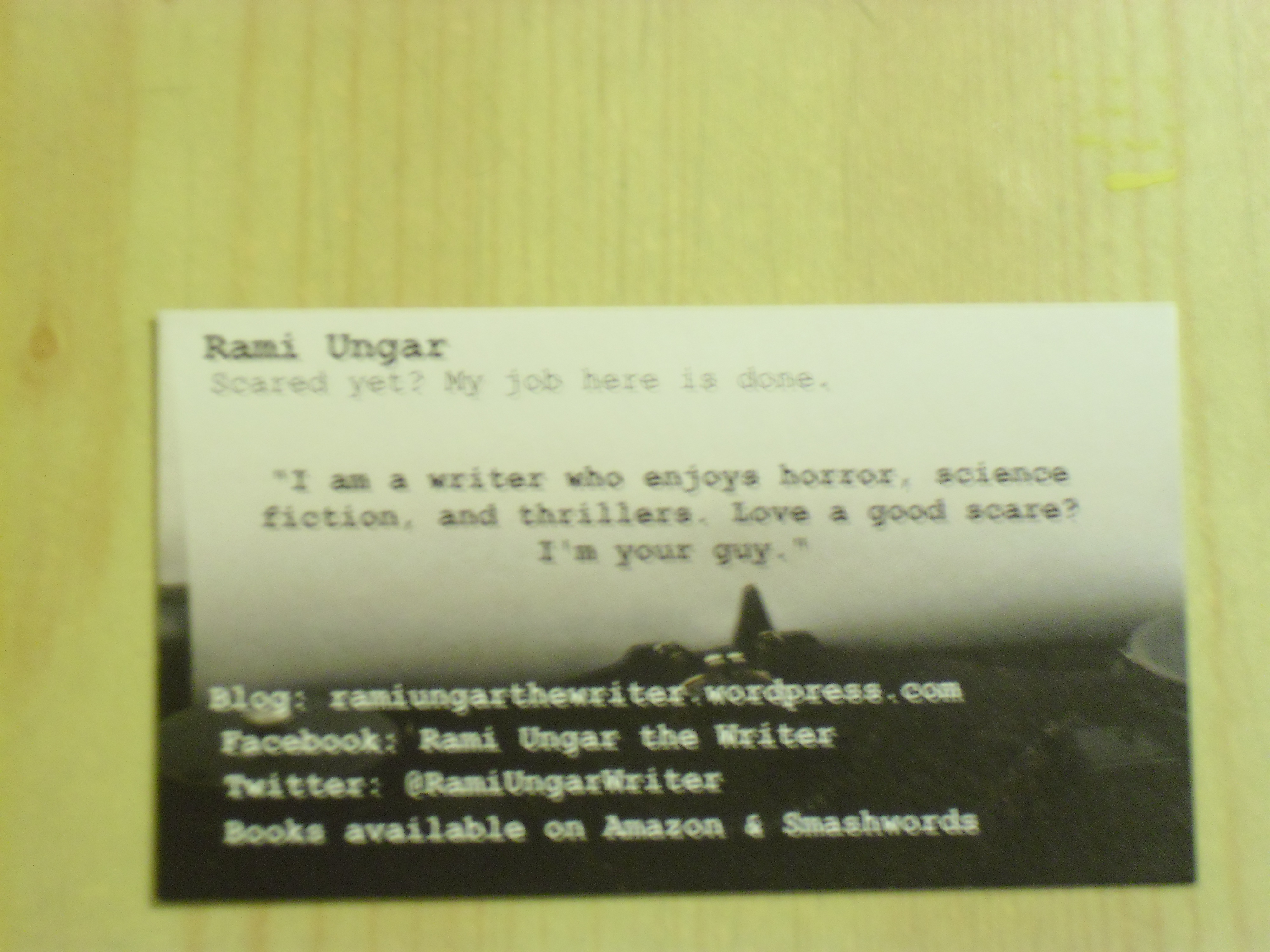
I’m sorry if these photos of them are a little blurry. I’m using my digital camera, and it’s a few years old. Anyway, here’s the front of the card.

business card 1

And here’s the back.

business card 2

Now if you couldn’t make out the writing on the card, the front has my name, the slogan of my blog (“Scared yet? My job here is done.”), a little about the stories I tend to write, and the social media sites I use, as well as where my books are available. The back has the names of my books in order of most recently published. And as you can clearly see, the design is a typewriter.

I hope that these cards will help spread word about my writing. I get a lot of people who say they want to or will read my books, but then they end up forgetting. It’s understandable, my books are not exactly top priority in the lives of the people I meet, and sometimes people forget my name, how to spell it, the names of my books, and/or how to spell those. I’m hoping these cards will act as physical reminders that will get people to actually check out my books and social media sites. They may also help me perhaps find new people to work and collaborate with and possibly open up some doors for me. I can hope, anyway.

At the very least, I’ve already given out a few to people interested in reading my work, so I guess it’s up to them now to decide whether or not to actually use the card and find my work. I’ll keep my fingers crossed and see what happens.

I plan on writing an article about business cards for Self-Published Authors Helping Other Authors when I get the chance. In the meantime though, I’ve still got a few chapters of Laura horn to get through, so I’ll work on that first. Wish me luck as I try to finish one or two chapters this evening.

What do you think of my new business cards?

Do you use business cards to help with your writing work? What are they like? Do you think they’re helpful?

DSCF0005

He started out on a farm, but had to leave because people were after his life. What happened over the many years for this man, before turning to writing, involved a life with more twists and turns than a labyrinth, involving drugs and crime, camping and living in the mountains across North America, and even some interesting paranormal experiences. Today’s interview is with Timothy Louis Baker, author of Fantastic Florida Fun, Crime and Drugs on Trip City Street, and his autobiographical When North Meets South and East Meets West.

Based on the descriptions of your books, a lot of your writing seems to be based on your own personal experiences. What motivates you to write about your past and how do you come up with stories based on your life?         

Rami, I often make the comment that I write what I know and I know what I write and that holds true, through present I refer to things of my own life to write about and very little do I have to look up in another book or online somewhere. That is all because I have had such an interesting life and I’ve found that if I take those experiences I’ve had and expound upon them in fiction but along the same lines as has occurred in my own past, that my writing is just that, not only interesting but entertaining, to the ultimate degree. I’m very well-traveled and have been in a variety of locations and multitude of actual experiences, so I have no trouble in keeping a story line going about a certain person, place or thing. Whether I write fiction or non-fiction in the case of my autobiographical works, my story unfolds and continues consistently with new material and not keep repeating the same thing over again. If you examine my writing, you’ll find that the pace is fast and constantly changing, with either what the character is doing, where they are in location or what they are up to. It all varies at an incredible rate because that’s exactly how I’ve lived, continuously changing where I am, what I’m doing or whatever, there is never a dull moment. My lifestyle reflects upon the pages of my books, even the fiction works and really as a writer and an author, because of the kind of person I am, I wouldn’t have it any other way. That just goes to show you, personalities show up through our work and I think that’s the way it’s supposed to be.

Could you walk us through your writing process, from the moment you get an idea to when you publish the book? 

I started writing on pencil and paper then graduated to a typewriter and eventually by computer, but it all goes the same route. I write my story and then I edit it with my own author’s knowledge but sometimes, after submitting to a publisher, I have to crack down on myself and allow them to edit it also. My full-length autobiography Where North Meets South and East Meets West was an idea I had long ago, I mean like when I was 16 years old and hitchhiking to Florida with little or no money, I had an idea that my life was going to be long enough and full enough to write a book about it all, and more. When I was in my 20’s and living part time in the mountains of Kentucky, Tennessee, Arkansas, and the forests of Michigan and Minnesota, I came about the idea for each and every story of all my books and made that mental note in my head the exact ideas I had for them, and eventually I did write them. It was easy because I already had the created version in my head, I just had to use my imagination to add the characters, places and events that were in my head to the pages of my books and behold I am an author again. Then after submission to publisher and acceptance of my manuscript I am again a published author. With me, writing is the work, editing is minuscule comparatively and when I get that acceptance email from a publisher is truly happiness. Because I know my writing is going to be available to the public for the people to have access and that is the point of my career. It’s not how much money I might make or how famous I will become that is important, but getting my writing out there to the people who may read it. The rest all comes along with extras in between that, not just as the main point of enjoyment in my life but the fulfillment of what I’ve written as an author to be enjoyed by others.

You’ve had some very interesting life experiences. What do you do now these days? Is your life any more interesting, or has things gotten somewhat calmer?                  

Ah, but life is the same. Now that I don’t do all of the things, as much or as many times in a row, as when I was younger, doesn’t mean that I’m any less active or live a less exhilarating lifestyle anymore. I keep occupied at what a great many people may do, and I’m sure they do, by online computer and other devices. Look we have access to all of the things that people used to have to go to the library to look up or reserve a mental note to ourselves to ask a certain particular person we might know, next time we see them. Now not only that we can read books and gain all of this information or personal entertainment, right at the touch of our fingertips. Life is as exciting as ever. I fish in the creek, I ride a bike almost everywhere I go in town and at 55 I still lift weights. Lifting weights is what I used to call bodybuilding, but because I’m not a spring chicken anymore and don’t grow as rapidly nor can I do as much weight as I used to, I now just ‘lift weights’ or ‘do my weightlifting.’ As far as living a calmer life? Maybe when I’m a hundred. Never a dull moment and I always mean that in a good way when I say it. One does not have to go thousands of miles to experience adventure. That is something a person can do anywhere they are and anything they’re doing. It is something you find inside yourself, so much of the time anyway. All it usually takes is a little bit of initiative to find or discover and that can be nearby as well as far away, it just depends on the situation. I like the days when the last thing I can possibly do that night when I go to bed is drag myself off to the bed and lay down to sleep, just as much as I like those days when I am able to sit for longer periods of time and let the radio or television entertain me rather than get it by just so much activity of my own hoping that will keep me excited enough to stay up without falling asleep until I get all the work done. Mentally I’m probably more active since becoming a writer than I ever was before. If not then just as much anyway.

How did you get into writing?               

When I was 33 years old I had the idea to write down some notes about my lifetime and because my life had been so interesting up to that point I soon invested in a typewriter that ended up the forerunner of a rough draft for my autobiography. I had lived so many interesting experiences that I thought the world should know all about them. It wasn’t until a few years later that I was able to gain the ownership of a computer but before I did I set down a rule in my house: Every time I came up with an idea on something pertaining to a real experience that happened to me personally in my lifetime I would write it down on a piece of scrap paper and lay it on a pile on my kitchen table. Well after several months and when the pile was a couple of inches tall and I was sure everything I would need the time to think of before writing had already taken place, I finally found a way to get a computer and that is when the placement in chronological and geographical locations began to take shape. With the computer I could write something where I thought it should be and then if I didn’t like where it was or how it was written, I could change it and copy and move it and paste it wherever the best place for it I judged would be at. Well this was OK except that something happened, that is now included in my autobiographical works, a catastrophe and all I got away with it all were the floppy disks of some of the stories of some of my books now, but also including a printout copy of my first rough draft. Well to make a long story short, being relocated a couple of times, finally I was able to manage to procure another computer and that was the one that wrote all of the rest of my seven books that I had not already written on either the floppy disks or the paper printout version of my autobiography. This led to me achieving internet access and that brought on copyrights for all seven books and eventual publishing of them all. Basically I got into writing because I had some things happen to me that I thought were so unique that nobody else in the world had these occurrences and so I was compelled to write then and that is my full-length version autobiography Where North Meets South and East Meets West, the less graphic and condensed edition An Experience Heaven Sent and My Life’s History in Poetry and the uniqueness of those events that I’ve never heard of happening to any living man in my generation were the miracles including and especially the living, waking, physical ascension in Heaven where everyone and everything was young and beautiful and lived forever. Then I was returned to the earth by my ‘higher power’ that had caused me to thus be arisen into that afterlife, also brought me back. If that isn’t something to write about then I certainly don’t know what is of my own personal lifetime of events and trivia.

What are you currently working on?                 

I haven’t been writing any actual books lately but I’ve got one started that I began a few years ago and sometime when the workload of book marketing the seven books I’ve already published slackens and begins to give me ample opportunity to finish writing that one I will. I have to have some time for me too on a personal level to do the things I want to do with my own time on my own space but the name of this newest work of mine is Some Sing Song Way and it is a historical novel about a man that is abducted by Indians from the Oregon Trail and he discovers that living with the red men is actually compatible to his own life. He has a past with the white men and now he lives with Indians, finally on a voluntary basis and actually sort of prefers them. Later in the book he will meet up with the past in a US fort out west and after that when he is alone and in solitude the events of his lifetime will unfold before him as he will contemplate that past with his own history with Indians, while he is living out in nature without either one, or anyone, and he will decide how he really feels about it all in his own present and that will make up his mind on his decision about how, where, and with who he will live the rest of his days.

What is some advice you would give a budding writer?              

I always give the same answer to people that ask me advice through posing this question and that is – write what you like and hopefully that will be what you know and if you write what you know, you are likely to write the very best that you can write. That has so far been my answer to this question of what to tell someone that asks what they should write for a book, written by them.

If you were stuck on a desert island and could only take three books with you, which ones would you take? 

That’s easy and they are all books that I have written. The books that are the most important things that I could ever take with me to be alone. Even if I ever doubted I would ever see anyone else ever again, I would take the three autobiographical works that I have written, Where North Meets South and East Meets West, An Experience Heaven Sent and My Life’s History in Poetry. Because in them I know what I left in print in books behind me back in civilization, the most important words or any kind of works I have ever performed in life would be there to remind me of what I left behind that someday, maybe not in my own lifetime, but someday in some generation in the future perhaps, would be invaluable to the rest of the world of their, those people’s time. In other words, someday in some generation this story will come out and make that big impression upon all humanity at that time and continue for the rest of life on earth as we now know it.

If you would like to know more about Timothy Louis Baker, you can find him at Author’s Den, on the website of SPBRA, Facebook, and Twitter. And if you’re interested in checking out his books, you can find them on Amazon.

That’s all for now. Hope to have some more interviews soon. And if you want to read previous interviews, head to the Interviews page, where authors and characters will tell you about themselves and their books (and whether they write them or spring from them).
I’m going to tell everyone a midrash, a story that helps to explain aspects of Judaism, and which may or may not be true, depending on the story. This story, no matter how you look at it, is very interesting and helps to explain why I’m able to give these reinterpretations.

The story dates back to the writing of the Talmud. Several rabbis were trying to decide on an issue of kashrut, or dietary law. Eventually all the rabbis except one decided a certain way on the issue, with the remaining rabbi insisting he alone was right. This rabbi, who was apparently so learned that he could teach Harry Potter a thing or two (my own phrasing, not the story’s), said that if he was right, then the walls in the study house would cave in, a tree would move from one place to another, and that the river outside would flow backwards. Sure enough, the walls started to lean in, a tree walked across the ground, and the river started flowing backwards. With each occurrence the other rabbis would remind the rebellious rabbi that walls, trees, and rivers don’t decide matters of Jewish law (and they chided the walls for trying to bring themselves down when it wasn’t their conflict). Finally the rebellious rabbi said, “If I am right, let a heavenly voice confirm it!”

At that moment a great voice from above was heard saying, “Follow this rabbi’s opinion!” The other rabbis, instead of cowering and giving in, replied to the voice, “Matters of law are now on Earth, not in Heaven.” The heavenly voice replied, “My sons have bested me.”

What does this tale tell, besides the fact that apparently Talmudic rabbis were said to be quite powerful? Besides the teaching that a majority rule is stronger than a single zealot (and the rebellious rabbi later became a heretic and was excommunicated, interestingly enough), the story shows that once God gave the Jewish people the Torah at Mt. Sinai, it was in their hands, and therefore they had to decide how to interpret it. So basically while some may claim that LGBT people and their allies are going to hell and claim the Bible says so, I can claim just as much that that law no longer applies and that LGBT people and their allies are just as holy as anyone else. And guess what? We can both be right!

I tell this story because a lot of people’s arguments and opposition to LGBT rights are based on a singular interpretation of the Bible, so alternative interpretations of the Bible can be just as legitimate as traditional ones. I also tell this story because, while two opinions can both be right, sometimes one opinion may have more reason to be right than the other (as in the ruling of the majority in the story). For example, I can say that I believe both evolution and the Genesis story to be right. I can’t ignore that dinosaurs, the fossil record, and the distance travelled by the light of certain stars make evolution seem more right than Genesis (which I tend to view as a metaphor for the Big Bang and evolution that humanity is too stupid to understand at this point in our existence).

No denying it: gay people are born that way. It’s in their DNA.

Understanding this, let us look at what science has proven: that sexuality is a genetic trait, and that multiple genes make up sexuality, so multiple sexualities arise. Some people, like a pastor I had the displeasure of hearing speak out on the Oval at OSU this spring, claims that meant homosexuality is a genetic defect. But that would mean there would have to be a loss or impairment of quality of life for the affected. If anything, the scientific method has shown through studies that people who are open about their sexuality and accepted for it tend to live happier lives. It’s only when they try to deny, change, or hide their sexuality that there is some impairment.

Likewise, this also means that homosexuality isn’t a lifestyle, or something you can indoctrinate youth into. As I said, differing sexualities are genetic, and you can’t pray away, condition someone, or ban something so caught up in the very DNA in a person.

Now, some might ask about my previous post, where I said that homosexuality was commonplace in Greece in a ritualized form. I say that was a form of cultural homosexuality. It was done because it was part of the culture, everyone was doing it, and nobody could see any reason not to do it. Plus, having a male lover was a choice, not a requirement. You could almost compare it to video games: everyone seems to play video games these days, and most people don’t see a reason not to play them if you can. (I know that we’re talking about two very different things here, but you get the idea, right?)

In any case, I’ve said what I wanted to say about the Bible, religion, and homosexuality before Pride weekend here in Columbus. I hope you enjoyed the posts I’ve written and perhaps were given some food for thought. And if you’re in the Columbus area this weekend and are looking for some fun, come to Pride. Leave the picketing signs at home, and have a blast. I’ll see you there.

Three articles within a week. I’m impressed with myself. And this one marks my 20th post for Self-Published Authors Helping Other Authors, which apparently is quite the milestone, seeing as WordPress gave me a congratulatory notification this morning.

Anyway, today’s article is How To Write An Epilogue, a follow-up to yesterday’s post about writing prologues. I figured that since I’d already written one on prologues, I might as well do one on epilogues, which require different tools from writing prologues in order to write them effectively. So far it’s gotten a pretty good reception, which I’m happy about. I hope plenty of people find it useful.

And if you’ve liked my previous posts on Self-Pub Authors, you should seriously consider checking out the other articles on the site. It’s a wonderful website, filled with helpful articles by other independent writers for independent writers on learning to write, edit, publish, and market independently without spending a ton of cash. I’ve certainly found it very helpful, and that’s why I write for them.

Now that this article is out, I’ll take a short break from article writing and focus on my other work. I want to conduct a few author interviews and then get back to work on finishing Laura Horn and promoting Snake. My life never seems to get easier, though I kind of like it that way. I wonder what life will be like for me when I’m no longer in school and I (hopefully) have a full-time job?

All for now. I’ll write again later if I can, my Followers of Fear.

Dr. Angelou, reading her poem “On the Pulse of Morning” at President Clinton’s 1993 inauguration.

As I booted up my laptop today and logged onto the Internet from my hotel room in Germany, I was greeted by the most depressing news: author, poet, activist, and just plain wonderful human being Dr. Maya Angelou had passed away. Dr. Angelou, who had been teaching at Wake Forest University since 1982 and was a prolific writer and poet throughout her life, had been experiencing health problems recently and had had to cancel several scheduled events because of it. She was 86 years old at the time of her passing.

Immediately I felt  a horrific sense of loss. I never met Dr. Angelou, nor have I read as much of her work as I’d have liked to. But I remembered very vividly reading I Know Why The Caged Bird Sings one summer for school a few years back, along with The Autobiography of Malcolm X. Both books impacted me very deeply and I remember feeling powerful emotions reading Dr. Angelou’s book as I read the events based on her early life experiences, sadness and sympathy and anger and several others depending on what story she was relating to me through her words. It left a very deep impression on me.

And so when I heard that Dr. Angelou had died, I immediately felt the loss that people around the world are probably feeling at this moment. I took to Facebook to write that the world has lost a guiding light in Dr. Angelou, that her passing was swift and painless, and that her memory, words and deeds will last for centuries. But somehow I felt it wasn’t enough, so I decided to write this post about her as soon as I could. Hence this post you are reading now.

Dr. Angelou was an influence for good throughout the world. She worked her way up from a variety of jobs, including a cook, prostitute and nightclub dancer, to become a writer and journalist. Active in the Civil Rights movement, she worked with both Dr. King and Malcolm X, and has also influenced the feminist movement. Her writing has been hailed as “a work of art that eludes description”, and helped bring memoirs from African-American women writers from the margins of literature to the forefront. She made on average eighty public appearances a year, even as she reached her eighties, and was given numerous doctorates and awards, including reciting a poem of hers at President Clinton’s inauguration in 1993, and she received the Presidential Medal of Freedom by President Obama in 2011. In addition to poetry and autobiographies, Dr. Angelou wrote plays, screenplays for TV and film, essays, cookbooks, children’s books, spoken word albums, and also did acting and directing work on stage and in film and TV.

But most importantly, she gave people a voice. Dr. Angelou gave voices to many African-Americans, women, and others who had been pushed to the margins of society. Caged Bird, probably Dr. Angelou’s most famous autobiography, has been translated into many different languages. This is not only a testament to the popularity of the book, but also to how relatable it is to people of other nations and cultures, how many different peoples can relate to Maya’s own struggles and see it in themselves, or in their people’s struggles. Some have even credited it with allowing black women writers to finally have center stage in the world of literature, instead of on the side where for far too long they’d been ignored and underappreciated.

President Obama said a few hours after the news came out of Dr. Angelou’s death that she reminded us “we all have something to offer”. Whether it be in words (written or oral), in action or just in being there for someone, we all have something to offer. Dr. Angelou offered many a voice, a way to speak about the struggles of the underappreciated and marginalized. Her words resonated with many throughout her lifetime, and I’m sure that they will continue to do so for years to come. And as the years go by, as Dr. Angelou’s works are read and dissected and discussed and debated by readers of all kinds and stripes, as movie adaptations and TV specials and new stories and poems recreate her for a new generation, and as the occasional politician or news commentator tries to appropriate her legacy for some political cause or another, I hope that one fact shines through it all, that she gave the world her voice, and allowed others to speak through it and with it.

And speaking of having something to offer, I decided on the spur of the moment to create a tribute video to Dr. Angelou. It’s not very good, and at the very most it showcases that I’m slowly getting more comfortable with video-making on computers (a valuable skill these days, it seems). But the song I put in, “Bye Bye” by Mariah Carey, is heartfelt and speaks to the emotions of many, and I think it shows my sincerity. What do you think?


You know. about five or six days ago, Dr. Angelou sent out this tweet:

I think this tweet says a lot about Dr. Angelou, because it seems that her words were definitely sent by somebody to make a difference in the world.

So to all those who were close to Dr. Angelou in life, I wish you my deepest condolences. To those who only knew her through her words, her reputation, or through her actions and influence in the world, you probably feel the same as I and many others do: like we’ve all lost someone important. And to the good Dr. Angelou herself, wherever you may be, I hope you’re doing well and that you know that your legacy will continue to influence and help us all for years to come. Thank you.

I thought this was coming out tomorrow, but it looks like it came out today. This is my final article on Self-Published Authors Helping Other Authors before I leave for my study abroad trip, What Makes A Strong Character? I wrote it because there seems to be an emphasis on creating a diverse array of strong protagonists in fiction, so I decided to write about what makes a strong character in the first place.

Honestly, it wasn’t an easy article to write. What makes or doesn’t make to be a strong character is a difficult thing to pin down. Several times writing this article I had to go back to the first paragraph and delete everything else because the definition I had just didn’t feel right to me. I’m still not sure if the definition I came up with in the end is the right one. Maybe that’s why I asked readers to give me their definitions of what constitutes a strong character.

And while you’re reading the article, make sure to check out my other articles from the past couple of weeks. I’m sure you’ll find them helpful in some way or another. In fact, check out all that Self-Published Authors Helping Other Authors has to offer. It’s a wonderful site with plenty of helpful articles on everything involving writing, editing, publishing, and marketing on a budget. So if you’re a self-published author or considering self-publishing, you should definitely check out this website.

That’s all for now. I’ve got some work to do, so I’m going to get on that. Once again, have a lovely day, my Followers of Fear.

My penultimate article on Self-Published Authors Helping Other Authors just went live this morning. Creating An Acknowledgements Section basically gives some useful tips on how to create a coherent acknowledgements section for your book. I thought it might be helpful to create an article on this because the acknowledgements section really isn’t talked about that much. I hope someone finds it useful!

And if you enjoy reading this article, check out my other recent articles as well. Doing an Excerpt came out April 7, When Trolls Attack! came out on the 13th, Creating Character Names came out on the 22nd, and What Makes A Strong Character will be out May 2nd. I hope you find them all fascinating reads, or at least helpful reads!

And if you get the chance, check out all of what Self-Published Authors have to offer. It’s a great blog with plenty of awesome articles on everything self-published authors need to know about writing, editing, publishing, and marketing. So if you’re a self-published author or you’re considering become a self-published author, this blog may be a valuable resource for you.

My latest article for Self-Published Authors Helping Other Authors just went live this morning. Today’s article is Creating Character Names, which is something I’ve seen plenty of authors (myself among them) struggle with. I thought it’d be fun to contribute something about the subject to the site, and thus this article came to be.

As you may remember, I mentioned a bit ago that I wrote about five articles for Self-Published Authors Helping Other Authors that I scheduled to come out before I leave for my study abroad trip (and if I have my way, there will be more on that later today). The first, Doing an Excerpt, came out on April 7th. The second, When Trolls Attack, came out on the 13th. Creating An Acknowledgements Section will be out on the 27th, and I believe What Makes A Strong Character? will be published May 2nd. So please do check them all out if you get the chance.

And if you are a self-published author or are considering going into self-publishing, I highly recommend checking out Self-Published Authors Helping Other Authors. It is a wonderful site full of very helpful articles on a variety of subjects related to writing, editing, publishing, and marketing, written by some really awesome indie authors (myself and yesterday’s interview, Ruth Ann Nordin, among them).

Well, that’s all for now. I’ve got to go to work, so I’ll write some more later. Have a wonderful day, everybody!

There have been a spate of articles, petitions, and organizations and groups popping up lately, all with one purpose in mind: to expose the evil of people who bully authors and others online, leaving hurtful reviews and comments all for the sake of their own cruel pleasure. I thought I’d add my two cents in and write an article about what one should do if exposed to this sort of harassment from “Internet trolls”, as they’ve come to be called.

If you head over to Self-Published Authors Helping Other Authors, you’ll be able to read my article When Trolls Attack! which has some very good tips on what to do if, God forbid, you are exposed to that sort of bullying. And if you have been exposed to any trolling on the Internet, I hope things are better now. And if they aren’t, I hope that maybe some foo these tips might be of service.

And if you’re a self-published author, I highly recommend taking the time to look through this site. Self-Published Authors Helping Other Authors is full of many helpful articles that are designed to make self-publishing not only cheap, but easy and fun. I’m proud to be one of the writers on the blog, and the others are very amazing writers whom I admire for their work and dedication.

And speaking of Self-Published Authors Helping Other Authors, I thin I mentioned the other day that I wrote five articles coming out in the next couple of weeks on that site before I leave for my study-abroad trip. The first article, Doing An Excerpt, came out last Tuesday if I remember correctly. Today’s article is the second one. On the 22nd we have Creating Character Names. On the 27th we have Creating an Acknowledgements Section. And finally on May 1st we have What Makes A Strong Character? All good stuff, and I can’t wait to share it with you all.

That’s all for now. I’ve homework to do, so I’m going to go and do it. If I get a chance, I’ll write another post later. Until then, have a good day, my Followers of Fear!