Posts Tagged ‘parody’

“This book is perfect for your conservative relatives. Especially at Thanksgiving.” This is the description I got of Wake Up and Open Your Eyes by Clay McLeod Chapman, a satirical horror novel about a demonic apocalypse. With a description like that, I was intrigued. And this past Thanksgiving, I started the audio book.

To which I say, “Woo-boy? What did I get myself into?”

Wake Up and Open Your Eyes starts with Noah Fairchild, who goes from his home in Brooklyn to check on his estranged parents after his mother leaves a strange, conspiracy-filled message in his voicemail and then doesn’t pick up. When he gets down there, he finds his parents seemingly brainwashed into dementia by their conservative news shows. However, it’s actually the beginning of the apocalypse. And the demons are possessing people through their devices. And what they choose to consume through their devices.

As I said, this is a satirical horror novel, so there are plenty of funny moments that made me laugh out loud. One of the main sources of possession is a parody of Fox News, and it’s so thinly disguised, you can tell immediately which anchor is getting made fun of. In the final third of the novel, the story is actually narrated by a fictional version of a real life news anchor, only he’s a hallucination living in a character’s head to help them process these events!* And even in the apocalypse, people are posting videos to YouTube, Instagram, and TikTok, as if they need to share their most intimate moments to make them real.

However, this is a horror novel, and it gets horrifying! The demon-possessed do some seriously fucked up shit when they take over people, and a lot of it is described in excruciating detail. The amount of body horror and gross out elements even borders on extreme horror, so it can be uncomfortable at times (I just barely tolerated it).

Still, it is hard to put down. While at first I could only listen to it in small doses, over time I got so hooked, I listened whenever I could. And the ending, while some may hate it, is definitely quite fitting for such a bleak horror novel.

On a scale of 1 to 5, I’m giving Wake Up and Open Your Eyes by Clay McLeod Chapman a 4.5. It’s bleak, horrifying, and pokes plenty of fun at a nation/world/species that is willing to give up its thinking faculties and let a talking head on a screen do the thinking for you (not just conservatives; liberals and everyone else, too). If you have a strong stomach and are at all interested, give it a read. You may never be able to look at cable news, wellness gurus, or even “Baby Shark” the same ever again, but it might just be worth it.

*And can I say, I find it so bold to put real, living figures in your stories, using their real names? I’ve read a few stories like this, such as Shoeless Joe featuring JD Salinger, or a story by Jonathan Maberry where Kevin Hart and Kelly Clarkson, among others, make an appearance. And ever time, I marvel. I know it’s kind of allowed if they’re a public figure and it’s either parody or their fictional selves are acting in a way that would correlate with their real selves. But still, it’s not something I would consider doing (especially when I put real figures in my stories as a form of punishment for real life bad acts). I would be too worried about getting sued!

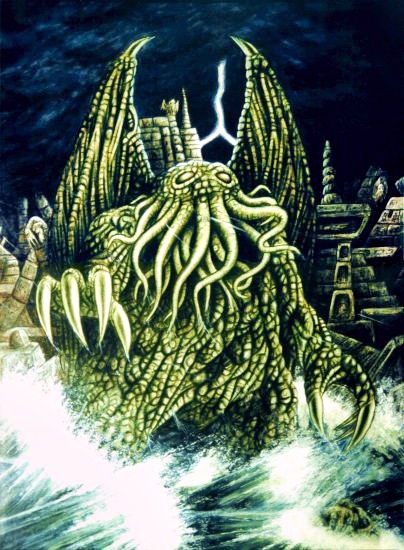
For a while now I’ve been reading The Complete Collection of HP Lovecraft on my Kindle. I figured it was about time, seeing as I haven’t been very exposed to his work up until this point, and the man has been a huge influence on greats like Stephen King, Allan Moore, Guillermo del Toro, and quite a few more. And since I am always looking to learn from other authors, I figured I should spend ten dollars of Amazon gift cards and see what happens.

Well, you get what you asked for. I didn’t realize that when I bought the collection, that it was 1112 pages! The length in itself is not such a problem, I’ve read books that long before. The thing is, Lovecraft…well, he’s hard to get through sometimes, and for a number of reasons. For one thing, there’s his style, which goes a little something like this:

And as I treaded up the stairs, filled with an anguish that panged the organs within my bosom to no end, I found my wife waiting for me in her chambers, her frown prominently featured upon her face. And I knew that my life had been transferred into a situation seriously detrimental and quite hazardous to my health, for that face on my wife at this hour could only mean that she had discovered my liaisons with Ellen the hotel maid from down in the village. I had endeavored to keep our trysts unknown from all but the walls of Ellen’s room, however it seemed that I was not secretive enough, as evidenced by the porcelain my wife volleyed at my head.

Okay, that’s a bit of a parody, but you get my point. Who talks like this?

Also, some of his early fiction isn’t that good. “Memory” is just a weird little flash fiction piece about a ruined city and a conversation between two beings about the city; “The Street” is about the houses on the titular street killing Communists after the street goes from a nice neighborhood to a slum; “Polaris” and “The White Ship” are obviously both dreams taken too literally, and “The Tree” is just not scary.

Also I noticed that so far, very few women appear in the stories. Several characters are mentioned as having wives, but so far the only woman who has any actual significance is the titular character of “Sweet Ermengarde”, and that’s a story parodying popular romantic melodramas of the day! But given that Lovecraft had a strained relationship with his mother, a turbulent one with his wife, and was dominated by his aunts in the later parts of his life, maybe that has something to do with it.

Lovecraft makes you wonder if maybe this guy is coming for you.

However, while I have my problems with Lovecraft’s early work, I have to admit that some of his stories do hit the mark, and even are a little scary. “The Tomb” is definitely somewhat chilling, as is “Dagon” and “The Picture in the House” (the former bears resemblance to Cthullu stories, while the latter has implications of murder and cannibalism). And I actually very much enjoyed “The Temple”, which was very strange and creepy.

I can’t say about the rest of his work, but for the early stuff I think what makes the successes so great is that they leave impressions on you. They make you think to yourself, “Imagine if that actually happened. That would be kind of creepy…” And then you take a look around yourself to make sure that a slippery slimy creature or some guy with wicked magic or something isn’t near you. Lovecraft is very good at leaving those sort of feelings with you. He makes you wonder, makes you think that there’s something just beyond the corners of our eyes or in the darkest parts of our world that we don’t understand, can’t understand, and that any interaction with that something or somethings would be very dangerous for us.

So there is definitely a reason why HP Lovecraft has stuck around and become well-known as a writer of weird and terrifying fiction. And as I progress from his early work to the stuff that he’s more famous for, like “Call of Cthullu” or “The Colour out of Space” or “History of the Necronomicon”, I’m sure I’ll find more reasons to like this guy (hence the reason this post is titled Part 1).

In the meantime though, I think I’ll take a break from his stuff. Like I said, he’s great when he’s good and I’m already learning a lot from him and seeing some of his influence on my work already, but he’s dense and hard to get through, and after so much of prose like my parody paragraph, I need a break if I’m going to continue someday. Besides, I finished on “The Nameless City”, which has that famous quote in it. You know the one:

That is not dead which can eternal lie,
And with strange aeons even death may die.

I can’t think of a better stopping point than on a creepy story that has that weird couplet in it. Can you?