Posts Tagged ‘Ruth Ann Nordin’

A couple of weeks ago, my friend and colleague Ruth Ann Nordin wrote about why she enjoys horror and romance stories (you can read her full post here). Midway through her post, she mentioned how she doesn’t like open endings or where things are left up to the reader’s interpretation. After reading her post, I commented on her post, “Ironically enough, a lot of horror stories have open endings, which only helps accentuate the feelings of horror and dread.”

I’ve been thinking about that conversation since then, and now I want to write about ambiguity in fiction. Especially in horror. And how that, as frustrating as it can be to some readers, that ambiguity can be helpful to stories at times.

Now, I’m not writing this to trash anyone who doesn’t like open endings or stories that leave unanswered questions. People have different preferences, and that’s okay. And honestly, at one point, I felt the same way…until someone pointed out that I’ve written stories like that in the past. I’m just writing about the open endings and the unanswered questions sometimes help a story more than wrapping everything up in a neat little bow.

So, why would writers create open endings? Or leave questions unanswered? Well, barring cases where extenuating circumstances keep the creator from tying up all the loose ends (*cough* Disney canceled The Owl House way too early *cough*), there could be a variety of reasons. In horror, it could be for a very simple reason: doing so makes the story that much scarier.

Great film. Lots of unanswered questions…until the sequels, at least.

Let’s take Hell House LLC. This horror film, while not in my top six, is a favorite of mine. The film is a found-footage mockumentary revolving around a horrific tragedy at a haunted attraction, and what happened to the team behind the attraction. While, over the course of events in this movie, what caused the tragedy in the first place is explained, a lot of things are left unanswered. Things are further explained in the sequels, but if you only see the original film, the things that are left unexplained lend this air of mystery to the story. And the fact that, at least for that film, we’re left to question what we don’t know, can be terrifying.

Another great example: Perfect Blue, one of my top six horror films and one of my favorites ever. I’ve discussed it here before, but if you’re unfamiliar, it’s an anime film about a celebrity who is hunted by a violent stalker, leading her to spiral into paranoia and madness. While the first third is straightforward, and the final third wraps things up nicely, the second third does a damned fine job of making it hard to tell what’s real and what’s delusion. You really feel the protagonist’s terror as she tries to figure out what’s real and what’s not, only to be swept along and finally stop fighting against the current.

Speaking of paranoia and madness, cosmic horror, especially Lovecraftian horror, thrives on ambiguity. The Great Old Ones and other ancient beings often have forms that are undefined by the writers. The most we can say is, “it’s so scary, even thinking about what it looks like is too terrifying! Also, it’s so unlike anything I know, my mind is having trouble defining any particular portion. That being said, it’s so scary, I can’t write it down to tell you about it.”
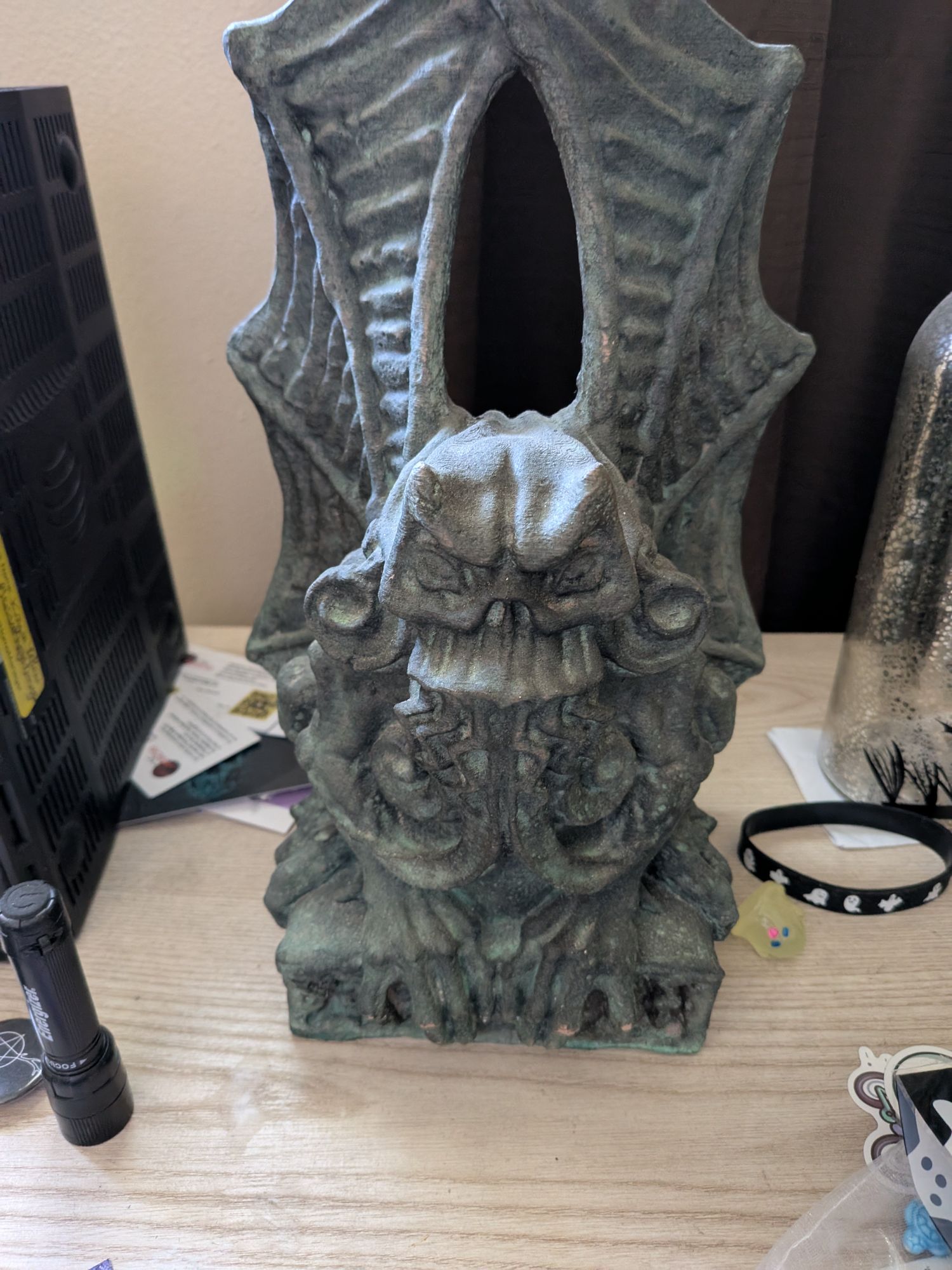
Even my Cthulhu statue is only an approximation of his true form!

Even Cthulhu, who is the most well-known and most defined of the Great Old Ones, is somewhat undefined. Technically speaking, his whole man/dragon/octopus thing is what people are able to recall he looked like. He’s still somewhat difficult to describe.

And that’s scary. We fear the unknown, and when we can’t fully define what we’re dealing with, it’s frightening.

So, yeah, ambiguity can be frustrating. But it does have its uses. And in the horror genre, it can help us horror writers do what we do best: scare people silly. Hell, at times, it helps the stories become that much more notable. And if a story can be made better by a bit of ambiguity, then a little bit of frustration is well worth the cost.

That’s all for now, my Followers of Fear. I’m off to make dinner and figure out what I’m doing with the rest of my evening. Until next time, good night, pleasant nightmares, and 82 days till Halloween. Thankfully, there’s nothing ambiguous about that!
I’ve had quite a few songs stuck in my head lately, most of them from the 1980’s: “If I Could Turn Back Time” by Cher and “Love Walks In” by Van Halen are frequent guests in my head. I’ve also had “Come Sail Away” by Styx and most of the soundtrack of Wicked playing in my head. No reason to tell you that. I just wanted to see if I could get any of those songs stuck in your head. I’m evil that way. You’re welcome.

Onto Day Three of the Ten Day Book Challenge, as nominated by my cousin Matthew. Let’s go over the rules one more time, shall we?

  • Thank whoever nominated you with big, bold print. If they have a blog, link to the post where you got tagged there.
  • Explain the rules.
  • Post the cover of a book that was influential on you or that you love dearly.
  • Explain why (because I don’t see the point of just posting a picture of a book cover without an explanation. That goes for Facebook as well as blogs).
  • Tag someone else to do the challenge, and let them know they’ve been tagged.

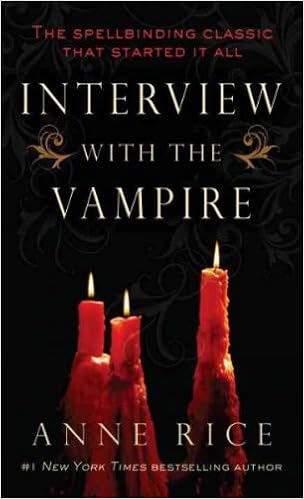
So for today’s book, I thought I’d talk about another important book in my development as a writer, Interview with the Vampire by Anne Rice.

Interview was another revelation in the power of words for me. I already knew how words could bring worlds and the people in them to life, but this book (and its sequels) not only painted them into being, but their thoughts and their outlooks on life. It was psychological storytelling before I even knew what psychological storytelling was. Interview, in particular. The novel follows Louis, a young man in the midst of depression and grief, become a vampire and then reluctantly going through his immortality, encountering companionship, pain and loss over the centuries.

Not to mention, these were vampires well before they were sparkly and insipid. They were human, in their way, but they were also dark creatures. And they’re still hugely popular today, whereas Twilight has come and gone. Hell, Anne Rice is still writing books in the series, with its thirteenth book on the way out in November. And now there’s a TV series in development based on the books over at Hulu! I can’t wait to see it. That says something not only of the characters and the author, but of the power of the stories being told. Of the words bringing them to life.

And if you haven’t encountered Anne Rice’s vampires, give yourself the Dark Gift (so to speak) and check them out.

And now to tag someone. Today I’m tagging my friend Ruth Ann Nordin. Hope you’re able to do this, Ruth. I look forward to seeing what books you choose if you are able to do this.

Someone is going to read this title and be very confused as to its meaning. Most likely, my parents. Or any juvenile who thinks pulling down a classmate’s pants is the height of comedy.

So, if you are wondering what the hell that title is about, it refers to two different styles of writing stories. Plotting is when writers plan out every part of the story. Everything, from beginning to middle to end, is planned and…well, plotted. Obviously, not everything is done according to a plan. A lot of stuff, like the wording in the story, is decided upon while writing. But the major elements–plot, characters, grisly character deaths involving giant monsters ripping deceitful high schoolers in half (no wait, that’s just me)–are decided upon before the story is even begun.

Pantsing is the exact opposite of that. Writers write by the seat of their pants and just make it up as they go along. There is some planning involved (for more on that, read this article by my friend/colleague Ruth Ann Nordin), mainly what sort of story arc you want to go through, what sort of characters there are, and perhaps some scenes you hope to include in the story, but for the moment it’s pretty much whatever comes out of your fingers at the moment you’re writing. The dialogue, action, and the descriptions are created spontaneously.

Plenty of writers have their own preferences. Stephen King is definitely more of a pantser: in his memoir On Writing, he compares writing stories to unearthing an artifact from some ancient civilization, revealing a little more with every dig of the shovel and brush, never knowing what you’ll uncover. JK Rowling, on the other hand, is probably a plotter. After all, she spent years putting together the seven books of the Harry Potter series, laying groundwork and hints of what is to come.  And you don’t just come up with stuff like Hallows and Horcruxes like that on the spot. No, she had those planned for ages and ages.

Personally, I’m a plotter. I usually have every scene planned out, especially with novels, where I tend to outline the story, and then do several drafts of the outline, before I get to the actual story. I’m not sure why. It might be I’m a bit of a control freak who takes being the “God of his fictional universe” a little too seriously. Or I just learned to write like that, and it’s done me well so far. Either way, it’s what I’ve done since I was a child, and it’s worked for me.

Writing by the seat of these, LOL

So why the hell am I talking about this? Because for the first time in I don’t know how long, I’m actually writing a story and pantsing it!

I mentioned in the post I wrote after I finished editing Rose that I was going to work on a couple of shorter works for a while. The first of these stories involves a bunch of people being trapped within a relatively small space, and this is going to be the meat of the story. In a confined space, tensions can get high, and the scenario of the story will probably raise those tensions a lot higher. So, I decided that it might be better to write this story by the seat of my pants, rather than plot the whole darn thing.

I figure that, rather than planning out that entire part of the story, I might instead plan only a few scenes and some plot points that I hope will come up in the story, and see what happens. I feel that will be more organic than just planning out who will lash out at whom when and what that leads to. The conflict will feel more real that way, not just to readers, but to the characters themselves, and to me too. If the conflict in a story feels fake, no one will buy it, and the story will suffer because the reader will disengage. Hopefully I can avoid it by changing things up.

I’m also kind of hoping I can experiment a little with humor in my stories. As I said in a previous post, I don’t include humor in most of my stories, and one of the reasons I think that might be is because I’m a plotter, so I keep in mind how dark my stories are from beginning to end and don’t insert humor because of how dark they are. I’m wondering if writing by the seat of my pants will give me more room to insert my style of humor, which is very situational, and make it not as forced as it might be under other circumstances.

It’s not a big reason why I’m trying pantsing with this story, but it’d be a perk if it happened.

So I’m trying to pants my way through this story, with only a few scenes planned, only eight characters fleshed out, and just a general idea of what I want to happen with this story. I have no idea what will happen, if this will be something I’ll do more often, or if the work I produce by pantsing will be any good. However, like every good writer, I have to be brave enough to keep pushing boundaries and to try new things. At least some of those new things have to work. Am I right?


That’s all for now, my Followers of Fear. I’ve got a few more blog posts I want to put out this week before I start on this story I’ve mentioned and fall into a proverbial rabbit hole, so I’m going to be putting those out one after the other this week (and maybe next). Hopefully by the time those are done, you won’t be sick of me.

Until next time, pleasant nightmares!