I was reading a blog post about whether or not it’s essential for an author to have a blog (you can read that here), and the post gave me something to think about. It occurred to me that people like interacting with authors in the digital age. In the age of Twitter, Facebook, and all sorts of social networking facilitated by the Internet, an author has the chance to truly interact with their readers, and those that do can have huge reactions from fans.
As I’ve mentioned before, author Anne Rice is very active on her Facebook page, and every time she posts something, especially an opinion piece or a review of one of her books. And I’ve read the blogs of authors here on WordPress with huge followings. Sometimes I’ll log onto their blogs for the latest post only to find that nearly 250 people have liked the post before me, and at least 20 have left encouraging comments, with the author giving just as many replies. I’m pretty sure that garners loyalty from people and keeps them coming.
For the readers, interacting with their favorite authors makes them feel good. They like talking to the people who create the worlds they love diving into, and to actually send a message or have a discussion or just to get these great writers’ thoughts as they have them makes them feel like they know the author. And for the author, it’s a potential boost to their readership and to their sales. Many authors start blogging just to get their work to a wider audience, and occasionally it works. So while the blogging and FBing and tweeting can be exhausting, it pays off if an author can get some more readers.
Of course, not all authors do the blogging thing just for readership, even though it may start that way. In fact, I’ve actually come to enjoy blogging, though I started just because I wanted more people than my friends and family to read my work. I like hearing what people have to say when I share my thoughts on writing, review the latest film, or update them on the latest developments for a novel. In addition, I’ve made some valuable friendships with other bloggers and authors, some of whom have been kind enough to help me with my work and whom I try to help when I can. To say that blogging has become important to me has become an understatement.
But to the original point of this post, there’s a mutual benefit to fans interacting with authors. Both parties get something from the relationship, even if it is basically over a computer 99% of the time. I certainly enjoy interacting with the authors I like, and I enjoy interacting with others as an author. To say that it’s enriched me as a writer and as a person would be an understatement.
Do you like interacting with your favorite authors? And if you write, do you like to interact with those who read your work?
Earlier this week, it came to light that E. Gordon Gee, the President of Ohio State University, had said some things about the University of Notre Dame and Catholics in jest at an athletics meeting. Some took the comments as offensive, He apologized for his comments and Notre Dame formally forgave him. Most of the Catholic students on campus and on Facebook have agreed that they didn’t find the comments offensive. Heck, I’ve heard more offensive comments from comedians on TV (Jeff Dunham and his dummies come to mind).
But today, President Gee announced his retirement, effective July 1st, because of the controversy his remarks led to.
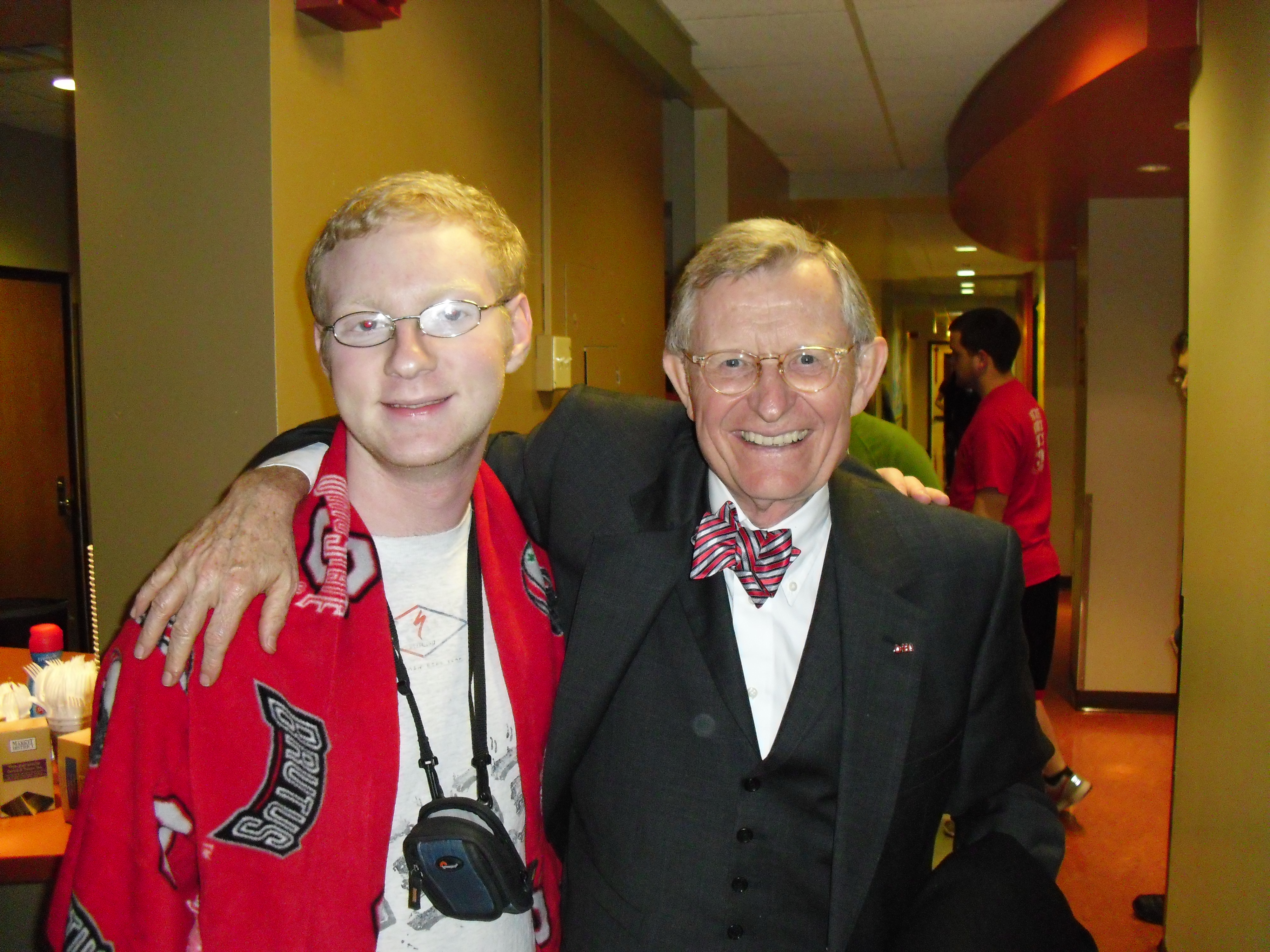
Naturally, I and several other OSU students are devastated. President Gee was a positive influence on the campus. He brought a smile to us with his bowties and jovial nature and kind and quiet manner of speech. To many students, meeting President Gee was a milestone in their OSU careers. I even met one student who said she came to Ohio State just to meet President Gee, right before she took a photo with him at the student union. To us, losing him because of this little incident will be a big blow to the morale of the university and to the students.
This is me with President Gee back in my freshman year. He was an inspiration. I hope he stays that way.
Which is why, after discussion with some other students and a lot of thought about the subject, I started a Change.org petition to get the Board of Trustees at Ohio State to let President Gee keep his position and continue to serve Ohio State as he’s done for several years. So far, 125 people have signed, and I’m hoping that I can get that number up to 10,000, or about one-sixth of the Ohio State student population.
I’d appreciate it if you signed the petition, and possibly shared it on your own blog or Facebook. This means a lot to me, and I’m trying to make a difference as best as I can. If I can, I want to see this petition reach the goal count. If you can help me, that’d be great.
If you decide not too though, that’s okay. I respect your opinion and your choice and I hope we can find other things to agree on. But if you feel like it, please do sign the petition. You don’t even have to donate money to do it! And the best part is, you’ll be making a difference for about sixty-thousand students.
At the end of the 2012 presidential election, riots broke out at a Mississippi university where racial slurs were shouted by the mob, and over the ensuing months the White House was inundated with petitions asking for individual states to secede from the Union. All these and a few other interesting little acts of rebellion and political anger were the result of President Barack Obama nabbing a second term and, in the eyes of these people, sitting comfortably in a position to create a dictatorship.
I thought these people were being overdramatic and possibly a little unpatriotic. I mean, why not wait till the next election, like the Democrats were forced to do from 2000 to 2008? Why threaten leaving the Union? And until this past weekend, I thought nothing could match this overreaction.
I was wrong.
Author Charlaine Harris is receiving hate mail and death threats for wanting to end her vampire series and to end it a certain way. Seriously?
This past weekend, I read several articles, online and off, about how Charlaine Harris, author of the Sookie Stackhouse books, was receiving negative reviews, angry letters, and even a few death threats. Why, you ask? Because a small but extremely passionate legion of her fans are upset that the latest book, Dead Ever After, also happens to be the last Sookie Stackhouse book. Some were angry that Ms. Harris was ending the series. A few were threatening to do horrible things to themselves or to Ms. Harris if the ending doesn’t put their favorite couples together (and when a leaked copy of the novel appeared in Germany, some fans did what they threatened).
This isn’t the first time an author has received this sort of treatment from fans. Stephanie Meyer received some very angry letters when she said she didn’t want to write any more vampire stories, and even Sir Arthur Conan Doyle got his share of haters attacking him when he threw Sherlock Holmes over a cliff, seemingly killing him. For the latter, this led to Holmes’s resurrection, which can show how powerful fans can be, and in the age of the Internet, a few people can create a tidal wave of faceless anger and indignation.
But can I remind everyone of something? THESE ARE FICTIONAL STORIES! There’s no actual Sookie Stackhouse or Bella Swann, Sherlock Holmes doesn’t actually mysteries in London, there are no vampires or Hogwarts, Klingons are the creation of talented make-up artists working with patient actors in seats, and the fact that adults get so worked up by a show about talking animated ponies seems a little creepy! None of it is real, but the fact that so many people treat these things like life or death just seems to disturb me.
The new target: celebrities and artists. It’s ridiculous.
So why do people go all Annie Wilkes when their favorite author decides to do something that a few fans disagree with? Or to go a little broader, why do some fans threaten to boycott or do horrible things to a celebrity when that celebrity does one little thing that doesn’t fit with the image these fans create of certain idols? And yes, fans create the images of their idols, because it is only in their minds that Tom Cruise is truly a dashing, charismatic, very eccentric man, or that the super model is the cool, serious seductress of your dreams. Magazines and TV and movies may help perpetuate these images, but the fans are the ones who create these images in the first place.
But to return to my original point, I don’t know why certain fans act so crazy when an idol does something that doesn’t fit their image, be it a pure actress that cannot be anything other than the sweet girl from the country, or the author that wants to end a book series after so many years, or the bad-boy musician who keeps his marriage and family secret because “that does not fit his image”. I always look at what these people do as gifts: they give us a wonderful story or a performance or a song and we appreciate it because of all the work that went into creating such a beautiful present.
“Mr. Spock, please set fanatics to minimal. Their interference could jeopardize the smooth running of our operations and the lives of many civilians.”
Even more so, plenty of artists treat their work like their babies, children they create and give birth to inside themselves. What happens when someone else tells them how they should raise their own children, what those children should learn and who they should love? It’s a little freaky, to say the least.
But it seems that some fans don’t see things the same way. They love their idols while the idols do what the fans want, but as soon as the idol does the opposite, the fans become hostile, believing they are owed something. The truth is, the rabid fans are the ones who owe something to the artist, and that’s an apology. You don’t own the work, you didn’t create it, and you sure as heck can’t tell the creators of such work what they should do with it. And if you are willing to go to such lengths such as try to ruin an artist’s career like hurting yourself or go on a hate campaign, then I seriously worry about your mental state.
So people, the next time you want to do horrible things to an artist for doing something not remotely criminal but you still find yourself feeling really upset about it, take a step back and ask: Is this really worth going to war over?
Is that the creepiest title I’ve ever written for a post or what?
Today while editing Snake, I thought I’d listen to some music off of YouTube (I’ve still no handle on Pandora or Spotify, if that’s what you’re wondering) when one of those three-minute ads came up. Normally I skip those ads, but I decided to check it out once I heard that the man speaking in the beginning of the ad was a forensic sketch artist for the FBI (guaranteed to get my attention, right?). The ad is below, and I strongly encourage you to watch it before going any further.
Let’s go over something very interesting about this ad: when the women in the ad described themselves to the artist, they tended to focus on the features they disliked about themselves. The resulting sketches then embodied those aspects and didn’t really match the actual women. But the people they’d become friendly with prior to the sketching, when they described these women to the sketch artist, they tended to focus on what made these women beautiful, what these newly-made acquaintances liked about these women. The portraits therefore were very beautiful and more closely resembled the women.
This is the guy who talks to his mirror image. If you’re familiar with his anime, you know he’s got a lot of work to do on himself.
Now despite being a Dove commercial (and not even Dove chocolate), I found myself really liking this commercial. I also found myself remembering something from an anime I’d watched years ago, where a character had a discussion with a mirror image of himself while trapped in another world (typical of anime, right?). The character was told that he represented how he saw himself, while his mirror-image was how others saw him. They were very different representations of the same character, but they were still the same person.
And that got me to thinking. Yes, dangerous activity, but I think anyway. We all focus on different aspects of ourselves and aspects of others. When we focus inward and look at ourselves, we often see what we don’t like about ourselves. For me, it’s my constant battle with zits and keeping off the weight I gain because I can’t resist those sweets. However when we focus on others however, we tend to focus on what we like about them, especially when we like them. When I think of a couple of friends of mine, I usually think about their height that I’m so jealous of or their smiles, and that twinkle they get in their eyes when they do smile.
So what does that tell us? Perhaps that we focus on ourselves and point out what keeps us from attaining some measure of perfection that society expects from us, and that we look for the good in others because that’s what we want for ourselves. It’s a possibility, although it’s not a nice one. Perhaps it also tells us that while we’re critical of ourselves, we love seeing the good in others, because it reminds us of the good in others, or the good we’re working to attain. That’s certainly a better take on things, right?
It’s also very true of some of the characters in my stories. Take Reborn City, for example: my heroine Zahara Bakur sees herself as a timid girl who gets easily scared when violence rears its head and can’t be relied upon when the chips are down. Her friends however see her as a very innocent but very strong girl, close to her faith and resourceful when the chips are down. Who’s right? Both actually: Zahara is nonviolent and doesn’t like to get herself into conflict, but she’s also quick-thinking and her faith supports her when times get bad. In addition, she likes to see the good in everyone, which can be a real comfort when you’re in a gang and people tell you that you’re a waste of space. In her own way, she’s helping people, all without a gun.
In addition, the titular character of Snake is also very multifaceted, though he and the people around him are more aware of that than Zahara is. The Snake is certainly gentle to those he cares about and is capable of compassion, but to those who pose a threat to him or those he loves he can be very dangerous. He’s also aware that he’s mentally unbalanced and that he’s also quite possibly evil, but at the same time he wants to at least use his evil for a good purpose. My heroine Allison Langland, who knows the Snake very well, is aware of his evil, but is also aware that he’s actually a very good guy. He’s sociable, he’s self-deprecating, and he’s responsible. She has to reconcile this with the fact that the main character is also a vicious killer capable of torture and murder, but she prefers his good side, because that’s the side she sees as the real Snake, and it’s the side that she thinks is the true hero.
To put my metaphor better, we are all something like this. Good or bad, our own perceptions or other perceptions. We just have to act on those to really get to know who we are.
So what does this say about all of us? For starters, we are not the sum of our features or our flaws, and we are not the sum of what others see in us. We are a combination of those ideas of ourselves, and we are what we use all those ideas about us for. For Zahara, she is the girl who can bring light to people living in the dark, even if she hates anything involving violence; for the Snake, he’s a monster doing good in the only way he knows how, even if it damns him; and for me, I’m trying to lose the weight, wash my face at least once a day, and write stories that people empathize with. We’re all combinations of our own perceptions, the perceptions of others, and what we use those perceptions for. Once we figure all that out, I think we can achieve a level of peace and live our lives in a way that’s conducive to us and those around us.
I’ll try to keep that in mind the next time I’m getting ready for bed and I see that one zit on my nose or how much weight I’ve gained this semester.
If the me of a year ago knew what I was doing these days, he may have a heart attack. Or possibly slap his future self. Or some combination of that.
Yes I, Rami Ungar, resistant to new technology and social media crazes, have gotten a Twitter. Why? For the same reason I got a Facebook: to spread my writing to those who may not be on this blog but may be on other social media websites. This twitter account of mine, @RamiUngartheWriter, will focus exclusively on my writing. Already I’ve published a couple of tweets advertising my upcoming collection The Quiet Game: Five Tales To Chill Your Bones. I’m very excited and I hope I gain a followship soon. You’re welcome to follow me if you like. Just know this: I’ve got a scary picture as my profile pic and it may cause some nightmares.
And no, it’s not of my face. Much scarier than that.
Also, I don’t know if any of my blog followers got a notification (do they send notifications for pages?), but I set up a new page that lists my upcoming books. Which means of course at this point only The Quiet Game is on that list, without even a picture, but I plan to rectify that soon. Check it out if you like, and have a great weekend.
You read the title, I’ve finally gotten a Facebook profile. And I’ve learned I should only play Angry Birds when I’m extremely bored and can’t find anything else to do, among other things.
So far I haven’t gotten into the whole checking-everyone’s-profiles-and-statuses thing yet, but I think that’s a good thing. I got this page just to spread the word on my writing without being a total braggart or a total bore about it. However I have found old friends that I fell out of touch with, and I did find a guy I was bullied by and made my peace with him. Not all that bad, right?
Plus, I get to play Angry Birds, but like I said, I should wait for a better time to play it, when I’m unoccupied by anything and can’t think of anything else I want or need to do.
So I guess in the end, Facebook is a useful little tool after all. But don’t expect me to get too excited about it; I still view it as unnecessary. And if any other WordPress bloggers have visited the Freshly Pressed page recently, you can see others who share my opinions.
All for now, I’ve got a short story to finish up. Bye
Looks like I have something to be grateful to Facebook for: I found an old bully of mine. In 3rd Grade he made my life hell with his friends, and I was so happy when I left that school and transferred to a school that, although I had a rocky start there, I felt I had found a home for myself. However the memory of that bully never left me, and I sometimes wondered from time to time what happened to him. I do admit I was bitter up until a few years ago, still upset about what I went through. I even made him a character in a story I wrote once, changing his name a little, where he ended up killed because he was an evil vampire.
Now, I don’t need to be psychoanalyzed to know that I wanted to put all the hurt I felt into a weapon and get back at him through the power of writing. And at some point I realized that holding onto this hate wasn’t going to do me any favors. So I tried finding reasons to forgive him. After a bit of soul searching, I found one: I was molded into a writer of scary stories by many sources, first and foremost by an experience involving two staff members at a synagogue scaring the hell out of me after services one day when I was no older than six. But the torment I went through in the third grade–the teasing, the isolation, the one time a friend of his put glue in my hair and I didn’t notice until someone pointed the glue out to me–helped mold me as a writer and as a person. It wouldn’t be the last source to warp me, but it played its role.
And I emerged from that experience much stronger than I had been. I started writing, found I loved it, discovered I loved writing horror, learned how to scare people with some effectiveness, and started getting some of my work published. In addition, I began to feel an empathy not only for those who were bullied, but for those who’ve been hurt and discriminated against because they were a little different than others. It’s a part of me I cherish, because it makes me a better person.
I’m now over the hurt, even though I still don’t like it when certain aspects of that time are brought up (my immediate family probably knows what I’m talking about). I write a lot, I emphasize with people, and I try to treat everyone as kindly as possible. But I wanted to find this guy, if only to ask why, or to get a little closure or something. I had trouble finding him, particularly because I didn’t want to use social networking to find him.
But I got a Facebook page to spread the word on my writing. Lo and behold, I found him. I sent him a message. And I told him I forgive him for all the hurts, and I wish him happiness and success in life.
Now that I’ve sent the message, I feel a sense of peace. I feel like I’ve finally gotten something off my back, and now that it’s gone, it feels so great. I don’t know what’ll happen next though. Maybe he’ll read the message. Maybe he won’t. Maybe he’ll send something back. Maybe he’ll ask to be my friend. I don’t know. But I do know that he’s in California and I’m in Ohio, so the distance between us is enough that I feel comfortable enough to just see where this goes and not worry that he’ll show up and harass me or something.
In the end, I’ve closed a chapter of my life that deserves to stay closed. And now, I would like nothing more than to continue working on the short story I’ve been working on since this morning.
Just warning you now, if you scan this, it’ll send you to the Wikipedia homepage.
As you all know, I’ve decided to go into self-publishing. And one of the hard facts of self-publishing is, you have to do most–if not all–of your own advertising. So I’ve been thinking a lot about how best to go about advertising Reborn City once it comes out, putting ideas on my checklist for the self-publishing process under “Advertising.” One idea for getting the word out was to put an ad in Entertainment Weekly or People Magazine, because they have ads for that sort of stuff in the back of the magazine, among the reviews for the latest movies, TV shows, music, and books.
I was reading my Entertainment Weekly yesterday when I saw one of those ads, and near the bottom of the ad, there was a large QR Code box that had a caption underneath: “Scan to read an excerpt.” My first thought was, I should do that. My second thought was, Wait, I don’t even know what these things are called! What should I do? Luckily I was able to find out they’re called QR codes (I usually just call them the scan-crossword-puzzle-with-a-smarphone-thing, and only in my head), but they got me thinking.
First off, how does one go about getting a QR code? Is there a company that specializes in making them? Or can you just go to a government agency and obtain one through them? Or how about just asking your programming-savvy next door neighbor to design one for you?
Secondly, how many people actually scan those things, and how often do they scan them? My phone isn’t a smartphone, so I don’t do any scanning. I also have no idea on the statistics, but I have to assume that at least a good amount of people will scan a QR Code with their phone if they see one on an advertisement that catches their eye. But even if they scan a code, will they end up buying the product? How many do?
I’ve aready done a little research on this, but I haven’t found much to answer my questions. So I’d like to ask you, fellow bloggers and faithful readers. Do you scan QR codes? Do you actually use them if you self-publish? How often do you scan QR Codes, and when you do scan them, how often do you end up buying the advertised products? Let me know, please.
The Jewish New Year recently came to pass. And with new years in any culture, we wish to make changes for the coming year so that hopefully, this year will be a good one. Well, I’ve decided to make a change.
As you well know, I’ve been trying the traditional publishing route for some time now (write and publish a bunch of short stories; write a novel; get an agent who can refer you to the best publishers; company publishes your novel). This process has been the norm for several years, but it does have its flaws: for instance, the big publishing companies are ruled by the need to make money, so they only publish work that they feel could be profitable, which can lead to numerous rejections for authors whose work doesn’t meet one criteria or another. Not only that, but the companies themselves have a lot of control over the author’s work, having the author edit it fifty different ways so that it can be more commercial or more profitable or whatever. All so that the author can reach the highest number of people possible.
But, self-publishing is on the rise, and people who have been reading Rami Ungar the Writer for some time are probably aware that I’ve been toying with the idea of self-publishing. Self-publishing allows an author to have more control over his or her work, recieve more profits from sales, and not be obligated by big corporate contracts. The pitfalls include that most self-publishers don’t make a lot of money off of self-publishing, and when they do it’s usually because a traditional publisher has made some sort of deal for their novel (this is what happened with Fifty Shades of Grey). Self-published authors also have to do most of their own advertising, and with the power of the Internet, anyone can upload anything, even if the work looks like a kindergartener wrote it.
But still, self-publishing is becoming more and more popular with every single day among writers, and now it’s got a new adherent. That’s right: I, Rami Ungar, have decided to self-publish, and since one of my classes has given me more confidence with computers, I’ll be doing it without the help of a service, instead compiling the whole thing myself and putting out my work as e-books (at least until I have the money and knowledge to do my own paperback).
My first self-published work will be my science fiction novel Reborn City, which I hope to have out next year at some point. I plan to take one more look at it for editing purposes, have someone else look at it afterwards (probably someone really into science fiction) and then, based on that person’s suggestions, edit again. After that I’ll set up my own independent press, one that’ll be dedicated to horror, thriller, science fiction, and fantasy, and which will allow me to have the most control over my work. It’ll be like how Akon has his own label, Kon Live and Konvict Muzik, but uses big labels like Universal to distribute his work (in my case, the Universal will be Amazon and B&N and Smashwords and such). I won’t say what I’ll name my press, but I do have a name for it, which I’ll reveal to you after I get the necessary legal paperwork out of the way to set it up. That, and a website and possibly a Facebook profile (yes, I’m considering using Facebook to get my work out there, please don’t make a big deal out of it).
I will then get a cover made for Reborn City, format the whole darn thing for an e-book, get RC copyrighted (and ISBN-ed; I’m not sure if one of those are necessary exactly but it’d be good to check), and on a release date that I will choose once I’ve formatted RC into an e-book, I will let the whole world read my work for a mere $2.99 per download.
I hope all of you will show me your support in this endeavor, and possibly consider reading RC when it comes out and letting your friends know about it. If you have any tips on how to do all this, please let me know, as your feedback is always helpful to me.
I’ll let you know when my new press is up-and-running, and when Reborn City will be released. Thanks for reading, and I hope you’re as excited as I am!
Or, to be more specific, Ephraim Ungar’s on LinkedIn (that’s my legal name; don’t ask me how you get Rami from that!).
Anyway, after months of people telling me to get a LinkedIn account and after my uncle wrote me an email saying I should join, I did (thank you Uncle Joel; I’ll lay off the Buckeye-love this one post as a thank you). If you go on, you’ll be able to friend me or whatever and we can do the whole networking thing. However I’m warning you, I’m very inexperienced when it comes to social-networking sites (though this one I might get very into).
Feel free to friend me or whatever it is we’re supposed to do on LinkedIn; just look for Ephraim Ungar in Columbus, Ohio.
Oh, and any suggestions on how to make my profile better are appreciated.
![gordon-gee-12490a4fe36e00ab[1]](https://ramiungarthewriter.com/wp-content/uploads/2013/06/gordon-gee-12490a4fe36e00ab1.jpg)


 Rami Ungar The Writer