Archive for the ‘Review’ Category

Junji Ito collections, with the exceptions of masterpieces like Remina or Uzumaki, usually rate a 3.8 out of 5 from me. There’s usually some good ones, but the bad ones can really bring down the score of the collection. And with Ito himself admitting in his last collection that as more time goes on, the more he’s scraping the bottom of the imagination barrel, I was braced for a collection full of duds.

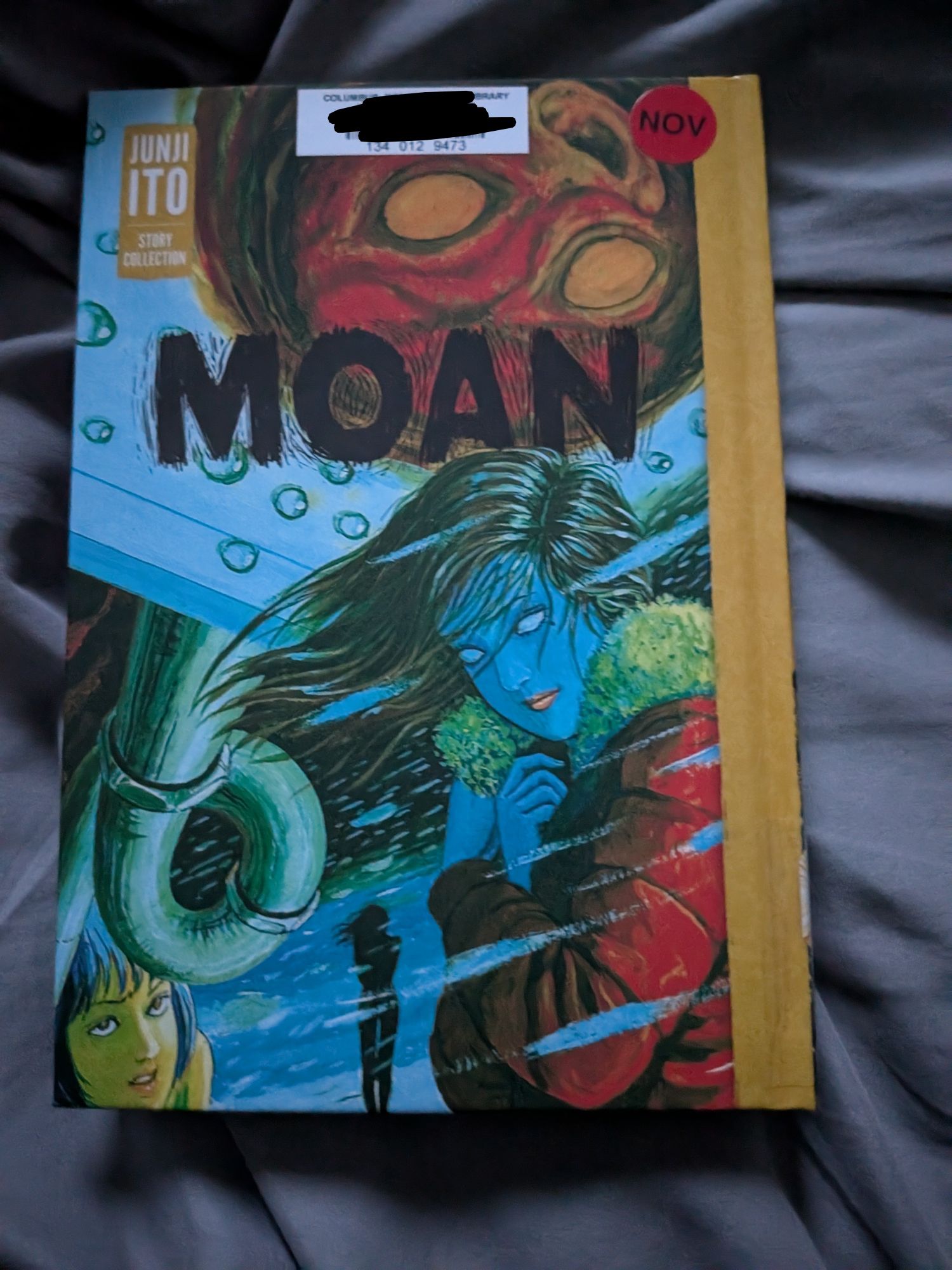
In Moan, Ito-sensei gives us four stories of around 60 pages or so, and two shorter ones of about 10-15. And what do you know? This time around, the majority of the stories worked for me.

The first story, “Supernatural Transfer Student,” is fun and imaginative. A small town high school gets a new transfer student, who immediately joins the Supernatural Studies club, which has some possibly-real, possibly-fake psychics. Suddenly, the town is full of weird phenomena right up the club’s alley, and the new kid might be causing it. It’s visually enjoyable and escalates nicely, so I enjoyed it.

The titular story, “Moan,” is about a family whose mother is obsessed with cleanliness to the point of neurotic. When a murder occurs in their home, things start getting weird and a moaning noise comes out of the pipes. Is it the spirit of the murder victim? Or is something else going on here? There’s a sense of claustrophobia and spiraling madness in this story, and the climax is very terrifying. The story ends a bit too abruptly to me, but I attribute that to manga publishers having a limited page count (still would have liked ten more pages to give the story a proper ending). Other than that, the story is chef’s kiss levels of good.

“Blood Orb Grove” is a tale of vampirism that has an interesting twist on the lore of vampires. It’s good, but there’s a bit too much talking and needless info-dumping in the climax. Meanwhile, “Flesh-Colored Mystery” is a great and imaginative story about how much someone’s beauty standards can mess up the lives of others around them. It’s visually creepy and the themes of beauty and abuse really resonate. Perhaps the ending for this one is also a bit too abrupt, but I still enjoyed it.

The fifth story, “Near Miss,” is very short and unimaginative, and is honestly the low point of the collection. However, the last story, “Under the Ground,” makes up for it with an engaging story that has a predictable, but still very well done, twist at the end.

All in all, I really liked Junji Ito’s Moan. On a scale of 1 to 5, I’m giving it a 4.5, much higher than the usual score. There’s some great stories here, and they’re all done with Ito-sensei’s iconic art style. Hell, some like “Moan” or “Blood Orb Grove” might make for great movies, so long as they were live action (at this point, I’m convinced you can’t make a good animated Junji Ito adaptation). Just avoid the fifth story in the collection, and you won’t regret reading it.

“This book is perfect for your conservative relatives. Especially at Thanksgiving.” This is the description I got of Wake Up and Open Your Eyes by Clay McLeod Chapman, a satirical horror novel about a demonic apocalypse. With a description like that, I was intrigued. And this past Thanksgiving, I started the audio book.

To which I say, “Woo-boy? What did I get myself into?”

Wake Up and Open Your Eyes starts with Noah Fairchild, who goes from his home in Brooklyn to check on his estranged parents after his mother leaves a strange, conspiracy-filled message in his voicemail and then doesn’t pick up. When he gets down there, he finds his parents seemingly brainwashed into dementia by their conservative news shows. However, it’s actually the beginning of the apocalypse. And the demons are possessing people through their devices. And what they choose to consume through their devices.

As I said, this is a satirical horror novel, so there are plenty of funny moments that made me laugh out loud. One of the main sources of possession is a parody of Fox News, and it’s so thinly disguised, you can tell immediately which anchor is getting made fun of. In the final third of the novel, the story is actually narrated by a fictional version of a real life news anchor, only he’s a hallucination living in a character’s head to help them process these events!* And even in the apocalypse, people are posting videos to YouTube, Instagram, and TikTok, as if they need to share their most intimate moments to make them real.

However, this is a horror novel, and it gets horrifying! The demon-possessed do some seriously fucked up shit when they take over people, and a lot of it is described in excruciating detail. The amount of body horror and gross out elements even borders on extreme horror, so it can be uncomfortable at times (I just barely tolerated it).

Still, it is hard to put down. While at first I could only listen to it in small doses, over time I got so hooked, I listened whenever I could. And the ending, while some may hate it, is definitely quite fitting for such a bleak horror novel.

On a scale of 1 to 5, I’m giving Wake Up and Open Your Eyes by Clay McLeod Chapman a 4.5. It’s bleak, horrifying, and pokes plenty of fun at a nation/world/species that is willing to give up its thinking faculties and let a talking head on a screen do the thinking for you (not just conservatives; liberals and everyone else, too). If you have a strong stomach and are at all interested, give it a read. You may never be able to look at cable news, wellness gurus, or even “Baby Shark” the same ever again, but it might just be worth it.

*And can I say, I find it so bold to put real, living figures in your stories, using their real names? I’ve read a few stories like this, such as Shoeless Joe featuring JD Salinger, or a story by Jonathan Maberry where Kevin Hart and Kelly Clarkson, among others, make an appearance. And ever time, I marvel. I know it’s kind of allowed if they’re a public figure and it’s either parody or their fictional selves are acting in a way that would correlate with their real selves. But still, it’s not something I would consider doing (especially when I put real figures in my stories as a form of punishment for real life bad acts). I would be too worried about getting sued!

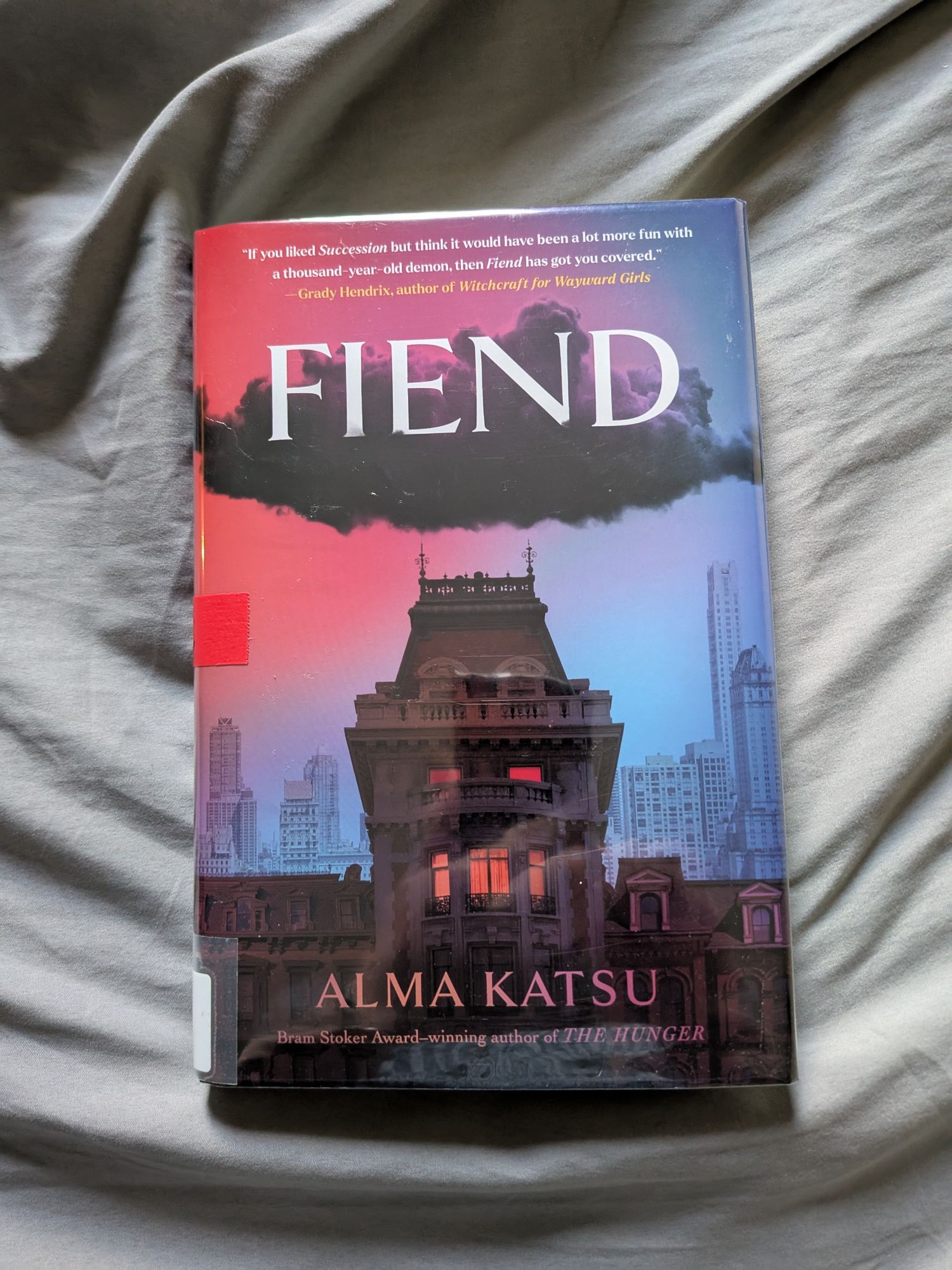
Alma Katsu’s become one of those authors for me that, when I hear they have something new coming out, I immediately want to scoop up a copy and read it. And when I heard that, for the first time, she was releasing a horror novel set in our modern era, I was intrigued. When Fiend finally came out, I immediately went to the library to grab my copy (support your local libraries, kids!) and started reading as soon as I could.

That was about a week ago. I finished the book today. And now, I’m reporting my thoughts.

Set in our modern times and with some flashbacks to the past (which, based on the characters’ ages and context clues, I assume is somewhere between 2004-2015), Fiend follows the Berishas, a powerful family hailing from Albania that rules over a wide business empire. Specifically, it follows the youngest generation of the Berishas: Dardan, an anxious young man being groomed to run the family empire; Maris, who rebels against her father’s patriarchal views and wants to rule while also wanting to please him; and Nora, a wildcard who’s more than she seems. They are well aware that their family, ruled over by the tyrannical Zef, is rumored to be aided by a demon that keeps them rich and untouchable. But after a particular incident, the dominoes start falling. Dominoes that will change the family, and possibly bring down the dynasty, forever.

So, while this book has been marketed or compared to “Succession with a demon” (not sure how accurate that is, having never seen Succession, though I know the basic pitch), I would compare it more with 2015’s The Witch. The focus is on these characters, showing an intimate portrait of a family that is breaking down due to isolation, clashing egos, and external pressures closing in. The demon itself, like the witch in the movie, is just one of the catalysts that hastens the breakdown of the family.

And the way Fiend is written, it is hard to put down or look away. I was breezing through each chapter, just wanting to find out what happened next and how each of these fascinating, unhappy, often terrible people would hurt each other next. We spend the most time with Maris, and you can see Alma Katsu having a ball writing her and showing her trying to achieve what she thinks she wants. After her, we spend the most time with Dardan, who is desperately struggling under the weight of his destiny but too scared to find a way out of it.

My two criticisms are this: one, I would have liked to have spent more time with Nora. As I said, she’s a wildcard who’s more than she seems, and I would’ve liked to get further below the surface than what we got with her. I get why she’s the sibling we spend the least amount of time with, but I still wanted to know her. And two, I honestly wanted to see more interactions with Olga, the Berisha matriarch. She’s mentioned more often than seen, and I think it would have been fascinating to see how she’s weathered being part of this screwy family for most of her adult life.

But beyond that, Fiend is an excellent family drama/horror story. On a scale of 1 to 5, I’m giving it a 4.5. An enthralling deep dive into the world of corporate intrigue and what can occur from generations of abuse and trauma (plus a little demonic magic). If this sounds like it might be up your alley, grab a copy and get ready for one hell of a ride.

It’s that time of year again, which means it’s time to recommend some movies for spooky season. So once again, I’m here to recommend thirteen movies that you can binge between now and Halloween. Hopefully you decide to check some of these out. As usual, I got a mix of old and new, well-known and lesser-known. All guaranteed to make your spooky season that much spookier.

So are you ready? One. BOO! Three. Let’s go.

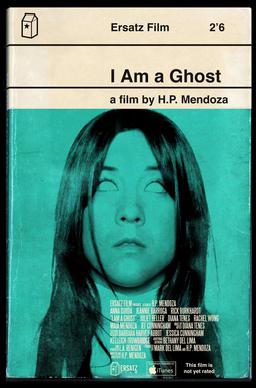
I Am A Ghost (2012)
A ghost is haunting an old, rambling Victorian home. However, she doesn’t know she’s dead. Not until a medium reaches out to her to let her know she’s dead and it’s time for her to move on. But that’s easier said than done. Especially given the truth of how she died.

Made for only ten thousand dollars, this little indie film has both a creepy mystery and a distinct style that makes it stand out. Some of the editing choices might not be for everyone, but honestly, it’s stuck in my mind for over ten years. And I think it’s something you’ll enjoy, too, if you give it a chance. Plus, it’s on Tubi, so it’s free.

Screamboat (2025)
An anthropomorphic mouse gets loose on an old Staten Island Ferry vessel, going on a violent murder spree. Hijinks ensue.

These public domain horror films based around characters like Winnie the Pooh and the Steamboat Willie version of Mickey Mouse get a bad reputation. And for the most part, deservedly so. However, this one is actually decent! The humor is top-notch, the slasher element is extremely gory and well done, and there are actually some really beautiful, heartfelt moments. The flooding closet scene alone will pull at your heartstrings! So, if you’re going to check out any of these crazy public domain slashers, make it Screamboat.

Plus, you can make one hell of a drinking game trying to catch all the Disney references. Just saying.

My Best Friend’s Exorcism (2022)
Set in 1989, friends Abby and Gretchen get together with some friends for a weekend of getting into trouble. However, while attempting to take some LSD, something attacks Gretchen. Something not human. It’s making her do horrible things to herself and those around her. It’s trying to drag Gretchen’s soul to Hell. And Abby will need help if she wants to save her best friend from damnation.

Based on the fabulous novel by Grady Hendrix (see my review of the novel here), this movie is equal parts funny and scary, and is also quite heartwarming. My sister and I watched it on a movie night, and she and I loved it. If you’re looking for a fun horror movie to watch this season, then this is definitely an option for you.

Heretic (2024)
A pair of young Mormon women doing their missionary work go to a man’s house after scheduling to meet with him and proselytize to him. However, the man hasn’t asked them to come to his home because he truly is interested in the Book of Mormon. He’s invited them because he’s built his house to be a giant trap. And while they’re stuck with him, they’re going to go on a religious/spiritual journey with him. Whether they want to or not.

With a standout performance by Hugh Grant as antagonist Mr. Reed, the film delivers both a tense atmosphere and a twisty plot full of religious, spiritual, and philosophical themes that really get you thinking. If you enjoy horror but are also very religious/spiritual, I would recommend seeing this film just to ponder its themes. Also, it’s a damn good horror film.

Banshee Chapter (2013)
After her best friend from college mysteriously disappears after taking a chemical associated with the MKUltra experiments, tries to figure out what happened. Along the way, she gets in deep with government conspiracies, a counterculture writer with a drug habit, and mysterious, barely seen creatures that want to inhabit our skins.

Based loosely on the short story “From Beyond” by HP Lovecraft, this found footage updates the story with one of America’s most infamous moments of violating the rights of its own people. It’s not perfect, but it has plenty of scary and tense moments and it’s hard to look away. Plus, Ted Levine as surly counterculture author Thomas Blackburn just steals the show in the best way.

Abigail (2024)
A group of career criminals kidnap a twelve-year-old ballerina to hold her for ransom. They’re told to lay low in a mansion for the next twenty-four hours. No names, no personal details, and no interacting with the girl. However, it soon turns out that the girl is the daughter of a terrifying underworld figure. And she’s a vampire. And she basically staged her own kidnapping so she could have some fun hunting her prey.

As bloody as it is hysterical, this was definitely one of the best horror films of last year. Watching a preteen in a bloody tutu tear out people’s throats and fight grown adults while dancing the steps to Swan Lake is like nothing else. Plus, you really grow to like these characters, even if some of them are total bastards. Give it a watch and see how it enhances your Halloween season.

Alice, Sweet Alice (1976)
Two young girls are growing up in a heavily Catholic community in early 1960s New Jersey. The younger is murdered on the day of her First Communion, and suspicion falls on her older sister Alice, who is neglected and displays antisocial behavior. She also has never been allowed communion, as she was conceived out of wedlock. As more bodies pile up, more fingers start pointing in Alice’s direction. Is she the one behind it all? Or is someone else the culprit?

When this early slasher was released in 1976, it caused an uproar due to its perceived anti-Catholic views. However, it’s since gained a huge cult following and has been examined and reexamined by scholars for what it says about religion, familial dysfunction, and adolescent psychology. For my part, Alice, Sweet Alice has been stuck in my memory since I saw it a few years ago, and I keep finding myself returning to the movie and its troubled main character, every now again.

If you want a slasher that pushes some boundaries, this might be the movie you should watch this spooky season.

In a Violent Nature (2024)
Another prominent slasher, this one takes things in a very different direction. After his grave is disturbed, an undead killer rises from the dead. He then goes on a killing spree, mowing through everyone he comes across. All while doing it in a slow, methodical, unemotional way. And I mean “slow, methodical, unemotional.” But in the most fascinating way.

Most slashers focus on the characters about to be killed, but In a Violent Nature shows things from the killer’s perspective. Not directly, but usually from behind him. Coupled with a lot of quiet moments, without even a soundtrack other than nature sounds, and it makes for a realistic take on a slasher story, though it still has its moments where you think to yourself, “Okay, you idiot, you did something stupid and now you’re going to die.”

Just make sure to be well-rested while watching. If you’re not careful, the quiet moments can put you to sleep.

The Gate (1987)
A young boy and his friend accidentally discover a gateway to semi-Lovecraftian cosmic entities of evil and try to close it before the demons swarm out into our reality and destroy it. Along the way, they’ll deal with some trauma and feelings of loneliness.

This film isn’t the scariest thing I’ve ever seen, but it is fun to watch. It’s filled with a lot of heart, some decent stopmotion effects, and an emotional undertone that will get you right in the feels. Plus, that opening scene that still scares me (plus it inspired a novel I hope to write someday)!

While I wish it would lean more in to the Lovecraftian elements (maybe a remake someday?), it’s still a great film. Give it a watch, and you’ll see.

The Collector (1965)
A man wins the lottery and buys a huge house in the country. He then uses it to keep a woman he’s infatuated with. Obviously, the woman wants nothing to do with him. But stuck in his home, she only has so many options at her disposal. Thus begins a terrible game of cat and mouse.

This psychological horror film may be older and a slow-burn, but it’s still effective. Watching both characters trying to outmaneuver one another and gain control in this messed up stalker-stalkee relationship, all in the background of the English countryside, has to be seen to be believed.

The Vigil (2019)
A young Jewish man who has recently left his ultra-Orthodox community is hired to watch over the body of a recently deceased man until his body is collected in the morning for the funeral. However, the deceased was apparently haunted his whole life by a terrible spirit. And now, the young man may be its next victim.

This is, by far, one of the best examples of Jewish horror films I’ve ever come across. Spooky, atmospheric, with an emphasis on practical effects and psychological horror, this film will stay with you long after you’ve watched it.

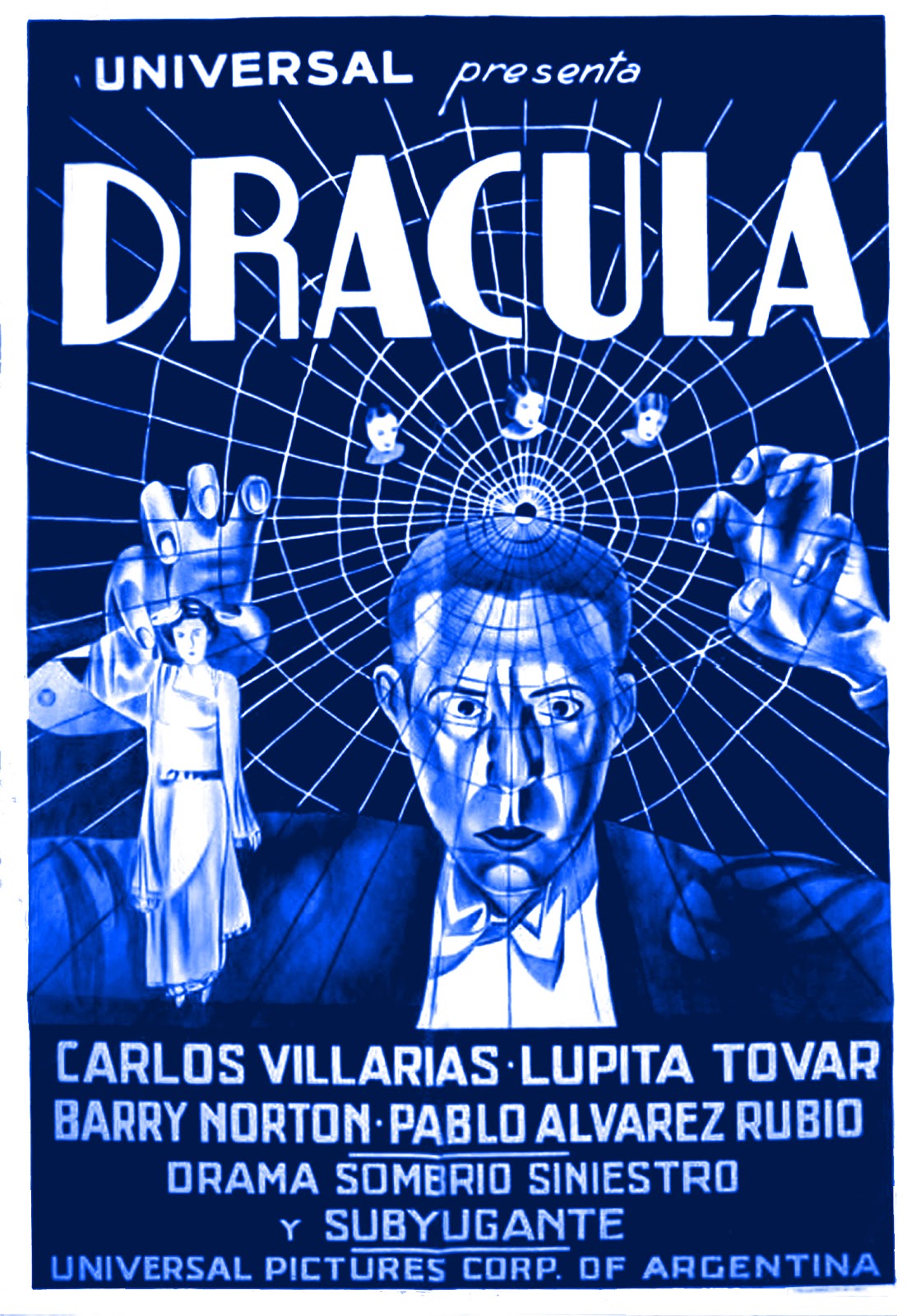
The Spanish-Language Dracula (1931)
It’s the same movie you know. The one that started the Universal horror line and is part of the foundation of modern horror films. Or is it?

Back in the 1930s, movie studios were trying to reach foreign markets, especially Spanish-language markets. And rather than dubbing over the soundtracks or figuring out how to put subtitles onscreen, they would have a Spanish-speaking cast and crew come in when the English-language crew were done filming for the day and film their own version. The Spanish-language Dracula is particularly famous, as director George Melford would watch what was filmed the day before to inform his own version.

The result is a version of the 1931 film that is on par with and maybe even better than the English-language version. It was thought lost for many years, but resurfaced in the 1970s and has since been preserved for both posterity and our viewing pleasure. And honestly, if you’ve seen the English version, then you really have to check out the Spanish version and compare the two.

Sinners (2025)
A pair of twins in Jim Crow Alabama decide to open a juke joint for the local African-American community, enlisting the help of their young cousin and some other locals to make it a success. However, on opening night, the joint gets some unexpected gate-crashers in the form of vampires. And these vamps, who are out for more than just blood, won’t stop till they get what they came for.

If you only watch one film off this list–nay, if you watch only one film this Halloween season, make it Sinners. This film is visual, musical, historical, thematic, and just a few other types of gold besides. Blending genres, breaking conventions, and putting a big boost into both African American horror and original horror stories, I’ve seen it twice and have been blown away each and every time.


So, those are my recommendations for this year. I hope you decide to check out a few of these. I know I’ll be giving the ones I haven’t seen in a while a rewatch.

But in the meantime, tell me: what would you add to the list? Which of these films have you seen? And what were your impressions of them? Let’s discuss.

That’s all for now, my Followers of Fear. Until next time, good night, pleasant nightmares, and 75 days till Halloween. Get watching.

No, you didn’t read that wrong. That’s not a misspelling on my part of “Halloween.” That is the name of the novel, and since I heard of it, I’ve wanted to read it. I mean, with a name like that, how could I not? And with the audio book just getting released recently, I decided to give it a listen and see if this would become a new classic for spooky season.

Taking place during the Halloween immediately following the September 11 attacks, several strange things are happening in the small town of Crook’s Corner, Massachusetts. A famous scream queen is kidnapped in town while filming a new horror film. A science teacher is putting together a machine that causes those near it to see strange shapes. A Goth teenager and her little sister use the latter’s psychic abilities to play pranks on their grandmother. All this and more herald the coming of something evil: a cosmic being who wishes to become a god over all humanity. And this Halloween, they may get their chance.

This book was so hard to put down (or should I say put on pause?). The first chapter, where the scream queen is kidnapped, is shocking enough, but then the novel jumps back several hours, showing what the main characters–a group of high schoolers filming a horror movie for a class–are up to. And with those opening chapters, you get several different plot threads and you wonder how they’re all going to wrap up into one neat little package.

Which, much to my delight, they did come together nicely, leading to a harrowing story with a strong atmosphere of dread and tension. In fact, that’s probably the book’s biggest strength: the atmosphere. Once the horror part really gets going in Helloween, it’s just nonstop threat to the characters. Even in the pauses to the horror, there’s so much tension, it’s hard to relax. Add in some of the events in the latter half of the book, and you start to wonder if the characters can even triumph over the great evil.

And that’s the book’s second biggest strength: it’s characters, particularly the antagonist Geth. Geth is an ancient entity who schemes to become a god, and when it–or they, I should say–gets the ball rolling on their plans, you better believe that shit will hit the fan! And the way Geth is written, this alien being who thinks differently than us but plans to become a god over us, just makes them fascinating to follow. Even as you fear their victory due to their overwhelming power and disregard for both human life and human autonomy.

The other characters are great, too. Ralston manages to make almost all of the supporting characters– from kooky science teacher Ernie Combs and the Catholic priest to would have been right at home during the Crusades, to scream queen Darla Knight and the annoying kid who annoys almost all the other characters–feel real and fleshed out. And yes, there are a lot of them, but at no point did I ever feel like I was overwhelmed with the number of characters I encountered in the book.

Of course, our six main characters were no exception. At first glance, they do feel like your typical high school stereotypes: Cody the jock; Britney the popular girl; Jay the computer geek; Walden the film buff; Cassandra the Goth and her sweet little sister Taylor. But early on, we see that they all have deep dimensions to them, and that only grows as we get deeper into the story. Before I knew it, I couldn’t help but root for and love these characters dearly.

All in all, Helloween by Duncan Ralston is scary AF and sure to become a Halloween classic in time. On a scale of 1 to 5, I’m awarding it a 4.8. Consider picking up a copy and adding it to your reading list this spooky season. If you’re a horror fan, you won’t regret it.

This isn’t my normal review. But then again, this is far from a normal graphic novel.

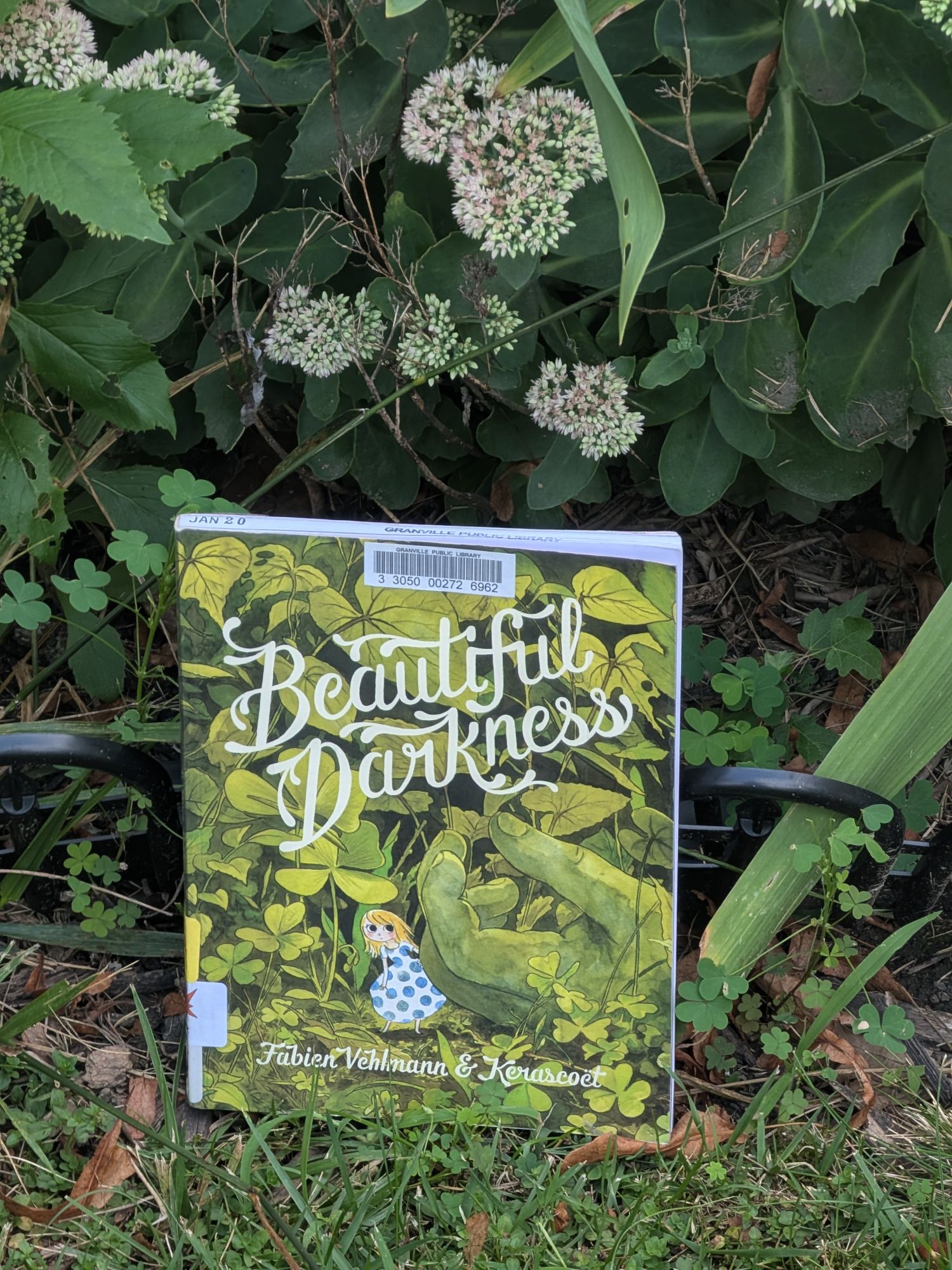
So, when you think of tiny, humanoid people, what do you think of? Fairies? The Borrowers? How about tiny people living inside you (and I don’t mean the emotions from Inside Out)? Not with Beautiful Darkness, a graphic novel by Fabien Vehlmann and Kerascoet.

The graphic novel starts out prettily enough. A girl named Aurora, who is like a Cinderella in a 1950s housedress, is being courted by a princely character named Hector. She’s helped by a short little friend named Plim. In the first page and a half, their romance is going just like a fairy tale…until the cutely drawn characters’ home starts dissolving around them, forcing them to leave.

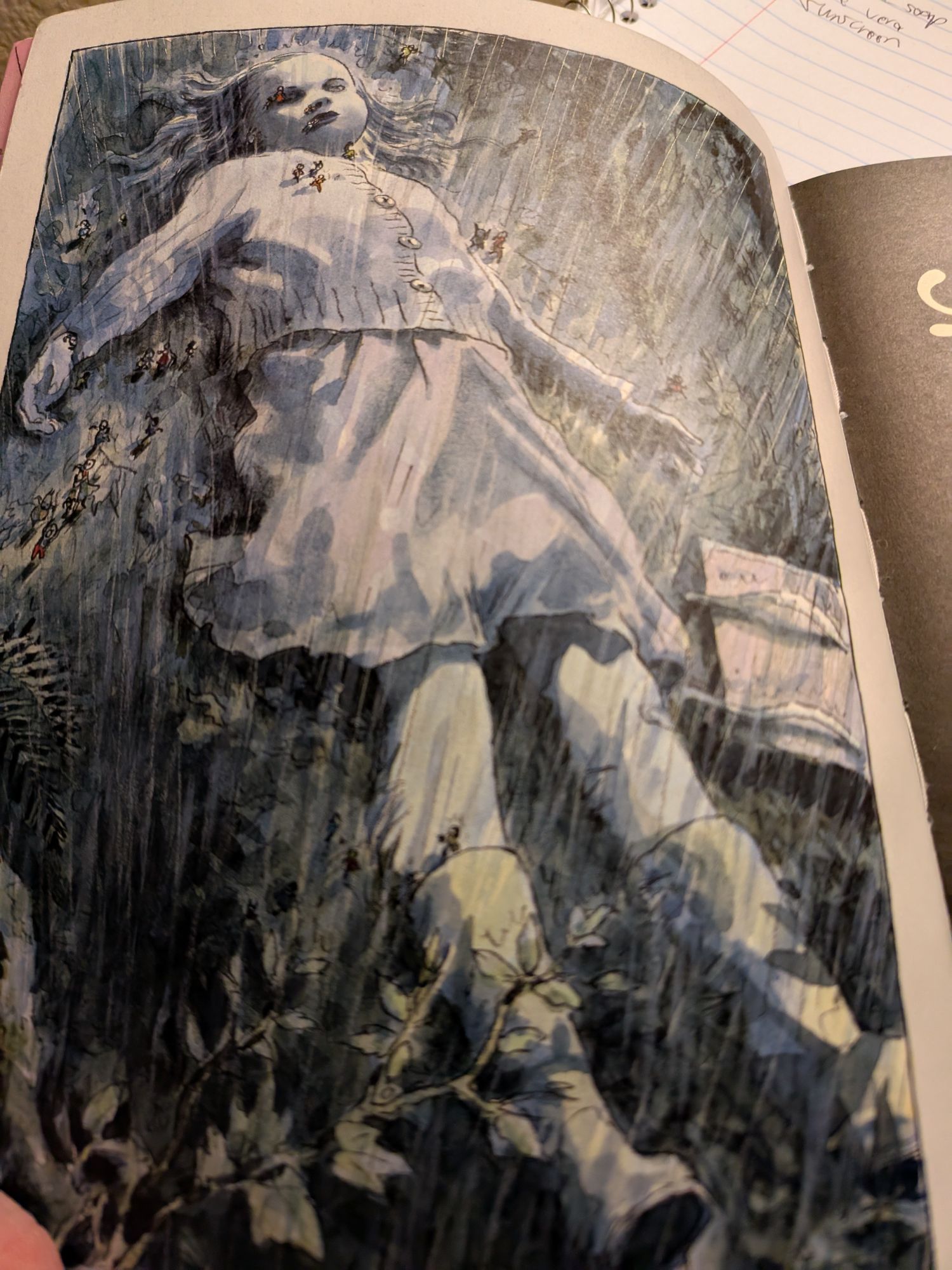
And then it’s revealed that home is the body of a little girl, left abandoned in the woods to rot. Her name, who she might have been, and how she died, never revealed.

And that’s just the start of a very dark saga dressed up in art that, in another graphic novel, would fit nicely in the children’s section at your local library.

This image is so disturbing, I almost didn’t include it in this review.

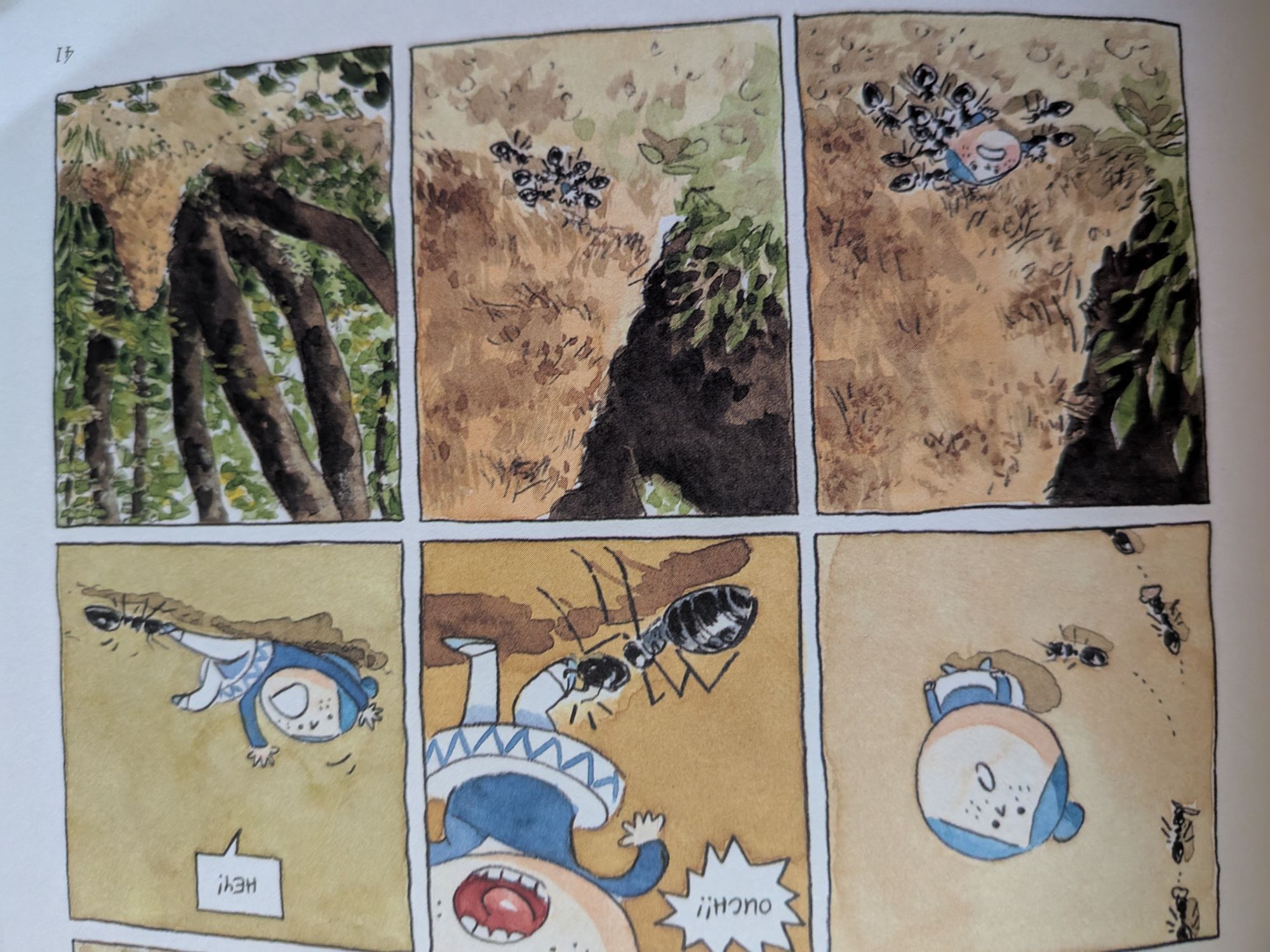
Aurora quickly finds herself trying to be a leader as she and the other survivors learn to grasp their new surroundings. However, Aurora, who might be the most realistic, as well as the most idealistic, of this community of tiny people, do not have it easy. Except for one mouse, all the animals and insects are as wild as you’d expect, and do what animals do best. The elements take their toll as well. Schemes to survive lead to further deaths or maiming, such as when one character tries to sneak into a nest full of baby birds and eat with them. The result is that her mouth gets torn open by the mother bird’s large beak, leading her to throwing up blood and running away.

But worse than animals, or nature, or survival attempts, are Aurora’s compatriots. Perhaps because they lived inside the body of a little girl, they are almost oblivious in their innocence and naivete. They see each other die, and move on to fish or fly kites or dance like it was nothing. They scheme against and backstab one another. They even kill each other, and do it with such callousness, never once sparing a thought for the lives they’ve taken!

All this betrayal and disappointment wear on Aurora, especially after her leadership role, and her lover, are usurped by rival leader Zellie. She later thinks that she’s found a friend in a loner survivor named Jane, but events soon force her to make the ultimate choice.

A prime example of how dark and uncaring the world of these characters is.

I’ve written before about “corruption of the innocent” before. The idea that the horrors one faces through a horror story destroys whatever innocence you have left and transforms you into something new. It could be childhood innocence, or that you thought the world was a rational place full of rational people, or that the world is ruled by a loving and merciful god. In some subgenres of horror, like Gothic, it could be considered essential. I certainly consider it essential, to the point I have a tattoo on my back representing it.

And it’s been such a long time since I’ve seen it done so well. Aurora tries to stay strong, but her innocence is destroyed in a world where she and her people are as inconsequential as dust motes, and those she should be able to rely on smile innocently while they betray her. In a way, it’s like cosmic horror, only instead of Cthulhu and the Great Old Ones, it’s a forest full of hungry animals and violent nature, as well as your own community.

(That’s not my observation, BTW: it’s the YouTube channel Tale Foundry, where I first heard of this graphic novel and which I highly recommend. You can check out their video about it here, but beware of spoilers.)

Anyway, it’s probably only a matter of time till this graphic novel appears on my personal shelves. In the meantime, I’m awarding Beautiful Darkness by Fabien Vehlmann and Kerascoet a 4.8 out of 5. It’s dark, it’s disturbing, it’s possibly the prime example of a new subgenre called “innocent horror,” and I think you should check it out.

Just don’t show it to young children afterwards. It’ll mess them up in all the wrong ways.

You know the drill: Junji Ito releases a new collection in the States; I read it; I review it. And in his latest collection, The Liminal Zone 2, Ito-sensei once again gives us four stories that try to toe the line between the world of human-caused horror and the more supernatural kind. (Plus the complicated relationships between fathers and sons, now that I think about it.)

You may recall, but I was not impressed with half of the stories in the first Liminal Zone (see my full review here). And, as Ito-sensei himself says in the afterword of Liminal Zone 2, he feels he’s having fewer ideas for stories every year. Can what ideas he has work for me this time?

For the most part, yes.

The first story, “Demon King of Dust,” follows a young boy living in what remains of a hot springs inn with his increasingly unstable father and two servants. The father is paranoid about dust, claiming it’s part of a terrible demon that rules over the abandoned resort town where the inn is located. It’s a very freaky story, where every couple of pages reveals more and more strange and disturbing imagery and truths. I love how it just escalates and how you’re left guessing how much is real or how much is in the father’s head.

The second story, “Village of Ether,” is about four college students returning to the small town one of them grew up in, and where a pair of scientists were supposedly developing perpetual motion machines (machines that lack an external power source and are considered impossible by mainstream scientists). However, the town is very changed from when the one student was a kid, and the only remaining scientist is hiding secrets that are about to come to the surface. Again, the art here is imaginative and terrifying, especially the “automaton servants,” and it just keeps getting freakier up until the end, which I would define as “explosive.”

The third story, “The Strange Hikizuri Siblings, Chapter 3: Uncle Ketanosuke,” is the latest venture in the Hikizuri siblings, six strange and dysfunctional siblings who have appeared in previous, increasingly supernatural stories (don’t worry, you don’t have to have read the previous stories to enjoy this one). In this tale, a girl named Hotaru senses a strange aura from the Hikizuri family home and ends up staying with the siblings in the hope that it may explain why she’s always felt a heavy weight upon her soul from early childhood. Be careful what you wish for, because the truth is as freaky as these siblings, and I bet a live-action film on just this one tale would be both hilarious and creepy!

The fourth and final story, however, is the weakest of the bunch. “The Shells of Manjunuma” is about a young man living in an area where the local turtles and crows are considered evil and cursed, and the turtles’ belly plates can predict who will die under mysterious circumstances. Ito-sensei himself all but admits in the afterword that he was really scraping the bottom of the barrel with this one, and it shows. The story feels pretty pointless, which only detracts from some of the very gruesome art.

But all in all, this is a much better collection of Ito-sensei’s work. Whereas The Liminal Zone earned a 2.5 out of 5, I’m awarding The Liminal Zone 2 a 3.8 out of 5. Plenty of great storytelling and scary imagery to match! Just skip the last story and you’ll be sufficiently creeped out.

Wow, it’s just been good book after good book after good book lately. At least I’m having luck in that area lately.

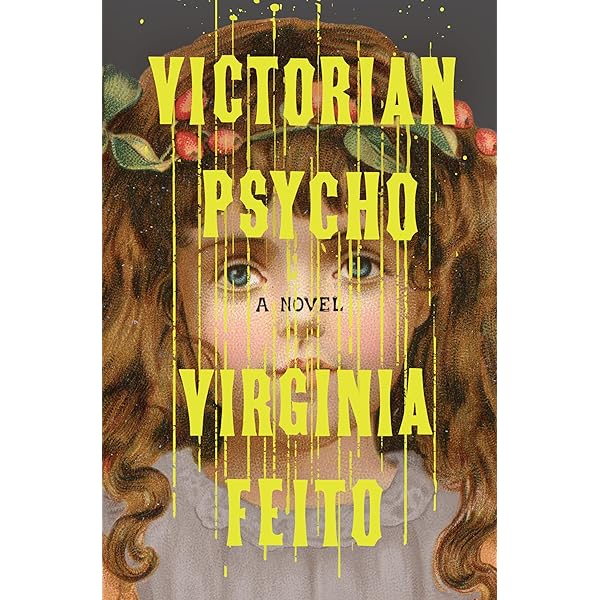
Set in my beloved Victorian England, Victorian Psycho follows Winnifred Notty, a governess who comes to Ensor House, the country home of the Pounds family to help instruct and raise the children. However, Winnifred is about as far from Mary Poppins as you can get. She’s got a history, has a mind that works in mysterious ways, and has some terrible plans in store for the Pounds family. Ones that will come to terrible fruition on Christmas Day.

Whoo-boy, this was a wild one. Written entirely from the point of view of Ms. Notty, you really get in her head, and it’s an uncomfortable place to be. She sees things that aren’t there (or are they?), does things that defy both common sense and my uncommon sense, and puts up red flags left and right while making the funniest observations (like what she says about the head maid’s sexual history). Compounded by the fact that you can’t rely on anything she says (I highly doubt most of the people’s last names in this book are their real last names), it’s an intriguing read that keeps you wanting to read more.

It’s also darkly funny, satirizing the manners and beliefs of the age in a way that somehow manages to keep things between insane and believable. I could hardly believe it when one character mentioned that when he got home, he’d have to deal with both a depressed wife (apparently she’s delaying getting over her child’s death much too slowly for her husband’s sake), and a chimney sweep who’s stuck in their chimney (they tried to light a fire under him to press the issue that they didn’t want him hanging around. It didn’t work).

And then what happened a few pages later…well, I’ll just say that was a real thing Victorians did, and seeing it depicted here was kind of amazing.

As far as downsides go, I did think some parts of the ending could have been tweaked. Also, maybe it was just because I was listening to the audio book, but I was only able to listen to this book in short spurts before needing a break. Which is weird, because when I first started, I thought this was the sort of story I would nearly binge from start to finish, and that feeling is hardly ever wrong.

All in all, though, Victorian Psycho by Virginia Feito is a quick and enjoyable read. On a scale of 1 to 5, I give it a 4.2 for its witty, stomach churning portrayal of insanity and evil set against the backdrop of banal, Victorian melodrama and morals. A movie version is set to release next year with Margaret Qualley in the lead, and if she brings the same A-game she brought for The Substance (which I recommend if you can deal with body horror), it’s going to be a hell of a film.

In the meantime, better go brew some (hopefully poison-free) tea, lie back in the drawing room, and crack open a copy of Victorian Psycho. Trust me, it’s worth a read.

(Note: This review contains some spoilers for this book’s predecessor, I Feed Her to the Beast and the Beast is Me. So, if you haven’t read that one and want to go in unspoiled, you’ve been warned.)

Sequels are tough. I’ve tried to write sequels before, and they are fucking tough to write. Not only do you have to continue the story you set up in the previous entry, but you have to keep up the tension and further develop the characters. And, if possible, up the stakes from the last story. So, when I started listening to I Am the Dark That Answers When You Call, the sequel to I Feed Her to the Beast and the Beast is Me (see my review here), on audio book, I hoped that the sequel would be up to the same level as the original book.

Starting a few months after the events of I Feed Her to the Beast, Laure Mesny is back in Paris and trying to move on with her life. However, things are not as easy as she would like. For one thing, not only is she the vessel for the dark god Acheron, who constantly whispers in her ear, but she’s also being haunted by ghosts from her past, both literal and figurative. And on top of that, Elysium, the strange dimension below Paris where the gods reside, is dying, setting in motion a chain of events that will see either Laure’s ascendancy…or her doom.

I enjoyed I Feed Her to the Beast immensely, but I think I enjoyed I Am The Dark even more.

For one thing, let’s look at the horror. There’s definitely more of an emphasis on the cosmic horror aspects in this volume, and they work well, with the power of the gods becoming a corrupting influence as Elysium continues to degrade and rot. The new human villains of Neve and her retinue were a great addition to the story, as was Laure’s relationship to Acheron, which I expected to be more like Eddie Brock and Venom in the movies but turned out completely different.

I also liked the development of Laure as a person. If the first book was about Laure trying to get what she wanted and deserved, only for her to see its dark side, then the second book was about Laure trying to find who she is and what she really wants out of life now that the Paris Ballet is behind her. Jamison Shea handles that deftly, leading to a climax that left me on the edge of my seat (metaphorically; I was cooking dinner during those scenes).

Finally, there were a lot of surprises in the story that threw me for a loop, which only deepened my enjoyment of it overall. Several times, I was like, “What? Are you serious?” And it’s not easy to surprise me, so kudos to the author for that.

If I have any criticisms, it’s that I thought the linking of the cosmic horror elements to the Cthulhu Mythos felt a little forced to me. Also, I thought a certain character introduced in the story was going to have a bigger role when it was revealed how much they were aware of, so it was kind of disappointing that they didn’t have that bigger role. I understand why the author did–it was part of Laure’s personal growth, after all–but still.

All in all, though, I came away from I Am the Dark That Answers When You Call by Jamison Shea very satisfied. On a scale of 1 to 5, I’m giving it a 4.8, which is 0.3 points higher than its predecessor. Unrelenting, cosmically dark, and full of twists and turns. I’m almost sad that there’s not a third book in the works (as far as I know), though Laure’s story does work well as a duology.

Anyway, if you’re at all interested, or if you enjoyed I Feed Her to the Beast, you won’t be disappointed by I Am the Dark. Give it a read and see for yourself.

That’s all for now. Until next time, my Followers of Fear, good night and pleasant nightmares.

Having read The Good House before, I knew I was in for a good time (see my review here). But I was not prepared for Tananarive Due’s latest novel. After starting it, I learned the book was based not only on the Dozier School for Boys, a reform school in Florida where numerous atrocities were committed against the kids there, but on a relative she had who died at the school. And even after learning that, I still wasn’t prepared for what was to come.

Set in Florida in 1950, The Reformatory follows twelve-year-old Robert Stevens (named after her relative) and his older sister, Gloria. After kicking a white boy who makes advances on Gloria, young Robert finds himself sent to the Gracetown School for Boys, a reform school where the boys are under threat by both the spirits haunting the campus after years of mysterious deaths, and the Warden Haddock, a terrifying personage with a sadistic streak. When Haddock learns Robert can see the ghosts on campus, he forces the kid to help him catch the spirits. Meanwhile, Gloria attempts to find a way to free her brother from the horrible reformatory, setting them both on a path that will change them forever.

Man, this book was a rough read! Due does not skimp on the human horror the characters face, whether that be the horrible things Robert faces at the reformatory at the hands of the adults and the other kids, or the racism Gloria faces trying to get her brother out of that place (not to mention the utterly disgusting advances Lyle McCormick makes on Gloria in the novel), it feels all too real. Not to mention kind of timely!

Speaking of feeling real, the worldbuilding is amazing! Gracetown, the location of the reformatory and most of the other events of the book, as well as the people in the book, feel extremely real. I noticed that with The Good House, but Due is great with character development, and setting can be as much a character as the characters! I also loved how Gracetown apparently has this reputation as a place where children are able to interact with spirits and lose the ability as they grow older. That’s a pretty cool idea, and Due uses it to flesh out the spirit world of Gracetown and the reformatory so well.

I think the one thing I didn’t like was that I feel we only scratched the surface of the Gracetown School for Boys. I know that might sound masochistic, considering what we saw was pretty horrific, but we only saw a fraction of the school grounds, of life at the school, and the sordid history there. And as much as that would’ve scarred my psyche, I would’ve like to see all that explored more.

Maybe an anthology based around the Gracetown School for Boys? They’re doing one for The Stand, after all. I can dream.

All in all, though, The Reformatory by Tananarive Due is a soul-shaking journey of abuse, racism, and the darkness of humankind that, at times, I had to take a break from, I was that shook. On a scale of 1 to 5, I give it a 4.5 out of 5. I feel like I get why this book was talked about so much when it came out last year, and I wish I’d read it sooner. And if you haven’t read it yet, you should go and read it, too.

Or listen to it. The audiobook is fantastic!