As many of you know, Kill Creek by Scott Thomas has become one of my favorite novels, if not my favorite (you can read my review from 2018 here). So, when I heard Thomas was releasing a collection of four novellas, I had to get my hands on it. And while it took me longer than I wanted to get through it (I picked it up in September and only just finished it), I’m glad I got to read it.
Taking place in a fictional version of Kansas that’s part of the same universe as Kill Creek (and possibly his other novel Violet, I’m not sure), each novella follows a native who gets pulled into horrors beyond their control. Three of these stories connect to the very land and the entities, natural or supernatural or preternatural, that inhabit and make up Kansas, all of these stories deal with dark histories and hidden truths, and each story connects in some way to the authors who were the stars of Kill Creek,* enhancing the reading experience.
The first novella, The Door in the Field, follows a young construction worker with anger issues who joins his boss for a drink after an incident, and ends up spending a night in terror. This story does move a bit slow at times, but it’s a thrilling tale full of blood, violence, and cosmic horror that pays off well at the end with the reveals and the main character’s growth. My one major criticism is that the novella is kind of a story within a story, and the framing device doesn’t really add much to the story. It doesn’t take anything away, but it doesn’t add much, either.
The second novella, Wear Your Secret Like a Stone, follows a troubled young woman who, after her pick of book for the Halloween display at her job is taken down by a customer complaint, goes on a mission to get her favorite book back. Only along the way, she learns some frightening local history which is more alive than she thought. I think this might have been my favorite novella of the bunch. It’s atmospheric, the protagonist is likeable, and the ending is a dark fantasy twist that will bring you chills.
The third novella, The Boy in the Woods, is about a young boy who, on the last night at camp, finds himself in the middle of a slasher story with a rage zombie twist. It’s a wild ride of a story with a sympathetic protagonist and a the way the slasher/rage zombie aspect are approached gives both tropes new life that I wasn’t expecting. If Wear Your Secret was my favorite, then The Boy in the Woods is a close second.
The final novella, One Half of a Child’s Face, is about a mother who is able to see into her ex’s apartment building al a Rear Window. There, she frets about not having her daughter living with her full-time and gets a vicarious thrill at watching the residents live their lives…until a strange painting in an empty apartment seems to throw an evil influence over the building’s residents. Of the four novellas, I would consider this the weakest. It takes a long time to build to anything and there are quite a few plot threads left hanging at the end. However, the last fifty pages are so were hard to put down and I enjoyed reading them.
All in all, Midwestern Gothic by Scott Thomas is a worthwhile collection of novellas. On a scale of 1 to 5, I would rate it a 3.9. Pick up a copy, settle down in your favorite chair, and prepare to be transported to a different sort of Kansas.
*If you haven’t read Kill Creek, don’t worry. You can still read the collection just fine. Kind of like how you can watch The Big Bang Theory and still laugh at all the jokes while not necessarily getting every sci-fi or comic book reference the characters make. Still, I highly recommend Kill Creek, so if you’re curious, read that one, too.
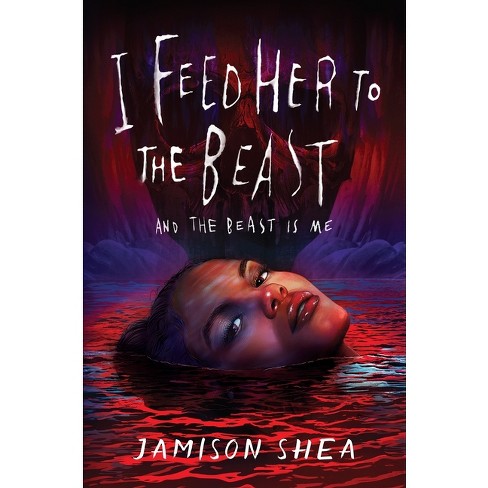
I love horror and I love ballet. I often combine the two in my work. And when I find another author who has combined the two forms of storytelling, I want to read it. And if it’s good? I’m especially glad to read it. Jamison Shea’s novel I Feed Her to the Beast and the Beast is Me is one of those books I’m especially glad to have read.
Taking place at the Paris Ballet and its attached academy, I Feed Her to the Beast follows Laure Mesny, a dance student in Paris who is the most talented in her class, but has had to deal with privilege and racism in the academy and the company every day. When a fellow ballerina she admires leads her into the tunnels of the catacombs, she is introduced to an ancient godlike entity that offers her a deal: her blood in exchange for the power she has always craved. Laure takes it, and it leads her on a path that could end in her stardom, or her destruction.
Where do I start?
Well, let’s talk about the horror. While there is some eldritch occult horror here, the real horror is with the human characters. Not just what the characters are willing to do for their goals, but what they’re willing to do to each other out of spite. Laure’s fellow dancers, often white and privileged, treat her horribly and tell her, behind her back and to her face, that she doesn’t belong and will never be good enough, even though she is amazing. More than a few bring up that she’s black and from a poor background and, in their view, wouldn’t be a good fit for the company. When Laure finally gets some power, it’s kind of scary how quickly she not only gets used to it, but how much she enjoys using it, including to do violence!
Not to say there isn’t some more traditional horror. The gods living beneath Paris are quite cool, as is the destruction they wrought, and there’s a murder mystery throughout the story which resolves in a way that surprised even me and which felt quite satisfying.
I also liked how most of the characters felt real. They’re all extremely complicated, especially Laure. She’s had it rough, coming from a broken family and dealing with racism and poverty, and often being told to be better and be perfect despite doing everything she should. And despite all that, she still wants to belong and feel loved by her coworkers, which honestly feels very human to me. I also empathized with her struggle to try to balance her dreams and her relationships. She’s not all good, and she’s very flawed, but it’s hard not to root for her, even at her worst. And we see her at her worst a lot.
I think the one flaw is that some of the supporting characters could have used some more development, especially Keturah. She sort of becomes a sister figure to Laure halfway through the novel, but I never really felt like we got a chance to see past her surface. Maybe in the sequel. (Yes, there’s a sequel, and I’ll check it out as soon as I can.) And, at times, the story did drag a little.
All told, I award I Feed Her to the Beast and the Beast is Me by Jamison Shea a 4.5 out of 5. This is a riveting slow-burn novel that delights in being bad and in delving into the darkest parts of humanity. Get yourself a copy, put on Stravinsky’s The Rite of Spring, and prepare to be transported. Believe me, it’s worth the read.
As we’ve entered September, horror fans have started celebrating spooky season. Because as we all know, spooky season starts as soon as the stores start putting up stock, and a few stores already have. And since we’re all thinking about what movies to watch, I’m putting out another list of films you can consider for this year.
I’ve tried to come up with a good mix of well-known and lesser-known films, as well as a good mix of older and newer films. So, hopefully there’s something here that will appeal to every horror fan out there. Enjoy, and let me know if you’re familiar with any of these films or if there are any I should check out myself. The more films we share, the better!
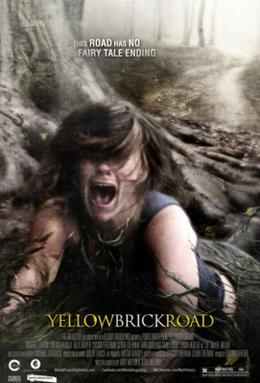
YellowBrickRoad (2010) In 1940, a small New Hampshire town up and walked north along an unmarked trail into the unexplored woods. Half were found dead, and the other half were never found. In modern day, a film crew tries to figure out the mystery of the disappeared townsfolk, including following the townspeople on the route they went. A route with a stone marker bearing the legend “YELLOWBRICKROAD.”
This move is an unsung gem. It’s a surreal and psychological piece of rural horror that takes the isolation and interpersonal conflicts of The Blair Witch Project and ups the ante by 100%. It’s not going to be everyone’s cup of tea, but it is certainly going to be an interesting watch, no matter what.
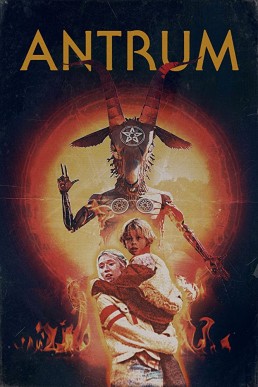
Antrum (2018) A film-within-a-film, Antrum is a documentary about…Antrum, a supposedly cursed film said to be the deadliest film in history. The documentary crew manage to get a rare copy of the film, and, for the first time, show it to the public. What proceeds is a horrifying trip through hell which will leave you wondering if you’ll survive to see the morning.
I love horror mockumentaries, and this one is one of the best I’ve seen. It starts out as a documentary, showcasing the history of the film, before showing us the actual film. And it all feels damn realistic, to the point you could almost believe there’s a cursed film called Antrum and you’re really watching it. In fact, my sister and I saw it together and wondered if we would survive after watching it! As you can see, we did, but it still made us believe a little.
Peeping Tom (1960) This proto-slasher follows a shy young man who works as a cameraman and spends his free time killing women while recording their deaths. It’s a slow-burn psychological horror that really lets you get to know its main character. I’m honestly surprised it hasn’t been remade, because we’re so obsessed with recording everything. Anyway, I would totally check this out if you’re interested. It’s not as bloody and horrifying as other horror films, but it is fascinating and at times quite tense.
The Dark and the Wicked (2020) A pair of siblings return to the family farm when it appears their father is on death’s door. However, events unfold that show that something sinister at the farm. And it’s after the family. It’s a very dark and nihilistic film, and while some will be annoyed by certain aspects of the film, such as how the characters react to the supernatural presence, it is still a very chilling film. If you’re looking for something very morbid and grim, this film is for you.
The Void (2016) After finding an injured man on the side of the road, a sheriff’s deputy and several other townsfolk find themselves under siege at the local hospital, menaced not just by a mysterious cult, but by monsters hidden within the hospital hallways. For those who love cosmic horror, this is one of the best I’ve seen in years. The special effects and creature designs bring to mind both The Thing and Color Out of Space, and the story is a terrifying thrill ride. It’s a movie that gets better with every viewing, and I highly recommend it if you want to scare yourself silly this Halloween.
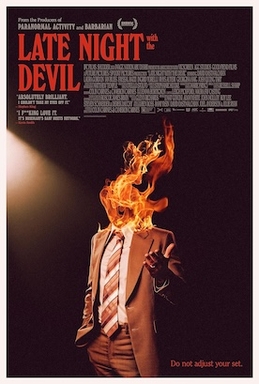
Late Night with the Devil (2023) In the 1970s, a struggling late night show host brings the lone survivor of a Satanic cult and the therapist working with her onto the show for a Halloween special. As you can imagine, shit eventually hits the fan. When this film got its limited theatrical run earlier this year, people were raving about it and even called it the best horror film of 2024. While I wouldn’t call it that, I would say it’s quite scary and a well-done film. I’m actually planning on watching it again myself as soon as my copy comes in from the library.
(I should warn you, though, a couple of images from the film utilize AI. It’s only three, but I know a lot of people feel strongly about AI, so I figured you should know.)
When Evil Lurks (2023) In a world where demons physically manifest like diseases and can infect everyone around the possessed, a pair of brothers try to protect their families when an infected individual goes missing and the disease starts to spread around the tiny village.
Some have called this the best horror film of 2023, and I can see why it was called that. Besides having a neat twist on the concept of demonic possession, this Argentinian horror film has plenty of tension and scary moments that keep you on the edge of your seat. Give it a watch and see for yourself.
Stopmotion (2023) A stopmotion animation artist is assisting her demanding mother in completing her last film. When the latter becomes gravely ill, the artist tries to make her own film, only to find herself spiraling into Hell.
I’m not normally a fan of horror stories where the whole premise is “the horror is the main character’s spiral into mental illness.” However, this film is quite captivating in how it melds stopmotion animation and real life storytelling to give us a frightening film with some seriously disturbing imagery. Warning you now: have a strong stomach before you go in to watch this one.
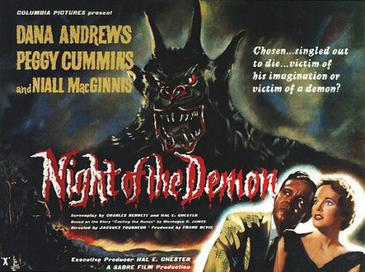
Night of the Demon (1957) A psychologist comes to England for a convention, only to learn that one of his esteemed colleagues has died and a so-called magician and cult leader is claiming his magic is responsible. Along with the deceased professor’s niece, the psychologist investigates the magician and his cult, and along the way learns that there may be more to the magician’s claims of magical power than just trickery and suggestible followers.
While it’s an older film, it’s quite influential in showing the demon multiple times throughout the film (quite unusual for the time), and many horror fans and creators, including Stephen King, have cited it as an influence. Just don’t watch its shortened American version, Curse of the Demon, because the original is the one to watch.
Land of the Dead (2005) Set in the same universe as Night of the Living Dead and Dawn of the Dead, Land of the Dead takes place decades after the undead have taken over the world. Pittsburgh has become a last bastion for humanity, with the wealthy living in a magnificent luxury skyscraper and the poor living in slums. However, when one zombie, nicknamed Big Daddy, begins leading his kind to the city after a supply raid ruins his territory, it sets off a chain of events that will forever change the city.
Fun fact: this was the first time in the film series the word “zombie” was actually used for the zombies! Up until now, the terms used were “ghouls” or “undead.” Besides that, the film’s quite thrilling, with plenty of horror and action to satisfy fans. Give it a watch, especially if you’ve seen the first two films in the series (I would skip Day of the Dead, the third film).
Other fun fact: I’ve met Eugene Clark, the actor who played Big Daddy, and he was very nice. He even let me take a photo with him, which you can find on my Instagram.
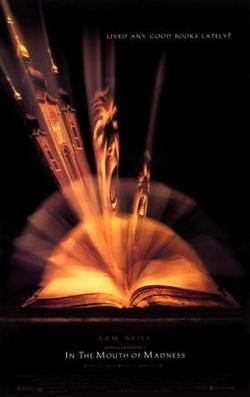
In the Mouth of Madness (1994) An insurance investigator goes to a small town to try and locate a horror author whose work is considered so terrifying, people have actually gone crazy from reading it. What happens there, however, will not only change him forever, but the world as well.
The last film in John Carpenter’s Apocalypse trilogy (the first two being The Thing and my own favorite, Prince of Darkness), this film has grown quite the cult following due to its meta-narrative and exploration of cosmic horror. It’s not perfect, but it’s a fun and at times quite scary movie with lots of great imagery and cool ideas involving what it’s like to live in a fiction story. By the end, you’ll want to read Sutter Cane’s work as well. No matter what it does to your sanity.
The Empty Man (2020) In the 1990s in the nation of Bhutan, a group of American tourists discover a cave, which leads to terrifying events on a mountaintop. Twenty-three years later, a former police officer is asked by a friend to find her missing daughter, and finds himself wrapped in a cult with ties to the tourists in Bhutan.
This movie is almost hypnotic in how it draws you in, and it is both terrifying and…dare I say this? It’s satisfying. It’s that good, and I’m honestly sad that it’s rarely available on any streaming service I actually have access to (and never on DVD or Blu-Ray). Anyway, it’s a great horror film, so check it out if you trust my word.
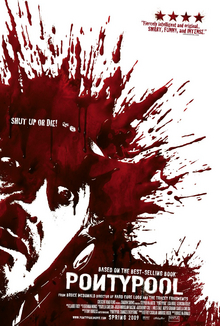
Pontypool (2008) In a small Canadian town, a radio host and his team are working in the middle of a blizzard when they get reports of riots and horrifying deaths happening elsewhere in town. As time goes on, a strange sort of apocalypse starts to occur in the town. An apocalypse based around language.
I first saw this in college and loved it. I saw it again recently, and, while there are some aspects about the ending I dislike/don’t buy, it still holds up very well. It’s a very tense and freaky film with a great concept at its heart, so if you’re looking for a fun twist on the zombie apocalypse, I highly recommend this one.
And those are my recommendations, my Followers of Fear. But tell me, Followers of Fear, have you seen any of these films? What did you think? And what are you watching this season? Anything you would add to this list? Let’s discuss.
Until next time, my Followers of Fear, good night, pleasant nightmares, and only 52 days till Halloween! Get the Headless Horseman’s horse ready for him at once!
Took a little longer than I expected, but I finally finished this book tonight and, as promised, I’m writing a review.
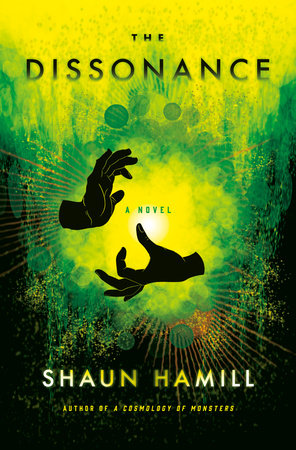
Jumping back and forth between the late 1990s and 2019, The Dissonance follows Hal, Athena, and Erin, who, along with their friend Peter, discover that they have mysterious powers. Powers that, according to Peter’s grandfather, stems from the Dissonance, a magical energy that stems from the gap between our broken world and the world as it should be. They start learning how to harness their powers, but tragedy strikes during their senior year of high school. Twenty years later, they return to their old stomping grounds as forces begin to throw the world out of whack. And in the midst of it all, a great evil descends on their hometown, dragging a closeted gay teen in tow…
I’ve heard this book called a cross between The Magicians and IT, and while I’m only vaguely familiar with the first one, I have to say, the comparison to IT is apt. Not only does it hop back and forth between past and present, but Hamill does a great job showing the characters as hormonal teens trying to navigate friendship and their lives in the past, and trying to deal with cosmic shift and their broken lives and relationships in the present.
As for the story, it’s definitely more in line with dark fantasy than horror. For example, the Dissonants conference feels more Harry Potter than The Craft. Still, it’s got some horror elements. The magic itself, which requires tapping into the pain and misery of life, is pretty dark in and of itself, and plenty of aspects of the novel are of the cosmic horror vein.
If there’s one thing I would have liked to see more of, it might have been more of the character Owen. I get that the focus was more on Athena, Hal, and Erin, but Owen was a relatable character and I would have liked to see the kid have a bigger role.
Well, if there’s a sequel, that might be a possibility. The book does present the possibility of being the jumping off point for a shared universe, like The Hobbit was for Lord of the Rings, but with more in common with the Cthulhu Mythos than Tolkien.
But getting back to the review, I award The Dissonance by Shaun Hamill a 4.5 out of 5. It’s an engaging dark fantasy novel with great characters and worldbuilding and a magic system that feels right for this wrong world. Grab a copy, tap into your deep well of inner pain, and prepare for a twisty, magical ride through hell.
That’s all for now, my Followers of Fear. Until next time, good night, pleasant nightmares, and only 61 days and one hour till Halloween!
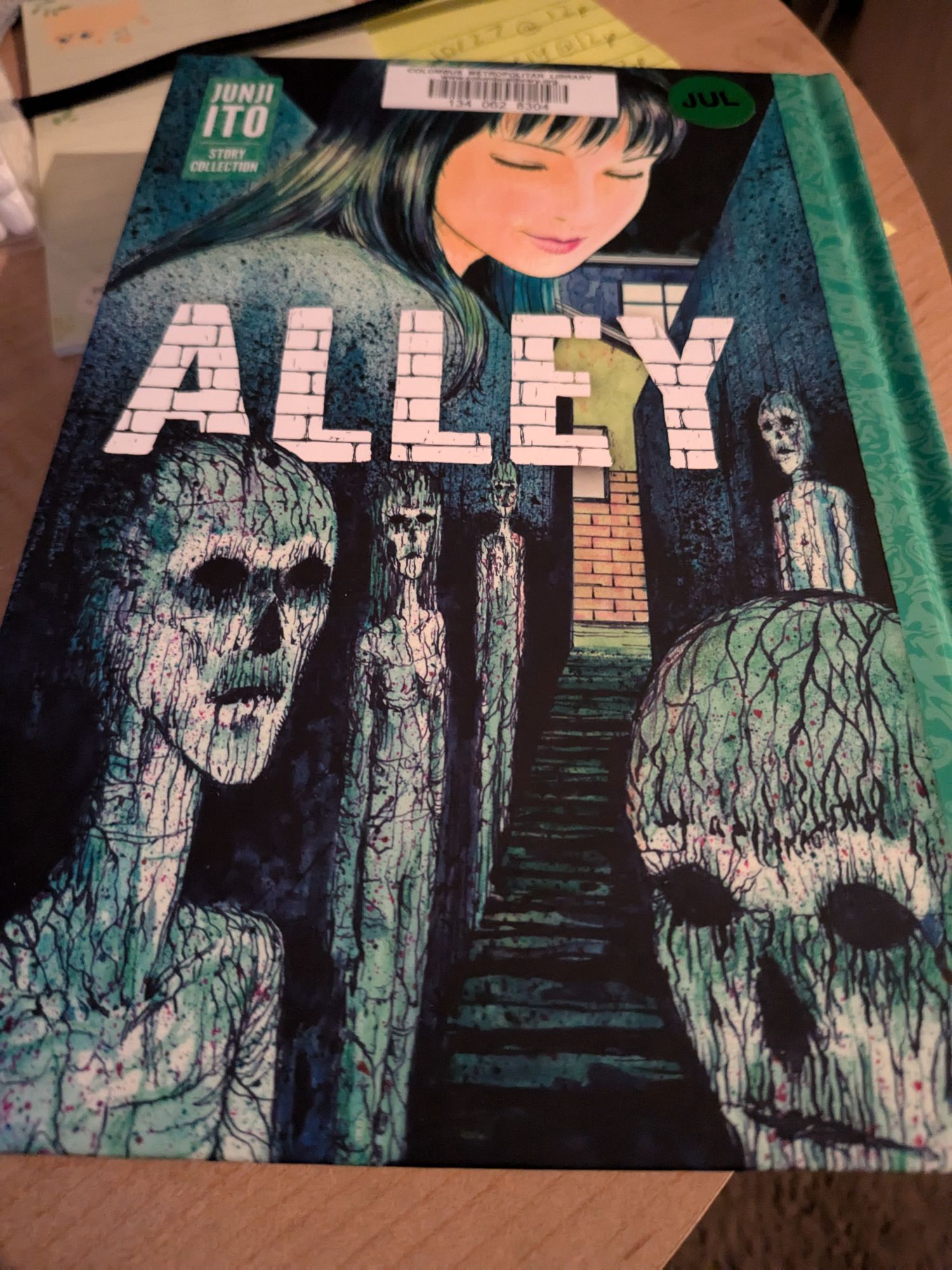
So, I just heard that Fangoria Entertainment is going to make a whole bunch of movies based on Junji Ito’s work. They mainly will adapt stories from his collection Smashed, but I hope Remina or Madonna get adaptations as well, as they are great stories (see my reviews for Remina and The Liminal Zone, respectively). In the meantime, a new collection of Junji Ito stories got translated, so I’m here to review it.
As I say, Junji Ito can be hit or miss with me, but this one was entertaining enough.
My favorite story was probably “Town of No Roads,” which follows a teen girl who goes to live with her aunt after her parents and brothers react the wrong way to a stalker breaking into her room. As if that’s not stressful enough, her aunt’s home has been swallowed up by a giant structure where nobody has any privacy. It’s weird, but you really start to empathize with the main character and the themes of the necessity for privacy really do resonate.
Other stories really struck a chord with me, which was nice. “”The Ward” is a creepy body horror story about several women in a hospital ward who start acting funny, while “Blessing” is a tragic love story with a great twist in the end. “Mold” just grossed me out (as a homeowner, I felt the main character’s pain, especially when it comes to cleaning one’s home). And “Descent” was a weird but engrossing story with a great hook and a mysterious resolution.
Of the rest, they were mostly decent. The titular story, “Alley,” has a great idea, but I feel like there’s too much exposition, which is followed by an ending that could have been a few pages longer. “The Inn” has a great idea and some terrifying art, though the ending kind of puttered out on me, and “Smoker’s Club” has a great idea about tobacco and smoking that would put anyone off cigarettes, though it also could have used more pages for its story. And “Memory” has a great story, though not enough scary art for me (it still would make a great movie).
The only bad story was “Ice Cream Bus,” which other than a reminder about why stranger danger exists, wasn’t much better than its animated Netflix adaptation.
Overall, I think I would give Alley by Junji Ito a 3.8 out of 5. There’s some decent horror in there, so if you’re looking to get into his work, this might be a good choice for your second or third read of his (I recommend picking between Remina, Uzumaki and Tombs for your first and second reads).
That’s all for now, my Followers of Fear. Until next time, good night and pleasant nightmares!
My copy of Horror Movie, surrounded by some of the horror movies on my shelves. Because how could I not?
I was not a fan of Tremblay’s last novel, The Pallbearers Club (see my review here), but when I first heard of his new book and saw its cover, I wanted to read it! And when I got my copy from the library, I got even more excited. You can’t tell from the photo I included, but the pages have red borders, which coupled with the black cover, makes it look like a restricted video from the age of VHS tapes and Blockbusters. So, almost as soon as I finished reading You Like It Darker (see that review here), I started reading this.
Hoo-boy, did I get on a rollercoaster ride.
In 1993,* a small team of amateur actors and filmmakers come together to make a movie tentatively titled “Horror Movie.” However, tragedy strikes on the last day of filming, preventing it from ever releasing. However, scenes, stills and scripts from the movie have made their way online, and as many of the original cast and crew die under mysterious or tragic circumstances, an air of mystique gathers around the mysterious film. In the 2020s, a reboot is in the works and the studio brings on our narrator, who also played the original film’s villain the Thin Kid and is the only surviving member of the cast and crew, to both co-produce and reprise his role.
Thus begins a journey through the past and the present that will answer a question the narrator, and many of us, ask often: why do people do terrible and fucked up things?
First off, this novel is incredibly well-written. Tremblay takes the unique storytelling he used in The Pallbearers Club and applies it here like an art. Jumping between the production of the original film, the process of creating the reboot in the present, and the script of the original, you essentially get two different stories woven together. I have to applaud Tremblay for writing both a script for a very scary and fucked up film and then writing a very personal story around the script and the movie that was supposed to come about from it.
I also really liked the narrator, whose name I can’t really remember because I’m not sure if it was ever mentioned. It’s easier just to call him by his character’s name, the Thin Kid, and that sort of makes sense, as another major theme of this novel is the blending of reality and fiction. Where does our narrator end and the Thin Kid begin? Is there even a difference? It kind of reminds me of Perfect Blue,** one of my favorite horror movies, and how that movie explored how quickly reality and fiction can combine under the right circumstances.
Anyway, our narrator doesn’t have a high opinion of himself, but he’s likable. Once he commits to the movie, he commits to it–the character, the reputation of the film, and its reboot–even at the detriment to himself. Towards the end, I wondered if maybe he might be an unreliable narrator, because some of what he describes both feels like something he would do and something he might make up. It’s just amazing to read his story (which he’s narrating as an audiobook or podcast), and I had a hard time putting the book down.
If I have one thing I didn’t like, it’s that the foreshadowing sometimes worked against itself. Since the narrator is technically speaking to an audience that presumably knows about the history of the titular film, he refers to things that have happened and kind of expects his audience to know. However, the audience in the real world doesn’t, so once or twice, he refers to something that appears to be common knowledge and I’m like, “Wait, did I read that and forget? Or is it something we haven’t read yet that he’s alluding to?”
It probably did not help that I could not remember if he mentioned the narrator’s real name (I think it was David, but don’t quote me on that), so that only heightened my confusion.
All in all, however, Horror Movie is an excellent novel and well worth the read. On a scale of 1 to 5, I give it a 4.8. Horrifying, entrancing and full of twists, you’ll find yourself hanging on as you discover not only why people do terrible and fucked up things, but how much reality and fiction can blend in the worst ways. Just grab a copy and see for yourself!
*The year I was born, by the way. Coincidence? I think not!
**BTW, if you have not checked that one out, I highly recommend it.
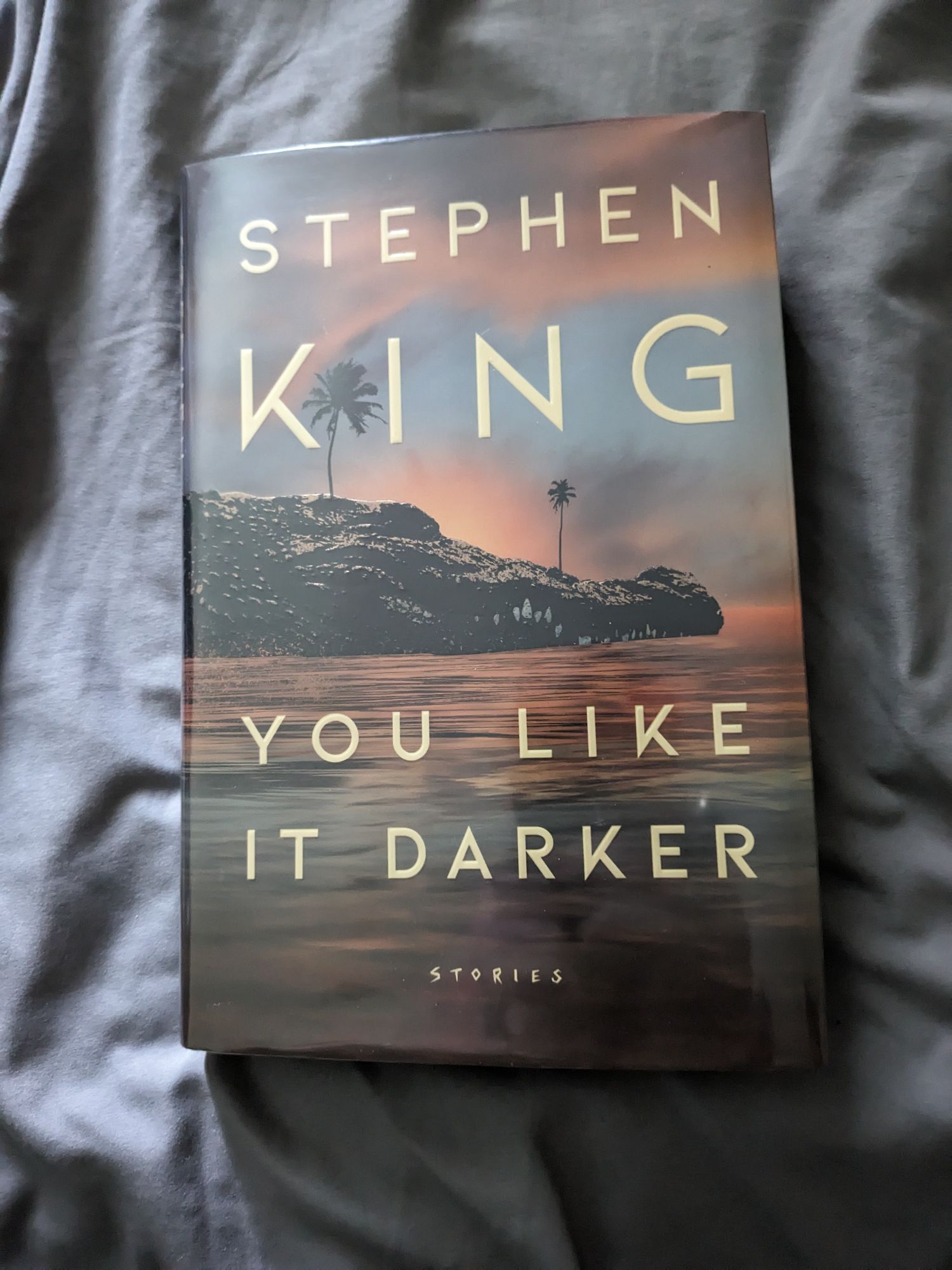
I was not a fan of Stephen King’s last collection (you can read my review here). However, I am ever the optimist when it comes to King’s work, and the sound of his latest collection, You Like It Darker, got me excited. I mean, it even had a sequel to Cujo in it! Why wouldn’t I check it out?
And tonight, on the night before it’s due back at the library, I finished it. So, what did I think?
I think this is a much better collection and a finer example of King’s storytelling than If It Bleeds was.
The strongest stories in the collection are four of the novellas. “Danny Coughlin’s Bad Dream,” possibly my favorite of the bunch, is a tense thriller about a man’s life unraveling after he has a nightmare and he does a good deed based on that dream. Honestly, it’s hard not to fall in love with the lead and want to find out if things get better for him or go further downhill. “Rattlesnakes,” the sequel to Cujo, starts out slow but quickly becomes a freaky ghost story that I thoroughly enjoyed once it got going. “The Dreamers” feels like an updated version of HP Lovecraft’s “From Beyond,” and I would love to see a movie version of it.
As for the final novella and the final story of the collection, “The Answer Man,” it’s King’s fantastical literary style of storytelling at its finest, and (surprisingly) left me with a warm feeling in my heart.
As for the short stories, “On Slide Inn Road” is a fun tribute to Flannery O’Connor’s “A Good Man is Hard to Find” (and delivers on the “darker” part of the book’s title), and “The Turbulence Expert” feels fresh while also like classic King. “Laurie,” which I’ve read before, is a fine story about grief and finding new life, and “The Fifth Step” and “Willie the Weirdo,” while not anything amazing, had some fun twists I enjoyed.
Unfortunately, the book has some duds. “Two Talented Bastids,” the opening novella of the collection, was a total letdown for me, which is sad because it had a strong start. The short story “Finn” felt like a crime thriller that never got around to thrilling anyone, and “The Red Screen” felt like it needed a few more pages to deliver on its premise.
However, like I said, You Like It Darker is a much better collection of King stories. On a scale of 1 to 5, I give this collection a 4.2. If you don’t mind the duds, you’ll probably enjoy this one, and feel like you’re reading one of King’s older collections again. So, if you haven’t already, go out and grab a copy.
In the meantime, I’ll be picking up my next read from the library tomorrow. It might even be my next review. And from what I’m hearing, it’ll be worth reading…
My signed copy of Silver Nitrate by Silvia Moreno-Garcia.
Back in September, author Silvia Moreno-Garcia visited Columbus as part of my local library’s Carnegie Author series of events. Me and many of my fellow members of HWA Ohio went to see the event, where she talked about the influences behind her latest book, Silver Nitrate, which I later got signed by the author herself. That was a cool Sunday.
Months later, I finally cracked open the book to read it. And, as you can tell from this blog post, I’m going to review it.
Taking place in Mexico City in the 1990s, Silver Nitrate follows Montserrat, the only female sound editor in a studio dominated by chauvinistic men, and her best friend Tristan, a former soap opera star whose career was marred by tragedy and now makes a living doing voicework. Their lives change forever when they meet Abel Urueta, a film director they both once loved whose last film was never completed. After learning the history of the film, including that it was co-written by a German occultist with Nazi ties who was trying to cast a spell with the film, Urueta convinces them to help him finish the film and occultist’s spell, thereby possibly fixing a string of bad luck that has plagued the director.
What occurs next is a series of events that comes with two realizations for our two leads. One is that magic, especially magic in film, is more than just a metaphor. The other is that they have set something in motion, something big. And if they’re not careful, they’re going to lose everything from it.
The best part of this book is definitely our two leads. Montserrat and Tristan are such fully realized characters that you feel like they could step out of the pages and you’d know them. Montserrat is quite prickly but does care a lot, while Tristan is slightly narcissistic and dramatic but does care and wishes he were a better person. Their interplay throughout the book is fun to watch, as well as their reliance on one another.
Another plus of the book is the magic system. Those of you who’ve been with me for a while know that I studied Nazi occultism in preparation for my WWII study abroad trip in college. Yes, a lot of that stuff is real, though it is highly exaggerated in most depictions. In any case, I was delighted to see a lot of what I had learned mixed in with the magic system used in the novel. It made it easy for me to grasp, and gave it a sense of “realism,” so to speak, that I liked.
However, Silver Nitrate does have its flaws. So much time is spent explaining the complexities of the magic system that the slow burn of the story is too slow. Things don’t really start to get exciting to the last hundred pages or so, and by then it’s a bit too late to really bring up the book’s final score.
I also had some issues with the ending, but I won’t say what because I don’t want to spoil it.
All in all, I would give Silver Nitrate by Silvia Moreno-Garcia a 3.9 out of 5. It’s a bit too slow for my tastes, but it’s got great characters and a fully realized setting and magic system. If you’re interested, give it a read and fall down the occultism rabbit hole.
I’ve been hearing of this novella for years, but for some reason I haven’t gotten around to reading it until recently. However, recently I felt an itch to indulge in some cosmic horror and the audio book was on sale, so I downloaded it and listened to it.
Followers of Fear, why did I wait so long to check this out? It was awesome! I can see why it was nominated for a Stoker award.
Set in 1924 New York and based on “The Horror at Red Hook” by HP Lovecraft, the novella follows Tommy Tester, a black man living in Harlem with his father, trying to get by as best he can. When he’s asked to play guitar at a dinner party for an eccentric gentleman named Robert Suydam, Tommy finds himself plunging headfirst into a world of magic, insanity, and cosmic forces. Such exposure will not only change his life, but the lives of all humanity.
If you’re not familiar with “The Horror at Red Hook,” this story was written when Lovecraft was living in New York, and, because he’s Lovecraft, he characterizes the non-white characters, many of whom live in Red Hook, as criminals and gangsters. This story is sort of a rebuttal of that, showing things mainly through the eyes of one of the people whom Lovecraft would have disdained. This allows for a great examination of cosmic horror versus the horrors of racism as seen through the eyes of Tommy Tester, later known as Black Tom. As he notes, the indifference of cosmic horror cannot compare to the malice and cruelty of racism, though both are equally horrifying in their own rights.
Beside that, it’s just a well-written and compelling story. You really grow to understand Tommy and sympathize with him, and can’t blame him when he makes certain choices later in the book. Not only that, but the emotional power of this story cannot be underestimated. One scene involving Tommy’s father was so heartbreaking, I wanted to pick up the phone and call my own dad just to check on him. That’s strong storytelling right there.
I also liked how part of the novel was shown through the eyes of Malone, the main character in “Horror at Red Hook.” Here’s, he’s written more as a character than just some vehicle for Lovecraft to transmit his purplish prose through, and he’s not unlikeable, though he’s still subject to the same prejudices that a lot of people back then unfortunately had. His role in the story is also more consequential, which is a nice change, and his final fate is a terrifying but welcome change from the original story.
On the whole, I give The Ballad of Black Tom by Victor LaValle a straight 5 out of 5. I cannot find anything wrong with this story and I’m so glad I finally experienced it. If you’re at all interested, grab a copy, put on some jazz or blues, and give it a read. Trust me, you won’t regret checking it out.
Also, the audio book has my recommendation. The narrator, Kevin R. Free, does a great job with the various voices and the sharp prose. It’s enough that you’ll want him to narrate something you’ve written. That, ladies and gentlemen, is talent.
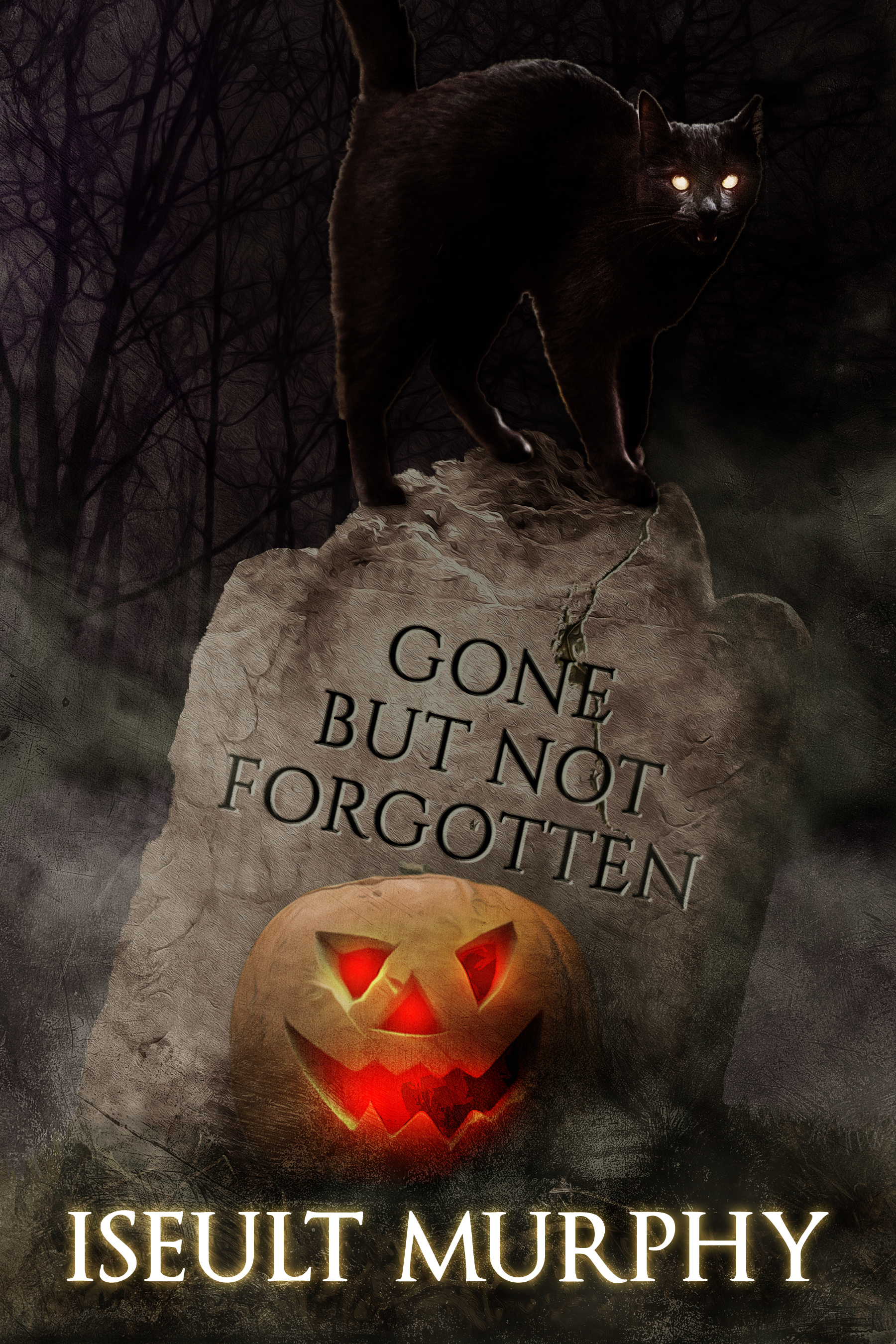
Iseult Murphy has been a friend and Follower of Fear since Rose came out, and I have always enjoyed not just hearing what she thought of my stories, but having conversations with her through blog comments, social media and email. But Iseult is not just a friend or a Follower of Fear. She’s a fellow horror author, and she recently put out a new novella, Gone But Not Forgotten. It sounded interesting and I’m very into authors supporting other authors, so I got a copy.
For someone who has Halloween every day in my soul, this was a good choice.
Taking place on Halloween in Ireland, Gone But Not Forgotten follows widow Mere as she goes to visit her friend and neighbor Bill, a widower who lost his wife Donna about a year ago. Bill has been having a rather rough go of it, as he’s seeing Donna everywhere. As it turns out, Mere can see her, too. And Donna’s not resting peacefully.
What I liked most about Gone But Not Forgotten was that it did not go in the direction I expected. When you’ve been reading horror as long as I have, you get good at guessing plot developments. But I did not see the development that occurred midway through the novella, and which really changed my outlook of the story. I won’t say what it was, because spoilers, but it was worth the read.
I also liked Mere as a protagonist. She’s sweet and a bit naive for her age, but I found her quite endearing as a person and was rooting for her throughout the story.
If there was one thing I would have liked more, I thought there could have been a bit more danger and violence to the story. Things were a bit too calm for my tastes. As it is, the levels of violence and threat put things more in line with cozy horror, which I’m sure many would enjoy. But it just wasn’t enough for me.
On a scale of 1 to 5, I’m going to give Gone But Not Forgotten by Iseult Murphy a 4.5. If you’re looking to feel that Halloween spirit at any time of year, this is a good novella to go with. Have some brack bread and an amaretto sour and pick up a copy today.*
*Irish barmbrack, or just brack, is a type of bread eaten in Ireland around Halloween. People would often put little things like rings or toys in it to tell fortunes. It features in the story, as do amaretto sours, which Mere drinks during the story.
And next Halloween, I’m definitely going to attempt to make a barmbrack bread. The amaretto sour, I’m not so sure. I already have a favorite cocktail.