Posts Tagged ‘celebrities’

Here’s an impression of some of my reactions while watching this film:

“Aah!”
and “Yikes!”
and let’s not forget “Oh my f***ing God!”

Yeah, it was a really good movie. It’s like watching the movie version of a Stephen King novel without actually having anything to do with Stephen King. Inspired by childhood nightmares of writer and director David Robert Mitchell, It Follows…well, follows Jay, a young woman who has recently been seeing a handsome young man named Hugh. One night they have sex in Hugh’s car, which leads to all sorts of trouble. Apparently Hugh’s passed on a curse, making Jay the target of a creature that can only be seen by those affected by the curse and follows them at a walking pace with the intent of killing them, and then going after whoever was the previous bearer of the curse. The only way to pass the curse on is to have sex with someone else.

The “sex equals death” trope has been part of horror since perhaps before Dracula or Frankenstein, but it’s so rare to see a well-worn theme reinvented like this, making the film a very strange metaphor for STDs and the overwhelming power they have on our lives. There’s also the fear of intimacy, alongside a fear of strangers and what they can do to us. That last theme is exploited pretty well in this movie, where every unknown character or extra could be It. Heck, at one point I was wondering if It was a squirrel, and I was afraid!

But that’s not all that makes this film awesome. For instance, the writing is phenomenal, starting slow but mysterious and quickly getting exciting. There’s barely any gore, and the jump-scares, rather than relieving tension, enhances the tense atmosphere that just builds throughout the film. The few moments of humor in this film seem to fit right in, giving us a short break from the constant suspense that characterizes It Follows throughout. And the way it ends is terrifyingly awesome, the perfect satisfactory ending (who knew I’d get that sort of ending just hours after my last post?). And the monster, so undefined and strange, is guaranteed to cause you terror, even at its strangest (and arguably slightly goofy) moments.

Not to mention the acting from the small cast, who are extremely talented! Special mention goes to Maika Monroe, the gorgeous actress playing Jay, shows wonderful breadth and ability despite still being very early in her acting career. I think I fell in love with her a little while watching her performance, it was that good. Also worth mentioning is Keir Gillchrist as Paul, a young man who obviously is crazy for Jay, and his earnest manner is so wonderful that you really want to support him no matter what happens. I definitely empathized with him, and I’m sure I’m not the only one who will.

I can say more about this film–it is phenomenal–but I don’t want to give away any more. Instead, I really encourage horror fans to go see this movie if you can. It’s creepy, it’s fresh, and you’ll have second thoughts about one-night stands forevermore. Just a wonderful example in the continuing trend of great horror films from the indie scene and made on smaller budgets that scare us more than any bigger-budget franchise film.

I’m giving It Follows a 4.5 out of 5. This film is a new gem in the horror genre, so much that I tried to get the poster from the box office after the movie (unfortunately they don’t give those away anymore, darn it). I’m almost kind of hoping for a sequel. God knows the film leaves open the possibility for one, and I wouldn’t mind having some questions answered and seeing Jay and her friends grow in the face of this threat. On the other hand, why risk the possibility of ruining a great story by making a sequel that might fail to live up to the original? It’s quite the dilemma.

Well, that’s all for now. I’m going to bed. Maybe I’ll have a nightmare that’ll lead to an awesome story of my own. One can only hope, right?
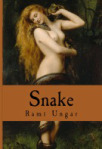
snake

How far would you go for love and revenge?

(Warning! This review has some spoilers. Proceed with caution if you haven’t read the book and might read it in the future.)

I’m super-excited to announce that my novel Snake has gotten it’s fifth review, and it’s second five-star review. For those of you who are unfamiliar with this book, Snake is the story of a young man whose girlfriend is kidnapped and becomes a serial killer to find her (yes, I wrote that sort of story. It is awesome). This latest review comes from Ruth Ann Nordin, fellow author, contributor and administrator on Self-Published Authors Helping Other Authors (psst! Check out her blog. It’s got good stuff).

Her review, titled Good Thriller, was uploaded onto Amazon earlier today. Here’s what Ruth had to say:

I really enjoyed this book. When I selected “dark” for the mood, it was almost a toss up with suspenseful. You knew early on who the mafia killer was, but the question of how he was going to find his girlfriend and rescue her was suspenseful. I ended up choosing “dark” because of the level of violence our main character used in getting to the girlfriend. But he was a complex character. Even though he definitely had the dark side to him, there was a surprisingly good side to him, too. You don’t really see this until later on in the book. So early on, you might think this is an unredeemable character. But one of the most intriguing characters are those who aren’t what they initially seem, and for this reason, I enjoyed this character. The pacing was just right. It wasn’t rushed, and in no way did I ever feel it dragged, which is awesome for a book that was over 500 pages in paperback.

This book is violent, and it contains sexual situations. Some of it can be cringeworthy. So I wouldn’t suggest this for young readers. I’d recommend this only to adults. If it was a movie, it would be a strong R. There’s also swearing. These things don’t bother me as a reader, but I know it bothers some, which is why I mention it. But if you don’t mind these elements, I think you will enjoy this book. It’s a great thriller.

Wow, this is one of the best reviews I’ve ever received. And you’re probably right, it would get an R rating if this were ever made into a movie (I wish! If it does happen though, I’d like Dylan O’Brien to play the Snake and Molly C. Quinn to play Allison). And I got to say, the other critics agree:

Rami Ungar makes a promise to (the reader) in all his writings: he WILL scare you, and if he does “his job is done.” Snake will scare you. I am a huge Stephen King fan, so this should give you some idea of my tolerance level for gore, death and mayhem – I was scared. Rami takes you into places you would never have believed possible, and manages to pull his hero (and eventually his heroine) out of them against all odds. If you like to be scared. If you LOVE to be scared. You should read this book.

Angela Misri, author of Jewel of the Thames and Thrice-Burned

Well, I took yet another vacation where I made my family “just wait until I finish this chapter.” This page-turning read was another great effort by Rami. He is not afraid to take risks in plot twists and turns, character development and he takes the reader on quite the journey in this book. So looking forward to his next creation!

Michele Kurland

Anyway, I have to say thanks to Ruth for this wonderful review. I really appreciate it and I look forward to continuing to work with you. And I hope maybe we’ll be able to read each other’s works in the future (if there’s something up my alley that you wrote, I’d really be interested in reading it). Also Ruth, thanks for the private email with the suggestions on how to better sell and market Snake. Please know I am considering your ideas and if I decide to use them, I’ll let you know.

And if any readers here are interested in reading Snake, you can check it out on Amazon and Smashwords. And if you do decide to read it, please let me know what you think, either in a comment or a review. Positive or negative, I love feedback and always use it to improve my writing.

Also make sure to check out Reborn City or The Quiet Game if you haven’t already. Both have also gotten some pretty good reviews and I think you might find them very enjoyable.

Well, that’s all for now. Got a phone interview in the morning so I’m going to get ready for bed. Goodnight, my Followers of Fear. Pleasant nightmares.

saturation [n]: the act or result of supplying so much of something that no more is wanted.

–courtesy of Merriam Webster Online

Lately Hollywood is all about the franchises. Disney announced recently that they are making a Frozen 2, that they’ve set release dates for a Star Wars spin-off and Episode VIII, and for some reason they’re doing a live-action Dumbo remake. Sony recently announced that alongside the new female-led Ghostbusters reboot they’re making a male led one as well to even things out (because three male-led films vs. one female-led one is true equality), plus a production company to come up with all sorts of Ghostbusters-related stuff, and a Zoolander 2 is on its way as well.

Look, I’m looking forward to some of these sequels and prequels and remakes and reboots and spin-offs and franchises. Try and keep me away from the Poltergeist remake, the new Star Wars episode, and a few other upcoming films. However, I think that all this emphasis on creating major film series and franchises is actually working against Hollywood rather than helping it. I know that place is run by money primarily, with the idea of making memories and memorable films being a far second, and all these mega-franchises has everyone wanting to have their own moneymaker. But to pursue all that without investing in new material, to me anyway, is not smart business practice.

Not that there haven’t been original films this year. Seventh Son, Jupiter Ascending, and Chappie all are original films (one’s based on a novel, but whatever), so studios aren’t totally ignoring original ideas. However, the former two were panned and didn’t do well at the box office, while the latter…well, it did well at the box office, but the critics don’t seem to like it. I didn’t either. And that isn’t good, because it might make movie studios more wary about greenlighting new projects.

Does this seem a little excessive to you?

This means more superhero movies, more film series and franchise, more reboots and remakes and God only knows what else. And that’s likely to continue. The question is, how long will it continue? Marvel and DC have films scheduled through 2019 and 2020 respectively, but will we feel like watching them by that time? Will we feel like we’ve seen these films so many times that it takes something rare to make us enjoy the film, like it is for so many horror fans today? Are we going to reach saturation point soon? And when it does, what will the film industry do?

Luckily, there’s the indie scene, which is producing original and wonderful stories all the time (particularly horror: I Am A Ghost, The Babadook, and the upcoming It Follows, though I haven’t seen that last one yet). And the comedy genre keeps churning out with originals, probably because they know that pulling off sequels are difficult in that genre. There’s a growing number of biopics coming out each year (not exactly original, but not exactly overly done either), and most of the movies nominated for the Oscars each year are meant to be stand-alone films. Maybe we won’t reach saturation too soon.

But if we do, I think we might have enough filmmakers out there who aren’t so concerned with money and sequels, and want just to tell good stories. Heck, I might even join in then: I’ve got a few idea for screenplays, so I might write one too one of these days. We’ll see.

Do you like the way Hollywood is these days? Why or why not?

Do you think we’ll reach saturation point soon? What’ll happen when we do?

I wanted to see this movie in theaters, but the one near my place wasn’t playing it (or it might have but forgot to post it on their website. Believe me, they did that once). So when I got it recently, I was hoping it would break the string of  bad horror films I’ve seen lately. Sadly, Ouija has only become the latest dud on my list. Even the great horror producer Jason Blum couldn’t make this project terrifying. I blame the fact that Michael Bay also produced this film, and most of what he touches blows up in his face, even if it does make tons of money.

Ouija is about a group of teenagers who try to contact their friend after she kills herself using the titular board game. This causes them to get marked by an angry spirit that seems intent on killing them. From there, it’s a race against the clock to stop the spirit before it gets strong enough to kill them all.

This movie’s good on jump scares, but it fails to keep up an atmosphere of suspense and dread, making the movie a long drag towards the end without even gore or sex to try to make up for it all. The acting is passable, though most of the “teens” in this movie look college age or older. Two of the characters are sisters and that’s supposed to mirror the ghost’s relationship with a living relative, but they don’t go into it enough to actually make the connection more than scant at best.

Still, Lin Shaye from the Insidious films and Shelley Hennig from Teen Wolf both have minor roles in this film, so that livens up the film slightly. Slightly.

I’m going to give Ouija a 1.3 out of 5. If you want to see a horror film and tell your friends that even though you’re a scaredy-cat you weren’t scared, this is the perfect film to be the foundation of that lie. I doubt it’ll ruin Ouija boards for enthusiasts of the game, which is something considering Michael Bay’s track record and possibly the one true positive thing to say about this film.

Still, I can’t say it’ll bring anyone joy to know that there’s a sequel in the works. Not surprising, considering that it made nearly a hundred million dollars at the box office and was made on only five million. Let’s hope the sequel will be several years off and direct-to-DVD, right? And in the meantime, I hope a good horror film comes out soon. I could use one!

(Note: the following post contains some spoilers from various television series. Be a little wary before reading on.)

I watch a lot of TV. Sometimes I think too much. Actually, there’s a strong case to say I watch too much TV But what can I say? A lot of great stuff on TV these days. Serial killers, seven different types of apocalypse, a dozen different types of crime shows, screwball comedy and dramas that twist and turn with every episode. And that’s just the tip of the iceberg.

Isn’t there another way to explain why Annalise is the way she is?

As much as I love TV though, sometimes I think Hollywood might be going in the wrong direction or not thinking things through before they create something. Here’s one thing that’s got my goat recently: in the latest episode of How To Get Away With Murder (SPOILERS!), it was revealed that main character Annaliese Keating, as well as several of her relatives, were raped when they were young, which is why Annaliese has such trust issues and puts up a tough, angry front.

While I do agree that sexual assault could cause this to happen, I have to wonder if it was necessary to use sexual assault as the reason why Annaliese is the way she is. In fact, it makes me wonder why sexual assault is being used as a form of character development in so many different shows. Not just HTGAWM, but Scandal, Reign, Game of Thrones, heck even Law & Order: Special Victims Unit, and several more than I could name here.

Now, I may not be the best person to speak about this. Sexual assault or attempted sexual assault has been part of my stories more than once. Heck, I wrote a novel about a young rape victim trying to fight her demons, set within the backdrop of a conspiracy in Washington (now that’s an original idea for a thriller, isn’t it). I plan to rewrite it later this year if possible. But I have to say, how much rape is being used as a form of character development or backstory is rather too much.

Rape is a horrible thing, and it does change the people to whom it happens. But there are other ways to change someone, to make their personalities make sense or to bring them to the next stage of their journey. The loss of the lover, seeing someone die, a war starting, an apocalypse, time travel, a new job, a betrayal, torture, kidnap, etc. Heck, that last one (SPOILERS!) was used in the last three or so episodes of Scandal, and Olivia told Fitz afterwards that there were some things worse than rape. Why is rape being used so much, to the point that it seems to cheapen the tragedy when it happens in real life? Makes it seem like it’s not a big deal, because it happens so often and heck, most of the characters on TV to whom it happens may not be 100% better afterwards but their characters grow and change in interesting ways?

It also says something that it’s used almost entirely with women than with men. Sexual assault of men does happen, but due to a number of reasons is not often reported by the victims themselves or by the mainstream press. And yet when portrayed on TV, almost always it happens to women or children. Men on TV are rare victims, which I can’t help but wonder might be because people don’t want to see that or something along those lines.

So I’m going to finish this post with a request to the heads of the television industry, to the writers and actors and producers and everyone else involved in the TV making process. The next time you wish to use rape in your show, ask if it’s absolutely necessary, if there’s a good reason for it, or if it’s just there to boost ratings and explain why a character is the way s/he is. Because I don’t believe the latter should be used that often. Perhaps something else might do the same sort of thing for your characters and show than what you plan to use. And I think many people would agree with me, maybe even articulate it better than me.

It’s something to think about.

About a week and a half ago, Variety reported that the Ghost in the Shell live-action film, which had been in development hell for years, was underway and had Scarlett Johanssen in the lead after Margot Robbie turned it down. Not only did this impress upon me to actually read the manga, but it excited and angered GitS fans across the world. The former is understandable, but the latter is a bit more complex. Why? Well, the main character of GitS is named Major Motoko Kusanagi, and she’s Japanese. Johanssen, while a great actress, is white. Why didn’t Touchstone Pictures ask any Japanese actresses?

And this isn’t the only live-action adaptation based on a Japanese franchise where Hollywood has looked at only white actors. The Akira film, which once again is in development after many years in and out of development hell, has been notorious for its producers trying to get white actors in the roles of Japanese characters. Justin Timberlake, Robert Pattinson, and Andrew Garfield are the latest names to come up. George Takei has been vocal about this, warning producers they will upset fans and have a repeat of The Last Airbender (an adaptation of the American anime Avatar: The Last Airbender) if they don’t cast Asian actors. Remember the latter film had a mostly white cast, and, although the film was problematic on a number of levels, the fact that the very diverse characters were all played by white actors upset many fans.

And it’s not just films based on anime that has had this problem. Biblical films such as Noah and Exodus: Gods and Kings have received a lot of criticism not just for the liberties taken with their stories, but the fact that while the characters being portrayed would have most likely have been from the Middle East and Africa, the principle actors were all white. And in Pan, an upcoming movie based on Peter Pan, Tiger Lily is played by Rooney Mara, who is white while her character is Native American. Surprisingly, the Peter Pan live musical on NBC last month actually had a Native American actress and tried not to be so stereotypical with their portrayal of Native Americans, which was one of the few good things about that disaster. The 2003 Peter Pan film also cast a Native American actress in the role of Tiger Lily, and that film rocked! Why can’t Pan do the same thing?

And here’s something interesting I’m not sure if other people have noticed: when the Harry Potter films were still being made, the first couple of films had two different actresses, both black, playing Lavender Brown. At that point she was a background character for the films, but once the sixth book came out she had a much bigger role. When we see her in the sixth movie, she’s played by Jessie Cave, who was white. I mean really. The HP universe has already shown that the main basis for discrimination is how pure your blood is. JK Rowling has already stated that gender isn’t a big deal in the Wizarding world, and I don’t think race would be a big deal either. What’s wrong with Ron dating a black girl, even if the relationship doesn’t work out in the end? Heck, Fred went to the Yule Ball with Angelina Johnson, who in the books was black, and after the series she married and had kids with George Weasley.

And why the heck wasn’t Selma in the Oscars this year? I mean, I don’t really care about the Oscars, but apparently this year has only white nominees, and of those most are male. I don’t know why. I saw Selma, and it was powerful and beautiful. Why can’t it get a nomination or two?

I’ve been vocal about how, almost 47 years after Martin Luther King Jr.’s death, this nation is still full of racial inequality, most illustrated this past year in the deaths of Eric Garner, Michael Brown, and quite a few others, the trials that seem to have lead to nowhere, and the protests that have followed them. The many roles where white actors have played characters of non-white nationalities may seem like a small thing, but it’s actually pretty big. The media has a great power to influence millions and millions of people. What does it say when the people who go to movies don’t see themselves in the movies that they go to see? Even in roles where they should be seeing themselves?

I’m not sure what Hollywood’s reasoning for doing all this white-washing. Maybe they like to bank on star power or something. But I think that studio execs are making a big mistake by not including more diverse casts in their films.  TV execs are catching on much faster: TV shows like Sleepy Hollow,  Scandal and How to Get Away With Murder, which pride themselves on their diversity, are tearing up the prime time landscape, Black-ish and Jane the Virgin, which feature mostly black or Hispanic casts, are some of the year’s best new comedies, and SNL has made it a point to diversify their cast members.

And while I’m still working on getting that sort of reach with my books, I like to use diverse casts in my stories when I can, and I think that that’s some of the best parts of my books. In my thesis novel Rose, half the main cast, including antagonist Akira, are Japanese. In Laura Horn, many of the characters are black or Hispanic, and I plan to keep that in the rewrite. And in the Reborn City series, most of my characters aren’t white. In fact, Zahara Bakur, my protagonist, is an Arab Muslim. And if in an adaptation of any of my works, the white-washing I’ve described above was used in the casting process, I’d be very, very upset.

Because that’s not how the characters should be. We want to see characters who look like us. I’m lucky that I see a lot of white characters. Occasionally I see a Jewish character, though they’re either secular or ultra-Orthodox Jews. But what about others? There have only been two black superheroes in the movies these past couple of years, and they’ve been sidekicks to the white superhero. And what about Hispanic or Asian heroes? Where are the Native American characters?

I think Hollywood is making a great mistake in not diversifying their casts and insisting on the big actors. I’m not saying that white actors no longer have roles in movies. But I do think that there needs to be more roles for blacks, Hispanics, Asians, Native Americans, and other groups and ethnicities in Hollywood movies. It’s not a moral thing. It’s because the world is becoming more diverse every day. The media we consume should reflect that. After all, the media reflects the world, doesn’t it? So reflect the world as it is, Hollywood. And that’s a beautifully diverse landscape of many different groups and peoples with a thousand different stories to tell.

First off, I just want to tell the Guardians of Peace and North Korea, there’s no need to hack our computers or our residence! My roommate and I were just drawn by the publicity of this movie! We are not a threat to North Korea! I repeat, we are not a threat to North Korea! The only thing we’re a threat to is the local alcohol population! Plus my roommate kicks ass in Destiny and I kill off fictional people at the drop of a hat, but that’s it!

That said, my roommate Morgan thinks the whole cyber attack and cancellation of this movie was a publicity stunt! How absurd! It’s not an Oscar winner, but it’s a decent movie. Why would Sony fake a cyber attack and then cancel a movie about the North Korean dictator and his highly repressive and cruel yet overly sensitive government in order to drum up press and get more people interested–oh my God!

Well, with the subject material, the buzz around this movie, the apparent drama with the terrorists and  how could we not see it? And when we found out the movie was available through YouTube, we decided to download it. We hooked up my computer to the TV, rented out The Interview, and sat down to watch it.

Me about to watch "The Interview." Totally awesome!

Me about to watch “The Interview.” Totally awesome!

Let me tell you, we had a ton of fun with this movie. Even me, and I prefer horror. James Franco and Seth Rogen are hilarious as a nutso man-child and his straight-man babysitter who possibly are closer than best friends (hint hint, wink wink). And every other major actor in this film, including Randall Park as Kim Jong-un and Diana Bang as Sook, play their roles with such convincing ease that it’s hard to believe that it’s just acting The only reason I don’t really believe that Randall Park is not Kim Jong-un is because there are some slight facial differences.

In any case, the humor is everywhere in this movie. From the WTF Lord of the Rings references to the somewhat disgusting body humor and especially Franco’s obviously-in-need-of-medication Dave Skylark, this film was a blast of hilarity and a good six dollars spent.

One of my criticisms is that they could’ve pushed the boundaries a bit more. Not just with the humor, but also with showing how evil North Korea is. Without spoilers, I felt that how they showed North Korea being evil wasn’t far enough. I know everyone is aware of North Korea’s evil, and it’s difficult to make fun of famines and about impossible with a concentration camp, but still, more could’ve been done.

So all in all, I’m giving The Interview a 4.0 out of 5. It’s a great film, I hope more people watch it, I hope I don’t get hacked, and I’m glad I got to watch it. Happy Holidays and good night, my Followers of Fear.

A truly terrifying time.

I know I don’t usually do back-to-back reviews, but this time around is an exception. Especially since this film is so damn good. It’s actually won a couple of awards and is nominated for plenty more, so I think it’s especially deserving of a review.

The Babadook follows Essie Davis as Amelia, a widow who refuses to confront her own grief over the death of her husband or the fact that her young son Samuel (played with convincing skill by Noah Wiseman), while brilliant enough to do advanced magic tricks and build weapons, has some behavioral problems (as evidenced by the weapons). One day Samuel finds a pop-up book entitled Mister Babadook, about a boogeyman-like creature whose name is derived from the onomatopoeia of two quick raps and three steady knocks. Anyone who sees it will be menaced by it until it kills them. Thus starts a terrifying saga in which both characters toe the line between reality, insanity and a world only barely glimpsed by man.

Jenifer Kent does an excellent job as a first time writer and director on a very small budget, easily weaving together a story where the audience can’t tell if the Babadook is real or a shared psychosis (or folie a deux for those poetic types) between mother and son. Throughout the film you’ll see evidence that it could be either or both (which is what I’m going with). Davis is wonderful, portraying a mother with heavy baggage who is trying to deal with what life has dealt her in the best way possible and suffering from it as well, while young Wiseman should get an award for how well he played such a psychologically demanding role. The atmosphere is great, the exploration of parenthood under rough circumstances is poignant, and the storytelling was executed well. I had to put my hands over my eyes several times because it was so scary.

I hope more people discover The Babadook, because it is a really awesome horror film that reminds one of the original Night of the Living Dead in its power to terrify and to tell a story worthy of analysis. All in all, I’m giving this film a 4.5 out of 5. I’m definitely hoping for more films from Ms. Kent, especially if they’re as terrifying as The Babadook was. And if there’s a copy of that picture book, I would like one.

Not recommended for anyone with a pet (especially a dog) or small children. Or both.

My friend and I (and the friend we ran into at the theater who joined us for the show) didn’t go into this movie with many expectations. We were trying to keep an open mind, trying not to form an opinion about a Biblical movie that apparently deviated a lot from the source material.

Well, I can’t speak for my friends with any sort of authority. But I can say that I was disappointed. And not because I thought it would’ve been better to have had Middle Eastern or black actors in the main roles rather than white people (I mean it is in Egypt). Or why a guy named Christian is playing Moses (so much irony in that).

I think what Ridley Scott was trying to do with this film was to tell the story of Moses as a very human story, of a man troubled by his decisions, his role as a leader, and possible brain damage or psychosis. I think those who go for the human story of Moses will like this movie. I however was still kind of hoping for the Exodus story, so I was kind of disappointed. And I don’t think they told the human story very well either.

Plus Ramses II’s motivation to exile Moses and try to take him down seemed a little weak. Didn’t help that Joel Edgerton, who plays Ramses, was pretty unconvincing as an actor. And sometimes the dialogue made us nearly burst out laughing because it was so awful. And why at the beginning do they have screen titles that explains what’s happening in Egypt at the time? Literally everyone knows this story! You would’ve done better actually telling us the minor characters’ names more than once!

Plus the traditional fourth plague isn’t flies, it’s wild animals! Lions and tigers and bears! I know with the profusion of frog and fish corpses out there flies seem like a better choice, but animals seem much scarier and harder to explain through science! Can’t we see that for once?

Still, the special effects are pretty impressive, especially around the scenes with the Ten Plagues. The decision of how to portray Moses’s interactions with God is pretty original. Plus there is a little bit of theological wrestling that really exemplifies Moses’s problems in this movie. I have to admit that those were high points.

All in all, I’m giving Exodus: Gods & Kings a 2.3 out of 5. I don’t think that, among movies about Biblical events, this one won’t be remembered as a classic and will more likely be remembered as a movie that got the people who prefer their stories closer to the book in conniptions.

Well, that’s all for now. I’m going to try to see The Legend of Princess Kaguya and Babadook later this week, might do a review of the former and probably will do a review of the latter. Keep an eye out.

Good night, my Followers of Fear.

Y U NO 1

It’s the truth: authors want their families to read their work.

Whether it’s our first book or our thirtieth or higher. Whether we’ve just published a blog post we wrote during our lunch break yesterday or a short story we’ve been working months on appearing in a prestigious magazine. There’s one thing all us authors want when this sort of thing happens: we want our folks to pay attention to it. Hell, we want our folks to buy at least one copy, drop everything else to read it, and then call us up to comment on it, tell us how much they loved it or hated it, and then go on Amazon or whatever site they got it from and write a (hopefully) three star or higher review.

This isn’t just narcissism on our part (though I’m sure that plays a big role in it). Authors like vindication, it’s one of the reasons we write and publish. And praise from our families on something we toil away at for hours and hours at a time is at the same time both something we kind of expect and something we desperately want. It’s a big deal for authors, no matter what the relationships between us and our families, that they take a look at our work and let us know what they think (and hopefully they actually like it and aren’t just saying it’s the most awesome thing ever to make us happy).

Sadly, that’s not always going to happen. My folks love me and I love them. Sure, occasionally we get on each other’s nerves and more than once I’ve fantasized about Daleks chasing them down the street (or was that my TA who keeps assigning extra work for our recitation class?). But yeah, we care pretty deeply about each other. Still, I know there are certain members of my family who won’t read my books, or won’t read them immediately. And I have to accept that.

The latter is pretty easy to explain: my folks are busy. Everyone above the age of 18 in my immediate family has a job of some sort. Plus my sister has schoolwork, my parents all have kids to still take care of, and bills to pay, and pets to take care of, and chores to do…basically, a lot on their plates. Eventually they get around to it, but until then I just have to be patient. Do I like it? No. But I know I can’t do anything to change it, so I wait and I let those members of my family get around to it in their own time. Eventually they get it done.

OAG 1

For the former, it’s another matter entirely. Some of them just aren’t big readers. It isn’t how they relax in the evenings. And I won’t even pick that fight, so why even bother getting them to read it if I know it’s a losing battle? Others like to read, but they don’t enjoy anything with monsters. Or ghosts. Or murder. Or blood. Or missing limbs. Or the occasional hot and heavy sex scene. Or darkness. Or scares. In other words, what I write is the exact opposite of what they look for in a story. Well, you can try with these people, but I can’t guarantee it’ll work. For some, unless you’re writing comedy, romance, or a highfalutin coming-of-age literary novel, they just won’t read it.

Though if you still want a specific family member or friend to read your work, by all means go ahead and try. You can try by emphasizing to them the aspects of the story they would most likely enjoy (this worked with a friend of mine when I highlighted the romantic aspect of Snake). It’s better than cutting a deal with them or guilt-tripping them (though I think the latter worked for me one time).

And if that doesn’t work, don’t be too glum about it. There are always people out there willing to read your work. You just have to work hard and try to connect to them, wherever they may be. That’s part of the reason why I blog and post on Facebook and tweet and all that: because I know that by doing so it has the potential to open all sorts of doors. Maybe even allow me to find some people who would enjoy my work. You never know.

Does your family read your work?

How do you get your folks to read your work when it doesn’t necessarily appeal to them?

Oh, and if you’re wondering about the meme photos and where I got them, I made them. Yeah, I made them. I found this website that allows you to create your very own memes. It’s amazing! Now I can put hilarious memes in my stories whenever I want.

Oh dear. Maybe that’s not such a good thing after all…