Posts Tagged ‘entertainment’

Review: Olympus Has Fallen

Posted: March 23, 2013 in Review
Tags: , ,

More and more I find myself disagreeing with Entertainment Weekly‘s reviews. I might stop reading them altogether, but along with being entertaining (obviously) and occasionally I agree with them.

Not this time though: Olympus Has Fallen is a thrill-a-minute, and comes with all the gunfire and explosions of an action film for guys, with a lot more substance to it. The ever-impressive Gerard Butler plays Secret Service agent Mike Banning, who must go into the White House and save Aaron Eckhart’s President Asher from being killed by North Korean terrorists with a much darker intention than simply destroying one of the symbols of the nation. With surprises around every corner, you’ll be left on the edge of your seat as you watch this film and the evil plan of the North Koreans unfold. Also, watch Morgan Freeman’s character. In every role he plays, he’s just the bomb (and I don’t mean literally in the case of this film).

For anyone in need of a good break from reality, or afraid of Kim Jong-Un playing with his daddy’s toys, I seriously recommend this film, which I give a 4.2 out of 5.

I was watching a movie recently and at one point near the end, a literature teacher is teaching her class that there is only one plot in any work of fiction: “Who am I?” And when I logged onto the Internet a little while ago, I read a blog post by my friend and fellow author Pat Bertram (see here:http://ptbertram.wordpress.com/2013/03/21/where-my-books-originated/) where she stated that at the core of every one of her novels, plus her memoir on grief, the central theme was “Who are we?” This all happened within a 48-hour period, so I definitely started thinking hard about these questions. Do all stories of fiction have just one plot to them, which can be summed up in “Who am I?” or “Who are we?”

Well, a lot of novels do have this question as a theme throughout the story. Plenty of coming-of-age novels are about children and teenagers finding themselves and learning just who they are, or becoming individuals, or finding their place in this chaotic universe. Heck, my own science-fiction novel Reborn City has plenty of identity themes in it, especially for Zahara and for the Hydras as a whole.

But at the same time, I’m not so sure that all stories are about “Who am I?” Look at some classic novels like “A Tale of Two Cities” by Charles Dickens. I hated that novel, but I do know that the central story was about one character nearly getting his head chopped off because of a family relation’s crime. I don’t think the whole “Who am I?” question figured much, especially when one character kept trying to keep his head on his shoulders. And recently I read Henry James’s “Daisy Miller” for class. That had nothing to do with “Who am I?” It was an unidentified narrator telling us about a story he heard (with details and all) about a guy trying to court a naive young girl who spends too much time with men and gets slandered in society for it.

Of course if you would rather me use a modern example, how about “Daughter of Time” by Josephine Tey? That whole novel was about figuring out an actual conspiracy in history, not about the main character’s identity as a cop or anything. Or what about any of the Hannibal Lecter books? Those are about one agent trying to catch a serial-killing criminal while Hannibal gets in their heads.

Sure, one can make an argument that each one of those examples has someone trying to find themselves, whether they know it or not (Richard III certainly didn’t know in “Daughter of Time” that people were helping him clear his name, a form of finding themselves). But those arguments sometimes seem very circuitous to me, at least when I go through them in my messed-up head. And do they necessarily prove those stories are about “Who am I?” or “Who are we?” I’m not sure, but if you can make an argument that doesn’t seem long and circuitous, then by all means, go ahead. I’d love to hear it.

Still, I don’t think you can sum up all fiction in one sentence or one question. And as for my friend Pat Bertram, that’s just the sort of stories she writes. I write some that are like that and some that are definitely not like that (Snake comes to mind for the latter). So like many things in the writing world, it all depends on the author and their particular stories and preferences.

What’s your view? Are all stories under a particular question, or do they fall under different questions and themes and beliefs?

I’ve noticed that I’ve been getting a lot of new followers over the past month or so, and especially during these past two weeks. So with that in mind, I’d thought I’d extend a welcome to my new followers and thank them for deciding to follow me and read my blog. And to my returning followers, welcome back and thanks for continuing to read my blog.

Also, I wanted to clarify some things for the newest readers. Occasionally on this blog, you’ll see words and phrases such as The Quiet Game, Reborn City, or Snake. These are my works-in-progress that I’ll be self-publishing hopefully within the next year or so. Each is very different from the other, and are at different stages of getting ready for publishing. I’d like to take this oppurtunity to tell you all about each of them and to let those who are already familiar with the works in question how progress is coming along.

So without further ado, here’s a look at my WIPs:

The Quiet Game: Five Tales To Chill Your Bones

TQG cover

This is a collection of short stories I’ll be putting out soon. I wrote these short stories over winter break and the beginning of spring semester, and it’s almost ready for publication. I’m just waiting for the US Copyright Office to get me my copyright and then I’ll be ready to upload this onto the Internet. Since the Copyright Office takes about two and a half months though, we’ve still got a bit of a wait to go before it comes out. So please be patient, and in the meantime you can read the description for the book on the page “Books by Rami Ungar” or watch the trailer below:

Reborn City

This is a science fiction novel about street gangs in a post-apocalyptic future I wrote in high school and that’s being reviewed by a beta reader before I prepare it for publication. The beta reader, Matt Williams, also happens to be a published writer and blogger, so you should seriously check out his blog here: http://storiesbywilliams.com/. Currently Matt’s halfway through the novel or thereabouts, and since he finished his latest novel Pappa Zulu, he’s been able to get the chapters back to me that much faster. I can’t wait to see what results from our collaboration.

Snake

This is a thriller novel I wrote over six months from June to December 2012 and follows a serial killer in New York who is hunting members of a powerful mafia family, his reasons for doing so clouded in mystery and in murder (how’s that for a description). I recently finished the second draft and have sent off the first four chapters to a beta reader I trust. Hopefully she’ll be able to let me know what she thinks very quickly. In the meantime, there are a few excerpts of Snake on this blog, so if you get bored you can probably go looking for them and find them.

Well, that’s all I’ve got. I hope this piqued your interest in some of my work. Once again, thanks for reading and agreeing to follow my blog. It really means a lot to me. Have a nice day, and I’ll post again soon.

Rami

We’ve been done one way for too long. Ugh!

In 1968, George A. Romero introuduced the concept of a zombie apocalypse created through a pandemic illness in his famous movie Night of the Living Dead. Although the term “zombie” was never used in the movie itself but was applied by fans who saw similarities between the flesh-eating undead of the film and the zombies of mythology, the idea stuck, and has grown over the years until every zombie novel, movie, and television series out ther either involves a zombie-creating virus or the cause of the zombie pandemic is not explained.

Although I have been horrified and fascinated by this type of zombie like any other type of horror fan, I also feel it’s being overdone in this day and age. It’s like vampires–the market’s too saturated with the same old drivel under different names and different faces. It’s enough to make you get out your stake and you automatic weapon.

It also makes me wonder, does anyone care about the original zombie? And by that, I don’t mean a zombie whose body is so rotted that there’s barely any rotted skin left on the corpse. I mean the zombie that wasn’t created via science gone wrong, but by magic gone right. Remember that zombie? The result of a voodoo curse? Yeah, that was actually a thing, based on actual Vodun mythology, and there were several famous zombie novels and a few films based on that kind of zombie well before Romero came along with Night of the Living Dead. One of the first novels about the supernatural zombie was The Magic Island by William Seabrook in 1929, which is believed to be the first timethe word “zombie” entered our lexicon. Then in 1932, Bela Lugosi starred in the Victor Halperin horror film White Zombie, which permanently cemented the word “zombie” in the English language.

Poster for “I Walked With A Zombie” in 1943

Other films that have included the supernatural type of zombie is 1943’s I Walked With A Zombie and 1988’s The Serpent and the Rainbow, but not much else. The most recent entry into supernatural zombie lore is Drums, a four-issue comic book series that ran in 2011. Unfortunately, almost all of these examples are very old and might not appeal to the SFX and CGI-addicted audiences today. And the series Drums has had mized reviews, with the first issue getting strong reviews but some thinking that by the end of the series, it seems to be “laid out like a bad SyFy movie”. That’s quite the insult right there.

So can there be an original take on the supernatural zombie that doesn’t suck? I should hope so. At the very least I have an idea for such a story that I’ve been saving for a very long time, and I may write it one of these days. However, that might not be for a couple of years, so that leaves plenty of time for other storytellers out there to steal my idea come up with something on their own that doesn’t suck or seem like the same old story retold in a new way.

What would such a movie or novel look like? I’m not sure, but I do know that sort of story carries with it different intricacies and challenges. For example, how does one become a zombie, and can it be transferred to the living? If so, how is it transferred? Can there be a Frankenstein’s monster-twist in the story? How do you defeat a corpse infused with supernatural power, if guns or machetes aren’t enough? Do these zombies need a food source, or is magic enough? And can creating a zombie through magic cause other strange things to occur, whether intended or not? And if other strange things occur, what will they be?

A traditional zombie in a cornfield. Freaky in profile, right?

You see how many questions a storyteller has to wrestle with in creating this sort of story? It’s very different from a virus-type zombie story. And I hope somebody realizes it someday and sees the possibilities and potential in such a story. Whether that’ll be my zombie story or someone else’s zombie story, I hope somebody does. I’d pay good money for that sort of story given a modern take, especially if it’s well done.

Would you like to see a zombie story using supernatural zombies? What kind of story do you think it’d be?

I don’t know why Entertainment Weekly gave this movie a C grade. This is by far the best movie I’ve seen in a long while.

In Ox, The Great and Powerful, director Sam Raimi and actor James Franco, both of Spider-Man fame, bring to us a magnificent world full of texture, color, and superb actors following a wonderful–and sometimes tragic–plotline written by David Lindsay-Abaire and Mitchell Kapner. At the beginning of the movie, we see Franco as Oscar Diggs–or “Oz” as he prefers to be called–as a carnival magician who is extremely selfish and often confronted by the limits and strains life has put on him. However, when he ends up in a hot air balloon in the middle of a tornado (sound familiar, anyone?), he prays to God and says he can change. Whether or not God has anything to do with it, Oz does change, in fits and starts, towards being a better man, one that we find ourselves rooting for in the end.

As the film progresses, we also see an evolution in one of the witches (I won’t say who, it’ll be a surprise), who turns from a plucky, lovestruck girl into a familiar green beast. Also, be prepared for plenty of surprises and reminders (such as the Wicked Witch does have a sister–that part always escapes my memory), and don’t expect to guess the plot except for stuff that will lead to (obviously) the sequel (you know what that stuff is without me telling you, and if you don’t read the original Oz books). There was only one part of the movie that I could guess what was going to happen, and only near when it happened, so be prepared to be wowed.

The only thing I had qualms against in this movie was that in the back there was a family who didn’t use their movie theater voices. Only when I went “Shush!” did they realize that they were being loud. Honestly, does anyone follow movie theatre ettiquette anymore? Please comment if you turn off your cell phones before a movie, just to reassure me.

There’s no one actor who was by far the best actor, each was convincing and endearing to me, though the Little China Girl, voiced by Joey King, definitely showed a lot of depth and personality and sincerely touched my heart. And Michele Williams as Glinda was everything I expected of the character and then some. Franco definitely made the con artist wizard more than annoying, as some critics have alleged, and Mila Kunis broke my heart as much as hers broke too (watch the movie, you’ll understand).

And the SFX! Wowee, they were something. The scenery is so amazingly real for CGI, and the flying baboons will make you want to flinch in terror! Plus the special effects on the witches and their magics are excellent examples of movie magic. Plus the Little China Girl is so cute! I want to pick her up and take her home with me!

For all that up there, I give Oz, The Great and Powerful a 4.5 out 5. This will definitely be a film to remember, just like the movie and book that this film is a somewhat-loose prequel to. I hope you enjoy it as much as I did.

Merriam-Webster.com: expatriate–to leave one’s country to reside elsewhere

I’m about to edit another chapter of Reborn City (yes, I’m still editing, but my beta reader’s schedule has freed up a little, so the chapters are coming faster than before). Before that, I read a blog post (read here:http://stevenglassman.de/2013/03/11/grokking-expatriates-in-sci-fi/) about how certain characters in science-fiction are considered expatriates and what category of expatriates they are (yes, there are categories. Read the blog post if you doubt me). The post covered everything from Superman to Futurama to Star Wars to even Buffy the Vampire Slayer characters, and it got me thinking: Zahara Bakur, main character of my own science fiction novel, is an expatriate, or expat for short.

For those of you who haven’t read the novel–which is basically everybody but me and my beta reader and fellow author Matt Williams–Zahara was born and raised until her elementary years in Cairo, which in the RC universe is one of the last remnants of the Egyptian state (don’t ask me why, just read the book when it comes out). However Zahara’s father moves the family to New York City, which is now its own independent city-state, to attend NYU’s law school, and the poor girl has to adopt to a much more liberal and sometimes very Islamaphobic culture. Over the years she gets used to New York and finds friends that don’t judge based on a person’s religious affiliation, but things shake up horribly for Zahara when she’s fifteen.

What happens? Her father has to relocate to Reborn City, which is the Las Vegas of the strange world of RC. There Zahara has to adjust to living in a city that is worse than New York City in how Islamaphobic it can be. When Zahara finds herself coerced into gang life, she finds the whole gangster culture mind-boggling, especially the taken-for-granted hostility between the various gangs and the equating of surviving violence and conquering enemies as being tough and cool. Zahara has to live with this sort of culture and try her best to adjust to it while also integrating the gang culture with the culture of New York, her Muslim upbringing, and her naturally peaceful nature.

Even without all the science fiction elements in this story, you can see how much conflict Zahara has to go through.  But as the story progresses, I hope Zahara can find a new strength that she didn’t have before. I’ll see where the two sequels go with the story and hopefully things will get better for Zahara and her friends.

But before that, I have to see the first book out on the digital bookshelves. I’ll let you know how things go as I get updates. Blog on you later.

Suspension of disbelief is when we disregard the unreality of a story and dive into the story anyway. For example, we ignore the fact that you can’t bring a corpse back to life with lightning and funky-looking machines, or we let it by that animals don’t wear clothes when we’re forced to watch The Great Mouse Detective with our younger family members, or I ignore that there are so many people in the cult in The Following that there’s no way that sort of cult could exist in reality, no matter how charismatic a serial killer Joe Carroll may be.

So many sick people follow him, even he has trouble believing it sometimes.

We need suspension of disbelief to enjoy some of the more strange of fiction, and sometimes to even get through the craziness of life. We’re pretty good about this as kids, when most of the shows we watch are cartoons with all sorts of improbable things going on.

But why do I mention all this? Most of the people who read this blog are well aware of suspension of disbelief and what it is, especially the writers who read this blog. Well, sometimes our suspension of disbelief cannot help us with a story, especially when we become adults and sometimes prefer our entertainment a little closer to reality.

But even for those of us who are still able to do suspension of belief like when we were kids, we occasionally find a story that we can’t get past the craziness in. For example, one of the problems I had with Mockingjay, the final book in the Hunger Games trilogy, was that after Katniss (spoiler alert!) killed President Coin for the murder of Prim, she wasn’t prosecuted or killed or thrown in the loony bin or held up as a hero by those who opposed both Coin and Snow. No, she was held in a room for several days and then dumped in District 12 for the rest of her life, with the only punishment being that she have counseling sessions on the phone for the rest of her life. If this were Egypt, China, Venezuala, Ukraine, or the United States (especially the United States!), any of the stuff I listed except what actually happened to Katniss would’ve happened. What makes Panem so different that the murder of the national leader gets you dumped in a coal-mining town that’s literally rebuilding itself from the ashes? Explain it to me, please!

“My country? Well, we’re hungry…and once a year 23 people die on national tV…and…that’s it.”

Another problem I had with the whole trilogy is that Panem had no character besides that of the Games and a capitol that oppressed the districts. Seriously, was that all there was to Panem? We only got brief looks into any sort of a national culture, with some district culture mixed in. And yet most culture is centered around the Games and the Victory Tour during the off-season. Is there anything else to Panem? There is so many questions left unanswered. Plus, what about the economy? It seemed the economy all depended on the Games and the oppressed districts. And did anyone in the Capital actually work, or did they all just party and do things related to the Games? I only know Panem as a nation of oppression and murder, and for Collins’ purposes, that’s all she really needs. But I have trouble believing that Panem could actually exist, especially when most of the nation is defined by oppression and a sick obsession with reality TV and the television in general.

I also have problems with other stories. I have a lot of trouble believing that Superman’s biggest problem in life is his love triangle with Lois Lane and himself (thank God it looks like Man of Steel might deal with that), or that a biologist might shy away from some skeletons of dead Ubermen but be attracted to a strange-looking cobra-worm in Prometheus. I’ve grown disillusioned with some Bond films because the villain’s super evil plan involves flooding the Earth or using diamonds as a laser beam or living in a space-station that nobody noticed until Bond pointed it out (you know I’m right). Why does Anakin go to the Dark Side just because he’s in love? Shouldn’t there be more darkness in him besides a fear of loss? And why in some fantasy films they can only get rid of a monster by sealing it away but hundreds of years later the very same magic used to seal the monster is suddenly able to kill it without any major innovation being mentioned?

I know I seem to be tearing into some very beloved stories, but I have to say, some of this boggles my already messed-up mind. Is there something I’m missing here? Or maybe the story is missing something and I and some others are angry enough or nitpicky enough or something else enough to point it all out.
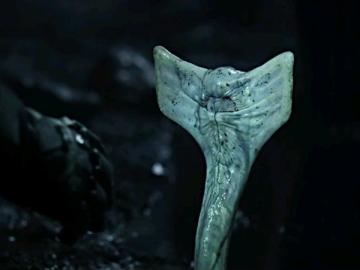
I bit that guy because he didn’t like the skeletons but for some reason wanted to pet me.

It’s probably why when I write a story and there’s a chance it may get crazy or overly complicated, I try and have something to make it easy to understand and believable. I dumped a whole idea for Reborn City‘s sequel just because I thought it might be disbelieved by more than a few readers. I went through a lot of parts of Snake before I wrote and even while I was writing it just to make sure there was nothing that could be too hard to believe. And with the bajillion stories in my head, I often tinker with them in my inmagination for years just to see if there’s something that could be pointed out as too weird to happen (believe me, even in speculative fiction that’s a lot).

What do you have trouble believing, even in beloved stories that everyone else is cool with? And do those things make you examine your work differently?

I think this might have been in Harry Potter. What do you think?

I always think the editing process is going to be longer than it actually is. And yet I’m already done with Part III of the thriller novel Snake, which means I’ve only got a small stretch of the novel left to edit. I could be done by the end of the weekend if I don’t let myself get too busy or too distracted (though my homework could lead to some busy-work or distraction, so that’s something to calculate in).

So far, most of the editing has been taking out unnecessary words or changing certain things grammatically so that the story flows better. Also, I’ve noticed sentences that made sense to me three months ago at the end of the first draft make no sense to me now, so I have to do a lot of rewriting when I encounter those sentences, occasionally adding to my word count.

But I’m enjoying rediscovering the story I wrote from June to Decenber 2012, and seeing how fast-paced and at certain times shocking the story can be. I’m going to try to keep this up, and rewrite the final battle scene to be more exciting and less unrealistic, at least to me. But first, I have to get through Part IV, which has sone of the longer chapters in the story (and that’s saying something, considering the longest chapters are between 8 and 10 pages).

I’ll have more updates as time goes on. Wish me luck.

I was editing a chapter of Snake this evening, when the Snake is torturing his third victim for information (on what, you ask? Read the book when it comes out). At some point during this chapter, the Snake becomes incensed by something his victim says to him and retaliates in a most gruesome manner. The thing is, I didn’t remember that I’d written that part the way I’d written it, which was fast, unforeseen, and totally horrifying in its inhumanity. It disturbed me a little, and I wrote the bloody scene over the summer! (By the way, no pun intended when I say “bloody”)

This is pretty ironic, seeing as I pride myself on being immune to most scenes of horror and death in fiction. But it also points out something: if I can be disturbed by a scene I created in a story I wrote, even just a little, and I knew that scene was coming, then what would the reaction be of someone who didn’t see it coming, and isn’t as desensitized to these sort of things as I am? I get a little excited just thinking about it.

It makes me wonder if I’ll be disturbed by any other scenes I’ve written in this thriller novel of mine. There are quite a few more murder and torture scenes to go through, so the likelihood is high that I might see something and feel a little twinge of horror, disgust, or queasiness. But if I do, that’s not necessarily a bad thing. After all, I write horror stories primarily, so if even I feel a little reaction from going over and editing a scene, I think that means I’m doing something right.

It can also point to how disturbed I am as a writer and possibly as a person, the way I have a character killed or how I describe the monsters in the story or how I build up to a terrifying conclusion in a certain scene. Critics will definitely wonder if I’m depraved (always possible), if I was traumatized as a child (yes I was, I wrote a post on it last year) or if I’m trying to corrupt my readers with this vile stuff I write (objection! I seek only to share and entertain while making a little money where I can).  But hey, if Stephen King and Anne Rice and Edgar Allen Poe can write some of the same stuff and survive the scathing criticism, why can’t I?

Besides, there are certain things those same writers above wrote that I do not plan to write (if you haven’t read Stephen King’s IT, please go to the Wikipedia page and read the last sentence of the second-to-last paragraph of the section titled 1957-1958 under Plot. You’ll understand what I mean). Even I have lines I won’t cross, though sometimes they don’t seem obvious to others.

Well, I’ll continue editing Snake and seeing what I find. Hopefully I’ll be able to find some more scenes, be disturbed when it’s necessary, and touch up some scenes to be more disturbing if I think it’s needed. Hopefully I’ll be able to create a novel that will catch on and cause a wave and be praised for its disturbing/thrilling/insert-advective-here aspects. That’s the dream, at least.

In the meantime though, I have to get ready for bed. I’ve got Abnomal Pyschology class in the morning, definitely one of my favorites, and I want to be awake when we discuss treating bipolar disorder. Good night, everybody.

TQG cover

Well, it’s been a busy Monday for me, but I have some good news: in addition to editing another chapter of Reborn City after recieving said chapter back from my friend/beta reader, I sent The Quiet Game: Five Tales To Chill Your Bones to the US Copyright Office for legal protection. Thus, I’ve initiated the final phase of the publishing process for my collection of short stories, which will culminate in publication.

Of course, the first thing I sent over to the US Copyright Office, I’m still waiting for them to process. This was about four weeks ago, so I’ll probably be finishing my finals when I finally get these oh-so important legal protections from plagiarism and illegal sales.

Oh well. In the meantime, please enjoy the tailer I created last week. It’s absolutely eerie.