Archive for February, 2014

I started a short story this past Sunday, a science-fiction story with LGBT characters and themes about how complicated relationships can get. It had a great concept, and it was an exciting story. I’ve been looking forward to writing it ever since I had the idea for it, and I made sure it was on the list of short stories I was going to work on when I decided it was time to limit how many more I was going to write. And I was making great progress on it too. I mean really good progress. Except for Tuesday night (I was busy that night with other stuff) I was getting 500-1000 words written each night.

But as I got further in this evening, I realized that I was slowing down, that something wasn’t working. I realized that the way I was going I was going to hit a wall with this story, so I had to stop and figure out what exactly was bugging me about this story. And I realized: like Resurrection, the way this story was going it’d be better off as a novel or a novella.

Normally I’d be okay with that, but for many reasons I don’t want to convert this particular short story into a novel. Not only do I already have so many ideas for novels to write that I’m not sure I want to add this story to that list, but I feel that if I can find some way to keep the short story as a short story, it’ll be a thousand times better than any novel I could ever write based on it. It’s a very strong feeling, too. So I’m not going to turn this particular story into a novel.

Instead, I’ll go back to the beginning. Most likely I’ll end up rewriting this story, and instead of writing a whole bunch of expository lead-up to the main scene, I’ll write that main scene, which is what inspired and excited me about this story in the first place. I feel overall it’ll be a better story that way, one that a sci-fi magazine would be proud to host within its pages.

So tonight I’ll end my writing spree by saving the short story and taking a break to think about how I can improve it. I have some ideas now, but nothing I want to act on just yet. I just need a little time to let the ideas cook and see what works and what doesn’t work. After all, this is one amazing short story idea I have. And it deserves to be written in a way I can be proud of.

That’s all for now. I’m going to watch something I’ve taped, and see what my brain can come up with in the morning. You all have a lovely night, and a fantastic weekend, my Followers of Fear. And I hope wherever you are, you’re warmer than I am. It’s Arctic temps here in Ohio. Trust me, I’m looking forward to spring and summer a lot more than most. Good thing I’ve got my Snuggie to keep me warm.

O-H!

It’s Week 8 of the semester, which means it’s time for me to check in and let you all know how I’m doing this semester at Ohio State. And I’m very happy to say, I’m doing extremely well. My classes are all going well, I’m on track for my study abroad trip, I may have a thesis advisor for next year, and work is going very well. Things are great!

First, starting with classes. As I said at the beginning of the semester, I’m taking five courses, four of which are related to my study-abroad trip. Those four courses are a course in American history centering around the period between 1921-1963, a class to learn some basic French, a seminar specializing in World War II-related topics, and a class on French-American relations through the years. I’ve been getting good grades in all of those classes, though the French language class has a lot of words I sometimes have trouble remembering (go figure, and I’m still better at German), and the research seminar requires a lot of reading. Normally that wouldn’t be a problem, but I need five primary sources and at least five secondary sources for my final paper, which is to be about the Nazi obsession on the occult. I have three secondary and one primary so far. Oy vey.

As for the fifth class, I’m taking a class on Deaf Literature. I thought that would be the class that would be difficult for me (there’s always at least one), but it’s been a delight. The teacher is someone I’ve had before (though she was a TA then), and she even bought a copy of The Quiet Game, definitely a plus. I also got the chance to write a short story for class, which I blogged about in a previous post, and I’ve been really enjoying the material. Heck, I’m learning so much more about Deaf culture than I thought possible. It’s pretty mind-blowing.

As for the study abroad trip, it’s coming along great. I’ve received the itinerary, and this weekend (if I have the chance) I’ll stop by my cellular company’s local store to see whether if it’s better to bring my phone abroad or get a prepaid. It’ll probably be the latter, from the advice I’ve been hearing. Now if only I can win some scholarships, I’ll be in heaven.

For the thesis, I’ve got a novel I want to write, one that’s pure horror and that’s got some great potential. I just need someone to advise me. I’ve got two teachers who may be able to help me. One of them is a teacher I’ve taken a class with before who may be willing to be my advisor, provided he can find the time in his schedule. The other is a teacher whose class I might be taking in the fall (provided she likes the pieces I sent her). She seemed open to working with me, so hopefully she’ll be willing to work with me.

And finally, for work I got my first raise. It’s not much, about twenty-five cents more per hour, but it’ll help a little with expenses. And I hope in the future I’ll be able to get some more raises in the future.

Well, that’s all for now. I’ll be doing another semester update after I get my final grades back. And now if you’ll need me, I’ll be working on a short story. Goodnight, Followers of Fear.

It’s happened! One of those milestones that every blogger waits and hopes for. I have just gotten my five-hundredth follower, making me feel like I’m on top of the world.

I’d like to thank everybody who’s been signing on to follow in the past couple of weeks, including dyslexiasuccesscoach, biggirlbigpanties, nandaputrari2014, and other bloggers. I’d also like to thank longtime followers and friends for all the support and love you’ve been giving me for over two-and-a-half years, including Angela Misri of a Portia Adams adventure, Matt Williams of Stories by Williams, and so many others. It means a lot to me that you’d listen to the thoughts and struggles of a college student trying to become a great horror writer. And when somebody from the blog buys one of my books, boy does it make my day.

That reminds me, I want to get to know my followers a bit more. I can’t follow everyone who follows me, so I’d like to know a bit more about you, the reader. Who are you? What do you blog about? Why do you follow my blog? Please let me know. I’m always happy to hear from people who are reading my work.

Well, that’s all for now. I’ve got work and classes in the morning, so I’m going to get ready for bed. You have a good night, my Followers of Fear. And I hope you’re having warmer temperatures than I am at this moment. Central Ohio is supposed to have temperatures that are below freezing during the next week or two. It’s too scary for even me to write in detail at the moment!

Great book if you’re interested in the Dust Bowl of the 1930s.

You know you’re a writer and a college student when you manage to find ways to make your writing count for a grade. And that was kind of the point of this latest short story, which I wrote for one of my classes. Called Darkness at Noon, it’s not a horror story despite the title. Instead, it’s more literary/historical fiction. Why the heck am I writing that sort of story? I’ll explain.

The class I wrote this story for is my Deaf Literature and Culture class. Our teacher gave us an assignment to bring in some artifact (a book, a painting, a TV show or movie), something that represented deaf culture and do a presentation on it. I chose to write a short story, partially because I didn’t want to repeat myself by bringing up the episode of House where he treats a deaf teenager (I’d used this for a previous assignment), but mostly because I seriously wanted to write a short story and get something from it, such as a good grade. After getting the okay from my teacher, I started on the short story immediately.

As with most writing, getting started and keeping it going can be difficult. The style of story was also difficult for me, as I prefer horror and with no serial killer, ghost, or even angry wild animal, it was sometimes slow going writing this one. However this evening, after getting home from watching a movie with some members of my study abroad group and taking a shower, I set down to finish the story. I’m happy to report that I finished it at 4,652 words, at about a quarter to two in the morning.

The story itself follows a young woman living in the Dust Bowl during the 1930s who is deaf. She’s unhappy with the direction her life has taken, and it takes a terrible dust storm to make her realize that things aren’t as bad as she thinks.

I got most of my research from what I’ve been learning in my Deaf Lit class, as well as from the book The Worst Hard Time by Tim Egan, which I finished last weekend for another class. Both helped me visualize not only the world my character lived in, but also taught me what might go through the mind of a young woman who has to live in a town where she’s the only one who can’t hear. I like to think my character has a lot of baggage to her. She feels alone and isolated because of her deafness, and has some understandable anger towards those who’ve looked down on her because of the fact that she’s deaf.

Anyway, I like how this story turned out for the most part. I think the ending will need a little tweaking to make for a smooth finish, but I feel confident that when I turn it in on March 21st, I’ll get a very good grade for it (and possibly a recommendation for some Deaf Lit magazines or somewhere else I could publish the story).

Well, that’s all for now. I’m probably going to go to bed soon, so I’d like to wish you all good night and hope you have pleasant dreams. See you tomorrow, my Followers of Fear.

I do not tolerate negative language meant to denigrate a person because of their race, gender, orientation, or ability. So when I see someone using this sort of language flippantly or carelessly, I usually tend to avoid that person. If they’re a friend though, I’ll try to convince them not to use that language before I cut them off.

Last night I was forced to do just that. Someone I’m acquainted with at school was responding to people lamenting about Facebook buying some app or another. He thought it was hypocritical that they were complaining about it on Facebook and said they should reevaluate their lives (though he didn’t phrase it in such nice terms). Where I got upset was when he used the word “retard”. I’ve mentioned before that I have an autism spectrum disorder and I’d been called “retard” or “retarded” more than once by bullies because I didn’t understand certain social boundaries or conventions when I was younger. Not to mention that mental retardation (or intellectual disabilities, which seems to be the preferred term among medical professionals these days) is an actual medical condition, so using it as an insult hurts the people with actual mental retardation worse than it hurts the people having the insult hurled at them.

I asked my friend if he would not use that word because it has the potential to hurt people. He responded that he was using the word without negative connotations and that people should realize that (as if we’re mind-readers!). He also said he uses racial and other denigrating terms, including the N-word, and said he uses them without the negative connotations and that it’s my problem if I was insulted by it.

At that moment another friend of his, whom I’m acquainted with as well, joined the thread and started using the very same terms we’d just been discussing. At that point I decided to leave the conversation, unfriend the both of them, and go to bed (though not before coming up with an idea for a short story based on this experience). And it’s still on my mind, as this blog post makes evident.

The thing is, even if they think they’re not using the words with their negative connotations, it’s not so easy to disassociate a word or symbol from its negative meanings. Otherwise the swastika would still mean good luck and auspiciousness rather than Nazi Germany and the Holocaust as it does for many Westerners. And these sort of microaggressions can have terrible effects on the people being denigrated. If you’ve never heard the term “microaggression” before, there’s a great blog post on microaggressions that explains them in depth. If you don’t have the time to read it though, a microaggression is basically the everyday little forms of discrimination that minorities experience throughout their lives. An example is the continued use of saying “that’s so gay” as a way of saying something’s stupid. It is not only bringing down whatever is being called gay, but it is saying that there is something wrong with being gay in the first place. And while the basic definition of microaggressions means they are small, especially when compared to gay-bashings or other forms of assault and more obvious forms of discrimination, over time they can build up and cause stress, depression, or suicidal thoughts in the person being denigrated.

Personally I only ever use these sort of terms in stories in order to portray a character the way I want him or her to come across to an audience. Even then I hesitate to do it and seriously consider whether I should really use such negative terms and if there is another way to get across the full impression of the character. That’s why within all of Reborn City, a novel about gangs divided mostly on racial lines and with a white supremacist gang, you’ll only see one instance where I use the N-word and other racial terms (though I do have several characters call Zahara a “terrorist” in order to illustrate how ignorant and prejudiced the world of RC is against Muslims).

So when I see people using these sort of terms so flippantly, uncaring about the negative consequences of these words, I get pretty upset. These terms are attacks on people because they’re minorities, and because my former friends are white or deeply tanned and don’t receive discrimination for their skin color, gender, sexual orientation, or level of ability, they don’t necessarily realize the damage they’re doing by using these terms. And by calling the rest of us oversensitive for being upset that they’re using these words, they’re proving that they’re insensitive to the problems of others, not that we’re oversensitive.

So I finish this post urging people to really think about the terms they use. You’re not being cool or rebellious by using terms that bring down minorities. What you’re doing is hurting people and causing people to think you’re ignorant or bigoted. If you’re going to use them, use them in a way that won’t hurt anyone, such as using the N-word in Huckleberry Finn is used to illustrate the beliefs of that age towards African-Americans. Or these words can be used to fight discrimination: there is a growing body of literature, music and other media that uses these words to show how hurtful they are and possibly change the way people think. Slowly but surely, some people are changing the way that they think.

That is all for now. I hope my former friends learn that using these words has negative consequences. Especially the guy who actually happens to own an up-and-coming business. How many businesses have failed because of something the owner has done? I hope that doesn’t happen to him someday.

This evening I went to a very interesting meeting of Ohio State’s Science Fiction Club (a whole other blog post to discuss what we talked about), and I got inspired for a few stories and articles. As I walked home from the meeting, I had another idea for an article, which you’re reading now.

As I walking home from Campbell Hall, enjoying the slightly warmer-than-usual weather and listening to heavy metal on my iPod (the mood music I usually listen to when I’m thinking or brainstorming), I was musing on the sorts of stories I tend to write, which ones were good and which ones were terrible, and what differentiated them. I realized something then: one thing that separated some of my good stories from my bad stories is which comes first, the plot or the theme.

Let me explain what I mean: when I first came up with the concept for Reborn City, it started as a simple gangster story with a science fiction twist. I had no idea of what the story would be like beyond that. I wanted it to be more adventure than explanation of scientific theory, I wanted excitement and sci-fi wackiness and life-or-death fights and maybe some sex (which got cut out after the first draft because it just didn’t fit the plot of the story). All the themes that ended up being woven into the story–the struggles and problems of gang life, Islamaphobia and racism, drug abuse, etc.–were woven in at a much later stage, though they became part of the story well before I started actually writing it.

On the other hand, there have been some short stories–which I don’t want to name–where I write them with the specific intention that they represent a theme or an idea. One early sci-fi story from high school about two technicians on a spaceship was meant to reflect on the loneliness of space travel and of isolation. Another was meant to be a ridicule of patriarchal values in society. And there are a few more I could mention, but let me just summarize by saying they were all conceived with a theme first that subjugated the story to the theme.

Apparently for me that latter approach doesn’t really work. The words feel all wrong and forced when I write like that and I find it difficult to make the story move forward.  And I realized as I walking home, past the library and towards the north end of campus, that my best stories are written when I focus more on the plot rather than any significant meaning behind the story. If the story itself is compelling, then the rest will follow, including any very deep themes.

I’m going to have to keep this in mind when I write stories in the future. And if I do end up writing a story where plot is subjugated to theme, at least it’ll be a good learning experience for me on what stories I shouldn’t write and how to avoid writing those sort of stories. I’m sure that there are plenty of authors who can write those stories and do it well (for some reason I’m thinking Kate Chopin’s The Awakening and plenty of other authors I’ve been assigned to read in my high school and college careers), but apparently I’m not one of them.

But in the end is that not surprising? People who love genre fiction, especially the sort of fiction I write, don’t necessarily read a story because they’re looking for a story that exposes the mindset of a battered woman or because they want an allegorical tale of small towns haunted by ghosts representing the ills of ignorance and a narrow-minded worldview. No, they want a story that scares them, and if the themes in the story make you think as well facilitate the whole scaring part of the story, then great. And since this is what I do when I read a story–to look for a good time, not for a deep meaning–it makes sense that my best fiction comes from focusing on the story rather than on what the story means.

Do you ever have problems with this? What are your thoughts on the subject?

As I’ve mentioned in previous posts, last night was BuckeyeThon, a twelve hour dance marathon that aims to raise money for cancer research, specifically research that benefits children. I went last night, full of energy, hope and excitement. I came away with my back in a bit of pain and so ready for an 8-hour nap (which I took). But it’s one of the best experiences going to BuckeyeThon. You get to dance your ass off, you meet some of the kids you’ve raised money and danced for, and you get to participate in the biggest fundraising dance marathon of its kind in the country! There’s nothing like the high of knowing that.

And I’m serious about the biggest marathon of its kind in the country. BuckeyeThon 2014 is estimated to have drawn upwards of 3600 participants this year, each fundraising at least a hundred dollars and many going well beyond that (I aimed for two-thousand but didn’t make it). It’s pretty amazing.

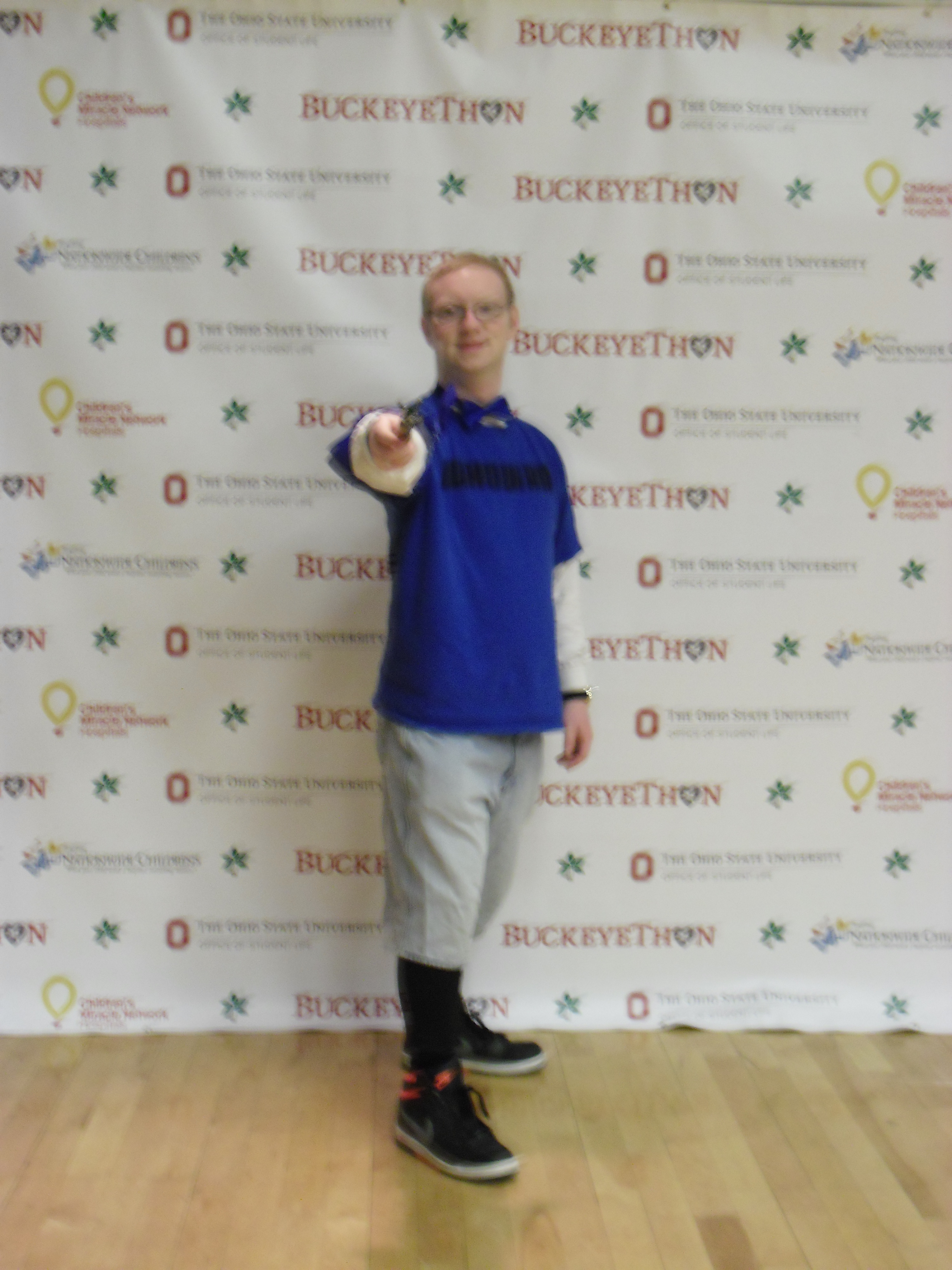
I can’t go into everything that happened last night, but I’ll give some of the highlights and a few photos too, plus a video. First let me tell you that the people who go to BuckeyeThon are divided into color-themed teams. I was on the Blue Team this year, and I dressed the part.

Allons-y!

Allons-y!

Some of you are thinking, What is he dressed up as? Others are thinking, Is he holding a sonic screwdriver? And one or two of you are thinking Go Michigan! I’m going to ignore the people thinking the last one and explain: I went last night as the Blue Doctor (please somebody be thinking, Blue Doctor? WHO is that?) Besides showing how overly obsessed with Doctor Who I am, I think the Doctor would totally get into something like this, which is why I went as him…if he were me and on the Blue Team. But hey, I was wearing a blue bowtie and had a sonic screwdriver and I was TARDIS blue the whole night. It kind of worked.

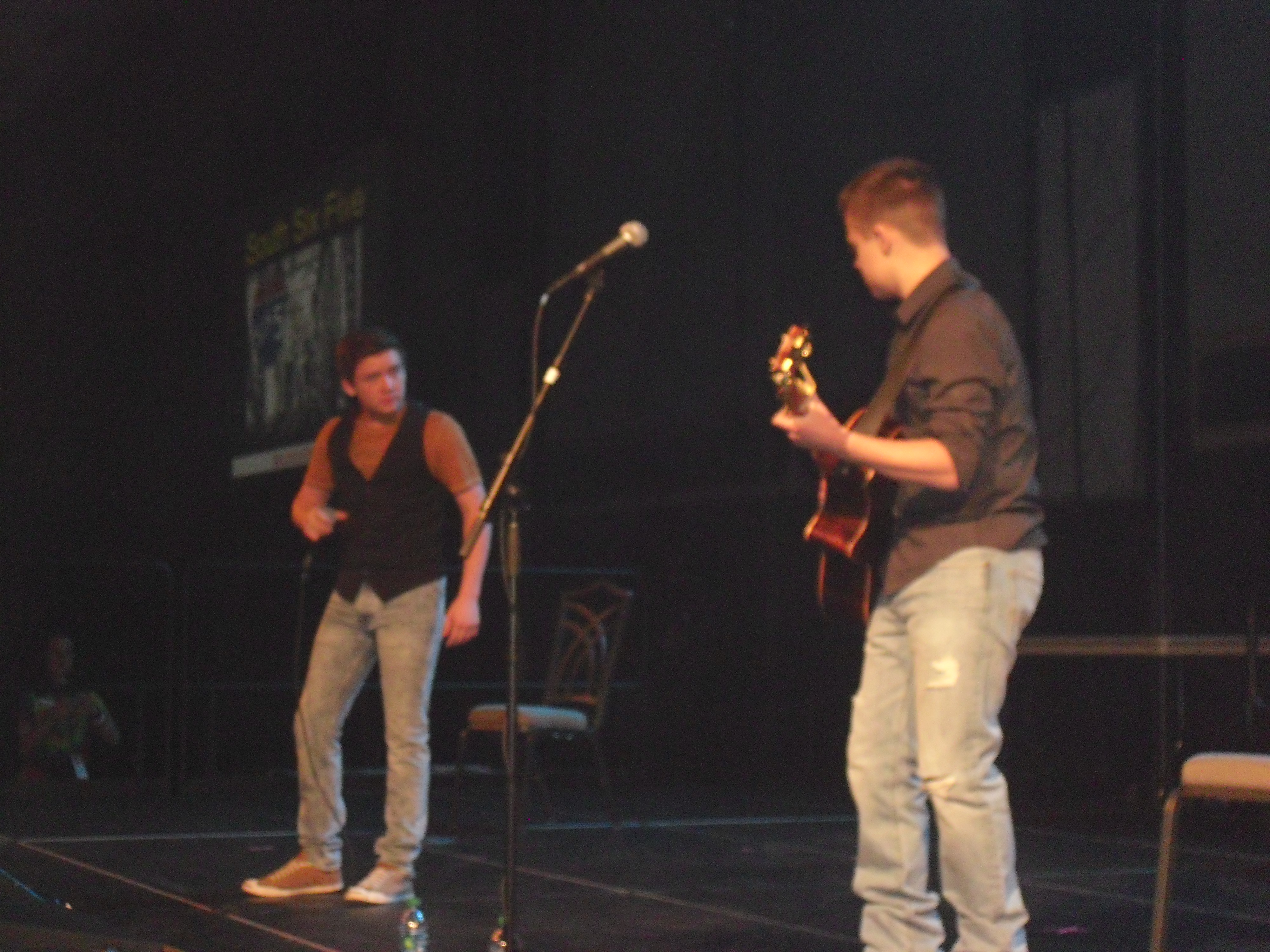
South Six 5. Don't let the Bieber hair full you, they're much better than him.

South Six 5. Don’t let the Bieber hair full you, they’re much better than him.

And we had a wild night. There was a whole lot of dancing, there was a rave DJ at one point, a dance instructor who sent women and some men into frenzies with his dancing which we were supposed to imitate, a concert with local band South Six 5 (check out photo) and a morale dance, which is like a huge flash mob we learn the steps to throughout the night.

And at around 8 in the morning, we broke with a singing of the school song Carmen Ohio before going home to sleep and let the second shift have their party (did I mention that there are two shifts to this thing? Half the dancers take one 12-hour shift overnight, the other half have a 12-hour shift over the course of Saturday). After I got home and showered, I slept till about five in the afternoon, got up, and ate, did some homework, cleaned my room (it needed it), and then went back to the Union where all this takes place.

There we heard stories from the families of the kids we were helping to cure, as well as some of the people who helped organize and set up BuckeyeThon, as well as other dance marathons from around the country. And we heard a story from a man who helps set up dance marathons across the country. He told us about a kid he knew who had survived cancer and had been in and around these dance marathons for a good chunk of his life. The kid said something like this: “When I was growing up, I heard we were in the generation that would find the cure for cancer. It’s not true: we are the cure for cancer.” Hearing that was pretty spectacular, and it’s kind of true. Even if we’re not doctors or nurses or chemists coming up with new drugs and treatments or monitoring these kids heart rates, we have been instrumental in creating the means to cure cancer. It’s really amazing.

This photo is actually from the start of Buckeyethon, but whatever. You get the point.

This photo is actually from the start of Buckeyethon, but whatever. You get the point.

And then, in the packed Union (see that photo to the right), we learned how much we made. Slowly, the number was revealed on big sheets of cardboard: $767, 227.78. That’s nearly $150,000 m0re than last year’s amount! And I was so happy to have been part of that, even if my donations weren’t as high as some others (one girl raised $15,000 on her own. What is her secret?).

And now that I’ve said all that, I’d like to thank everyone who donated to me to support BuckeyeThon and the kids we helped. I was really a great experience and I was so happy to have so many people supporting me and to be with so many amazing people last night. I hope I can count on you all next year, when I do it again for the last time around. Hopefully I won’t cry too much when it happens.

Oh, lastly I want to show you the morale dance. Looks like someone posted a video of it this morning. Actually it’s the morale dance competition, when the various teams send two representatives to compete in doing the entire morale dance in front of the entire room. I got to represent the blue team, which was quite fun. You don’t see much of me in the video (mostly my arm) but you get to see the first-place and third-place teams do it, and it’s pretty fun to watch. Check it out.

That’s all for now. I’ll post more photos on my Facebook page and Twitter feed tomorrow. Until then, goodnight Followers of Fear.

See also: The 3 Types of Terror

As a horror writer, one of the biggest challenges I face is building terror in a story. As Stephen King said on Facebook not too long ago, terror is “when you come home and notice everything you own had been taken away and replaced by an exact substitute. It’s when the lights go out and you feel something behind you, you hear it, you feel its breath against your ear, but when you turn around, there’s nothing there…”

Creepy! Anyway, I’ve been thinking of different ways authors utilize terror in their stories, how they manage to insinuate that terror element into their work and look for patterns. Based on those observations, I think I’ve come up with some answers, and I’ve put those answers into two models for using terror, which I will talk about below.

The first model of using terror is called the Uphill Model. In this version, you slow ramp up the strangeness and terrifying aspects of the story, starting with small, subtle cues but gradually introducing more overt signals until the wrongness of the situation is so obvious that at this point you can introduce the horror aspect (aka the vampire or the demon or whatever’s meant to creep us out in the story) to the sound of terrified squeals and screams (especially if you’re in a movie theater). A good example of this model would be Samson Weiss’s Curse, one of the short stories from The Quiet Game. The story starts out with small things that are out of the ordinary (a stalker at a rally, maybe some trouble sleeping, a voice or two), but things escalate and become more obvious as the story goes on until the villain of the piece is revealed, in all his horrifying grandeur. I also used the Uphill Model in The Loneliest Roads, one of my more recent short stories, which is currently going through the editing process and may be submitted to magazines soon. This is a good method to use for short stories, especially since it requires a steady but quick escalation in order to keep the reader interested and scared. However, the method requires precision in measuring out how much terror you should use and in what ways. Too much or too little terror used too soon or too late will work against the story, and actually turn readers away. Writers need to be cognizant of this when using this model.

Bad movie. Great example.

The second model is called (quite appropriately) The Seismograph Model, because there are moments where there is intense moments of terror followed by lulls or smaller spikes of terrifying elements. A wonderful example of this is Stephen King’s IT, where there are moments where the strangeness of the situation is very high followed by moments where the amount of terror is low or non-existent. Usually during the spikes of terror there is also a lot of accompanying horror and Gross-out, the other two types of terror. During the lulls, authors generally use this time to work on character development and to expand on the situation the characters find themselves in, as well as to maybe show the characters in more casual settings or enjoying life without threat of something evil. This model is helpful for novels, especially longer ones where there are plenty of run-ins with the great evil of the story before the actual climax takes place and it requires a bit less precision than the Uphill Model, though it does require some skill to do it right.

Let me just say that these models are not perfect and that they don’t apply to every horror story out there. They are simply frameworks to examine a story and maybe to help shape your stories while you are writing them. There may be other models out there that I’m unaware of and have yet to discover, and if there are, I doubt any story out there fits any of these models perfectly. Like I said, the models are tools of examination and reference more than actual models to be followed.

Anyway, I hope as time goes on and I work on new short stories, I hope to be able to use both models to some degree and to use them effectively in my stories. I think that if I can, I might be able to write better stories and further my career as an author. That’s the hope, anyway.

Do you use any models when writing? If so, what?

Oh, and while I have your attention, I have some announcements to make. First, I’ve included links to the book trailers of my various books on the pages above. So if you want to see the book trailer for a novel or a collection of short stories, all you have to do is visit the appropriate page and click on the link. Makes more sense than having to scour YouTube or this blog for the correct video or post, right?

Second, I’d like to announce that I’m starting work on a new collection of short stories. By that, I mean I merely plan to write a new collection that includes some old, unreleased work and some new work that I’ve been looking forward to writing. I’m not sure when this collection will be ready, when it’ll be released, or what I’ll call it, but when I do get around to all that, everyone here will be the first to know.

And finally, I’ve created a new page on this blog, entitled Interviews. The page contains both interviews with other authors and interviews with characters from my novels. It doesn’t have much on it yet, but I plan to add more interviews for both authors and characters as time goes on. I’m especially looking forward to adding more interviews with other authors: those are a chance to help out friends with new books coming out, meet new authors and get a chance to know them, and to possibly expand the number of people reading my work. We’ll see what happens, but I hope only for good things.

Well, that’s all for now. Tonight’s Buckeyethon, so I’ll be offline until I get home after a 12-hour dance marathon, followed by a 6-12 hour nap to catch up on my sleep. See you guys Saturday evening, when I write a post about how awesome Buckeyethon was and what happened while I was at it. Happy Valentine’s Day, Followers of Fear.

Here’s a fun manga I highly recommend.

Well, that was a longer title than what I usually give a blog post. But it contains grains of truth.

Last night I was reading a manga in bed. The manga was Hikaru no Go, which is about a boy who starts learning how to play Go (a Japanese board game, for those of you who haven’t heard of it before) and how he becomes a better Go player. While it’s not the kind of story you’d expect to have you at the edge of your bed, I couldn’t turn the pages fast enough. I wanted to know if the main character passed the pro test (in Japan, you can take the pro test if you’re under the age of 30), and was reading as fast as I could to find out what happened.

When I finally got to the last chapter of the volume I was reading, I couldn’t put the book down. They kept me wondering the results right up until the last moment, and when they finally revealed the results, I jumped out of bed and started doing a funny little dance. Thank goodness I didn’t shout for joy, though I was tempted to (I did not want to wake up my roommate, who had just gone to sleep).

But you see, this illustrates a very important point. While Hikaru no Go isn’t a very complex manga and its rating is for “General Audiences”, the author and illustrator were able to tell the story in such a way that you begin to feel the emotions of the characters and you wish the best for them while at the same time reading on ahead just so you can find out how they are doing. And when the resolution presents itself, you just want to dance like I did at the end of the volume I was reading, because you felt you were there and that you wanted to partake in the celebrations as well.

I think the mark of a great story is when an author can induce this effect in its readers. It’s an effect I don’t usually see in stories, but when I do they end up becoming some of my favorite stories. Every author tries to replicate that effect, and whether or not they do depends on the skill and experience of the author, as well as on the readers who take the time to commit to the story. I know it’s an effect I’ve been trying to create in my stories, and if some of the reviewers of my work are being truthful, I’m getting to the point where I might be able to insert that effect into my stories.

But how does one go about getting that effect into the stories? I’m not sure any author can answer that very well. The only advice I can give is that you should read a lot and take notes on what the writers did in the novels or other stories you find yourself celebrating with the authors. Then trty to replicate that wth your own stories. If your audiences end up enjoying your work and give responses like what you’re looking for, that they celebrated the victory of the characters, then I guess you’ve done your job.

What are some stories you’ve read that made you celebrate the victories of the characters? What do you think the author(s) did to make you feel that way?

After finishing “A Haunted Man” two nights ago, I’ve decided that, although I’ve got so many short stories I’d like to work on, I need to narrow it down to a few choices so I can return to my WIP Laura Horn. Yeah, I know I can just get through all the short stories I want to get through before I get back to the WIP, but I don’t like to leave a novel unfinished like that, and I would prefer having several short stories unwritten than have a novel languishing unfinished on my flash drive.

Besides, as I recall most of the chapters of LH were pretty easy to get through, so I don’t see it taking too much time to finish up. Then during the summer after I get back from my study-abroad trip, I can spend the whole summer editing my other novels and working on short stories. Besides, I’ll most likely be working on a novel for my senior thesis in the fall, so it’ll work out in the end. At least, I think it will.

So I’ve narrowed the number of short stories I’m going to work on to about eight, and I’m going to try to get through as many of them as possible before mid-March, when I plan to start working on LH again. I picked the short stories based on a couple of factors, namely that I thought the ideas behind them were exciting, that I knew where I wanted to go with the story in terms of plot, and that I think they could be published in magazines, especially ones that pay for their published work (I know that sounds crazy, but it helps pay the rent, so I’m trying to get into more magazines that pay for their work). Oh, and one of the short stories will be submitted as a homework assignment to one of my classes, so I could get a very good grade on it.

So that’s my plan for the next four weeks or so. I hope to at least get two to five of these short stories written. Among the eighty-odd ideas for short stories I have written down, these are among some of the best, so I think I’ll enjoy writing them. When each of them is done, I’ll write a post and let people know how they’re doing.

I’m also going to try to come up with an idea for an article. A friend of mine runs a magazine, and I want to write an article for it. Just the question of the subject that’s getting to me. We’ll see what I can come up with.

Oh, and one last thing: I’m thinking of posting a few stories on WattPad all at once. Would you be interested in reading anything of mine if I published it on WattPad, even if it wasn’t strictly horror?

Well, that’s all for now. I’m going to prepare myself mentally for writing later this evening. Wish me luck.