Posts Tagged ‘authors’

Some writers like to compare themselves to gods of the worlds they create, prodding their characters this way and that as the write their stories. I’m one of those writers, as blasphemous as it sounds (even more blasphemous when you consider that my parents are rabbis). But in a strange way, it’s true. I come up with an outline for my stories, I start writing, my characters take over to some degree and make their own choices, but at the end of it all they get to where I wanted them to go.

Sounds like God, doesn’t it? My characters, my creations, have free will of a sort in my world, but in the end the story usually works the way I want it to go because this world is mine and I have ultimate say. Evil has a purpose in my world, and so does reward and punishment (in a way). There’s an ultimate plan or idea of where things will go because I will it to be so, but you have to see the whole picture in order to understand the plan.

And I’m going to stop right there before I get a ton of people angry at me.

But if I’m the god of my worlds and my characters, what does that make me? What kind of god am I? I specialize in horror. It’s a dark genre, where anyone can die at any second, where monsters exist, and if you’re lucky enough to live, you might wish you’d died. It’s the genre that revels in the darkest of humanity as well as the best, brings doubt as well as faith, and above all, scares. I’m the god of such worlds, I adore making them up in my mind and then bringing them to life on the page.

What does that say about me? What does that say about any writer that wants to put their characters through torment or hardship? What does it say about God, that His world which He (or She, I’m equal opportunity) authored is so full of darkness?

Well, this isn’t a philosophy or theology post. But it brings up some good questions in those areas. Imagine if the characters we write were real people and the pain we put them through was real to them. Would we want to keep writing anything where they felt pain? Writers often feel like these characters are family to them, like children. If these were our real children, would we want to keep doing these sort of things to them? Would we ever write a story with conflict in it?

And could we continue to worship God with this sort of definition of Him?

The thing is, we’re not God. And our characters are most likely not real. But if they were, we’d probably go about writing sad or tragic stories. Like God, we have a plan, and the characters who we killed off, if we have any amount of mercy in us, we’d give the dead an afterlife to live in, so that killing them off wouldn’t hurt us as much. Because you know what? We have stories to tell, and maybe they’re not happy all the time, but they’re ours and that’s what we write.

And I do feel my characters are real to some degree. But that doesn’t mean I won’t write. After all, their stories deserve to be told.

So I’m working on Rose, my latest novel as well as my thesis, and I’m working on a chapter that I finished earlier today. However, this chapter was special, because it’s the first of two chapters that take place away from the titular character’s point-of-view. As I’ve mentioned in previous posts, Rose is told from the first-person point-of-view, and it’s told in the present tense, which originally I had difficulty with but eventually became easier with practice. However, as this chapter takes place away from Rose’s POV, I did it in the third-person POV, and I did it in the present tense.

Needless to say, it was incredibly awkward writing. I don’t know many stories that are written in the present tense, and those that I do are written usually in the first-person, like someone is narrating their life (who actually does that, I don’t know, but whatever). I don’t think I’ve ever read one that is present-tense and told in the third-person though. Maybe John Barth’s Lost in the Funhouse, but I can’t remember that one as well, so don’t take my word on that one. Anyway, writing this chapter in such a way is incredibly awkward for me. And I think it shows throughout the chapter, all six pages of it.

Well, my advisor M, my fellow writer/thesis worker P, and I are trying to arrange to meet sometime next week. I’ve already sent the chapter to them, and I’ve already suggested some changes I could make to this chapter in the second draft. I’m hoping they let me keep it in third-person but switch to past tense, as that would be much easier for me to write. But whatever they feel or whatever suggestions they give, I’ll definitely take them into account. They haven’t steered me wrong before, and I’ve learned a whole lot working from them.

In any case, I’m taking the night off from writing. I’m going to do some reading for homework, practice Torah reading for my cousin’s bar mitzvah next month, and if there’s time relax in front of the TV or with a good book. Stay warm and have a good night, my Followers of Fear. I know I am.

Boy, do I owe her so much. Even today, I’m getting so much from her books. I’ve got to read her new novel one of these days.

It’s been a good day for me. Classes have been fun (I almost wish they’d last longer), work’s been going well, and I’ve already finished one chapter of Rose (six more to go!). And I’ve recently gotten another lesson in writing.

I’ve been listening to the Harry Potter audiobooks lately and I’m currently on Book 4 (Harry’s currently dealing with most of the school and his best friend hating him for being the fourth champion. Hang in there, Harry!). This was the series that made me want to be a writer in the first place. And you can get something out of the HP books at any age, I find. But I also remembered something that I’d forgotten about JK Rowling’s famous series: she can build such amazing images in our heads and do them with such few words.

I forgot about that, how every word is picked to be useful and poetic and not a single one seems wasteful. That sort of economic use of words is hard to come by, and she wields words so well in her books. I used to try to imitate that style when I was first starting out (I also was trying to write my own version of the Harry Potter series with a female protagonist, but that’s another story). Sometimes I didn’t use enough words! Though in my defense, most writers under the age of thirteen are very visual and we don’t always consider that our readers might need a few more words to visualize the story in their heads when we can see it just fine in ours.

As I grew up though, as I got better and I started getting published occasionally, I started using more, bigger words. I think that’s common with plenty of writers at many different ages. We want to sound smart, intelligent, eloquent with words. I’ve done it just now! Eloquent. That’s a word a lot of people know, but wouldn’t it just be fine to use “good with words”? And I used “economic” in the last paragraph. How about frugal? Or choosy? Or maybe even thrifty?

And we do it just to make ourselves look educated and verbose (there it is again). Sometimes we worry that our readers will get lost along the way, but we’re too afraid to stop! We’re afraid we won’t live up to people’s images of writers. Is it our vanity or our fears of how people look at us? Is there a difference? I’m not sure.

But I’m listening to the HP books, and it’s so precise with the words. And it’s a good story. Scratch that. It’s a great story (my mother would kill me with Avada Kedavra if I didn’t make that distinction). Maybe because JK Rowling wrote the HP books with kids rather than adults in mind, but she’s never worried about the words she’s using, about sounding intelligent or loqacious (again!). She just puts down the words as is needed.

Have to stop using words like I’m pulling them out of a thesaurus just because they’re big and fancy. It might be detrimental–darn it!

In my Business and Professional Writing class, we’ve been looking at how businesses and corporations and even school districts use lots of big words in order to sound like they’re qualified for their jobs. What it really does is sound like a robot has produced a lot of inpersonal and indecipherable terms (again) and let’s be honest, nobody likes an inpersonal robot, whether in real life or on the page.

It’s a crazy coincidence that it’s all happening at the same time, but JK Rowling and my class are teaching me something: that perhaps all those words are unnecessary, that instead of making me sound intelligent and articulate (trying to stop) they’re making me sound less like a person and more like a machine. And even though I do a great impression of a Cyberman, I’d rather not be mistaken for a robot.

So I’m going to try being less long-winded, switch to simpler words and get my point across in half the time. Heck, it might help me finally get a short story written in less than forty-five hundred words, something I’ve been trying to do for ages. And maybe it’ll make for a better story overall. We’ll see what happens.

For the present though, I’m certainly exhausted my patience for the overuse of ample language in the pursuit of resplendent storytelling and will henceforth cease such unreasonable actions for the betterment of my vocation and for the beneficial enhancement of my readership.

I’m done.

A while back I posted on character tropes and cliches that needed to be retired from literature. Some of my Followers of Fear thought that maybe the trope of “The Chosen One” could stand to be retired. I’ve been thinking about this since I wrote that post, and I thought I’d discuss it in contrast to what I call “Someone Who Grows Into a Hero.” If I had another name for that character trope, something a bit shorter, I would use it. Maybe I’ll think of one in the course of this post. Or maybe you’ll give me one (please?).

So, let’s talk tropes. The Chosen One is, in essence, a character who is basically chosen by some higher power–God, Fate, some powerful wizard, the President, the Force, that kooky neighbor down the street, etc.–to take on some great evil and defeat it. Sometimes this choosing takes place pretty early in life, sometimes years or ages before the Chosen One’s birth. A good example is Harry Potter being chosen to defeat Lord Voldemort (funnily enough, I’ve been listening to Harry Potter audiobooks while I’ve been working lately. Already on Book 3. You can always get something new from these books no matter your age, I find). It’s been used hundreds and hundreds of times throughout history, since possibly before the Greeks and Romans started telling stories involving oracles.

Now, this trope has a good reason for being used so much. The character who is the Chosen One–usually the protagonist–is usually a good person, selfless, kind, somewhat charismatic. They’re often presented with insurmountable odds, but through their own ingenuity, goodness, and the help of their allies they overcome and become victorious. We want to be that person, who is good and destined to be great as well, to save everyone and to have the best group of friends around them. To be a messianic or godlike figure.

However, there are some problems with this trope. For one, it’s been used so much that we know it by heart. Harry Potter, Eragon, Mila Kunis’s character in Jupiter Ascending, Gregor the Overlander, Emma Swan, Anakin Skywalker/Darth Vader (with Luke’s help, I guess), Neo, Buffy, Po the Panda, Thomas from The Maze Runner and many, many more. These characters are everywhere. And they seem to all have similar personal stories. They grow up in simple circumstances–programmer, abused nephew, farmer, teenage girl, etc.–but are thrust into extraordinary circumstances that change their lives and center events on them. They’re told they’re special, that there are things that only they can do. At first they might be reluctant, or not have the confidence to do what they are told to do. But as time goes on and they somehow make it through the most dire circumstances, they become confident and settled in their roles, and they do end up destroying the ultimate evil (except if you’re the Slayer, in which case it never ends) once all is said and done.

trelawney 1

These sort of stories also say something about how the universe works, namely fate vs. free will. In some circumstances, the way these stories work is that no matter what, the Chosen One is to win against the ultimate evil. So personal choice isn’t a factor. The universe must work to get the Chosen One to win. Remember when I said I was listening to the HP audiobooks? In the 2nd, when Harry stabs the diary, and I remember this clearly, Harry doesn’t think when he sees the fang and the diary. He just acts. Perhaps the universe intervened so that Harry could someday take on the full mantle of his destiny? And in the case of Buffy, no matter how much she tries, the duties of a Slayer force her back into the world of darkness and away from anything resembling a normal life. The universe (or the writers) seem to have no care for Buffy’s choices, apparently.

So the problems of this trope is not only that it’s overused, but that it’s predictable, and that it takes the freedom of choice out of the equation to a great extent, sometimes even totally. There are ways to change up the trope, but it’s rarely done. Katniss Everdeen could be considered a slight variation on the theme, as she kind of stumbled into the role of Chosen One by an act of defiance, but from that point on her life is controlled by others. Heck, even Peeta manipulates her by forcing her into the relationship and pregnancy ruses. Still, I’ve been open about my disdain for the Hunger Games trilogy, so I’ll say it’s not the best example. I’m trying to think up a better one, even if I write it myself, so I’ll let you know if I think of (or write) something.

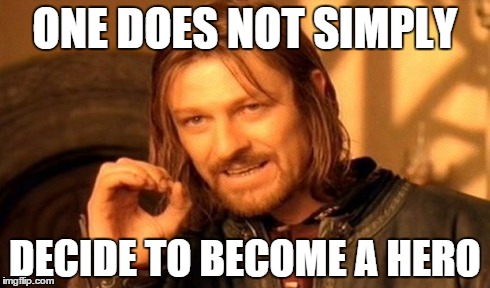
The other trope is the Accidental Hero trope (I did find another title for this trope). This is one I like a bit more, because you can do so much more with it and there’s a growing number of examples of this kind of character. This is a character who, rather than by fate, is made a hero through circumstances and their own choices. They may not be hero material, they may not want to be heroes, they may rather go home, but they rise to become heroes by their own merits. For example, Nathaniel from the Bartimaeus books wasn’t chosen to be a hero, and never set out to be a hero. In the first book, he was seeking revenge for personal reasons, the second book he did it because of his job and because of political reasons. In the third book he does it after a lot of self examination and because he’s scared of the demon uprising.

one does not simply 1

Another example is Teen Wolf (the awesome TV series, not the very bad 80’s movie). Scott McCall became a werewolf by accident, and because of the threats to his family, friends and his town, he has to rise to become a hero and save the day. No fate, no gods, no prophecies. He becomes a hero (and later a very special form of werewolf) because his personality, the events in his town, and his love for the people close to him mold him into a hero.

And there are many more examples. Chuck from the titular series never asked for the Intersect, and he wasn’t supposed to have it. It could’ve been taken out ages ago. But he chose to keep it, use it for his friends, and save the people he cared about. Through that he becomes a spy and a hero. In Doctor Who, the Doctor only wanted to travel and see the universe. He is a hero of his own choice. Lelouch Lamperouge from the anime Code Geass received his powers through luck, and later chose to use them for his own ends and to get his revenge (more antihero I guess, but whatever). It’s a trope with a lot of wriggle room in it, and even better, it’s still underused, unlike the Chosen One trope. So perhaps many more authors should write less Chosen One stories and more Accidental Hero stories.

Of course, there’s no way that this post will cause less Chosen One stories to be written. For better or worse, that trope is popular and will stick around for a long while. Still, I’m hoping for more Accidental Hero stories. I figure most of my stories will feature them. Reborn City and Snake‘s protagonists become heroes (or in the latter’s case, antiheroes) through choice and circumstance. Heck, I might try and find ways to subvert the Chosen One trope while writing Accidental Heroes. We’ll see what I can do.

Which trope do you prefer? What’s your favorite example?

What is a way that one could change either trope so that either one could be a bit more original?

Trope: a common recurring literary and rhetorical device, motif, or cliche. When referring to a character, it often refers to a common or well-known character archetype of stereotype that is instantly recognizable (ex. the noble hero, the avenging antihero, the slightly clumsy socially awkward girl in a romantic comedy, etc.)

There are hundreds and hundreds of these different tropes, each with their own special qualities and characteristics that are recognizable to many different people. Some of these tropes have even become staples in our own culture and in the stories we tell. However, there are a few that are, for many different reasons, just unusable these days. Maybe they’ve become so overused they’re a cliche, or maybe just the way society is or what psychology tells us makes such a character hard to believe in. In any case, there are character tropes and archetypes, not just in literature but on TV and in the movies as well, that just have to be retired, and I list some of them here.

I’d like to thank the people who helped to contribute to this list, including Pat Bertram for her many suggestions (though I have to disagree on serial killers. Sure, they’re overused, but there’s plenty of different ways to write them. Case in point: Snake).

So without further ado, let’s take a look at who/what needs to go:

The orphan who grows up with a heart of gold without any adult intervention whatsoever. Whether it’s Oliver Twist or Harry Potter, this character trope is pretty much the same wherever you go: a kid who grows up in an abusive environment, has never received a smile or a word of kindness from anyone, and yet still grows up with virtues to make statues of angels weep for joy. I don’t buy it. Although it’s possible for a kid to grow up that way (and usually, based on these stories, it’s a boy), it’s very unlikely. Without parental love and affection, kids can grow up to be distrustful and try to find other ways (sometimes really unhealthy ways) to replace the bond they should’ve had with their parents. Like I pointed out the other day, Harry should’ve grown up with some insecurities and trust issues, if not full on sociopathy (I might’ve written him that way anyway).

The drunk, possibly depressed cop. I’m sure there are cops who are drunk and/or depressed. But there seems to be a plethora of them in literature, and they are either meant to be tragic, comical, or go on a spiritual quest where they find the meaning in life, stop drinking, and maybe even get the girl. Unless someone finds a new slant on this trope, or it has got to go.

The killer with an intellectual disability. While I disagree with Pat on the need to get rid of serial killers, there is a strain of that sort of character I think we could do without. This strain are characters who would be classified as mentally retarded, and that’s somehow hinted by the writers (and in film and TV, the directors and actors) to be linked to their violent killing sprees. Leatherface from Texas Chainsaw Massacre is an example, and so is a certain character in the current season of American Horror Story (not saying who, because you know, spoilers). It’s actually rather saddening and disturbing to see this trope constantly resurfacing, because most people with intellectual disabilities are really sweet and wouldn’t harm a fly unless under extreme stress. If you’re going to create a killer with a brain problem, make it someone who kills for their own sick pleasure, rather than suggesting that it might have something to do with some intellectual disability they may have. Not only would I thank you, but I’m sure that many people with intellectual disabilities and their friends, family, and caretakers would thank you as well.

The dystopian dreamboy. I think you could actually extend this to a lot of YA stories as well, but I’m not familiar enough with the genre to make that sort of inference, so I’ll just keep it to dystopia fiction. In any case, this character shows up a lot in dystopian/YA fiction, particularly stories trying to portray a strong, female character (whether or not they do depends upon the story and personal choice). The dystopian dreamboy is very one-dimensional, their whole point is to be a romantic interest, and they have hardly any other aspects to them besides being very handsome, props the heroine up when she’s feeling down, and maybe fights or demonstrates some other helpful skill. Other than that, not much to fill that Wikia page. I’d like to see these characters either more developed or just gone.

The damsel in distress. Like our last entry, this character has very little character development or point besides being a male lead’s romantic interest. Of course, there’s a rich history of this character in literature, so it’s hard to get rid of such an archetype. However, in a world where women are taking breaking the glass ceiling in so many ways, the damsel in distress is the sort of character that we could stand to lose, because all it says is that women need a guy to save them and are otherwise helpless. Either that, or it needs a total revamping, where the damsel is at least somewhat proactive (like Allison from Snake).

The bitch who just needs some love in her life. Again, in an era where women are working hard to break the glass ceiling, this trope could be retired. Not tweaked. Retired. This trope basically says that there’s an ambitious, job-driven woman who is at the top of the business world. But she’s a little lonely, pretty stressed, and more often than not kind of bitchy. That is, until she meets this awesome, handsome guy who is sexually stimulating. And then she realizes as fulfilling as her job is, this guy is what she truly wants, and he makes her a better person, and given a choice between him and her job, she’ll take him. I don’t know, it might just be me, but I think plenty of women can be in business and find fulfillment without a guy. Or have a guy (or girl) and not have to choose between the two to get happiness. I’ve seen it plenty of times. Like my boss.

The barely-Jewish Jew. This is the one that gets my goat. Rachel Berry, Noah “Puck” Puckerman, Howard Wolowitz, Willow Rosenberg, John Munch, Dr. Chris Taub. These TV characters  are all Jewish, but if you looked only at them to form your idea of what a Jew is, you’d think that a Jew is someone who just says a bunch of Yiddish words but isn’t that different than anyone else.  Really, that’s only a small–really small, actually–portion of the Jewish population. I’d really like to see more Jewish characters eating kosher, maybe being involved in synagogue activities or doing Israel activism or something. Show some Hasidic Jews or some modern Orthodox or Conservative Jews who like the Ramones and go to day school (I had a friend or two like that). And for more than one guest episode, thanks! The only character who bucked the trend was Ziva David on NCIS, but the actress who played her left the show, so what’s left?

What are your thoughts on these choices?

What are some character tropes and archetypes that you need to be retired? Any you want to be resurrected?

I come from a family where it’s typical for most of us to obsess over certain TV shows, books or movies. One of those things that we love is Harry Potter. Around my mother’s house you will find copies of each book (sometimes more than one), the movies on DVD or VHS, a couple of wands and my mother’s acceptance letter to Hogwarts (apparently you can get those), and a few other knickknacks. Plus two very strange cats. When I told my mom that on Pottermore I’d been sorted into Slytherin, she considered not talking to me for a while (but does that choice surprise any of you?). And at some point soon, my mom and her partner, my stepmom, will be heading down to Florida, where my mom plans to visit Harry Potter World.

But that doesn’t mean that we’re above poking fun at the thing we love or pointing out the flaws. For example, my family is pretty much in agreement that the fact that Harry grew up with the Dursleys and was such a good person despite the abuse and isolation he suffered is very improbable. As I finished the conversation one evening after a long car-ride discussing HP, “At the very least he should have some self-esteem and trust issues. At the very worst he should be a full-on sociopath to rival Voldemort in evil.”

“I grew up in a broken home. Don’t mess with me, baldy.”

One of these days I’ll have to revisit the trope of the righteous orphan in literature, but now is not the time or the place.

The point is, this small flaw is one of a few that people could point out and make a big deal about in the HP series. In fact, if you look at many different works of literature, TV shows, and movies, you’re bound to find something that doesn’t make sense if you really think about it. Even if you don’t count the prequels, there’s some stuff about the Star Wars films that don’t add up (*cough* Princess Leia’s adoption and royal status *cough*). All of Frozen could’ve been avoided if the King and Queen had actually tried to help their daughter instead of trying to shut up her growing powers (but where would the fun in that be?). And don’t get me started on some of the stuff that happens in some comic books and superhero films. Or Hunger Games.

And there are people who LOVE pointing out these flaws to audience, sometimes making it difficult to enjoy these things ever again. How It Should Have Ended, CinemaSins, Nostalgia Critic, so many more. These guys love deconstructing these things and pointing out their flaws. It’s enough to make you want to root out every plot hole you can find in your story so that you don’t get caught in the web of these guys. Or you might just be too afraid to write at all.

The thing is, no story is perfect. Harry Potter is one of the bestselling franchises in the world, yet it’s not free of flaws. And look at Doctor Who! I’m a huge Whovian, yet I’ll admit that it sometimes  falters in the stories it tells (honestly, I thought I’d throw a shoe at the TV after I saw Kill the Moon. What an awful story that makes no sense!). Heck, I’ll admit I have stories that aren’t problem-free. The latter half of Snake has been criticized in the past of being slightly a little hard to justify (though not outside the realm of possibility). And if I learned one thing from my creative writing class, my short stories “Evil Began in a Bar” and “What Happened Saturday Night/Frauwolf”, will need several drafts. Heck, the latter is going to need one more draft before I can even think about submitting it somewhere. Don’t even get me started on the former.

What you have to keep in mind is that you can’t stress over the teeniest, tiniest detail and hoping there’s not something some blogger or YouTube producer or whatever is going to seize upon and make it into a reason to destroy the book. First worry about the big stuff. For example, if you have a plot that basically goes “In a world everyone has a gun but no one uses them, until someone does”, people are going to definitely look at that one and be like, “Say what?” Hash out the big details first. Then worry about the smaller ones. And know that you won’t get them all. Just try and make sure the ones you don’t get are ones that won’t really matter in the end.

“You are of questionable royal lineage and you will need to undergo a blood test. Take her away!”

Sure, Princess Leia’s adoption would probably draw some questions, maybe even the attention of the Empire. Doesn’t mean that it has to draw the attention of the Empire and Leia’s real father Vader. Or that Star Wars isn’t still one of the most awesome stories in the universe (and I count even the prequels, though I’m a little iffy on Episode III).

Keep that in mind for your own work as well. Nothing’s ever perfect, but it can still be great.

That’s all for now, my Followers of Fear. Hope you enjoyed this slightly-rambling post. I’m taking the rest of the night off. You have a good one, and remember to check out my big holiday sale. All books are marked down till December 31st, so check them out now while you got the chance.

Pleasant nightmares.

snake

How far would you go for love and revenge?

Boy, do I have plenty of good news to share with everyone. Including the publication of two of my stories in Strange Portals, today is the six month anniversary of the publication of my second novel, Snake. Maybe because I’ve been so busy this past semester, but it feels like so much longer since that book came out.

For those of you who haven’t heard of Snake yet, it’s a thriller novel following a young man who dons a mask and becomes a dangerous serial killer in order to save the woman he loves. It’s gotten some very good reviews since it came out, and I’m quite proud of how it’s done. Here’s what some people have said since Snake has come out:

Rami Ungar makes a promise to (the reader) in all his writings: he WILL scare you, and if he does “his job is done.” Snake will scare you. I am a huge Stephen King fan, so this should give you some idea of my tolerance level for gore, death and mayhem – I was scared. Rami takes you into places you would never have believed possible, and manages to pull his hero (and eventually his heroine) out of them against all odds. If you like to be scared. If you LOVE to be scared. You should read this book.

Angela Misri, author of Jewel of the Thames

Quite gripping story. enjoyed a lot reading this.

Jyoti

Well, I took yet another vacation where I made my family “just wait until I finish this chapter.” This page-turning read was another great effort by Rami. He is not afraid to take risks in plot twists and turns, character development and he takes the reader on quite the journey in this book. So looking forward to his next creation!

Michele Kurland

And partly in honor of this milestone, but mostly because of the holiday season, all my books are on sale from today December 10th through December 31st. This includes e-books and paperbacks getting marked down. So if you haven’t read The Quiet Game, Reborn City, or Snake yet, this is the best time to do so. Especially if you want or need something new and different to read this month.

So anyway, I hope you decide to check out any of my books, as well as Strange Portals (which, by the way, is free to download). And if you like, or if you dislike, what you read, please let me know. Just leave me a comment or write a review. I would love to hear what you say.

Well, that’s all for now. Happy reading and happy holidays, my Followers of Fear. You are all, as far as I’m concerned, a gift to me.

It’s been a while, but I’ve written a new article for Self-Published Authors Helping Other Authors. This one is called Writing a Blurb for Your Book Cover and has some wonderful tips for writing that little summary on the backs of books that you read before you decide whether or not you want to invest time and money in reading this book.

If you like the article, please let me know. And if you like what you read and want to read more, please check out the rest of the website. Self-Published Authors Helping Other Authors is a website from indie authors, by indie authors, and for indie authors in order to help authors write, edit, market, and publish in an easy and affordable manner. You never know what bit of advice might help you publish that next big novel.

All for now. See you later, my Followers of Fear. I’ve got to get to class.

Some exciting news to share with you all. I’ve been holding off until I had some more details, but it’s out now and I’ve got to share it with you all.

Last month I received word from colleague and fellow author Joleene Naylor that she was putting together an anthology of horror/paranormal/sci-fi/fantasy short stories for a holiday season release and she was looking for submissions. Despite my crazy busy life I did some editing on two short stories of mine, “Buried Alive” and “Travelers of the Loneliest Roads”, and sent them in. I’m extremely pleased, grateful, and proud to say that they both got into the final anthology!

I’d like to thank Joleene for this awesome opportunity (you should seriously check out her blog, the link for which is above), and I’d encourage you to check out the anthology “Strange Portals”, which contains works from several different authors, including AK Stein, Adan Ramie, Roxanna Matthews, Jolene, myself, and many more. Right now the anthology is only available from Smashwords as an e-book (the link to download it is right here), but it’ll be available for Amazon soon (and I’ll be updating this post when it is, so keep an eye out for that update). Did I mention it’s free to download? Well, it’s free to download. So that’s even more incentive to check it out.

Well, that’s all for now. I’m really excited, as you can understand. I’m even listening to my go-to celebration song, “Voodoo Child” by Rogue Traders, playing now, that’s how excited I am. I’m taking the rest of the night off, my Followers of Fear. You have a good one, okay?

*Update: As of December 9th, the Amazon link was posted. It costs $0.99 because Amazon never does anything free, but what are you going to do? Anyway, the link is here if you want to check it out. I certainly will.

You may also know this story by its original title, Frauwolf. It’s still the same story as well, about a girl who’s a werewolf and who is in a relationship with another girl. And its second draft got critiqued in my creative writing class.

Luckily this time I won’t have to rewrite the whole damn story again, or I might seriously turn into a werewolf myself and go on a rampage  (boy, wouldn’t that make for an interesting horror movie). My classmates found this draft much easier to read and felt that the first half was awesome, that the language was superb and that the emotions between the two main characters felt real. Most of all they were glad I’d changed the story from a crazy fast-paced psycho-drama that left little time to linger on the actual story and made it more about the characters themselves.

The thing they didn’t like is that near the end of the story I add a new character, who happens to be a psychopath, and it just takes the story in a bad direction. Well, in my defense I had only so many days to finish the new draft and I was pressed for time, so when I got stuck I went with what first came to mind.

In any case, I only have about half a short story to rewrite rather than a full short story, and I have to turn in a third draft by next Wednesday. God help me, because I have an eight-page Shakespeare paper due the day before and I still have three and a half pages left. Plus I’m still figuring out where to go with this short story of mine. Boy, is my life crazy!

Well, I’m going to turn in. I’ve had a long day, I’m exhausted, and I need my rest if I’m going to tackle either of these tomorrow. Wish me luck Followers of Fear, because I have a feeling I’m going to need all the luck I can get. Goodnight, everybody.