Posts Tagged ‘films’

When I was a kid, I read the Goosebumps books, as did a good number of other kids in my generation. Some of us even watched the TV series based on the books. Back then, they were, although not traumatic, pretty scary. When you look back at them now though, you realize that not only do they seem somewhat tame, but the stories have plot holes that only a kid would miss (like why haven’t the authorities figured out there’s a theme park that is being run by homicidal goblins and called in the National Guard?). Still, one tends to have fond memories of those books.

Which is why when I heard recently that there is a movie being made based on those books with Jack Black set to play author R.L. Stine (who happens to be from Columbus, by the way), I got a little excited. In fact, here’s an interview with Jack Black from San Diego Comic-Con on the movie, about a week or so after filming ended.


I’m certainly going to look forward to this movie. I’ll probably laugh at most of it rather than being scared, but I wouldn’t be surprised if something in the movie made me jump out of my seat. And when you add in the news that CBS Films had bought the rights to the Tales You Tell in the Dark books with the hope of producing a movie based on them and that MGM is developing an animated Addams Family movie, it gets me excited.

But these are kids stories. Why should any of us care? Most of my readers (I assume) are past Goosebumps age, and if any of them do like a good horror novel or movie or TV series, they’re more likely to read a Stephen King novel or see As Above, So Below when it hits theaters or try and guess what’ll happen in the new season of American Horror Story (I have a feeling most of that speculation will be wrong).

Expect this freaky mask, plus Slappy the dummy and a few others to make it into the new movie.

Remember in the video above, how Jack Black was talking about how his kids like being scared but they don’t like blood or any of that other stuff? We were all like that once. We wanted to be scared, but we didn’t want to have our heads messed up too badly (though mine was plenty messed up to begin with). Goosebumps, Tales You Tell in the Dark, or even Are You Afraid of the Dark?* were all like gateways into the world of horror for youngsters, allowing them to be scared while also allowing them to have fun. And getting a love of horror through kids horror is way better than a first exposure through a King novel or through watching Scream. Even when you’re an adult, those stories can turn you off from the genre if they’re too intense.

Heck, those books even helped me out a little. I remember once in third grade our teacher reading to us a story from Tales You Tell in the Dark that had me terrified and excited all at the same time. And later on when I got really into Goosebumps, they may have been getting me ready for when I would sit down and read Interview with the Vampire and later It, which were key to me deciding to become a horror writer.

So when Goosebumps (and Tales You Tell in the Dark and Addams Family, if they ever get past the development stage) reaches theaters, adults with or without kids will go to see their old favorite stories come to life on the silver screen. And if any of them have kids, they’l come along to, maybe leading to another generation of horror lovers. And maybe even the next generation of horror writers and filmmakers.

Well, that’s all for now. Join me tomorrow though, because then I plan to reveal what my next big project–which also doubles as my thesis for my senior year–will be. Should be exciting. Have a good night, my Followers of Fear.

*That last one I’ve watched a few episodes of recently. It’s actually got some pretty solid stories in that show. A few even resemble Stephen King short stories in the way they’re told.

I’ve been meaning to do this post for a while, but with Laura Horn still needing to be finished and everything…

Anyway, last year I did a countdown of my favorite villains from fiction (to read that contest, click here for #10-6 and here for #5-1). I’m doing it again this year to show case the awesome villains that have impressed and terrified me since that list last year. And a lot has happened over the last year: we’ve got only one person is returning to the list from last year, which just goes to show that Hollywood/New York/everyone else can come up with some really amazing villains sometimes. In fact, I’d like to announce our honorable mention now: Peter Pan from Once Upon a Time. The revisionist fairy tale show came up with a unique take on the classic character as a manipulative sociopath living in a magical Lord of the Flies kingdom who will go to any lengths to stay young, free, and powerful forever. Creepy!

Now let’s get this show started with the first half of the list!

10. The Daleks (from Doctor Who)

Despite their at-first rather ridiculous appearance, the Daleks are terrifying to behold. A genetically-engineered creature living inside a cyborg transport machine, the Daleks are a powerful metaphor for racism, particularly Nazi racism. That, their pure destructive force, their popularity with fans, and many other reasons is why they’ve continued to terrify children and adults since their debut in 1963, and are still part of DW lore and pop culture today. Honestly, even though I love Daleks, if one of them shouted “EXTERMINATE” near me, I might freak out myself.

9. Bughuul (from Sinister)

Sinister is probably one of the best horror films in the past ten years, and Bughuul, also known as Mr. Boogie, is one of the main reasons for that. Portrayed by Nick King, Bughuul is a reimagined boogeyman, a Babylonian god that causes children to murder their families and then feeds on their souls for centuries in his spirit world. Throughout the movie, Bughuul weaves a web of psychological terror around the main character and around the viewer, even up until the final moment of the film. It’s no wonder a sequel is in the works, and no wonder Bughuul deserves a place on this list.

8. The Headless Horseman (from the Sleepy Hollow TV series)

In this reimagining of the classic short story by Washington Irving, the Headless Horseman is one of the Four Horsemen of the Apocalypse, specifically Death, and he’s looking to find his head so he can continue with his mission to start the end of the world. Not only that, he is looking to gain his revenge on Ichabod Crane, whom he has a strange history with, and the revelation of that history just makes things that much more exciting in this awesome show. Also, it’s so cool to see the Headless Horseman riding down the street with an axe and automatic weapons. Total badassery right there.

7. William Lewis (from Law & Order: Special Victims Unit)

Portrayed by Pablo Schreiber, Lewis appeared in the finale of Season 14 and throughout Season 15 and is probably one of the worst villains ever to be on the show in its 16-year run. A monster who gets his kicks from terrorizing his victims and putting them in pain and agony, Lewis kidnapped Detective Benson and tortured her even as he was running from the cops who were looking for him. Even after he was caught, Lewis continued to find ways to harass Benson both in person and in her nightmares, and even escaped to cause more terror. Even after committing suicide, he nearly destroyed Benson and a few other people too. A man like that is the worst, and deserves his place on this list.

6. The Nogitsune (from Teen Wolf)

Season 3 of the hit MTV series was unique in several ways, particularly because it was literally two seasons in one, each half comprising of 12 episodes. The latter half of the season featured the Nogitsune, a fox spirit of chaos who causes murder and mayhem wherever he goes. And all for the sake of a few laughs. When he possesses one of the main characters, you know you have reason to be afraid. Especially when he starts out his day by telling his potential victims riddles.


That’s all for now. Tune in later this week when I list #5-1 of my top villain list. And let me know what you think of these villains. Like them? Hate them? Who do you think should have gone on the list? Let me know in the comments below.

After a year, a week, and two days, with twenty-six minutes before midnight, I am finally finished with the first draft of my fourth novel Laura Horn. I wish I hadn’t had to take so many breaks to focus on schoolwork (not to mention writing was nearly impossible during my study abroad trip), but I’m glad I was able to get it done. And even though it’s a first draft and obviously will need a lot of editing when the time comes for that so it can look something resembling publishable quality, I’m quite happy with the result.

For those of you who are not very familiar with LH, it follows the story of a girl with a very traumatic past who, through an odd series of accidents, stumbles upon a conspiracy that could destroy the United States of America. With a few good friends to help her, she sets out to save her nation from the threat that looms over it, and confronts her demons as well.

So it’s kind of like White House Down or Olympus Has Fallen, only it’s got less explosions and a little more character development. Actually, a lot more character development. Our titular character goes through a lot of changes throughout the book, and it’s astounding even to me, the guy who created her, how much she changes in the course of the story.

It’s also a lot more thriller than I tend to write, but my next big project will be some pure psychological/supernatural horror, so it all pans out in the end.

Anyway, I’m happy to announce that I’m finally done with LH, and that in a few months (schedule permitting) I can start editing the book and getting it ready for eventual publication. I’ll be setting up a page for the book on this blog with the notice “Coming Soon”. With any luck, I can have this book out sooner rather than later, and maybe work on a sequel or two (I have a couple planned out, I just need to commit to them).

So now for the page and word counts. I wasn’t actually too far off. I did say the three chapters that would make up the epilogue would be around five-thousand words and it turned out to be more like nine-thousand, but hey, it could’ve ended up much longer. Anyway, the Epilogue in total was 32 pages and the word count ended up as just under eighty-nine hundred. That brings the total page count to 356 pages and 94,774 words. About average for a Rami Ungar novel. Of course, these counts might change drastically by the second draft, but this is a good placeholder until then.

In the meantime, let me tell you guys what projects I plan to take up next (though they may or may not be in this order):

  • Work on the outline for the novel that’ll be my senior thesis (more on that at another time)
  • Edit Video Rage
  • Write several articles on writing for Self-Published Authors Helping Other Authors
  • Write a few blog posts I’ve been putting off so I could finish LH.
  • Write several short stories, and hope I can get a few of them published in magazines
  • Start assembling a new collection of short stories
  • Experiment with writing erotic fiction (yes, I plan on doing that. I meant to do it earlier this summer, but things got in the way).
  • Try and get through the many books I still have to read for pleasure.
  • And just have a good time as usual.

Not too hard to do, right? At least, I hope so.

Anyway, that’s all for now, my Followers of Fear. It’s late, so I’m going to read a little and then sleep. It’s my day off tomorrow, so I’m going to find plenty of time to celebrate before I get back to writing (it’s a work hazard, I just can’t stay away from it). Anyway, that’s all for now. Have pleasant nightmares tonight. I know I will be!

As any author can tell you, there’s no one way we get our ideas. In fact, we get our ideas from everything: stuff that goes on in our lives, the people we know, current events, books, TV shows, movies, video games, from a phrase, from a place, from something we like or something we hate, and from more things than I can list. It’s the actual spinning of the story that can be rather difficult. We have the start of an idea, but we need to build up the story around it. Who’s the protagonist, what’s going to happen, where and when is it going to happen, why is it happening, etc. And depending on the author, the idea, and where it came from or what it consists of, the story based on the idea can come either very quickly or take a while.

For me usually it doesn’t take too long to come up with a story once I have the idea. There’s one notable exception however, and that’s when the idea revolves around a character and nothing else. By this I mean a character pops into my head, maybe no more than just an image but still a character, and I want to write a story around that character. And it isn’t easy for me to come up with that idea.

Other inspirations don’t take that long. I saw the movie Schindler’s List and came up with a whole book series based around the idea of someone actually leading a rebellion against the Nazis. Remember when I went to the Sky Steele show a week back? I had an idea from something we talked about after the concert involving a supernatural crime story. And a creature featured in a fantasy TV series I watched last year inspired a story about how religion can actually kill you. All of this happened within minutes or hours of being inspired.

But starting out with an intriguing character and little to nothing else? It takes me days to come up with a story to match. In fact, of the last ten ideas for novels I’ve had, half of them were based around characters and took me days to actually come up with an idea I could write down on my list of feature-length ideas (I’m up to 145 of those, by the way. Unless I can become successful enough to write full-time, I’m not sure I’ll be able to write them all!). They all started with one or two characters, maybe a setting, but all of them took days to come up what they would be doing or what would happen to them. The most recent one, which I first started trying to brainstorm a story around on Tuesday, I finally got something today.

Sometimes, the gears in my head turn so loudly, you can hear them.

What happened was that I saw this Halloween-themed video (which I will have to post about when October rolls around) and I got a little scared by it. Not only that, but I also kind of fell in love with one of the characters in the video and decided to base an entire Halloween-based story around her. Just one question: what kind of story? Finally figured out today to base the story around ancient myths about Samhain, the holiday Halloween is based on, but up until then I could not think of a single thing to base the story around. Well I did, but none of them really worked for me. I couldn’t see myself writing something around those other story possibilities, let alone anything I thought would be good. I’m glad that I was able to finally come up with something though, or might have gone a little madder than usual.

You know, as much as I love getting ideas for stories, I hope that in the future these sort of ideas, the ones that take several days to form and usually start with a single character, pop into my head less often. And when they do, I hope it takes less time to come up with a story based around them.

What about you? What sort of ideas do you struggle to create stories around?

What do you do when you’re struggling with an idea and can’t think of anything?

Even when I hear bad tings about a film, I’ll go just to get my own opinion. Sometimes I agree with the critics, sometimes I don’t. In this case, I’ll have to agree with the critics.

Based on a book by Ralph Sarchie, which in itself is based on things that actually happened to him while with the NYPD, Deliver Us From Evil follows a hard-nosed Bronx cop who finds himself caught in a conspiracy involving demonic forces that have possessed a soldier and are unleashing hell upon New York. Teaming up with a strange priest and questioning his own doubts and beliefs, our hero (played by Eric Bana) races against time to stop any more victims from dying, including his own family.

I thought the film had a strong start. We’re in Iraq, we see some really freaky stuff occur in a cave, and then we switch to some horrific stuff happening in Bronx, including a baby in a dumpster and a very abusive husband. Later on though, things kind of drag out. There are jumps here and there, but a terrifying atmosphere is lacking. To make up for this, the film tries to deliver blood, possessed people acting crazy and animals making scary sounds, but it just doesn’t make things scary enough.

The high point of the film is definitely the final exorcism, which has plenty of weird effects, some emotional struggles, and even a little humor. Eric Bana and Edgar Ramirez (the priest Mendoza) are great in the roles, but they can’t make the rest of the film enjoyable. Even the mystery to be solved in this story doesn’t keep it from seeming to drag on. And the way the film ends, all in a little bow, seems almost too sugary-sweet. Plus there’s a detail from the exorcism scene involving Father Mendoza that isn’t resolved, and I wish they would’ve done that.

In any case, this movie might’ve done better as a book–oh wait, it already is. Never mind. I’m giving Deliver Us From Evil a 2.6 out of 5.

The good thing about this film is that I got some great recommendations for some other films. The theater I go to has these specials before the movie where staff from the theater interview local celebrities about film, and I got some great recommendations for films I’ll have to check out. Not a bad evening, if you ask me.

This is a post I’ve been wanting to write for a while, but I had to find time (and enough films) to actually settle down and write an article worthy of this subject.

If you’ve seen movies like Scream or Cabin in the Woods, you realize they are not just really good scary movies, but they’re also great commentary on the horror genre itself. Scream was basically saying that, rather than restricting the creativity of film directors, the conventions of horror films, especially slashers, gave them considerable freedom to work with and explore new areas of fear, as well as being a sort of examination of slashers themselves. Cabin in the Woods gave you the impression that horror filmmakers were somewhat like slaves in the entertainment industry, having to abide by certain rules in order to please audiences or be ruined (occasionally that’s true).

These horror films below have their own lessons to teach on the genre, and I’ll try my best to convey them here (and possibly convince you, dear reader, to go and see them for yourself). Whether it’s on unique ways to tell a story, reinventing a familiar story, or even just finding a way to insert some philosophical musings into your movie, these movies all have something to share on the genre.

Urban Legend

The slashers that come after the classics of the eighties and the early nineties come in three categories: really bad sequels, movies that try to copy the classics and fail disastrously, and the ones that go above and beyond, often finding ways to redefine the slasher genre while they do it. Urban Legend is definitely part of the third category, and it shows how the slasher genre can change itself despite some critics’ claims of  “same story, different killer/kids/location/motive”. In this case, a killer begins attacking students and faculty at a remote college campus, but kills them in ways that mirror popular urban legends. Who is the killer, why are they killing like this, and what does all this have to do with one young student and her connection with the original victim? The answers will not only shock you, but it’ll make you appreciate adaptable slashers and those urban legends you all heard as kids and teens in new ways.

Devil

You know how in most horror films the audience knows there’s a supernatural explanation for why freaky stuff is happening and the characters in the film are looking for a rational explanation? In this movie, it’s different: you suspect there’s a supernatural explanation, but at the same time you look for ways it could be rationally explained. In this film based off an M. Night Shyamalan story, five people get stuck in an elevator and are murdered under mysterious circumstances while trapped inside. Who is the killer? Why are they killing? Is it a bizarre murder plot? A psychopath at work? Or maybe, as one security guard believes, it’s a mystical meeting between the damned and the Devil himself. A terrifying film, just watching how the filmmakers portray the unfolding events and make us wonder exactly what is happening is enough to give you some ideas on how to switch up your own stories. Or give you nightmares. That’s always a possibility.

Pulse

Known as Kairo in Japan, this supernatural horror film is as deeply philosophical as it is terrifying. In this movie, spirits manage to find a way into our world through the Internet, and start killing the living, though why they kill the living isn’t always clear. The movie follows several different people, particularly a young woman who is among the first to notice what is happening, and a college student who finds himself delving into the mysterious ghosts with a computer science co-ed he knows. The film besides being scary, offers great insight into our strange, modern world, which can be full of connections and isolating all at once, and why ghosts would want to return to this world in the first place. There’s an American remake of this film, but it loses some of its philosophical/psychological bite in favor of special effects and some more Western horror conventions. It’s not bad, but it’s not as good as the original. Anyway, check out both if you can. They’re both interesting takes on our Internet-obsessed society, if you ask me.

Behind the Mask: The Rise of Leslie Vernon

Our last entry is not even true horror, but horror-comedy and mockumentary. Behind the Mask follows a group of students filming a documentary in a world where famous killers like Jason Voorhees, Freddy Kreuger, and Michael Myers are as real as you or I. The subject of their documentary is a man named Leslie Vernon, a would-be killer who is in training to become a famous killer himself and is preparing for his own night of carnage.  The film switches between documentary-style footage and the more traditional horror-movie footage, breaking down the conventions of the slasher genre as well as their philosophical and Freudian psychological meanings (particularly the role of the “survival girl” motif in these films). Not only is it a great story that examines, pokes fun of, and psychoanalyzes the slasher sub-genre, it also depicts a very doomed romance that is stll rather beautiful and lovely in a weird way. Whether or not you like horror, this is definitely not a film to be missed, because what you can learn from it is great.

Have you seen any of these films? What were your thoughts on them?

What are some great horror films you think can teach people about the genre itself? What is great about them?

Not literally, of course. I mean how to make one for a horror novel, movie, or TV show.

Haunted houses are such a staple of horror, tales of them dating farther back than The Fall of the House of Usher, and have continued to terrify readers and viewers alike over the years, whether they be watching The Shining or American Horror Story or even that episode of Doctor Who with the haunted house. The question is, with so many famouse haunted houses out there, both real and fictional*, how do you construct one that stands out from the crowd (and once again, I mean metaphorically)? Here are some tips that might help.

*For those of you who don’t believe in ghosts or hauntings, you can interpret this as houses in the real world that have history of or are purported to be haunted. For those of you who believe in ghosts…well, I don’t need to finish that sentence, do I?

1. A haunted house doesn’t have to be old and dilapidated. I know the standard image in our minds of a haunted house is one that’s an old manor, with shingles falling out and holes in the porch and plenty of leaks in the pipes, or sometimes a castle with no glass windows and plenty of dungeons and hidden chambers.  That’s great if you want to market it to the Addams Family, but haunted houses don’t necessarily have to look like that. They can be only a few years old, very modern-looking, and in the middle of a nice neighborhood. Heck, you can even make the house a haunted apartment building if you so desired (there was a movie that did that a few years back. Would’ve been good if it hadn’t been a direct-to-DVD sequel).

Not your average haunted house, is it?

In this one novel I plan to write, I plan on the haunted house being only about three decades old, and without any sort of dilapidation or other trademarks to make it a haunted house. What makes it terrifying is its current occupant, as well as the atmosphere that hangs over the place.

For some good examples of haunted houses that don’t fit the standard mold, try the remake of When A Stranger Calls, the first season of American Horror Story, the Buffy episode Where the Wild Things Are, and (if you really want to) The Grudge 3 for that haunted apartment building. Oh, and Ghostbusters as well, that has a haunted apartment building. Or is that a doorway? You decide for yourself.

2. You don’t always need ghosts for a haunted house. For example, you can zombies, witches, a serial killer, vampires, werewolves, just something out of the ordinary. A haunted house doesn’t become haunted because it has ghosts in it, but when something (usually malevolent) is inside. That’s why the movie Cabin in the Woods is so genius: besides breaking down and exploring/philosophizing on the tropes of the horror genre, it also shows how much variety there is to the haunted house and what can haunt it. Anything from zombies to wraiths to werewolves to evil dolls to giant bats to merman to scarecrow people and everything in between, you can use.

3. Use plenty of description when describing the house. In a horror movie, you don’t need to describe the house, because you can see it just fine. But in a novel, the author has to supply the information. What does the outside look like? Is there a distinctive style of architecture involved? Is it painted in really ugly colors that don’t compliment one another? What’s inside? Accessories, knick-knacks, the odd little mirror that’s always in the northwest corner of a house? Is there a yard? What’s in the yard? Does a colony of rabbits live in the yard? Keep all this in mind the moment you introduce your characters (and by contrast, the readers) to your haunted house.

4. Don’t go all out as soon as the door’s closed. By this I mean one should use a subtle build-up in order to properly scare the reader. You can’t just come out with a ghost or an axe murderer showing up and attacking people the moment the door is closed and the character or characters are settled in. There should be a steady build-up. First small things go awry or weird things that can easily be explained but are still creepy nonetheless. Then weirder stuff happens: you might see a form out of the corner of your eye, or you walk into a room and the furniture is all moved or ruined. There might be voices you can’t explain, or perhaps something catches on fire inexplicably. You touch a certain section of the wall, and you feel intense pleasure or pain. And then finally, there’s no denying that weird stuff is going on: the ghost has appeared, the threat is revealed, you’re going to have to deal with it or die. Using the house to do all that and more can really ramp up the suspense and terror of the story and make your haunted house terrifying and distinctive.

Don’t reveal THIS too quickly.

A great example of this ramping up of the terror is the original Amityville Horror, as well as the movie Sinister.

5. Your house should have a history. Whether the house is ten, a hundred, or several hundred years old, it should have a history, and the author should know what it is, even if they won’t reveal all of it to the reader. What is the history of the house, or the land it sits on? Does it involve an Indian burial ground? Was there a really nasty murder there? Or was there something even darker than that lurking beneath the floorboards and behind the walls? This will help you flesh out the story, the haunting, and whatever is happening in your story. Also, often times one can figure out how to defeat the antagonist of the story through its history (like Jason Voorhees and water, or Goblin from Blackwood Manor by Anne Rice). And if this history involves certain people or objects, make sure to have that worked out as well.

There are many great examples of haunted houses with history, just watch any episode of a show for investigating haunted locations. If that isn’t your thing, try movies like The Conjuring, or the TV mini-series version of The Shining (not the movie though, that was a terrible adaptation).

6. Research common signs or symptoms of hauntings. I know some of you will be like, “What’s he talking about?” Well, besides sightings of ghosts or voices being heard, people often report certain things when experiencing a haunting: inexplicable areas where it is cold, electrical devices being drained, objects being moved, and even attacks, and each can happen for very different reasons. I like to include these things in my story because they seem to give my stories an air of authenticity (if you want to call it that). You don’t have to go this route with your haunted house, but if you do and you want to do some research, ghost-hunting shows or manuals on ghost-hunting can be great resources. Also do some research on why these signs and symptoms might not be caused by a haunting, because…

7. A little bit of uncertainty goes a long way. One of the scariest things with a haunted house is not knowing. Not knowing if you’re going crazy, not knowing if there’s actually a ghost in the house, not knowing what it wants or how you’re going to stop it. It’s scary not knowing, which is why a writer should exploit it for as long as they can in a story. It’ll make your story that much better. So knowing explainable ways for a “haunting” to occur can help to add to that uncertainty. Could it be electrical fields? Could it be a spirit? Or is it just the pipes and my new medication? It’s scary just not being sure.

Ultimately, it’s how the writer writes the story that makes the story scary. But if these tips have helped make your story scarier, then I’m glad to have helped and I hope that you have fun constructing your haunted house. I bet it’ll be very terrifying.

That’s all for now, I–that’s odd. My water bottle just fell off the counter. I could have sworn I put it farther back on the counter. Wait, what was that I just saw out of the corner of my mind. I must be working too hard or watching too many movies. I–oh my God! AAAAAAAAAAAAAAAAAAAAAAAAAAH!!!!!

….

….

….

He’ll be coming for you next.

Two words: awesomely freaky!

Ever since I heard of this film and saw the trailer for it, I’ve been dying to get my hands on it. I mean, it’s won a lot of awards, and just watching the trailer you can tell it’s a truly terrifying movie. I’ve seen it a couple of times, and I still jump every time they do those creepy notes. (If you were unable to watch the trailer for any reason, please click here)

If you thought that was terrifying, you can see why I wanted to get this movie. Sadly, it was really hard for me to get my hands on, so I only got it tonight by downloading it off of Amazon. Suffice it to say, it was money well spent.

I Am a Ghost follows Emily, a woman in a 19th-century white dress living in a house with a strange mix of Victorian and early 20th century furniture. Slowly, you see her act out certain activities over and over. Each time, it’s a little different, a little stranger, a little freakier. And then comes in Sylvia, a psychic whom we don’t see. She is only accessible to Emily and to the viewer as a disembodied voice, a medium hired by the family who owns Emily’s house to help her move on. (We don’t see the family either, but if we did, I’d say it’s a couple of cheery kids who break into tears when freaky stuff happens, a wife who’s opened herself up to the paranormal because it threatens her family, and a father who’s reluctant to admit his house is haunted, let alone that they need a medium). From there, it is a strange, deeply psychological story that keeps you glued to the screen from strange start to terrifyingly freaky finish.

H.P. Mendoza, the writer, director, and cameraman of this film, weaves a very fascinating story, showing Emily’s chores and life through different angles as she repeats them in a dream over and over again, and then finding new ways to make them even freakier. Slowly but surely, you will find yourself drawn in like a fish on a reel, and as the film moves towards the end, we become shocked with more and more information on Emily’s life and death, which ultimately leads to an ending that will leave you terrified to the core.

Anna Ishida, the actress who plays Emily, gives a wonderful performance as a ghost stuck in time (or floating in time, considering that she’s comfortable in a house with furniture and technology from several eras, wears a 19th-century dress, and speaks like she’s from modern times). You find yourself unable to look away from her as she becomes slowly aware of why she’s been unable to move on and on how to get out. It became quite easy to identify with her early on. And Jeannie Barronga, who voices Sylvia, makes a great counselor, with a kind, maternal voice that makes you want to get on the red couch.

The script is well-written, and H.P. Mendoza has earned the comparisons to Hitchcock and Kubrick (though I have no idea who Bergman is), mixing suspense and avant-garde filming techniques in perfect harmony. And he found a gem in his make-up artist Diana Tenes, who did a wonderful job with a certain character near the end of the movie (I won’t spoil it, but I’m still reeling from what she did near the climax of the film with a certain creepy character). I’m sure in years to come, I Am a Ghost will receive plenty more awards, and a lot of analysis and interpretations, not just from filmmakers, but from academics and philosophers and filmophiles everywhere (in fact, there’s already a few on the website, but don’t read them till after you’ve seen the movie). I’d certainly love to read some of those analyses, if they ever make it into a published essay.

All in all, I Am a Ghost is a wonderful, terrifying tour de force, and well worth the time for any true fan of horror. I’m rating it a 4.5 out of 5. The only flaw, in my opinion, is that it wasn’t a little bit longer. I certainly wouldn’t have minded the movie being a little longer than it was. But the rest is just great, and I think H.P. Mendoza did an awesome job creating it. He’s definitely a director I wouldn’t mind letting adapt one of my stories or collaborate on a film together. And I don’t say that about a lot of directors.

For my first review upon returning from Europe, I’d like to do Maleficent, a retelling of the 1959 Disney film Sleeping Beauty. And like its predecessor, Maleficent has some storytelling problems. Emphasis on the “telling” in “storytelling”: during the course of the movie more is left to narration in this film than to actually showing us the exact events as they happen. So we basically skip over several of the formative events in Maleficent’s early life, and in King Stefan’s early life as well. The result is that we really don’t get to know the characters very well, We just see Maleficent go from sweet girl to young woman to angry witch, all in the course of maybe half an hour. We also don’t get to see Stefan’s development either, which would’ve made his character easier to understand and relate to.

And this is only the tip of the problems with the story here. I don’t want to go into great detail, but let’s just say the writing and the lack of characterization leave much to be desired, with huge plot holes and characters that are as two-dimensional as paper cut-outs and as unrelateable as them too. I know Disney made this film mostly to catch in on the trend of retelling old fairy tales for a new, modern audience (explaining why Once Upon a Time is heading into its fourth season and why Disney is doing retellings of Cinderella and a Cruella DeVil movie and Alice Through The Looking Glass, among others), but it wouldn’t have destroyed te studio to add maybe another forty to fifty minutes to a ninety-seven minute film and fill out those characters and plug up the plot holes.

Overall, I give Maleficent a 1.6 out of 5. Not even its good moments (few and far-between) are enough to redeem this film. Not even Angelina Jolie can fix it, and she’s an amazing actress! I really can’t wait to see how the guys at How It Should Have Ended decide to fix this film up. Because like I said, it’s not a very good film.

Ah, the Eiffel Tower. See how it glows in the night.

Ah, the Eiffel Tower. See how it glows in the night.

Hi honey I’m home! After about three weeks in England, France, and Germany, I’m finally back in the States. I will definitely miss being in Europe (I will especially miss transportation made easy through the Metro systems), but I was beginning to miss my family and my life here and I’m glad to be back.

Of course, now that I’m back I’m not going to spend the whole time on my butt (though for the most part that’s what I’ve been doing while I get reacclimatized). In addition to catching up on all my shows and going to see some movies that came out while I was abroad, I plan to be very busy this summer. I’ll be doing my usual chores and errands, for one thing, and I’ll be working in the financial aid office for the whole summer (and if I can find one, I’ll try for another job that’ll allow me to work one or two days a week to help with the income). I also plan to finish my novel-in-progress Laura Horn, which I think I can get done by mid-July if I don’t get too distracted. I also hope to write plenty of short stories after I finish the book, because God knows I have plenty of ideas for those (I came up with about 40 ideas for stories while in Europe, most of them short stories. The lesson to be derived from this is that if you’re a writer and you find yourself on a trip abroad, bring a notebook to write down any ideas you have).

What else do I plan to do? Oh yeah, Snake will be coming out on June 10th, so I’ll be getting ready for that. And The Quiet Game’s one-year anniversary will be in July, so I plan to hold a sale for that on the e-book. And I’ll try to do some author interviews now that I’m back in the States, as well as finally getting around to editing Video Rage, the sequel to Reborn City. And maybe I’ll finish some of the series I’m watching on Netflix.

In short, I’ll be very busy.

But enough about that. I said I was going to share some of the stories from my study abroad trip. I think I’ll start with my last night abroad, with the final dinner. Why? Because it shows how much we bonded over the trip:

We were having a special dinner on the second floor of a beer garden at Alexanderplatz in Berlin called Lindenbrau. The weather was cloudy and rainy, but we didn’t really care, because we were all very happy. Maybe that was because of the alcohol and warm food, but we were happy. I was talking with my teachers and y roommate Henry and my friends, and I had a wheat beer in front of me. Most of us were really sad to go, but we were also glad that we’d had this experience together. Also, a few of us were itching to go home, or to go to other places if we were staying in Europe longer (I might have and gone to see Poland and Italy or maybe go back to England, but I couldn’t afford it).

And then our teachers, Dr. Steigerwald and Professor Willging (affectionately nicknamed Dad and Mom, respectively, by our group), stood up to say some words. They said how proud they were of us, and how they hoped we would all stay in touch for years to come. And then they handed out awards to us, the kind like “Most Likely To…” or “Least Likely To…” awards. We were invited to guess whom each award was for, and I got about three or four of them before anyone else. My award was, “Most Likely To Wander Into Rommel’s Chateau.” Considering how oblivious I can be sometimes, that’s not very surprising.

And then something interesting happened: Ramsey Hardin, one of the people on my trip who had become probably my best friend while on the trip, arrived late and hungry. He’d gone to a museum to get a little bit more culture, but on the way back traffic had been really bad, and he’d ended up about an hour or so late getting to the beer garden. Believe me, he was upset, and only a jug of beer and a really huge ham could possibly relieve that anger.

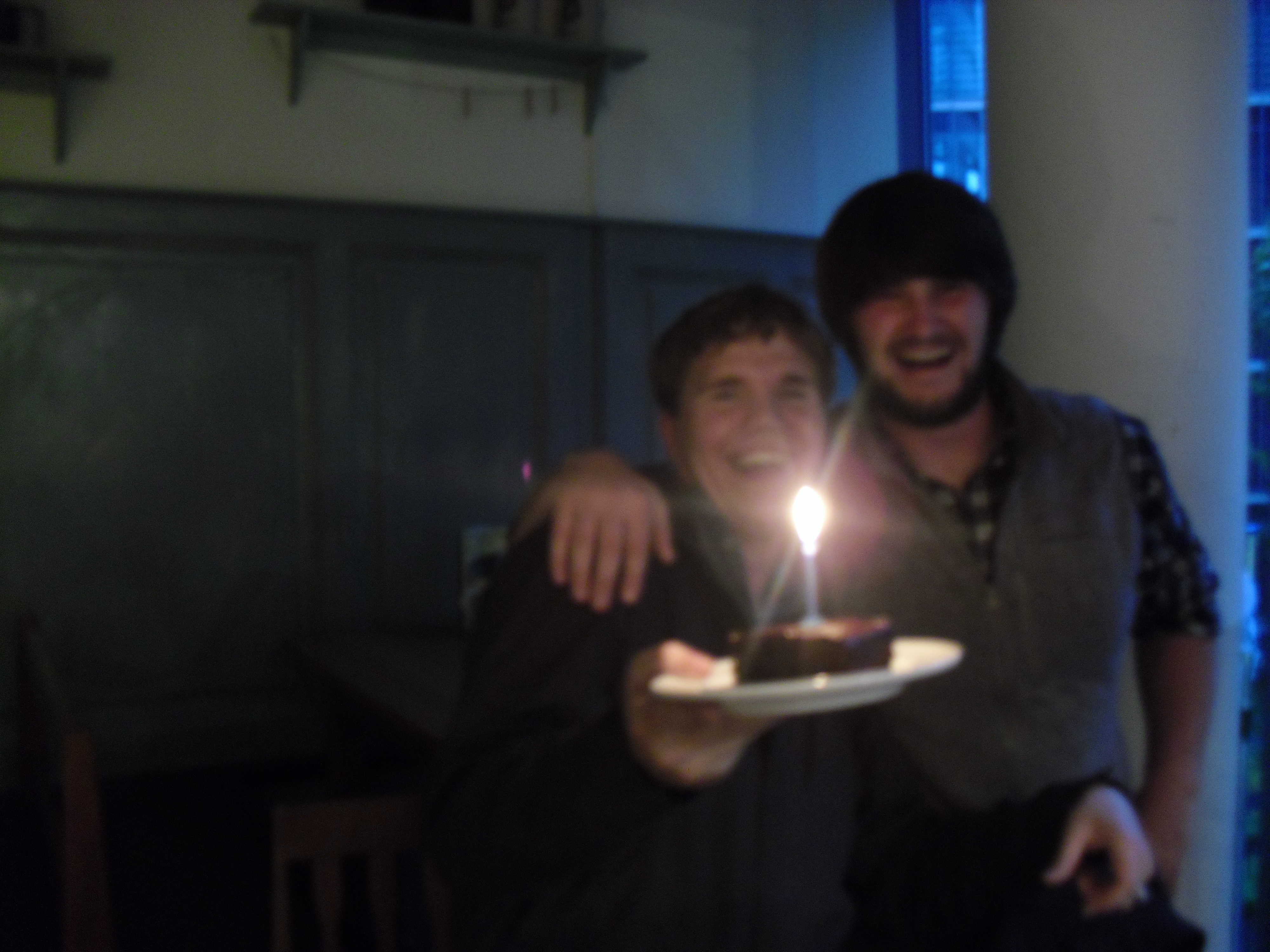
Happy Birthday Ramsey Hardin! By the way, that's David Corrigan photo-bombing te shot. What a goof!

Happy Birthday Ramsey Hardin! And that David Corrigan with him, by the way.

But then a huge surprise came out: the waiter brought Ramsey a piece of chocolate cake with a single blue candle stuck into it, a flame dancing on the wick. It was Ramsey’s twenty-fourth birthday. Boy, did that cheer him up! I wonder what he wished for, though. He probably asked for a big book of history. Ramsey’s a huge history buff, and reads anything about the past. In fact, he was voted “Most Likely To Teach Alexander the Great History” or something like that.

We ended the evening with dessert and a few more drinks, and then I went back to the hotel, to get ready for tomorrow’s flight and to store all these wonderful memories in my head.

And trust me, I’ll have a fun time relating them to you all in the coming months (or until you’re sick of hearing about them). That’s all for now though. Hope you enjoyed the story, my Followers of Fear. I’ll tell another one when I have a moment.