Posts Tagged ‘living and life’

Sorry it’s coming a little late, but you know, my crazy life. And I wanted to watch it taped so I could fast forward through the commercial breaks.

Anyway, I liked this season of AHS much better than Coven last year. In terms of tone it was closer to the first season, though it had some more lighthearted moments than Season 1. Also, the show’s creator Ryan Murphy -incorporated a few musical scenes, so he’s either testing the waters for a crossover with his other show Glee or he’s just trying to keep things fresh. I definitely think it’s the latter. But like I was saying, this is some pretty good horror. Like previous seasons, you can’t tell where the story is going, and no one’s safe from death. Unlike previous seasons, nobody comes back to life or dies twice (shocker!) and the final episode of the season doesn’t just feel like filler with minimal scares to wrap up loose ends, but an actual episode that is kind of terrifying and very entertaining. There are a few loose ends, but I think we can assume what happened based on what happens in that episode.

Also, this is the first season to connect with another season (Asylum), and apparently all the seasons connect, so I’m wondering how they’re going to connect that in upcoming seasons. Minor detail, but it’s important to talk about.

Anyway, back to the review. What I really liked about Freak Show, besides the final episode actually being pretty good, is that the writers were able to tell a really beautiful story about people on the outskirts of society, and while also keeping things scary and interesting. Everyone has their own story, their own darkness, and their own potential to be evil. In fact at several times many characters cross the lines from good folks to villains and then back again. It’s very hard to pin down a central villain, especially during the first six episodes or so. I guess it shows that in an imperfect world, where most of the characters are scared or in trouble with the authorities, you’ll do what you have to in order to survive.

I also like how the story twists and turns, taking us in directions we couldn’t see, and still keeps things within reasonable bounds of imagination. And I loved the guest stars: Neil Patrick Harris and Jamie Brewer as Chester and Marjorie the Doll, Wes Bentley as Edward Mordrake (my favorite minor character) and quite a few others. But the main cast! Whoo, were they amazing. Sarah Paulson playing a pair of conjoined twins and did it so convincingly, I forgot it was acting and CGI! And Finn Wittrock as Dandy Mott deserves an award, playing the most horrific serial killing chameleon I’ve seen outside of Hannibal. And I loved Jessica Lange as Elsa Mars, who is just as evil and as tragic as any character in this show, but with quite the theatrical flare. Plus all the actors playing the freaks! Some actually have certain conditions, others are actors, but all are amazing in their roles.

Finn Wittrock, the man who played Dandy Mott. I hope he comes back for Season 5, he was definitely my favorite actor this season.

The one thing I did not care for is that Twisty the Clown, who appears in the first four or so episodes, is given an intellectual disability and his mental illness as the reason for which he kills. I swear, I’m tired of people with mental retardation being portrayed in these things as serial killers! I’ve known people with intellectual disabilities. At the worst, they can be difficult to handle in a bad mood, but they are normally sweet and kind. Why they’re portrayed over and over this way, I’m not sure. Honestly, the only times I’ve been okay with it is the Friday the 13th and Texas Chainsaw Massacre franchises, but only then. (Please see my article on tropes that need to be retired for more on this subject).

All in all, I’m giving American Horror Story: Freak Show a 4.5 out of 5. Scary, entertaining, beautiful, and a great 4th season for the anthology series with wonderful performances by all the actors in the show. I’m looking forward to the next season (which has been ordered). I hope it’ll be as dark as Asylum. I wonder what they’ll do for Season 5. I heard a rumor that it might be magicians, and there’s reasons to believe that might be it. Other contenders could be a prison season (though that might be too close to Season 2) and one taking place at a summer camp (a favorite of horror fans everywhere). And there’s always the chance of a high school filled with evil, I guess.

Well, that’s all for now. I’m heading to bed. Friday’s a shorter day for me, so I want to be wide awake for it. Goodnight, my Followers of Fear. I’ll try to write tomorrow or the day after if I can. See ya then!

About a week and a half ago, Variety reported that the Ghost in the Shell live-action film, which had been in development hell for years, was underway and had Scarlett Johanssen in the lead after Margot Robbie turned it down. Not only did this impress upon me to actually read the manga, but it excited and angered GitS fans across the world. The former is understandable, but the latter is a bit more complex. Why? Well, the main character of GitS is named Major Motoko Kusanagi, and she’s Japanese. Johanssen, while a great actress, is white. Why didn’t Touchstone Pictures ask any Japanese actresses?

And this isn’t the only live-action adaptation based on a Japanese franchise where Hollywood has looked at only white actors. The Akira film, which once again is in development after many years in and out of development hell, has been notorious for its producers trying to get white actors in the roles of Japanese characters. Justin Timberlake, Robert Pattinson, and Andrew Garfield are the latest names to come up. George Takei has been vocal about this, warning producers they will upset fans and have a repeat of The Last Airbender (an adaptation of the American anime Avatar: The Last Airbender) if they don’t cast Asian actors. Remember the latter film had a mostly white cast, and, although the film was problematic on a number of levels, the fact that the very diverse characters were all played by white actors upset many fans.

And it’s not just films based on anime that has had this problem. Biblical films such as Noah and Exodus: Gods and Kings have received a lot of criticism not just for the liberties taken with their stories, but the fact that while the characters being portrayed would have most likely have been from the Middle East and Africa, the principle actors were all white. And in Pan, an upcoming movie based on Peter Pan, Tiger Lily is played by Rooney Mara, who is white while her character is Native American. Surprisingly, the Peter Pan live musical on NBC last month actually had a Native American actress and tried not to be so stereotypical with their portrayal of Native Americans, which was one of the few good things about that disaster. The 2003 Peter Pan film also cast a Native American actress in the role of Tiger Lily, and that film rocked! Why can’t Pan do the same thing?

And here’s something interesting I’m not sure if other people have noticed: when the Harry Potter films were still being made, the first couple of films had two different actresses, both black, playing Lavender Brown. At that point she was a background character for the films, but once the sixth book came out she had a much bigger role. When we see her in the sixth movie, she’s played by Jessie Cave, who was white. I mean really. The HP universe has already shown that the main basis for discrimination is how pure your blood is. JK Rowling has already stated that gender isn’t a big deal in the Wizarding world, and I don’t think race would be a big deal either. What’s wrong with Ron dating a black girl, even if the relationship doesn’t work out in the end? Heck, Fred went to the Yule Ball with Angelina Johnson, who in the books was black, and after the series she married and had kids with George Weasley.

And why the heck wasn’t Selma in the Oscars this year? I mean, I don’t really care about the Oscars, but apparently this year has only white nominees, and of those most are male. I don’t know why. I saw Selma, and it was powerful and beautiful. Why can’t it get a nomination or two?

I’ve been vocal about how, almost 47 years after Martin Luther King Jr.’s death, this nation is still full of racial inequality, most illustrated this past year in the deaths of Eric Garner, Michael Brown, and quite a few others, the trials that seem to have lead to nowhere, and the protests that have followed them. The many roles where white actors have played characters of non-white nationalities may seem like a small thing, but it’s actually pretty big. The media has a great power to influence millions and millions of people. What does it say when the people who go to movies don’t see themselves in the movies that they go to see? Even in roles where they should be seeing themselves?

I’m not sure what Hollywood’s reasoning for doing all this white-washing. Maybe they like to bank on star power or something. But I think that studio execs are making a big mistake by not including more diverse casts in their films.  TV execs are catching on much faster: TV shows like Sleepy Hollow,  Scandal and How to Get Away With Murder, which pride themselves on their diversity, are tearing up the prime time landscape, Black-ish and Jane the Virgin, which feature mostly black or Hispanic casts, are some of the year’s best new comedies, and SNL has made it a point to diversify their cast members.

And while I’m still working on getting that sort of reach with my books, I like to use diverse casts in my stories when I can, and I think that that’s some of the best parts of my books. In my thesis novel Rose, half the main cast, including antagonist Akira, are Japanese. In Laura Horn, many of the characters are black or Hispanic, and I plan to keep that in the rewrite. And in the Reborn City series, most of my characters aren’t white. In fact, Zahara Bakur, my protagonist, is an Arab Muslim. And if in an adaptation of any of my works, the white-washing I’ve described above was used in the casting process, I’d be very, very upset.

Because that’s not how the characters should be. We want to see characters who look like us. I’m lucky that I see a lot of white characters. Occasionally I see a Jewish character, though they’re either secular or ultra-Orthodox Jews. But what about others? There have only been two black superheroes in the movies these past couple of years, and they’ve been sidekicks to the white superhero. And what about Hispanic or Asian heroes? Where are the Native American characters?

I think Hollywood is making a great mistake in not diversifying their casts and insisting on the big actors. I’m not saying that white actors no longer have roles in movies. But I do think that there needs to be more roles for blacks, Hispanics, Asians, Native Americans, and other groups and ethnicities in Hollywood movies. It’s not a moral thing. It’s because the world is becoming more diverse every day. The media we consume should reflect that. After all, the media reflects the world, doesn’t it? So reflect the world as it is, Hollywood. And that’s a beautifully diverse landscape of many different groups and peoples with a thousand different stories to tell.

So I’m working on Rose, my latest novel as well as my thesis, and I’m working on a chapter that I finished earlier today. However, this chapter was special, because it’s the first of two chapters that take place away from the titular character’s point-of-view. As I’ve mentioned in previous posts, Rose is told from the first-person point-of-view, and it’s told in the present tense, which originally I had difficulty with but eventually became easier with practice. However, as this chapter takes place away from Rose’s POV, I did it in the third-person POV, and I did it in the present tense.

Needless to say, it was incredibly awkward writing. I don’t know many stories that are written in the present tense, and those that I do are written usually in the first-person, like someone is narrating their life (who actually does that, I don’t know, but whatever). I don’t think I’ve ever read one that is present-tense and told in the third-person though. Maybe John Barth’s Lost in the Funhouse, but I can’t remember that one as well, so don’t take my word on that one. Anyway, writing this chapter in such a way is incredibly awkward for me. And I think it shows throughout the chapter, all six pages of it.

Well, my advisor M, my fellow writer/thesis worker P, and I are trying to arrange to meet sometime next week. I’ve already sent the chapter to them, and I’ve already suggested some changes I could make to this chapter in the second draft. I’m hoping they let me keep it in third-person but switch to past tense, as that would be much easier for me to write. But whatever they feel or whatever suggestions they give, I’ll definitely take them into account. They haven’t steered me wrong before, and I’ve learned a whole lot working from them.

In any case, I’m taking the night off from writing. I’m going to do some reading for homework, practice Torah reading for my cousin’s bar mitzvah next month, and if there’s time relax in front of the TV or with a good book. Stay warm and have a good night, my Followers of Fear. I know I am.

Boy, do I owe her so much. Even today, I’m getting so much from her books. I’ve got to read her new novel one of these days.

It’s been a good day for me. Classes have been fun (I almost wish they’d last longer), work’s been going well, and I’ve already finished one chapter of Rose (six more to go!). And I’ve recently gotten another lesson in writing.

I’ve been listening to the Harry Potter audiobooks lately and I’m currently on Book 4 (Harry’s currently dealing with most of the school and his best friend hating him for being the fourth champion. Hang in there, Harry!). This was the series that made me want to be a writer in the first place. And you can get something out of the HP books at any age, I find. But I also remembered something that I’d forgotten about JK Rowling’s famous series: she can build such amazing images in our heads and do them with such few words.

I forgot about that, how every word is picked to be useful and poetic and not a single one seems wasteful. That sort of economic use of words is hard to come by, and she wields words so well in her books. I used to try to imitate that style when I was first starting out (I also was trying to write my own version of the Harry Potter series with a female protagonist, but that’s another story). Sometimes I didn’t use enough words! Though in my defense, most writers under the age of thirteen are very visual and we don’t always consider that our readers might need a few more words to visualize the story in their heads when we can see it just fine in ours.

As I grew up though, as I got better and I started getting published occasionally, I started using more, bigger words. I think that’s common with plenty of writers at many different ages. We want to sound smart, intelligent, eloquent with words. I’ve done it just now! Eloquent. That’s a word a lot of people know, but wouldn’t it just be fine to use “good with words”? And I used “economic” in the last paragraph. How about frugal? Or choosy? Or maybe even thrifty?

And we do it just to make ourselves look educated and verbose (there it is again). Sometimes we worry that our readers will get lost along the way, but we’re too afraid to stop! We’re afraid we won’t live up to people’s images of writers. Is it our vanity or our fears of how people look at us? Is there a difference? I’m not sure.

But I’m listening to the HP books, and it’s so precise with the words. And it’s a good story. Scratch that. It’s a great story (my mother would kill me with Avada Kedavra if I didn’t make that distinction). Maybe because JK Rowling wrote the HP books with kids rather than adults in mind, but she’s never worried about the words she’s using, about sounding intelligent or loqacious (again!). She just puts down the words as is needed.

Have to stop using words like I’m pulling them out of a thesaurus just because they’re big and fancy. It might be detrimental–darn it!

In my Business and Professional Writing class, we’ve been looking at how businesses and corporations and even school districts use lots of big words in order to sound like they’re qualified for their jobs. What it really does is sound like a robot has produced a lot of inpersonal and indecipherable terms (again) and let’s be honest, nobody likes an inpersonal robot, whether in real life or on the page.

It’s a crazy coincidence that it’s all happening at the same time, but JK Rowling and my class are teaching me something: that perhaps all those words are unnecessary, that instead of making me sound intelligent and articulate (trying to stop) they’re making me sound less like a person and more like a machine. And even though I do a great impression of a Cyberman, I’d rather not be mistaken for a robot.

So I’m going to try being less long-winded, switch to simpler words and get my point across in half the time. Heck, it might help me finally get a short story written in less than forty-five hundred words, something I’ve been trying to do for ages. And maybe it’ll make for a better story overall. We’ll see what happens.

For the present though, I’m certainly exhausted my patience for the overuse of ample language in the pursuit of resplendent storytelling and will henceforth cease such unreasonable actions for the betterment of my vocation and for the beneficial enhancement of my readership.

I’m done.

A picture from the Ohio State Fair, which was a big influence on my own “State Fair”.

Well, it took me a day longer than I wanted it to, but I got it done. This is my final short story for winter break, and I got it done. This one’s called State Fair, and it’s about a ghost haunting a state fairgrounds who becomes infatuated with a girl he sees one day. It’s different than some of my other short stories, very literary but also very ghostly. I also think that this short story’s first draft is much better than my usual first draft, and I wish I could have submitted this one to my creative writing class to critique. I think they would’ve liked this very much.

From the moment I had the initial idea for this short story, I knew this one was different, that it was special. It’s probably why I decided to work on it over winter break. I also got to integrate many of the lessons I got from last semester and from some books I’ve been reading recently with this story, which I think might have contributed to the quality I feel this first draft has (though I still can’t keep a short story under forty-five hundred, it seems).

I’m still deciding what to do with this short story. My ultimate goal for State Fair is to submit it to a contest on campus for short stories. The deadline’s in mid-February, so I have a little time to edit and maybe get another person to take a look and give me some feedback. I got an honorable mention for my submission last year, so I think that this year I’ve got a pretty good chance with State Fair. Whatever the case, I’ll keep everyone posted and let you know how it goes.

In the meantime, I’m watching my beloved Ohio State Buckeyes take on the Oregon Ducks, and I want to see how this game ends. Tomorrow I get back to working on my thesis Rose, with the hope of getting that done by late February. I’ll keep everyone updated on what i’m doing and how things are going. Wish me luck and have a goodnight, my Followers of Fear.

I’ve mentioned several times on this blog that I do a kind of meditation called Sahaja Yoga, and I have to say, it’s been an amazing influence on my life. Not only is it really relaxing, but it’s invigorating and I feel calmer and more balanced and focused after meditation (though nothing can ever seem to take away my wild, silly side). And, during the three years I’ve been meditating, I’ve been given a lot of ideas for stories or on how to modify stories that I’ve been having trouble with.

The first time this happened was after I started learning Sahaja Yoga. I was having trouble trying to figure out this short story I was working on and make it flow as a story. I knew something was missing, but I couldn’t figure out what. At one point I just sat down, started meditating for five or six minutes, and then went out for a walk. During that walk I felt much calmer and more open minded, and I found a way to make the short story work. I went home and finished the short story within the week.

It’s been like that a lot since then, especially during classes on Sundays. I’ll meditate and while I’m cleaning chakras and relaxing, my mind will go into a very different state, in which ideas just come much more easily to me. It’s amazing. Today, I was having trouble figuring out which direction to to go with this short story I’m working on, and I was hoping that today’s class would help me figure out where to go with this story. I put myself into a meditative state and let my mind go. And about ten, twenty minutes into the class, I had it. I knew how to make this story work. And after we finished the meditation, everyone looked very happy to hear that I’d had my idea (everyone in the class is very supportive of my career, and one woman has even read all my books and reviewed one of them). I also had four other ideas for stories today, which is a bit more than usual (don’t know if they’re all related to my class, but I like to think they are).

Why does meditation make me so much more creative? Like hypnosis, meditation puts you into a different state of mind that helps you unwind, relax, and sometimes make you a bit more suggestible. I think that state of mind allows me to hold onto passing thoughts and twist and turn them into workable ideas for stories. In any case, usually after meditation I’m pulling out my little notebook and writing down my ideas, making Sunday one of my more creative days of the week.

Whatever the case, there’s no doubt that, in addition to all the other benefits of meditation I receive, Sahaja Yoga definitely makes me a much more creative person and gives me several more ideas for interesting stories. I never know when I’ll write any of them (that’s how many stories I have and how busy I am trying to get through just one story at a time), but it definitely means I’ll never run out of stories. And it’s another reason why I won’t be giving up meditation any time soon.

Well, that’s all for now, my Followers of Fear. Tomorrow’s the first day of classes, so I’m going to finish up and call it  a night. I’ve got a busy first day (2 classes, a shift at work, and a phone conference, plus Buckeyes take on Oregon tomorrow night. Go Bucks!) so I have to get as much sleep as possible if I’m going to get up tomorrow and take it all one with my usual chipper temperament. Wish me luck, and goodnight, my Followers of Fear!

A while back I posted on character tropes and cliches that needed to be retired from literature. Some of my Followers of Fear thought that maybe the trope of “The Chosen One” could stand to be retired. I’ve been thinking about this since I wrote that post, and I thought I’d discuss it in contrast to what I call “Someone Who Grows Into a Hero.” If I had another name for that character trope, something a bit shorter, I would use it. Maybe I’ll think of one in the course of this post. Or maybe you’ll give me one (please?).

So, let’s talk tropes. The Chosen One is, in essence, a character who is basically chosen by some higher power–God, Fate, some powerful wizard, the President, the Force, that kooky neighbor down the street, etc.–to take on some great evil and defeat it. Sometimes this choosing takes place pretty early in life, sometimes years or ages before the Chosen One’s birth. A good example is Harry Potter being chosen to defeat Lord Voldemort (funnily enough, I’ve been listening to Harry Potter audiobooks while I’ve been working lately. Already on Book 3. You can always get something new from these books no matter your age, I find). It’s been used hundreds and hundreds of times throughout history, since possibly before the Greeks and Romans started telling stories involving oracles.

Now, this trope has a good reason for being used so much. The character who is the Chosen One–usually the protagonist–is usually a good person, selfless, kind, somewhat charismatic. They’re often presented with insurmountable odds, but through their own ingenuity, goodness, and the help of their allies they overcome and become victorious. We want to be that person, who is good and destined to be great as well, to save everyone and to have the best group of friends around them. To be a messianic or godlike figure.

However, there are some problems with this trope. For one, it’s been used so much that we know it by heart. Harry Potter, Eragon, Mila Kunis’s character in Jupiter Ascending, Gregor the Overlander, Emma Swan, Anakin Skywalker/Darth Vader (with Luke’s help, I guess), Neo, Buffy, Po the Panda, Thomas from The Maze Runner and many, many more. These characters are everywhere. And they seem to all have similar personal stories. They grow up in simple circumstances–programmer, abused nephew, farmer, teenage girl, etc.–but are thrust into extraordinary circumstances that change their lives and center events on them. They’re told they’re special, that there are things that only they can do. At first they might be reluctant, or not have the confidence to do what they are told to do. But as time goes on and they somehow make it through the most dire circumstances, they become confident and settled in their roles, and they do end up destroying the ultimate evil (except if you’re the Slayer, in which case it never ends) once all is said and done.

trelawney 1

These sort of stories also say something about how the universe works, namely fate vs. free will. In some circumstances, the way these stories work is that no matter what, the Chosen One is to win against the ultimate evil. So personal choice isn’t a factor. The universe must work to get the Chosen One to win. Remember when I said I was listening to the HP audiobooks? In the 2nd, when Harry stabs the diary, and I remember this clearly, Harry doesn’t think when he sees the fang and the diary. He just acts. Perhaps the universe intervened so that Harry could someday take on the full mantle of his destiny? And in the case of Buffy, no matter how much she tries, the duties of a Slayer force her back into the world of darkness and away from anything resembling a normal life. The universe (or the writers) seem to have no care for Buffy’s choices, apparently.

So the problems of this trope is not only that it’s overused, but that it’s predictable, and that it takes the freedom of choice out of the equation to a great extent, sometimes even totally. There are ways to change up the trope, but it’s rarely done. Katniss Everdeen could be considered a slight variation on the theme, as she kind of stumbled into the role of Chosen One by an act of defiance, but from that point on her life is controlled by others. Heck, even Peeta manipulates her by forcing her into the relationship and pregnancy ruses. Still, I’ve been open about my disdain for the Hunger Games trilogy, so I’ll say it’s not the best example. I’m trying to think up a better one, even if I write it myself, so I’ll let you know if I think of (or write) something.

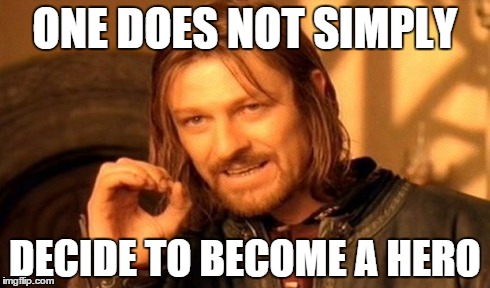
The other trope is the Accidental Hero trope (I did find another title for this trope). This is one I like a bit more, because you can do so much more with it and there’s a growing number of examples of this kind of character. This is a character who, rather than by fate, is made a hero through circumstances and their own choices. They may not be hero material, they may not want to be heroes, they may rather go home, but they rise to become heroes by their own merits. For example, Nathaniel from the Bartimaeus books wasn’t chosen to be a hero, and never set out to be a hero. In the first book, he was seeking revenge for personal reasons, the second book he did it because of his job and because of political reasons. In the third book he does it after a lot of self examination and because he’s scared of the demon uprising.

one does not simply 1

Another example is Teen Wolf (the awesome TV series, not the very bad 80’s movie). Scott McCall became a werewolf by accident, and because of the threats to his family, friends and his town, he has to rise to become a hero and save the day. No fate, no gods, no prophecies. He becomes a hero (and later a very special form of werewolf) because his personality, the events in his town, and his love for the people close to him mold him into a hero.

And there are many more examples. Chuck from the titular series never asked for the Intersect, and he wasn’t supposed to have it. It could’ve been taken out ages ago. But he chose to keep it, use it for his friends, and save the people he cared about. Through that he becomes a spy and a hero. In Doctor Who, the Doctor only wanted to travel and see the universe. He is a hero of his own choice. Lelouch Lamperouge from the anime Code Geass received his powers through luck, and later chose to use them for his own ends and to get his revenge (more antihero I guess, but whatever). It’s a trope with a lot of wriggle room in it, and even better, it’s still underused, unlike the Chosen One trope. So perhaps many more authors should write less Chosen One stories and more Accidental Hero stories.

Of course, there’s no way that this post will cause less Chosen One stories to be written. For better or worse, that trope is popular and will stick around for a long while. Still, I’m hoping for more Accidental Hero stories. I figure most of my stories will feature them. Reborn City and Snake‘s protagonists become heroes (or in the latter’s case, antiheroes) through choice and circumstance. Heck, I might try and find ways to subvert the Chosen One trope while writing Accidental Heroes. We’ll see what I can do.

Which trope do you prefer? What’s your favorite example?

What is a way that one could change either trope so that either one could be a bit more original?

I’ve been meaning to do this post for ages, since I wrote the first one nearly a year ago. Well, better late than ever. Also, I needed time to find out some more secrets about my beloved alma mater. So I took the time, and I got what I was looking for. Here are two secrets you probably didn’t know about The Ohio State University, courtesy of one of its stranger students (they’re still proud to have me though).

Jeffrey Dahmer is an alum of OSU. Didn’t see that one coming, did you? Yes, the serial killer who killed and ate the male lovers he brought home was an alum of Ohio State. Well, not actually an alum in the traditional sense. He was only a student for one quarter. He was kicked out after missing most of his classes due to his excessive drinking. Still, he went here for a little while, and some have never let the university forget it. In fact, I think a couple of years ago they showed a documentary about Dahmer at the nearby movie theater. Wish I’d gone, now that I think about it.

The Vietnam protests made OSU a more open campus. This is another thing the Ohio State big shots would rather people forget about, but my American history teacher from this past spring, who is also an alumnus of OSU, thought it would be good for us to know. So I’m passing it on to you.

Back in the sixties, there was a huge protest movement against Vietnam at Ohio State, just like at many other universities across the country. At that time, Ohio State had a fence around its campus, so that people could only get in from certain places. During one protest, the OSU students went to the gates and closed them from the inside so that the faculty and staff couldn’t get in and do their jobs, effectively shutting down campus. The National Guard was called to open campus back up again, with mixed results if I remember correctly.

There was a summer break, and when students came back in the fall, OSU didn’t have gates or fences around campus anymore. So remember kids, you can change the world around you. It might not be in the way you expect, though.


That’s all for now. I’m getting to work on a short story now, so I’ll get right on that. Have a good day, my Followers of Fear.

Double, double. Toil and trouble. Fire burn and cauldron bubble! Mwa ha ha ha!

I’ve just finished the second draft of The Murderer’s Legacy, which I’ve renamed Miranda’s Tempest (after trying Miranda’s Retribution and Miranda’s Reprisal). This is the same short story I had a breakthrough on Christmas after having a lot of trouble trying to figure out how to fix that one since I wrote the first version back in May. It took me a couple of days, but I got it done. This draft is about forty-eight hundred words long, it seems I can never get a short story done without it being over 4,500 words.

A lot has changed from the original draft and the second draft. The original was set in a magical version of Victorian England, was complicated and cumbersome, and my protagonist wasn’t enough of an asshole like I wanted to portray him. This version makes magic the result of one person, and my protagonist is a total asshole, like I wanted. Plus I got to add in William Shakespeare’s The Tempest. Can’t complain about that.

Like all my short stories, it could stand some editing. A lot of the story involves flashback and exposition, and I’m worried that might be less in the story’s favor than I think. We’ll see what I can do. I’m hoping that I can get a few people I know to take a look at it before I edit it, maybe get some feedback. There are a couple of fantasy magazines that I think could be interested in this one if I can polish it up a bit.

In the meantime, I have one more short story I’d like to get done before I get back to working on Rose. It’s called State Fair (might change it to The State Fair later on) and its about a ghost haunting a state fairground who becomes infatuated with a girl attending the fair one day. I’m hoping to submit it to an annual short story award they have at Ohio State every year. It’s the kind of thing they tend to like, so I’m hoping they’ll go for it. But first I have to get it finished. In fact, I’m going to start working on it now, and also through tomorrow if I can, I have the day off tomorrow so I shouldn’t have any problem working on it then.

Well, that’s all for now. Have a good night, my Followers of Fear. I certainly am.

Well, it was bound to happen. It’s been a long time coming. I’m not surprised that it’s here. I’m actually looking forward to it ending (provided that I have some sort of job by the end of it all). But still, it’s pretty amazing that I’m here. My last semester as an Ohio State student.

I’m going into this coming semester, which starts a week from today, with a lot of emotions. Hope for a variety of things to happen, as always. A tiny bit of nervousness about my grades, though that’s expected. Excitement that this’ll be my last time around this block. Fear that I won’t find a job before the semester is over (God forbid). Impatience over just wanting to get it over with. At least I’m not feeling the apathy of senioritis. Or maybe I am but I don’t realize it. Can you have senioritis if you know you still have to work very hard to get good grades and still intend to?

Going to try my best not to become this guy.

Anyway, I’m taking three classes this semester, something that I haven’t done since my first year at Ohio State when we were still on the quarter system. Normally I’d take four to be considered a full-time student and receive financial aid, but my English advisor and my thesis advisor got together and changed how much my thesis counts for credit so I can still be considered full-time. I don’t mind; I get a bit more time during the day to work on my thesis Rose and maybe watch a little television in the evenings. And after this past semester, with five classes and a thesis to work on, I could use the rest time.

I have some very interesting classes this semester. First is a Restoration and 18th-century British literature course, which should be challenging in a good way. I don’t normally care for stuff written in that time period, but I’ll give it a shot. I might even grow to like some of what I read and use it in a future story. I’m also taking a Business and Professional Writing class, which I hope might be useful when I get a job. This class is being taught by a teacher I’ve had before and whom I absolutely love because she’s such a funny and sweet woman. Plus she’s a huge science fiction nerd, including Doctor Who (her husband actually saw the very first episode in 1963 and knew right then and there it was something special. Maybe he had a time machine too).

Those two courses will fill out my English major. As for my History major, I just have one class left, and I have to say this one will make for a great last course. It’s History of Witchcraft in Medieval Europe, which is a new course and is being taught by a new teacher. As soon as my History advisor, who knows of my writing preferences, mentioned it to me, I was like “Sign me up!” You can bet that something I learn in that class might make it into a future short story or novel. My dad and one of my friends though are concerned it’s a how-to course. They need not worry; I already know how to do all that. Mwa ha ha ha!

As for my thesis Rose, I’ve seven chapters left to write, and I hope to get back to working on it by Monday next week. Right now I’m working on two short stories, one of which I hope to submit to a short story contest held every spring in the English department, so I want to get those done first. But I’m hopeful that when I do finish Rose (and I’m hoping that it’ll be done by the end of March at the very latest, though I’m aiming for late February), I bet it’ll be great. I just hope my advisor and the people who read it prior to my thesis argument think it’s great as well.

At Ohio State, graduation takes place in the Ohio Stadium. I’m looking forward to it. More on graduation as time goes on!

Well, that’s all for now. I’ll update you on how the semester’s going about eight weeks in, when it’s halfway over. I’m hoping that I’ll have some good grades and maybe I’ve finished Rose by that point. We’ll just have to wait and see! Wish me luck, my Followers of Fear. To make sure I graduate on time, I might just need it.