Posts Tagged ‘mystery’

If you live in the English-speaking world and you pay any attention to scary stories, serial killers, or England, you’ve probably heard of Jack the Ripper, whose legend has become so great that sometimes it’s hard to tell what’s fact and what is fiction (and it blends more often than you think). If for some reason you’ve been living under a rock, here’s a quick overview of Jack the Ripper (even if you’re familiar with the Ripper legends, you might want to read this for a little refresher):

Jack the Ripper was the name given to a supposed killer who operated in the impoverished neighborhoods of Whitechapel and the surrounding areas in 1888 London. It is believed he killed and severely mutilated the abdomens of five women, all prostitutes, as well as possibly killing several more women. The killer gained his now-famous name when a letter, now called the “Dear Boss” letter, was sent to the Central News Agency of London, signed “Jack the Ripper” (whether the actual killer sent this letter and others is up for debate). The press  sensationalized the murders and anything even remotely linked to hte murders, and hundreds of people sent in letters claiming to be the killer (some people are really hungry for fame and attention). However, Jack the Ripper was never caught, and his identity has become one of the greatest mysteries of our modern era.

Almost immediately after the murders, Jack the Ripper became a household name and legend, appearing in numerous works of fiction over the years and becoming a sort of boogeyman for the masses. For numerous years, anything having to do with the Ripper would terrify Londoners and call out the police to investigate. And even today, authors (and more than one or two killers) have been inspired by the Ripper murders. In fact, it seems that at least one book a year is released offering a new story or fresh insight into the identity of Jack. People who dedicate themselves to trying to solve the Ripper mystery are known colloquially as Ripperologists.

One such Ripperologist, businessman and “armchair historian” Russell Edwards, claims in his book Naming Jack the Ripper to have finally figured out the killer’s identity through…DNA evidence?

Mr. Edwards book, claiming to have “definitively” identified the Ripper through DNA evidence

Apparently Edwards owns a piece of evidence from the original murders: the bloodstained shawl of Catherine Eddowes, one of the “canonical” Ripper victims, which he bought at auction a couple of years ago. According to his book, he was able to extract usable DNA from the shawl and have it analyzed by a professor in molecular biology at Liverpool John Mores University. Said professor managed to extract not just blood, but semen from the shawl and isolate DNA from his samples. The blood was eventually matched to Eddowes through a descendant of hers, while the semen was matched to Aaron Kosminski, a man suspected at the time of possibly being the Ripper, through one of his direct descendants.

On the surface, this could be credible. Kosminski, a married Plish Jew who emigrated to London with his family to escape the pogroms in Tsarist Russia. He lived in the area where the murders took place, and he was committed to Colney Hatch Lunatic Asylum in 1891 for paranoid schizophrenia, later transferring to another asylum where he died in 1899. However, there is good reason to suspect he might not have been the killer.

Aaron Kosminski, one of the main suspects of the Jack the Ripper murders.

Setting aside how amazing it is to get any workable DNA off a 130-year-old shawl and that the DNA results still haven’t been peer-reviewed by any scientific journal, Catherine Eddowes was a prostitute, so it wouldn’t have been unusual for her to have some semen on her, especially if it was from a man who happened to live in the neighborhood she worked in. And there’s also no evidence to suggest that Kominski killed her or anyone else. We lack a working timeline or any forensic evidence to possibly implicate Kominski or anyone else.  And Kominski himself, although mentally disturbed, was mostly harmless: except for two incidents while incarcerated in the asylums he lived in, Kosminski was mostly harmless. Indeed, some believe he may have been confused for Nathan Kaminsky, also known as David Cohen, another Polish Jew who was himself sent to Colney Hatch in 1888 a month after the last Ripper victim and was said to be violent and antisocial during his short stay in the asylum (he died in 1889).

The truth is, while this DNA evidence may tell us that Kosminski availed himself of Eddowes’ services prior to her death (as did  probably several other men who could all possibly be the killer), we are no closer to identifying Jack the Ripper than we were 130 years ago. Such is the case with famous serial killers who, due to time or design, have left little or no evidence behind of their murders. And that’s even if there is a killer to begin with (some have argued that some of the “canonical” Ripper victims may have actually been the work of other killers, and that maybe only three of the murders, if any, are related).

But you know what? Maybe that’s okay. A good chunk of the appeal from Jack the Ripper is that he’s unknown, that he could be a polish Jew, a surgeon, or even a member of the Royal House. And that means that there’s room for many more generations of Ripperologists and fans to come up with their own theories and stories about who Jack the Ripper is, why he killed, whom he killed at all, and where he ended up. And maybe someday someone will truly, beyond the shadow of a doubt, solve the identity of the Ripper.

Until that day, he’ll stay among the many famous serial killers whose identities are unknown, such as the Zodiac Killer, the Alphabet murderer, the killer of the Black Dahlia, the Servant Girl Murderer, the Axeman of New Orleans–God, how messed up is it that I know all this?

[Thanks to the Huffington Post for most of the information for this article as well as quick references on Wikipedia.]
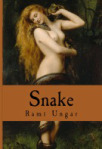
snake

I’m going to be perfectly honest: I nearly jumped out of my chair when I saw Snake had its first review. The only reason I didn’t was because my computer was in my lap and it’s not even six months old yet. It’d be a pain in the butt to get it fixed because of some well-deserved excitement.

Anyway, back on point: Snake received its first review, from fellow author and dear friend Angela Misri, who helped with the editing and sprucing up of Snake prior to publication. She named her review If you LOVE to be scared, you should read this book, and gave Snake four stars out of five. Here’s what she had to say:

Rami Ungar makes a promise to (the reader) in all his writings: he WILL scare you, and if he does “his job is done.” Snake will scare you. I am a huge Stephen King fan, so this should give you some idea of my tolerance level for gore, death and mayhem – I was scared. Rami takes you into places you would never have believed possible, and manages to pull his hero (and eventually his heroine) out of them against all odds. If you like to be scared. If you LOVE to be scared. You should read this book.

Okay, any review with me and Stephen King, and even being scarier than him, makes it onto my list of favorite reviews of all time. And I’m glad you found it terrifying, Angela. There were times I wanted to hold back on how terrifying to make the story, and I’m glad I didn’t. And I’m glad you gave Snake such a strong recommendation. Coming from you, it is a really huge compliment.

If you would like to read Snake after reading that review, you can check it out on Amazon, both in paperback and in e-book (which until the 7th is on sale for $1.99, so now’s a great time to get it). If you do decide to get Snake and end up reading it, please let me know in a comment or in a review on Amazon what you think. Good or bad, I love feedback, and I would love to hear yours.

And while you’re at it, you should also check out Angela’s book Jewel of the Thames, which I’ve reviewed here. It’s a great mystery in the style of Sherlock Holmes (in more ways than one), and great for mystery lovers. Check out her blog for details, which I’ve left a link to above.

That’s all for now, I’m off to get some more writing done before the evening’s done. Have a good night, my Followers of Fear.

I was very excited to read Angela’s first book (you should read my interview with her back in late March) and I’m sorry it took me so long to get through it. Now that I have, I have to say I had a lot of fun reading the first book of the Portia Adams adventures.

Jewel of the Thames is three stories (or “casebooks”) in one book, each detailing a different case young Portia Adams, a young woman with an inquisitive eye and a thirst for knowledge who moves to London from Toronto upon inheriting a very notorious property from some very distinguished ancestors. When she gets to London with her guardian Irene Jones and moves into 221B Baker Street (yes, you read that address right), she soon finds herself getting into some very interesting mysteries, each one more thrilling than the last, and all will have you scratching your head till the last page. Of course, the most interesting mystery will turn out to be Portia’s ancestry, and its resolution at the end of the book will leave you stunned. Or at least it did me, and I had an inkling on how the story would end.

I only had a few critiques on the story. One is that a couple of moments in the story, Angela uses more telling than she does showing. That’s not a huge problem, but I thought a little more showing would make the scenes a bit more real to me. Also, I would’ve liked to see more delving into the lives and personalities of the other characters, even those that only showed up for one or two pages. Portia’s the most developed of all the characters, and I’d like to know more about Constable Brian Dawes, or about Sergeant Michaels and Mr. Archer, or even that snooty girl from Portia’s class at Somerville (I’d love to see her mentioned in a sequel! Imagine if they became friends).

All in all, JotT is a wonderful book for mystery readers looking for an exciting new read and especially for fans of Sherlock Holmes stories, earning a 4.5 out of 5 from yours truly. I can’t wait to read the sequel.

Some of you may be acquainted with Angela, or have heard me gush over her awesome feedback to my novel Snake. But did you know that Angela’s first novel, Jewel of the Thames, has just been released (I’ve already got it on my Kindle)? When I heard about it, I was so excited for her, and I got the chance to interview her before JotT came out.

Angela was born in London, England, but currently she lives in Toronto, Canada with her family. She has been writing for a number of years, most notably for CBC Radio as a journalist. She also does freelance and digital projects on the side, but currently she’s been devoting her time to the Portia Adams books she’s been writing (last I checked she’s got around eight or nine casebooks in the series).  She is a fan of mysteries, Doctor Who, and most stuff Sherlock Holmes (but not Elementary).

RU: Hello Angela, it’s a pleasure to talk to you. Give us an idea about what Jewel of the Thames is about.

AM: Sure Rami: Jewel of the Thames is the first book in a series of stories about aspiring detective Portia Adams. It is also an homage to my favourite detective novels – the Sherlock Holmes books, the Nancy Drews, the Hercule Poirots. All of the books I read from childhood till now, and all the great authors who inspired me to create this character. So far in this series, I have written ten casebooks – cases that Portia has taken on – and the first three make up Jewel of the Thames.

There is a lot that had to happen in the first book – Portia needs to find out what her link is to the property she has inherited in London, and she needs to start standing on her own. The whole book is three casebooks wrapped in a mystery driving towards a big reveal at the end. You’re gonna have to read it to find out what the heck I’m talking about.
RU: Considering my level of confusion and intrigue, I will. Now tell us a little about your protagonist, Portia Adams. Who is she exactly?

AM: Hmm, what can I tell you without spoiling it? She’s a 19 year old Canadian who at the very beginning of the books loses her mom, leaving her a poor orphan in 1930s Toronto. It is at the reading of her mother’s will that she discovers she has been left a mysterious property in London and that she has a guardian – Mrs. jones from New York.

Portia is an intelligent introvert who has always preferred books and quiet to social situations, she loves school, hates fashion, often forgets to eat and has no friends. This is partially because she’s viewed as odd and anti-social despite her mother’s best efforts. Her overwhelming curiosity leads her to what interests her rather than what others are focused on, and gives her a focus most don’t understand.
She’s tall and slim, with dark brown hair which she wears unfashionably long and usually in a bun, with startling blue eyes. Feel like you know her a little better?
RU: Maybe just a bit. What do you say your writing process is?
AM:  write long-hand in Moleskin notebooks, so for Jewel, my writing time was my commute back and forth to my full-time job in downtown Toronto. So for 30 minutes in each direction on transit twice a day I would write about Portia Adams, ignoring the smells, sounds and closeness of the Toronto Transit crowd. As a result, I have about 30 Moleskin notebooks filled with my handwriting in lots of colours detailing Portia’s adventures.

Angela and her moleskin notebooks

RU: Wow, that kind of writing schedule requires tenacity. What do you think will draw people to Jewel and to Portia?

AM: Hmm… I guess the same things that drew me to her – a young female protagonist who is learning to stand on her own – I find that premise compelling. Her relationships are part of what make her the woman she is, and as those develop I think she will become an unforgettable character, as will the recurring characters around her like Brian, Sergeant Michaels and Mrs. Jones. That’s how I feel about her at least, I find that even when I’m not writing about Portia, I’m thinking about her. I’ve got a bit of a WWPD mentality in my own life, so that when things happen, I often think What Would Portia Do?

It doesn’t hurt that the setting is London in the 1930s, a really interesting time in history between the two great wars and smack in the middle of the great depression. I hope that people come to care for Portia, because I know from my own experience as a reader that a connection with the characters is key. I guess I will be looking for that kind of feedback from book 1 as I get into the editing phase of books 2 and 3.
RU: Speaking of Books 2 and 3, are you going to continue writing and editing on the bus to and from work, or have things changed since you found out Jewel of the Thames was going to be published?

AM: Things have indeed changed, but actually before I got my contract for Jewel. Last June, after I finished writing the third book in the series, I decide it was time to concentrate my time on this part of my life. I’ve spent the past 14 years working as journalist for the CBC, I think it’s fair to try ‘something else’ for a while.

So I work from home now as a freelance journalist and so far I’m loving it. I try to write a few hours every morning (in the series on book 4, blogging, research) and then spend the afternoons working my freelance contracts. I think I’ve hit a rhythm that works for me, so we’ll see how it goes.
RU: I’m glad it’s working out for you. And you know, I feel kind of bad, because I forgot you were also a journalist for the CBC. How did you get into writing and journalism in the first place? What inspired you to go down that path?

AM: (Laughs)  Don’t feel bad about that! But to answer that question, I’m going to steal from the bio I wrote for my publishers last week:

“Everything changed for young Angela Misri one spring day in 1992 at an assembly in the gym where, as per usual, she was giggling and whispering with her friends in the audience. Suddenly her name was called by the Principal of the school and she was jostled out from the safety of the herd and to the front of the room. Having not really listened to the preceding speech, she was shocked to learn that a poem she had written as part of a school assignment had been published in an anthology of like-quality poems by Canadian children. The Principal smiled the biggest smile she had ever seen on a teacher, and handed her a copy of the coil-bound anthology, turning the young poet towards the audience of her schoolmates and starting the applause that followed her back to her safe haven between her best friends.
That was the moment when Angela discovered that despite being of Indian descent, there were in fact other options for your life’s work than medicine or engineering.”
So there you are! That was the moment for me, and I’ve been writing ever since. I wrote my first book when I was your age, Rami. It’s a historical fiction called ‘Savitri’ and it’s sitting upstairs in a binder. The only other copy is on a floppy disk (no, I’m not kidding, that’s how long ago it was since I was your age ; ) . I haven’t read it in about 15 years and I will admit, that I am scared to. I’m worried that the vision of the story (which I still think is the best I ever wrote) will not live up to reality.
RU: That’s a problem that a lot of authors face when they think of their early stories. So how did you come up with the Portia Adams stories?

AM: It was after reading the Stephen King short story called ‘The Doctor’s Case’ that the idea for Portia came to me. If you haven’t read it, I suggest you do, it’s one of my favourites. As the title suggests, its an original Holmes-Watson story with a twist – Watson solves the case before the great detective. I loved that idea, and Portia started to form in my mind as a kind of homage to King and Conan Doyle.

The first case I wrote jumped straight into the jewel thefts and was over in less than 12 thousand words. I read it over a few times and realized that if this was going to be more than a short-story, I need to write some backstory for my detective. So I went back, created a beginning for Portia, and did a whole bunch more research into the time period, the whole family tree of Holmes, Watson and many others from the original canon. Once I had expanded Portia’s world to about 20 thousand words, I had the idea for the third case in the book – the one that happens on the train. I wrote that in two days and then, rereading it, decided I needed another case between the jewel thief and the train story because she was moving around too much. I felt she needed more time to get to know London and to get comfortable with her new College, so I wrote the casebook I called “A Case of Darkness.”
RU: What’s next for you?
AM: Wonderful, an easy question! I have written books 2 and 3 of this series already, so my next steps are to edit the heck out of them for my publishers and get them into production! I have also started a new dystopic novel that I’d like to carve out some time to write.
RU: Ooh, that sounds interesting. Now just a couple more questions. First, how have your family and friends reacted to the news about Jewel?

AM: They’re very excited but not really surprised. I guess it’s normal for me to be the most nervous about putting my work out there (since it’s mine) but most of my friends and family told me it was just a matter of time before I would get published. I don’t know if they were just saying that to be supportive, but I was no where near as confident. Now that it is really happening and there is a date when a physical book will be available in stores, their excitement has doubled. Seriously, I have the most supportive network – and that includes this blog and you Rami!

RU: I’m happy to be a part of that network, and I’m glad you’re a part of mine. Now here’s a fun question: if some big Hollywood producer came up to you and said they wanted to make a movie or TV show about Portia, who would you want to play the characters?

AM: I LOVE this question as you well know, because I’ve spent too much time thinking about it.

So I would love Katie McGrath (of BBC’s Merlin) to play Portia. I think she has the right balance of beauty and bark that my detective needs. I believe Jensen Ackles (of the CW’s Supernatural) would make a kick-ass Brian. And I think Irene Jones would benefit from the beauty and wit of someone like Lynda Carter (original Wonder Woman).
RU: Since I don’t know who those people are, I’ll take your word for it that they’re perfect for the roles. Final question: If you were stuck on a desert island and could only take three books with you, what would those books be?
AM: Hmm.. I guess Stephen King’s The Stand, Tolkein’s The Two Towers, and Conan Doyle’s Complete Adventures of Sherlock Holmes. If I had a fourth option I’d have to take an Ann Rice. Can I please take my iPad instead Rami? I’m going to need more books than the average human.
I’d say yes, but there’s the question of charging it when the battery gets low. And the lack of a Wi-Fi network. Anyway, thanks for joining us, Angela.
If you would like to find out more about Angela, you can find her on Facebook, Twitter, Google+, and Pinterest, as well as on her blog a Portia Adams adventure.