Posts Tagged ‘WWII/Holocaust’

Yesterday was the second day of Rosh Hashanah, the Jewish New Year. I had the day off, but unfortunately no one could take me to the chaplain’s house that day, and while I tried to go to the nearest synagogue, I couldn’t find it even though it should’ve been in front of me (I found out later from the chaplain that you have to walk into the building where it should’ve been to find it. Otherwise it’s hidden behind businesses. Not sure why that is, but I’ll go with it). So with the day off and nowhere else to go, I decided to do what I promised to do my first week in Germany, and go explore some more of my temporary home.

If you head down to the Marktplatz on a Tuesday afternoon, certain areas will be busy while certain areas won’t be. The main plaza was pretty empty save for some pigeons, while further back you’ll find plenty of people strolling and shopping. It was into these back alleys I went, armed with a map and a general idea of where I was going. Needless to say, I got turned around more than once.
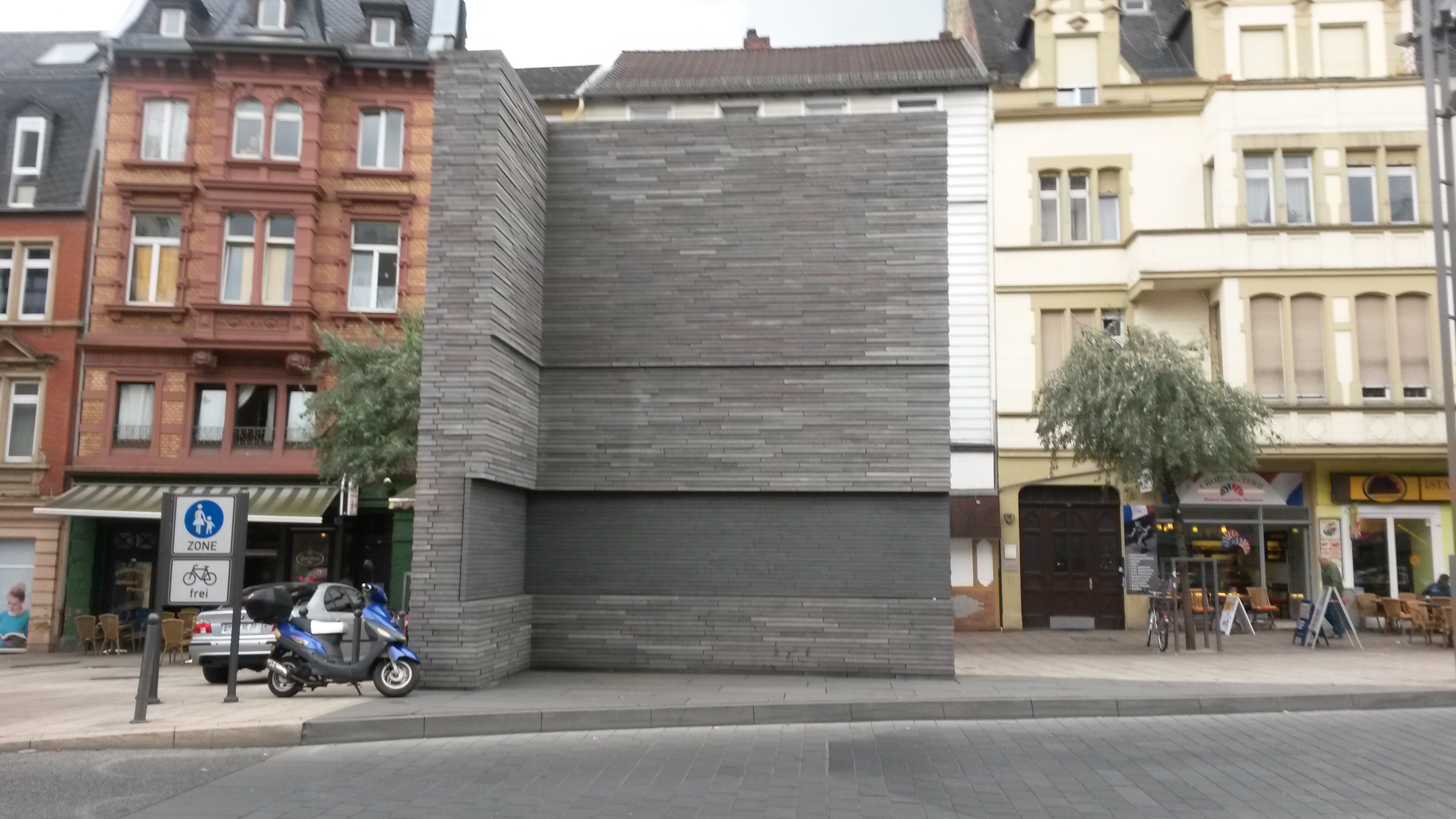
The smaller half of the Jewish Memorial in Wiesbaden.

The smaller half of the Jewish Memorial in Wiesbaden.

The first stop I went to was the Jewish Memorial in Wiesbaden, which was a pretty moving experience. The memorial stands where the old Michelsberg synagogue, which was a magnificent building with domes and spires that was destroyed during the war, used to be and is dedicated to the German Jews from Wiesbaden who died during the Nazi era. Today a road bisects the former grounds, so the memorial is split in half as well. The smaller part is an L-shaped, two story structure made from black stone, with a white display detailing in German and in English the purpose of the memorial. A small touch screen contains more information on the Jewish community of Wiesbaden (all in German unfortunately).

The second half, on the other side of the street, is much bigger. It’s in the shape of a giant rectangle with one side missing and along the walls, there’s a band where all the names of Wiesbaden’s Jews who were murdered during that period are listed. When I crossed the street, I felt the atmosphere change.

The larger, more emotional half of the Jewish memorial in Wiesbaden.

The larger, more emotional half of the Jewish memorial in Wiesbaden.

They say that certain places can hold certain emotions. I’m not sure if that’s true in this case, or if that was just my own associations affecting me, but the moment I got to the other side of the street, I suddenly felt very melancholy and started walking around the memorial, my hand running over the many names listed there. I found myself talking to the Jews listed there—I knew they probably couldn’t hear me, even if their souls were hanging around that space—but in that moment I talked, and I felt really sad because these people had lived and then had their lives violently and tragically ended, and their stories would never be known because the Nazis had done all they could to erase them. I cried a little while I was there, and I felt like something was with me in that memorial (though not necessarily the spirits of the dead Jews…maybe the spirit of the synagogue itself, if that makes sense), and it was very pleased I’d taken the time to talk to it.
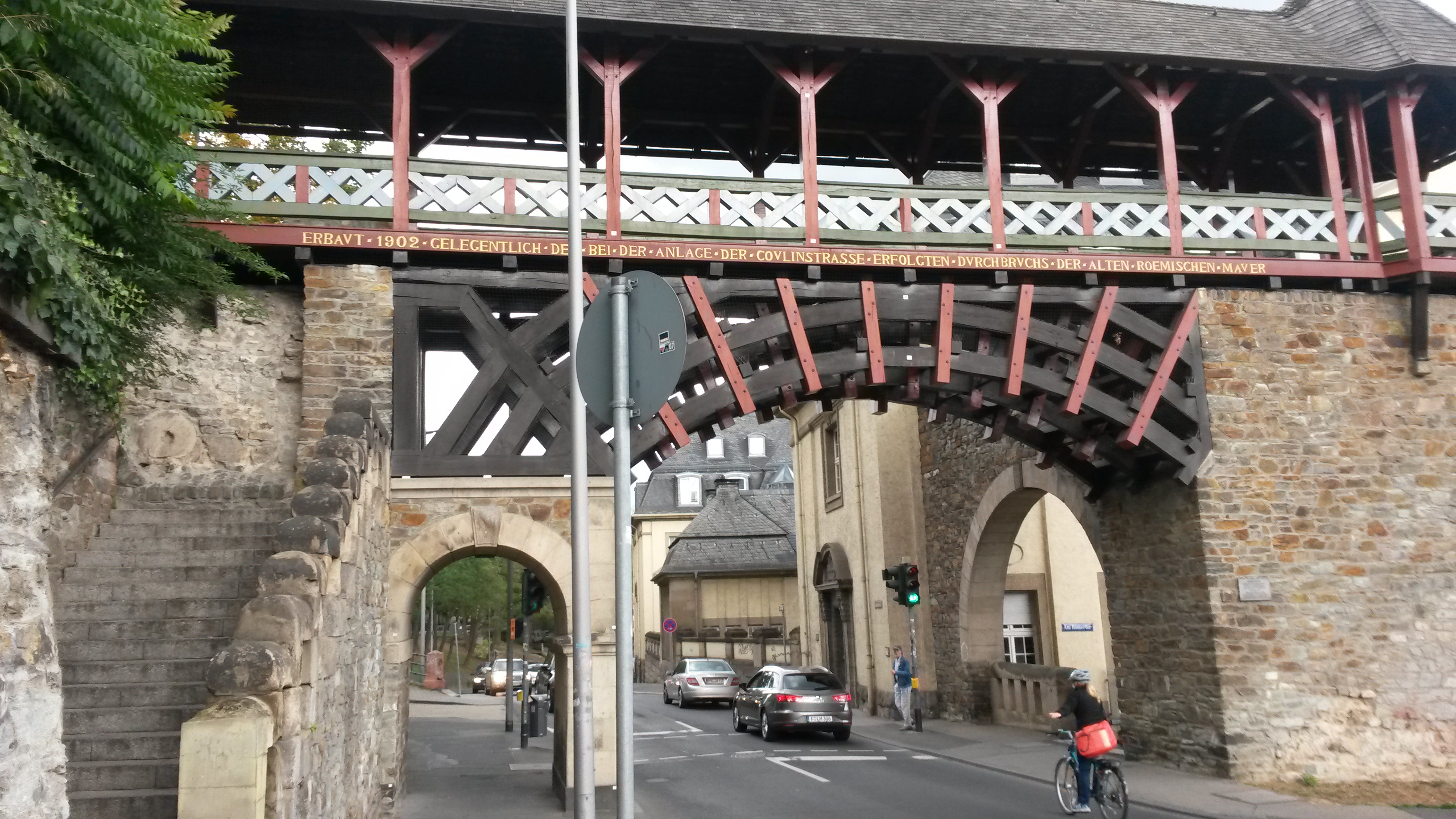
The Roman Wall, with some additions from the Germans.

The Roman Wall, with some additions from the Germans.

After that I left (and felt much better once I was outside the memorial space). I then headed to something I’d wanted to see but had totally forgotten about looking for that first week in Wiesbaden: the Roman wall, known as “die Romantor” in Deutschland. Right down the road from the Jewish memorial, the wall has been reinforced and repaired and even built upon by the Germans (hence why there’s a wooden bridge connecting two parts of the wall). Nearby there are statues and reliefs that are either relics of the Roman age or they were created to resemble Roman works of art, and behind one apartment’s driveway there is a small alcove that might’ve been a storage area. These are all that remains of what might’ve been a Roman fortress against barbarian hordes. It was actually pretty cool, and I couldn’t help but think of a friend of mine from my study abroad trip who would’ve loved to see the wall.

Possibly a storage space for weapons and supplies?

Possibly a storage space for weapons and supplies?

You know thinking about it, I should write a story or two involving the ancient Greeks or Romans. There are already plenty of horror stories involving their mythologies, but involving them? I don’t know of many, though a few Anne Rice books do take place in ancient Rome or thereabouts.

Anyway, after that I headed back to the Marktplatz, where I discovered a costume shop with all these different masks and costumes and accessories available. Apparently Oktoberfest here in Germany involves costumes like Halloween does in the States (fun fact: only a fifth of Germans practice Halloween, as the holiday was mostly discouraed up until the 1990s by the Lutheran church. It’s becoming a growing trend, but still pretty small here except among Americans). I tried on a few masks and took some photos in a full-length mirror in the shop for kicks, then left while thinking about maybe getting a mask of some sort later on.

Mother always said I was a werewolf. I guess we now have proof. Awooo!

Mother always said I was a werewolf. I guess we now have proof. Awooo!

All in all, it was a pretty interesting and fun afternoon. I got to connect with my heritage in a very personal way, as well as immerse myself pretty deep in German history and culture. And I got to see some more of the city I’ve been living in for the past three months, and which I’m going to be sad to leave. Guess that means I’ll have to come back someday, right?

Of course, my adventures in Germany are far from over. I’m trying to arrange to go to this castle with a very interesting history called Wewelsburg over the weekend, and I would like to go to Oppenheim, which is not too far away from where I live, because they have underground labyrinths you can explore (sounds a bit like the Paris catacombs). Hopefully I’ll be able to do both and have fun at Oktoberfest too while I’m at it.

Until next time, my Followers of Fear!

*Warning: this post contains spoilers on a recent novel. Read with caution.*

I heard something very interesting yesterday that I, as a writer, a Jew, and a scholar on the Holocaust have to comment on. When you read that title and saw the words “Nazi Romance”, what popped through your mind? Probably nothing good if you haven’t heard yet, and probably a ton of controversy and maybe some simmering anger if you have heard yet. In case you’re among those who haven’t heard, let me explain:

The controversy centers around a Christian romance novel called For Such a Time by a woman named Kate Breslin that came out last year. The novel has received nods for awards and positive reviews in that time, including a few from the Romance Writers of America. However, a lot of people are taking offense at the subject matter: it’s a retelling of the Biblical story of the Book of Esther set in a Nazi concentration camp with a Jewish woman with Gentile looks and a Nazi commandant as the heroes. Long story short, the commandant thinks this blonde beauty can’t be Jewish and puts her to work in a supervisory role in the camp under a false name. Thus begins a strange, tension-filled romance that some have likened to sexual harassment coupled with Stockholm Syndrome (sounds a bit like my thesis Rose) that ends with the two heroes getting together despite all obstacles and, because this is a Christian romance novel, the heroine converts to Christianity (not like my thesis Rose at all).

Now I have not read the novel–I only found out about this yesterday, I’m not interested in reading a romance novel, let alone one trying to get me to look at Jesus in a new light, and even if I was by the time I finished it the Internet’s short attention span might have moved onto something else–but you can see why this sort of story might cause some upset feelings. The major criticism is that the novel co-opts one of the greatest tragedies in modern history, and the biggest tragedy in modern Jewish history, so as to advance a particular religious aim.

At the same time, some have come out in favor of the book. Anne Rice actually defended the novel, saying that writers should be able to experiment and that the almost extreme outcry rising on the Internet around this novel is akin to censorship and a lynch mob. The organization Romance Writers of America has said something very similar in response to For Such a Time getting two nods for major awards they hand out.

Now, I don’t like Internet confrontation. But like I said, I’m a writer, a Jew, and a scholar on the Holocaust, so I feel some need to weigh in on this subject. First off, I understand the point of view about experimentation vs. censorship. In several stories I’ve written over the years, including Rose, I’ve pushed boundaries of my own comfort zone and maybe the comfort zones of my readers in order to create a better story. Writers should be able to do just that, experiment and push boundaries in the name of creating a great story. To regulate what writers work on or threaten them if they write something someone finds offensive, which is made all too much easier by the anonymity of the Internet, does smell of censorship and makes me think of extremist vigilante justice using a new medium to intimidate people. Almost like a lynch mob, in fact.

Can you really make fiction–let alone romantic Christian fiction–out of a subject like this?

However, I do see why people are outraged over this book. Like I said, the Holocaust was a tragedy. Of the estimated 12 million victims of the Nazi genocide, around half were Jews. To take what was a horrific and defining moment for modern Jewry and use it as a backstory for a romance meant to draw readers close to Jesus is very insensitive to victims and survivors of the Holocaust who lost their lives because of their heritage, as well as those who carry that heritage today. The conversion to Christianity at the end is also very disturbing, because many Jews were forced to convert before, during, and after the war for survival and it sometimes caused trouble for them later in life. To portray it as an act of love…to say the least it seems unsettling.

Ultimately, I feel the best way to view For Such a Time by Kate Breslin is to view it as a teachable moment. While writers should be able to write and experiment as they wish, they should also be cognizant that writing about some subjects (like the Holocaust) requires more sensitivity and caution than others. When dealing with a subject such as this, it’s important not just to know your facts, but how people–particularly those affected directly by said subject–feel about it. That way when you write about it, you are writing it in a way that, while it may not please everyone, it will not cause the sort of outrage this novel has caused.

This was what I did with Reborn City when I wrote it. I’m as far away from the gangster lifestyle as possible, so I did my research to make sure I represented gangsters in a way that would do the lifestyle justice . So far, I haven’t had any complaints.

Thankfully Breslin has already issued an apology, saying she wrote it with the best of intentions and she’s very sorry for any offense or pain she caused to the Jewish people. And while others may not forgive her, I think I can. I think she’s learned form this experience. And when she puts out her next book, perhaps it’ll get the attention that every author wants their book to have, rather than the nasty kind her first received.

What’s your take on this subject? Is Ms. Breslin out of line or was she just trying to write a good story?

Should authors be more sensitive when experimenting with their stories? And is the uproar over this book overblown or justified?

Let’s discuss.

The building where Kristallnacht was planned.

The building where Kristallnacht was planned.

I’m telling you, I had quite the day yesterday. Besides spending half the day traveling between my apartment in Wiesbaden and the train station in Munich, I mean. That was just a pain in the butt, as well as a strain on my wallet (I will not be traveling for the next few weeks because of it most likely).

Well, let’s skip over the long, mostly uneventful train rides, and get right into my day in Munich. I got there a bit before noon despite several delays along the way and managed to grab a bite to eat and some extra water before meeting up with Taff Simon, my tour guide. Taff, a Welsh archaeologist who works on WWII-related sites when not in the midst of giving people tours (and whom I highly recommend for a tour if you’re interested in WWII stuff), was the best tour guide. Since we both were well-versed in Nazi history, he didn’t have to spend a lot of time filling me in on basic Nazi history. Instead, he took me to various locations around the city that had Nazi history attached to them.

For example, our very first stop was the place where Kristallnacht was thought up. Yeah, that place still exists, it’s an old, church-like building with two arched tunnels built into it for through-traffic. Kristallnacht was thought up during a dinner party for the fifteenth anniversary of the Beer Hall Putsch being held inside. To this day there are memorials in one of the tunnels commemorating what had happened.

The coffee shop where Hitler would come up with his speeches. The Devil's Column is in the back.

The coffee shop where Hitler would come up with his speeches. The Devil’s Column is in the back.

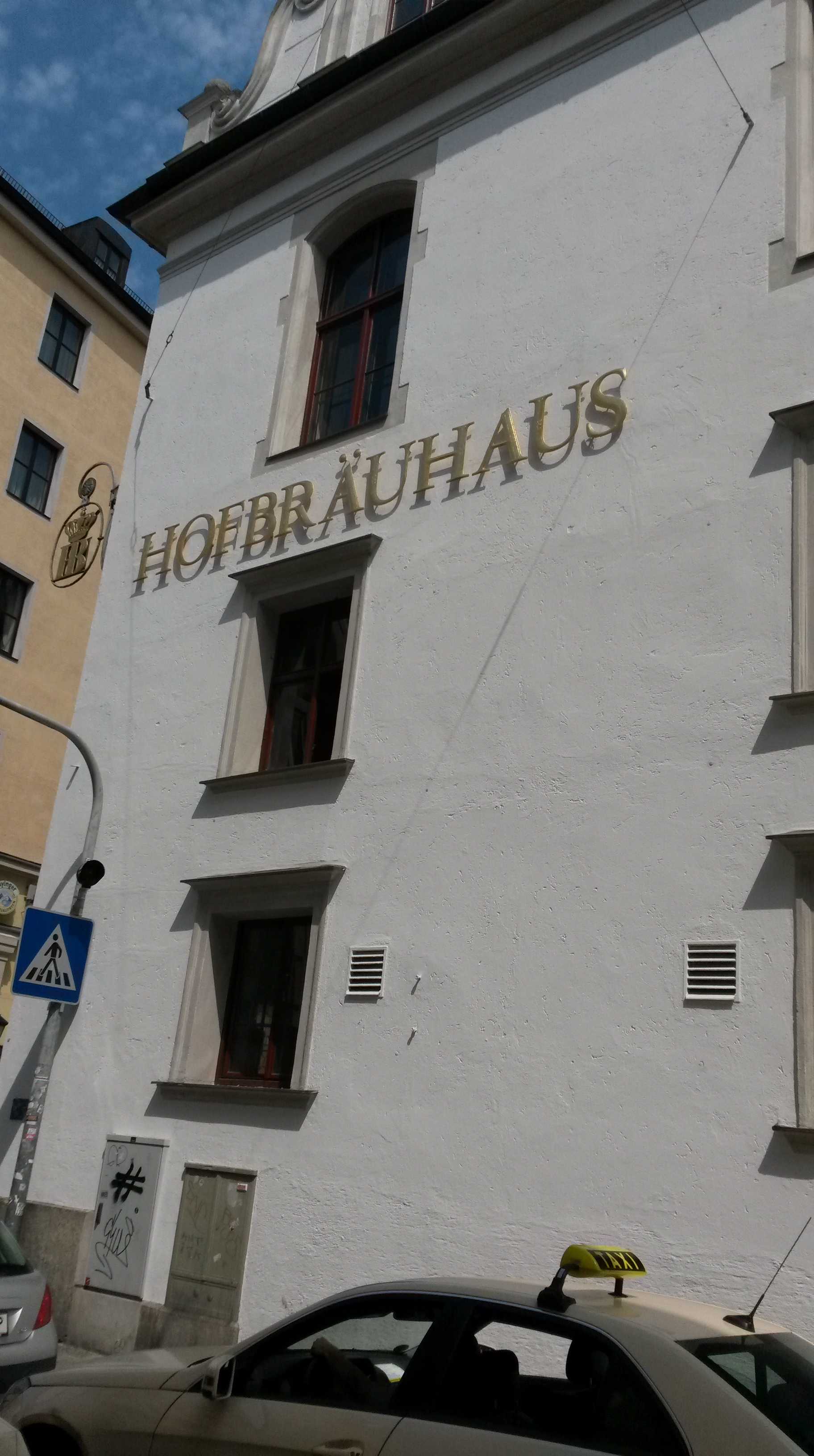
I also got to see the places where the German Worker’s Party, the forerunner of the Nazi Party, met, as well as the meeting place of the Thule Society and the building where the SS was founded. We also visited the spot where the Beer Hall Putsch was stopped by police and an alleyway that was used to avoid the memorial that would later be set up there and became pretty famous consequently. We also visited a few beer gardens that had some history with the Nazis (though no one likes to admit it), including the Hofbraushaus, where Hitler would often give speeches after writing them in a coffeehouse down the street (to this day, the column in that shop he’d sit next to while preparing his speeches is known as The Devil’s Column).

20150808_124604

The Hofbrauhaus, where Hitler gave some of his speeches in Munich.

Really, one of the big things you take away from this tour of Munich is that Nazism really was born here. This was the city where the German Worker’s Party grew and evolved into its more terrifying form that we know so well today, where major events shaping the party took place, where the Thule met and where the SS was born. You even see pieces of that history today, not just in memorials but in buildings and architecture, in pieces of art, and just in the stories told about certain places. It’s quite fascinating.

Taff also took me to the University District of Munich, and brought me to the place where the White Rose, a small resistance group that operated during the early forties, would distribute leaflets hoping to get their fellow students and intelligentsia to resist the Nazis. To this day there are stone copies of their leaflets embedded in the courtyard in front of the medical school and memorials to the group within for their heroism and martyrdom.

He also took me around that area of town, showing me a building where the Nazis used to hold offices and where Hitler signed the 1937 “peace accords”, a square with Greco-Roman buildings set up where rallies were held, the remains of a temple decided to the people who died on the night of the Putsch, and quite a few others. Believe me, when he showed me the building where the Gestapo used to be headquartered, I had a bit of a chill.

One of the stone leaflets in memory of the White Rose.

One of the stone leaflets in memory of the White Rose.

By the end of the tour we ended up back where we started, in the square near the building where Kristallnacht had been planned. As I was hot and nursing a small headache by that time, I thanked Taff for showing me all that I described above and more and asked him to send me information of any future tours he might be doing (including one about some rather gruesome witch hunts and other nastiness that had happened in the city). Taff also directed me to the Hugendubel, a five-floor bookstore that had several books on Nazism and Munich’s history within its walls. I bought a very large tome and headed home after that, feeling like I had definitely made the most of my weekend.

All in all, it was a very exciting and edifying tour. I took somewhere between sixty and seventy-five photos in total, most of which I deemed good enough to send to myself (uploading them to Facebook, Twitter, and Instagram is going to be a pain in the ass). I also got to see locations I didn’t know existed, let alone were still standing, and I felt like I was getting to step right into history thanks to Taff’s expertise and storytelling. And I got to see the city of Munich, which in itself is just wonderful.

The old headquarters of the Gestapo. Actually took a step back in fear when I found out what it was. You can guess why.

The old headquarters of the Gestapo. Actually took a step back in fear when I found out what it was. You can guess why.

And I even got some help with my writing here. As you can imagine, I’ve got plenty of ideas for stories that involve World War II and the Holocaust, including a book series I plan to write someday that I think could be my Dark Tower series (though probably not as complicated). Going to Munich yesterday certainly helped to give me a sense of what living back then was like and helped flesh out the setting for those stories, and I even had an idea for a new short story based on the info Taff told me.

It was just a wonderful trip and I’m glad I went. I’lm definitely going to try to do another post or two about my day in Munich, one showing some more of the photos I took and one about some of the really cool souvenirs I got from the city (trust me, that’s worth doing another post about).

Well, that’s all for now. I’m going to get off the computer and get some other work done. I hope you have a wonderful rest of your day, my Followers of Fear.

And if any of you are ever in Munich and want to go on a tour like I did, I highly recommend giving Taff Simon a call. He’s a great guy, he knows what he’s talking about, and you’ll definitely come away feeling it was worth the trip.Here’s the link to his website if you’re interested.

It’s coming soon.

It’s coming.

Well actually at the time I started writing this post it’s six days, eighteen hours, and 18 minutes till graduation. But who’s counting?

Still, it’s amazing that this milestone in my life is coming so quickly. I’ve been looking forward to it for nearly a year, and by he time I turn around, it’s probably going to be here. I’ll see my whole family (and I mean my whole family, around ten or so people are showing up for this), I’ll walk down that aisle for my diploma, my mother will cry her eyes out and then be grateful that for mother’s day she’s got one kid graduated and three to go. There will be tears, photos, selfies galore. I’ll get my diploma and meet President Drake for the first and possibly only time. Afterwards there will be more photos and congratulations, I might have time to change my clothes, and then we’ll go out to dinner.

Oh, and alcohol. Pleeeenty of alcohol will be consumed. It’s graduation, it’s to be expected.

You know, I’m really going to miss Ohio State. So much happened here. I took so many fun classes, a few ones I wish I could do over or never took at all. I made great friends, some of whom I’ll stay friends with for life. I met so many great professors and learned so many awesome things from them. I published my first three books and wrote two or three more while I was here. I published some articles and short stories, started working for Self-Published Authors Helping Other Authors. I went to Europe on a study abroad trip. I worked in a really wonderful office with really awesome people. I got my first apartment and started to really become an adult (paying bills, creating a credit history, etc.). And while I was here, I grew an audience of readers who enjoy my posts, love giving me feedback, and even read my books from time to time.

I think what I’m going to miss the most though, more than the excitement and surprises of learning something new each and every semester, is the challenge. Each and every year, and each and every semester, I’ve had new challenges to overcome, new obstacles to tackle and fight against. This has ranged from getting used to college, to getting used to semesters, living in my first apartment with a new friend, going abroad, doing a thesis, and a million other things. I like to think I met and beat challenge successfully.

Well, depending where I get my next job, there will definitely be new challenges to deal with, so that won’t be a problem. Hopefully I’ll know where I’m going soon (still working on my first job, but hopefully I’ll have more news soon). And you know what? As much as I love OSU, I feel it’s time to move on and see what’s next for me. I can’t remain as a student forever, and I don’t think I’d want to, even if I could and it cost me next to nothing. College is meant to be temporary anyway, so why stick around?

And I’m actually looking forward to getting away from a few things. Classes I hate, huge reading assignments, that sort of thing. Enough with that. And I’ll definitely be glad to see the last of those preachers on the Oval who keep telling us we have to become proper Christians (whatever that means) or we’ll go to hell. Honestly, I heard one of those guys claim the Girl Scouts are going to turn us into hedonists. I was like, “Whuuuuuuut?”

Well, I’ll make sure to post about graduation after it happens in one week. Or as a certain ghost I know likes to say:


Sorry, could not resist. You know, I once joked on Facebook that I’d married the ghost in that movie and that one post got so many likes and hilarious comments. And then some people thought it was true. Yeah, that was the awkward icing on the cake. Still, hilarious story. Might post about it some day.

Anyway, I’d like to thank everyone for sticking with me through all of my undergraduate career. I hope you guys continue to stick with me as I take on whatever comes next and as I continue to work on becoming the next big horror writer.

Until the next time, my Followers of Fear. Hope you’re not as busy as I am.

It’s expected in the coming weeks that the grand jury will hand down a decision on whether or not to indict Darren Wilson in the death of Michael Brown. Protesters have threatened to riot if Wilson isn’t indicted, the governor has declared a state of emergency, and police are getting ready for what many see as a second, bigger powder keg after the first one went off back in August. And around the country, in living rooms and coffee shops, in workplaces and on news talk shows, people are asking what caused this and what will happen next.

I’ll keep my own personal views on what should happen to Wilson to myself, lest everything else I try to say in this piece gets forgotten because of one opinion. I will state that I think it’s tragic that a young man who had his whole life ahead of him and was planning to go college and maybe own his own business someday was taken too soon, and that his legacy has to be another awful bullet point in the United States’ long, troubled history with race.

And make no mistake, there is a racial element to this. I know some will say that we shouldn’t be talking about race, that we’re living in a post-racial society, that race is a sociological construct of the mind rather than a biological certainty, and that therefore race should not be brought up. I’ve said it many times before, and I’ll keep saying it: social construct or not, many people treat race as a biological reality, and racism is still a pervasive problem in the United States. In fact, I’ve often compared racism to cancer, and the way you deal with cancer isn’t to avoid it or pretend it doesn’t exist. The way you deal with cancer is to take a multi-pronged approach to cure it, and one of those approaches is to talk about racism.

And for those who continue to insist that race shouldn’t be part of the discussion because we live in a so-called “post-racial” society, here are some facts:

  • In November 2012, students of the University of Mississippi rioted upon learning that Barack Obama was reelected. Several racial slurs were heard shouted out during the riot.
  • In February 2012, a young man in Florida was profiled by a self-appointed neighborhood watchman, who then followed the young man despite being told by police not to pursue, and engaged the young man in a scuffle that ultimately ended with the young man’s life being taken. The young man, Trayvon Martin, was black.
  • There are over 900 documented hate groups in the United States according to a report released by the Southern Poverty Law Center last year. Most of them are primarily focused on race and racial differences.

Still want to argue that racism doesn’t exist? Racism is still very prevalent in the United States, and the fact that so many want to deny its existence or say that discussing race and racism in America makes you racist really disturb me. (The latter claim actually is the most ridiculous, especially since it goes against the very definition of racism, and real racists wouldn’t benefit from discussions on race as a societal problem unless it involved doing horrible things to other races. In fact, when economist Ben Stein went on Fox News the other day and called Obama the “most racist president” ever, I wanted to throw a dictionary and a history book at the guy. If you’re going to call a President racist, it’d be better to refer to possibly Andrew Johnson, Woodrow Wilson, or Franklin Roosevelt for starters.)

I think we owe today’s racism to some of the things that happened during Reconstruction, in part. Slavery itself definitely plays a role, but I want to focus on Reconstruction because during this time, President Andrew Johnson encouraged the return of defeated Confederate states to self-rule and to take part in federal government. The people who ended up seizing control were mostly plantation owners and businessmen, some of whom had been involved in the Confederate government, and had benefited from slavery. They used their power to pass sweeping legislation depriving freed slaves of rights, and used terror in the form of the KKK to prevent push back. There was also some propaganda directed to poorer whites who were told that giving freed slaves power was bad for them. The federal government, including Johnson, didn’t do much to prevent this (Johnson also didn’t support the Civil Rights Bill or the 13th Amendment, which is why I mentioned him above in my examples of racist presidents).

This set a painful pattern in motion that would last for nearly 100 years. The legislatures continued to have people in it who would keep up the status quo, African Americans and whites who sympathized with them were kept in place through lynching, the KKK, and other forms of terror, and efforts on state and federal levels to stop it faced uphill battles. It wasn’t until WWII, when African-Americans were determined to achieve victory at home and abroad after their rough treatment during WWI, that things began to change for the better.

Why do I go into all this, and at the risk of getting a bunch of people shouting at me in the comments about how I know nothing or I’m oversimplifying it or something along those lines? Because there are a lot of painful episodes, going back further than I have covered, that have happened and continue to happen long after MLK and the Civil Rights Acts, and we need to examine the whole picture in order to understand what is happening now. Racism existed then, and although they’re in new forms, racism exists today. So we need to confront the past and examine the present if we’re to better the future.

And now that I’ve led you through this long, somewhat rambling post, I have to ask: how do you think racism can be combated? What approaches should we take to stop racism and make it less prevalent in future generations?

*By the way, I know that some of the arguments here can also be applied to other forms of prejudice and discrimination towards other minorities, women, religions, ethnic groups, socioeconomic levels, and sexual orientations. For simplicity’s sake, I’ve only focused on race here, but I do cover other problems in other posts and in some of my fiction as well.

Gene Simmons, frontman of KISS

Since the unfortunate death of Robin William on Monday, there’s been a lot of memorials, tributes, and discussions about the loss of this famous entertainer and his battles with depression, substance abuse, and, as we learned recently, with Parkinson’s disease. While most of the discussion has been rather good and dedicated to healing and trying to understand the tragedy, there’s been a lot of people whose contributions have been less than helpful. After the coroner’s report came out, some news networks chose to focus on the degree of rigor mortis that had set into Williams’ body or how he killed himself rather than have a meaningful discussion on the effects of depression or on the actor’s life (why would we want to know that CSI stuff on a real actor?). Rush Limbaugh said that the reason Williams took his life was that, as a leftist, he was never satisfied with what he had and kept wanting more, and his dissatisfaction led him to ultimately take his life (why does anyone listen to this guy anymore?). And that group of ignoramuses who think they’re Christians but are not, Westboro Baptist, has announced plans to picket Robin Williams’ funeral (do any of these people have day jobs, or do they make and sell crystal meth to finance their protests?). And I’d be remiss if I didn’t mention that numerous people sent hurtful and abusive tweets to Robin Williams’ daughter Zelda on Twitter, causing her to shut down her account (sometimes I think the Internet just brings out more of the worst in us than the best).

But the worst reaction I’ve heard is from Gene Simmons, frontman from popular band KISS. Mere days after telling immigrants to the United States to “learn goddamn English” on a HuffPost Live interview, Simmons said during an interview with SongFacts.com that he doesn’t “get along with anybody who’s a drug addict and has a dark cloud over their head and sees themselves as a victim.” He went further to say:

Drug addicts and alcoholics are always, “The world is a harsh place.” My mother was in a concentration camp in Nazi Germany. I don’t want to hear fuck all about “the world as a harsh place.” She gets up every day, smells the roses and loves life. And for a putz, 20-year-old kid to say, “I’m depressed, I live in Seattle.” Fuck you, then kill yourself.

I never understand, because I always call them on their bluff. I’m the guy who says “Jump!” when there’s a guy on top of a building who says, “That’s it, I can’t take it anymore, I’m going to jump.” Are you kidding? Why are you announcing it? Shut the fuck up, have some dignity and jump! You’ve got the crowd.

Now, I’ve never exactly been a big KISS fan to begin with, but Simmons’ comment have definitely made it very unlikely that I ever will become one. Sure, your representative has sent a message to the HuffPost saying that you regret your comments and that they were spur of the moment, but I’m not sure how many people will be forgiving you any time soon for this. Especially since you didn’t come out and say it yourself but had your representative shoot off an email.

And let me take the time to point out a few things about depression, and other mental disorders that can cause suicidal thoughts and behaviors. First, let’s get one thing in the open right now. Depression is an illness. Sometimes it’s even a chronic illness, like diabetes or cystic fibrosis. Plenty of people forget or don’t realize that depression is an illness, maybe because it’s in the brain and isn’t caused by a virus. Even so, telling people with a chronic illness that they should kill themselves is just wrong. We don’t tell people with MS, Crohns disease, and lupus to kill themselves. Instead we tell them to have hope that treatments will emerge someday and give money to the charities that raise money for research. I don’t see why people with depression have to be treated differently.

Not to mention that if every person with serious depression followed your advice and actually took their lives rather than mope around, we’d have a lot of deaths. According to the National Institute of Mental Health, approximately 16 million adults aged 18 and over suffered from at least one major depressive episode in 2012, or 7% of the US population. Some of those people would be people I know. I and many of my friends and family have dealt with depression or know someone who has dealt with it over the years. That’s how prevalent depression is. At one point in my life my own depression was bad enough to make me consider suicide. Should I kill myself then? Or should I work on treatment and making myself better?

And I applaud your mother for being able to continue living and finding meaning in life after her experiences with the Holocaust. It’s not easy to do that. Many survivors suffered from problems afterwards, including depression, paranoia, anxiety, and many other disorders. A few even took their own lives. And they probably felt the same sort of feelings of darkness that the kid in Seattle felt.

That’s the insidious thing about depression. It affects people in different ways, from all walks of life, and it affects so many. And still we have no idea what causes it. There’s plenty of research that points to it to being a biological or genetic disorder, as well as research that points to environmental or social causes. And there’s even evidence to support that a combination of these factors could cause depression. Depression can also be a side effect of other chronic illnesses. Plenty of people with cancer, Parkinson’s, or MS end up developing depression. We don’t entirely understand what causes depression like that either, but we do research and we try to fight back.

And don’t be the person who yells at the person on the ledge to just jump and get it over with. Very rarely is anything ever grained by taking a life, especially one’s own. And people kill themselves for a number of reasons: depression, anxiety, paranoia, schizophrenia. Sometimes they feel they are actually helping people or the world by taking their lives. Other times they feel that they don’t matter in the long run and no one will miss them. And occasionally we can’t understand the reasons why people take their lives. But that does’t mean we should ignore them or egg them on. That’d just be too cruel and would mean humanity isn’t worth savng after all.

Rest in peace, O Captain, My Captain.

So let me do what you obviously couldn’t do, Chaim Witz. I’m not going to tell people with depression or considering taking their lives to either have an attitude adjustment or just get it over with and kill themselves. If you are depressed or considering suicide, talk to a licensed therapist. If you can’t afford one or there’s none in your area, talk to a teacher, counselor, clergymen, or someone you trust who is in a position to help you. Or if you live in the US, call the National Suicide Prevention Lifeline at 1-800-273-8255, where therapists and counselors are standing by to help you.

And I know things won’t always be sunshine and daisies. In fact, even with treatment there are plenty of people who have trouble and feel down or upset. But that doesn’t mean it’s hopeless. Like any illness, you’ve just got to keep working at it and hoping that things will improve. Perhaps then, things will get better.

The entrance to the Louvre, surrounding by many fountains.

The entrance to the Louvre, surrounding by many fountains.

The other night, I was watching the classic Doctor Who serial City of Death (one of these days I will have to write an article on Classic Who from a writer’s perspective, because it deserves one), and I found myself freaking out because the serial takes place mainly in Paris, about thirty-five years before I myself was there. (Fun fact: City of Death was the first Doctor Who serial to be filmed abroad, filming between April and May of 1979. So yeah, 35 years before I would visit the city itself).

It was delightful for me to see all those sights in the actual episode, because I’d been to those places and I remembered what it was like to be there. I found myself reliving riding the Metro after a long day, trying to navigate my way back out onto the street after taking a twenty-minute train ride, because those stations can sometimes be little mazes in themselves. Or walking along the river Seine during a leisurely stroll and then sitting in a café near the Champs Elyesees and having a crepe and Orangina (I miss that brand of soda, by the way. It’s so hard to find here in the States).

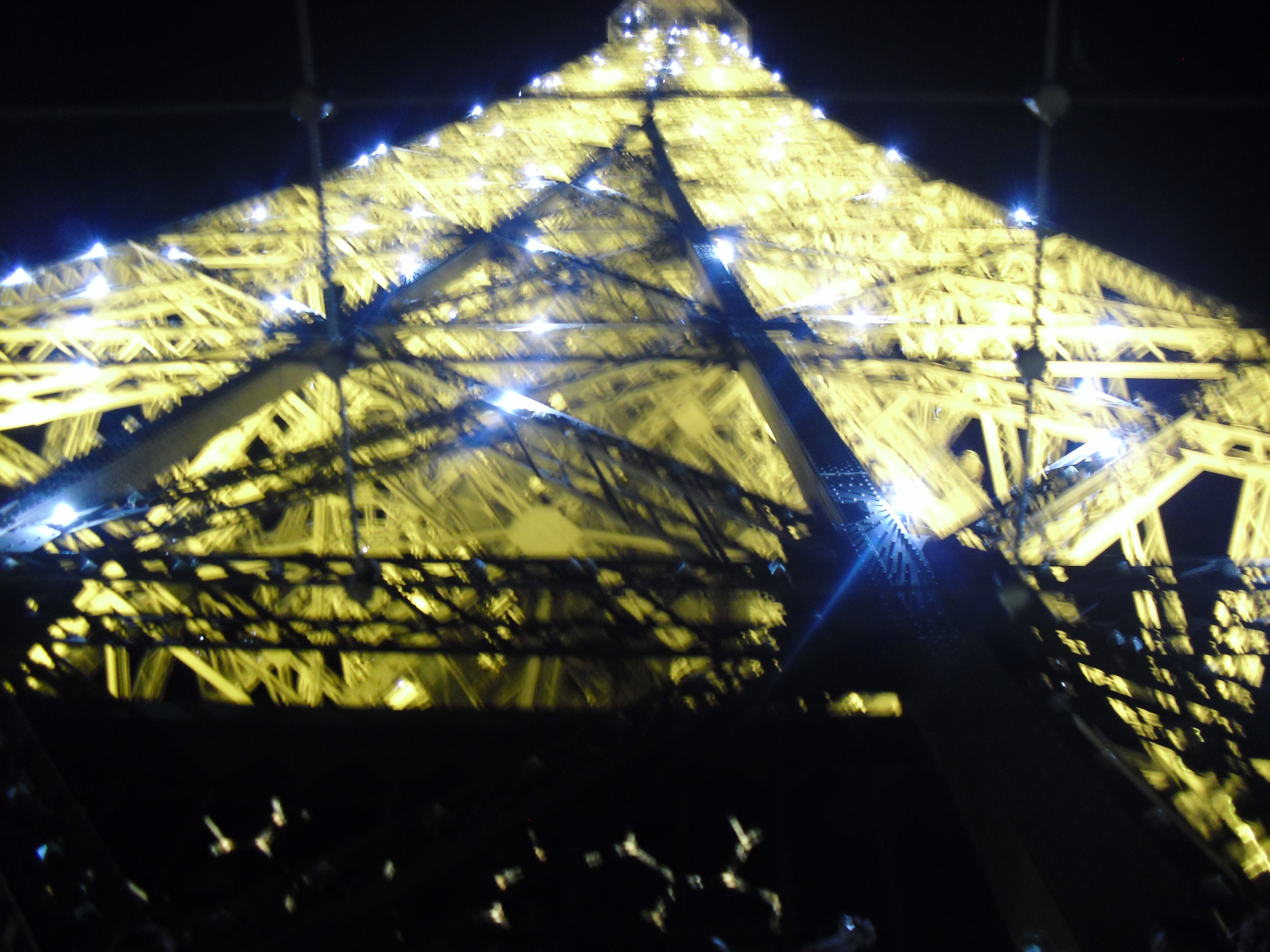
The Eiffel Tower at night.

The Eiffel Tower at night.

The serial also had scenes set at the Eiffel Tower and in the Louvre. Both those places hold a lot of memories for me. For the Eiffel Tower, it was one of the very first places I visited when I was in Paris. My friend Ramsey Hardin and I decided we go on a late-night jaunt to see the Eiffel Tower at night, and we ended up somehow climbing all the way to the second level (not the top, because that was closed that late at night). It was an amazing view. From every angle you could see Paris at night, a lovely city of lights and mystery. There are hardly any skyscrapers in Paris, mostly due to the French’s distaste for them, so we had a clear view of the city at night. The tower itself starts having a light show with flashing bulbs bright enough to give people seizures about every hour or so, and that was fun to watch. While there we also had the opportunity to talk to a family from the States who were there for a special birthday celebration (the mother’s) and a group from a technical school in Texas that were there for their own study-abroad trip. If the Tower hadn’t had to close, I’m sure we would’ve spent another hour or two there talking to people and enjoying the views.

Ramsey and I at the Eiffel Tower.

Ramsey and I at the Eiffel Tower.

The Louvre has an altogether different feeling. There is more nudity depicted in that museum than in the world’s biggest strip club, and yet there’s just as much religious iconography and scenes to rival the Vatican. And through it all is an air of strange reverence, as if everyone is aware that they are in a temple as holy as any shrine. Even as people take photos of the Mona Lisa or Madonna on the Rocks or paintings so big they take up an entire wall or ones small enough to fit on a cramped bookshelf, there’s a subdued air, as if people are paying their respects to the products of old history and culture. It’s very strange, and you can only really get a sense of it by actually going to the museum itself.

My most artistic selfie.

My most artistic selfie.

But compared to Notre Dame, the Louvre might be a funhouse. I went there after the Louvre, and it’s a very amazing place. From the moment you arrive, you are struck by the very detail of the building. The entrances have so many figures carved into them that you could spend an hour just looking at them and guessing who they are. And once inside, it is very dark and quiet, with people looking around or praying. You can’t help but feel a strange holiness to the place, a sense of godliness no matter what your religious beliefs (or lack of them) are. I even met a couple of OSU alumni there (we’re everywhere!) and they agreed with me on that. I might’v spent more time there if I didn’t have to be back to the hotel by a certain time to meet up for dinner.

See any hunchbacks behind me?

See any hunchbacks behind me?

What does all this rambling have to do with anything? Well, I guess it’s the power of memory. Although sometimes very fallible, the power of memory can transport you through time and space, landing you in a totally different age and location. Just watching that Doctor Who serial was enough to bring me all the way back to France and those five or six lovely, idyllic days of study and learning and wonder and fun, faster than even the TARDIS, even. And I was so happy to return too, because it’s an experience I’ll never be able to relive again, and the memories and photos are what keep the memories alive.

And I hope they stay alive for a long, long time.

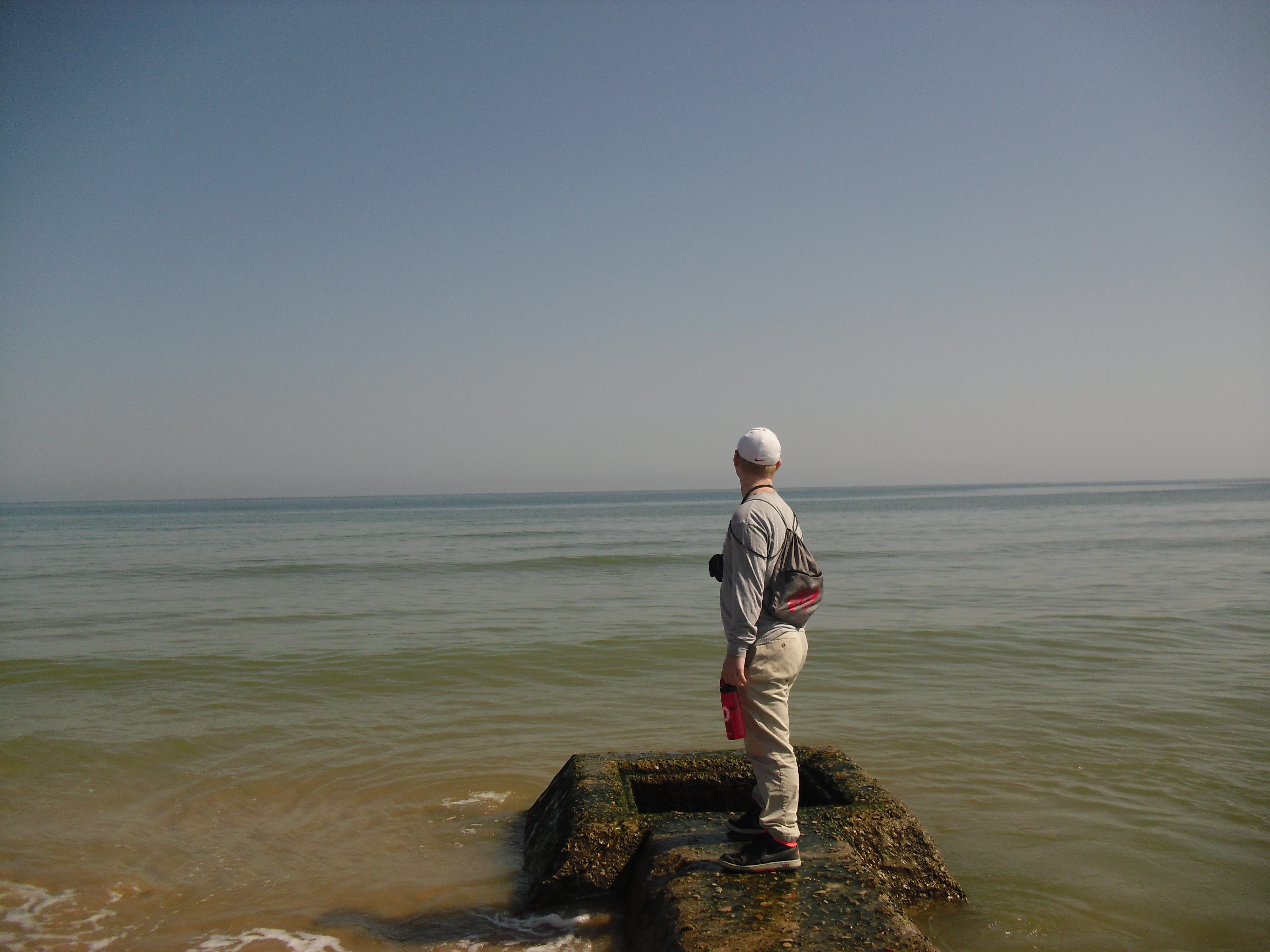
Me standing on a stone walkway on Omaha Beach, looking into the distance and trying to imagine what the seas looked like on June 6, 1944.

Me standing on a stone walkway on Omaha Beach, looking into the distance and trying to imagine what the seas looked like on June 6, 1944.

While my study abroad trip was in Normandy, we visited Utah Beach, Omaha Beach, and Pont-du-Hoc. It was quite an experience. For one thing, except for the memorials at Utah Beach to fallen soldiers and the museum next to the memorials, each beach looked like an ordinary beach. You had to really look for vestiges of the war that had raged on the sands nearly 70 years ago. Whether it was the structure in the water meant to obstruct the D-Day boats, or the preserved (I assume preserved) anti-aircraft gun standing on a pedestal, or the set of stairs leading up to a bunker in the mountain, there were hints at what had happened there.

It was really weird. You stand there, and you’d think it was just an ordinary beach. It’s hard to believe that the things that happened there really happened. I wonder how it was for the veterans who were still alive and able to make the trip to the commemoration ceremonies (like this badass Ohio former paratrooper), to come back to the beaches all these years later and seeing bare vestiges of the war left. Must have been disorientating, to say the least.

At Pont-du-Hoc though, you could totally hear the echoes of the past. Pont-du-Hoc, if I remember correctly, is not too far from Omaha Beach. Scattered all throughout the area are rubble, the remains of German bunkers and weapons, and dozens of craters, varying in size from six feet across to twenty feet across or more. Don’t even get me started on how deep those things went! I was scared to go down into the deeper ones lest I be unable to get out again without assistance.

CIMG2417

My friend David Corrigan in one of the deeper pits. This one was maybe twenty feet deep and twenty-five across. It was quite the shock to see it for the first time.

It was easier there to get an idea of what the war was like. You could see evidence in the craters, from the huge blocks of concrete, and from the gun pits and passageways, that war had been waged in this area. And what an area it was! You get the impression from movies and TV shows that a battle, no matter the size of the army, is maybe contained to a place the size of a football field. Pont-du-Hoc was probably several football fields long and wide. It really redefined my belief on what a battle was like.

And when I closed my eyes, I could almost hear the sounds of the battle, echoing across the stream of time from seventy years ago. And I was awed by it all, by the magnitude of what had happened and the horrors the soldiers must’ve witnessed in the spots I stood on. It was so hard to fathom. Thank God I have a writer’s imagination, which made it a little easier, but what I saw in my mind’s eye was probably nothing like it really was back then.

Now, veterans, their families, and world dignitaries such as Obama and Putin and so many others are there to remember the fallen and the battles waged just as I did a few weeks before. It’s right that they should, because it was D-Day and Operation Overlord which began the destruction of the Nazi regime and helped to free so many people from the horrors of fascism and racism. And while technically it was the Soviets who really ended Nazi Germany’s reign of terror, D-Day had a large role in ending it as well. D-Day and everything after.

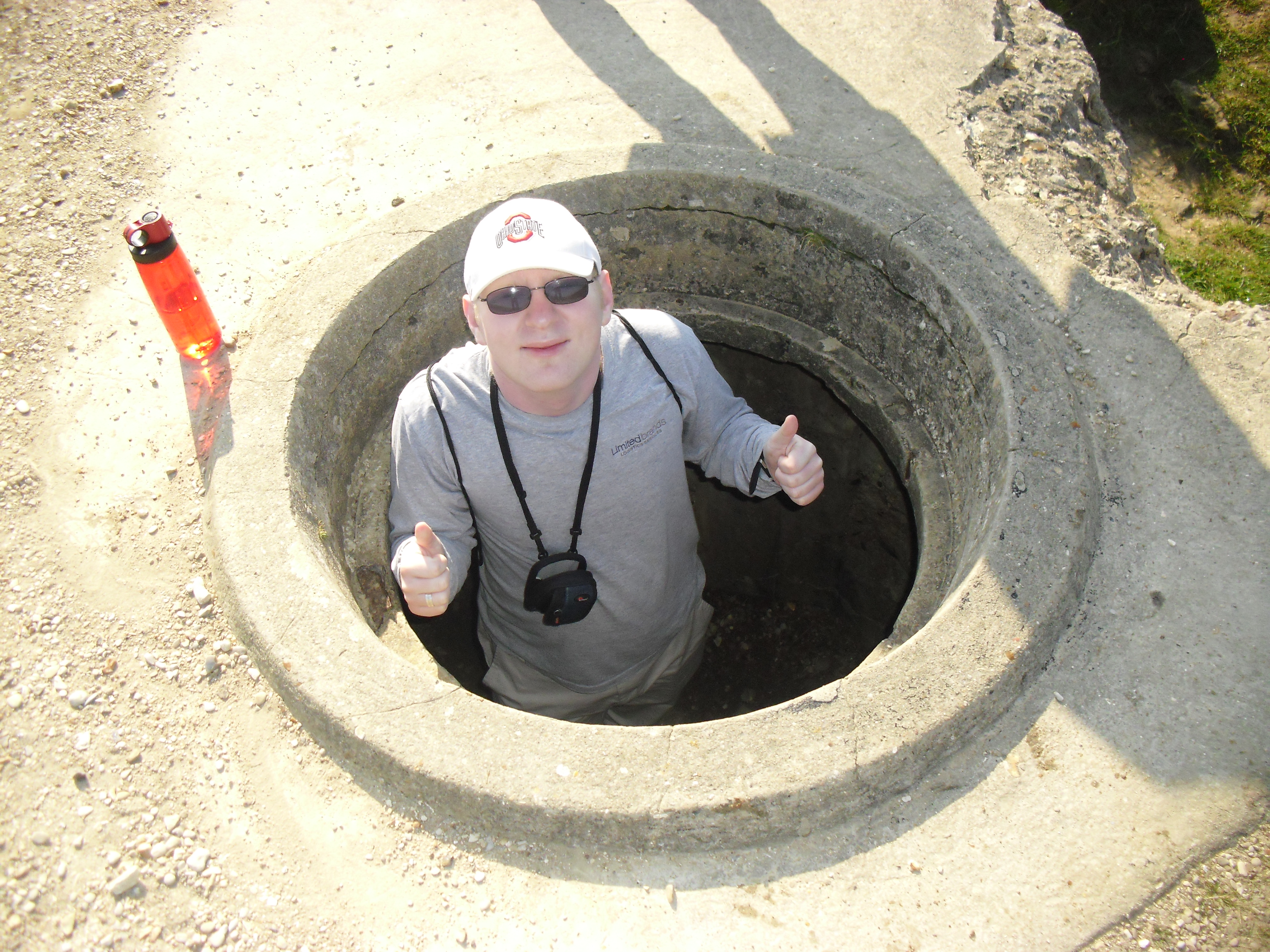
Me in an anti-aircraft gun pit. Trust me, I had to struggle to get in there.

Me in an anti-aircraft gun pit. Trust me, I had to struggle to get in there.

And I’m so glad I’m at least able to contribute something, even if it’s only some musings and a couple of memories and photos, to the celebrations and commemorations. I’m so happy to say that I was there and that I have more knowledge than I did of the invasion on this auspicious day. And I’m happy that I was able to reach back across time like that and get some sense, even if it was just a small one, of what happened on those beaches and in the surrounding countryside.

Thanks to all those who served in the war, who helped to liberate Europe from Nazi tyranny, and who still today serve to protect the ideals of freedom and peace. It’s all because of you that I’m able to write this. And I and so many others will never forget it.

Ah, the Eiffel Tower. See how it glows in the night.

Ah, the Eiffel Tower. See how it glows in the night.

Hi honey I’m home! After about three weeks in England, France, and Germany, I’m finally back in the States. I will definitely miss being in Europe (I will especially miss transportation made easy through the Metro systems), but I was beginning to miss my family and my life here and I’m glad to be back.

Of course, now that I’m back I’m not going to spend the whole time on my butt (though for the most part that’s what I’ve been doing while I get reacclimatized). In addition to catching up on all my shows and going to see some movies that came out while I was abroad, I plan to be very busy this summer. I’ll be doing my usual chores and errands, for one thing, and I’ll be working in the financial aid office for the whole summer (and if I can find one, I’ll try for another job that’ll allow me to work one or two days a week to help with the income). I also plan to finish my novel-in-progress Laura Horn, which I think I can get done by mid-July if I don’t get too distracted. I also hope to write plenty of short stories after I finish the book, because God knows I have plenty of ideas for those (I came up with about 40 ideas for stories while in Europe, most of them short stories. The lesson to be derived from this is that if you’re a writer and you find yourself on a trip abroad, bring a notebook to write down any ideas you have).

What else do I plan to do? Oh yeah, Snake will be coming out on June 10th, so I’ll be getting ready for that. And The Quiet Game’s one-year anniversary will be in July, so I plan to hold a sale for that on the e-book. And I’ll try to do some author interviews now that I’m back in the States, as well as finally getting around to editing Video Rage, the sequel to Reborn City. And maybe I’ll finish some of the series I’m watching on Netflix.

In short, I’ll be very busy.

But enough about that. I said I was going to share some of the stories from my study abroad trip. I think I’ll start with my last night abroad, with the final dinner. Why? Because it shows how much we bonded over the trip:

We were having a special dinner on the second floor of a beer garden at Alexanderplatz in Berlin called Lindenbrau. The weather was cloudy and rainy, but we didn’t really care, because we were all very happy. Maybe that was because of the alcohol and warm food, but we were happy. I was talking with my teachers and y roommate Henry and my friends, and I had a wheat beer in front of me. Most of us were really sad to go, but we were also glad that we’d had this experience together. Also, a few of us were itching to go home, or to go to other places if we were staying in Europe longer (I might have and gone to see Poland and Italy or maybe go back to England, but I couldn’t afford it).

And then our teachers, Dr. Steigerwald and Professor Willging (affectionately nicknamed Dad and Mom, respectively, by our group), stood up to say some words. They said how proud they were of us, and how they hoped we would all stay in touch for years to come. And then they handed out awards to us, the kind like “Most Likely To…” or “Least Likely To…” awards. We were invited to guess whom each award was for, and I got about three or four of them before anyone else. My award was, “Most Likely To Wander Into Rommel’s Chateau.” Considering how oblivious I can be sometimes, that’s not very surprising.

And then something interesting happened: Ramsey Hardin, one of the people on my trip who had become probably my best friend while on the trip, arrived late and hungry. He’d gone to a museum to get a little bit more culture, but on the way back traffic had been really bad, and he’d ended up about an hour or so late getting to the beer garden. Believe me, he was upset, and only a jug of beer and a really huge ham could possibly relieve that anger.

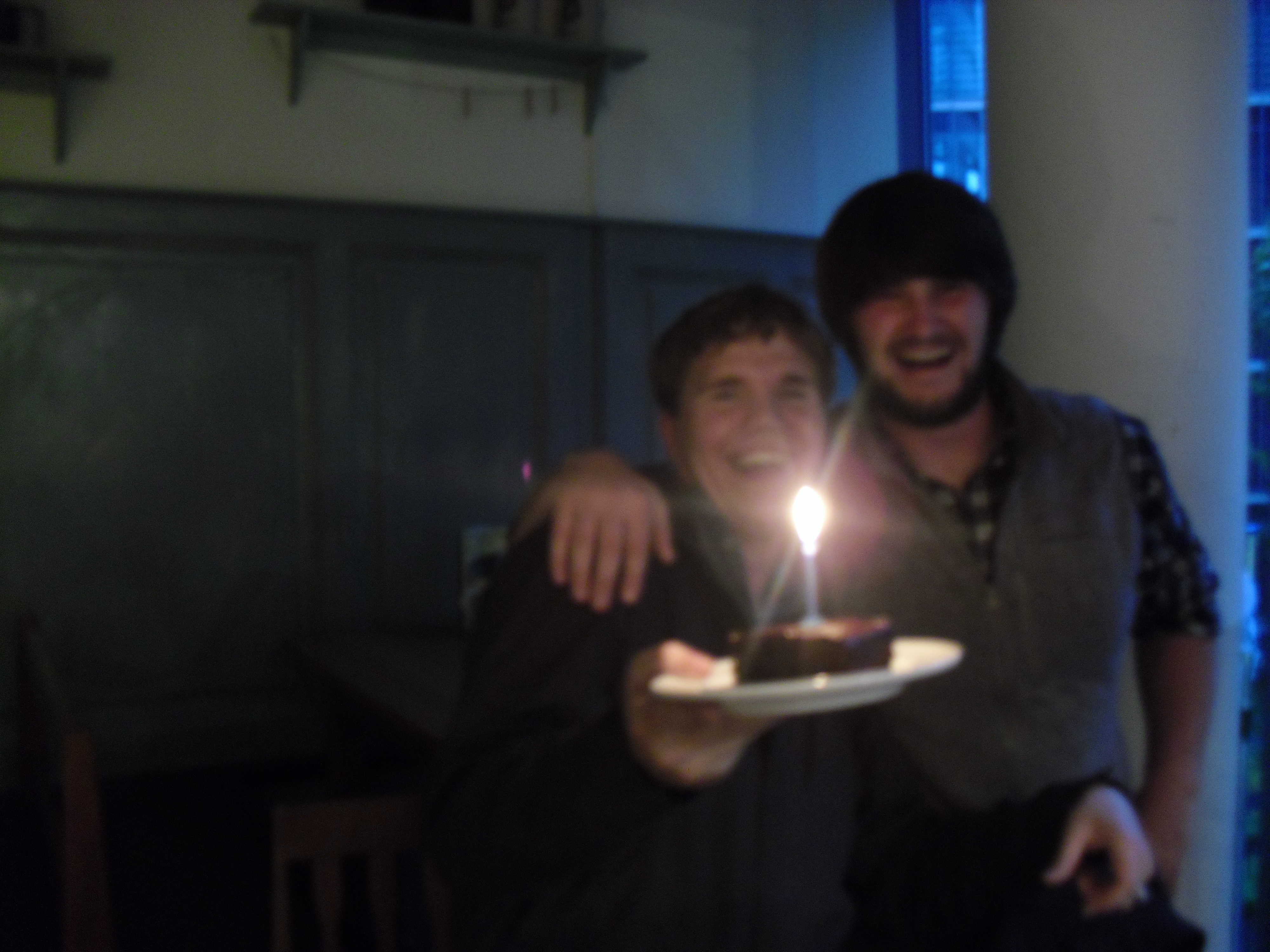
Happy Birthday Ramsey Hardin! By the way, that's David Corrigan photo-bombing te shot. What a goof!

Happy Birthday Ramsey Hardin! And that David Corrigan with him, by the way.

But then a huge surprise came out: the waiter brought Ramsey a piece of chocolate cake with a single blue candle stuck into it, a flame dancing on the wick. It was Ramsey’s twenty-fourth birthday. Boy, did that cheer him up! I wonder what he wished for, though. He probably asked for a big book of history. Ramsey’s a huge history buff, and reads anything about the past. In fact, he was voted “Most Likely To Teach Alexander the Great History” or something like that.

We ended the evening with dessert and a few more drinks, and then I went back to the hotel, to get ready for tomorrow’s flight and to store all these wonderful memories in my head.

And trust me, I’ll have a fun time relating them to you all in the coming months (or until you’re sick of hearing about them). That’s all for now though. Hope you enjoyed the story, my Followers of Fear. I’ll tell another one when I have a moment.

Snake

Guten morgen, meine Anhanger der Angst!

I think I said “Good morning, my Followers of Fear” in German. I was teaching myself German, but the craziness of the semester kind of ended my lessons abruptly. Anyway, these past two weeks I’ve been doing character interviews for my upcoming novel Snake, out June 10th. The first interview was with the two investigators leading the hunt for the Snake. The second interview was with the Snake’s girlfriend, Allison Langland. And today, we have the Snake himself! How exciting! Let’s hop right into it, ja?

Notes and Stats:
Sex: male
Age: 18
Race/Ethnicity: Caucasian
Birthday: January 2
Eye color: blue
Hair color: Dark brown
Religion: If he had to describe his religious beliefs, they’d probably align with Deism.
Affiliation: None
Special Powers/Abilities: Physical strength, a very high IQ, knowledge of various ways to kill people as well as deep forensic knowledge, adept at languages and chemistry, experience with training guard dogs and with reading body language.
Notes from the Author: The Snake hasn’t changed much from my original conception of the character as a serial killer whom people might root for. At the same time, I had to really work hard to make him a believable character, because I had to make it believable that he was normal until the events of the novel turned him into a serial killer. I like to think that in the end it worked out very well, though.
Oh, and another interesting thing about the Snake: I never reveal his name in the novel. Not once. I know what it is, but I find all sorts of ways so that I can avoid using it. I did that because I wanted to show that any one of us could be like the Snake: one day an average person, the next day transforming into a killer through circumstance and necessity. It is a scary concept when you think about it, because you realize that it is possible that could happen to just about anyone. Including you.

RU: Hello, Snake.

Snake: Hello.

RU: Wow, you didn’t ask me who I was or how the heck you ended up in Berlin. That’s a first.

Snake: I have an idea.

RU: …Okay. So Snake, how goes the search for Allison Langland?

Snake: I always knew that I loved Allison. I only realized how much my love for her went when I heard her kidnapped over the phone.

RU: Wait, you were on the phone with her when she was kidnapped?

Snake: In that moment, I realized how much she meant to me, how much she lit up my life and filled me with such joy. And I felt such a loss at the thought that something might happen to her. Like a great deep hole had opened up in me where she belonged. And every second that I’m not with her, that I don’t know if she’s okay or if something horrible is happening to her…it’s agonizing.

RU: I can’t imagine. You didn’t become a killer just then, right?

Snake: No, that happened later. After I witnessed something horrible.

RU: Well, don’t reveal it here. There are some people I’d rather not hear that particular story just yet.

Snake: I think you just partially confirmed my theory about who you are.

RU: Well, I hope you turn out to be mistaken. Anyway, where are you now in your search for Allison?

Snake: I can’t really be sure how many people I’ll have to go through before I find her. I’m now hunting a man named Veretti. He actually saw Allison, if my last victim is to be trusted. If he yields valuable information, then I’ll be one step closer in my search for her. That’s all I care about, really. Finding Allison. And I won’t let anyone get in my way.

RU: Well, I’ll let you get back to it. Good luck.

Remember, Snake comes out June 10, and will be available in paperback and e-book. And if you’d like to find out more about Snake before that date, you can read the other interviews or you can check out the Snake page here. And if you’d like something to tide you over until the book actually comes out, Reborn City’s e-book is still available for $0.99 on Amazon and Smashwords. Better download it before June 1st, or the price will go up a dollar.

That’s all for now. I’ve got a trip to a museum in a few hours. Auf weiderschein, as they say here. I hope I can write again before I come back!