Archive for the ‘Review’ Category

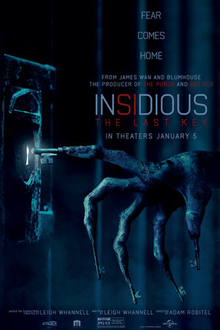
You know, horror sequels get a bad reputation for getting silly or boring over time. Now, there are some that do give this rep some credibility (looking at you, Jason Takes Manhattan). But among horror sequels, there are some truly great gems that have as much punch, or sometimes even more punch, than the originals. And Insidious: The Last Key is one of those sequels, not just for being scary and creepy, but also for keeping things interesting with a character-driven narrative.

In this entry in the Insidious series, Elise Rainier (played by unacknowledged Hollywood treasure Lin Shaye) is called back to her childhood home to defeat the evil spirits that live there and which haunted her childhood. As she and her two stalwart companions Specs and Tucker delve deep into the hauntings in the house, they will not only uncover horrors from the Further, but from this world as well, and from Elise’s own dark memories.

This was a seriously solid horror movie. The best part of it, of course, is Lin Shaye’s performance as Elise Rainier, along with the character’s own arc in this movie. The arc itself is kind of similar to Elise’s arc in the last film–that she’s dealing with trauma and has to overcome it to save a life–but here, the scars are so much deeper, and the raw emotion you feel from Shaye as Elise opens them up makes it seem all so new. You feel her pain, you feel her wanting to make amends, and when you see her triumphs, you share in them.

As always, the atmosphere in these movies is creepy, the right balance between tension and jump scares. The creepiest part, in my opinion, is the antagonist, The Man With the Keys, or Key Face as he’s listed on Wikipedia. This is such a freaky looking demon, and unlike the Man Who Can’t Breathe from the last film, who got scary once you could see him in the light, The Man with the Keys is freaky no matter when you see him. In the light, out of the light, he’s so scary. I think if you put him up next to Bill Skarsgard’s Pennywise and had a contest on just visual terror, it’d be a very close call.

I also like, in addition to the many keys we see in the movie, there is just so many key-shaped imagery in the movie. Pumps, signs, etc. They’re all key-shaped, kind of tying into the theme of the movie of opening up old wounds and opening up the past.

I also thought that new character Imogen (whose name only makes me think of the song “Hide and Seek” by Imogen Heap) was an interesting addition. Not giving anything away, but her presence in the film could be a hint of where the franchise could go from here, given where this film takes place in the series’ timeline. Especially if Lin Shaye wants to finish her time with the series with this film or with the next one.*

Was there anything I didn’t like? A few things. I honestly thought the climax wasn’t as epic as it could’ve been. Not only that, but a few things we saw in the trailers didn’t show up in the film, which is always annoying. And finally, Specs and Tucker, our supposed comic relief, just weren’t that funny.

But all in all, Insidious: The Last Key is well worth plunking down cash for a ticket. On a scale of 1 to 5, I give it a 4.4. Check it out, and open yourself up to some terrifying storytelling.

That’s all for now, Followers of Fear. We’re likely going to have a bunch more reviews this month, so I hope you’re ready for recommendations and opinions. And if the trailers I saw in the theater are any indication, I’m going to have a lot to say in 2018.

Until next time, pleasant nightmares!

*I’m assuming that we’re going to get a sequel, given that already the film has made back its budget and then a bit two days after coming out.

Guillermo del Toro’s films are very much like Tim Burton’s films: there’s a distinctive feel and style to them that sets them apart from other films. A tendency towards the strange and the dark, creatures not oft experienced by man nor treated that much in modern fiction, etc. And such is the case with his latest venture, The Shape of Water, which del Toro says was inspired by when he saw Creature from the Black Lagoon as a kid and was disappointed that it wasn’t a romance between the Creature and Julie Adams.

I have to say, all these decades later, the concept has aged well.

The Shape of Water follows Elisa, a mute custodian at a government facility in Baltimore in 1962. One day, the facility receives an amphibian-man creature from South America, which is kept in a room that Elisa cleans. The two start interacting and romancing, leading to a plot to save the creature from the facility and those who would do him harm.

There’s a lot going for this film. For one thing, it’s beautiful. Everything from the sets to the costumes looks right out of the late 50’s, early 60’s, the lighting is used in different ways to highlight moods and atmosphere, and there are even throwbacks to classic films from that period, including a short musical number that I feel like was inspired by the ones American Horror Story does every couple of seasons. The acting is also pretty stellar: Sally Hawkins as Elisa is wonderfully expressive through facial expressions, body language, and sign language. Octavia Spencer (can that woman do no wrong?) and Richard Jenkins as Zelda and Giles, Elisa’s friends, are full of pathos and charm. And Michael Shannon as the antagonist Strickland, while feeling like a hammy caricature at times, is entertaining to watch on screen.

And oh my God, the make-up on the Amphibian Man (which is his listed name in the movie, I checked). That is award-winning stuff. It looks so real, and as far as I know, mainly CGI-free. That’s really impressive.

All that being said, there were a couple of issues I had with the film. For one, once you kind of understand what sort of film you’re watching, you can kind of guess the plot. It’s been done before, though not with Amphibian Men. So if you can guess the story archetype, you probably will guess where the story is going to go.

There’s also this theme of tolerance and the difficulties of otherness that pervades the film, which you would expect. There’s the Amphibian Man, which isn’t even human. Elisa is mute, Zelda is black, and Giles is gay. Obviously, the filmmakers are going to bring this up. And I’m not opposed to that, I love stories that explore the difficulties of being on the outside for no other reason than being who you are. The problem is, the theme is handled differently from scene to scene. In some scenes, like a scene midway through the movie at a diner, it’s handled very well. But at other times, the handling feels kind of clumsy, which kind of brings down the impact of the theme.

Regardless, this is a wonderful film. If you’re going in for a science-fiction/horror story, you won’t get that. But if you go in for a visually appealing and well-done love story with some sci-fi elements, you’ll end up getting your money’s worth at the theater.

On a scale of 1 to 5, I give The Shape of Water a 3.8. Take a dip into a strange new world, and see for yourself if there’s something to love here.

Now if only del Toro could do an adaptation of At the Mountains of Madness, which he tried to do a few years ago (but only after I’ve read that particular HP Lovecraft story). That would be awesome.

Ever since I stayed overnight and experienced paranormal activity at the Lizzie Borden Bed & Breakfast back in July, I’ve kind of become a bit obsessed with the case and the hauntings that occurred because of the murders. The latest manifestation of that obsession is reading the latest fictional retelling of the events (of which there are several, believe me), See What I Have Done by Sarah Schmidt, who says she was inspired to write it after recurring dreams of Lizzie’s spirit visiting her. I first came across a review of this in Entertainment Weekly, and as soon as I saw it, I knew I had to read it.

See is a fictionalized account of the story of Lizzie Borden, who in 1892 was accused of murdering her stepmother and father with an ax and was acquitted due to lack of evidence and investigator bungling. The story is told from the perspectives of Lizzie herself, her elder sister Emma, their live-in maid Bridget, and a violent drifter named Benjamin, all of whom tell what they were up to on a hot, fateful day in August 1892 in Fall River, Massachusetts.

I have to say, See is not the usual sort of historical fiction I read when I delve into that genre.

Firstly, the four narrators are each given a unique personality and desires, so that it doesn’t entirely sound like just one person narrating four different people. Lizzie is a spoiled youngest child with a hell of a lot of quirks (to say the least); Emma is an older sister who has become constricted by her responsibility as Lizzie’s older sister and as a Borden and wants to run to a new life; Bridget is overworked, and is trying to leave for her homeland of Ireland, despite Mrs. Borden’s attempts to keep her; and Benjamin is a man who sees the whole world as his enemy, and can’t wait to take a swing at the world. Working with one first-person narrator and making them unique is hard enough, so it’s great that for a debut novel, Schmidt distinguishes them so well.

I also liked how flawlessly she manages to weave these four narratives, especially Lizzie, Bridget and Benjamin’s narratives, together on the day preceding and the day of the murders. Telling overlapping storylines, where several characters are in the same place and experiencing things at the same time, has always struck me as a monumental task which requires skills I’m not sure I have yet (if it’s actually easier than I think, let me know in the comments below). Schmidt did it like a pro, to which I applaud her.

But my favorite part is the descriptions Schmidt has her characters use. I’ve never seen descriptions like what she uses. She turns nouns like “termites” or “critters” into verbs (is there a word for that?), and…you know what, let me quote from the first page:

I breathed in kerosene air, licked the thickness from my teeth…My heart beat nightmares, gallop, gallop, as I looked at Father again…Pear skin crisped in my mouth…

How different was that? I have never heard any of these things described this way in fiction, and it’s kind of refreshing to hear. And Schmidt does this throughout the book, particularly with food. She goes all out to describe the food and the sensations of eating in a variety of ways. You really have to read it to believe it.

Now was there anything I disliked? A few things. I was kind of hoping going in that this would be a thriller of sorts that revealed an interesting take on an old theory or even better, a new scenario for the still-unsolved murders. What I got was more of a dissection of the Borden family, showing through several different eyes how grating these people have become on each other, and how it might have been a factor in the murders. And while the portrait painted is beautiful and quite telling of both the author’s vision of and what the family might’ve really been like, I thought the ending where the killer is revealed rang a bit hollow. Like I said, I wanted a new scenario or an interesting take on one of the standard theories for the case, and the way it was eventually portrayed fell a little flat for me.

And as much as I liked the unique descriptions in the book, some of them are used repetitively throughout the novel. I can’t count how many times things, especially fingers, are described as sticky, or how many times heat “itches” at someone. To quote some of my editors, variety in words and phrases throughout a story is important.

And what was up with the dislike for Lizzie and Emma’s uncle John? I get why Abby and Andrew Borden dislike him, he’s probably a bad reminder of Lizzie and Emma’s deceased mother, but why do Emma and Bridget dislike him so much but Lizzie adores him? There’s a lot there that I would’ve liked explained.

But all in all, See What I Have Done is an excellent debut for a new novelist. Putting a score on this book on a scale of 1 to 5 was difficult, but my head kept coming back to a 3.8. Engaging, atmospheric, and full of wonderful prose. Check it out, and ax yourself if you’re ready to dive into Lizzie’s madness.

And yes, I intentionally made that pun. And I stand by it. Goodnight, everybody!

I’m halfway through this series I’ve been doing of rewatching and reevaluting horror films I previously disliked to see if I missed something. And for those of you who are keeping score, I found I now love Perfect Blue, hate The Strangers more than I did the first time, don’t really have a different opinion on The Witch, and feel underwhelmed by The Texas Chainsaw Massacre. And I’ve just finished watching my fifth entry, Oculus. What did I think? Let’s find out.

WHAT’S IT ABOUT: Oculus follows Kaylie and Tim Russell, a pair of siblings who witnessed their parents murdered by the spirit in a mirror as children. They return to their childhood home ten years after those events with the mirror in tow, Kaylie determined to prove that the mirror is haunted, Tim believing he hallucinated everything he experienced as a child. Weaving between past and present, Kaylie and Tim unearth dark memories, old wounds, and eventually, must decide if they are facing they’re own insanity, or an old and intelligent evil.

WHY I DIDN’T LIKE IT: Simple: the ending. I really liked these siblings, and without going into spoilers (though I could be forgiven for them, this film has been out for four years), I didn’t like how the ending treated them. Plain and simple, it just poisoned the film for me.

WHY I REWATCHED IT: An online critic I follow on YouTube did a video a while back of the Top 11 New Halloween Classics, and Oculus got #7. That alone was enough to get me interested in a rewatch. And when I did this series, Oculus was definitely on the list.

Thoughts: How did I hate this movie? It was awesome!

Now, I won’t go into full review mode, but this movie is almost entirely flawless. The concept alone is pretty ingenious, but it’s done in a way that puts you right in there with the characters. You’re seeing their memories as they remember them, at the moment they’re remembering them. And you’re experiencing what they’re experiencing the moment they’re experiencing it. It leaves you not only wondering what is real and what isn’t, but also makes you feel the paranoia and terror of the characters, who by the way are played amazingly by their actors. Especially Karen Gilliam as Kaylie Russell (we love you, Amy Pond!).

I also like how the film isn’t afraid to use a bit of body horror. There were definitely moments where I had to look away because I was so freaked out by what I was seeing, and these moments are never excessive in terms of gore or number of uses.

Add in some great camera work, ambiguity, and CGI that really deposits itself within the uncanny valley, and you got yourself a creepy horror film.

And as for that ending, it’s been four years, and I’ve done some just like it in that time. It’s honestly a good way to close out a horror story, especially if you care about these characters. It makes the ending that much more gut-wrenching. To sum it up, I now approve of the ending.

Judgment: This is definitely a masterpiece in horror filmmaking. On a scale of 1 to 5, I’m giving Oculus a well-deserved 5. Check it out, and see the horror through the looking-glass.

That’s all for now, my Followers of Fear. The next one in this series should be entertaining, at least. And if it’s not, at least the sequels are supposed to be betterthan the original. I’m talking Evil Dead.

Until next time, Happy Holidays and pleasant nightmares one and all.

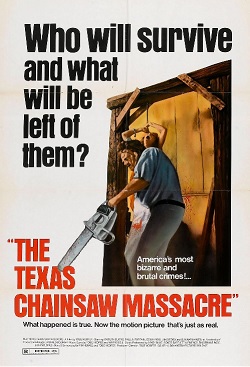
Going with a classic this time around, as well as one of the most polarizing films in horror. Some love it, some hate it. I hated it at first, but I think it’s time I see if my opinion needs to change. After all, this was one of the earliest slashers and is considered a staple of horror movies. Maybe it’ll give me a jump.

WHAT’S IT ABOUT: A pair of siblings and their friends go to the former’s ancestral home to make sure their grandfather’s grave wasn’t a victim of recent grave-robbing in Texas. They later come across a house filled with a cannibalistic family, including the chainsaw-wielding Leatherface.

WHY I DIDN’T LIKE IT: In high school, I had heard this movie hyped so much among horror fans. When I finally could get Rated R movies on my own library card, I was disappointed. I didn’t jump, or feel any atmosphere. I wasn’t scared. It just felt over-hyped.

WHY I REWATCHED IT: You learn more about its production and legacy, you see some remakes and one sequel. You wonder if you missed something. Hence a rewatch.

THOUGHTS: I didn’t care for it.

Yeah, I was more aware of the film’s importance in the horror genre, but I still didn’t find myself enjoying it. It took the film forever to actually get going and become interesting. And even then, it was cheap to the point of noticeable (I refer you to the meat hook scene), there were lots of awkward close-up shots of girls freaking out, and more shouting and screaming than was probably necessary…from the villains. When damsels in distress scream, it’s fine with me, it’s kind of expected. But villains being so loud and annoying…yeah, I don’t care for it.

Yeah, it was quite the shocker in 1974, and that was the point. The film was meant to shock the 70’s movie-going audience. And it did, which lead to it becoming so famous and getting so many sequels and remakes. But to me, who is used to more gore and shock and terror from later slashers, it just feels tame and boring.

JUDGMENT: 1.5 out of 5. Watch it to see what it did for horror, but honestly, once you’re past a certain age and seen enough horror films, you’re just not going to get scared.

Don’t kill me in the comments for hating my opinion. It is what it is.


Next time around, I’ll be taking a look at a film that has become a staple for Halloween, but I had one particular problem with it that ruined the experience for me. It’s time to rewatch Oculus.

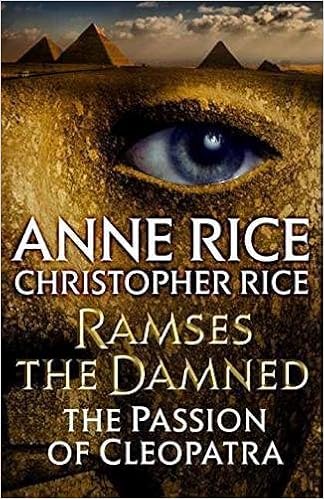
I haven’t read the original Ramses the Damned novel since I was bar mitzvah age, but I remembered enough of the details (and remembered more during the reading of the book) to be very excited upon learning earlier this year that Anne Rice had written a sequel twenty-eight years after the original with her son, author Christopher Rice (whose books I need to put on my reading list one of these days). And now that I’ve read the Rices’ first collaboration, what do I think?

Well, you know how George Miller revisited the Mad Max franchise with Fury Road several years after the last entry, with a new cast and crew to help shape his vision, and the results were pretty awesome? It’s kind of like that.

 Ramses the Damned: The Passion of Cleopatra revisit Ramses and Julie Stratford shortly after the events of the last novel, preparing for their engagement party and their lives as globe-trotting immortals. However, news that Cleopatra is still alive reaches their ears, and there’s a chance she still holds a grudge against them. And as if that weren’t enough, new forces threaten the immortal couple, including an ancient queen whose very existence will turn the immortals’ world upside down.

Honestly, I could not tell this was a collaborative work. This may be because I’m unfamiliar with Christopher Rice’s work, but it’s more than likely he’s very good at imitating his mother’s style. Whatever the reason, the novel has a great story and moves along at a nice pace. The expansion of this fictional world to include new elements and characters didn’t feel forced or weird, and the twists and dramatic moments really allowed you to feel the surprise and attention when they occurred. You can’t complain about that.

And let’s talk about the new characters, because they were great! Bektaten’s addition to the cast was a real shake up, as was her companions Enamon and Aktamu (I hope I didn’t butcher those names trying to spell them). There’s a gravitas to them that leaps off the page and commands respect not just from characters, but from readers. It’s as if their many centuries have allowed them to transcend many human flaws and become something more. Imagine what they could be like in our modern world! It’d be truly something to see.

But of course my favorite new character (and possibly my new favorite character) is the aptly named Sybil Parker, an American author whose dreams cause her to be roped into this strange and magical world.* From the moment she appears on the page, she is just so interesting to follow, as her part in the story is so full of mystery and a bit of intrigue. And her arc, going from this timid homebody to this brave young woman who doesn’t bat an eye at immortals, was masterfully written. 

I don’t have any real problems to point out with this story. Possibly a bit more of Elliot Savarell would have been nice, but that is probably nitpicking on my part.

All in all, Ramses the Damned: The Passion of Cleopatra is a great return for a story we had thought finished long ago. On a scale of 1 to 5, I give the novel a 4.8. Pick it up, and get wrapped up in the story (been waiting a week to make that pun, and it was worth it).

But tell me, what did you think of this novel? What immortal creatures will we get from Anne (and possibly Christopher) Rice next year (I’m hoping angels)? And which Christopher Rice novel should I put on my reading list? Let’s discuss.

*Sounds like my dream life right there. Well, hopefully the former will be achieved someday soon.

Well, I’m back at this again, with an odd film for my third outing. You see, I watched this film last July, and I even wrote a review. So why am I watching it again and making it part of the Rewatch Review series? Well, here’s why:

WHAT’S IT ABOUT: A Puritan family is forced to move out into the wilderness and start a farm on the edge of a forest. There, a witch sets into motion events that will change the fate of this family, especially the teenage daughter Thomasin, forever.

WHY I DIDN’T LIKE IT: Well, I actually did like it. I gave the film a 3.8 out of 5. That’s a good score. However, I went into the film with different expectations based on the title (the titular witch is actually very peripheral to the story), and I had a hard time without subtitles understanding what anyone was saying, which affected my enjoyment of the film.

WHY I REWATCHED IT: Over the past year and however many months, I’ve thought a bit about this film, and how my enjoyment of it was skewed by the fact that I had totally different expectations going in. I wondered if maybe, f I rewatched the film knowing what it’s really about–not the witch, but the family she affects–I’d enjoy it more. So when I decided to do this series, I put this film on my list.

THOUGHTS: I guess I did enjoy it a bit more, but I wouldn’t raise that 3.8 any higher.

The Witch is a good film, and I go into detail why in my review. It’s faithful to the time period in all the best ways, the psychological aspects are handled very well for a first-time writer/director, and the actors are all good in their roles. With great setting and music, it’s a pretty damn good horror flick. And if you watch it with the subtitles and don’t get miffed by the witch only being in the film for about two or three minutes, you’ll enjoy yourself thoroughly.

I did notice this time though that sometimes the lighting makes it hard to make out what’s going on, though. Like seriously, I know you’re in the middle of the woods, but maybe still use some lights so we can see the characters? Thank you!

JUDGMENT: My opinion doesn’t change, but I’m glad I watched it the way it was meant to be watched. It’s still a good movie, and if you get the chance, check it out. Just remember: subtitles! Those thick accents will puzzle you to death if you allow them to.


Well, that’s all for this entry in the series. Honestly, it was shorter than I expected it to be. The next one will probably be a bit longer, at any rate. After all, I’m watching one of the first slashers ever. That’s right: The Texas Chainsaw Massacre. Bring it on!

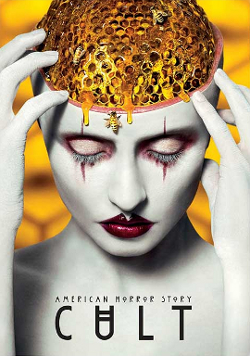
I finally watched the final episode of American Horror Story’s seventh season (one day I’ll be able to give a review right after the season premiere or finale on my own cable package), and I have to say, this has definitely been an interesting season. When people heard that the new season was going to be about the 2016 American Presidential Election, after months of speculation that it would be about either a cruise or something else ocean-related, we weren’t sure what to expect. Would it be preachy and lean towards one end of the political spectrum or the other? Would Trump, Clinton, or some other political figure be featured as a character? And would Sarah Paulson play Trump (if she did, she’d be great at it, no doubt)? And as further details came out, namely that it would be about a cult that arose in the wake of the election and focused on people who felt isolated and galvanized by the election, we got intrigued. Could this actually work as a season arc? Could this be good?

Well, before I get into that, let’s go a bit deeper into the plot. Returning to a normal mode of storytelling after the reality TV show format of Roanoke and being perhaps the most down-to-Earth season in the show’s history, Cult follows two very different people who become intertwined in ways neither would believe. The first is Allie Mayfair-Richards, a business owner and mother with liberal leanings and crippling anxiety who isn’t dealing well in the post-election climate. The other is Kai Anderson, a charismatic young man who begins to gather a group of devoted followers around him as he pursues power in local politics. As their lives start to intersect, they’ll not only make permanent impressions in each other’s lives, they’ll make impressions in the very surface of American politics.

I loved this season. Yes, the first two episodes were kind of slow and clunky, more devoted to commentary than to actually scaring the viewer, but after that the story and scares really picked up. The writers kept things very intimate, so that while this may have seemed like a big story about national politics and American political culture on the surface, it felt incredibly intimate, letting us into the lives and minds of these people. As per usual with American Horror Story, the story was twisty as heck, keeping you guessing where the story would go from one episode to the next and being unable to figure out most of the time where things would go. And after the second episode, they managed to keep the political commentary from getting too over the top. In fact, I think they managed to capture the spirit of American politics very well in this season: confused, divisive, changing from day to day and week to week. Things come up and down, change and merge and break, and become so muddled that you don’t know how it all started. All this was captured very well in this season.

And oh my God, that ending! That’s going to stay in my head for a while.

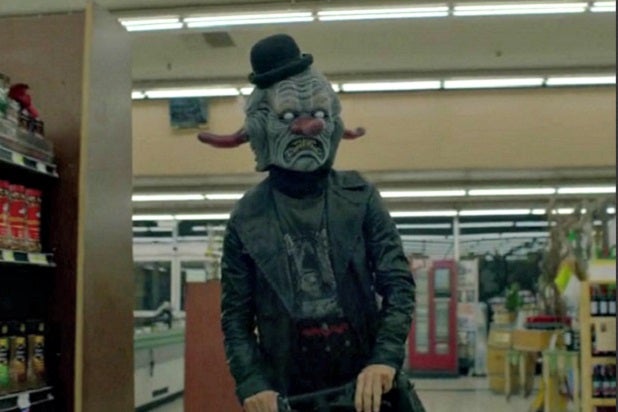
Beware this guy. He is a villain par excellence.

I also really enjoyed the characters. Obviously, the two main ones are exaggerated distillations of the stereotypes of the liberal and conservative voters, with Kai representing some of the darker views of what Donald Trump is to some Americans, but they also feel like real people whom you want to watch and see where they want to go from episode to episode. Each major character is given time to develop so that they feel real to the viewer, and you feel their struggles and/or death. I especially love Beverly Hope, played by Adina Porter (who played my favorite character last season), whose struggles within her workplace, followed by her struggles within a cult that changes drastically from the time she joins to the time she escapes. Kai is also just terrifying to watch. You know what his final goal is, but you never know what to expect from him from moment to moment. He’s like a pinball, causing something every time he touches something. He makes for a great villain. And watching Allie go from this weak, paranoid woman to this strong, somewhat devious fighter was just stunning.

Now, were there any parts I didn’t care for? Well, as I said, the first two episodes didn’t jibe with me, they were more devoted to commentary and set up than actual scares. Those could have been done better. Another issue I had was that I felt the final episode was kind of predictable. I mean, once I saw where it started, I kind of knew where it was going to go (except for maybe that last scene). I expect better from American Horror Story.

I also didn’t care for Lena Dunham playing Valerie Solanas in the seventh episode. Now, I have nothing against Lena Dunham. I think she’s a great crusader for a number of important issues, and I admire her for the success she’s had in the entertainment business. But sadly, I’ve only seen her in a couple of roles, not enough to get a gauge on whether or not I like her as an actress. And in the seventh episode, she just felt miscast. The episode was written brilliantly, the character she played was interesting, but she just didn’t fit well into the role, to the point that she was annoying (I don’t mean that in a sexist way, I just mean she didn’t fit the role and it had a negative impact. Don’t go after me in the comments).

And finally, I felt like the clown costumes could’ve used an explanation. Yes, the character Meadow designed the costumes, but why clowns? Why not a minority abused by the right, or ninjas, or just people dressed in dark clothing? It’s hinted that it has something to do with Twisty the Clown, who makes a surprise guest appearance in the first episode, but we never find out why the cult decides to commit crimes in custom-made clownsuits. I would’ve loved an explanation on that, especially since clowns figured so much in the advertising for the season (speaking of which, where are the bees? They show up a lot in the ads and the opening theme, but barely in the show proper).

This needed more of an explanation.

But other than that, American Horror Story: Cult was a great entry into the series. On a scale of 1 to 5, I give this season a 4.2, as well as the designation of my second favorite season so far (Hotel‘s still the best). It’s engaging, thrilling, and different from any other season so far. Plus it does a better job of talking about oppression and women’s empowerment than Coven ever did, so good on the writers for fixing that mistake. Check it out, and see it for yourself.

Now as for Season 8, details are scarce beyond that it will come out sometime next year, and that Sarah Paulson will return for her eighth consecutive season (yay!). I’m still hoping that I’ll eventually get an Orphanage or Academy/School-themed season. I’m curious as to how, if the theory about each season being a circle of Hell is true, how those themes might apply to those circles that are left. And I’m wondering who will be coming and going for the next season (Lady Gaga! Kathy Bates! Please come back!).

Well, that’s American Horror Story for you. It leaves you wondering up until the moment something happen, and then it blows us all away.

Reborn City, Book 1 of the Reborn City series.

I almost totally forgot this was happening today. I’ve been attending a training this week for work, so that’s been occupying most of my thoughts, and on top of that, yesterday was Halloween, so I totally forgot that anything else was happening this week. Lo and behold though, one look at my Facebook memories today showed me otherwise, and reminded me that today is the four-year anniversary of the publication of my first novel, Reborn City.

Now if you don’t know what Reborn City is, it’s a science fiction novel I wrote back in high school, and which I published back in my third year of college. The novel follows the Hydras, a street gang in a dystopian future whose leaders have incredible powers, and the shadowy government corporation that shows a great interest in the gang. A sequel, Video Rage, came out last year, and the third and final book in the series, Full Circle, is in the works.

Of the stories I’ve published, Reborn City is probably the one that’s gotten the best response from readers, even if it doesn’t have as many reviews as The Quiet Game. A lot of people have gravitated to the world of the story, and to the struggles of the characters, as well as to the intrigue and action that takes place within. But don’t take my word for it. Here are some of the top reviews:

This is an extremely commendable effort by a new young writer, whom I believe we will see much more of in the years ahead. Rami Ungar’s vision of a frightening dystopian future is peppered with those elements that make us all human. There are quite a few surprises in the book, and I am anxious for the next volume in the series to be released.

–Marc M. Neiwirth

This is not a genre I typically delve into, but I took this book on vacation and couldn’t put it down. The plot had me turning pages at quite the clip. The characters were unique and interesting and the imagery had me creating my own visual of what Rami’s interpretation of the future looked like. For first time novelist, Rami Ungar, this was an outstanding showing of talent and commitment to his passion of writing. Looking forward to seeing what he comes up with next!

–Michele

As a reader who does not read books in this genre, I must admit that I could not put down the book. I attribute this to the talent of the author. I am looking forward to reading the next books published by Ungar. I recommend this book to readers who enjoy action with features of supernatural powers and sci-fi.
–ENJ
These and other reviews are the reason why RC has a 4.6 out of 5 rating on Amazon (Video Rage has also gotten some good reviews, but I won’t post them here).

Video Rage, Book 2 of the Reborn City series.

If that short description of Reborn City and the reviews made you want to read the book, I’ll include the links to check it out down below, as well as links to Video Rage. You can also click this month’s featured novel, which happens to be Reborn City, to get taken directly to its Amazon page. And if you end up getting a copy and reading it, please let me know what you think in a review. Positive or negative, I love feedback and I would love to hear (as well as probably post) yours.
Feedback also makes me a better writer in the long run, so you’d be doing me a couple of solids as well.
And if you’re wondering how Full Circle is coming along, please know that I haven’t forgotten about it. I’m just taking a break to work on some horror stories, as well as to make sure Rose eventually gets published. As more news materializes, I will let you know.
Until next time, my Followers of Fear. Pleasant nightmares, and HYDRAS!!! (That makes so much more sense if you read the book).

I did not expect to do a review today. I didn’t even expect to see a new movie this weekend! But then I found out that the fourth or fifth Stephen King film to come out this year (he really is in the middle of an adaptation renaissance) was out on Netflix, I was like, “I gotta watch this. I gotta watch this, and I gotta review it.” So I watched 1922. And what did I think?

Well, it was nothing like I expected. I’ll give it that much.

1922 follows a farmer who plots with his son to murder his wife after she threatens to force them to leave their farm and move to the city, and the consequences of their plans. It’s based on a novella that I’ve only read half of (I was just coming off a huge Stephen King binge, and at the end of those, I just get sick of his style), and I honestly didn’t know it was being adapted into a movie until I saw the trailer last month. I wasn’t too excited, because while the trailer was good, I felt a lot more hype for movies like It and Gerald’s Game. Who knows? Maybe it would blow me away.

Too bad I found it average.

I think the film’s biggest problem is its first half hour, in which the farmer and his son kill the wife (spoilers). They cram that whole thing into about twenty minutes or half hour, from the introduction to the main characters to the murder. Now, usually movies about murdering someone take more time to do that, introduce the characters and then get to the murder. This gives the filmmakers time to introduce us to the characters so that we, the audience, can connect and empathize with them. This time is also used to explain why the characters feel murder is necessary to accomplish their goals. Otherwise the audience won’t understand, and that takes them out of the story.

However, 1922‘s filmmakers are in such a rush to get to the actual murder, they skip over all that. Instead, they use narration and jumpy shots of the characters thinking or pacing or staring into space to try to get all that across, and it’s done poorly. There’s a phrase we writers use: “show, don’t tell,” and that applies to movies too. We only get so much interaction between the characters during this time, in favor of the jumpy shots and narration, and by the time we get to the commitment to murder, we’re just like, “Wait, I have a hundred questions and points I’d like to bring up! I seriously don’t get why this murder needs to happen!”

After that first half hour though, the film does even out, becoming a much better horror film. The pacing becomes much more even, and they dispose of the jumpy shots. It actually makes for a really well-plotted thriller, in which we really see how this murder, as well as some of the consequences–expected and otherwise–psychologically damage the farmer and his son. The actors do a good job of making their characters seem real, and the use of the supernatural in this film isn’t too over-the-top or distracting. It’s actually pretty creepy at times.

Still, there’s nothing during the time after the first half hour of the film that makes the film extraordinary. No terrifying corn chase scene, no stalking of the main characters that makes you feel a chill. It’s just average psychological thrills and family drama, and we’ve seen a lot of it before in a hundred films, books, and TV shows.

Still, it’s better than the first half hour.

On a scale of 1 to 5, I give the film 1922 a 2.5. It’s a horror film, but there’s better material out there, Stephen King or otherwise. Go watch that instead.


That’s all for now, my Followers of Fear. I’ll try to make the next blog post I put out either something about my life or about examining something in writing or horror that’s worthy of discussion. Until then, have some pleasant nightmares and a great weekend.