Posts Tagged ‘Ohio State University’

Every now and then I look to do a post musing on the mechanics or subtleties of writing fiction, and today is one of those days. And as you can tell from the title of this post, I want to talk about unreliable narrators, those strange voices in the books we read (and occasionally in the films and TV shows we watch) whom we can’t always trust.

According to that awesome source of usually-factual info that is Wikipedia, an unreliable narrator is a narrator, usually in some medium of fiction or another, whose veracity has been called into question. Usually this happens very early in the story, where the narrator may make a plainly false or delusional claim, or it may happen elsewhere in the story, perhaps near the end where a twist in the story turns everything we thought we knew upside down or slowly through hints that are given to us in the narration. Stories with unreliable narrators can feature a single narrator, or multiple narrators giving their own versions of events, or even a supporting or side character who tells a story in such a way that we question whether or not they’]re being entirely truthful about what happened.

A great example of an unreliable narrator is Patrick Bateman from the novel American Psycho. As a man suffering from psychoses and the occasional hallucinations, Bateman makes a great unreliable narrator. Other examples include Nell from Wuthering Heights, most of the characters from the Japanese movie Rashomon, and Ted Mosby from How I Met Your Mother (according to show creator Craig Thomas, anyway). Oh, and any story that has children narrating it could possibly have unreliable narrators, because kids sometimes remember things incorrectly.

(If you want to think about it though, every one is an unreliable narrator, because no matter how they see events, they are biased, they may mis-remember details, and they may cover things up in order to make themselves look good or to hide their own guilt. But let’s not get too philosophical about this. Otherwise we’ll be here all evening)

One of the characters in my thesis project, the antagonist, is an unreliable narrator. Because of his mental problems and his infatuation with protagonist Rose, he sees things through a very certain light, so when he tells a story it is often through that lens, which probably won’t reflect reality too well. As I’ve never written a story from the point of view of an unreliable narrator, so exploring the device through this character should be interesting. (Or have I used unreliable narrators before? Technically, any time I tell a story from the protagonist’s first-person point of view, it could be construed as unreliable, but i’m not sure if it counts. Oh darn it! Now I’m an unreliable narrator of my own writing career!)

But why are unreliable narrators used so much? And why do they appeal to readers and writers alike? It’s a very difficult question, and I’m not sure I have an answer. Perhaps for writers, it’s the chance to tell a warped version of events. When we tell a story, especially through the lens of an omniscient or almost-omniscient third-person narrator, it’s almost expected that the story being told is what actually happens, one-hundred-and-ten percent factual. Even when the story is limited to the viewpoint of a single character, that third-person narrator’s portrayal of events is assumed to be accurate. Heck, even when we read a novel told in the first-person, we tend to see the depiction of what happens as true. Especially if we like the character.

An unreliable narrator allows the writer to break from that, to tell a story that might not be accurate, and that the reader and maybe even the writer will have to guess how true the story is or how much we can trust the narrator to tell the truth. In fact, maybe that’s what the reader gets from these sort of storytellers: they have to figure out how trustworthy the storyteller is, or where the line between truth and the storyteller’s own delusions or beliefs is laid down. It’s like solving a mystery or a puzzle, in a way, and the only way to really solve it is to read on until you finish the story. And even then, you might not be able to tell how reliable the narrator is (which is why there are e-forums to discuss these issues).

In any case, I’m going to enjoy exploring the antagonist’s own unreliable stories and seeing how much we can or should believe him. It’ll make for an interesting discussion point when talking about my thesis with my adviser during the next semester.

What do you think of unreliable narrators?

Have you ever used them in your own writing? How did it go?

This morning I woke up to a very interesting article, about a female volleyball player who was being criticized for “being too beautiful to play”. Sabina Altynbekova of the the women’s under-19 volleyball team of Khazakstan, has come under fire recently because her looks are too distracting. At a tournament in Taiwan, fans becae infatuated with her, and caused an Internet sensation that’s spread to the rest of the globe, with videos of her doing the simplest things gaining hundreds of thousands of views. As her coach, Nurlan Sadikov*, said to the press, “It is impossible to work like this. The crowd behaves like there is only one player in the championship.”

Sabina Altynbekova before a game.

*Just in case you can’t figure it out from the name, Sadikov is male.

If the photo I’ve attached to this post doesn’t make it obvious, Ms. Altynbekova is a very beautiful young lady. in fact, if I were standing right in front of her right now and I thought I had even a sliver of a chance, I’d ask her out. However, what irritates me isn’t that she’s pretty. It’s that she’s being criticized for it.

For years, female athletes have been held to a much different standard to their male counterparts. Males athletes have to be able to stay athletic and be good at the games they play. At the same time, the female players are expected to be athletic, good at their sport of choice, and feminine. In intervies, men are asked about what they do to stay good at the game, where they see themselves and their teams going this year, and what they hope to do if and when they retire. Heck they might even get a question about politics or religion. The women get asked about how they stay fit or what they look like in a bikini or if they have boyfriends or plans to marry and have kids.

And when a man has huge legions of screaming fans, regardless of sex, it’s considered a plus, that they’re the epitome of manhood and that’s just something that comes with the game. Apparently when women like Ms. Altynbekova have that problem, it’s considered a distraction and takes awa from the game and the players. To a female athlete, her status as woman means she must be held to a different standard. She must be pretty, but not too pretty, good at the game but not too good and let it not be suggested that how good she is should be the thing we focus on, lest we give women the idea they are just as good as their male compatriots. Otherwise, she is neither an athlete nor a woman.

Even a guy who is unable to care about sports outside of Buckeye football like me finds this treatment appalling. And you know what else? This attitude isn’t anything new. In fact, one could even say this attitude that the sports industry has towards women–that they are inferior, and only as good as their ovaries and what they must do to get men and children–has been going on since the ancient Greeks, when women were barred from the Olympics and all participating were required to play naked to make sure this was an all-boys club.

It’s no coincidence these figures are male.

And this is just the tip of the problem. There is all sorts of denigration of women in the sports industry, from constant jokes about women’s sports teams being wastes of times unless someone flashes a side boob or that they should waitress instead to the emphasis that women can never be as good as men at sports (considering my stepmom taught me how to play soccer and softball in our backyard, I’ll disagree on that one), and moreover, they shouldn’t.

Occasionally this spills over to the realms of domestic abuse. In May, Ravens’ running back plead not guilty to aggravated assault after being arrested for beating his fiancee and dragging her unconscious body out of an elevator by the armpits three months previously. What did the NFL do about this? They gave him a two game suspension from playing football. You read that right. He’s not allowed to play for the Ravens for two games.

Stephen A. Smith, whose comments have caused a huge storm among viewers.

The suspension, as expected, has caused a flurry of controversy. Unfortunately, some of that controversy has been less than helpful. Stephen Smith, a commentator from ESPN’s “First Take”, said last Friday on the show that women should be aware of “the elements of provocation”, basically saying that women are partly to cause for the abuse they suffer, which is what their abusers would want them to believe. He apologized for it on Monday, saying that it was the most “egregious error of his career”, but the fact is, when he said that women were partly to blame for their abuse, he said it to millions of men across the nation. Some of whom may see it as justification for their own abusive ways and would have shrugged off the apology as something Smith’s bosses or the liberal media or whatever wanted him to say.

At least Keith Olbermann over on ESPN2 had the right idea of it. As he said on a recent segment of his show:

“By some tiny amount each one of those things lowers the level of basic human respect for women in sports. And sooner or later, there are so many tiny amounts that the level of basic human respect is gone altogether…Eventually after all the b-words and ho comments and penis remarks and nudity demands and waitress jokes, the most powerful national sports league in the world can then get away with suspending a wife-beater for just two games.”

Olbermann speaks the truth. And luckily there are ways to fight against this sexist attitude in the sports industry, and in other places as well where sexism pervades. First, we can stop with the comments that put women down, saying that they’re inferior or bad athletes or that they focus on being pretty. At the same time, we should focus on not giving power to the myth that men, in order to be men, have to be strong, dominant, and sometimes even violent. This idea turns men into monsters, not men, and we should work to stop it.

And the best way to do that is to walk the walk and not just talk the talk. One of the ways we can show that is to be an example to other men and women. Show that you are not that kind of guy by being respectful to women, by outright saying that these harmful jokes and stereotypes aren’t funny or okay and also teach those who can be changed and taught the right way to go about things. It’s not much, but it’s a start.

What do you think of these problems in the sports industries and other places? What do you recommend to fix them?

This morning I started work on my next book, which will double as my thesis for my senior year. Well, that’s not quite accurate. Truth be told, I came up with the idea for my thesis back in autumn last year, and then while searching for a thesis adviser, I fleshed it out a bit more, deciding what would happen in this or that scene or whether I wanted this or that event to happen at the beginning or ending of the story. And after I found my adviser, I had to make some decisions so I could know what books I would order for research and therefore why I was applying for a small grant to afford said books. And after I got said grant and returned from Europe, I worked hard on Laura Horn so I could get that done before I began work on my thesis.

Well, this morning I began in earnest to start researching and outlining my thesis. I stopped by the English Department to make sure everything was in order for the following year, stopped by another department so I could possibly do some more research for my main character, and then started on the first draft of the outline, of which I’ve made a little bit of progress on.

Now, some of you might be asking yourselves, “Is he going to tell us what his thesis is about?” Actually, I’ve decided to be cruel and not tell you at all. You’ll have to wait until the book comes out.

Just kidding! No, my book is called Rose, and follows the story of a grad student named Rose Taggert. On the night of Rose’s engagement party, she gets killed in a hit-and-run. This leads one of her students, who has an obsessive infatuation with Rose, to kidnap her body from the morgue and resurrect her using nature-based magic. The way he resurrects her though leaves Rose dependent on him for her survival, which causes the young man to believe they are in a relationship. With Rose trying to find a way out of her situation, she is set against impossible odds, and may not be able to overcome them.

How’s that for a setup?

Rose is the first full supernatural horror novel I’ve written in a while. Reborn City and Video Rage were sci-fi stories, while Snake and Laura Horn were thrillers, the former having some obvious horror undertones. I’m looking forward to diving into some full on horror. I know how the novel begins and I know where it’s going to end, and I know some of the things that’ll happen in this story, I just have to flesh out the rest. The thing about some horror stories, this one among them, the main character or characters have to face seemingly insurmountable obstacles in order to escape the evil plaguing them. Sometimes they do it successfully, other times they don’t. The thing is, you’ve got to make it about the protagonist dealing with the great evil at each and every turn and looking for ways to fight back against it. And sometimes fighting back will do more harm than good, leading the reader to wonder how they will continue on with the odds against them and read on.

So believe me when I say, I will be looking for some great ways to make Rose’s life difficult. Or second life, I guess. Either way, it’ll be very exciting for the reader (I hope).

I’ll be doing periodic updates on the progress of Rose, with the ultimate goal being finishing the first draft before the school year is up and I graduate (oh my God, I can’t believe how close it is! It’s sneaking up on me). Tonight, I hope to resume my work on the outline and get that done by the end of the week. First though, I’ve got some other things to take care of, including another blog post to write up. As usual, my life won’t slow down any time soon.

Wish me luck, my Followers of Fear!

When most people hear that I work, they ask me where I work. I inevitably reply, “I work part-time at the financial aid office at OSU.” What I often forget to add is, “I’m also a fiction writer in my spare time.” The reason I bring this up is because I recently read this article on the Huffington Post (which you can check out here) in which she learns that her friends don’t see her as working because she writes full-time, and reasons why writing full-time should be considered working (some of those reasons I will reiterate here).

The thing is, writing is work. Hard work. Some people envision writers as sitting on their butts with a notebook, typewriter, or a laptop and watching a story unfold before our eyes. In their minds, we might as well be playing video games or watching Netflix for all the energy we’re expending.

The reality is far from that image. Here’s my process for writing a novel, for example: I outline the story, which usually takes a couple of weeks depending on how crazy my life is. Then I do my preliminary research, which is usually done when I’m not working at the office or doing schoolwork (so summers make a great time to do research because I’m not in classes, but sometimes I’m not lucky enough to be in summer when I do research). Then I start to write. And there’s nothing more daunting than the blank page at the beginning of a project. My novels are usually upwards of eighty-thousand words, so seeing that first blank page is terrifying. I have to force myself to get the first words onto a page and from there try to get into a groove.

Usually I’m doing schoolwork and working part-time while I’m writing, so I often save my writing during the evenings, and usually during the commercial breaks when I have something on TV I really want to watch. So how much I get done is dependent on time, how distracted I am, if anything else comes up in my life, and a million other things. With this sort of schedule, writing a novel can take anywhere between six months (which was the case with Snake) to almost two years (as was the case with Reborn City). I’m in the final chapters of Laura Horn, and I’ve been working on that for over a year, taking breaks for all of life’s crazy moments.

And that’s another thing: sometimes I have to take a break from writing in order to work on school or anything else going on in my life. When that happens, it usually takes longer to get words down on the page. As was the case with RC and is the case with LH.

Your average writer.

And if I need to do some additional research? That takes a bite out of writing time too.

And after I finish a novel, it usually requires one to three more drafts before I’m ready to publish it. Even then I usually send it to someone (usually another author and a friend, though in the future I might be looking at professional beta reader/copy editor to help me with the technical stuff) to make sure I haven’t missed any plot holes or horrible typos. Then I design the interior and the cover, apply for a copyright, and set a release date.

And after the book comes out, there’s all the marketing to do. Heck, even before the book comes out, I’m advertising in every place I can so that as many people as possible will know about the book and maybe want to read it. I’m blogging, Facebooking, tweeting, updating business cards, e-mailing, slipping mentions of my new book into articles, updating my resume, telling people by word-of-mouth, and asking people who do end up buying the book that once they’re done, I’d really appreciate it if they’d write a review or do something else to let me know what they think. And that’s just the tip of the iceberg when it comes to all the marketing I have to do in order to get word of my book out there.

Because let’s face it, I don’t have a team of advertising professionals. I’m self-published, so part of the territory is that I’m doing all my advertising on my own. It isn’t easy, but it’s something I take upon myself so that my book can sell well and people will read it.

Does that sound like sitting on my butt playing video games or watching Netflix? No, it’s work. We don’t have time cards or an office cube or water coolers, and very rarely anything like a regular paycheck. But yeah, we are working. It’s as grueling a job as working in the Sales Department or on an assembly line or going to a meeting with execs from another company. Our job just allows us the perks of setting our own hours and picking our own projects.

In summary.

So I think from now I’ll be adding that writing is my other part-time job when people ask me where I work. And I hope people who read this article who aren’t writers will realize we’re not just relaxing in our living rooms or home offices (if we’re lucky enough to have those) playing solitaire or watching funny cat videos on our computers. We’re working, and we’re working hard.

Still don’t believe me? Then go ahead and write your own novel that’s halfway decent, and then tell me it’s not work. I’ll wait.

How do you feel about writing as work?

Has anyone ever mistook what you do for free time? How did you respond?

The entrance to the Louvre, surrounding by many fountains.

The entrance to the Louvre, surrounding by many fountains.

The other night, I was watching the classic Doctor Who serial City of Death (one of these days I will have to write an article on Classic Who from a writer’s perspective, because it deserves one), and I found myself freaking out because the serial takes place mainly in Paris, about thirty-five years before I myself was there. (Fun fact: City of Death was the first Doctor Who serial to be filmed abroad, filming between April and May of 1979. So yeah, 35 years before I would visit the city itself).

It was delightful for me to see all those sights in the actual episode, because I’d been to those places and I remembered what it was like to be there. I found myself reliving riding the Metro after a long day, trying to navigate my way back out onto the street after taking a twenty-minute train ride, because those stations can sometimes be little mazes in themselves. Or walking along the river Seine during a leisurely stroll and then sitting in a café near the Champs Elyesees and having a crepe and Orangina (I miss that brand of soda, by the way. It’s so hard to find here in the States).

The Eiffel Tower at night.

The Eiffel Tower at night.

The serial also had scenes set at the Eiffel Tower and in the Louvre. Both those places hold a lot of memories for me. For the Eiffel Tower, it was one of the very first places I visited when I was in Paris. My friend Ramsey Hardin and I decided we go on a late-night jaunt to see the Eiffel Tower at night, and we ended up somehow climbing all the way to the second level (not the top, because that was closed that late at night). It was an amazing view. From every angle you could see Paris at night, a lovely city of lights and mystery. There are hardly any skyscrapers in Paris, mostly due to the French’s distaste for them, so we had a clear view of the city at night. The tower itself starts having a light show with flashing bulbs bright enough to give people seizures about every hour or so, and that was fun to watch. While there we also had the opportunity to talk to a family from the States who were there for a special birthday celebration (the mother’s) and a group from a technical school in Texas that were there for their own study-abroad trip. If the Tower hadn’t had to close, I’m sure we would’ve spent another hour or two there talking to people and enjoying the views.

Ramsey and I at the Eiffel Tower.

Ramsey and I at the Eiffel Tower.

The Louvre has an altogether different feeling. There is more nudity depicted in that museum than in the world’s biggest strip club, and yet there’s just as much religious iconography and scenes to rival the Vatican. And through it all is an air of strange reverence, as if everyone is aware that they are in a temple as holy as any shrine. Even as people take photos of the Mona Lisa or Madonna on the Rocks or paintings so big they take up an entire wall or ones small enough to fit on a cramped bookshelf, there’s a subdued air, as if people are paying their respects to the products of old history and culture. It’s very strange, and you can only really get a sense of it by actually going to the museum itself.

My most artistic selfie.

My most artistic selfie.

But compared to Notre Dame, the Louvre might be a funhouse. I went there after the Louvre, and it’s a very amazing place. From the moment you arrive, you are struck by the very detail of the building. The entrances have so many figures carved into them that you could spend an hour just looking at them and guessing who they are. And once inside, it is very dark and quiet, with people looking around or praying. You can’t help but feel a strange holiness to the place, a sense of godliness no matter what your religious beliefs (or lack of them) are. I even met a couple of OSU alumni there (we’re everywhere!) and they agreed with me on that. I might’v spent more time there if I didn’t have to be back to the hotel by a certain time to meet up for dinner.

See any hunchbacks behind me?

See any hunchbacks behind me?

What does all this rambling have to do with anything? Well, I guess it’s the power of memory. Although sometimes very fallible, the power of memory can transport you through time and space, landing you in a totally different age and location. Just watching that Doctor Who serial was enough to bring me all the way back to France and those five or six lovely, idyllic days of study and learning and wonder and fun, faster than even the TARDIS, even. And I was so happy to return too, because it’s an experience I’ll never be able to relive again, and the memories and photos are what keep the memories alive.

And I hope they stay alive for a long, long time.

I’m going to tell everyone a midrash, a story that helps to explain aspects of Judaism, and which may or may not be true, depending on the story. This story, no matter how you look at it, is very interesting and helps to explain why I’m able to give these reinterpretations.

The story dates back to the writing of the Talmud. Several rabbis were trying to decide on an issue of kashrut, or dietary law. Eventually all the rabbis except one decided a certain way on the issue, with the remaining rabbi insisting he alone was right. This rabbi, who was apparently so learned that he could teach Harry Potter a thing or two (my own phrasing, not the story’s), said that if he was right, then the walls in the study house would cave in, a tree would move from one place to another, and that the river outside would flow backwards. Sure enough, the walls started to lean in, a tree walked across the ground, and the river started flowing backwards. With each occurrence the other rabbis would remind the rebellious rabbi that walls, trees, and rivers don’t decide matters of Jewish law (and they chided the walls for trying to bring themselves down when it wasn’t their conflict). Finally the rebellious rabbi said, “If I am right, let a heavenly voice confirm it!”

At that moment a great voice from above was heard saying, “Follow this rabbi’s opinion!” The other rabbis, instead of cowering and giving in, replied to the voice, “Matters of law are now on Earth, not in Heaven.” The heavenly voice replied, “My sons have bested me.”

What does this tale tell, besides the fact that apparently Talmudic rabbis were said to be quite powerful? Besides the teaching that a majority rule is stronger than a single zealot (and the rebellious rabbi later became a heretic and was excommunicated, interestingly enough), the story shows that once God gave the Jewish people the Torah at Mt. Sinai, it was in their hands, and therefore they had to decide how to interpret it. So basically while some may claim that LGBT people and their allies are going to hell and claim the Bible says so, I can claim just as much that that law no longer applies and that LGBT people and their allies are just as holy as anyone else. And guess what? We can both be right!

I tell this story because a lot of people’s arguments and opposition to LGBT rights are based on a singular interpretation of the Bible, so alternative interpretations of the Bible can be just as legitimate as traditional ones. I also tell this story because, while two opinions can both be right, sometimes one opinion may have more reason to be right than the other (as in the ruling of the majority in the story). For example, I can say that I believe both evolution and the Genesis story to be right. I can’t ignore that dinosaurs, the fossil record, and the distance travelled by the light of certain stars make evolution seem more right than Genesis (which I tend to view as a metaphor for the Big Bang and evolution that humanity is too stupid to understand at this point in our existence).

No denying it: gay people are born that way. It’s in their DNA.

Understanding this, let us look at what science has proven: that sexuality is a genetic trait, and that multiple genes make up sexuality, so multiple sexualities arise. Some people, like a pastor I had the displeasure of hearing speak out on the Oval at OSU this spring, claims that meant homosexuality is a genetic defect. But that would mean there would have to be a loss or impairment of quality of life for the affected. If anything, the scientific method has shown through studies that people who are open about their sexuality and accepted for it tend to live happier lives. It’s only when they try to deny, change, or hide their sexuality that there is some impairment.

Likewise, this also means that homosexuality isn’t a lifestyle, or something you can indoctrinate youth into. As I said, differing sexualities are genetic, and you can’t pray away, condition someone, or ban something so caught up in the very DNA in a person.

Now, some might ask about my previous post, where I said that homosexuality was commonplace in Greece in a ritualized form. I say that was a form of cultural homosexuality. It was done because it was part of the culture, everyone was doing it, and nobody could see any reason not to do it. Plus, having a male lover was a choice, not a requirement. You could almost compare it to video games: everyone seems to play video games these days, and most people don’t see a reason not to play them if you can. (I know that we’re talking about two very different things here, but you get the idea, right?)

In any case, I’ve said what I wanted to say about the Bible, religion, and homosexuality before Pride weekend here in Columbus. I hope you enjoyed the posts I’ve written and perhaps were given some food for thought. And if you’re in the Columbus area this weekend and are looking for some fun, come to Pride. Leave the picketing signs at home, and have a blast. I’ll see you there.

Last night, my roommate and I went out on a pub crawl, trying various bars in the campus and Short North area. At some point we were joined by a friend of mine and his friend from Israel. It was a fun time and I enjoyed it very much, especially in the gay bars (for those of you who haven’t known me for that long, I came out in bisexual back in March of this year). I made some great memories with people I care about, I learned where you can get some interesting mixes and cocktails, and I even met one of Columbus’s drag icons (yes, we have drag icons. Not surprising, considering that Columbus is one of the LGBT capitals of the Midwest. Yes, Columbus is one of them).

However, there was one aspect of last night that I did not enjoy: around the time I was done at the Union bar (great fun, by the way), I started to feel very strange. I’d had a few drinks, and I guess I’d had more than I’ve previously had (even at that Jewish wedding not too long ago, if you can believe that), because I was feeling much more inebriated than I’d ever felt before. And despite how happy I was, I was kind of scared. I felt like the connections between the rational part of my brain and my body were being disconnected, because I had less control over my body. I also noticed that a few connections were being loosened between my rationality and whatever part of my brain makes decisions, because I was acting a little wilder than usual.

Luckily I didn’t do anything I’d end up regretting later on (so calm down, Ima and Abba). I do that often enough while sober. But at some point, I said to my friends that I’d had enough and that I wasn’t going to drink anymore. I got encouraged to have a few more drinks, but I held my ground and stopped drinking. Even at the next bar we visited, a famous dance club across from the Ohio Union, all I had was water (I was thirsty anyway, so it was good of me to get hydrated). And some of my friends thought I should’ve continued testing my limits or that I was trying to put a stop on my own 21st Birthday Pub Crawl, but I thought–or as much as I could think, anyway–and I still do think I made the right decision. I like being in a good mood, and last night I was in a very good mood, partly because of the alcohol I was drinking.

But I don’t like the feeling of my body and mind being so out of control. It’s a scary feeling, like watching yourself through your own eyes and not having any input over what’s happening. And it’s not something I’m willing to repeat any time soon. So for the time being I’m going to stay away from drinking (along with sweets and a few other things that aren’t necessarily good for me), even though my fridge is stocked with some really good drinks at the moment. I have a feeling that after last night, and with Columbus Pride Weekend and a wedding coming up soon, I would be better off holding off until the next weekend. And even then, I’ll probably drink sparingly.

Perhaps another time I’ll test my limits with alcohol. For now though, I think it’s best I stay at the limits I tested last night. Because not only do I not want to make a mistake that will haunt me while trying to have a good time, but I just don’t want to feel that out of control again. In fact, I don’t know why anyone would.

That’s all for now. I’m going to get some work done, and then do some reading before meeting my dad, my grandfather, and my sisters for a Father’s Day dinner. Happy Father’s Day, my Followers of Fear.

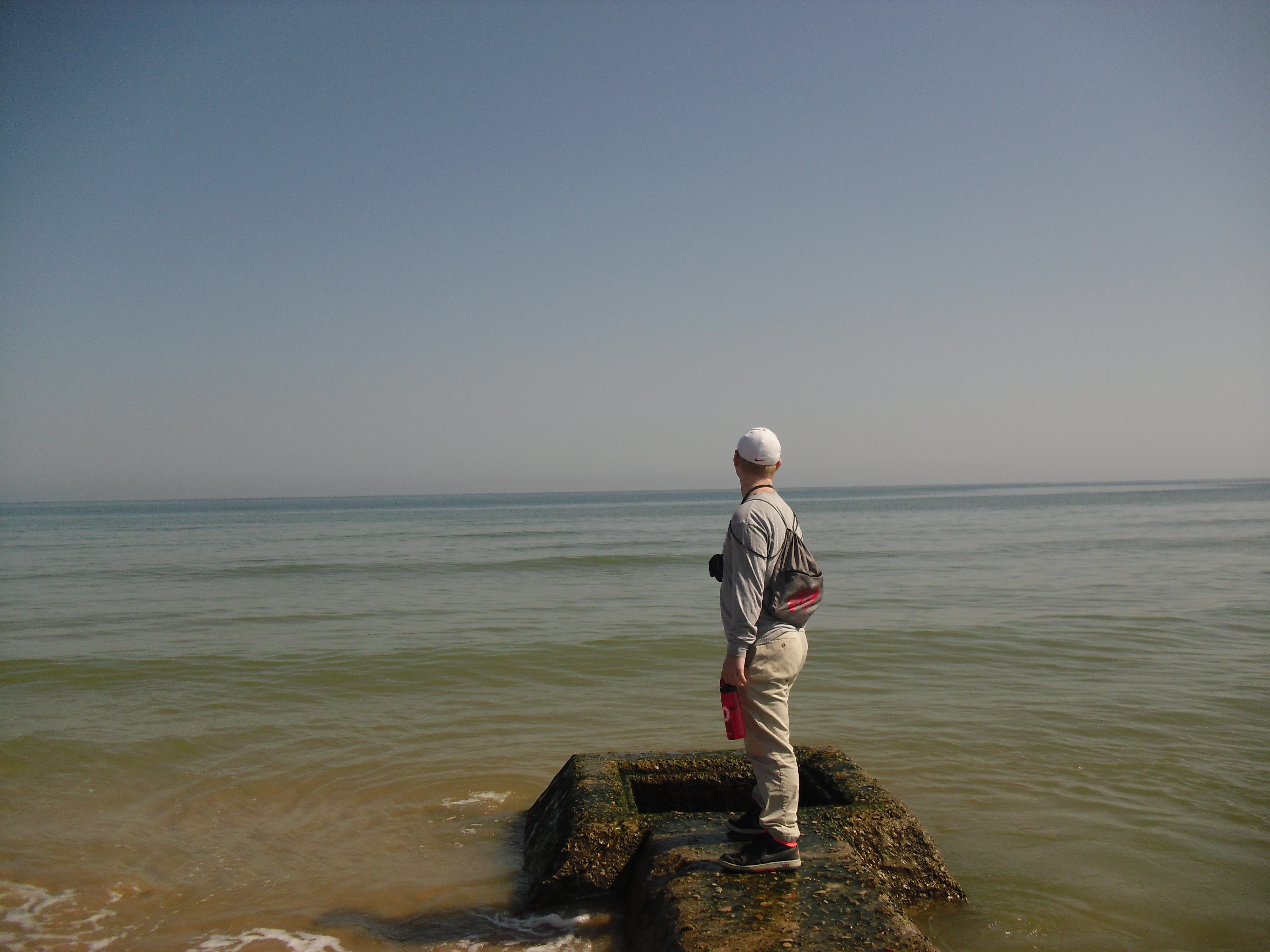
Me standing on a stone walkway on Omaha Beach, looking into the distance and trying to imagine what the seas looked like on June 6, 1944.

Me standing on a stone walkway on Omaha Beach, looking into the distance and trying to imagine what the seas looked like on June 6, 1944.

While my study abroad trip was in Normandy, we visited Utah Beach, Omaha Beach, and Pont-du-Hoc. It was quite an experience. For one thing, except for the memorials at Utah Beach to fallen soldiers and the museum next to the memorials, each beach looked like an ordinary beach. You had to really look for vestiges of the war that had raged on the sands nearly 70 years ago. Whether it was the structure in the water meant to obstruct the D-Day boats, or the preserved (I assume preserved) anti-aircraft gun standing on a pedestal, or the set of stairs leading up to a bunker in the mountain, there were hints at what had happened there.

It was really weird. You stand there, and you’d think it was just an ordinary beach. It’s hard to believe that the things that happened there really happened. I wonder how it was for the veterans who were still alive and able to make the trip to the commemoration ceremonies (like this badass Ohio former paratrooper), to come back to the beaches all these years later and seeing bare vestiges of the war left. Must have been disorientating, to say the least.

At Pont-du-Hoc though, you could totally hear the echoes of the past. Pont-du-Hoc, if I remember correctly, is not too far from Omaha Beach. Scattered all throughout the area are rubble, the remains of German bunkers and weapons, and dozens of craters, varying in size from six feet across to twenty feet across or more. Don’t even get me started on how deep those things went! I was scared to go down into the deeper ones lest I be unable to get out again without assistance.

CIMG2417

My friend David Corrigan in one of the deeper pits. This one was maybe twenty feet deep and twenty-five across. It was quite the shock to see it for the first time.

It was easier there to get an idea of what the war was like. You could see evidence in the craters, from the huge blocks of concrete, and from the gun pits and passageways, that war had been waged in this area. And what an area it was! You get the impression from movies and TV shows that a battle, no matter the size of the army, is maybe contained to a place the size of a football field. Pont-du-Hoc was probably several football fields long and wide. It really redefined my belief on what a battle was like.

And when I closed my eyes, I could almost hear the sounds of the battle, echoing across the stream of time from seventy years ago. And I was awed by it all, by the magnitude of what had happened and the horrors the soldiers must’ve witnessed in the spots I stood on. It was so hard to fathom. Thank God I have a writer’s imagination, which made it a little easier, but what I saw in my mind’s eye was probably nothing like it really was back then.

Now, veterans, their families, and world dignitaries such as Obama and Putin and so many others are there to remember the fallen and the battles waged just as I did a few weeks before. It’s right that they should, because it was D-Day and Operation Overlord which began the destruction of the Nazi regime and helped to free so many people from the horrors of fascism and racism. And while technically it was the Soviets who really ended Nazi Germany’s reign of terror, D-Day had a large role in ending it as well. D-Day and everything after.

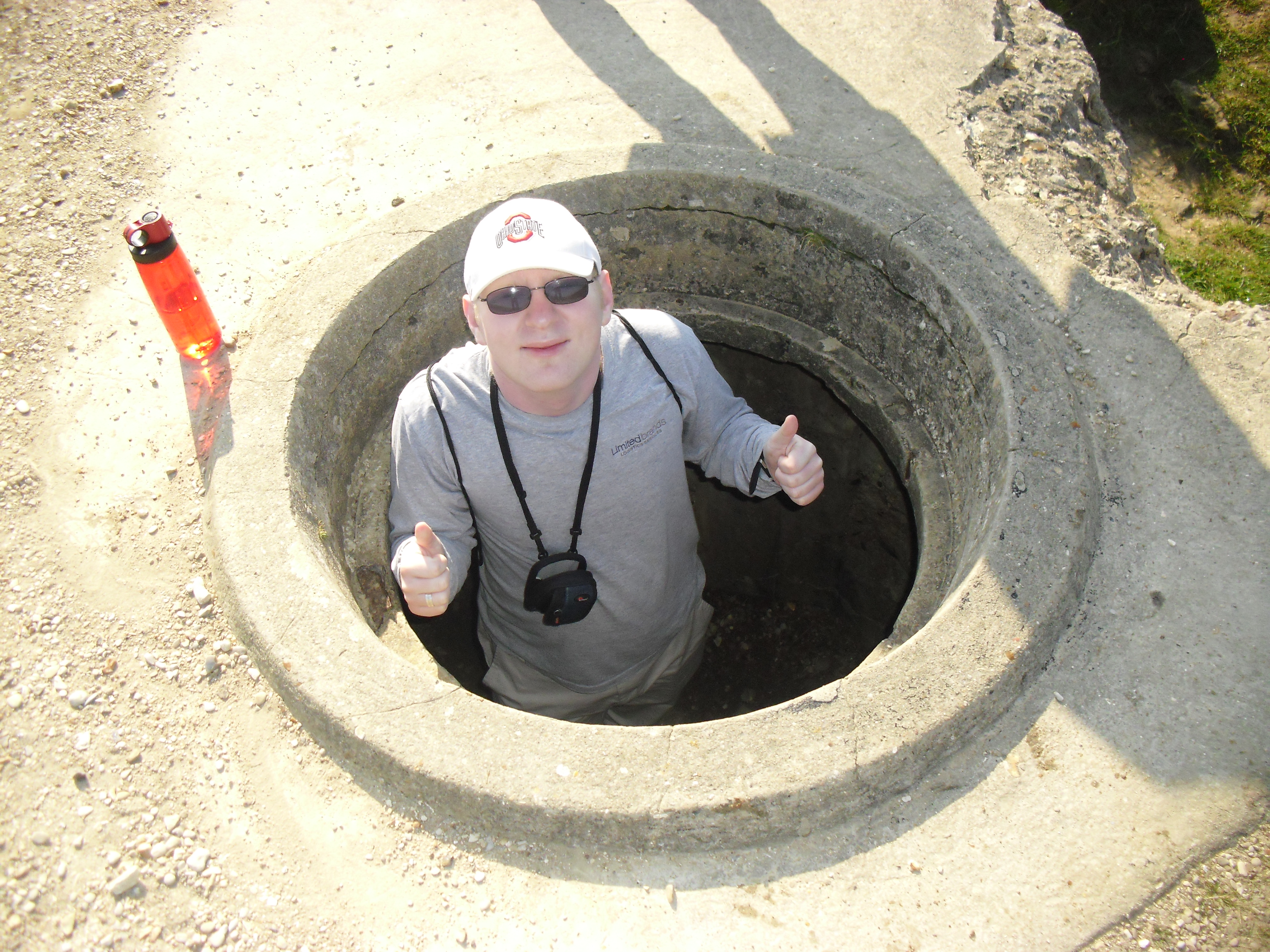
Me in an anti-aircraft gun pit. Trust me, I had to struggle to get in there.

Me in an anti-aircraft gun pit. Trust me, I had to struggle to get in there.

And I’m so glad I’m at least able to contribute something, even if it’s only some musings and a couple of memories and photos, to the celebrations and commemorations. I’m so happy to say that I was there and that I have more knowledge than I did of the invasion on this auspicious day. And I’m happy that I was able to reach back across time like that and get some sense, even if it was just a small one, of what happened on those beaches and in the surrounding countryside.

Thanks to all those who served in the war, who helped to liberate Europe from Nazi tyranny, and who still today serve to protect the ideals of freedom and peace. It’s all because of you that I’m able to write this. And I and so many others will never forget it.

Ah, the Eiffel Tower. See how it glows in the night.

Ah, the Eiffel Tower. See how it glows in the night.

Hi honey I’m home! After about three weeks in England, France, and Germany, I’m finally back in the States. I will definitely miss being in Europe (I will especially miss transportation made easy through the Metro systems), but I was beginning to miss my family and my life here and I’m glad to be back.

Of course, now that I’m back I’m not going to spend the whole time on my butt (though for the most part that’s what I’ve been doing while I get reacclimatized). In addition to catching up on all my shows and going to see some movies that came out while I was abroad, I plan to be very busy this summer. I’ll be doing my usual chores and errands, for one thing, and I’ll be working in the financial aid office for the whole summer (and if I can find one, I’ll try for another job that’ll allow me to work one or two days a week to help with the income). I also plan to finish my novel-in-progress Laura Horn, which I think I can get done by mid-July if I don’t get too distracted. I also hope to write plenty of short stories after I finish the book, because God knows I have plenty of ideas for those (I came up with about 40 ideas for stories while in Europe, most of them short stories. The lesson to be derived from this is that if you’re a writer and you find yourself on a trip abroad, bring a notebook to write down any ideas you have).

What else do I plan to do? Oh yeah, Snake will be coming out on June 10th, so I’ll be getting ready for that. And The Quiet Game’s one-year anniversary will be in July, so I plan to hold a sale for that on the e-book. And I’ll try to do some author interviews now that I’m back in the States, as well as finally getting around to editing Video Rage, the sequel to Reborn City. And maybe I’ll finish some of the series I’m watching on Netflix.

In short, I’ll be very busy.

But enough about that. I said I was going to share some of the stories from my study abroad trip. I think I’ll start with my last night abroad, with the final dinner. Why? Because it shows how much we bonded over the trip:

We were having a special dinner on the second floor of a beer garden at Alexanderplatz in Berlin called Lindenbrau. The weather was cloudy and rainy, but we didn’t really care, because we were all very happy. Maybe that was because of the alcohol and warm food, but we were happy. I was talking with my teachers and y roommate Henry and my friends, and I had a wheat beer in front of me. Most of us were really sad to go, but we were also glad that we’d had this experience together. Also, a few of us were itching to go home, or to go to other places if we were staying in Europe longer (I might have and gone to see Poland and Italy or maybe go back to England, but I couldn’t afford it).

And then our teachers, Dr. Steigerwald and Professor Willging (affectionately nicknamed Dad and Mom, respectively, by our group), stood up to say some words. They said how proud they were of us, and how they hoped we would all stay in touch for years to come. And then they handed out awards to us, the kind like “Most Likely To…” or “Least Likely To…” awards. We were invited to guess whom each award was for, and I got about three or four of them before anyone else. My award was, “Most Likely To Wander Into Rommel’s Chateau.” Considering how oblivious I can be sometimes, that’s not very surprising.

And then something interesting happened: Ramsey Hardin, one of the people on my trip who had become probably my best friend while on the trip, arrived late and hungry. He’d gone to a museum to get a little bit more culture, but on the way back traffic had been really bad, and he’d ended up about an hour or so late getting to the beer garden. Believe me, he was upset, and only a jug of beer and a really huge ham could possibly relieve that anger.

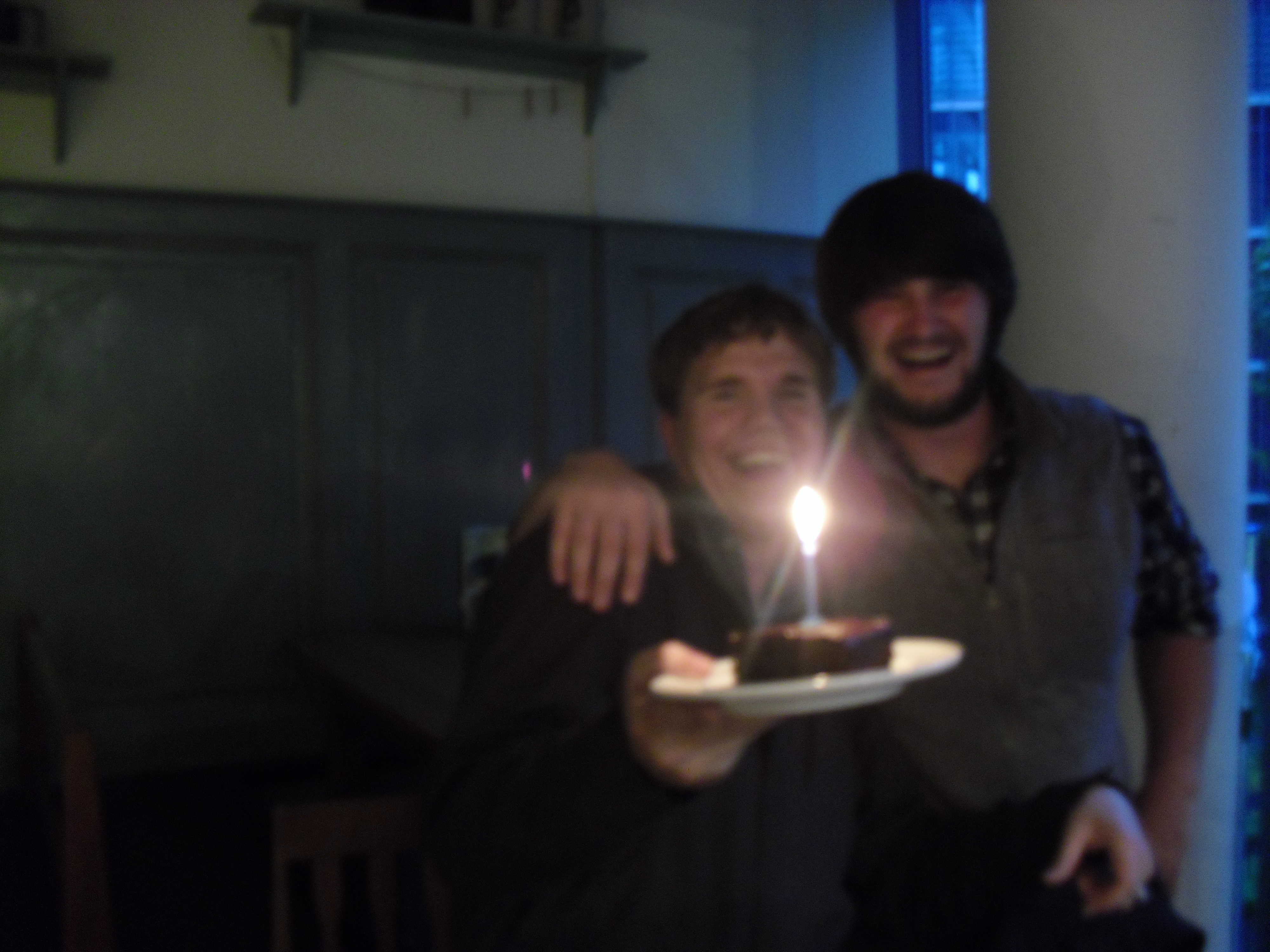
Happy Birthday Ramsey Hardin! By the way, that's David Corrigan photo-bombing te shot. What a goof!

Happy Birthday Ramsey Hardin! And that David Corrigan with him, by the way.

But then a huge surprise came out: the waiter brought Ramsey a piece of chocolate cake with a single blue candle stuck into it, a flame dancing on the wick. It was Ramsey’s twenty-fourth birthday. Boy, did that cheer him up! I wonder what he wished for, though. He probably asked for a big book of history. Ramsey’s a huge history buff, and reads anything about the past. In fact, he was voted “Most Likely To Teach Alexander the Great History” or something like that.

We ended the evening with dessert and a few more drinks, and then I went back to the hotel, to get ready for tomorrow’s flight and to store all these wonderful memories in my head.

And trust me, I’ll have a fun time relating them to you all in the coming months (or until you’re sick of hearing about them). That’s all for now though. Hope you enjoyed the story, my Followers of Fear. I’ll tell another one when I have a moment.

Snake

Guten morgen, meine Anhanger der Angst!

I think I said “Good morning, my Followers of Fear” in German. I was teaching myself German, but the craziness of the semester kind of ended my lessons abruptly. Anyway, these past two weeks I’ve been doing character interviews for my upcoming novel Snake, out June 10th. The first interview was with the two investigators leading the hunt for the Snake. The second interview was with the Snake’s girlfriend, Allison Langland. And today, we have the Snake himself! How exciting! Let’s hop right into it, ja?

Notes and Stats:
Sex: male
Age: 18
Race/Ethnicity: Caucasian
Birthday: January 2
Eye color: blue
Hair color: Dark brown
Religion: If he had to describe his religious beliefs, they’d probably align with Deism.
Affiliation: None
Special Powers/Abilities: Physical strength, a very high IQ, knowledge of various ways to kill people as well as deep forensic knowledge, adept at languages and chemistry, experience with training guard dogs and with reading body language.
Notes from the Author: The Snake hasn’t changed much from my original conception of the character as a serial killer whom people might root for. At the same time, I had to really work hard to make him a believable character, because I had to make it believable that he was normal until the events of the novel turned him into a serial killer. I like to think that in the end it worked out very well, though.
Oh, and another interesting thing about the Snake: I never reveal his name in the novel. Not once. I know what it is, but I find all sorts of ways so that I can avoid using it. I did that because I wanted to show that any one of us could be like the Snake: one day an average person, the next day transforming into a killer through circumstance and necessity. It is a scary concept when you think about it, because you realize that it is possible that could happen to just about anyone. Including you.

RU: Hello, Snake.

Snake: Hello.

RU: Wow, you didn’t ask me who I was or how the heck you ended up in Berlin. That’s a first.

Snake: I have an idea.

RU: …Okay. So Snake, how goes the search for Allison Langland?

Snake: I always knew that I loved Allison. I only realized how much my love for her went when I heard her kidnapped over the phone.

RU: Wait, you were on the phone with her when she was kidnapped?

Snake: In that moment, I realized how much she meant to me, how much she lit up my life and filled me with such joy. And I felt such a loss at the thought that something might happen to her. Like a great deep hole had opened up in me where she belonged. And every second that I’m not with her, that I don’t know if she’s okay or if something horrible is happening to her…it’s agonizing.

RU: I can’t imagine. You didn’t become a killer just then, right?

Snake: No, that happened later. After I witnessed something horrible.

RU: Well, don’t reveal it here. There are some people I’d rather not hear that particular story just yet.

Snake: I think you just partially confirmed my theory about who you are.

RU: Well, I hope you turn out to be mistaken. Anyway, where are you now in your search for Allison?

Snake: I can’t really be sure how many people I’ll have to go through before I find her. I’m now hunting a man named Veretti. He actually saw Allison, if my last victim is to be trusted. If he yields valuable information, then I’ll be one step closer in my search for her. That’s all I care about, really. Finding Allison. And I won’t let anyone get in my way.

RU: Well, I’ll let you get back to it. Good luck.

Remember, Snake comes out June 10, and will be available in paperback and e-book. And if you’d like to find out more about Snake before that date, you can read the other interviews or you can check out the Snake page here. And if you’d like something to tide you over until the book actually comes out, Reborn City’s e-book is still available for $0.99 on Amazon and Smashwords. Better download it before June 1st, or the price will go up a dollar.

That’s all for now. I’ve got a trip to a museum in a few hours. Auf weiderschein, as they say here. I hope I can write again before I come back!