Posts Tagged ‘reflections’

Three articles within a week. I’m impressed with myself. And this one marks my 20th post for Self-Published Authors Helping Other Authors, which apparently is quite the milestone, seeing as WordPress gave me a congratulatory notification this morning.

Anyway, today’s article is How To Write An Epilogue, a follow-up to yesterday’s post about writing prologues. I figured that since I’d already written one on prologues, I might as well do one on epilogues, which require different tools from writing prologues in order to write them effectively. So far it’s gotten a pretty good reception, which I’m happy about. I hope plenty of people find it useful.

And if you’ve liked my previous posts on Self-Pub Authors, you should seriously consider checking out the other articles on the site. It’s a wonderful website, filled with helpful articles by other independent writers for independent writers on learning to write, edit, publish, and market independently without spending a ton of cash. I’ve certainly found it very helpful, and that’s why I write for them.

Now that this article is out, I’ll take a short break from article writing and focus on my other work. I want to conduct a few author interviews and then get back to work on finishing Laura Horn and promoting Snake. My life never seems to get easier, though I kind of like it that way. I wonder what life will be like for me when I’m no longer in school and I (hopefully) have a full-time job?

All for now. I’ll write again later if I can, my Followers of Fear.

Yes, I wrote another article for Self-Published Authors Helping Other Authors. This one is How To Write A Prologue, which I found a little bit challenging to write. I’ve written prologues before, but I really struggled with what made a good prologue, and had to really examine all the ones I’ve read and all the ones I’ve written over the years to write a helpful argument.

Interesting enough, I originally didn’t intend to write this article. But while in France (in Paris, if I remember correctly), the site got a comment asking if we had any articles on writing prologues. We didn’t, and I was sad to report that. So this article was kind of to rectify that lack of prologue-related article. I hope that the reader who posted it is able to read the article and find some helpful advice in it.

And speaking of helpful advice, make sure to check out the rest of Self-Pub Authors. It’s written by independent authors for independent authors, and offers a variety of helpful articles on making writing, editing, publishing, and marketing independently easy and cost-effective. You never know what helpful articles you’ll find while reading this website.

All for now. I’ve got some other work to do, so I’m going to get on that. Have a good weekend and have a safe Friday the 13th (because it’s also a full moon. That can only mean trouble!).

I’m back on Self-Published Authors Helping Other Authors, and it’s good to be back. My latest article is Showing vs. Telling, which covers one of the most difficult aspects of learning to be a writer. Often we are told by our English teachers when learning creative writing to “show, don’t tell”, but rarely are we actually shown how to distinguish between the two. The purpose of this article is to do just that.

So if you have a moment, please go check out the article. And if you have a few more minutes, please check out the rest of the website. Self-Published Authors Helping Other Authors is one of the most helpful sites for independent authors, written by independent authors to help others write, edit, publish, and market their books for little-to-no cost. Take it from me, you never know what helpful article you’ll come across.

All for now. I’ve got a bit of work today to get done, so I’m going to get on it as soon as possible. Wish me luck, my Followers of Fear, and have a great day.

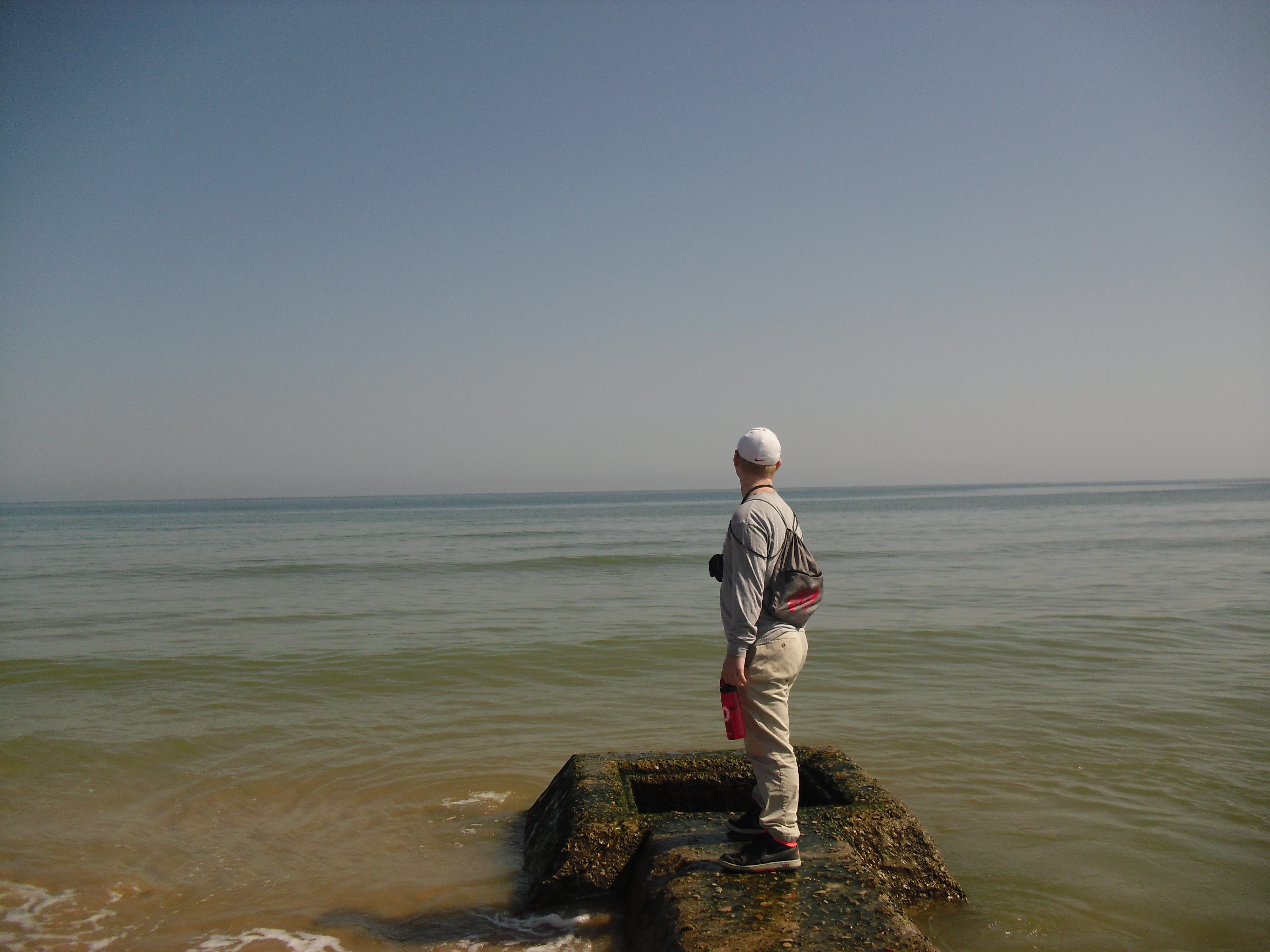
Me standing on a stone walkway on Omaha Beach, looking into the distance and trying to imagine what the seas looked like on June 6, 1944.

Me standing on a stone walkway on Omaha Beach, looking into the distance and trying to imagine what the seas looked like on June 6, 1944.

While my study abroad trip was in Normandy, we visited Utah Beach, Omaha Beach, and Pont-du-Hoc. It was quite an experience. For one thing, except for the memorials at Utah Beach to fallen soldiers and the museum next to the memorials, each beach looked like an ordinary beach. You had to really look for vestiges of the war that had raged on the sands nearly 70 years ago. Whether it was the structure in the water meant to obstruct the D-Day boats, or the preserved (I assume preserved) anti-aircraft gun standing on a pedestal, or the set of stairs leading up to a bunker in the mountain, there were hints at what had happened there.

It was really weird. You stand there, and you’d think it was just an ordinary beach. It’s hard to believe that the things that happened there really happened. I wonder how it was for the veterans who were still alive and able to make the trip to the commemoration ceremonies (like this badass Ohio former paratrooper), to come back to the beaches all these years later and seeing bare vestiges of the war left. Must have been disorientating, to say the least.

At Pont-du-Hoc though, you could totally hear the echoes of the past. Pont-du-Hoc, if I remember correctly, is not too far from Omaha Beach. Scattered all throughout the area are rubble, the remains of German bunkers and weapons, and dozens of craters, varying in size from six feet across to twenty feet across or more. Don’t even get me started on how deep those things went! I was scared to go down into the deeper ones lest I be unable to get out again without assistance.

CIMG2417

My friend David Corrigan in one of the deeper pits. This one was maybe twenty feet deep and twenty-five across. It was quite the shock to see it for the first time.

It was easier there to get an idea of what the war was like. You could see evidence in the craters, from the huge blocks of concrete, and from the gun pits and passageways, that war had been waged in this area. And what an area it was! You get the impression from movies and TV shows that a battle, no matter the size of the army, is maybe contained to a place the size of a football field. Pont-du-Hoc was probably several football fields long and wide. It really redefined my belief on what a battle was like.

And when I closed my eyes, I could almost hear the sounds of the battle, echoing across the stream of time from seventy years ago. And I was awed by it all, by the magnitude of what had happened and the horrors the soldiers must’ve witnessed in the spots I stood on. It was so hard to fathom. Thank God I have a writer’s imagination, which made it a little easier, but what I saw in my mind’s eye was probably nothing like it really was back then.

Now, veterans, their families, and world dignitaries such as Obama and Putin and so many others are there to remember the fallen and the battles waged just as I did a few weeks before. It’s right that they should, because it was D-Day and Operation Overlord which began the destruction of the Nazi regime and helped to free so many people from the horrors of fascism and racism. And while technically it was the Soviets who really ended Nazi Germany’s reign of terror, D-Day had a large role in ending it as well. D-Day and everything after.

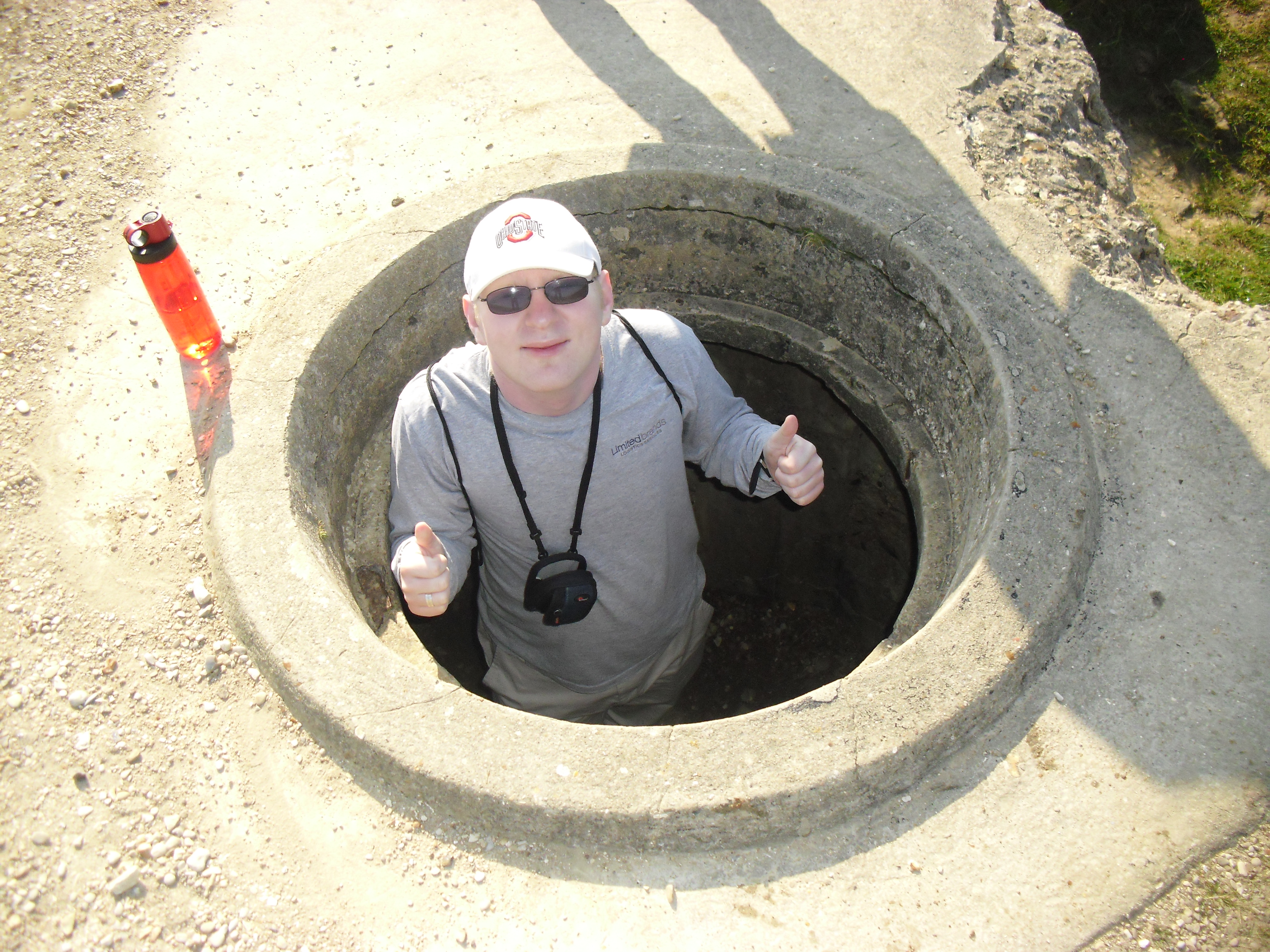
Me in an anti-aircraft gun pit. Trust me, I had to struggle to get in there.

Me in an anti-aircraft gun pit. Trust me, I had to struggle to get in there.

And I’m so glad I’m at least able to contribute something, even if it’s only some musings and a couple of memories and photos, to the celebrations and commemorations. I’m so happy to say that I was there and that I have more knowledge than I did of the invasion on this auspicious day. And I’m happy that I was able to reach back across time like that and get some sense, even if it was just a small one, of what happened on those beaches and in the surrounding countryside.

Thanks to all those who served in the war, who helped to liberate Europe from Nazi tyranny, and who still today serve to protect the ideals of freedom and peace. It’s all because of you that I’m able to write this. And I and so many others will never forget it.

This afternoon I found on my news feed that another college, this time Seattle Pacific University, was hit by a gunman. Details at this point are still few, but what is known at this time is that one person has died, three more are in the hospital, and that the gunman was disarmed by students while reloading his gun.

While I’m glad that nobody was hurt, I have one question: is it enough yet? Because it’s only been a couple of weeks since Elliot Rodger went on a shooting spree in his black BMW, killing 7 people around UC Santa Barbara because, as he said in a very creepy YouTube video, “girls aren’t interested in me”. And these are just the most recent: Sandy Hook, Aurora, Virginia Tech, the Sikh Temple, and even more that I may have missed. The point is, we have a serious gun problem here in the United States, as well as a serious opposition to seeing any sort of change to try and stem the bloodshed. In fact, only a couple of states have enacted any sort of gun legislation, such as background check and limitations on ammunition or automatic rifle bans. Other states have actually made it easier to get and carry guns around, and the federal government has bowed to the pressure of gun lobbies so that no legislation has gone through on that part.

Look, I know that as a nation the United States is slow to do things that are vital to protecting the health of its current and future citizens. Our healthcare is still tied for 37th place worldwide, our welfare system loses funding every year as well as our education system, and the road to environmental reforms designed to stop climate change is like climbing a mountain sometimes. But honestly, we’ve lost so many lives to gun violence in so many years, and every time, everything from the media to lack of God to making gun pictures in school is blamed, but guns are not. Legislation dies, the news moves elsewhere. And every time the event repeats, more people shout “Enough is enough! We’re tired of this!”

Indeed we are. And we’re tired of the rhetoric against gun control. “Guns don’t kill people, people do.” If that’s so, do toasters not toast toast, but toast toasts toast? “Gun laws don’t work, because people will still break the law to get guns.” And people will still buy meth even against drug laws or run red lights against traffic laws. Maybe we should get rid of law altogether. “We have a Second Amendment right to guns.” That amendment was written when the worst you had was a hunting rifle, that rifle could get your family food for the week, and the state might call upon you at any time for a militia. Not to mention that a handgun does just as much damage to an intruder in your home as an automatic rifle, which is actually worse for hunting than just a regular rifle. And you know what else is a right to us as Americans? Freedom of speech, but the Secret Service will still arrest people who say they will kill the President or anyone else in high office.

Look, I’m not saying that we should lock away every gun in the United States and only let the military, police, or the government handle them. But I think some common sense laws would do a world of good. Several other developed nations have gun control laws, and remarkably, their levels of homicides and suicides with guns are much lower than that of the United States. Surely we can do the same and be even better at it, if the USA really is the greatest nation in the world?

Or are we going to let some more shootings happen? Where will they happen next, I wonder? Perhaps one will happen in my backyard, near where I live and go to school. Or one will happen on Capitol Hill and scare the bejesus out of every senator around. Or maybe at another elementary school! The point is, the way things are it’s very easy for these shootings to happen at all these locations and more! Airports, grocery stores, office buildings, subway systems, libraries, apartment buildings–stop me anytime!

None of us want this to happen again. But unless we enact some long-term change, gun violence will continue to be a constant problem in our nation, and will claim the lives of so many more. And that’s something we just can’t keep allowing if we’re to continue on as a country, especially one that the rest of the world looks to a lot as an example of what it means to be a superpower.

Oh, and I just want to mention one more thing: two girls, much more influenced in their crime by violent media than any other killer I’ve seen so far, nearly murdered their friend after stabbing her 19 times in the name of Slender Man. I garauntee you, if she was shot with a gun even once, she probably wouldn’t have survived. And the man who attacked a bunch of children in China with a knife around the same time as the Sandy Hook massacre? All of those kids survived too. Just something to chew on.

Diversity is a big thing these days. We need more diverse student bodies, more diverse workforces, and above all, more diverse casts in movies, books, and TV shows. And I don’t consider that a bad thing. On the contrary, diversity is a good thing, because it represents our diverse population and the many wonderful people on it.

However, I take issue when writers stick in a single minority character or one female character into the main cast and say, “Diversity element added”. Because that’s not diversity. That’s just being lazy. You see, a really diverse cast doesn’t just have a couple of characters you don’t usually see in these sort of stories. A really diverse cast has fully developed characters that grow and evolve over the course of the story, and they all come from many different backgrounds.

Take the main cast of Captain America 2: The Winter Soldier (I would’ve done Reborn City instead, but I have a strange feeling that more people have seen Captain America 2 than have read RC. Just a feeling, but it’s a strong one). In that movie, the four main characters have great depth, they do some growing in the movie, and we see sides to them that have not been revealed previously. Three of them also happen to be the exact opposite of the usual superhero protagonist, namely a white guy on the front lines. Black Widow is a woman and Falcon and Nick Fury are both black, but neither of those traits define them or are the main points to make them interesting.

Okay, the main points that make them interesting is their fighting abilities, cool gadgets, and the awesome things they can do, but that’s beside the point! There’s more to them than the fighting and what’s on the surface. They are all given a chance to grow in this film, and we really get a chance to know them. Natasha and Steve Rogers develop a relationship over the course of the film that swings between best friends and a sibling love for each other, while San Wilson becomes the one person who can relate to Rogers because of their shared experience. And Nick Fury, besides revealing information about himself that might have been a surprise to many fans, also had to question the organization he lead. Specifically, is it doing more harm than good? And is it worth it to keep SHIELD around?

All these characters are different from what might be or have been considered normal for superhero films, but that’s not what makes them great. What makes them great is that they have depth, they have growth, and whoever wrote the film didn’t feel that just because they were black or female that was character development enough!

So with the upcoming Batman vs. Superman film, they’ve apparently already cast Wonder Woman (who is obviously female) and Cyborg (who is black). I don’t know what sort of role they’ll have in this film (or in any sequels which will inevitably pop up), but I do hope that their characters are given as much time to develop and grow and reveal their hidden sides in the movies as the other characters. There’s a huge literature from which the writers can draw wonderful storylines from. I’d really like to see what they do.

And if they only focus on Wonder Woman’s being a woman or don’t give Cyborg enough treatment as a character, it’ll diminish my enjoyment of the film that much more.

So thanks for listening to my rant on the need for real diversity in our popular media. I’ve got a flight in a few hours, so I’ll write again when I can (though when that’ll be I have no idea). Have a lovely day, my Followers of Fear.

Dr. Angelou, reading her poem “On the Pulse of Morning” at President Clinton’s 1993 inauguration.

As I booted up my laptop today and logged onto the Internet from my hotel room in Germany, I was greeted by the most depressing news: author, poet, activist, and just plain wonderful human being Dr. Maya Angelou had passed away. Dr. Angelou, who had been teaching at Wake Forest University since 1982 and was a prolific writer and poet throughout her life, had been experiencing health problems recently and had had to cancel several scheduled events because of it. She was 86 years old at the time of her passing.

Immediately I felt  a horrific sense of loss. I never met Dr. Angelou, nor have I read as much of her work as I’d have liked to. But I remembered very vividly reading I Know Why The Caged Bird Sings one summer for school a few years back, along with The Autobiography of Malcolm X. Both books impacted me very deeply and I remember feeling powerful emotions reading Dr. Angelou’s book as I read the events based on her early life experiences, sadness and sympathy and anger and several others depending on what story she was relating to me through her words. It left a very deep impression on me.

And so when I heard that Dr. Angelou had died, I immediately felt the loss that people around the world are probably feeling at this moment. I took to Facebook to write that the world has lost a guiding light in Dr. Angelou, that her passing was swift and painless, and that her memory, words and deeds will last for centuries. But somehow I felt it wasn’t enough, so I decided to write this post about her as soon as I could. Hence this post you are reading now.

Dr. Angelou was an influence for good throughout the world. She worked her way up from a variety of jobs, including a cook, prostitute and nightclub dancer, to become a writer and journalist. Active in the Civil Rights movement, she worked with both Dr. King and Malcolm X, and has also influenced the feminist movement. Her writing has been hailed as “a work of art that eludes description”, and helped bring memoirs from African-American women writers from the margins of literature to the forefront. She made on average eighty public appearances a year, even as she reached her eighties, and was given numerous doctorates and awards, including reciting a poem of hers at President Clinton’s inauguration in 1993, and she received the Presidential Medal of Freedom by President Obama in 2011. In addition to poetry and autobiographies, Dr. Angelou wrote plays, screenplays for TV and film, essays, cookbooks, children’s books, spoken word albums, and also did acting and directing work on stage and in film and TV.

But most importantly, she gave people a voice. Dr. Angelou gave voices to many African-Americans, women, and others who had been pushed to the margins of society. Caged Bird, probably Dr. Angelou’s most famous autobiography, has been translated into many different languages. This is not only a testament to the popularity of the book, but also to how relatable it is to people of other nations and cultures, how many different peoples can relate to Maya’s own struggles and see it in themselves, or in their people’s struggles. Some have even credited it with allowing black women writers to finally have center stage in the world of literature, instead of on the side where for far too long they’d been ignored and underappreciated.

President Obama said a few hours after the news came out of Dr. Angelou’s death that she reminded us “we all have something to offer”. Whether it be in words (written or oral), in action or just in being there for someone, we all have something to offer. Dr. Angelou offered many a voice, a way to speak about the struggles of the underappreciated and marginalized. Her words resonated with many throughout her lifetime, and I’m sure that they will continue to do so for years to come. And as the years go by, as Dr. Angelou’s works are read and dissected and discussed and debated by readers of all kinds and stripes, as movie adaptations and TV specials and new stories and poems recreate her for a new generation, and as the occasional politician or news commentator tries to appropriate her legacy for some political cause or another, I hope that one fact shines through it all, that she gave the world her voice, and allowed others to speak through it and with it.

And speaking of having something to offer, I decided on the spur of the moment to create a tribute video to Dr. Angelou. It’s not very good, and at the very most it showcases that I’m slowly getting more comfortable with video-making on computers (a valuable skill these days, it seems). But the song I put in, “Bye Bye” by Mariah Carey, is heartfelt and speaks to the emotions of many, and I think it shows my sincerity. What do you think?


You know. about five or six days ago, Dr. Angelou sent out this tweet:

I think this tweet says a lot about Dr. Angelou, because it seems that her words were definitely sent by somebody to make a difference in the world.

So to all those who were close to Dr. Angelou in life, I wish you my deepest condolences. To those who only knew her through her words, her reputation, or through her actions and influence in the world, you probably feel the same as I and many others do: like we’ve all lost someone important. And to the good Dr. Angelou herself, wherever you may be, I hope you’re doing well and that you know that your legacy will continue to influence and help us all for years to come. Thank you.

I can’t believe it’s already upon me. I mean, I’m just about all packed up, I’ve written numerous posts about it here and elsewhere, and I’ve got my passport and plane tickets and everything else (I think. I always forget something. Hopefully that won’t happen this trip, and if it does hopefully it’ll be something easily replaceable).  I’m still coming to grips with the fact that it’ll be happening. I feel like I’m in a novel, about to go through a wardrobe or be taken by cyclone or get in a blue police box and travel to some fantastical place only glimpsed in dreams, a place where history comes alive and romance is possible (I wish) and new adventures await at each and every corner.

But it is happening. My dad will pick me up later today and take me to his place for an overnight so he can drive me to the airport in the morning. I’ll stay in Toronto the latter half of that day waiting for my flight, and then I’ll take a red-eye to arrive early morning in London* to meet up with some of my fellow study-abroad goers and one of our teachers, where we’ll take a bus to our hotel and…well, from there it’s pretty open. Anyway, it’s happening, as hard as it is to believe. I’ll be in Europe till the 29th, and I’ll be experiencing everything and anything while I’m there.

*If God forbid my plane disappears over the Atlantic and CNN devotes all its time and energy to making a big deal out of very little information, I swear I will come back as a ghost and haunt the people in charge of CNN until they actually start acting like a news channel. I was already planning on becoming a ghost, but now I have something to haunt!

You know, it’s hard to put my finger on what exactly I’m looking most forward to. Is it visiting these museums, or places where battles or atrocities actually happened? Is it seeing Titus Andronicus at the Globe Theatre, or visiting the Paris catacombs? Is it taking a million photos and coming up with a thousand ideas for novels and short stories? I have no idea. I’m looking forward to just about all of it.

Well, I’ll be coming back with plenty of stories to tell, I’m sure. I’ll probably make several posts about the trip too. However, you can get these stories sooner by checking in regularly to my OSU-provided blog, which I will update in each new city we stay in (we’re going to be in London, Bayeux, Paris, and Berlin, by the way). And if for some reason that link isn’t working, you can find the blog at u [dot] osu [dot] edu [slash] ungar [dot] 19. I promise, there will be plenty of photos and stories there for me to share with you.

And don’t worry, I’ll be posting some other stuff on this blog while I’m away. After all, Snake‘s coming out in a month and five days. I’ve got to advertise for that (and I plan to, as only Rami Ungar can). And of course, if you’re really desperate to read something by me while I’m gone, or more likely you’re looking for something new to read, Reborn City‘s e-book is available for $0.99 throughout the month of May. You can check it out on Amazon and Smashwords any time this month, and get a great discount when buying it. And if you love it or hate it, please don’t hesitate to leave a comment or write a review letting me know. I love feedback, no matter what sort it is.

All for now. I’m going to go through my apartment and make sure I’m not forgetting anything important that I have to take with me. It’d suck if I forgot something important, wouldn’t it? Have a great day, my Followers of Fear.

I’m going to share something that happened to me this morning with you all. I woke up much later than I’d planned to, made myself breakfast, and turned on my laptop to see my messages. In my inbox, I found that someone had replied to a comment I’d made to a YouTube video. The video in question was a Tibetan bowl singing meditation video that I listened to yesterday in order to relax after a long day. When it was over, I had commented, “Whoa, what did that just do to me?” (I was really relaxed afterwards). Between commenting on that video and checking my messages, some merry prankster had replied to my comment with this: “it raped you…with Tibetan singing bowls :)”.

Of course, you can guess how I replied: “not funny”.

And it’s true, rape is not funny, especially when you look at the realities of the problem. It’s estimated that every two minutes, an American is sexually assaulted. One in five female college students will be sexually assaulted before they graduate, usually by someone they know. Often their rapists are not punished as thoroughly as they should be by the university, receiving academic probation or being banned from campus for a year. Imagine having to be on the same campus as your rapist every day until one or both of you have graduated. It’s enough to drive you insane. And rapists who are let off easy like this are likely to repeat and rape again, averaging six assaults before graduation. It’s even likelier for rapists who include violent acts like strangulation in their assaults. Because of these statistics and several colleges apparently mishandling sexual assaults, 55 universities, my own included, are being investigated for mishandling sexual assault cases by the federal government. For some victims, they wish this investigation would’ve come sooner.

And that’s not the worst part about it. In some countries women are jailed or killed if they are raped, sometimes with the permission of the governments that are supposed to protect them. These “honor killings” or jail sentences are supposed to punish the woman for making herself sexually desirable to her rapist and causing him to commit adultery. Sometimes they are even married off to their rapists in order to preserve family honor! For many women, anxiety, depression, PTSD, and other psychological disorders can arise from being sexually assaulted, so imagine having to be punished by law or married to your rapist in order to preserve some silly notion of honor.

Even in countries where women aren’t punished or married off on their rapists, sometimes things are little better. Assault victims are shamed or intimidated into keeping silent for a variety of reasons. They may believe that their assault was their fault, or that they’ll be humiliated or disbelieved if they come forward, or that coming forward will forever change how they’re viewed by people. In cases of pregnancy, some won’t be able to get abortions because laws make it difficult or impossible to do so.

Even in the United States, supposedly a progressive country where all are equal, most are seriously misinformed about sexual assault. They believe it only happens to others, that all rapists are strangers to the victim, that it’s a rare occurrence. In reality, rape is all too common, as well as pregnancies that result from rape, most rapists are someone the victims know, and it could happen to just about anyone. And when we do not blame the rapists but find ways to blame or hurt the victims or create reasons why we shouldn’t believe them, we only make things worse.

And so do the comedians who make fun of rape. Whether they make one single joke or an entire act out of rape and sexual assault, they are doing as much damage as some rapists. They tell people that rape isn’t a serious problem, that you can make fun of it and the victims who are assaulted every two minutes in America (there was a great Law & Order: SVU episode about this recently). And some people, like my commenter above, will take these comedians seriously. One or two may actually rape themselves, believing it’s no big deal.

I’m here saying that rape is a very big deal, and it is not something that should be made fun of or turned into comedy club stand-up. Rape is a serious problem people all over the world must face, and that unless we seriously try to change our culture, things will not improve. They’ll stay the same, or get worse.

So if you ever find yourself confronted with a rape joke or you think about making a rape joke, imagine that making such a joke makes someone as horrible as a rapist. And then ask yourself if you should really laugh at or make that joke, or if you should try and change things so that those jokes are never made again. You might get thanked down the road for that.

b2da2-9ddeee92a3dd2120ed55e789959dfff5

Horror stories usually have three basic types of endings. At least, in my experience they do. There are variants on the the endings, but for the most part horror stories and movies tend to fall into three broad categories: the happy ending, the temporary reprieve, and the monster’s victory. I hope that in the course of this post, I can go through all three and describe the benefits and cons of using each of these methods. This may bring a better understanding not only to other horror authors, but to myself of the stories we write and why we write them and how to improve upon them.

So without further ado, let’s begin the examination of endings in horror.

The Happy Ending. This one doesn’t need much explanation, because this ending appears in most stories. Good conquers evil, the monster is vanquished, and the hero or heroine returns home, maybe sporting some very attractive partner on their arm if they’re lucky. This is a standard ending that all authors use at least once, and it’s a good one because most audiences want a happy resolution to their stories. However, the problem with the happy ending (at least in horror), is that if it is done wrong, the reader could be given the impression that all is flowers and roses and that everyone who survived the terror is left unscathed. And fans of horror have only one response to that sort of Hollywood-sweet ending: “Bullsh*t!” Even though we enjoy realms with monsters, ghosts, and serial killers, we want some things to be realistic, and that includes having your characters somewhat scarred, even after they’ve achieved total victory over the enemy. At the very least, show how the characters are haunted by their experience, how they wish they could’ve done more or they’re sad that their lives are so messed up.

A good example of a happy ending in horror that is well done can be found at the end of the novel Misery. Protagonist Paul Sheldon has barely escaped Annie Wilkes. He hasn’t even escaped in one piece! He’s missing a foot and thumbs, he’s dealing with alcoholism and writer’s block, and he keeps seeing Annie’s ghost wherever he turns. Yet at the end he finds inspiration for a story and starts to cry, because he’s able to start writing again, that he was able to get away from Annie at all, and because of what his life has become post-captivity. That is a really well-handled happy ending for horror if ever I’ve read one.

The Temporary Reprieve. Another common ending in horror, and if you ask me the best of all three. The temporary reprieve is when the hero or heroine has defeated the monster at the end and has had a few pages or minutes of screen time to recover, maybe even celebrate and have a smoke. But then evil rears its ugly head again. The monster has returned, it’s only been stopped a short while, and it plans to continue doing horrible things no matter what happens (you don’t have to end the story with the monster reappearing, though. You can show what happens after it reappears or just end it there). This is a great way to end a horror story, because it gives the readers one last scare and leaves open the possibility of a sequel.

The problem with this ending though is pulling off another good scare (I’d also include whether or not you should do a sequel, but I’ve written about that elsewhere). You want to lull a reader into a false sense of security and get them to really be terrified at the end, and doing that relies largely on your talent and skill as a writer. If you are unable to create that twist at the end, it may come off to readers as cheesy, contrived, or unnecessary. Some good examples of horror stories that do this well are the movies Insidious and Nightmare on Elm Street.

The Monster’s Victory. Strangely for horror this one is a rarer ending, and I think that has to do with people wanting a positive resolution to their stories, even in horror (I have trouble with these endings sometimes). However the monster’s victory is still a great ending, and in the right hands can be a fantastic final note to a good horror story. In it the monster of the story has won, the protagonist has been killed or been rendered a victim, and evil will continue its reign forevermore (or until a sequel is made).

Like I said, this sort of ending does have the possibility of turning off readers, but at the same time, doing it well done will create a very positive response. I would recommend practicing it as well as looking at endings that have done the monster’s victory well. Some good examples would be the movies Sinister and The Skeleton Key. Terrifying and fun.

Now, not all horror stories fall neatly into these categories. Some are a mishmash of these endings, such as Texas Chainsaw 3D, which is arguably a combination of all three endings. And some endings don’t seem to be any of these endings: the novel Carrie has everyone in it, from insane Margaret to most of the cruel and evil teens to poor Carrie herself dying at the end of the book with a bunch of carnage in her wake. How do you categorize that sort of story?

Regardless though, these endings do crop up a lot in horror, and they provide a framework for authors to work and experiment with in their own writing. Using these sort of endings or examining them and identifying their flaws as well as their positive sides can help you identify which would work best for you or your story, or if you should try some sort of different ending that is not among the ones above. And if it produces a great story, then all that examination is worth it, don’t you think.