Posts Tagged ‘science fiction’

I started a short story this past Sunday, a science-fiction story with LGBT characters and themes about how complicated relationships can get. It had a great concept, and it was an exciting story. I’ve been looking forward to writing it ever since I had the idea for it, and I made sure it was on the list of short stories I was going to work on when I decided it was time to limit how many more I was going to write. And I was making great progress on it too. I mean really good progress. Except for Tuesday night (I was busy that night with other stuff) I was getting 500-1000 words written each night.

But as I got further in this evening, I realized that I was slowing down, that something wasn’t working. I realized that the way I was going I was going to hit a wall with this story, so I had to stop and figure out what exactly was bugging me about this story. And I realized: like Resurrection, the way this story was going it’d be better off as a novel or a novella.

Normally I’d be okay with that, but for many reasons I don’t want to convert this particular short story into a novel. Not only do I already have so many ideas for novels to write that I’m not sure I want to add this story to that list, but I feel that if I can find some way to keep the short story as a short story, it’ll be a thousand times better than any novel I could ever write based on it. It’s a very strong feeling, too. So I’m not going to turn this particular story into a novel.

Instead, I’ll go back to the beginning. Most likely I’ll end up rewriting this story, and instead of writing a whole bunch of expository lead-up to the main scene, I’ll write that main scene, which is what inspired and excited me about this story in the first place. I feel overall it’ll be a better story that way, one that a sci-fi magazine would be proud to host within its pages.

So tonight I’ll end my writing spree by saving the short story and taking a break to think about how I can improve it. I have some ideas now, but nothing I want to act on just yet. I just need a little time to let the ideas cook and see what works and what doesn’t work. After all, this is one amazing short story idea I have. And it deserves to be written in a way I can be proud of.

That’s all for now. I’m going to watch something I’ve taped, and see what my brain can come up with in the morning. You all have a lovely night, and a fantastic weekend, my Followers of Fear. And I hope wherever you are, you’re warmer than I am. It’s Arctic temps here in Ohio. Trust me, I’m looking forward to spring and summer a lot more than most. Good thing I’ve got my Snuggie to keep me warm.

This evening I went to a very interesting meeting of Ohio State’s Science Fiction Club (a whole other blog post to discuss what we talked about), and I got inspired for a few stories and articles. As I walked home from the meeting, I had another idea for an article, which you’re reading now.

As I walking home from Campbell Hall, enjoying the slightly warmer-than-usual weather and listening to heavy metal on my iPod (the mood music I usually listen to when I’m thinking or brainstorming), I was musing on the sorts of stories I tend to write, which ones were good and which ones were terrible, and what differentiated them. I realized something then: one thing that separated some of my good stories from my bad stories is which comes first, the plot or the theme.

Let me explain what I mean: when I first came up with the concept for Reborn City, it started as a simple gangster story with a science fiction twist. I had no idea of what the story would be like beyond that. I wanted it to be more adventure than explanation of scientific theory, I wanted excitement and sci-fi wackiness and life-or-death fights and maybe some sex (which got cut out after the first draft because it just didn’t fit the plot of the story). All the themes that ended up being woven into the story–the struggles and problems of gang life, Islamaphobia and racism, drug abuse, etc.–were woven in at a much later stage, though they became part of the story well before I started actually writing it.

On the other hand, there have been some short stories–which I don’t want to name–where I write them with the specific intention that they represent a theme or an idea. One early sci-fi story from high school about two technicians on a spaceship was meant to reflect on the loneliness of space travel and of isolation. Another was meant to be a ridicule of patriarchal values in society. And there are a few more I could mention, but let me just summarize by saying they were all conceived with a theme first that subjugated the story to the theme.

Apparently for me that latter approach doesn’t really work. The words feel all wrong and forced when I write like that and I find it difficult to make the story move forward.  And I realized as I walking home, past the library and towards the north end of campus, that my best stories are written when I focus more on the plot rather than any significant meaning behind the story. If the story itself is compelling, then the rest will follow, including any very deep themes.

I’m going to have to keep this in mind when I write stories in the future. And if I do end up writing a story where plot is subjugated to theme, at least it’ll be a good learning experience for me on what stories I shouldn’t write and how to avoid writing those sort of stories. I’m sure that there are plenty of authors who can write those stories and do it well (for some reason I’m thinking Kate Chopin’s The Awakening and plenty of other authors I’ve been assigned to read in my high school and college careers), but apparently I’m not one of them.

But in the end is that not surprising? People who love genre fiction, especially the sort of fiction I write, don’t necessarily read a story because they’re looking for a story that exposes the mindset of a battered woman or because they want an allegorical tale of small towns haunted by ghosts representing the ills of ignorance and a narrow-minded worldview. No, they want a story that scares them, and if the themes in the story make you think as well facilitate the whole scaring part of the story, then great. And since this is what I do when I read a story–to look for a good time, not for a deep meaning–it makes sense that my best fiction comes from focusing on the story rather than on what the story means.

Do you ever have problems with this? What are your thoughts on the subject?

As I’ve mentioned in previous posts, last night was BuckeyeThon, a twelve hour dance marathon that aims to raise money for cancer research, specifically research that benefits children. I went last night, full of energy, hope and excitement. I came away with my back in a bit of pain and so ready for an 8-hour nap (which I took). But it’s one of the best experiences going to BuckeyeThon. You get to dance your ass off, you meet some of the kids you’ve raised money and danced for, and you get to participate in the biggest fundraising dance marathon of its kind in the country! There’s nothing like the high of knowing that.

And I’m serious about the biggest marathon of its kind in the country. BuckeyeThon 2014 is estimated to have drawn upwards of 3600 participants this year, each fundraising at least a hundred dollars and many going well beyond that (I aimed for two-thousand but didn’t make it). It’s pretty amazing.

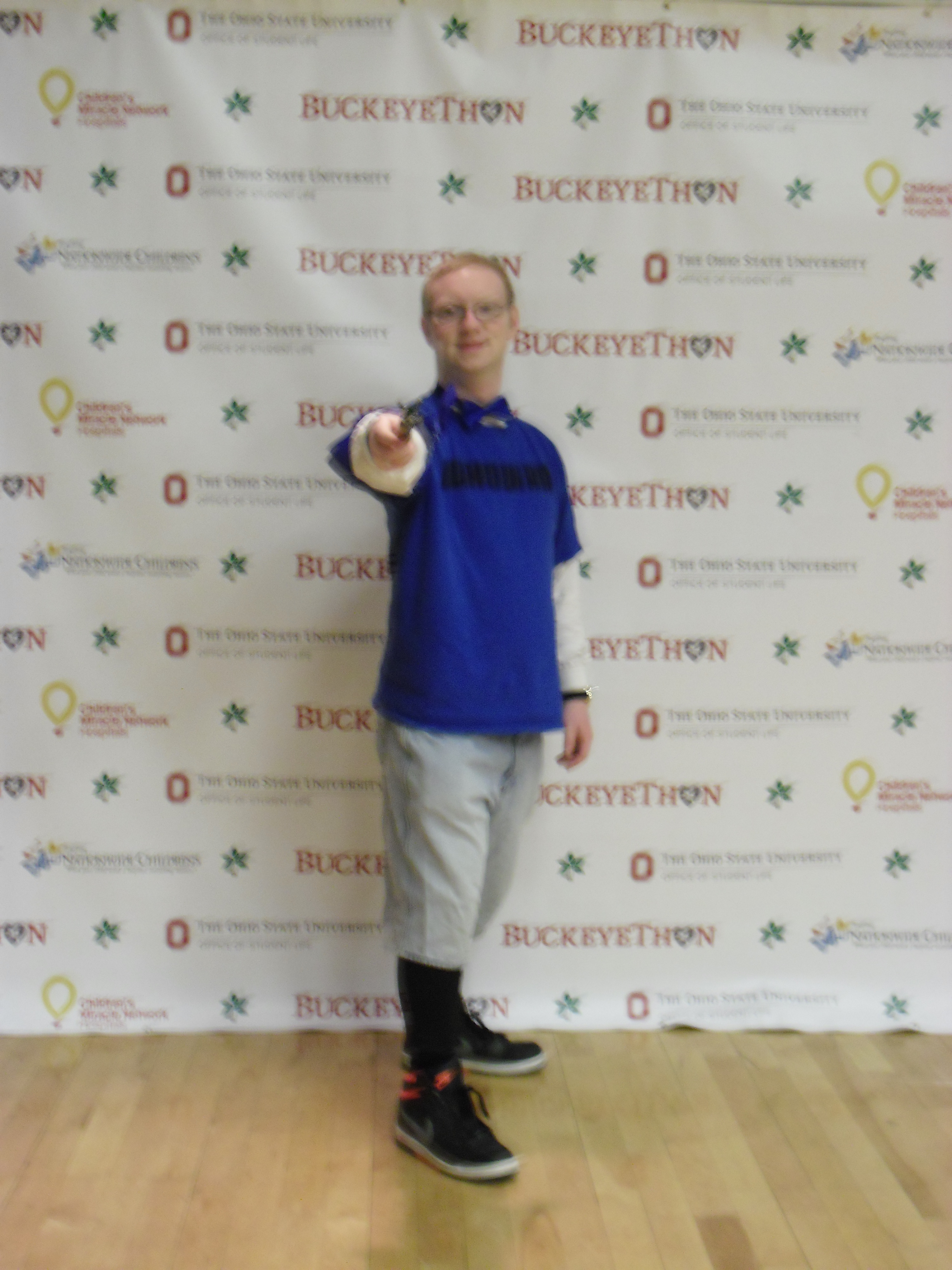
I can’t go into everything that happened last night, but I’ll give some of the highlights and a few photos too, plus a video. First let me tell you that the people who go to BuckeyeThon are divided into color-themed teams. I was on the Blue Team this year, and I dressed the part.

Allons-y!

Allons-y!

Some of you are thinking, What is he dressed up as? Others are thinking, Is he holding a sonic screwdriver? And one or two of you are thinking Go Michigan! I’m going to ignore the people thinking the last one and explain: I went last night as the Blue Doctor (please somebody be thinking, Blue Doctor? WHO is that?) Besides showing how overly obsessed with Doctor Who I am, I think the Doctor would totally get into something like this, which is why I went as him…if he were me and on the Blue Team. But hey, I was wearing a blue bowtie and had a sonic screwdriver and I was TARDIS blue the whole night. It kind of worked.

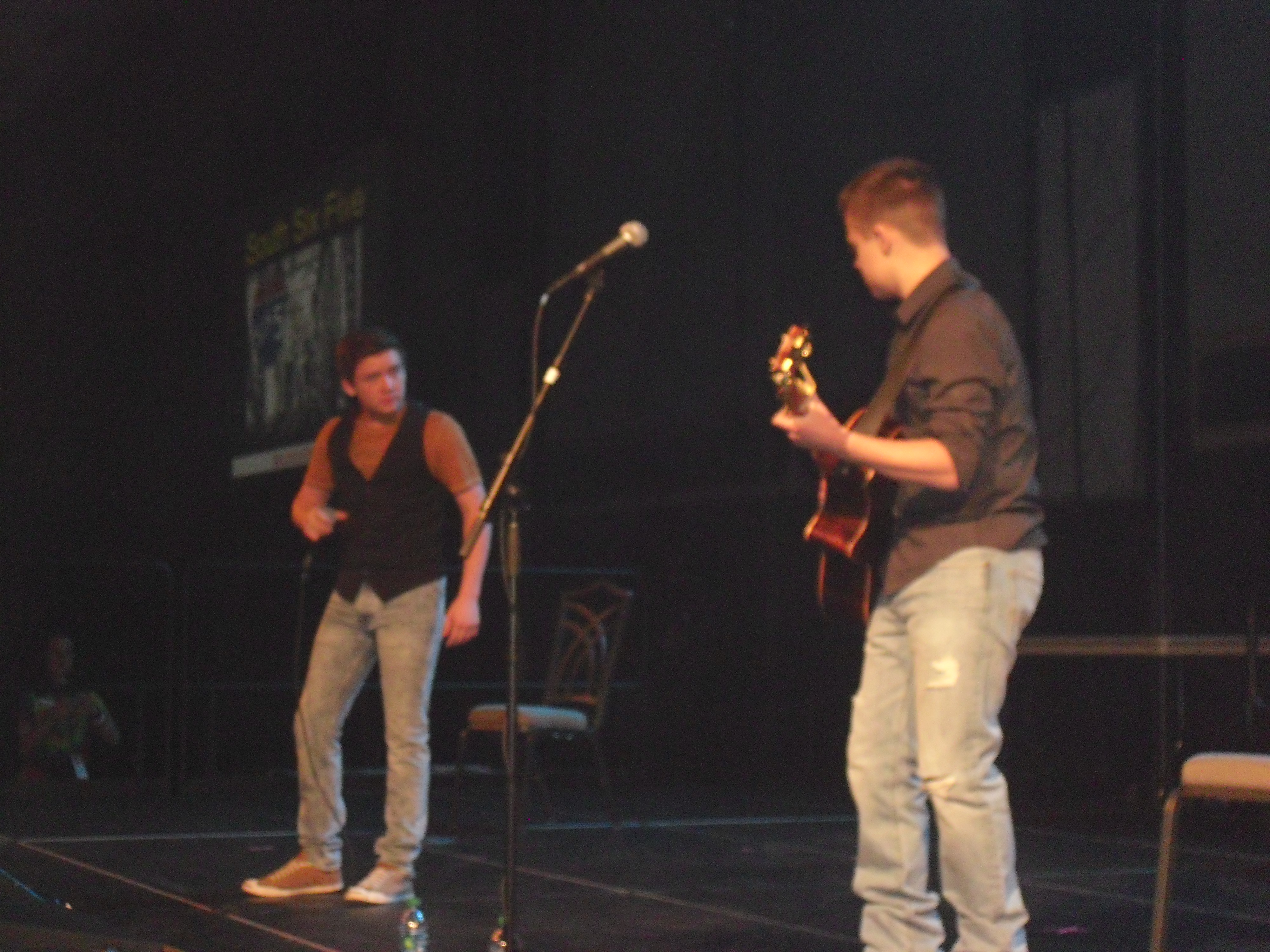
South Six 5. Don't let the Bieber hair full you, they're much better than him.

South Six 5. Don’t let the Bieber hair full you, they’re much better than him.

And we had a wild night. There was a whole lot of dancing, there was a rave DJ at one point, a dance instructor who sent women and some men into frenzies with his dancing which we were supposed to imitate, a concert with local band South Six 5 (check out photo) and a morale dance, which is like a huge flash mob we learn the steps to throughout the night.

And at around 8 in the morning, we broke with a singing of the school song Carmen Ohio before going home to sleep and let the second shift have their party (did I mention that there are two shifts to this thing? Half the dancers take one 12-hour shift overnight, the other half have a 12-hour shift over the course of Saturday). After I got home and showered, I slept till about five in the afternoon, got up, and ate, did some homework, cleaned my room (it needed it), and then went back to the Union where all this takes place.

There we heard stories from the families of the kids we were helping to cure, as well as some of the people who helped organize and set up BuckeyeThon, as well as other dance marathons from around the country. And we heard a story from a man who helps set up dance marathons across the country. He told us about a kid he knew who had survived cancer and had been in and around these dance marathons for a good chunk of his life. The kid said something like this: “When I was growing up, I heard we were in the generation that would find the cure for cancer. It’s not true: we are the cure for cancer.” Hearing that was pretty spectacular, and it’s kind of true. Even if we’re not doctors or nurses or chemists coming up with new drugs and treatments or monitoring these kids heart rates, we have been instrumental in creating the means to cure cancer. It’s really amazing.

This photo is actually from the start of Buckeyethon, but whatever. You get the point.

This photo is actually from the start of Buckeyethon, but whatever. You get the point.

And then, in the packed Union (see that photo to the right), we learned how much we made. Slowly, the number was revealed on big sheets of cardboard: $767, 227.78. That’s nearly $150,000 m0re than last year’s amount! And I was so happy to have been part of that, even if my donations weren’t as high as some others (one girl raised $15,000 on her own. What is her secret?).

And now that I’ve said all that, I’d like to thank everyone who donated to me to support BuckeyeThon and the kids we helped. I was really a great experience and I was so happy to have so many people supporting me and to be with so many amazing people last night. I hope I can count on you all next year, when I do it again for the last time around. Hopefully I won’t cry too much when it happens.

Oh, lastly I want to show you the morale dance. Looks like someone posted a video of it this morning. Actually it’s the morale dance competition, when the various teams send two representatives to compete in doing the entire morale dance in front of the entire room. I got to represent the blue team, which was quite fun. You don’t see much of me in the video (mostly my arm) but you get to see the first-place and third-place teams do it, and it’s pretty fun to watch. Check it out.

That’s all for now. I’ll post more photos on my Facebook page and Twitter feed tomorrow. Until then, goodnight Followers of Fear.

Reborn City

I don’t usually do this sort of advertising, but I figure what’s the harm in trying? Reborn City has gotten its price lowered on Amazon for paperback, down form a little over $11 to $8.99 (I’m not sure why Amazon lowered the price, but if it gets more people reading the book, I’m not going to complain).

As many of you already know, Reborn City is the story of Zahara Bakur, a girl who joins a street gang in Las Vegas-style Reborn City after her parents are killed for being Muslims. The gang she joins, the Hydras, become a family for her, but that family is under threat by older gangs, who dislike the Hydras rise to power, the fact that they’re interracial, and that they accepted Zahara, who is Muslim. In addition, there is a connection between the Hydras and the Parthenon Company, the corporation that runs Reborn City and other metropolises like it. The choices Zahara makes as she tries to become part of the gang and protect her friends will change the course of her life and the lives of others for a long time to come.

I hope that sounded interesting to you. So far, RC has gotten four reviews averaging around 4 or 5 stars. I’m very happy about the response, and I’m hoping that if more people buy the book, more people will add their feedback as well and let me know what they think. Honestly, I love reader feedback.

You can check out Reborn City at Amazon.com, as well as on Smashwords. The paperback is $8.99 like I said, while the e-book is $2.99. Hope you enjoy reading it and have a lovely evening, Followers of Fear.

Reborn City

I’m not sure what could make this week go any better…besides winning the lottery, because that’d make anyone’s week. Yesterday Reborn City got another review on Amazon, the second this week (and a whole new record for reviews in a single week). The review comes form Josh Mangel, someone I’ve known personally for several years and downloaded the book not too long ago. He gave RC four stars, bringing the average of the book to 4.5 out of 5. His review, titled Very Good, is below:

“This was really a page-turner; I was hooked from the start and read it in a day. While not perfect, this is an auspicious debut novel from a good author. I look forward to reading the rest of the books in this series when they come out!”

I’m glad you liked it Josh. And the whole page-turner thing is something I’ve been getting a lot on RC. Kind of makes me happy, because it’s my first novel, I wrote it in high school, and I’m happy to know that people are being honest with me when they say that. Also, thanks for posting the review. Hearing back from readers means a lot to me, and I’m always happy for feedback, whether it’s positive or negative. So thanks for that, Josh.

If you’d be interested in checking out Reborn City, you can find it in both paperback and e-book on Amazon and Smashwords. And whatever you think of the novel, please let me know. I always love to hear feedback.

All for now. I hope to write a post later today about the necessity of editing and some editing experiences I’ve had in the past. For now though, I’ve got classes to get ready for. See you later!

Today I finally get the chance to post my interview with science fiction author Charles Coleman Finlay, or CC Finlay for short. A graduate of Ohio State, his first story Footnotes was published in 2001 in Fantasy and Science Fiction, where several of his short stories have been published since. He’s also published four novels, including the Traitor to the Crown series (which one of my favorite shows, Sleepy Hollow, strangely resembles) and a collection of short stories, The Wild Things.

I sat down with him to talk about writing, fiction, and how delicious the food from the Wexner Café was (comments about that last subject are not in this interview). It was a great way to have lunch on a Friday afternoon.

RU: I guess the first question I want to ask you is, how did you get into science fiction?

CCF: I’m not sure there’s a short answer. When I was a kid, I felt overwhelmed by the world just because of personal events in my life. So I was looking, unconsciously,  for larger than life characters, people who faced world-sized problems and overcame them. So I started with cartoons and comic books. I loved superheroes–Superman, Batman, Green Arrow, the Flash, the X-Men. When I started reading a lot of books, science fiction and fantasy fulfilled the same needs but in a more complex way. Take Lord of the Rings, for example. Here’s Frodo with this burden he didn’t want, and he’s not a wizard or a superhero, and still he finds some way to triumph. That really resonated with me. Edgar Rice Burroughs was also a really important writer for me. All of his characters face big overwhelming problems, whether it’s Tarzan orphaned in the jungle or John Carter transported to another planet. Science fiction and fantasy are  full of those kinds of stories, and I loved them. I still do.

RU: I like comic books too, though they’re usually the Japanese kind, and I still read them a lot. When you write, what is your process?

CCF: Every writer is different. For me, it’s an iterative process. I have to have the whole story in my head, the shape of it like a picture, and then write it down. My first drafts can be pretty rough, but then I revise it and rewrite it many times. My wife’s also a writer, but she’s the exact opposite of me. She needs the scene perfect each time. So she writes more slowly, but she does less editing than I do. But if you ask this question of a hundred different writers, you’re going to get a hundred different answers. Everyone is different.

RU: A lot of the readers on my blog are a strange grouping of traditionally-published and self-published authors. How do you feel about the changing dynamics of the publishing industry these days?

CCF: There’s not a period of time where you can point to traditional publishing–however you define traditional publishing–as stable. It’s always changing, always evolving. If you’re thinking of it from a professional point of view, the most important question is this: how do authors get paid. A lot of technologies are allowing authors to get paid and published in new ways. That can be good for authors. But there are also a lot of authors who publish their books too soon, before they’re ready. I know one writer who, when he was young, self-published his first novel and was so discouraged by the reaction to it that he gave up writing for a decade. That was a shame, because he was incredibly talented. Had he stuck with traditional publishing there would have been more people around him to keep him going and to help make his books better, so that when they did come out, people would have loved them. On the other hand, I have friends who, after being traditionally published, have started to self-publish. T.A. Pratt and Henry Connolly, for example, both had series that got cancelled by their publishers, but they had a hardcore group of dedicated readers. They self-published more books in the series and had huge success with it. So it’s a lot like the question about the writing process. There’s no single right answer, and every writer has to find the right path for them. Everyone will make mistakes along the way. So it’s up to authors to educate themselves about potential opportunities, but also potential problems.

RU: What advice would you have for an author who isn’t having much success right now?

CCF: Keep working at it. I was writing seriously and submitting fiction for over six years before I sold my first story professionally. That’s pretty common. I’ve heard it described as the Million Words of Crap theory–that every writer has to write a million words of crap before they start producing something good. Other people I know quote Malcolm Gladwell and point out that you need to put in 10,000 hours of practice to get good at any skill.

Also, surround yourself with other writers who are as serious about it as you are. Pick them up when they get discouraged, and let them do the same for you. Learn from them and share your own mistakes to shorten the learning curve for everyone. Writing can be lonely enough, but don’t let it isolate you.

RU: Do you think as less people are reading, the novel will die out?

CCF: More people are reading than ever before, not just in the US but throughout the world and ebooks are making that easier. So I don’t see the novel dying out soon. The problem is there are more writers, more novels, than ever before. So it’s harder to find a big readership for any single book.

(Editor’s note: Mr. Finlay recommends going to this website for more information on the subject.)

RU: What do you look for in the stories you read?

CCF: That is a great question. I am a guest editor for the July/August issue of Fantasy and Science Fiction. In the month of January, over 750 stories were submitted to me to read for this issue. From that I had to narrow it down to about 12 stories that I will get to publish. So I’ve been thinking about this a lot.

I like to be surprised, which is hard when you’re a writer. The surprise can be plot, language, format, character, knowledge. But it has to be something. The more I read, the more it’s something else besides plot–you see every plot twist, every angle in a story before it happens. So when a plot surprises me, I really value it. And then I look for stories that make me feel. It’s not just putting characters through terrible things, there has to be some emotional resonance as well. Fear, excitement, sadness are all good emotions, but I really look for and enjoy stories that can make me feel delight, wonder, joy. Those are a lot harder to write, and I appreciate stories that can evoke those emotions. And then I love to laugh. Not every story is funny, or should try to be funny, but when a writer can make me laugh consistently, I really appreciate that.

RU: So much science fiction has become reality: communicators become cell phones, all-matter materialization devices are 3D printers, and we have information literally at the tips of our fingers. Where do you think science fiction will go from here now that a lot of it is becoming science reality?

CCF: I don’t think it’s something new. Thomas Disch wrote a great nonfiction book called The Stuff Our Dreams Are Made Of about this phenomenon. But I also don’t think that science fiction is a laboratory for new technology. Science fiction is about the present, not the future. If people envision something and make it a reality, then that’s something different from science fiction.

RU: Final question: If you were stuck on a desert island and could only bring three books with you, what would you bring?

CCF: I think you have to take Robinson Crusoe by Daniel Defoe with you for all the obvious reasons. Defoe invented the novel and Robinson was one of the first he invented. I would also take a collection of Lois McMaster Bujold. I think she’s an amazing writer, and I reread her Vorkosigan series in particular every year or so. And then I’m a writer. So the last one would be a book full of blank pages, so I could write the book I wanted to read. That’s what we do as writers, right?


If you’re interested in learning more about CC Finlay, you can check out his website at www.ccfinlay.com.

Reborn City

Today a new review came in for Reborn City, which I’m very happy about (didn’t the three-month anniversary since its publication just pass? Oh yes, here’s the article). The review comes from Michele Kurland, and she gave RC five stars (oh, I love it when people do that), bringing RC‘s average up to a 4.7 out of 5. Her review, entitled I can’t wait for the sequel! (she must have heard about Video Rage), is below:

“This is not a genre I typically delve into, but I took this book on vacation and couldn’t put it down. The plot had me turning pages at quite the clip. The characters were unique and interesting and the imagery had me creating my own visual of what Rami’s interpretation of the future looked like. For first time novelist, Rami Ungar, this was an outstanding showing of talent and commitment to his passion of writing. Looking forward to seeing what he comes up with next!”

Well, how do you feel about a thriller about a serial killer, Michele? Well, there’s more on that later, so if you’re reading this blog, you can tell me then. Oh, and VR has been written. I just need to find the time to edit it a couple of times. Seeing as I have a few projects ahead of that though, VR will have to wait.

But anyway, thanks for reading RC and giving me a review telling me what you think. I always enjoy hearing feedback and I’m looking forward to hearing what other people feel about Reborn City. Speaking of which, if you’re interested in reading RC, you can check it out on Amazon and Smashwords, in paperback and e-book format. And if you do end up reading RC, please let me know what you think. I always enjoy feedback, whether positive or negative.

All for now. Hope to have another blog post out tonight.

Reborn City

As I said earlier in the week, it’s been three months since my first novel Reborn City was published. I still can’t believe it’s only been three months! Maybe it’s because during November, December, and this past month I’ve been busy with school and work, but it feels much, much longer.

For those unfamiliar with RC, this is a science-fiction novel I wrote in high school and edited and polished through my first two years or so of college before publishing it in November. The first book in a trilogy, the novel follows Zahara Bakur, a Muslim teenager living in Reborn City, a Las Vegas-esque entertainment city owned by the powerful and mysterious Parthenon Company. The world Zahara lives in is a dystopia that resulted from the War on Terror devolving into a third world war, leaving most of the Western world prejudiced against Islam and Muslims, making life for Zahara very difficult. One day though she’s forced to join an interracial street gang called the Hydras, and it’s from there the story begins, with Zahara learning to live in a gang and finding out that there are more than just other gangs after the Hydras. The choices she makes will not only influence her own life, but the lives of those around her.

I’ve only gotten two reviews on RC so far, but they’ve all been pretty positive. Here’s what they’ve had to say:

“As a reader who does not read books in this genre, I must admit that I could not put down the book. I attribute this to the talent of the author. I am looking forward to reading the next books published by Ungar. I recommend this book to readers who enjoy action with  features of supernatural powers and sci-fi.”

Enji

“Gangland violence, superhero-like enhancements, a futuristic setting, and social commentary that stems from a semi-post-apocalyptic theme. And then there’s a story where people come together as a family to deal with mutual loss and tragedy. What’s not to like?”

Matthew S. Williams, author of Whiskey Delta and other great books.

I must say, I really enjoy RC, and I’ve grown close to many of the characters. And if you end up liking RC, there’s good news: I just finished the second book in the trilogy and I’ll probably start editing it later this year (for a summary of Video Rage, please click here). I’m very excited for VR, actually. I felt that while writing it I experienced both personal growth and growth as a writer, and it shows in how I wrote VR. It also expands a bit on the world the Hydras inhabit and explores their personal relationships more deeply than the first book. I think a lot of readers will like it.

If you’d be interested in reading Reborn City, you can get it in both print paperback and e-book from Amazon and Smashwords. And whatever you think of it, please let me know what you think. I enjoy feedback, positive or negative.

Thanks and I wish you happy reading!

I started a short story the other night about a family that moves into a haunted house (yes, that’s been done before a hundred times, but I’m trying to do something new with it. Hopefully I’ll succeed). For some reason I started writing it in present tense, something I rarely ever do. Most stories, especially the ones I’ve read  and the ones I usually write, are in past tense. I think I was trying to make the story unique by writing it in present tense, or maybe it sounded good at first to write it in the present tense.

But as this short story’s been coming along, I’m finding it harder to continue going, and I think the tense of the story is a major contributor to that problem. The only story I’ve ever written that’s been in present tense and that I’ve barely had any trouble with is Addict, one of the short stories I included in The Quiet Game, but that was also in second-person, and that kind of made it easier to write. Heck, it was practically begging to be written in present tense as well in second person (“You walk out of the bathroom and you rejoin your buddy. He asks you a question and for a moment you’re not sure what he said”. See what I mean?). But this is third-person, and I think unless you’ve had a lot of training in writing in present tense or you prefer that tense, then it’s just not the sort of tense you write in.

Okay, the TARDIS doesn’t have much to do with tenses, but it does with past, present and future.

Well, I’ve certainly learned my lesson. I can’t write this story in present tense and I’m definitely not going to attempt to attempt future tense (never seen an entire story of any length written that way). So tomorrow (or the next day, depending on the amount of homework I have), I’m going to through the short story and switch it to past tense. Then I’ll go through it again, adding, editing, and deleting where I see appropriate. Luckily I’m only about seven pages into this short story, so I can probably get both tasks done fairly quickly.

For now though, I’m going to go to bed. I’ll let my mind swirl this short story in my head overnight and see if I can come up with any other ideas to improve this short story. I think it could be great, but since I’m trying to do something new with a familiar trope, I really have to work hard to make the story believable and enjoyable to the audience. Hopefully I can do that.

That’s all for now. I’ll post again when I’m done with the short story, or when I have something else to post about (whichever comes first). Goodnight, Followers of Fear.

In Judaism, that hand is called a Hamsa. It’s designed to keep the evil eye away. I have no idea what it’s doing on this poster though.

Last week or so I posted about an interesting discussion I had in my meditation class about hypnosis vs. meditation (see post here). At one point during that conversation, I said that although hypnosis could be abused, meditation could just as easily be abused by someone of unscrupulous character. I then gave an example to my group, which was immediately followed by this realization: “Hey, that could make a great short story.” I told that to my meditation group, which caused them to laugh while also looking at each other in fear. It was a “What have we done?” moment right there.

Well, I started the short story Saturday evening before SNL started, and I’ve worked on it every evening since. And this evening I finished it. Then I went back and added a few more details to earlier parts of the story in order to make it flow more smoothly. Then I clicked Save and decided to write this blog post.

As you can see from the title of this post, the short story is called “Ohm.” I wanted a title that would go very well with a story of someone using meditation for bad purposes, and I went with “Ohm”, because it was simple, the word itself was relevant to the story, and it gave people an immediate sense of what this story might be about. It’s on the short end of short stories, a little under 2100 words, and it’s more literary than horror, if you look at it closely. Still, I think it’s an interesting story, even if there are no demons or serial killers, and I even managed to use a new technique in order to tell it:

Last semester, I read a short story for my science-fiction literature class called “Gene hackers”. The story was about a man who was quite famous in the near-distant future for his role in the industry of genetic engineering and manipulation, and chronicled various events throughout his life in short little vignettes, starting from when he was young and all the way up until he was a very old man. I was really impressed by the style used to tell the story, and I wanted to try that for myself with “Ohm”. I think it turned out pretty well, personally.

I’m going to ask my meditation group if any of them want to read the rough draft. After they get back to me, I’m going to try to submit this story to a creative writing contest here on campus, see if I can impress any judges. Hopefully my meditation group and the people running the contest will like “Ohm”. At any rate, I think they might find it at least a bit interesting.

Well, that’s all for now, Followers of Fear. I’ve got classes tomorrow, so I’ll sign off and see you in the morning. Goodnight and pleasant nightmares. I’ll let you know if anything comes of “Ohm”.

Oh, and before I forget, I bought my plane tickets for my study abroad trip today. They cost me an arm and a leg, but it was well worth it. I’m so looking forward to this trip. It’s going to be so much fun!