Posts Tagged ‘social media’

Some of you may be acquainted with Angela, or have heard me gush over her awesome feedback to my novel Snake. But did you know that Angela’s first novel, Jewel of the Thames, has just been released (I’ve already got it on my Kindle)? When I heard about it, I was so excited for her, and I got the chance to interview her before JotT came out.

Angela was born in London, England, but currently she lives in Toronto, Canada with her family. She has been writing for a number of years, most notably for CBC Radio as a journalist. She also does freelance and digital projects on the side, but currently she’s been devoting her time to the Portia Adams books she’s been writing (last I checked she’s got around eight or nine casebooks in the series).  She is a fan of mysteries, Doctor Who, and most stuff Sherlock Holmes (but not Elementary).

RU: Hello Angela, it’s a pleasure to talk to you. Give us an idea about what Jewel of the Thames is about.

AM: Sure Rami: Jewel of the Thames is the first book in a series of stories about aspiring detective Portia Adams. It is also an homage to my favourite detective novels – the Sherlock Holmes books, the Nancy Drews, the Hercule Poirots. All of the books I read from childhood till now, and all the great authors who inspired me to create this character. So far in this series, I have written ten casebooks – cases that Portia has taken on – and the first three make up Jewel of the Thames.

There is a lot that had to happen in the first book – Portia needs to find out what her link is to the property she has inherited in London, and she needs to start standing on her own. The whole book is three casebooks wrapped in a mystery driving towards a big reveal at the end. You’re gonna have to read it to find out what the heck I’m talking about.
RU: Considering my level of confusion and intrigue, I will. Now tell us a little about your protagonist, Portia Adams. Who is she exactly?

AM: Hmm, what can I tell you without spoiling it? She’s a 19 year old Canadian who at the very beginning of the books loses her mom, leaving her a poor orphan in 1930s Toronto. It is at the reading of her mother’s will that she discovers she has been left a mysterious property in London and that she has a guardian – Mrs. jones from New York.

Portia is an intelligent introvert who has always preferred books and quiet to social situations, she loves school, hates fashion, often forgets to eat and has no friends. This is partially because she’s viewed as odd and anti-social despite her mother’s best efforts. Her overwhelming curiosity leads her to what interests her rather than what others are focused on, and gives her a focus most don’t understand.
She’s tall and slim, with dark brown hair which she wears unfashionably long and usually in a bun, with startling blue eyes. Feel like you know her a little better?
RU: Maybe just a bit. What do you say your writing process is?
AM:  write long-hand in Moleskin notebooks, so for Jewel, my writing time was my commute back and forth to my full-time job in downtown Toronto. So for 30 minutes in each direction on transit twice a day I would write about Portia Adams, ignoring the smells, sounds and closeness of the Toronto Transit crowd. As a result, I have about 30 Moleskin notebooks filled with my handwriting in lots of colours detailing Portia’s adventures.

Angela and her moleskin notebooks

RU: Wow, that kind of writing schedule requires tenacity. What do you think will draw people to Jewel and to Portia?

AM: Hmm… I guess the same things that drew me to her – a young female protagonist who is learning to stand on her own – I find that premise compelling. Her relationships are part of what make her the woman she is, and as those develop I think she will become an unforgettable character, as will the recurring characters around her like Brian, Sergeant Michaels and Mrs. Jones. That’s how I feel about her at least, I find that even when I’m not writing about Portia, I’m thinking about her. I’ve got a bit of a WWPD mentality in my own life, so that when things happen, I often think What Would Portia Do?

It doesn’t hurt that the setting is London in the 1930s, a really interesting time in history between the two great wars and smack in the middle of the great depression. I hope that people come to care for Portia, because I know from my own experience as a reader that a connection with the characters is key. I guess I will be looking for that kind of feedback from book 1 as I get into the editing phase of books 2 and 3.
RU: Speaking of Books 2 and 3, are you going to continue writing and editing on the bus to and from work, or have things changed since you found out Jewel of the Thames was going to be published?

AM: Things have indeed changed, but actually before I got my contract for Jewel. Last June, after I finished writing the third book in the series, I decide it was time to concentrate my time on this part of my life. I’ve spent the past 14 years working as journalist for the CBC, I think it’s fair to try ‘something else’ for a while.

So I work from home now as a freelance journalist and so far I’m loving it. I try to write a few hours every morning (in the series on book 4, blogging, research) and then spend the afternoons working my freelance contracts. I think I’ve hit a rhythm that works for me, so we’ll see how it goes.
RU: I’m glad it’s working out for you. And you know, I feel kind of bad, because I forgot you were also a journalist for the CBC. How did you get into writing and journalism in the first place? What inspired you to go down that path?

AM: (Laughs)  Don’t feel bad about that! But to answer that question, I’m going to steal from the bio I wrote for my publishers last week:

“Everything changed for young Angela Misri one spring day in 1992 at an assembly in the gym where, as per usual, she was giggling and whispering with her friends in the audience. Suddenly her name was called by the Principal of the school and she was jostled out from the safety of the herd and to the front of the room. Having not really listened to the preceding speech, she was shocked to learn that a poem she had written as part of a school assignment had been published in an anthology of like-quality poems by Canadian children. The Principal smiled the biggest smile she had ever seen on a teacher, and handed her a copy of the coil-bound anthology, turning the young poet towards the audience of her schoolmates and starting the applause that followed her back to her safe haven between her best friends.
That was the moment when Angela discovered that despite being of Indian descent, there were in fact other options for your life’s work than medicine or engineering.”
So there you are! That was the moment for me, and I’ve been writing ever since. I wrote my first book when I was your age, Rami. It’s a historical fiction called ‘Savitri’ and it’s sitting upstairs in a binder. The only other copy is on a floppy disk (no, I’m not kidding, that’s how long ago it was since I was your age ; ) . I haven’t read it in about 15 years and I will admit, that I am scared to. I’m worried that the vision of the story (which I still think is the best I ever wrote) will not live up to reality.
RU: That’s a problem that a lot of authors face when they think of their early stories. So how did you come up with the Portia Adams stories?

AM: It was after reading the Stephen King short story called ‘The Doctor’s Case’ that the idea for Portia came to me. If you haven’t read it, I suggest you do, it’s one of my favourites. As the title suggests, its an original Holmes-Watson story with a twist – Watson solves the case before the great detective. I loved that idea, and Portia started to form in my mind as a kind of homage to King and Conan Doyle.

The first case I wrote jumped straight into the jewel thefts and was over in less than 12 thousand words. I read it over a few times and realized that if this was going to be more than a short-story, I need to write some backstory for my detective. So I went back, created a beginning for Portia, and did a whole bunch more research into the time period, the whole family tree of Holmes, Watson and many others from the original canon. Once I had expanded Portia’s world to about 20 thousand words, I had the idea for the third case in the book – the one that happens on the train. I wrote that in two days and then, rereading it, decided I needed another case between the jewel thief and the train story because she was moving around too much. I felt she needed more time to get to know London and to get comfortable with her new College, so I wrote the casebook I called “A Case of Darkness.”
RU: What’s next for you?
AM: Wonderful, an easy question! I have written books 2 and 3 of this series already, so my next steps are to edit the heck out of them for my publishers and get them into production! I have also started a new dystopic novel that I’d like to carve out some time to write.
RU: Ooh, that sounds interesting. Now just a couple more questions. First, how have your family and friends reacted to the news about Jewel?

AM: They’re very excited but not really surprised. I guess it’s normal for me to be the most nervous about putting my work out there (since it’s mine) but most of my friends and family told me it was just a matter of time before I would get published. I don’t know if they were just saying that to be supportive, but I was no where near as confident. Now that it is really happening and there is a date when a physical book will be available in stores, their excitement has doubled. Seriously, I have the most supportive network – and that includes this blog and you Rami!

RU: I’m happy to be a part of that network, and I’m glad you’re a part of mine. Now here’s a fun question: if some big Hollywood producer came up to you and said they wanted to make a movie or TV show about Portia, who would you want to play the characters?

AM: I LOVE this question as you well know, because I’ve spent too much time thinking about it.

So I would love Katie McGrath (of BBC’s Merlin) to play Portia. I think she has the right balance of beauty and bark that my detective needs. I believe Jensen Ackles (of the CW’s Supernatural) would make a kick-ass Brian. And I think Irene Jones would benefit from the beauty and wit of someone like Lynda Carter (original Wonder Woman).
RU: Since I don’t know who those people are, I’ll take your word for it that they’re perfect for the roles. Final question: If you were stuck on a desert island and could only take three books with you, what would those books be?
AM: Hmm.. I guess Stephen King’s The Stand, Tolkein’s The Two Towers, and Conan Doyle’s Complete Adventures of Sherlock Holmes. If I had a fourth option I’d have to take an Ann Rice. Can I please take my iPad instead Rami? I’m going to need more books than the average human.
I’d say yes, but there’s the question of charging it when the battery gets low. And the lack of a Wi-Fi network. Anyway, thanks for joining us, Angela.
If you would like to find out more about Angela, you can find her on Facebook, Twitter, Google+, and Pinterest, as well as on her blog a Portia Adams adventure.

Today I received an interesting e-mail from one of the professors in the English department. Some of you may remember Ohm, the short story I wrote about a cult leader who makes up his own brand of meditation and yoga to get money and power. I submitted it to the Jacobson Short Story Award at OSU, hoping that it might do well in the contest and maybe win me a little bit of money for rent purposes.

Today I got the results. While Ohm did not get the first or second prizes, it did get an honorable mention, which is definitely worth celebrating. The person who reviewed Ohm, a novelist and a professor from the University of Colorado, Boulder, said it deserved the honorable mention “for its confident use of language”. Reading that gave me a boost to my own confidence.

I’m glad Ohm got some good recognition, even if it didn’t win the award. I’ll see about getting it in a print magazine, and if that route is unsuccessful, maybe I’ll publish it on WattPad. I won’t know until I try, so I’ll be optimistic and see what opportunities are available.

That’s all for now. I’ve got a big night of writing ahead of me. I hope to have more good news and more posts to write as time goes by. Wish me luck.

This year in Ohio, same-sex marriage is on the ballot. As someone who supports LGBT rights, I’m throwing my support in for anyone who wants to marry someone regardless of their sex. It’s only just right.

But besides that, there’s something else I want to share with you all. I’m bisexual. I’ve been bisexual for nearly 21 years (though I’ve only just recently realized it) and I’ll be bisexual for the rest of my life. And there is absolutely nothing wrong with that.

For those of you who aren’t very well-versed in bisexuality (or in the LGBT community at all, for that matter), this only means that I am attracted to men as well as women. I don’t really have a preference or a set type. All I care about is that I’m happy with the person I’m with and if they’re happy with me. I’m not confused or unsure of which one I really like, as some–even members of the LGBT community–might think. I also am not confused, living a horrid lifestyle, or have the Devil whispering in my ear (I think he’d rather whisper in the ears of Assad or Putin than in mine). It’s a biological trait based on a combination of several genes, and there could be a good argument that it runs in my family.

Also, I’m not oversexed or always looking at guys and girls in a sexual way. If I’m oversexed it’s because I’m a healthy young man in college, and we’re all oversexed to some degree. Also, don’t flatter yourself. I don’t look at every person hoping and praying for a hook-up, including you. I’m not even sure what my type is, so don’t assume you’re it. And I’m also not looking to molest kids or brainwash kids. The monsters who molest kids are only looking for power over victims or because they can’t rise to the occasion (so to speak) with adults, so they target kids. And you can’t brainwash kids to be LGBT: like I said before, it’s genetic. If you’re kid is LGBT, it’s because they were that way at conception. And the more you try to prove me wrong or pray away the gay or whatever, the more you’ll find I’m right.

And the LGBT community is not a cabal or a bunch of bullies. If there’s a cabal, gay marriage would already be legal in every nation on earth and anti-gay rhetoric would result in prison sentences. Also, calling us bullies is saying that a small minority, maybe 10-20% of the population at the most, is more powerful than the heterosexual majority and is able to beat up straight people on the streets. I really don’t think that’s the reality. Do you?

I also don’t let my sexuality define me. I’m not that kid from Glee who everybody identifies as “the gay guy” or “the gay guy with the really high voice”. I identify more with the fact that I’m a horror writer or that I’m Jewish than I do with my sexuality. So if you start calling me “the bisexual horror writer”, I’ll counter that with “I’m a writer that just happens to be attracted to both men and women.” And most people wouldn’t realize my sexuality if they looked at me. They might realize I’m eccentric or not your ordinary college student. But my sexuality? I’d need to reveal it or be detected by an actual gaydar for people to realize it.

How did this post become a testimony for the fallacies with most anti-gay arguments and how people should treat me? I’m not sure, but I want to say that I’m happy to let people know finally about who I am and not have to keep it to myself like a disgusting burp. It’s just who I am, like my being a writer or Jewish or that I can make a conversation amusing and strange with just one sentence. Just one part of being me.

And if you don’t like what I am, if you believe differently about my sexuality, then that’s your choice. Just don’t leave hateful comments or try to tell me I can be cured or that I’m going to Hell. I don’t even believe in Hell! Judaism has no set definition of the afterlife. We’re more likely to be plagued by acid reflux than by an afterlife of fire and brimstone for our transgressions, and I’m already on antacids. But if you want to try to change me or make me feel bad for being who I am, then I don’t think we should associate too much, online or offline.

Finally, I would like to close this post with a big, hearty thank you for all of you who’ve supported me and continue to support me. The love I’ve received and the acceptance of who I am is overwhelming, and I’m happy to be surrounded by so many understanding and loving people. It’s great to be who I am and not punished for it. So I bid you adieu till next time, my Followers of Fear (which might be later today, who knows?). And let me say to all those who are suffering from bigotry, it gets better. Don’t despair, because there are so many people like you and we all love you regardless of who you’re attracted to. All you have to do is reach out, and we’ll be there for you.

In the meantime, please enjoy this awesome video: Same Love by Macklemore and Ryan Lewis. It repeats a lot of what I’ve been saying here, and it is an anthem of love, truth, and hope for so many people out there. Please watch it with me. Thank you.

Does anyone here ever use taglines for their novels? I do occasionally (I created one not too long ago for Snake: “How far will you go for love and revenge?”), and they really are fascinating marketing tools. Sometimes they even become more than what their creators intended, and become part of our collective pop culture.

For my twelfth article on Self-Published Authors Helping Other Authors, I decided to write on taglines and how to create your own. It’s a quick read, but I think the tips are very informative, and I spice it up with my own weird brand of humor in and around the article. If you’d like, please check it out by following this link.

And if you’re a self-published author, you should definitely take time to peruse Self-Pub Authors and see the articles we have there. The blog is written by other self-published authors and has articles on many, many different subjects involved in DIY writing, editing, publishing, and marketing. You never know what article might give you the gem you need to create, publish, or market a wonderful story.

That’s all for now. I’m heading for bed. You have a good night, my Followers of Fear.

becket

Today’s interview is with indie author Becket, whose books include The Blood Vivicanti series and the Key The Steampunk Vampire Girl books, including the recently released The Tower Tomb of Time. When not writing, Becket works for author Anne Rice and is supplementing his education with a degree in psychology.

I had the chance to email Becket and learn a little bit about him, his books, and what it’s like to work for Anne Rice. It was definitely an enjoyable correspondence.

RU: So Becket, you’ve had quite the interesting life, working as an author, working for an author, and at one point you were a Benedictine monk. Makes me curious about what else you’ve done, so could you give us a brief history of yourself?

Becket: I entered the seminary when I was 21 because I wanted to deepen my relationship with God as well as be a minister of hope, faith, and love. I spent three years in the seminary, during which time I also finished my BA in music composition. Then in the summer of 2000, I entered a Benedictine monastery, St. Joseph Abbey in Covington, LA. The spiritual charisma of the monastic life appealed to my personality type. The monks lived a very silent life, guided by two principals of work and prayer. During my first year in the monastery, Anne Rice requested a harpsichord for a book signing in New Orleans. We monks had a very nice one; and the abbot asked me to deliver it because of my musical background – I had studied the instrument in college, along with several others. That was when Anne and I first met. We developed an email rapport over the next few years while I was earning my MA in theology. When I completed my degree in 2005, I decided that it was time for me to re-enter lay life and, needing a job, I emailed Anne, asking her fi she had a job on her staff for a former monk with a few degrees. She replied with a job offer. I’ve been with Anne ever since, studying the craft of writing under her guidance while also earning an MS in psychology.

RU: What is it like, working for Anne Rice? Besides the amount of jealousy you must receive from fans including myself, I mean.

Becket: What is it like, working for Anne Rice?

Working for Anne Rice is like working for a childhood hero. I first read Anne’s books when I was a teen. Being a lonely adolescent, an outsider, Anne’s words spoke to me powerfully – because her words have a wonderful way of showing empathy for the outsider/reader. Many days she and I talk about literature and the book publishing business. It is a continual learning experience. Every day I learn something helpful and significant about my writing, about the publishing of my own books, about my own capacity for problem-solving, about many things. But every day is a new experience because every day I’m presented with a new challenge. Before I started working for Anne, I had never used Photoshop. So to assist her as best as I could, I learned many new skills, such as photography, shooting video, proper lighting, sound engineering, etc. I also learned several programs in the Adobe Creative Suite, namely Photoshop, Illustrator, and even Premier Pro and After Effects. Most of those programs I use every day, whether it is creating an app for Anne, or posting an image, or editing a video for Youtube. And today all those programs have helped me greatly in my own work; they are invaluable book publishing tools. A successful indie author cannot live on Word alone.

RU: Tell me about it. iMovie and Photoshop have been great tools in the past for me. Now, you’re new book is the latest adventure for your character Key the Steampunk Vampire Girl. Tell us about her and the new book.

Becket: Key’s new adventure picks up where the last book left off: Key has just escaped from the Dungeon of Despair. Yet unlike the last book, which takes place over the course of 250 years, the course of this book happens in a single night. Key gets to do what she has not done in over two centuries: She gets to explore the City of the Dead. She rides a Hobbeetle, she meets the Worm King, she visits the Grave of the Grim Goblin, whose not as grim or dead as some people might think, and she does so much more! Ultimately she finds herself at the Tower Tomb of Time, which allows her to visit the moment when she was first made a vampire. She discovers the mystery behind her mom and dad’s disappearance, as well as the reason she was taken to the City of the Dead in the first place. In other words, The Tower Tomb of Time explores questions that were raised in The Dungeon of Despair.

RU: Some people would hesitate to write a vampire novel these days when most people associate vampires with Twilight. What made you decide to write about vampires?

Becket: Before there was Twilight, there was Anne Rice. She was ground breaking (and indeed she still is) in the sense that she made the vampire a Byronic hero – someone whom we could easily identify with. Moreover, being a vampire isn’t the story of Key the Steampunk Vampire Girl – which is fundamentally the case with Bella, the heroine of Twilight. Bella actively seeks to become a blood drinker. Key, on the other fang, like Anne’s Louis or Lestat, never wanted to be a vampire at all. Becoming what she is happened to her, and then lots more terrible things happened to her, and so she has to make the best of her situation. That kind of narrative ambience is what I strove to create when I wrote Key. I hope readers will associate with her story and say to himself or herself, “I know how she feels being in the Dungeon of Despair, or confronting the Worm King, or revisiting a past that was hitherto forsaken.” Additionally, I hope readers would also feel inspired by Key’s successes and victories over personal demons. Key’s story is a coming of age story.

RU: What is your writing process like for you?

Becket: Generally my process begins with an idea, which usually comes to me while I’m writing another book. I write down that idea, and if it stays with me for some time, I will jot down notes about potential plot development, prose style, themes, and so on. When I finish one novel, I immediately begin another; there is no waiting for me. I write every day. It is a routine. And the routine for starting new novels is grounded in two goals: (1) the long-term goal of my book, and (2) the short-term goal of my daily writing. My long-term goal is the size of the book that I want to write, and I generally determine that by comparing it with other books. For instance, I know that Alice’s Adventures in Wonderland is about 25,000 words. So if I am seeking to create a children’s story, such as Key the Steampunk Vampire Girl, I will make the long-term goal of my first draft comparable to 25,000 words. My short-term goal is the amount of words that I will write in a day. On average my goal is at least 1000 words a day; usually I write more, often twice as much; and some times I write fewer words. The point isn’t perfection: It’s progress. As long as I am writing, I am coming closer to the completion of a book.

RU: I admire your tenacity. Now what are some tips you might have for other self-published authors, such as myself, on writing and getting your work out there?

Becket: The beauty of indie-publishing is in the word “indie” – independent. This is a quintessential word to keep in mind because, if a writer gets embroiled in the industry of professional book publishing, that writer would lose some degree of control. The writer would usually not be able to control, for instance, interior or exterior formatting. In other words, you would probably have little to say in the creation of your book jacket. I can’t tell you how many times I have heard professionally published authors complain about their book jacket, how it does not look like the story they told. Other authors have complained about the struggle they have with their editor or copy editor, how important words will be edited out, or how sometimes sentences or pages completely rewritten. There are some authors who want to be controlled like that. And that is good! Great books have been written with the help of excellent editors. But finding such an editor is like finding love in your life: It usually happens when you least expect it. Being an indie-author means controlling every element of your work. I like this, not micro-managing, but being purposeful and meaningful with every element that I produce.

RU: I love that independence too. It’s gone well for me. So what’s next for you, Becket?

Becket: The Blood Vivicanti Parts 5 and 6 will come in March and April. And after that, I will be publishing a book titled, The Door to Heaven, which is about a boy whose life is changed forever when he encounters an old man’s face on the doorknob to the Door to Heaven.

RU: That “Door To Heaven” sounds very Stephen King-ish. Last question: If you were stranded on a desert island and could only take three books with you, which books would you take?

Becket: Well, I am a man of faith and prayer, so I would probably take the ESV Bible (because I like that translation), The Imitation of Christ, and a book of blank pages, so that my mind could fill it up with my own stories.

RU: I love it when authors say they want to bring a blank notebook with them. Shows their true writing spirit, in some ways. Well, thanks for joining us, Becket, and best of luck to you.

If you’d like to find out more about Becket or check out some of his books, you can check out his website, his Facebook page, Twitter feed, and get personally autographed copies from the Changing Hands Bookstore.

Our next scheduled interview is March 31st with author and dear friend Angela Misri, who will be talking about her debut novel Jewel of the Thames. So get excited for that!

b2da2-9ddeee92a3dd2120ed55e789959dfff5

Recently a fellow horror author and blogger I admire brought up a good point about horror, one that I’ve made in countless other posts. The point that he made was that a lot of horror out there is actually pretty terrible because of an over-reliance of gore and gross-out elements (blood, knives, etc.). Real horror is made not by grossing people out continuously over the course of a horror story, but by creating a feeling of dread, that feeling that something bad is going to happen and that it is going to get worse. That feeling builds and builds, until (hopefully) the reader is scared stiff by ensuing events.

Creating that dread feeling is difficult, to say the least. Like I’ve said in previous posts about terror (and I’m not yet convinced that they can’t be the same thing, depending on the circumstances), it’s one of the hardest parts of creating a good horror story. Creating that feeling takes time, precision, keen insight, and skill, cultivated over years and years of practice. It’s why plenty of would-be horror writers and filmmakers just opt out of trying to use terror in favor of just plain old blood and guts and gore as a so-so substitute. And when that doesn’t work so well, they add in sex as well (don’t believe me? Watch the Friday the 13th remake in all its crummy filmmaking and see how much dread there isn’t and how much sex and blood and gore there is. And no, I’ll never stop harping on how bad that film was).

Here’s an exercise that can help authors of all kinds visualize creating that dread feeling for your story: close your eyes and imagine yourself in a dark, dank, eerie hallway. This hallway goes on for some length, so far that you may not be able to see the very end. And it also takes many twists and turns, so that doesn’t help. As you walk down this hallway, you get the strange feeling that something horrible is going to happen just around the next corner or right behind that table or from that ceiling lamp with the crackling bulb. And as you get farther along, this feeling that something bad will happen grows and grows. Sometimes the places you think something will happen prove to be harmless, but other times you are correct and you’re only just able to get away with your head still on. Even so, you continue on, even though the feeling of ill-boding keeps growing, and you wish you could turn back or even just stop and stay where you are but you can’t, those aren’t options. The only option left is to continue on, reach the end with hopefully all your body parts still attached, and find a safe room located at the end of the hallway.

That hallway is your horror story. And it can be as long as it needs to be, have as much furniture under which monsters can hide as needs be, and have as many twists and turns as needs be. You just got to find a way to create that feeling of ill-boding, which is the feeling of dread that all the best horror stories are able to create. The exercise above is meant to help give people an idea of how creating that terror and dread can happen and to give them something to work with if they need help or practice creating that dread.

I hope that helps in some ways. Also, if you want to check out some books, TV shows, or movies that do a great job creating that feeling of dread, I highly recommend Stephen King’s IT, The Amityville Horror, and the first two seasons of American Horror Story. They do a very great job with creating dread in the reader/viewer. Trust me, I was afraid to go to sleep after I encountered one or two of these titles. They’re that scary.

All for now. I’m going to try to get some of my own fiction written and full of that dread feeling. Goodnight, Followers of Fear.

I do not tolerate negative language meant to denigrate a person because of their race, gender, orientation, or ability. So when I see someone using this sort of language flippantly or carelessly, I usually tend to avoid that person. If they’re a friend though, I’ll try to convince them not to use that language before I cut them off.

Last night I was forced to do just that. Someone I’m acquainted with at school was responding to people lamenting about Facebook buying some app or another. He thought it was hypocritical that they were complaining about it on Facebook and said they should reevaluate their lives (though he didn’t phrase it in such nice terms). Where I got upset was when he used the word “retard”. I’ve mentioned before that I have an autism spectrum disorder and I’d been called “retard” or “retarded” more than once by bullies because I didn’t understand certain social boundaries or conventions when I was younger. Not to mention that mental retardation (or intellectual disabilities, which seems to be the preferred term among medical professionals these days) is an actual medical condition, so using it as an insult hurts the people with actual mental retardation worse than it hurts the people having the insult hurled at them.

I asked my friend if he would not use that word because it has the potential to hurt people. He responded that he was using the word without negative connotations and that people should realize that (as if we’re mind-readers!). He also said he uses racial and other denigrating terms, including the N-word, and said he uses them without the negative connotations and that it’s my problem if I was insulted by it.

At that moment another friend of his, whom I’m acquainted with as well, joined the thread and started using the very same terms we’d just been discussing. At that point I decided to leave the conversation, unfriend the both of them, and go to bed (though not before coming up with an idea for a short story based on this experience). And it’s still on my mind, as this blog post makes evident.

The thing is, even if they think they’re not using the words with their negative connotations, it’s not so easy to disassociate a word or symbol from its negative meanings. Otherwise the swastika would still mean good luck and auspiciousness rather than Nazi Germany and the Holocaust as it does for many Westerners. And these sort of microaggressions can have terrible effects on the people being denigrated. If you’ve never heard the term “microaggression” before, there’s a great blog post on microaggressions that explains them in depth. If you don’t have the time to read it though, a microaggression is basically the everyday little forms of discrimination that minorities experience throughout their lives. An example is the continued use of saying “that’s so gay” as a way of saying something’s stupid. It is not only bringing down whatever is being called gay, but it is saying that there is something wrong with being gay in the first place. And while the basic definition of microaggressions means they are small, especially when compared to gay-bashings or other forms of assault and more obvious forms of discrimination, over time they can build up and cause stress, depression, or suicidal thoughts in the person being denigrated.

Personally I only ever use these sort of terms in stories in order to portray a character the way I want him or her to come across to an audience. Even then I hesitate to do it and seriously consider whether I should really use such negative terms and if there is another way to get across the full impression of the character. That’s why within all of Reborn City, a novel about gangs divided mostly on racial lines and with a white supremacist gang, you’ll only see one instance where I use the N-word and other racial terms (though I do have several characters call Zahara a “terrorist” in order to illustrate how ignorant and prejudiced the world of RC is against Muslims).

So when I see people using these sort of terms so flippantly, uncaring about the negative consequences of these words, I get pretty upset. These terms are attacks on people because they’re minorities, and because my former friends are white or deeply tanned and don’t receive discrimination for their skin color, gender, sexual orientation, or level of ability, they don’t necessarily realize the damage they’re doing by using these terms. And by calling the rest of us oversensitive for being upset that they’re using these words, they’re proving that they’re insensitive to the problems of others, not that we’re oversensitive.

So I finish this post urging people to really think about the terms they use. You’re not being cool or rebellious by using terms that bring down minorities. What you’re doing is hurting people and causing people to think you’re ignorant or bigoted. If you’re going to use them, use them in a way that won’t hurt anyone, such as using the N-word in Huckleberry Finn is used to illustrate the beliefs of that age towards African-Americans. Or these words can be used to fight discrimination: there is a growing body of literature, music and other media that uses these words to show how hurtful they are and possibly change the way people think. Slowly but surely, some people are changing the way that they think.

That is all for now. I hope my former friends learn that using these words has negative consequences. Especially the guy who actually happens to own an up-and-coming business. How many businesses have failed because of something the owner has done? I hope that doesn’t happen to him someday.

As I’ve mentioned in previous posts, last night was BuckeyeThon, a twelve hour dance marathon that aims to raise money for cancer research, specifically research that benefits children. I went last night, full of energy, hope and excitement. I came away with my back in a bit of pain and so ready for an 8-hour nap (which I took). But it’s one of the best experiences going to BuckeyeThon. You get to dance your ass off, you meet some of the kids you’ve raised money and danced for, and you get to participate in the biggest fundraising dance marathon of its kind in the country! There’s nothing like the high of knowing that.

And I’m serious about the biggest marathon of its kind in the country. BuckeyeThon 2014 is estimated to have drawn upwards of 3600 participants this year, each fundraising at least a hundred dollars and many going well beyond that (I aimed for two-thousand but didn’t make it). It’s pretty amazing.

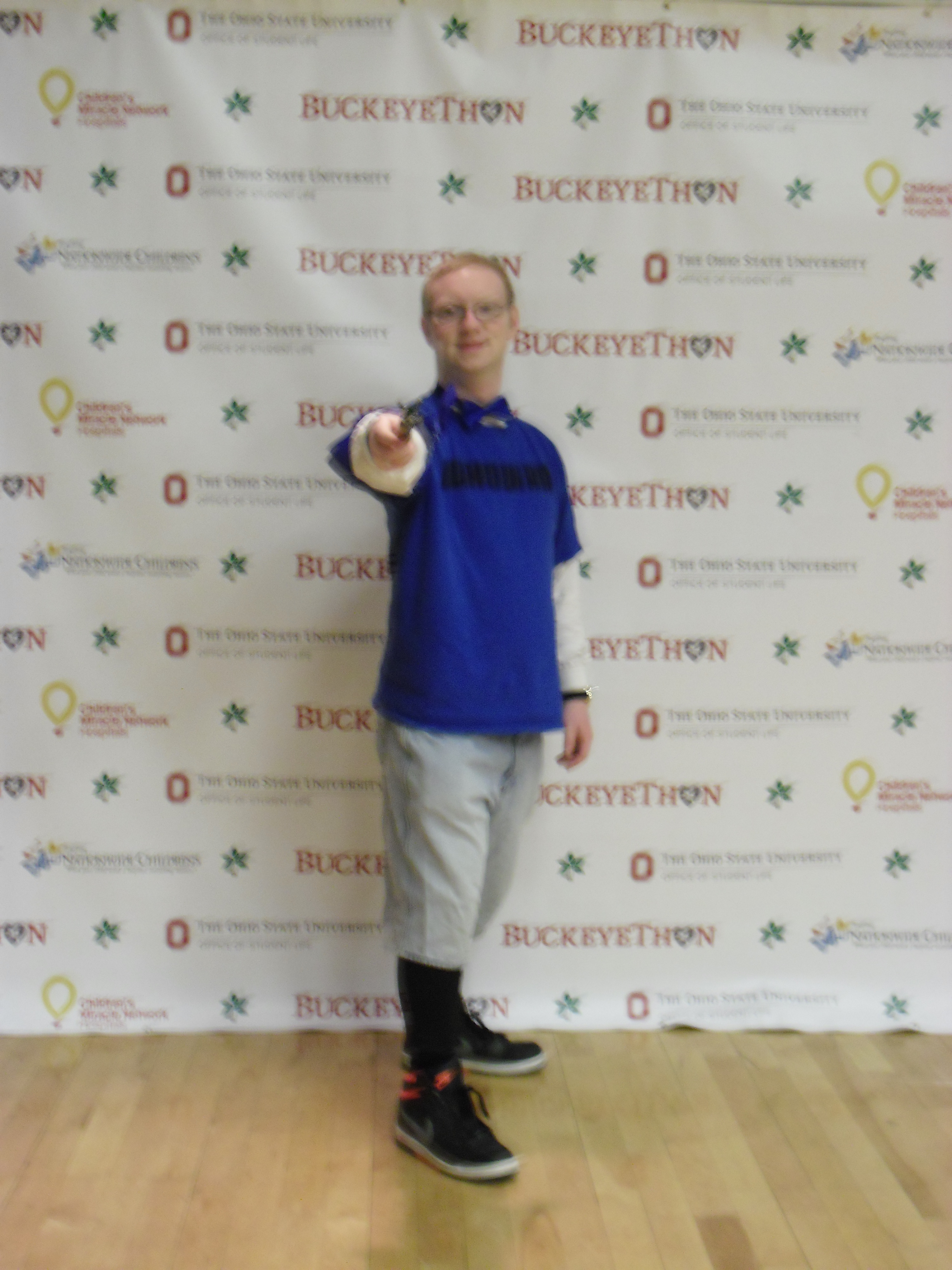
I can’t go into everything that happened last night, but I’ll give some of the highlights and a few photos too, plus a video. First let me tell you that the people who go to BuckeyeThon are divided into color-themed teams. I was on the Blue Team this year, and I dressed the part.

Allons-y!

Allons-y!

Some of you are thinking, What is he dressed up as? Others are thinking, Is he holding a sonic screwdriver? And one or two of you are thinking Go Michigan! I’m going to ignore the people thinking the last one and explain: I went last night as the Blue Doctor (please somebody be thinking, Blue Doctor? WHO is that?) Besides showing how overly obsessed with Doctor Who I am, I think the Doctor would totally get into something like this, which is why I went as him…if he were me and on the Blue Team. But hey, I was wearing a blue bowtie and had a sonic screwdriver and I was TARDIS blue the whole night. It kind of worked.

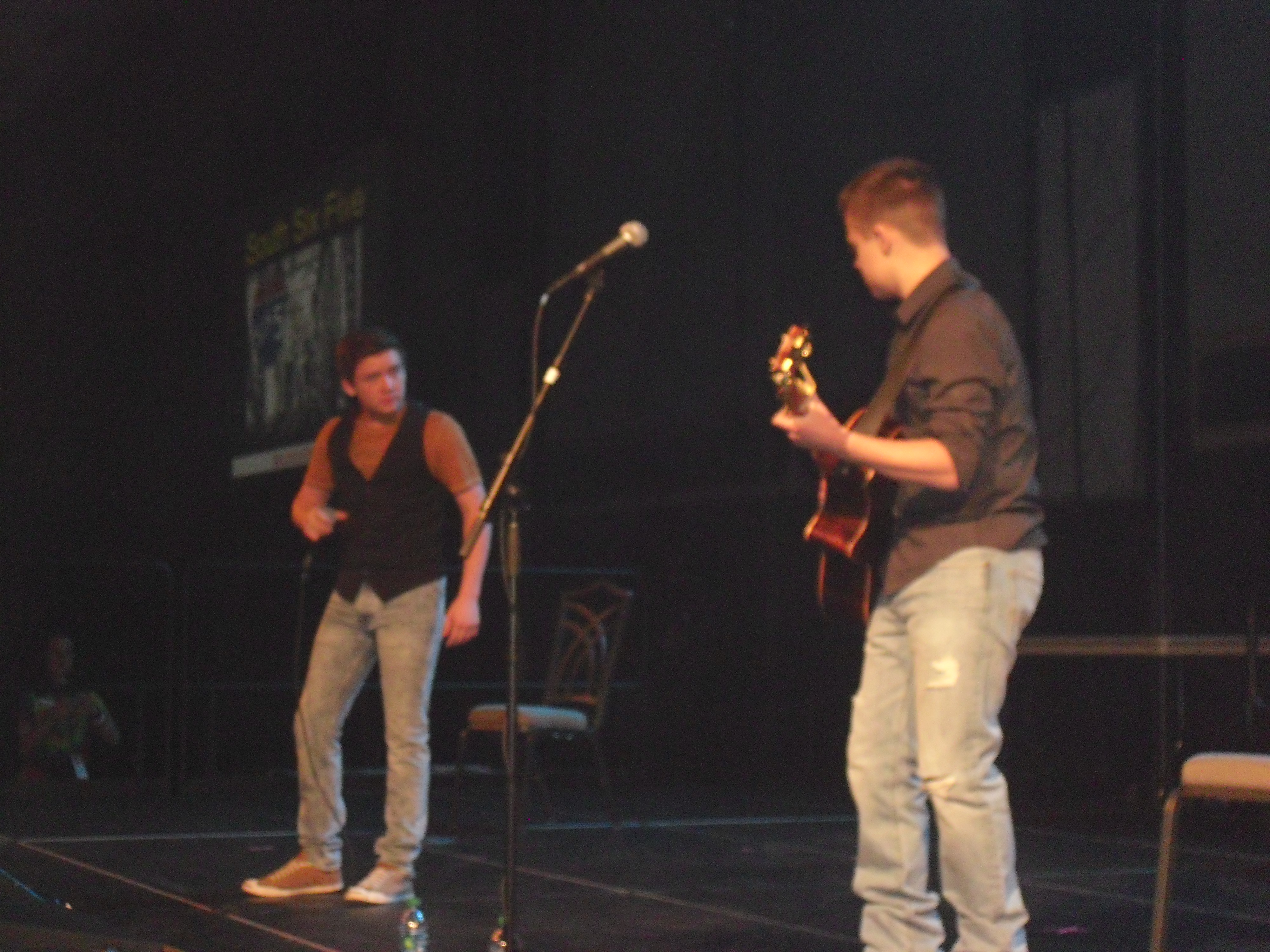
South Six 5. Don't let the Bieber hair full you, they're much better than him.

South Six 5. Don’t let the Bieber hair full you, they’re much better than him.

And we had a wild night. There was a whole lot of dancing, there was a rave DJ at one point, a dance instructor who sent women and some men into frenzies with his dancing which we were supposed to imitate, a concert with local band South Six 5 (check out photo) and a morale dance, which is like a huge flash mob we learn the steps to throughout the night.

And at around 8 in the morning, we broke with a singing of the school song Carmen Ohio before going home to sleep and let the second shift have their party (did I mention that there are two shifts to this thing? Half the dancers take one 12-hour shift overnight, the other half have a 12-hour shift over the course of Saturday). After I got home and showered, I slept till about five in the afternoon, got up, and ate, did some homework, cleaned my room (it needed it), and then went back to the Union where all this takes place.

There we heard stories from the families of the kids we were helping to cure, as well as some of the people who helped organize and set up BuckeyeThon, as well as other dance marathons from around the country. And we heard a story from a man who helps set up dance marathons across the country. He told us about a kid he knew who had survived cancer and had been in and around these dance marathons for a good chunk of his life. The kid said something like this: “When I was growing up, I heard we were in the generation that would find the cure for cancer. It’s not true: we are the cure for cancer.” Hearing that was pretty spectacular, and it’s kind of true. Even if we’re not doctors or nurses or chemists coming up with new drugs and treatments or monitoring these kids heart rates, we have been instrumental in creating the means to cure cancer. It’s really amazing.

This photo is actually from the start of Buckeyethon, but whatever. You get the point.

This photo is actually from the start of Buckeyethon, but whatever. You get the point.

And then, in the packed Union (see that photo to the right), we learned how much we made. Slowly, the number was revealed on big sheets of cardboard: $767, 227.78. That’s nearly $150,000 m0re than last year’s amount! And I was so happy to have been part of that, even if my donations weren’t as high as some others (one girl raised $15,000 on her own. What is her secret?).

And now that I’ve said all that, I’d like to thank everyone who donated to me to support BuckeyeThon and the kids we helped. I was really a great experience and I was so happy to have so many people supporting me and to be with so many amazing people last night. I hope I can count on you all next year, when I do it again for the last time around. Hopefully I won’t cry too much when it happens.

Oh, lastly I want to show you the morale dance. Looks like someone posted a video of it this morning. Actually it’s the morale dance competition, when the various teams send two representatives to compete in doing the entire morale dance in front of the entire room. I got to represent the blue team, which was quite fun. You don’t see much of me in the video (mostly my arm) but you get to see the first-place and third-place teams do it, and it’s pretty fun to watch. Check it out.

That’s all for now. I’ll post more photos on my Facebook page and Twitter feed tomorrow. Until then, goodnight Followers of Fear.

After finishing “A Haunted Man” two nights ago, I’ve decided that, although I’ve got so many short stories I’d like to work on, I need to narrow it down to a few choices so I can return to my WIP Laura Horn. Yeah, I know I can just get through all the short stories I want to get through before I get back to the WIP, but I don’t like to leave a novel unfinished like that, and I would prefer having several short stories unwritten than have a novel languishing unfinished on my flash drive.

Besides, as I recall most of the chapters of LH were pretty easy to get through, so I don’t see it taking too much time to finish up. Then during the summer after I get back from my study-abroad trip, I can spend the whole summer editing my other novels and working on short stories. Besides, I’ll most likely be working on a novel for my senior thesis in the fall, so it’ll work out in the end. At least, I think it will.

So I’ve narrowed the number of short stories I’m going to work on to about eight, and I’m going to try to get through as many of them as possible before mid-March, when I plan to start working on LH again. I picked the short stories based on a couple of factors, namely that I thought the ideas behind them were exciting, that I knew where I wanted to go with the story in terms of plot, and that I think they could be published in magazines, especially ones that pay for their published work (I know that sounds crazy, but it helps pay the rent, so I’m trying to get into more magazines that pay for their work). Oh, and one of the short stories will be submitted as a homework assignment to one of my classes, so I could get a very good grade on it.

So that’s my plan for the next four weeks or so. I hope to at least get two to five of these short stories written. Among the eighty-odd ideas for short stories I have written down, these are among some of the best, so I think I’ll enjoy writing them. When each of them is done, I’ll write a post and let people know how they’re doing.

I’m also going to try to come up with an idea for an article. A friend of mine runs a magazine, and I want to write an article for it. Just the question of the subject that’s getting to me. We’ll see what I can come up with.

Oh, and one last thing: I’m thinking of posting a few stories on WattPad all at once. Would you be interested in reading anything of mine if I published it on WattPad, even if it wasn’t strictly horror?

Well, that’s all for now. I’m going to prepare myself mentally for writing later this evening. Wish me luck.

Looks like I get to do a post again with a snake at the top again. You may remember my previous post about the cover for Snake that I created (if not, you can read it here). I got some feedback on it, and most of the people who commented on Facebook said that they wanted more of the painted Lilith’s face and less of her legs. Well, I kind of went with the choice to hide her face because it meant that I could hide her bare breasts. The last thing I wanted was someone to flag Snake as abusive or offensive because of a little T&A.

But I decided that my friends had some very valid points. So I changed the design of the book cover to Aspen, and made the color for the background burnt sienna. The result got better reviews than the first cover. Okay, one guy thought it was “too racy”, but to be fair he’s Orthodox Jewish, so I guess to him a sleeveless shirt on a young lady might be crossing lines. Still, I see his point: Lilith by John Collier, while definitely a work of art in the style of the old Renaissance masters, is pretty sexual. Given the references to the Genesis story though, I think it’s important to keep the theme there, and that’s part of why I chose the painting (along with the obvious snake wrapped around her Britney Spears-style and the red hair which is also upon the head of an important character in this book).

So to recap here’s the previous cover I created:

Snake

And here’s the second version:

Snake

Is it much racier? Yes, it really is. Might it get me in trouble? Possibly. Am I going to change it? At this point, I’d have to say no. I kind of like it, the painting entered the public domain ten years ago, so there’s no copyright issues, and it looks like something I might pick up and at least consider at Barnes & Noble. And I hope people who come across this book on the Internet won’t be embarrassed by the naked woman on it to buy it. Then again, that is what made Kindle and Fifty Shades of Grey such great bedfellows: nobody felt embarrassed reading the book on a tablet on a train or bus. We’ll see.

And yes, that “bedfellows’ thing was intentional. I wasn’t going to do it, but I put it in anyway.

Anyway, unless anybody gives me some objection or some feedback that makes me change my mind, I think I’ll go with this cover. Tomorrow I’ll send it off to the copyright office and possibly start on a book trailer if I have the time. I already have a song I’m going to use, and several images I plan to put into a rather interesting slideshow. I’ll post it here when I’m done.

Anyway, that’s all for now. I’m heading to bed soon. Goodnight, Followers of Fear.