Posts Tagged ‘television shows’

Only the worst of the worst get to hang out here.

Yesterday we took a look at my choices for #10-6 for my top villains list for 2014. Today we look at the Big Bads, the worst of the worst, the folks and creatures we should all fear in our sleep. These top 5 villains are the ones that have amazed, impressed, and/or terrified me the most.

And remember to click here if you’d like to compare #10-6 and #5-1 from last year. Here we go! Mwa-ha-ha!

5. Jennifer Blake (from Teen Wolf)

Once again we have another villain from Teen Wolf, this one from the first half of season three. At first, you think the only thing that the main characters have to worry about is a pack of Alpha werewolves, but then Jennifer Blake comes into the picture. At first just an innocent English teacher who becomes Derek Hale’s love interest after a close encounter, she is actually the Darach, a Druid gone bad, and she has all sorts of dangerous magic on her hands, which she enhances through elaborate human sacrifices. All in the name of revenge against t;he Alpha werewolves who betrayed her several years ago. Her devious tactics, her theatrical flare, and the lengths she’s willing to go are enough to put her above the wily Nogitsune, who was only out for some twisted laughs.

4. The Murder House (from American Horror Story)

I’ve always maintained that a setting can be as much a character as your other characters, and that especially goes for haunted houses. In this house in particular, we feel it as a character, a force with a devious and wily personality for drawing in the innocent and guilty alike, twisting their minds and then trapping their souls forever. All for a very dark purpose that isn’t revealed until the very end of the first season of the groundbreaking FX show. Trust me, you do not want to spend the night in this place. EVER!

3. Dr. Oliver Thresden/Bloody Face (from American Horror Story: Asylum)

Movie and TV serial killers are hard to make unique. A few even come out looking like carbon copies of Jason Voorhees or Michael Myers. In AHS‘s second and much darker season, they not only give us a serial killer with character development, but with a soul. Dr. Thresden originally arrives at Briarcliff Manor to perform a psych evaluation on protagonist Kit, who is believed to be the infamous serial killer Bloody Face. Dr. Thresden ends up staying on to help update Briarcliff’s outdated methods to treating insanity. He takes a special interest in leading lady Lana Winters, a lesbian who, after some failed aversion therapy, he deems sane. After helping her to escape the asylum though, he reveals himself to be Bloody Face, and he is looking for a woman to be his mother, his real mother having abandoned him years ago. With an unhealthy preoccupation for human skin and for his mommy, Bloody Face may at first seem like a bad copy of Leatherface, but in reality he’s unique in so many ways. Played by actor Zachary Quinto, it’s no wonder this character was nominated for so may awards, and won a few as well.

2. Hannibal Lecter (from the books by Thomas Harris)

Our only returning villain from last year, Hannibal Lecter earns his spot for his incredible ability to continue to terrify and manipulate us on the NBC show Hannibal. Honestly, watching Mads Mikkelsen perform in the iconic role is a dark pleasure. In this previous season, he managed to keep the authorities dancing around him, even as some of them began to suspect that he was the Chesapeake Ripper. What’s most horrific is that he almost manages to get protagonist Will Graham to become just like him, a monster without a conscience who likes to see what happens on impulse. And the way he sets things in motion is like watching a Rube Goldberg machine in motion, only with people involved. Until the very last episode and the awesome twists and turns, you’ll be on the edge of your seat wondering what will happen next I’m looking forward to season 3 next year. I hope they can keep up the fun!

1. The Weeping Angels (from Doctor Who)

Our winner this year for Top Villain is another creature from Doctor Who, but this one is slightly stranger and more sinister than the Daleks. The Weeping Angel is a strange being. It can only move when it isn’t seen, thus it keeps its hands over its eyes in case its working with one of its own kind. When they take their hands off though, they reveal monsters that are anything but angelic. And you literally can’t even blink in front of them, because they can move even between the opening and closing of your lids to get you. Once they do, they’ll send you back in time so that you die maybe hundreds or thousands of years before you were born, while they feed on the displaced time energy that results from your timeline into the future being erased. Created by show runner Steven Moffat, these are probably one of the Doctor’s most terrifying enemies, enough to make my sister scream in fright when they feature in an episode. If you ever watch the episode in which they debuted, Blink, you’ll know why.


That’s all for this yer. Join me in 2015 for another Top 10 list. Maybe making the list will be thesis deadlines, because that will be one of the scarier things I’ll have to deal with in this coming school year.

Anyway, hope you had fun reading my Top 10 Villains list. Have a good day, my Followers of Fear. And let me know what you think of the list. Who do you think should have gotten on? And was there anyone here you agreed or disagreed with? I’d love to hear your thoughts.

I’ve been meaning to do this post for a while, but with Laura Horn still needing to be finished and everything…

Anyway, last year I did a countdown of my favorite villains from fiction (to read that contest, click here for #10-6 and here for #5-1). I’m doing it again this year to show case the awesome villains that have impressed and terrified me since that list last year. And a lot has happened over the last year: we’ve got only one person is returning to the list from last year, which just goes to show that Hollywood/New York/everyone else can come up with some really amazing villains sometimes. In fact, I’d like to announce our honorable mention now: Peter Pan from Once Upon a Time. The revisionist fairy tale show came up with a unique take on the classic character as a manipulative sociopath living in a magical Lord of the Flies kingdom who will go to any lengths to stay young, free, and powerful forever. Creepy!

Now let’s get this show started with the first half of the list!

10. The Daleks (from Doctor Who)

Despite their at-first rather ridiculous appearance, the Daleks are terrifying to behold. A genetically-engineered creature living inside a cyborg transport machine, the Daleks are a powerful metaphor for racism, particularly Nazi racism. That, their pure destructive force, their popularity with fans, and many other reasons is why they’ve continued to terrify children and adults since their debut in 1963, and are still part of DW lore and pop culture today. Honestly, even though I love Daleks, if one of them shouted “EXTERMINATE” near me, I might freak out myself.

9. Bughuul (from Sinister)

Sinister is probably one of the best horror films in the past ten years, and Bughuul, also known as Mr. Boogie, is one of the main reasons for that. Portrayed by Nick King, Bughuul is a reimagined boogeyman, a Babylonian god that causes children to murder their families and then feeds on their souls for centuries in his spirit world. Throughout the movie, Bughuul weaves a web of psychological terror around the main character and around the viewer, even up until the final moment of the film. It’s no wonder a sequel is in the works, and no wonder Bughuul deserves a place on this list.

8. The Headless Horseman (from the Sleepy Hollow TV series)

In this reimagining of the classic short story by Washington Irving, the Headless Horseman is one of the Four Horsemen of the Apocalypse, specifically Death, and he’s looking to find his head so he can continue with his mission to start the end of the world. Not only that, he is looking to gain his revenge on Ichabod Crane, whom he has a strange history with, and the revelation of that history just makes things that much more exciting in this awesome show. Also, it’s so cool to see the Headless Horseman riding down the street with an axe and automatic weapons. Total badassery right there.

7. William Lewis (from Law & Order: Special Victims Unit)

Portrayed by Pablo Schreiber, Lewis appeared in the finale of Season 14 and throughout Season 15 and is probably one of the worst villains ever to be on the show in its 16-year run. A monster who gets his kicks from terrorizing his victims and putting them in pain and agony, Lewis kidnapped Detective Benson and tortured her even as he was running from the cops who were looking for him. Even after he was caught, Lewis continued to find ways to harass Benson both in person and in her nightmares, and even escaped to cause more terror. Even after committing suicide, he nearly destroyed Benson and a few other people too. A man like that is the worst, and deserves his place on this list.

6. The Nogitsune (from Teen Wolf)

Season 3 of the hit MTV series was unique in several ways, particularly because it was literally two seasons in one, each half comprising of 12 episodes. The latter half of the season featured the Nogitsune, a fox spirit of chaos who causes murder and mayhem wherever he goes. And all for the sake of a few laughs. When he possesses one of the main characters, you know you have reason to be afraid. Especially when he starts out his day by telling his potential victims riddles.


That’s all for now. Tune in later this week when I list #5-1 of my top villain list. And let me know what you think of these villains. Like them? Hate them? Who do you think should have gone on the list? Let me know in the comments below.

As any author can tell you, there’s no one way we get our ideas. In fact, we get our ideas from everything: stuff that goes on in our lives, the people we know, current events, books, TV shows, movies, video games, from a phrase, from a place, from something we like or something we hate, and from more things than I can list. It’s the actual spinning of the story that can be rather difficult. We have the start of an idea, but we need to build up the story around it. Who’s the protagonist, what’s going to happen, where and when is it going to happen, why is it happening, etc. And depending on the author, the idea, and where it came from or what it consists of, the story based on the idea can come either very quickly or take a while.

For me usually it doesn’t take too long to come up with a story once I have the idea. There’s one notable exception however, and that’s when the idea revolves around a character and nothing else. By this I mean a character pops into my head, maybe no more than just an image but still a character, and I want to write a story around that character. And it isn’t easy for me to come up with that idea.

Other inspirations don’t take that long. I saw the movie Schindler’s List and came up with a whole book series based around the idea of someone actually leading a rebellion against the Nazis. Remember when I went to the Sky Steele show a week back? I had an idea from something we talked about after the concert involving a supernatural crime story. And a creature featured in a fantasy TV series I watched last year inspired a story about how religion can actually kill you. All of this happened within minutes or hours of being inspired.

But starting out with an intriguing character and little to nothing else? It takes me days to come up with a story to match. In fact, of the last ten ideas for novels I’ve had, half of them were based around characters and took me days to actually come up with an idea I could write down on my list of feature-length ideas (I’m up to 145 of those, by the way. Unless I can become successful enough to write full-time, I’m not sure I’ll be able to write them all!). They all started with one or two characters, maybe a setting, but all of them took days to come up what they would be doing or what would happen to them. The most recent one, which I first started trying to brainstorm a story around on Tuesday, I finally got something today.

Sometimes, the gears in my head turn so loudly, you can hear them.

What happened was that I saw this Halloween-themed video (which I will have to post about when October rolls around) and I got a little scared by it. Not only that, but I also kind of fell in love with one of the characters in the video and decided to base an entire Halloween-based story around her. Just one question: what kind of story? Finally figured out today to base the story around ancient myths about Samhain, the holiday Halloween is based on, but up until then I could not think of a single thing to base the story around. Well I did, but none of them really worked for me. I couldn’t see myself writing something around those other story possibilities, let alone anything I thought would be good. I’m glad that I was able to finally come up with something though, or might have gone a little madder than usual.

You know, as much as I love getting ideas for stories, I hope that in the future these sort of ideas, the ones that take several days to form and usually start with a single character, pop into my head less often. And when they do, I hope it takes less time to come up with a story based around them.

What about you? What sort of ideas do you struggle to create stories around?

What do you do when you’re struggling with an idea and can’t think of anything?

Today during my lunch I started watching the Fourth Doctor serial The Sontaran Experiment. Later this week or next I’ll start watching the Fifth Doctor serial Arc of Infinity, and by the end of the summer I’ll probably have watched quite a few more serials. In short, I’ve been bingeing and will continue bingeing on Classic Doctor Who for a while.

Classic Who is pretty interesting. The show lasted for 26 seasons, usually around 20 or so episodes a season, and ran from 1963-1989. They went through seven different leads, at least fifty companions, and a whole host of supporting actors, cameos, writers, directors, producers, and other crew members during that time, becoming one of sci-fi’s biggest staples and was revived twice, once in a TV movie and again in a new TV series whose eighth season (or series, as they call it in the UK) will premiere in a month and a week. This is all quite amazing, considering that Classic Who had a fairly limited budget for special effects.

And I mean fairly limited budget. Like Star Trek in its early years, and occasionally even worse than that. The first couple of years under the Third Doctor, most serials were confined to defending the Earth because of budget cuts preventing the filming of stories taking place in fantastic and strange locales. And even at the best of times, the special effects weren’t that great. Check out this clip from the Third Doctor serial The Three Doctors (also the first serial ever to feature a former Doctor return to the role). Near the end, you’ll see what I mean:

Yeah, that stuff at the end was an anti-matter monster. And apparently it teleported them somewhere. Not exactly high tech, was it? You watch enough classic episodes, you see that they had to make do with not a lot of money, which sometimes made the monsters look very homemade and laughable, or they had to be filmed in certain ways so that the kids at home wouldn’t see an actor’s two feet sticking out of a monster’s butt. Occasionally that even led to criticism of the whole story: the Third Doctor serial Invasion of the Dinosaurs was derided by viewers because the stop motion dinosaurs weren’t very good and seemed to take away from the overall story.

But that just goes to show how amazing the stories the writers told were, both then and now. What they didn’t have in terms of budget, they made up for in telling compelling tales where the Doctor had to fight in order to save the world (or worlds). Stories like the First Doctor serial The Edge of Destruction or the Fourth Doctor serial The Horror of Fang Rock are very suspenseful stories that rely on very little special effects to instead tell very character-driven horror/suspense stories, and the Seventh Doctor serial The Curse of Fenric was actually so terrifying I was a little scared! Not bad for a story whose special effects were mostly make-up and costumes.

Just a glance at that photo is enough to unnerve me!

These old stories contained much more than special effects. They had mystery, pretty funny jokes, history and science, and compelling plots that kept viewers coming back for more and more each episode. Not to mention how these episodes could confront and tackle complex social issues so that even very small children could learn from them. Dalek stories, from the original First Doctor serial The Daleks to modern-day stories are rife with Nazi Germany metaphors, which have been mentioned by various characters over the years. The Green Death dealt with environmental themes by showing what can happen when you let corporations run rampant over natural resources without enough regulation. And American viewers probably squirmed a little when they saw The Power of Kroll and saw in the conflict between the colonists and the Swampies the fight between white Americans and the Native Americans. I’m surprised the Doctor hasn’t been used as a teaching tool for different causes or issues.

And it wasn’t just the stories that drew the viewers in. The characters the writers created were pretty amazing as well. Heck, it was the writers who managed to keep the show going after First Doctor William Hartnell had to leave the show for health reasons and was replaced by Patrick Troughton. In any other show, the main character being replaced by someone who was a completely different character (but still the same person) would’ve ruined the show. It says something about the writers that they could keep the show going after such a change.

And not just the changes in Doctors. The other characters were amazing as well, helping the viewers to connect with the Doctor and see him and the events surrounding him from a human perspective (literally). Yeah, some of them were annoying (Peri Brown got on my nerves), but for the most part they were all a pretty awesome group of characters. Some of my favorites include Jo Grant, played by Katy Manning, who learned much from the Doctor and became quite a heroine in her own right during her time as his assistant. Or Ace, the last companion of the classic series and played by Sophie Aldred, a punk teen from London who nicknamed the Doctor “Professor” and was in many ways his protege. And I’d be remiss if I didn’t mention Sarah Jane Smith, played by Elisabeth Sladen, one of the longest running companions and by far the most popular. She even had her own spin-off show for a few years. God, we Whovians miss her.

Not just the stories, but the characters made this show amazing.

All in all, it’s not surprising that nearly fifty-one years after two teachers followed one of their students home and into a police box that was much bigger on the inside than on the outside, the show is still going on all these years later. Sure, ther have been hiatuses and breaks, but there’s been a fandom big enough that the show has gone on to become one of the most popular and probably the longest running sci-fi franchises in the world. And I believe the writers over the years, especially the writers in the classic series, have played a huge part in that.

Anyway, I’m certainly having fun watching the old Doctor Who serials. I just wish it was easier to get hold of them. Well, that’s all for now. I’ve got the first draft of a novel to finish up, so I’m going to get on that hopefully tonight, but first I need to reverse the polarity of the neutron flow. Wish me luck with that.

The entrance to the Louvre, surrounding by many fountains.

The entrance to the Louvre, surrounding by many fountains.

The other night, I was watching the classic Doctor Who serial City of Death (one of these days I will have to write an article on Classic Who from a writer’s perspective, because it deserves one), and I found myself freaking out because the serial takes place mainly in Paris, about thirty-five years before I myself was there. (Fun fact: City of Death was the first Doctor Who serial to be filmed abroad, filming between April and May of 1979. So yeah, 35 years before I would visit the city itself).

It was delightful for me to see all those sights in the actual episode, because I’d been to those places and I remembered what it was like to be there. I found myself reliving riding the Metro after a long day, trying to navigate my way back out onto the street after taking a twenty-minute train ride, because those stations can sometimes be little mazes in themselves. Or walking along the river Seine during a leisurely stroll and then sitting in a café near the Champs Elyesees and having a crepe and Orangina (I miss that brand of soda, by the way. It’s so hard to find here in the States).

The Eiffel Tower at night.

The Eiffel Tower at night.

The serial also had scenes set at the Eiffel Tower and in the Louvre. Both those places hold a lot of memories for me. For the Eiffel Tower, it was one of the very first places I visited when I was in Paris. My friend Ramsey Hardin and I decided we go on a late-night jaunt to see the Eiffel Tower at night, and we ended up somehow climbing all the way to the second level (not the top, because that was closed that late at night). It was an amazing view. From every angle you could see Paris at night, a lovely city of lights and mystery. There are hardly any skyscrapers in Paris, mostly due to the French’s distaste for them, so we had a clear view of the city at night. The tower itself starts having a light show with flashing bulbs bright enough to give people seizures about every hour or so, and that was fun to watch. While there we also had the opportunity to talk to a family from the States who were there for a special birthday celebration (the mother’s) and a group from a technical school in Texas that were there for their own study-abroad trip. If the Tower hadn’t had to close, I’m sure we would’ve spent another hour or two there talking to people and enjoying the views.

Ramsey and I at the Eiffel Tower.

Ramsey and I at the Eiffel Tower.

The Louvre has an altogether different feeling. There is more nudity depicted in that museum than in the world’s biggest strip club, and yet there’s just as much religious iconography and scenes to rival the Vatican. And through it all is an air of strange reverence, as if everyone is aware that they are in a temple as holy as any shrine. Even as people take photos of the Mona Lisa or Madonna on the Rocks or paintings so big they take up an entire wall or ones small enough to fit on a cramped bookshelf, there’s a subdued air, as if people are paying their respects to the products of old history and culture. It’s very strange, and you can only really get a sense of it by actually going to the museum itself.

My most artistic selfie.

My most artistic selfie.

But compared to Notre Dame, the Louvre might be a funhouse. I went there after the Louvre, and it’s a very amazing place. From the moment you arrive, you are struck by the very detail of the building. The entrances have so many figures carved into them that you could spend an hour just looking at them and guessing who they are. And once inside, it is very dark and quiet, with people looking around or praying. You can’t help but feel a strange holiness to the place, a sense of godliness no matter what your religious beliefs (or lack of them) are. I even met a couple of OSU alumni there (we’re everywhere!) and they agreed with me on that. I might’v spent more time there if I didn’t have to be back to the hotel by a certain time to meet up for dinner.

See any hunchbacks behind me?

See any hunchbacks behind me?

What does all this rambling have to do with anything? Well, I guess it’s the power of memory. Although sometimes very fallible, the power of memory can transport you through time and space, landing you in a totally different age and location. Just watching that Doctor Who serial was enough to bring me all the way back to France and those five or six lovely, idyllic days of study and learning and wonder and fun, faster than even the TARDIS, even. And I was so happy to return too, because it’s an experience I’ll never be able to relive again, and the memories and photos are what keep the memories alive.

And I hope they stay alive for a long, long time.

Not literally, of course. I mean how to make one for a horror novel, movie, or TV show.

Haunted houses are such a staple of horror, tales of them dating farther back than The Fall of the House of Usher, and have continued to terrify readers and viewers alike over the years, whether they be watching The Shining or American Horror Story or even that episode of Doctor Who with the haunted house. The question is, with so many famouse haunted houses out there, both real and fictional*, how do you construct one that stands out from the crowd (and once again, I mean metaphorically)? Here are some tips that might help.

*For those of you who don’t believe in ghosts or hauntings, you can interpret this as houses in the real world that have history of or are purported to be haunted. For those of you who believe in ghosts…well, I don’t need to finish that sentence, do I?

1. A haunted house doesn’t have to be old and dilapidated. I know the standard image in our minds of a haunted house is one that’s an old manor, with shingles falling out and holes in the porch and plenty of leaks in the pipes, or sometimes a castle with no glass windows and plenty of dungeons and hidden chambers.  That’s great if you want to market it to the Addams Family, but haunted houses don’t necessarily have to look like that. They can be only a few years old, very modern-looking, and in the middle of a nice neighborhood. Heck, you can even make the house a haunted apartment building if you so desired (there was a movie that did that a few years back. Would’ve been good if it hadn’t been a direct-to-DVD sequel).

Not your average haunted house, is it?

In this one novel I plan to write, I plan on the haunted house being only about three decades old, and without any sort of dilapidation or other trademarks to make it a haunted house. What makes it terrifying is its current occupant, as well as the atmosphere that hangs over the place.

For some good examples of haunted houses that don’t fit the standard mold, try the remake of When A Stranger Calls, the first season of American Horror Story, the Buffy episode Where the Wild Things Are, and (if you really want to) The Grudge 3 for that haunted apartment building. Oh, and Ghostbusters as well, that has a haunted apartment building. Or is that a doorway? You decide for yourself.

2. You don’t always need ghosts for a haunted house. For example, you can zombies, witches, a serial killer, vampires, werewolves, just something out of the ordinary. A haunted house doesn’t become haunted because it has ghosts in it, but when something (usually malevolent) is inside. That’s why the movie Cabin in the Woods is so genius: besides breaking down and exploring/philosophizing on the tropes of the horror genre, it also shows how much variety there is to the haunted house and what can haunt it. Anything from zombies to wraiths to werewolves to evil dolls to giant bats to merman to scarecrow people and everything in between, you can use.

3. Use plenty of description when describing the house. In a horror movie, you don’t need to describe the house, because you can see it just fine. But in a novel, the author has to supply the information. What does the outside look like? Is there a distinctive style of architecture involved? Is it painted in really ugly colors that don’t compliment one another? What’s inside? Accessories, knick-knacks, the odd little mirror that’s always in the northwest corner of a house? Is there a yard? What’s in the yard? Does a colony of rabbits live in the yard? Keep all this in mind the moment you introduce your characters (and by contrast, the readers) to your haunted house.

4. Don’t go all out as soon as the door’s closed. By this I mean one should use a subtle build-up in order to properly scare the reader. You can’t just come out with a ghost or an axe murderer showing up and attacking people the moment the door is closed and the character or characters are settled in. There should be a steady build-up. First small things go awry or weird things that can easily be explained but are still creepy nonetheless. Then weirder stuff happens: you might see a form out of the corner of your eye, or you walk into a room and the furniture is all moved or ruined. There might be voices you can’t explain, or perhaps something catches on fire inexplicably. You touch a certain section of the wall, and you feel intense pleasure or pain. And then finally, there’s no denying that weird stuff is going on: the ghost has appeared, the threat is revealed, you’re going to have to deal with it or die. Using the house to do all that and more can really ramp up the suspense and terror of the story and make your haunted house terrifying and distinctive.

Don’t reveal THIS too quickly.

A great example of this ramping up of the terror is the original Amityville Horror, as well as the movie Sinister.

5. Your house should have a history. Whether the house is ten, a hundred, or several hundred years old, it should have a history, and the author should know what it is, even if they won’t reveal all of it to the reader. What is the history of the house, or the land it sits on? Does it involve an Indian burial ground? Was there a really nasty murder there? Or was there something even darker than that lurking beneath the floorboards and behind the walls? This will help you flesh out the story, the haunting, and whatever is happening in your story. Also, often times one can figure out how to defeat the antagonist of the story through its history (like Jason Voorhees and water, or Goblin from Blackwood Manor by Anne Rice). And if this history involves certain people or objects, make sure to have that worked out as well.

There are many great examples of haunted houses with history, just watch any episode of a show for investigating haunted locations. If that isn’t your thing, try movies like The Conjuring, or the TV mini-series version of The Shining (not the movie though, that was a terrible adaptation).

6. Research common signs or symptoms of hauntings. I know some of you will be like, “What’s he talking about?” Well, besides sightings of ghosts or voices being heard, people often report certain things when experiencing a haunting: inexplicable areas where it is cold, electrical devices being drained, objects being moved, and even attacks, and each can happen for very different reasons. I like to include these things in my story because they seem to give my stories an air of authenticity (if you want to call it that). You don’t have to go this route with your haunted house, but if you do and you want to do some research, ghost-hunting shows or manuals on ghost-hunting can be great resources. Also do some research on why these signs and symptoms might not be caused by a haunting, because…

7. A little bit of uncertainty goes a long way. One of the scariest things with a haunted house is not knowing. Not knowing if you’re going crazy, not knowing if there’s actually a ghost in the house, not knowing what it wants or how you’re going to stop it. It’s scary not knowing, which is why a writer should exploit it for as long as they can in a story. It’ll make your story that much better. So knowing explainable ways for a “haunting” to occur can help to add to that uncertainty. Could it be electrical fields? Could it be a spirit? Or is it just the pipes and my new medication? It’s scary just not being sure.

Ultimately, it’s how the writer writes the story that makes the story scary. But if these tips have helped make your story scarier, then I’m glad to have helped and I hope that you have fun constructing your haunted house. I bet it’ll be very terrifying.

That’s all for now, I–that’s odd. My water bottle just fell off the counter. I could have sworn I put it farther back on the counter. Wait, what was that I just saw out of the corner of my mind. I must be working too hard or watching too many movies. I–oh my God! AAAAAAAAAAAAAAAAAAAAAAAAAAH!!!!!

….

….

….

He’ll be coming for you next.

I do a lot of female leads in my writing And for some time now, it’s been bothering me. Not the kind of bothering like “I’m a dude, I should write more male leads”, but the kind of bothering where you ask every four-year-old’s favorite question: why? Why do I feel such an affinity towards female leads? And why do they always seem to come into the story with some baggage or that they get baggage early on in the story?

I’ve been wondering about both points for some time, and I think I might finally have some answers. For why I prefer using female protagonists, I think it has a lot to do with my childhood. I grew up in a family with a lot of women in it. That has some upsides and some downsides, one of the upsides of which being that I had some very good examples of strong women right in my own home. My mother is a woman rabbi and became ordained in an era when there were very few women before her or with her in that role (there still aren’t many women rabbis, but there are certainly more than when my mother was ordained). And sometime after she divorced my dad, she became involved with another woman, who I’ve come to look up to as another mother. My mother’s partner is an accountant, and was there countless times when I was having trouble with math throughout middle school and high school. She was also one of the people who taught me to play sports during the few instances where I showed an interest in sports (rare instances, but thy exist).

Besides my family, some of my childhood heroes were actually heroines. Growing up, I was very big into shows with girls who could have normal lives one minute and kick monster ass the next. This primarily involved Sailor Moon and Buffy the Vampire Slayer, both of which I’m still huge fans of (by the way, Sailor Moon is getting an anime reboot next month. If you haven’t guessed, I’m kind of counting down the days till then). Besides sometimes having really creepy monsters and awesome battle scenes, these shows portrayed women as more than just screaming damsels in distress who need a man to help them. They show women able to fight back as well as have real character development and  growth. With all these influences, it’s no wonder as a writer I tend to write more female protagonists than male.

And I think that that’s a good thing, really. If you look at our contemporary media, you see several more men than women as leads, and generally the men are much more developed. Sure, there are women like Katniss Everdeen and Black Widow or Mystique, but the former seem very underdeveloped in Books 2 and 3 when you consider how she keeps going back to her romantic issues and how her life is mostly manipulated by powerful men, and the latter have yet to have their own solo films. Recently there’s been controversy over the new Assassin’s Creed game not having any female leads, and most video games still don’t have as many female playable characters as men, and those that do don’t always take the time to develop their leading ladies. To be sure, there are a new class of women (particularly women of color) emerging in the media who are portraying women in strong, positive, fully-developed roles, such as Olivia Pope in Scandal, the detectives from SVU, and even the women from Orange is the New Black. But there is still a long way to go, and the landscape is still very uneven.

Even though my work is only read by a small amount of people at this point, I like to think that with the large number of female protagonists I write (and hopefully received as well-written role models) is helping to correct the problem and give more girls what I was given at a young age, which was some great examples of strong women.

As for the whole thing with the baggage that a lot of my characters come with, I think that can be said for a lot of writers. Let’s face it, authors tend to have their characters come with baggage. Maybe they’re orphans, or they lost a loved one, or they have a dark past with family issues or drugs or something. I think that’s because we like our characters to be a little broken, in order to make them more identifiable and to make it easier for us to facilitate character growth. Honestly, I think it’d be more of a challenge to give a compelling story with development and growth to a character who doesn’t have anything worse than clinical depression or a tendency to pig out on junk food.

In any case, I’m happy to say I now have a better understanding of myself. I look forward to seeing what I can do and what I can write now that I have a better understanding of my process and the sort of characters I create.

Well, that’s all for now. I think I’ll sign off now and watch some TV. Have a good night, my Followers of Fear.

Ah, the Eiffel Tower. See how it glows in the night.

Ah, the Eiffel Tower. See how it glows in the night.

Hi honey I’m home! After about three weeks in England, France, and Germany, I’m finally back in the States. I will definitely miss being in Europe (I will especially miss transportation made easy through the Metro systems), but I was beginning to miss my family and my life here and I’m glad to be back.

Of course, now that I’m back I’m not going to spend the whole time on my butt (though for the most part that’s what I’ve been doing while I get reacclimatized). In addition to catching up on all my shows and going to see some movies that came out while I was abroad, I plan to be very busy this summer. I’ll be doing my usual chores and errands, for one thing, and I’ll be working in the financial aid office for the whole summer (and if I can find one, I’ll try for another job that’ll allow me to work one or two days a week to help with the income). I also plan to finish my novel-in-progress Laura Horn, which I think I can get done by mid-July if I don’t get too distracted. I also hope to write plenty of short stories after I finish the book, because God knows I have plenty of ideas for those (I came up with about 40 ideas for stories while in Europe, most of them short stories. The lesson to be derived from this is that if you’re a writer and you find yourself on a trip abroad, bring a notebook to write down any ideas you have).

What else do I plan to do? Oh yeah, Snake will be coming out on June 10th, so I’ll be getting ready for that. And The Quiet Game’s one-year anniversary will be in July, so I plan to hold a sale for that on the e-book. And I’ll try to do some author interviews now that I’m back in the States, as well as finally getting around to editing Video Rage, the sequel to Reborn City. And maybe I’ll finish some of the series I’m watching on Netflix.

In short, I’ll be very busy.

But enough about that. I said I was going to share some of the stories from my study abroad trip. I think I’ll start with my last night abroad, with the final dinner. Why? Because it shows how much we bonded over the trip:

We were having a special dinner on the second floor of a beer garden at Alexanderplatz in Berlin called Lindenbrau. The weather was cloudy and rainy, but we didn’t really care, because we were all very happy. Maybe that was because of the alcohol and warm food, but we were happy. I was talking with my teachers and y roommate Henry and my friends, and I had a wheat beer in front of me. Most of us were really sad to go, but we were also glad that we’d had this experience together. Also, a few of us were itching to go home, or to go to other places if we were staying in Europe longer (I might have and gone to see Poland and Italy or maybe go back to England, but I couldn’t afford it).

And then our teachers, Dr. Steigerwald and Professor Willging (affectionately nicknamed Dad and Mom, respectively, by our group), stood up to say some words. They said how proud they were of us, and how they hoped we would all stay in touch for years to come. And then they handed out awards to us, the kind like “Most Likely To…” or “Least Likely To…” awards. We were invited to guess whom each award was for, and I got about three or four of them before anyone else. My award was, “Most Likely To Wander Into Rommel’s Chateau.” Considering how oblivious I can be sometimes, that’s not very surprising.

And then something interesting happened: Ramsey Hardin, one of the people on my trip who had become probably my best friend while on the trip, arrived late and hungry. He’d gone to a museum to get a little bit more culture, but on the way back traffic had been really bad, and he’d ended up about an hour or so late getting to the beer garden. Believe me, he was upset, and only a jug of beer and a really huge ham could possibly relieve that anger.

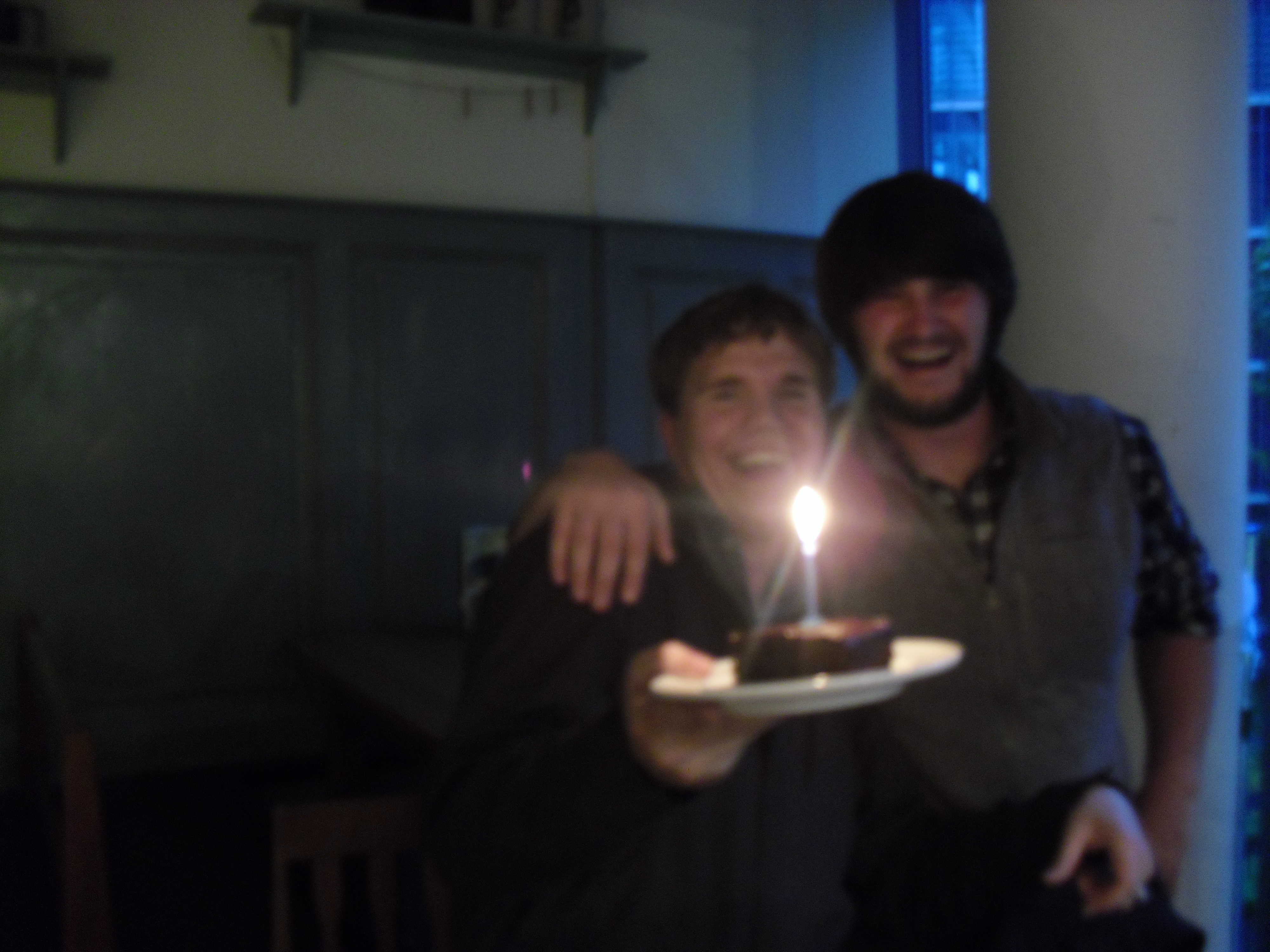
Happy Birthday Ramsey Hardin! By the way, that's David Corrigan photo-bombing te shot. What a goof!

Happy Birthday Ramsey Hardin! And that David Corrigan with him, by the way.

But then a huge surprise came out: the waiter brought Ramsey a piece of chocolate cake with a single blue candle stuck into it, a flame dancing on the wick. It was Ramsey’s twenty-fourth birthday. Boy, did that cheer him up! I wonder what he wished for, though. He probably asked for a big book of history. Ramsey’s a huge history buff, and reads anything about the past. In fact, he was voted “Most Likely To Teach Alexander the Great History” or something like that.

We ended the evening with dessert and a few more drinks, and then I went back to the hotel, to get ready for tomorrow’s flight and to store all these wonderful memories in my head.

And trust me, I’ll have a fun time relating them to you all in the coming months (or until you’re sick of hearing about them). That’s all for now though. Hope you enjoyed the story, my Followers of Fear. I’ll tell another one when I have a moment.

I’m going to share something that happened to me this morning with you all. I woke up much later than I’d planned to, made myself breakfast, and turned on my laptop to see my messages. In my inbox, I found that someone had replied to a comment I’d made to a YouTube video. The video in question was a Tibetan bowl singing meditation video that I listened to yesterday in order to relax after a long day. When it was over, I had commented, “Whoa, what did that just do to me?” (I was really relaxed afterwards). Between commenting on that video and checking my messages, some merry prankster had replied to my comment with this: “it raped you…with Tibetan singing bowls :)”.

Of course, you can guess how I replied: “not funny”.

And it’s true, rape is not funny, especially when you look at the realities of the problem. It’s estimated that every two minutes, an American is sexually assaulted. One in five female college students will be sexually assaulted before they graduate, usually by someone they know. Often their rapists are not punished as thoroughly as they should be by the university, receiving academic probation or being banned from campus for a year. Imagine having to be on the same campus as your rapist every day until one or both of you have graduated. It’s enough to drive you insane. And rapists who are let off easy like this are likely to repeat and rape again, averaging six assaults before graduation. It’s even likelier for rapists who include violent acts like strangulation in their assaults. Because of these statistics and several colleges apparently mishandling sexual assaults, 55 universities, my own included, are being investigated for mishandling sexual assault cases by the federal government. For some victims, they wish this investigation would’ve come sooner.

And that’s not the worst part about it. In some countries women are jailed or killed if they are raped, sometimes with the permission of the governments that are supposed to protect them. These “honor killings” or jail sentences are supposed to punish the woman for making herself sexually desirable to her rapist and causing him to commit adultery. Sometimes they are even married off to their rapists in order to preserve family honor! For many women, anxiety, depression, PTSD, and other psychological disorders can arise from being sexually assaulted, so imagine having to be punished by law or married to your rapist in order to preserve some silly notion of honor.

Even in countries where women aren’t punished or married off on their rapists, sometimes things are little better. Assault victims are shamed or intimidated into keeping silent for a variety of reasons. They may believe that their assault was their fault, or that they’ll be humiliated or disbelieved if they come forward, or that coming forward will forever change how they’re viewed by people. In cases of pregnancy, some won’t be able to get abortions because laws make it difficult or impossible to do so.

Even in the United States, supposedly a progressive country where all are equal, most are seriously misinformed about sexual assault. They believe it only happens to others, that all rapists are strangers to the victim, that it’s a rare occurrence. In reality, rape is all too common, as well as pregnancies that result from rape, most rapists are someone the victims know, and it could happen to just about anyone. And when we do not blame the rapists but find ways to blame or hurt the victims or create reasons why we shouldn’t believe them, we only make things worse.

And so do the comedians who make fun of rape. Whether they make one single joke or an entire act out of rape and sexual assault, they are doing as much damage as some rapists. They tell people that rape isn’t a serious problem, that you can make fun of it and the victims who are assaulted every two minutes in America (there was a great Law & Order: SVU episode about this recently). And some people, like my commenter above, will take these comedians seriously. One or two may actually rape themselves, believing it’s no big deal.

I’m here saying that rape is a very big deal, and it is not something that should be made fun of or turned into comedy club stand-up. Rape is a serious problem people all over the world must face, and that unless we seriously try to change our culture, things will not improve. They’ll stay the same, or get worse.

So if you ever find yourself confronted with a rape joke or you think about making a rape joke, imagine that making such a joke makes someone as horrible as a rapist. And then ask yourself if you should really laugh at or make that joke, or if you should try and change things so that those jokes are never made again. You might get thanked down the road for that.

Some in the American government and in the media have made the proclamation that “racism is dead”, at least here in the United States. If you ask me, the people saying this are either overly idealistic and naïve or they’re willfully ignoring facts. Because the sad fact of the matter is, racism is far from dead. It’s just not as overt as it used to be, it’s become subtler so it can thrive without being reprimanded or outcasted by the majority of Americans who don’t believe in racism or think it’s immoral.

Need proof? The Southern Poverty Law Center estimates that there are over 200 known hate groups in the United States, with Ohio having 31, New York 42, and California 77. Other large states have many different hate groups, most having racist beliefs, and the states with fewer hate groups are more likely to have groups that can be categorized as Neo-Nazi, White Nationalist, KKK, Racist Skinhead, Black Separatist, and General Hate. And that’s just the tip of the iceberg! Just imagine how many small or new hate groups out there the SPLC has yet to document! The numbers are scary if you think about it.

And then there are recent episodes where racism has reared its ugly head and broadcast all over the media. Cliven Bundy recently remarked that he believes that blacks (or as he calls them, “negros”) were better off under slavery than they are now, because apparently not learning to pick cotton has lead to them being on government welfare, aborting kids, and sending their young men to jail (I could write an entire post on the meshuggas of this guy if I wanted to, but why bother? He’s obviously nuts and in the end the federal government will force him to pay the money or send him to jail, possibly with his militia friends in tow). And then he acts like the victim when reasonable people are offended by his words and says MLK Jr. didn’t finish his job.

First off, Mr. Bundy seems to forget that slavery was not a walk in the park. It was inhumane, cruel, and caused the deaths of untold millions. He also doesn’t seem to realize that there is much more to why some African Americans are on welfare, mostly because they are not afforded the economic, environmental, and social resources to help them get off welfare. Plus not all blacks are on welfare, aborting babies, or in jail. Our President identifies as black*, and he’s not on welfare (unless you count living in a government building and receiving your paycheck through taxpayer money welfare), has two beautiful daughters, and has never been to jail unless it’s been to talk to prisoners.

*Yes, he identifies as black. It’s not a biological thing, but a social construct. Amazing that we make such a big thing over a construct of our minds, but there you go. (see this post for more)

And is being on welfare necessarily a bad thing? Mr. Bundy’s ancestors were brought from Nevada on a welfare program, if I remember correctly. So don’t preach like you’re better than them, because your life is the result of welfare programs, Mr. Bundy. And by the way, don’t blame a dead man for what’s in your heart. You have only yourself to blame for your racist beliefs, and if people are offended, it’s because there is still reverberations in our own society resulting from the darkness in our past. No covering up will rid our nation of that darkness, and people are right to be offended by your remarks. At the very least, you can be considered callous, if not outright racist.

And then there’s Donald Sterling, who’s been banned from the NBA and forcibly relieved of the LA Clippers because he didn’t want his biracial mistress seen with black people. Some people say he may be senile, others say he’s worried about his performance, and others just say he’s a racist pig. I think that whatever he is, he is a hypocrite because his team is mostly black and he’s seeing a woman who is half-black, and that his hypocrisy, as we have seen, is his downfall.

It is nice to know that the same weekend we all started talking about Sterling, Family Guy had a wonderful episode that dealt with racism, not just from whites but from blacks as well. And it is nice to know that we are having a dialogue about this, that we are not trying to sweep racism under the rug or deny that it exists. That’s like trying to ignore a serious medical condition or disorder in the hopes that it goes away. Just doesn’t work out in the end.

You know, the Supreme Court is right: a lot has changed since the Civil Rights Acts were passed. We are now a more technological, global, connected society. We recycle in the hopes of not accelerating the destruction of the Earth, and the idea of a black man or a woman running for President is no longer ludicrous, but the former has become a successful reality (twice!) and the latter is welcomed by a huge majority of the country.

However racism is still a problem in this country, and it is something we will have to deal with if this country is to continue to grow and prosper. So denying racism and saying it’s dead isn’t the answer. Rather, open dialogue and a lot of love and understanding is. And we need to have more of it.

Oh, and to the KKK guy in that one news clip who says he has black friends but doesn’t believe in “racial mixing”, where are your black friends exactly? Do they know you wear a KKK robe? And could you bring me an article from an accredited medical journal published in the past ten years that says “racial mixing” is a bad thing? I would love to see it!