Archive for the ‘Reflections’ Category


I’ve been busy this past weekend, attending my cousin’s bar mitzvah in Detroit and when not doing bar mitzvah things, I was busy with homework or being in the car (hard to get Wi-Fi while in the car). Otherwise I would have posted something Friday or Saturday. Well, better late than never, right?

And on the subject of writing posts, I want to talk about something that’s a subject of controversy for writers: a daily word count. I’ve heard plenty of writers give their opinions on the topic, from being proponents of 500 to 1000 words a day, to others who say that the daily word count is some draconian form of masochism for writers. Me, being “ambitious”, as my English major advisor called me (or was it “overachiever”?), have tried to at least get 500 words typed out each day, whether it be short story, novel, or blog post. 500 words seems to be the amount of words most proponents seem to advocate, whatever the reason that be.

Well, the other day I was working on a short story that I’ve been working on and off for about eight months. That night I barely got three or four hundred words written and I was feeling pretty ashamed about that. This story’s been wrestling with me for ages, and I’ve been trying to get a version of it written that I feel would be up to the standards I (and possibly the magazines I could submit it too) like of my short stories.

The next night though I had a different idea of where to go with this story, and I wrote about fifteen hundred words. Obviously, I felt elated by that. But I also had a bit of an epiphany that evening. The night before I’d been unsatisfied with the direction the story was going and obviously it stalled. The next night I had a different direction for the story that I thought might work better and I got out over a thousand words.

I won’t be worrying about word counts while writing any time soon.

It made me realize that some days, if I’m enjoying how the story goes or if I’m really in the flow, I’ll write a huge amount. And other days, if I’m tired, if I’m not really liking the direction of the story, or if it’s just not my day, I might not get a hundred words out. It’s not any fault of mine, it’s just the way sometimes these things go. Writers have bad days too and on those days we just have to deal with it, and maybe try again tomorrow.

These past couple of days, outside of homework, I haven’t gotten anywhere near five-hundred words written. Am I upset? More about not having the chance to write than anything else. The word count isn’t important to me anymore. Or it isn’t as important as it used to be. I’ll definitely try to get more written out than I have previously over these next couple of nights. Since I’ll be editing Rose starting Tuesday, I might just get a lot out depending on how much I want to change from one draft to the other. We’ll see.

But I’m not that concerned. As I said, some days you’re going to get plenty done and some days you’ll only get a few words out. It’s important at the very least that you try. And believe me, I’ll be trying.

How do you feel about daily word counts? For or against? Why?

Are you planning on asking me how many words this post is?

If you are, you shouldn’t! Because if you ask, I won’t tell you! I’m evil that way.

And by the way, thanks once again to everyone who contributed to Buckeyethon this past year. Even though I could not attend the dance this year because of my cousin’s bar mitzvah, I heard about the great achievements of my fellow students and I this year. 1.2 million dollars towards cancer research! Thank you so very much for your spiritual and financial support in this. You helped make the difference with me.

Well, that’s all for now. It’s getting late, and I’m going to head to bed. I’ve had a lot of late night recently, so I need some sleep if I’m going to be able to deal with school and work and the writing tomorrow. Have a great night, my Followers of Fear.

I’ve mentioned this a couple of times, but I’ve rewritten a number of stories, especially short stories, over the course of my writing career. It’s annoying to a certain degree, to have to start from scratch while writing the same story over and over again. It’s easier to just edit a single story, but when things need to be changed to such a degree that rewriting the story is either simpler or the same as editing the story.

I’ve rewritten What Happened Saturday Night more than once (especially the last third of it), still have to rewrite Evil Began in a Bar (as soon as I figure out how to go about it) and I’m in the process of doing a major revision of Miranda’s Tempest that was inspired by one of my History of Witchcraft classes. Plus I plan to rewrite Laura Horn as soon as I have a moment. And you remember when I had to writ a new outline of Rose because the story was getting way too crazy for my advisor Manny (finally asked if I could name him here on my blog) and he told me to rethink where it was going? That was basically an outline rewrite. And it was after I had to rewrite the first four chapters because they were too light and campy for a horror novel.

Oy vey! That’s a lot of rewrites!

Still, as much as I hate having to do it, I know that a rewrite is ultimately beneficial. It makes the story much, much better. The difference between the first draft of What Happened Saturday Night, “Frauwolf” and the second draft was immense. And the third and fourth drafts showed even greater improvement. The Murderer’s Legacy improved a great deal once it became Miranda’s Tempest, though it still had its flaws. And now I’m doing another version of Miranda’s Tempest, though I’ve renamed it Strong’s Trial due to the new content and theme. It resembles Harry Potter a bit, though I think it’ll end up much removed from that. The rewrites of Rose have vastly improved it and I’m sure when I get to rewriting Laura Horn it’ll be much, much better.

And a lot of great works have been rewritten before publication. The Book Thief was apparently written 200 times before being published, and that’s a famous work. And I hear every script that gets turned into a movie in Hollywood goes through several rewrites before finally going into production. So perhaps my constant rewriting of my stories might make for a famous story someday. We’ll see someday.

Well, that’s all for now. I’m going to spend some time relaxing this evening before going to bed. I’ve done a lot of (re)writing today, so I’m going to take a break and try to relax. I’m setting up an account on my roommate’s PS4 and I’m going to play my first survival-horror game, Outlast. I’ve heard good things about it. Should be very exciting (and if I don’t like it, I’ll rewrite it!). Wish me luck!

My latest article from Self-Published Authors Helping Other Authors is Short Stories That Are Too Short. This post was inspired by things I learned in my creative writing class last semester, and details one of the lessons I learned there. If you’ve ever worried that the short stories you write are too long or too short, this article might be helpful for you.

And if you’re a writer, traditionally published or independently published, this website might be what you’re looking for. We have hundreds of articles that are devoted to helping authors of all stripes write, edit, publish, and market their books effectively and without too much cost. Check it out if you get the chance.

Well, I’ve got work to do. Goodnight, my Followers of Fear. Pleasant nightmares.

Some writers like to compare themselves to gods of the worlds they create, prodding their characters this way and that as the write their stories. I’m one of those writers, as blasphemous as it sounds (even more blasphemous when you consider that my parents are rabbis). But in a strange way, it’s true. I come up with an outline for my stories, I start writing, my characters take over to some degree and make their own choices, but at the end of it all they get to where I wanted them to go.

Sounds like God, doesn’t it? My characters, my creations, have free will of a sort in my world, but in the end the story usually works the way I want it to go because this world is mine and I have ultimate say. Evil has a purpose in my world, and so does reward and punishment (in a way). There’s an ultimate plan or idea of where things will go because I will it to be so, but you have to see the whole picture in order to understand the plan.

And I’m going to stop right there before I get a ton of people angry at me.

But if I’m the god of my worlds and my characters, what does that make me? What kind of god am I? I specialize in horror. It’s a dark genre, where anyone can die at any second, where monsters exist, and if you’re lucky enough to live, you might wish you’d died. It’s the genre that revels in the darkest of humanity as well as the best, brings doubt as well as faith, and above all, scares. I’m the god of such worlds, I adore making them up in my mind and then bringing them to life on the page.

What does that say about me? What does that say about any writer that wants to put their characters through torment or hardship? What does it say about God, that His world which He (or She, I’m equal opportunity) authored is so full of darkness?

Well, this isn’t a philosophy or theology post. But it brings up some good questions in those areas. Imagine if the characters we write were real people and the pain we put them through was real to them. Would we want to keep writing anything where they felt pain? Writers often feel like these characters are family to them, like children. If these were our real children, would we want to keep doing these sort of things to them? Would we ever write a story with conflict in it?

And could we continue to worship God with this sort of definition of Him?

The thing is, we’re not God. And our characters are most likely not real. But if they were, we’d probably go about writing sad or tragic stories. Like God, we have a plan, and the characters who we killed off, if we have any amount of mercy in us, we’d give the dead an afterlife to live in, so that killing them off wouldn’t hurt us as much. Because you know what? We have stories to tell, and maybe they’re not happy all the time, but they’re ours and that’s what we write.

And I do feel my characters are real to some degree. But that doesn’t mean I won’t write. After all, their stories deserve to be told.

About a week and a half ago, Variety reported that the Ghost in the Shell live-action film, which had been in development hell for years, was underway and had Scarlett Johanssen in the lead after Margot Robbie turned it down. Not only did this impress upon me to actually read the manga, but it excited and angered GitS fans across the world. The former is understandable, but the latter is a bit more complex. Why? Well, the main character of GitS is named Major Motoko Kusanagi, and she’s Japanese. Johanssen, while a great actress, is white. Why didn’t Touchstone Pictures ask any Japanese actresses?

And this isn’t the only live-action adaptation based on a Japanese franchise where Hollywood has looked at only white actors. The Akira film, which once again is in development after many years in and out of development hell, has been notorious for its producers trying to get white actors in the roles of Japanese characters. Justin Timberlake, Robert Pattinson, and Andrew Garfield are the latest names to come up. George Takei has been vocal about this, warning producers they will upset fans and have a repeat of The Last Airbender (an adaptation of the American anime Avatar: The Last Airbender) if they don’t cast Asian actors. Remember the latter film had a mostly white cast, and, although the film was problematic on a number of levels, the fact that the very diverse characters were all played by white actors upset many fans.

And it’s not just films based on anime that has had this problem. Biblical films such as Noah and Exodus: Gods and Kings have received a lot of criticism not just for the liberties taken with their stories, but the fact that while the characters being portrayed would have most likely have been from the Middle East and Africa, the principle actors were all white. And in Pan, an upcoming movie based on Peter Pan, Tiger Lily is played by Rooney Mara, who is white while her character is Native American. Surprisingly, the Peter Pan live musical on NBC last month actually had a Native American actress and tried not to be so stereotypical with their portrayal of Native Americans, which was one of the few good things about that disaster. The 2003 Peter Pan film also cast a Native American actress in the role of Tiger Lily, and that film rocked! Why can’t Pan do the same thing?

And here’s something interesting I’m not sure if other people have noticed: when the Harry Potter films were still being made, the first couple of films had two different actresses, both black, playing Lavender Brown. At that point she was a background character for the films, but once the sixth book came out she had a much bigger role. When we see her in the sixth movie, she’s played by Jessie Cave, who was white. I mean really. The HP universe has already shown that the main basis for discrimination is how pure your blood is. JK Rowling has already stated that gender isn’t a big deal in the Wizarding world, and I don’t think race would be a big deal either. What’s wrong with Ron dating a black girl, even if the relationship doesn’t work out in the end? Heck, Fred went to the Yule Ball with Angelina Johnson, who in the books was black, and after the series she married and had kids with George Weasley.

And why the heck wasn’t Selma in the Oscars this year? I mean, I don’t really care about the Oscars, but apparently this year has only white nominees, and of those most are male. I don’t know why. I saw Selma, and it was powerful and beautiful. Why can’t it get a nomination or two?

I’ve been vocal about how, almost 47 years after Martin Luther King Jr.’s death, this nation is still full of racial inequality, most illustrated this past year in the deaths of Eric Garner, Michael Brown, and quite a few others, the trials that seem to have lead to nowhere, and the protests that have followed them. The many roles where white actors have played characters of non-white nationalities may seem like a small thing, but it’s actually pretty big. The media has a great power to influence millions and millions of people. What does it say when the people who go to movies don’t see themselves in the movies that they go to see? Even in roles where they should be seeing themselves?

I’m not sure what Hollywood’s reasoning for doing all this white-washing. Maybe they like to bank on star power or something. But I think that studio execs are making a big mistake by not including more diverse casts in their films.  TV execs are catching on much faster: TV shows like Sleepy Hollow,  Scandal and How to Get Away With Murder, which pride themselves on their diversity, are tearing up the prime time landscape, Black-ish and Jane the Virgin, which feature mostly black or Hispanic casts, are some of the year’s best new comedies, and SNL has made it a point to diversify their cast members.

And while I’m still working on getting that sort of reach with my books, I like to use diverse casts in my stories when I can, and I think that that’s some of the best parts of my books. In my thesis novel Rose, half the main cast, including antagonist Akira, are Japanese. In Laura Horn, many of the characters are black or Hispanic, and I plan to keep that in the rewrite. And in the Reborn City series, most of my characters aren’t white. In fact, Zahara Bakur, my protagonist, is an Arab Muslim. And if in an adaptation of any of my works, the white-washing I’ve described above was used in the casting process, I’d be very, very upset.

Because that’s not how the characters should be. We want to see characters who look like us. I’m lucky that I see a lot of white characters. Occasionally I see a Jewish character, though they’re either secular or ultra-Orthodox Jews. But what about others? There have only been two black superheroes in the movies these past couple of years, and they’ve been sidekicks to the white superhero. And what about Hispanic or Asian heroes? Where are the Native American characters?

I think Hollywood is making a great mistake in not diversifying their casts and insisting on the big actors. I’m not saying that white actors no longer have roles in movies. But I do think that there needs to be more roles for blacks, Hispanics, Asians, Native Americans, and other groups and ethnicities in Hollywood movies. It’s not a moral thing. It’s because the world is becoming more diverse every day. The media we consume should reflect that. After all, the media reflects the world, doesn’t it? So reflect the world as it is, Hollywood. And that’s a beautifully diverse landscape of many different groups and peoples with a thousand different stories to tell.

So I’m working on Rose, my latest novel as well as my thesis, and I’m working on a chapter that I finished earlier today. However, this chapter was special, because it’s the first of two chapters that take place away from the titular character’s point-of-view. As I’ve mentioned in previous posts, Rose is told from the first-person point-of-view, and it’s told in the present tense, which originally I had difficulty with but eventually became easier with practice. However, as this chapter takes place away from Rose’s POV, I did it in the third-person POV, and I did it in the present tense.

Needless to say, it was incredibly awkward writing. I don’t know many stories that are written in the present tense, and those that I do are written usually in the first-person, like someone is narrating their life (who actually does that, I don’t know, but whatever). I don’t think I’ve ever read one that is present-tense and told in the third-person though. Maybe John Barth’s Lost in the Funhouse, but I can’t remember that one as well, so don’t take my word on that one. Anyway, writing this chapter in such a way is incredibly awkward for me. And I think it shows throughout the chapter, all six pages of it.

Well, my advisor M, my fellow writer/thesis worker P, and I are trying to arrange to meet sometime next week. I’ve already sent the chapter to them, and I’ve already suggested some changes I could make to this chapter in the second draft. I’m hoping they let me keep it in third-person but switch to past tense, as that would be much easier for me to write. But whatever they feel or whatever suggestions they give, I’ll definitely take them into account. They haven’t steered me wrong before, and I’ve learned a whole lot working from them.

In any case, I’m taking the night off from writing. I’m going to do some reading for homework, practice Torah reading for my cousin’s bar mitzvah next month, and if there’s time relax in front of the TV or with a good book. Stay warm and have a good night, my Followers of Fear. I know I am.

Boy, do I owe her so much. Even today, I’m getting so much from her books. I’ve got to read her new novel one of these days.

It’s been a good day for me. Classes have been fun (I almost wish they’d last longer), work’s been going well, and I’ve already finished one chapter of Rose (six more to go!). And I’ve recently gotten another lesson in writing.

I’ve been listening to the Harry Potter audiobooks lately and I’m currently on Book 4 (Harry’s currently dealing with most of the school and his best friend hating him for being the fourth champion. Hang in there, Harry!). This was the series that made me want to be a writer in the first place. And you can get something out of the HP books at any age, I find. But I also remembered something that I’d forgotten about JK Rowling’s famous series: she can build such amazing images in our heads and do them with such few words.

I forgot about that, how every word is picked to be useful and poetic and not a single one seems wasteful. That sort of economic use of words is hard to come by, and she wields words so well in her books. I used to try to imitate that style when I was first starting out (I also was trying to write my own version of the Harry Potter series with a female protagonist, but that’s another story). Sometimes I didn’t use enough words! Though in my defense, most writers under the age of thirteen are very visual and we don’t always consider that our readers might need a few more words to visualize the story in their heads when we can see it just fine in ours.

As I grew up though, as I got better and I started getting published occasionally, I started using more, bigger words. I think that’s common with plenty of writers at many different ages. We want to sound smart, intelligent, eloquent with words. I’ve done it just now! Eloquent. That’s a word a lot of people know, but wouldn’t it just be fine to use “good with words”? And I used “economic” in the last paragraph. How about frugal? Or choosy? Or maybe even thrifty?

And we do it just to make ourselves look educated and verbose (there it is again). Sometimes we worry that our readers will get lost along the way, but we’re too afraid to stop! We’re afraid we won’t live up to people’s images of writers. Is it our vanity or our fears of how people look at us? Is there a difference? I’m not sure.

But I’m listening to the HP books, and it’s so precise with the words. And it’s a good story. Scratch that. It’s a great story (my mother would kill me with Avada Kedavra if I didn’t make that distinction). Maybe because JK Rowling wrote the HP books with kids rather than adults in mind, but she’s never worried about the words she’s using, about sounding intelligent or loqacious (again!). She just puts down the words as is needed.

Have to stop using words like I’m pulling them out of a thesaurus just because they’re big and fancy. It might be detrimental–darn it!

In my Business and Professional Writing class, we’ve been looking at how businesses and corporations and even school districts use lots of big words in order to sound like they’re qualified for their jobs. What it really does is sound like a robot has produced a lot of inpersonal and indecipherable terms (again) and let’s be honest, nobody likes an inpersonal robot, whether in real life or on the page.

It’s a crazy coincidence that it’s all happening at the same time, but JK Rowling and my class are teaching me something: that perhaps all those words are unnecessary, that instead of making me sound intelligent and articulate (trying to stop) they’re making me sound less like a person and more like a machine. And even though I do a great impression of a Cyberman, I’d rather not be mistaken for a robot.

So I’m going to try being less long-winded, switch to simpler words and get my point across in half the time. Heck, it might help me finally get a short story written in less than forty-five hundred words, something I’ve been trying to do for ages. And maybe it’ll make for a better story overall. We’ll see what happens.

For the present though, I’m certainly exhausted my patience for the overuse of ample language in the pursuit of resplendent storytelling and will henceforth cease such unreasonable actions for the betterment of my vocation and for the beneficial enhancement of my readership.

I’m done.

I’ve mentioned several times on this blog that I do a kind of meditation called Sahaja Yoga, and I have to say, it’s been an amazing influence on my life. Not only is it really relaxing, but it’s invigorating and I feel calmer and more balanced and focused after meditation (though nothing can ever seem to take away my wild, silly side). And, during the three years I’ve been meditating, I’ve been given a lot of ideas for stories or on how to modify stories that I’ve been having trouble with.

The first time this happened was after I started learning Sahaja Yoga. I was having trouble trying to figure out this short story I was working on and make it flow as a story. I knew something was missing, but I couldn’t figure out what. At one point I just sat down, started meditating for five or six minutes, and then went out for a walk. During that walk I felt much calmer and more open minded, and I found a way to make the short story work. I went home and finished the short story within the week.

It’s been like that a lot since then, especially during classes on Sundays. I’ll meditate and while I’m cleaning chakras and relaxing, my mind will go into a very different state, in which ideas just come much more easily to me. It’s amazing. Today, I was having trouble figuring out which direction to to go with this short story I’m working on, and I was hoping that today’s class would help me figure out where to go with this story. I put myself into a meditative state and let my mind go. And about ten, twenty minutes into the class, I had it. I knew how to make this story work. And after we finished the meditation, everyone looked very happy to hear that I’d had my idea (everyone in the class is very supportive of my career, and one woman has even read all my books and reviewed one of them). I also had four other ideas for stories today, which is a bit more than usual (don’t know if they’re all related to my class, but I like to think they are).

Why does meditation make me so much more creative? Like hypnosis, meditation puts you into a different state of mind that helps you unwind, relax, and sometimes make you a bit more suggestible. I think that state of mind allows me to hold onto passing thoughts and twist and turn them into workable ideas for stories. In any case, usually after meditation I’m pulling out my little notebook and writing down my ideas, making Sunday one of my more creative days of the week.

Whatever the case, there’s no doubt that, in addition to all the other benefits of meditation I receive, Sahaja Yoga definitely makes me a much more creative person and gives me several more ideas for interesting stories. I never know when I’ll write any of them (that’s how many stories I have and how busy I am trying to get through just one story at a time), but it definitely means I’ll never run out of stories. And it’s another reason why I won’t be giving up meditation any time soon.

Well, that’s all for now, my Followers of Fear. Tomorrow’s the first day of classes, so I’m going to finish up and call it  a night. I’ve got a busy first day (2 classes, a shift at work, and a phone conference, plus Buckeyes take on Oregon tomorrow night. Go Bucks!) so I have to get as much sleep as possible if I’m going to get up tomorrow and take it all one with my usual chipper temperament. Wish me luck, and goodnight, my Followers of Fear!

A while back I posted on character tropes and cliches that needed to be retired from literature. Some of my Followers of Fear thought that maybe the trope of “The Chosen One” could stand to be retired. I’ve been thinking about this since I wrote that post, and I thought I’d discuss it in contrast to what I call “Someone Who Grows Into a Hero.” If I had another name for that character trope, something a bit shorter, I would use it. Maybe I’ll think of one in the course of this post. Or maybe you’ll give me one (please?).

So, let’s talk tropes. The Chosen One is, in essence, a character who is basically chosen by some higher power–God, Fate, some powerful wizard, the President, the Force, that kooky neighbor down the street, etc.–to take on some great evil and defeat it. Sometimes this choosing takes place pretty early in life, sometimes years or ages before the Chosen One’s birth. A good example is Harry Potter being chosen to defeat Lord Voldemort (funnily enough, I’ve been listening to Harry Potter audiobooks while I’ve been working lately. Already on Book 3. You can always get something new from these books no matter your age, I find). It’s been used hundreds and hundreds of times throughout history, since possibly before the Greeks and Romans started telling stories involving oracles.

Now, this trope has a good reason for being used so much. The character who is the Chosen One–usually the protagonist–is usually a good person, selfless, kind, somewhat charismatic. They’re often presented with insurmountable odds, but through their own ingenuity, goodness, and the help of their allies they overcome and become victorious. We want to be that person, who is good and destined to be great as well, to save everyone and to have the best group of friends around them. To be a messianic or godlike figure.

However, there are some problems with this trope. For one, it’s been used so much that we know it by heart. Harry Potter, Eragon, Mila Kunis’s character in Jupiter Ascending, Gregor the Overlander, Emma Swan, Anakin Skywalker/Darth Vader (with Luke’s help, I guess), Neo, Buffy, Po the Panda, Thomas from The Maze Runner and many, many more. These characters are everywhere. And they seem to all have similar personal stories. They grow up in simple circumstances–programmer, abused nephew, farmer, teenage girl, etc.–but are thrust into extraordinary circumstances that change their lives and center events on them. They’re told they’re special, that there are things that only they can do. At first they might be reluctant, or not have the confidence to do what they are told to do. But as time goes on and they somehow make it through the most dire circumstances, they become confident and settled in their roles, and they do end up destroying the ultimate evil (except if you’re the Slayer, in which case it never ends) once all is said and done.

trelawney 1

These sort of stories also say something about how the universe works, namely fate vs. free will. In some circumstances, the way these stories work is that no matter what, the Chosen One is to win against the ultimate evil. So personal choice isn’t a factor. The universe must work to get the Chosen One to win. Remember when I said I was listening to the HP audiobooks? In the 2nd, when Harry stabs the diary, and I remember this clearly, Harry doesn’t think when he sees the fang and the diary. He just acts. Perhaps the universe intervened so that Harry could someday take on the full mantle of his destiny? And in the case of Buffy, no matter how much she tries, the duties of a Slayer force her back into the world of darkness and away from anything resembling a normal life. The universe (or the writers) seem to have no care for Buffy’s choices, apparently.

So the problems of this trope is not only that it’s overused, but that it’s predictable, and that it takes the freedom of choice out of the equation to a great extent, sometimes even totally. There are ways to change up the trope, but it’s rarely done. Katniss Everdeen could be considered a slight variation on the theme, as she kind of stumbled into the role of Chosen One by an act of defiance, but from that point on her life is controlled by others. Heck, even Peeta manipulates her by forcing her into the relationship and pregnancy ruses. Still, I’ve been open about my disdain for the Hunger Games trilogy, so I’ll say it’s not the best example. I’m trying to think up a better one, even if I write it myself, so I’ll let you know if I think of (or write) something.

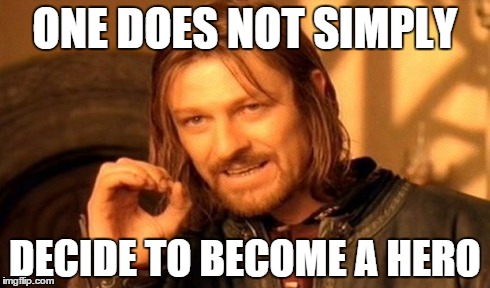
The other trope is the Accidental Hero trope (I did find another title for this trope). This is one I like a bit more, because you can do so much more with it and there’s a growing number of examples of this kind of character. This is a character who, rather than by fate, is made a hero through circumstances and their own choices. They may not be hero material, they may not want to be heroes, they may rather go home, but they rise to become heroes by their own merits. For example, Nathaniel from the Bartimaeus books wasn’t chosen to be a hero, and never set out to be a hero. In the first book, he was seeking revenge for personal reasons, the second book he did it because of his job and because of political reasons. In the third book he does it after a lot of self examination and because he’s scared of the demon uprising.

one does not simply 1

Another example is Teen Wolf (the awesome TV series, not the very bad 80’s movie). Scott McCall became a werewolf by accident, and because of the threats to his family, friends and his town, he has to rise to become a hero and save the day. No fate, no gods, no prophecies. He becomes a hero (and later a very special form of werewolf) because his personality, the events in his town, and his love for the people close to him mold him into a hero.

And there are many more examples. Chuck from the titular series never asked for the Intersect, and he wasn’t supposed to have it. It could’ve been taken out ages ago. But he chose to keep it, use it for his friends, and save the people he cared about. Through that he becomes a spy and a hero. In Doctor Who, the Doctor only wanted to travel and see the universe. He is a hero of his own choice. Lelouch Lamperouge from the anime Code Geass received his powers through luck, and later chose to use them for his own ends and to get his revenge (more antihero I guess, but whatever). It’s a trope with a lot of wriggle room in it, and even better, it’s still underused, unlike the Chosen One trope. So perhaps many more authors should write less Chosen One stories and more Accidental Hero stories.

Of course, there’s no way that this post will cause less Chosen One stories to be written. For better or worse, that trope is popular and will stick around for a long while. Still, I’m hoping for more Accidental Hero stories. I figure most of my stories will feature them. Reborn City and Snake‘s protagonists become heroes (or in the latter’s case, antiheroes) through choice and circumstance. Heck, I might try and find ways to subvert the Chosen One trope while writing Accidental Heroes. We’ll see what I can do.

Which trope do you prefer? What’s your favorite example?

What is a way that one could change either trope so that either one could be a bit more original?

Another year has come and gone. And what a year it was! Personally a lot of amazing things happened to me: I got to go on the study abroad trip of my dreams (sadly one doesn’t exist to explore haunted locations) and make unforgettable memories with amazing friends while learning about WWII. I published my second novel Snake, which currently has an average of 4.2 out of 5 on Amazon. I started my last year of school, which I shall finish in four months and ten days from now. And so much more has happened, so much that I can’t mention them all here or you might get bored. I’m definitely not going to mention any of that stuff WordPress sends in an email about Sydney Opera Houses and whatever. It’s boring, and I usually save that stuff for the anniversary of my blog being created in August anyway.

What do I hope for 2015? Well, I’m hoping to get at least one book published at some point this year. No definite plans at the moment, but I’ll let you know if something does seem imminent. I’d like to finish up my thesis Rose and get some really good remarks and feedback on it (a lot of reports indicate that the former will definitely happen soon, while the latter depends on who reads Rose and what they think). I’d also like to finish editing Video Rage and get to work on improving Laura Horn, which might happen sometime after graduation. As I’ve got close to 400 short story ideas and only a few of them actually written, I’d like to get some more short stories written, maybe get back to work on another collection or publish those short stories in a magazine. And of course I’d like to grow my readership, get more people reading my blog and my books.

And of course I’d like to get a well-paying job by the time I graduate. That would be very nice.

Anyway, thank you to the many Followers of Fear who show up here to read my many posts and interact with me. You give me encouragement every day to keep pursuing my goals and to make my dreams come true. I hope we can have another fabulous year together, through graduation and beyond.

Also thanks to everyone who bought or downloaded a copy of one of my books during the holiday sale this year. I hope you enjoy what you bought and if you feel like it, please let me know what you think. Positive or negative, I love feedback, and I’d be happy to hear yours, even in a comment or a review.

Happy New Year, everyone.