Posts Tagged ‘Die Hard’

The detective arrives at the crime scene and finds the body is nearly identical to another murder. A soldier is walking through a swamp, when they are warned by their sergeant that mines are buried underfoot. The bride leaves her groom at the altar, looking to find herself after years of being told what she should do with her life. The singer comes across Robert Johnson’s guitar, thought to be long lost, and finds there’s more than just history attached to it.

All of these could be the beginning of a story that starts in media res.

Latin for “in the middle of things,” a story that begins in media res is one that starts midway through the plot, rather than at the beginning. And believe it or not, a lot of stories start like this. Hell, you’re probably familiar with most of them. The Star Wars movies arguably all start in media res, as they all start when a conflict is well underway. The novel Gone Girl begins with the protagonist’s wife being discovered missing. Wicked, from novel to musical to movie adaptation (love those last two) always start with the Wicked Witch being a well known figure and with several events implied as having happened and being common knowledge.

That last example brings up something important: how do these stories start in the middle when there’s who knows how much backstory we’ve missed? Often, this is accomplished through dialogue, flashbacks, and exposition. Flashbacks are especially popular, with the majority of Wicked being flashbacks, and the Deadpool films using flashbacks to explain why the film starts off with Wade Wilson getting into some insane shit.

And in horror, in media res is also quite popular. From the classics like Dracula, Frankenstein and Jekyll & Hyde to modern entries like Firestarter and Nightmare on Elm Street. Many of my own stories also start this way: Rose begins with Rose Taggert waking up in a greenhouse with no memory of how she got there or of the past two years, “Queen Alice” begins with my main character Joshua Blumfield already giving his report on the urban legend, and “The Dedication of the High Priestess” begins with Annie Hummel going to a gallery after already serving as a model for three paintings.

Why do horror authors, as well as authors in other genres, begin their stories this way? Well, one thing is the immediate hook. Take Nightmare on Elm Street: it starts with Freddy crafting his claws and then chasing after a teenage girl, only to wake up right on time. We’re immediately left wondering what happened and why, and that keeps our interest.
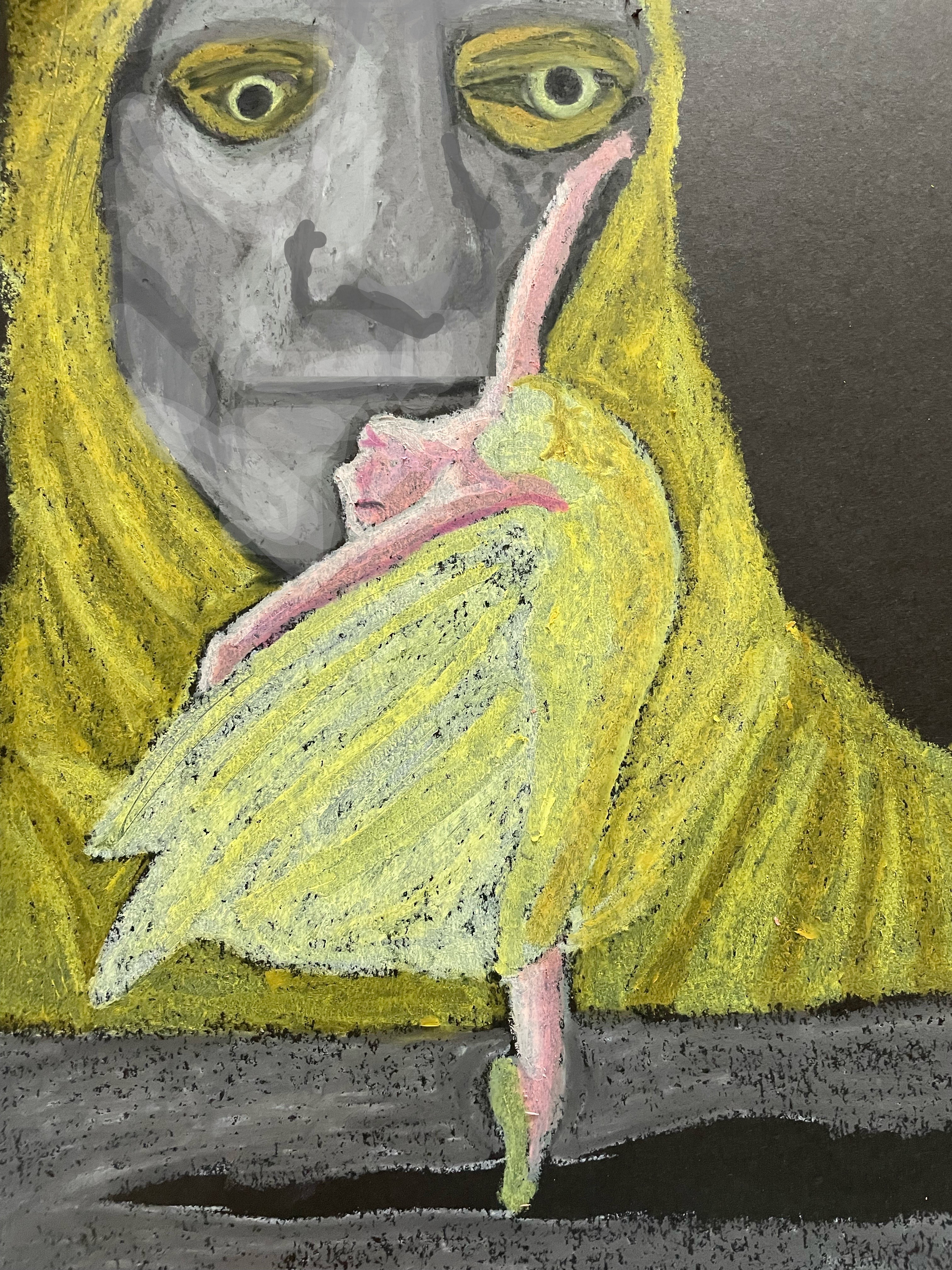
This oil painting by friend and colleague Iseult Murphy is based on “The Dedication of the High Priestess.” The story is an excellent example of a story starting in media res.

It also makes for great suspense. Take Nightmare again: we’ve already witnessed what Freddy’s capable of in the first scene, and so we wonder what else he can do. Would that have happened if we started with Freddy’s first murders and then getting killed by the parents? That opening violence builds up our expectations and keeps us enthralled.

Finally, you manage to get through a lot of exposition writing this way. Take Gone Girl, for example. Gillian Flynn could have started the story with Nick and Amy meeting, getting married, and the fracturing of their relationship before Amy’s disappearance, but would that have been as fun? It’s more interesting and suspenseful to read about the disappearance and then see how their relationship developed.

Another great example would be my story “The Dedication of the High Priestess” (spoilers for a story that came out in 2022). As I said, that story starts with my protagonist Annie already having modeled for a famous artist. She then goes through the gallery, which then causes her to be caught up in the King in Yellow’s plot to come to Earth. I could have started with Annie taking ballet classes, being scouted for the painter’s new series, doing the modeling gigs, and then going to the gallery, but that would have taken a lot of time and pages, and a lot of effort to keep readers interested. Starting with the gallery showing, using dialogue and exposition to explain how we got to this start, and then getting straight to the horror was very effective.

So, there’s a lot of reasons to use in media res to start a story, no matter the genre. It won’t work with all stories (looking at you The Hogfather, Die Hard, and Kill Creek), but if it works with your story, and you can do all the backstory parts without any issue, I see no reason not to use it. After all, I use it all the time. And look at me now!


Thanks for reading, my Followers of Fear. I’m about to start a new story, and it starts so in media res, some readers might need to read the start again. I thought about starting it from earlier in the events of the story, what I would normally reserve for flashbacks or exposition, but it felt like it would take too long and take up too much of a word count. Thinking about it and weighing my options made me want to write this blog post.

And now, if you need me, I’ll be busy writing what may be the most Halloween-y story I’ve written to date. Until next time, good night and pleasant nightmares!
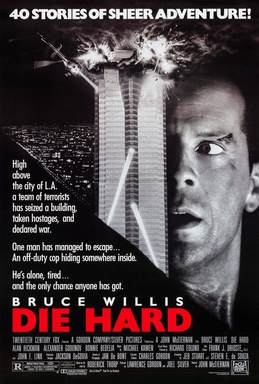
So, it’s been a bit of a strange week for me. Most of it was work, where my workload somehow doubled this week and a bunch of other things occurred, but the thing that I want to talk about is about Die Hard. As many of you know, there’s a big debate over whether or not Die Hard counts as a Christmas movie. This humble Jew not only counts it as a Christmas movie, but as many of you know, has the tradition of getting takeout and watching the movie every Christmas Eve.

And earlier this week, I was at my chiropractor’s office getting an adjustment and was talking to the receptionist while I was paying my bill. Here’s a reproduction of the conversation:

Receptionist: “Are you doing anything for Christmas?”

Me: “Just getting Chinese food and watching Die Hard.”

Receptionist: “What’s that? Some new TV show?”

Me: “…”

Receptionist: “From the look on your face, this is something I should know about, isn’t it?”

And that was the conversation in a nutshell. And you can imagine how stunned I was. I can understand people having never seen the film (I used to be related to someone like that), but having never heard of it? And no, she wasn’t some youngster, this woman was old enough to be a few years behind my parents in high school! You’d think she would have heard of a major blockbuster that came out in 1988.

Anyway, I explained to her what the film was, and she said she’d consider checking it out (whether or not she does, I won’t know till next month). However, that’s not where the story ends. If it was, it would be amusing, but not enough to warrant a blog post.

No, what happened next was that I posted the conversation on my social media so other people could laugh at it, too. And Followers of Fear, over on Threads (Facebook’s answer to Twitter, if you didn’t know), it went viral! I kid you not, within twelve hours, I had tens of thousands of views on that post! Hundreds of people commenting every minute, talking about how old they were when they saw the movie, incidents where young and old alike were unfamiliar with something that was supposed to be common knowledge, and a hundred other things that, more and more, strayed away from the main topic at hand.

As of writing this, that post has over 189,000 views, 2,700 likes, 1,100 comments, and twelve reposts. And I’ve still no idea why it went viral like that. I mean, I know Die Hard and whether it’s a Christmas movie or not is big around this time of year, but holy shit! If any post about one of my books gets even a hundredth of that sort of attention, I would be in heaven!

So yeah, that happened. As did a post about the Disney Princesses duking it out to the death getting nearly 17,000 views (Mulan and Merida are the favorites to win if you force the magical ones not to use their powers), and over on BlueSky, the director of the movie Suitable Flesh saw my review of it (I found it unnecessarily horny), and was pretty much like, “Oh well, I thought it was horny enough, but to each their own. Thanks for watching.” With a GIF of Elmo shrugging. I was touched.

And this is only part of what has been a weird, weird week. But this is the part that I’ve been dying to tell someone all week and which I’ve only been able to do now. Really, no deeper reason than that. Thanks for indulging me while I unloaded what’s been rolling around in my head this week.

Anyway, hope you’re all doing well as the year begins to wind down. I’m counting down the days till I’m off for two weeks and working on The Shape of Evil in the meantime (nearly halfway through the second draft). And in the meantime, if you’re looking for a good scary book for yourself or for someone else this holiday season, I’ll leave a link below. From plant/human hybrids and strange gods to Mafia-hunting serial killers and carnivorous horses, I have something for every horror fan, so be sure to check them out. They’ll make the holiday gatherings that much easier.

Also, if you would like to keep up with me on Threads, BlueSky, or any of my other social media platforms, I’ll include those as well. I post more often there than here, and it’s another way to support me, so please do check me out.

Until next time, good night and pleasant nightmares.

So, one thing that really surprised me about the editing process for Hannah was that I had to get rid of brand names from the stories. YouTube became WeTube, and Kroger and Meijer became Lundgren’s, etc.

But those weren’t the only things I had to take out. Ohio State University, which was featured in What Errour Awoke and which was mentioned in Hannah, has been renamed Aurelian University. And Disneyland is now Mueller Land. Yeah, Disneyland was in a story at one point, but now it’s Mueller Land. And I was really surprised I had to change those both.

As my publisher explained, we have to be careful, because if we use a real brand and the company that owns the brand thinks the depiction is negative, they can sue both me and the publisher. Which makes sense. I mean, Apple doesn’t allow its products to be used by bad guys in movies and TV shows. If you see someone in a movie using a generic android phone, chances are they’re bad guys. And in the TV show Chuck, the name of the store where the main character works is a Best Buy parody called Buy More. And given that the store is regularly depicted as being staffed by lazy, incompetent, and oftentimes creepy employees, or is the sight of shootouts and spy shenanigans, it makes sense that the creators would change the name.

Also explains why Subway, which was a sponsor for the show in later seasons, was only ever eaten by the good guys. As far as I can remember, I never once saw a bad guy in that show going for Subway.

Still, that show also depicted Stanford University as a major recruiting center for CIA operatives, and during the first season, the main character has negative feelings towards the school due to his being framed for cheating and getting kicked out while there. Did Stanford not care? And if it didn’t, would Ohio State really care that some characters in my collection were students there?

On the bright side, I was able to keep Slender Man in Queen Alice. Even though he’s a copyrighted character (I know, most people think he’s public domain as well), I was able to keep him as mentioned in Queen Alice because he illustrates an ongoing phenomena regarding Internet boogeymen. And in What Errour Awoke, I was able to keep a reference to Die Hard because, as my editor put it, Nakatomi Plaza is not a copyrighted name or actual location and everyone loves a Die Hard reference (truth).

I still find myself wondering about this, though. Some authors, especially big-name authors, can put references to brands, businesses and universities, among other things, into their work and don’t think twice about changing them. Occasionally, you even see song lyrics from famous songs! Gerald’s Game‘s antagonist draws his name from lyrics from “The Joker” by the Steve Miller Band, and My Best Friend’s Exorcism had lyrics to many popular songs from the 1980s, albeit sung with the wrong lyrics because that’s what the characters liked to do. Not sure if that counts as parody or fair use, but it doesn’t change the fact that We Got the Beat by the Go-Gos was used as an exorcism chant later in the book.

And how does Law & Order: SVU get away with using TikTok and TikTok stars in one episode? Yeah, season 23, episode 5. Even if the app isn’t portrayed as having any bearing on the bad guys in that episode, I can’t imagine TikTok was happy to have its name used in the show like that.

I guess what I’m saying is, there’s a lot to using real brands in fictional contexts that I don’t get. It’s incredibly nuanced, and you can’t get away with using a real brand by using it in a positive light and then pointing to the copyright text at the beginning of the book stating that all characters, settings, and whatever are fictional or used fictionally. In which case, more often than not, it might be better to just turn a popular brand or institution into a fictional version with a name that may or may not reference the real thing. YouTube becomes WeTube, Disneyland becomes Mueller Land, Ohio State University becomes Aurelian University, and…well, you get the idea.

Do you have any insight on this, my Followers of Fear? Please sound off in the comments below.

That’s all for now, my Followers of Fear. Just a reminder, though: this Saturday I’ll be at the Canal Town Book Festival in Dover, Ohio, selling books. If any of you are in the area, please stop by and visit. Also keep an eye out for some exciting news on the horizon regarding Hannah and Other Stories. Trust me, you won’t want to miss it.

Until next time, good night and pleasant nightmares!

Occasionally in fiction writing, you create characters you find utterly repulsive. Maybe it’s their personality, maybe it’s what they do or believe in, but these characters are VILE.

And surprisingly, writing them well is kind of challenging. I should know. I’m working on a story now where I hate most of the characters. Why? I’ll get into that a little later.

(Though if you’ve been paying attention to my Facebook posts or Twitter feed, you might already know why.)

The thing is, while you may hate the character you’ve created, you can’t let that hate show too much in your writing. You have to treat them like you would any other character. Showing your contempt may be easy, but the reader may notice. And while they may agree with you, they will be turned off by the clear aversion and disdain coming off the page, especially if it’s a protagonist. “Why even bother writing this character if you’re going to make it so obvious you don’t like them?” That might be what goes through their minds. Instead, write them like you would a character you like.

A good example of this is how Vladimir Nabokov treats Humbert Humbert in the novel Lolita. In an interview, Nabokov stated he found Humbert a hateful person for obvious reasons. But he didn’t show his dislike for the character and his predilections in the story. Instead, he writes the novel normally and let’s the readers come to hate him by his actions.

That’s something to keep in mind. Instead of showing your disdain for a vile character, let their actions do the work for you. You can do a lot just by showing a cruel teacher depriving a kid of ice cream or a prison warden manipulating his prisoners to attack each other, rather than by describing them as nasty pieces of shit.

Dolores Umbridge. A great example of a vile character.

You can then supplement that by showing other characters’ reactions to the hated characters for being assholes. JK Rowling, despite her faults, did this quite well when Harry and his friends described characters like Umbridge or Pansy Parkinson and focused on their negative traits. Rowling famously hates those characters, by the way, and made sure they suffered or didn’t get happily-ever-afters in the end.

What if you have to show things through the perspective of the hated character, however? Well, that’s where it can get queasy to write them. Because, as much as you might hate them, you’ll often have to write them as any other character. For instance, l’m writing characters who are neo-Nazis.

Yeah, you read that right. The story I’m working on now is full of neo-Nazis, people who would gladly see me dead for being Jewish (among other things). And I am writing them as I would most other characters. I could write them and focus on their hatred and nasty ideology, and in another story I could get away with that. But for this story, I can’t let them just be stock characters or stereotypes, much as I want to. Instead, I’m trying to show the reader how the characters might see the world. And let’s face it, neo-Nazis are people, and they’re as complicated as any other character. So I should try to write them that way.

That being said, I am going to show just how horrible these people and their toxic ideology can be. And then I’ll take great pleasure in showing what horrors occur to them later in the story. Hey, I’m a Jewish horror author who loves visiting terrors upon his enemies. What do you expect?

So, writing characters you consider vile is more than just making them hateful or showing how much you hate them. It’s a combination of actions, character description, and even writing them in a complex manner. And, of course, making sure they get what’s coming to them if it fits the story. It may make you feel sick to write them that way, but it can also lead to a good story becoming that much better.


On an unrelated note, the anthology I’m helping to produce, That Which Cannot Be Undone, is closing in on forty percent funded on Kickstarter! Not only that, but we’ve added a whole bunch of new perks and have announced some new authors joining the project as well. Some of those authors have even volunteered to name characters after backers and kill them off in style should they back certain limited pledges. Isn’t that cool? You could be a character in another author’s story!

If that, and helping our group produce a kickass horror anthology featuring new stories from me and my friends, you can check out the campaign by clicking the link below.

https://www.kickstarter.com/projects/crackedskullproject1/that-which-cannot-be-undone-an-ohio-horror-anthology

That’s all for now, my Followers of Fear. For those who celebrate, I want to wish you a Merry Christmas. If you need me, I’ll be joining my friend John McClane at Nakatomi Tower for Nakatomi Corp’s annual Christmas party. I hear they tend to go out with a bang every year.

Until next time, Happy Holidays and pleasant nightmares!