Posts Tagged ‘fantasy’

Otherwise known as a pretty amazing Korean horror film.

I first heard about this film from Rare Horror and was very interested (they’ve turned me onto a couple of interesting films). It took a while, but I finally tracked down and got my hands on a copy of this very strange Korean fantasy/horror film, directed by Yim Pil-sung and starring Chun Jung-myung. I have to say, I’m surprised this one hasn’t been given an American remake yet. It’s definitely the sort of story that makes you think of the success of The Ring or The Grudge.

Hansel and Gretel (or in its Romanized form, Heljelgwa geuretel; don’t ask me for the Hangul, I  don’t know how to get it on this blog) is about a salesman named Eun-soo who has learned that has gone on a trip to visit his sick mother, which may also be an excuse to get away from his girlfriend, who is four weeks pregnant. On the highway he gets into an accident and wakes up in a forest. He meets a young girl who takes Eun-soo to her home, where he meets her parents and her older brother and younger sister. At first glance, they seem like a 1950’s TV family from Korea. But from the moment he arrives, Eun-soo has senses something very strange about the house and the family here, confirmed when the parents up and leave, asking him to watch over the kids. Unable to leave the forest, Eun-soo tries to figure out the mystery of the house and the children and find a way to escape. And when he finally finds out the secret, it’ll change him forever.

This is definitely an interesting film. The sets and cinematography are excellent, like looking at a Christmas tableau with a horror hidden within it (which makes sense, considering Christmas is a running theme in this story). And the acting, especially from the child actors, is amazing. I forgot that these were actors, but thought they were their characters. This film is practically gore-less (yay!), doesn’t have many jump-scares (sad, but whatever), and works hard on building an atmosphere of dread, which works for it (especially if you turn off the lights and watch it in the dark like I did).

There are only two things I don’t like about this film. One is that it’s two hours long and may feel like a drag to people who like fast-paced stories with plenty of jumps and scares.The other is that when we finally find out how this whole creepy thing gets started, it seems a little riddled with cliches. But other than that, it’s a pretty creepy film with lots of dark, fantasy-based beauty. There’s plenty of character development and growth, which can be rare in horror films, and in the end you find yourself being very impressed with this journey you’ve gone on with the character.

I’m giving Hansel and Gretel a 3.5 out of 5. It’s a very strange movie, a lot of fun, and if you get a chance, check it out.  It’s already given me a few ideas for stories, so that’s definitely a good sign. I’ll definitely check out a few more Korean horror films if I can find some. Should be fun and inspiring.

I come from a family where it’s typical for most of us to obsess over certain TV shows, books or movies. One of those things that we love is Harry Potter. Around my mother’s house you will find copies of each book (sometimes more than one), the movies on DVD or VHS, a couple of wands and my mother’s acceptance letter to Hogwarts (apparently you can get those), and a few other knickknacks. Plus two very strange cats. When I told my mom that on Pottermore I’d been sorted into Slytherin, she considered not talking to me for a while (but does that choice surprise any of you?). And at some point soon, my mom and her partner, my stepmom, will be heading down to Florida, where my mom plans to visit Harry Potter World.

But that doesn’t mean that we’re above poking fun at the thing we love or pointing out the flaws. For example, my family is pretty much in agreement that the fact that Harry grew up with the Dursleys and was such a good person despite the abuse and isolation he suffered is very improbable. As I finished the conversation one evening after a long car-ride discussing HP, “At the very least he should have some self-esteem and trust issues. At the very worst he should be a full-on sociopath to rival Voldemort in evil.”

“I grew up in a broken home. Don’t mess with me, baldy.”

One of these days I’ll have to revisit the trope of the righteous orphan in literature, but now is not the time or the place.

The point is, this small flaw is one of a few that people could point out and make a big deal about in the HP series. In fact, if you look at many different works of literature, TV shows, and movies, you’re bound to find something that doesn’t make sense if you really think about it. Even if you don’t count the prequels, there’s some stuff about the Star Wars films that don’t add up (*cough* Princess Leia’s adoption and royal status *cough*). All of Frozen could’ve been avoided if the King and Queen had actually tried to help their daughter instead of trying to shut up her growing powers (but where would the fun in that be?). And don’t get me started on some of the stuff that happens in some comic books and superhero films. Or Hunger Games.

And there are people who LOVE pointing out these flaws to audience, sometimes making it difficult to enjoy these things ever again. How It Should Have Ended, CinemaSins, Nostalgia Critic, so many more. These guys love deconstructing these things and pointing out their flaws. It’s enough to make you want to root out every plot hole you can find in your story so that you don’t get caught in the web of these guys. Or you might just be too afraid to write at all.

The thing is, no story is perfect. Harry Potter is one of the bestselling franchises in the world, yet it’s not free of flaws. And look at Doctor Who! I’m a huge Whovian, yet I’ll admit that it sometimes  falters in the stories it tells (honestly, I thought I’d throw a shoe at the TV after I saw Kill the Moon. What an awful story that makes no sense!). Heck, I’ll admit I have stories that aren’t problem-free. The latter half of Snake has been criticized in the past of being slightly a little hard to justify (though not outside the realm of possibility). And if I learned one thing from my creative writing class, my short stories “Evil Began in a Bar” and “What Happened Saturday Night/Frauwolf”, will need several drafts. Heck, the latter is going to need one more draft before I can even think about submitting it somewhere. Don’t even get me started on the former.

What you have to keep in mind is that you can’t stress over the teeniest, tiniest detail and hoping there’s not something some blogger or YouTube producer or whatever is going to seize upon and make it into a reason to destroy the book. First worry about the big stuff. For example, if you have a plot that basically goes “In a world everyone has a gun but no one uses them, until someone does”, people are going to definitely look at that one and be like, “Say what?” Hash out the big details first. Then worry about the smaller ones. And know that you won’t get them all. Just try and make sure the ones you don’t get are ones that won’t really matter in the end.

“You are of questionable royal lineage and you will need to undergo a blood test. Take her away!”

Sure, Princess Leia’s adoption would probably draw some questions, maybe even the attention of the Empire. Doesn’t mean that it has to draw the attention of the Empire and Leia’s real father Vader. Or that Star Wars isn’t still one of the most awesome stories in the universe (and I count even the prequels, though I’m a little iffy on Episode III).

Keep that in mind for your own work as well. Nothing’s ever perfect, but it can still be great.

That’s all for now, my Followers of Fear. Hope you enjoyed this slightly-rambling post. I’m taking the rest of the night off. You have a good one, and remember to check out my big holiday sale. All books are marked down till December 31st, so check them out now while you got the chance.

Pleasant nightmares.

Some exciting news to share with you all. I’ve been holding off until I had some more details, but it’s out now and I’ve got to share it with you all.

Last month I received word from colleague and fellow author Joleene Naylor that she was putting together an anthology of horror/paranormal/sci-fi/fantasy short stories for a holiday season release and she was looking for submissions. Despite my crazy busy life I did some editing on two short stories of mine, “Buried Alive” and “Travelers of the Loneliest Roads”, and sent them in. I’m extremely pleased, grateful, and proud to say that they both got into the final anthology!

I’d like to thank Joleene for this awesome opportunity (you should seriously check out her blog, the link for which is above), and I’d encourage you to check out the anthology “Strange Portals”, which contains works from several different authors, including AK Stein, Adan Ramie, Roxanna Matthews, Jolene, myself, and many more. Right now the anthology is only available from Smashwords as an e-book (the link to download it is right here), but it’ll be available for Amazon soon (and I’ll be updating this post when it is, so keep an eye out for that update). Did I mention it’s free to download? Well, it’s free to download. So that’s even more incentive to check it out.

Well, that’s all for now. I’m really excited, as you can understand. I’m even listening to my go-to celebration song, “Voodoo Child” by Rogue Traders, playing now, that’s how excited I am. I’m taking the rest of the night off, my Followers of Fear. You have a good one, okay?

*Update: As of December 9th, the Amazon link was posted. It costs $0.99 because Amazon never does anything free, but what are you going to do? Anyway, the link is here if you want to check it out. I certainly will.

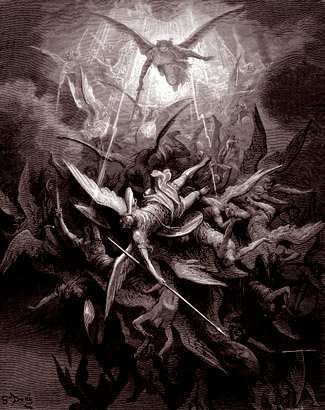
Man, am I in a good mood lately. Semester’s going well, work hasn’t been too difficult lately, and…oh yeah. I finished the first of two short stories for my creative writing class today. This one, called Evil Began in a Bar, involves a meeting in a dive bar in a magnificent city about certain decisions the city’s leader, known as Father, has made recently. As you get further along in the story, something extraordinary is revealed about the protagonist Luca, and the rest of the characters as well. That something extraordinary has a lot to do with this picture, which was the hint I used when I talked about my creative writing class the other day:

0471a-fallenangels

Can you guess what it is?

I’m actually pretty amazed at how quickly I finished this short story. It usually takes me a week or so to finish a short story, usually longer. I got this one done in three days, a record by my standards. The last time this happened was back when I was writing Addict for The Quiet Game, which I finished in a single day. I’m thinking that’s not just because I found the story exciting to write, but because of changes I’ve been making to my diet these days. I’ve noticed I’m a bit less twitchy and easily distracted, and feeling a lot more energetic too. Maybe I’ll be able to significantly speed up my writing process in the future. Who knows?

I’m really interested to hear what my class will say when they read this story. Like I’ve explained before, my teacher is looking for fiction that is interesting and doesn’t conform to conventions, and I think this story fulfills both of those requirements. It’s that little twist near the middle of the story that explains everything and throws it all into perspective that I think will really get them, but I wonder how many of them will figure it out beforehand.

Anyway, that’s all I have for now. I’ll hopefully have a chance to write a blog post tomorrow, but right now I’ve got to get ready for bed. Goodnight, my Followers of Fear. Have some pleasant nightmares tonight.

You know, I said I wasn’t going to do much writing while I was abroad. Well, I may have been a little naughty and wrote a short story in about six days or so. Wasn’t planning on it, it just sort of happened that way.

You see, I had this idea while in London for a short story (and I’ve had so many ideas for stories while abroad, but that’s a discussion for another post), and on the ferry from Portsmouth to Normandy, I had a lot of time on my hands, about four hours worth. Most people were sleeping or working at the last minute on assignments. I didn’t feel like doing either, and there was Wi-Fi, perfect for searches on random facts for a story.

So, I finished writing and editing an essay for an anthology I’d heard about, and then I started on “The Murderer’s Legacy” (that’s the working title, anyway. I may change it when I edit it). It’s about a man living in a magical version of Victorian England who is accused of murdering his wife and is about to receive the worst punishment imaginable. The story follows his attempts to figure out who actually killed his wife and why as he is lead off to his punishment.

I got about two-thousand words in on Monday, when I started the story (like I said, I had a lot of time on my hands). I might’ve finished the story sooner, but as I was writing it the story sort of evolved on me. At first the magical elements were minimal, but then they started becoming a bit more widespread. And then I started having my main character try to figure out who might be the real murderer, and I added more dialogue, and even up until the last minute, I was making changes to the story that I’d never intended to put there.

Well, I guess Stephen King would approve. He said in his nonfiction book On Writing that one should write a story as one unearths an artifact, starting with one small piece revealing itself and then dusting and picking away to find what else is there (that’s what he advises, more or less). But still, at nearly fifty-eight hundred words, I had no idea I would unearth so much!

Anyway, I hope that when I get the chance in a few weeks (or months), I’ll be able to do a really good job of editing this story. Despite being a lot longer than most magazines like to accept, I like to think it has potential. And I want to see what more I unearth when I go through the editing phase, maybe see if I can make my main character a bit more of a bastard, someone you’d want to hate, as well as add more explanation into the world the characters inhabit and go into some of the more principle characters themselves. And hey, maybe I can add a whole new scene to the beginning.

Though if I do that last one, I may need to do a lot of rewriting and editing. Well, if the story calls for it. And it’s not like I haven’t done that before with a story.

Well, it’s late here in Bayeux, and I better head off to bed. Big day tomorrow and all that. I’ll try and write some more if I can. As they say here in France, bon nuit, my Followers of Fear.

Today I finally get the chance to post my interview with science fiction author Charles Coleman Finlay, or CC Finlay for short. A graduate of Ohio State, his first story Footnotes was published in 2001 in Fantasy and Science Fiction, where several of his short stories have been published since. He’s also published four novels, including the Traitor to the Crown series (which one of my favorite shows, Sleepy Hollow, strangely resembles) and a collection of short stories, The Wild Things.

I sat down with him to talk about writing, fiction, and how delicious the food from the Wexner Café was (comments about that last subject are not in this interview). It was a great way to have lunch on a Friday afternoon.

RU: I guess the first question I want to ask you is, how did you get into science fiction?

CCF: I’m not sure there’s a short answer. When I was a kid, I felt overwhelmed by the world just because of personal events in my life. So I was looking, unconsciously,  for larger than life characters, people who faced world-sized problems and overcame them. So I started with cartoons and comic books. I loved superheroes–Superman, Batman, Green Arrow, the Flash, the X-Men. When I started reading a lot of books, science fiction and fantasy fulfilled the same needs but in a more complex way. Take Lord of the Rings, for example. Here’s Frodo with this burden he didn’t want, and he’s not a wizard or a superhero, and still he finds some way to triumph. That really resonated with me. Edgar Rice Burroughs was also a really important writer for me. All of his characters face big overwhelming problems, whether it’s Tarzan orphaned in the jungle or John Carter transported to another planet. Science fiction and fantasy are  full of those kinds of stories, and I loved them. I still do.

RU: I like comic books too, though they’re usually the Japanese kind, and I still read them a lot. When you write, what is your process?

CCF: Every writer is different. For me, it’s an iterative process. I have to have the whole story in my head, the shape of it like a picture, and then write it down. My first drafts can be pretty rough, but then I revise it and rewrite it many times. My wife’s also a writer, but she’s the exact opposite of me. She needs the scene perfect each time. So she writes more slowly, but she does less editing than I do. But if you ask this question of a hundred different writers, you’re going to get a hundred different answers. Everyone is different.

RU: A lot of the readers on my blog are a strange grouping of traditionally-published and self-published authors. How do you feel about the changing dynamics of the publishing industry these days?

CCF: There’s not a period of time where you can point to traditional publishing–however you define traditional publishing–as stable. It’s always changing, always evolving. If you’re thinking of it from a professional point of view, the most important question is this: how do authors get paid. A lot of technologies are allowing authors to get paid and published in new ways. That can be good for authors. But there are also a lot of authors who publish their books too soon, before they’re ready. I know one writer who, when he was young, self-published his first novel and was so discouraged by the reaction to it that he gave up writing for a decade. That was a shame, because he was incredibly talented. Had he stuck with traditional publishing there would have been more people around him to keep him going and to help make his books better, so that when they did come out, people would have loved them. On the other hand, I have friends who, after being traditionally published, have started to self-publish. T.A. Pratt and Henry Connolly, for example, both had series that got cancelled by their publishers, but they had a hardcore group of dedicated readers. They self-published more books in the series and had huge success with it. So it’s a lot like the question about the writing process. There’s no single right answer, and every writer has to find the right path for them. Everyone will make mistakes along the way. So it’s up to authors to educate themselves about potential opportunities, but also potential problems.

RU: What advice would you have for an author who isn’t having much success right now?

CCF: Keep working at it. I was writing seriously and submitting fiction for over six years before I sold my first story professionally. That’s pretty common. I’ve heard it described as the Million Words of Crap theory–that every writer has to write a million words of crap before they start producing something good. Other people I know quote Malcolm Gladwell and point out that you need to put in 10,000 hours of practice to get good at any skill.

Also, surround yourself with other writers who are as serious about it as you are. Pick them up when they get discouraged, and let them do the same for you. Learn from them and share your own mistakes to shorten the learning curve for everyone. Writing can be lonely enough, but don’t let it isolate you.

RU: Do you think as less people are reading, the novel will die out?

CCF: More people are reading than ever before, not just in the US but throughout the world and ebooks are making that easier. So I don’t see the novel dying out soon. The problem is there are more writers, more novels, than ever before. So it’s harder to find a big readership for any single book.

(Editor’s note: Mr. Finlay recommends going to this website for more information on the subject.)

RU: What do you look for in the stories you read?

CCF: That is a great question. I am a guest editor for the July/August issue of Fantasy and Science Fiction. In the month of January, over 750 stories were submitted to me to read for this issue. From that I had to narrow it down to about 12 stories that I will get to publish. So I’ve been thinking about this a lot.

I like to be surprised, which is hard when you’re a writer. The surprise can be plot, language, format, character, knowledge. But it has to be something. The more I read, the more it’s something else besides plot–you see every plot twist, every angle in a story before it happens. So when a plot surprises me, I really value it. And then I look for stories that make me feel. It’s not just putting characters through terrible things, there has to be some emotional resonance as well. Fear, excitement, sadness are all good emotions, but I really look for and enjoy stories that can make me feel delight, wonder, joy. Those are a lot harder to write, and I appreciate stories that can evoke those emotions. And then I love to laugh. Not every story is funny, or should try to be funny, but when a writer can make me laugh consistently, I really appreciate that.

RU: So much science fiction has become reality: communicators become cell phones, all-matter materialization devices are 3D printers, and we have information literally at the tips of our fingers. Where do you think science fiction will go from here now that a lot of it is becoming science reality?

CCF: I don’t think it’s something new. Thomas Disch wrote a great nonfiction book called The Stuff Our Dreams Are Made Of about this phenomenon. But I also don’t think that science fiction is a laboratory for new technology. Science fiction is about the present, not the future. If people envision something and make it a reality, then that’s something different from science fiction.

RU: Final question: If you were stuck on a desert island and could only bring three books with you, what would you bring?

CCF: I think you have to take Robinson Crusoe by Daniel Defoe with you for all the obvious reasons. Defoe invented the novel and Robinson was one of the first he invented. I would also take a collection of Lois McMaster Bujold. I think she’s an amazing writer, and I reread her Vorkosigan series in particular every year or so. And then I’m a writer. So the last one would be a book full of blank pages, so I could write the book I wanted to read. That’s what we do as writers, right?


If you’re interested in learning more about CC Finlay, you can check out his website at www.ccfinlay.com.

I was just informed that JK Rowling, author of the Harry Potter books (as if I need to elaborate on who she is, but whatever) is writing a screenplay for a spin-off movie of the Harry Potter series based on the fictional Hogwarts textbook Fantastic Beasts and Where to Find Them, with the possibility of many sequels. Not only that, but she’s okayed a play to premiere in London’s West End that will explore Harry’s early days with the Dursleys. This, plus the amount of involvement Rowling has in the development of the website Pottermore and various other projects and books related to the Potterverse, points to one thing: Rowling, who wanted to get away from Harry Potter, has come back to him to turn him into an even bigger franchise than he is now.

Now here’s my question: why? Is it because the lackluster response to The Casual Vacancy and the early reveal that Rowling was the real author behind The Cuckoo’s Calling called attention back to the boy wizard who’s name is synonymous with Rowling’s? Did she make a bad bet in stocks and she needs the money? Does she actually want to revisit this magical world (it’s a great world, don’t get me wrong, but I got the sense at some point that she wanted to move on with her career)? Or, God forbid, is she actually selling out for the money?

I guess I’m a little peeved about all this. I love Harry Potter. JK Rowling was the one who got me into writing stories in the first place, HP left an indelible mark on my writing style, I’m a proud member of Slytherin (according to the Pottermore sorting quiz for houses), and I geeked out as much as anyone when the last book and films came out. But perhaps what’s really getting me is that Rowling’s turning her beloved franchise into one of the mega-franchises we keep seeing cropping up all over the place today.

This is something along the lines of what some franchises are going for. I say TOO MUCH!

Everywhere you look, Hollywood producers are looking to make the next mega-franchise, the next Star Trek/Star Wars/Doctor Who/Avengers, something with a main body of work that’s accompanied by tons of additional work of varying canonical status but brings in a ton of money no matter what. Once Upon a Time has its own accompanying novel and a spin-off TV show, The Avengers has a TV show to go with it now, Terminator is doing a reboot/prequel/sequel film with a TV series to go with it, and now Harry Potter has jumped on the bandwagon! As if 8 films, several video games and board games, memorabilia and a theme park, almost all of which came into being because of the films and not the original books, weren’t enough! Now Rowling’s got to go and add in all this prequel and spin-off stuff.

Look, I’m not saying franchises are bad, and I’m definitely not saying we should do away with mega-franchises. I’m a total Sith Lord and Whovian, among other things. But some works are just fine without having a million different products that make up the Expanded Universe and a million more products in merchandising! The seven HP novels and the supplemental books that JK Rowling wrote for charity purposes were wonderful. Isn’t it enough just to have those and all the crap that came with and after the movies? Why do we need all this supplemental stuff that will give us an initial thrill but in the end won’t really add to the Pottermania experience?

If Reborn City or any of my other works were to get famous (and I try to have faith in that, especially with RC. After all, it’s a dystopian science fiction novel with heavy YA themes. I hear that’s popular these days), I would be choosy as to how I continue these stories, especially in other formats. Snake and Laura Horn both have sequels planned for them, while RC is the first in a trilogy. Several other ideas I have for stories have the potential to become franchises. Will I make them into that though? Probably not; sure, some of my stories like RC have the potential to have their worlds explored in other stories and formats. Doesn’t mean I’m going to do that, or let someone else do that. Sometimes it’s just best to leave a story as it is, and not constantly expand upon it, especially if it’s with the intent of making a huge profit.

Yeah, don't expect an expanded universe with 12 different trilogies, a Silmarillion, and a spin-off book series, TV show, or comic book series. Probably won't happen.

Yeah, don’t expect an expanded universe with 12 different trilogies, a Silmarillion, and a spin-off book series, TV show, or comic book series. Probably won’t happen.

At least, that’s my take on the subject.

Thanks for reading my rant. If I post anything else in the coming days, I promise it won’t be as full of ranting as this post was. Have a good night, Followers of Fear.

The final article in my series of the various common themes (aka “beauties”) found in science fiction, fantasy, and horror. What started as a discussion in class led to these three posts: The 7 Beauties of Science Fiction, The 7 Beauties of Fantasy, and now the 5 Beauties of Horror.

Now, as to why there are only five beauties in horror, I have an explanation for that: simply, horror often crosses genre. When it features supernatural creatures or monsters from another planet or realm, it’s horror crossing over into fantasy or science fiction. When the story features more human monsters and less of a supernatural aspect, it tends to cross over into the suspense and thriller genres. In that sense, it’s very difficult to get into pure horror, because that’s so difficult to define. So instead, I opted to go into some general themes you find in all forms of horror, no matter what genre they cross over into.

If you have any ideas on how these could be expanded, please let me know. I’d love your opinion on these beauties, since I came up with them on my own (not a lot of horror fans in my science-fiction lit class sadly, or at least not any fans who are as into it as I am).

1. The antagonist–the starting point of the story. Often you can define a horror story by its antagonist. because that’s often what comes first in planning a story and what you use to describe the story: “it’s a story about a murderous ghost”, “it’s a vampire novel”, “there’s a serial killer terrorizing this small farming town”, etc. And in this capacity, I’d like to mention that the antagonist can count as something else if there’s no real human antagonist. For example, in my short story “Addict”, there wasn’t a human or demon up against the narrator. Instead his own addictions were the antagonists of the story. So the antagonist would be more like the evil in the story that wants to do the characters harm or is already doing them harm, I guess.

2. Characters and setting. Usually after I’ve come up with the villain of a story, I start to create the other characters and the setting. The latter can also be a character, such as a haunted house or a forest (if you have trouble believing me on that watch the first season of American Horror Story to see what I’m talking about). I ask myself, who are the characters? Why are they opposite or beside the antagonist? Where is this all happening? What is each character like? All important questions that the author goes into in creating the story.

3. Conflict–there’s going to be one. If there’s a vampire in town, there’s either a vampire hunter or some townsfolk who are going to try and kill the vampire. If someone’s girlfriend has been kidnapped, expect someone’s going to try and get her back. If there’s an evil ghost trying to claim the lives of a family, there might be an exorcist or a paranormal investigator or a really angry mom trying to keep the kids safe from whatever is menacing her family. That conflict is the driving point of the story, and it sets up for the next beauty.

4. Fear. This one seems obvious, but it needs stating anyway. In a horror story, the point is to get the reader or viewer scared silly by telling a story and using the various elements within to terrify. Whether it’s a feeling of being watched, of something out fo the corner of our eyes, of something jumping out, or something just damn strange that we can’t put our fingers on, the whole point of the story is to scare, to create that fear, and it’s up to the storyteller to figure out how to do that and do it well. Otherwise the storyteller has to rely on silly gimmicks like sex or too much blood or watching teens get drunk, stoned, and naked.

5. Rules–there is an MO to what’s happening. Vampires can’t walk in the sun, the killer only goes after people who enter his father’s old prison, the ghost tries to take the souls of children from their parents. There are rules to how the antagonist operates and how it can be taken down. And for the most part, those rules are concrete, or else the story makes no sense and the reader/viewer will lose interest due to disorientation and confusion.

I hope you found these helpful. And once again, if you have any suggestions on how to improve this list, let me know. I do better on this sort of stuff in a group setting sometimes.

This is the second in my series of blog posts exploring the general guidelines or common themes that appear in the genres of science fiction, fantasy, and horror (click here to read The 7 Beauties of Science-Fiction). This whole series started in my science-fiction/fantasy literature class this past Wednesday, when we examined the 7 Beauties of Science-Fiction, we also came up with an original list for the 7 Beauties of Fantasy, and I on my own came up with 5 Beauties of Horror. I thought a series of blog posts sharing and examining these various beauties would be helpful and fun to write, especially when you consider how often the three genres intertwine and overlap.

Now without further ado, here are the 7 Beauties of Fantasy, seven themes or motifs that are found in most fantasy stories, as the examples I pick will show.

1. Character–someone through whose eyes we see this mysterious world. Every fantasy story has at least one focal character, someone through whom the world we’ve been introduced is explained and explored. These sort of characters usually end up becoming heroes of some sort and we end up identifying with them very deeply in the course of the story. Examples include Bilbo Baggins and his nephew Frodo in the Lord of the Rings canon, Eragon in the Inheritance Cycle, and Nick Burkhardt in Grimm.

2. Setting and culture–the magical, mysterious world our character explores. If it’s a fantasy novel, there’s almost a 99% garauntee that the world is nothing like the world we live in, and there’s a 100% certainty that something will need to be explained to us. Be it Middle-Earth, Narnia, or Harry Potter’s Wizarding world, there’s a whole realm to explore, with its own cultures, nations, societies, geographies, floras and faunas, and so much more. It’s up to the author, through the narrator’s eyes, that we find out as much as we need to about it.

3. Novums and Neologisms–technology/tools and words/phrases exclusive to the world we are in. Just like in science-fiction, the world of the story in fantasy has words or devices that are exclusive to that world and that we don’t understand entirely. Be it the Invisibility Cloak and Apparation, or the gedwey ignasia and Eldunari, they make no sense in the context of the real world but they make plenty of sense in the context of a fantasy realm.

4. Adventure(s)–you will go on one. Can you think of a single fantasy novel that doesn’t involve some sort of quest or journey or something along those lines? Neither can I. It seems every fantasy story is predicated on the main character going off to save a princess from a dragon or to toss the One Ring into the boiling flames of Mount Doom or find the genie she’s engaged to but who has been kidnapped by an evil sorcerer. Along the way the character fights enormous perils, learns valuable lessons, and grows as a character until he or she becomes the hero or heroine we all long to be on some level.

5. There are things that can’t be explained rationally. How does magic work? Why can a dragon fly when its body is too big for its wings to reasonably lift it off the ground? How come unicorns have magic in their horns? In a science-fiction novel, television show or movie, everything is based on science, and in theory everything can be explained scientificially. Not so with a fantasy story, which are not based on science but on mysterious forces and strange new worlds to explore and are limited only by the author’s own imagination. So don’t ask how come a sword from a water maiden is more powerful than your average sword or how magic can respond to a blood sacrifice, because you’re not likely to find the answer unless the author wants you to.

6. Familiarity–the characters don’t wake up one morning going “what the heck?” The world of the character is the one they gew up in. They know it like the back of their hand, and it would take much to surprise them in this world. In other words, unless they’re a little baby the world isn’t one they are unfamiliar with. It’s the one they know like the real world is the world we know. Not only that, but the world is somewhat familiar to us. You could channel-flip to HBO and might think you’re watching a special on the War of the Roses or on the Norman invasion, and not realize you’re watching Game of Thrones.

7. Internal history–there’s a history to this fantasyland. This is similar to the “historical extrapolation” beauty in science-fiction, but very different. Sci-fi is what could be possible with our world, so the history is the same for the most part. In fantasy though, the world has a very different history than ours. Different nations, different wars, different cultures, different creatures. This world we are visiting through the story likely has its own history that has its own unique players and events. And probably the one person who knows the full extent of that history is the author of the story his/herself (or sometimes not even then: half the time I’m not sure the writers of Once Upon a Time know where there story is going, let alone the entire history of each and every character).

No matter what, fantasy is always a strange and new exploration of new territory. It’s fun to look into and it’s fun to inhabit. And in some cases, it can even become a phenomena lasting years after the new world has entered ours. Knowing how to examine and analyze such places don’t detract from the story, but they make them all the more fun, all the more beautiful.

At least, I think so. Hope you liked the post and be on the lookout for the 5 Beauties of Horror, coming soon.