Posts Tagged ‘HP Lovecraft’

Yesterday someone in one of my writers’ groups on Facebook posted about a recent upsetting experience. She’d told her family that her book was coming out later this year in July, and that she had other books on the way too. Apparently her family’s response was entirely negative, telling her that only rich and famous people actually called themselves authors, and that she should keep her head out of the clouds and on the ground because she obviously wasn’t one.

Not only was this reaction just plain horrible (we should be getting tons of love and support from our families for our writing dreams, not criticism and put-downs), but it’s also ignorant. While not all authors become rich and famous, they don’t need to be to be called authors. And even the rich and famous ones, which are rare to begin with, started out as dreamers with a manuscript they wanted to get published. Seriously, every one. JK Rowling was a single mother living on state benefits while writing Harry Potter. Stephen King was a teacher with three kids and not a lot of cash before the paperback rights to Carrie allowed him to move up the economic ladder a little. HP Lovecraft never saw true success in his lifetime, but he’s considered one of the most influential authors in modern-day horror. We all have to start somewhere.

But that’s beside the point. What I’m actually trying to say is that fame or finances are horrible ways to measure whether or not someone should be called an author. Someone could have millions in the bank or have a reality show and a famous spouse and write terrible fiction. No, if you’re going to measure by what right someone has to be called an author, then do it by how passionate someone is about writing, and by how their work resonates with others. If someone is very passionate about writing, about telling stories and sharing them with others, and that person’s work resonates with readers, I really think they deserve to be called an author. And in the case of this particular author, she’s clearly passionate about her writing, and it resonated enough with her publisher that they want to publish it and believe it’ll do well in sales. In my eyes, she definitely deserves to be called an author.

Of course, there are always people who feel they know better, whether or not they’re inside the industry, and there will always be people who just want to put others down just so they can put others down. I run across those people from time to time. I can’t say which kind the family of the author I’ve been talking about it, but I know what response I would give them: Screw you. Those people don’t hold any power unless you allow them to, and your own opinion of yourself and your work is more important than what they have to say. And if they’re only going to say hurtful or denigrating things, then maybe it’s best to put them aside and find people who will give you the support you need. Let them stew in their own negativity.

Or to put things more simply (and humorously):

So let them naysay. It won’t get them anything if we don’t let them have anything from it. And I don’t know about you, but I don’t intend to let any of my detractors (few that I have) say anything bad about me and bring me down. No, I’ll keep on writing, editing, publishing, and marketing, and listen to the voices who will help me along in that.

And in its way, having those supporters is way better than any riches or fame (though those would be nice).


You know what there are a lot of these days? Fictional universes where characters from a variety of diverse works are all brought together into a single work or series of works where they interact with one another in various ways. From HP Lovecraft’s Cthulhu Mythos, to the many different iterations of DC and Marvel comic book worlds and their film and television counterparts, to the shared elements of Anne Rice’s vampire and witch series and Stephen King’s interconnected multiverse and then some, there are a lot of these shared universes these days. Heck, there’s even theories from everyday people about how different works by certain creators are all secretly part of the same story (examples include this Pixar theory and this theory on the majority of Joss Whedon’s work).

So I’m wondering, what is the reason behind all of these interconnected story worlds? What makes storytellers and creators of all different mediums want to have such expansive universes where everything is secretly connected and you have to create a huge conspiracy layout on your wall with tape and string and stuff?

Well, I think some part of it is money. At the end of the day, most storytelling is a business (except for maybe some of what appears on YouTube), and if two characters in separate stories are making profits for a creator or their business, they may try to bring the characters together if it’s feasible and if the fans want to see it. Heck, that’s kind of the reason for most comic book crossovers and the movies based around those crossovers. Fans enjoy seeing Superman and Batman work together or Tony Stark mentor Spider-Man or whatever, so the companies give them what they want and get a profit back.

That’s not to say that all of it is money or that money’s the biggest motivator (unless you’re a Hollywood studio, of course). Another big part of it is the creators. They love their characters, and many would like to see those characters they’ve invested time and effort in come together in an awesome story. How would they play off each other? What sort of trouble would they get into with each other and how would they pull themselves out of it? And how would they grow after meeting each other? I think a lot of writers create these crossovers just so they can answer these questions. They may make multiple volumes to continue asking those questions, adding new characters or situations to continue creating exciting new stories and dynamics. It can be pretty enticing to do that with characters you love so much, and I bet audiences enjoy it as well.

In fact, I’ve imagined doing that with Snake and Laura Horn. Yeah, I have. I’ve mentioned before that I’ve wanted the story of the Snake to continue, and I’ve planned sequels not just for Snake, but for LH as well, including one where the two characters meet and get into a crazy adventure together. And I may be a few books and several years from that crossover, but it’s there if I want to write it, and eventually I will write it. It just sounds like too much fun to pass up.

snake front cover

I really have to get around to that sequel someday soon.

Another reason that creators may do crossover works is just because it makes things easier. Now, I hear you typing in the comments already “How the heck does a crossover or shared universe make things easier?” I know it seems counter-intuitive, but let me give an example: Anne Rice introduced in Queen of the Damned, the third book in her Vampire Chronicles, the Talamasca, an international organization of scholars interested in studying the paranormal. Now, try as I might I could not find any information on why, but when Rice wrote her Mayfair Witches trilogy, she brought in the Talamasca society. Why? Because at some point in the first book she details the entire family history of the Mayfair family and its dozen-plus matriarchs and I guess it made sense to just bring in the Talamasca as an explanation as to why there was an entire history of the family when the family itself isn’t very interested in its history. And it helped with the later books in certain ways to have the Talamasca. See? It was easier to bring in an existing fictional organization concerned with the paranormal than make up an entirely new reason for a third party to document an entire mystical family’s history.

I’ve also heard that’s why HP Lovecraft created the Cthulhu Mythos. He didn’t intend to create an entire cosmology, he just decided it might be easier to work with some familiar characteristics when creating all-powerful monsters, and from there it wasn’t too hard to make the jump to connecting Cthulhu to Yog-Sothoth and any of the other Old Ones. Now, I’m no Lovecraft expert, but I’d buy that explanation.

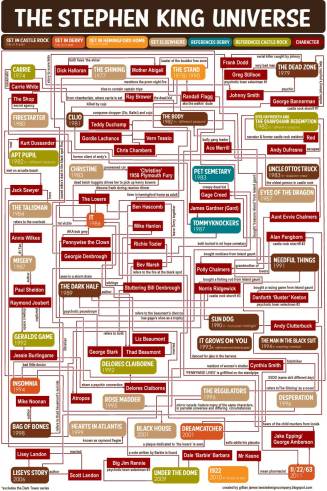
King’s references are so crazy! Check out this chart!

Of course, some authors do it because it’s fun to have a shared universe, for a variety of reasons. You can return to familiar characters and locations by doing so. You can make your readers marvel and go back to another story to say, “Hey, that matches up with so-and-so.” You can create a cosmology or a special reason why a character or characters or place or places appears in so many stories (I’ve got a character or two like that, I just haven’t been able to put them into any works yet. I tried with the human Barbie story and Evil Began in a Bar, but I couldn’t fit them into the former and I haven’t figured out how best to edit the latter yet, so…). And sometimes, it’s just fun to mess with your readers and make them wonder what the heck it all means (I’m pretty sure that’s the reason Stephen King references his other works so much, and the Dark Tower books simply grew out of a desire to create a complex story out of all that messing about).

Whatever the reason someone creates a shared universe, it’s pretty clear that there are plenty of reasons to do so, and that shared universes are here to stay. And whatever the reason behind them, as long as they’re done with love and people enjoy them, I see no reason not to keep doing them. Besides, I may have one or two I’d like to create someday.

Do you have a shared universe in your fiction? Why’d you create it? What has been the result of that?

For a while now I’ve been reading The Complete Collection of HP Lovecraft on my Kindle. I figured it was about time, seeing as I haven’t been very exposed to his work up until this point, and the man has been a huge influence on greats like Stephen King, Allan Moore, Guillermo del Toro, and quite a few more. And since I am always looking to learn from other authors, I figured I should spend ten dollars of Amazon gift cards and see what happens.

Well, you get what you asked for. I didn’t realize that when I bought the collection, that it was 1112 pages! The length in itself is not such a problem, I’ve read books that long before. The thing is, Lovecraft…well, he’s hard to get through sometimes, and for a number of reasons. For one thing, there’s his style, which goes a little something like this:

And as I treaded up the stairs, filled with an anguish that panged the organs within my bosom to no end, I found my wife waiting for me in her chambers, her frown prominently featured upon her face. And I knew that my life had been transferred into a situation seriously detrimental and quite hazardous to my health, for that face on my wife at this hour could only mean that she had discovered my liaisons with Ellen the hotel maid from down in the village. I had endeavored to keep our trysts unknown from all but the walls of Ellen’s room, however it seemed that I was not secretive enough, as evidenced by the porcelain my wife volleyed at my head.

Okay, that’s a bit of a parody, but you get my point. Who talks like this?

Also, some of his early fiction isn’t that good. “Memory” is just a weird little flash fiction piece about a ruined city and a conversation between two beings about the city; “The Street” is about the houses on the titular street killing Communists after the street goes from a nice neighborhood to a slum; “Polaris” and “The White Ship” are obviously both dreams taken too literally, and “The Tree” is just not scary.

Also I noticed that so far, very few women appear in the stories. Several characters are mentioned as having wives, but so far the only woman who has any actual significance is the titular character of “Sweet Ermengarde”, and that’s a story parodying popular romantic melodramas of the day! But given that Lovecraft had a strained relationship with his mother, a turbulent one with his wife, and was dominated by his aunts in the later parts of his life, maybe that has something to do with it.

Lovecraft makes you wonder if maybe this guy is coming for you.

However, while I have my problems with Lovecraft’s early work, I have to admit that some of his stories do hit the mark, and even are a little scary. “The Tomb” is definitely somewhat chilling, as is “Dagon” and “The Picture in the House” (the former bears resemblance to Cthullu stories, while the latter has implications of murder and cannibalism). And I actually very much enjoyed “The Temple”, which was very strange and creepy.

I can’t say about the rest of his work, but for the early stuff I think what makes the successes so great is that they leave impressions on you. They make you think to yourself, “Imagine if that actually happened. That would be kind of creepy…” And then you take a look around yourself to make sure that a slippery slimy creature or some guy with wicked magic or something isn’t near you. Lovecraft is very good at leaving those sort of feelings with you. He makes you wonder, makes you think that there’s something just beyond the corners of our eyes or in the darkest parts of our world that we don’t understand, can’t understand, and that any interaction with that something or somethings would be very dangerous for us.

So there is definitely a reason why HP Lovecraft has stuck around and become well-known as a writer of weird and terrifying fiction. And as I progress from his early work to the stuff that he’s more famous for, like “Call of Cthullu” or “The Colour out of Space” or “History of the Necronomicon”, I’m sure I’ll find more reasons to like this guy (hence the reason this post is titled Part 1).

In the meantime though, I think I’ll take a break from his stuff. Like I said, he’s great when he’s good and I’m already learning a lot from him and seeing some of his influence on my work already, but he’s dense and hard to get through, and after so much of prose like my parody paragraph, I need a break if I’m going to continue someday. Besides, I finished on “The Nameless City”, which has that famous quote in it. You know the one:

That is not dead which can eternal lie,
And with strange aeons even death may die.

I can’t think of a better stopping point than on a creepy story that has that weird couplet in it. Can you?