Posts Tagged ‘reflections’

DSCF0005

He started out on a farm, but had to leave because people were after his life. What happened over the many years for this man, before turning to writing, involved a life with more twists and turns than a labyrinth, involving drugs and crime, camping and living in the mountains across North America, and even some interesting paranormal experiences. Today’s interview is with Timothy Louis Baker, author of Fantastic Florida Fun, Crime and Drugs on Trip City Street, and his autobiographical When North Meets South and East Meets West.

Based on the descriptions of your books, a lot of your writing seems to be based on your own personal experiences. What motivates you to write about your past and how do you come up with stories based on your life?         

Rami, I often make the comment that I write what I know and I know what I write and that holds true, through present I refer to things of my own life to write about and very little do I have to look up in another book or online somewhere. That is all because I have had such an interesting life and I’ve found that if I take those experiences I’ve had and expound upon them in fiction but along the same lines as has occurred in my own past, that my writing is just that, not only interesting but entertaining, to the ultimate degree. I’m very well-traveled and have been in a variety of locations and multitude of actual experiences, so I have no trouble in keeping a story line going about a certain person, place or thing. Whether I write fiction or non-fiction in the case of my autobiographical works, my story unfolds and continues consistently with new material and not keep repeating the same thing over again. If you examine my writing, you’ll find that the pace is fast and constantly changing, with either what the character is doing, where they are in location or what they are up to. It all varies at an incredible rate because that’s exactly how I’ve lived, continuously changing where I am, what I’m doing or whatever, there is never a dull moment. My lifestyle reflects upon the pages of my books, even the fiction works and really as a writer and an author, because of the kind of person I am, I wouldn’t have it any other way. That just goes to show you, personalities show up through our work and I think that’s the way it’s supposed to be.

Could you walk us through your writing process, from the moment you get an idea to when you publish the book? 

I started writing on pencil and paper then graduated to a typewriter and eventually by computer, but it all goes the same route. I write my story and then I edit it with my own author’s knowledge but sometimes, after submitting to a publisher, I have to crack down on myself and allow them to edit it also. My full-length autobiography Where North Meets South and East Meets West was an idea I had long ago, I mean like when I was 16 years old and hitchhiking to Florida with little or no money, I had an idea that my life was going to be long enough and full enough to write a book about it all, and more. When I was in my 20’s and living part time in the mountains of Kentucky, Tennessee, Arkansas, and the forests of Michigan and Minnesota, I came about the idea for each and every story of all my books and made that mental note in my head the exact ideas I had for them, and eventually I did write them. It was easy because I already had the created version in my head, I just had to use my imagination to add the characters, places and events that were in my head to the pages of my books and behold I am an author again. Then after submission to publisher and acceptance of my manuscript I am again a published author. With me, writing is the work, editing is minuscule comparatively and when I get that acceptance email from a publisher is truly happiness. Because I know my writing is going to be available to the public for the people to have access and that is the point of my career. It’s not how much money I might make or how famous I will become that is important, but getting my writing out there to the people who may read it. The rest all comes along with extras in between that, not just as the main point of enjoyment in my life but the fulfillment of what I’ve written as an author to be enjoyed by others.

You’ve had some very interesting life experiences. What do you do now these days? Is your life any more interesting, or has things gotten somewhat calmer?                  

Ah, but life is the same. Now that I don’t do all of the things, as much or as many times in a row, as when I was younger, doesn’t mean that I’m any less active or live a less exhilarating lifestyle anymore. I keep occupied at what a great many people may do, and I’m sure they do, by online computer and other devices. Look we have access to all of the things that people used to have to go to the library to look up or reserve a mental note to ourselves to ask a certain particular person we might know, next time we see them. Now not only that we can read books and gain all of this information or personal entertainment, right at the touch of our fingertips. Life is as exciting as ever. I fish in the creek, I ride a bike almost everywhere I go in town and at 55 I still lift weights. Lifting weights is what I used to call bodybuilding, but because I’m not a spring chicken anymore and don’t grow as rapidly nor can I do as much weight as I used to, I now just ‘lift weights’ or ‘do my weightlifting.’ As far as living a calmer life? Maybe when I’m a hundred. Never a dull moment and I always mean that in a good way when I say it. One does not have to go thousands of miles to experience adventure. That is something a person can do anywhere they are and anything they’re doing. It is something you find inside yourself, so much of the time anyway. All it usually takes is a little bit of initiative to find or discover and that can be nearby as well as far away, it just depends on the situation. I like the days when the last thing I can possibly do that night when I go to bed is drag myself off to the bed and lay down to sleep, just as much as I like those days when I am able to sit for longer periods of time and let the radio or television entertain me rather than get it by just so much activity of my own hoping that will keep me excited enough to stay up without falling asleep until I get all the work done. Mentally I’m probably more active since becoming a writer than I ever was before. If not then just as much anyway.

How did you get into writing?               

When I was 33 years old I had the idea to write down some notes about my lifetime and because my life had been so interesting up to that point I soon invested in a typewriter that ended up the forerunner of a rough draft for my autobiography. I had lived so many interesting experiences that I thought the world should know all about them. It wasn’t until a few years later that I was able to gain the ownership of a computer but before I did I set down a rule in my house: Every time I came up with an idea on something pertaining to a real experience that happened to me personally in my lifetime I would write it down on a piece of scrap paper and lay it on a pile on my kitchen table. Well after several months and when the pile was a couple of inches tall and I was sure everything I would need the time to think of before writing had already taken place, I finally found a way to get a computer and that is when the placement in chronological and geographical locations began to take shape. With the computer I could write something where I thought it should be and then if I didn’t like where it was or how it was written, I could change it and copy and move it and paste it wherever the best place for it I judged would be at. Well this was OK except that something happened, that is now included in my autobiographical works, a catastrophe and all I got away with it all were the floppy disks of some of the stories of some of my books now, but also including a printout copy of my first rough draft. Well to make a long story short, being relocated a couple of times, finally I was able to manage to procure another computer and that was the one that wrote all of the rest of my seven books that I had not already written on either the floppy disks or the paper printout version of my autobiography. This led to me achieving internet access and that brought on copyrights for all seven books and eventual publishing of them all. Basically I got into writing because I had some things happen to me that I thought were so unique that nobody else in the world had these occurrences and so I was compelled to write then and that is my full-length version autobiography Where North Meets South and East Meets West, the less graphic and condensed edition An Experience Heaven Sent and My Life’s History in Poetry and the uniqueness of those events that I’ve never heard of happening to any living man in my generation were the miracles including and especially the living, waking, physical ascension in Heaven where everyone and everything was young and beautiful and lived forever. Then I was returned to the earth by my ‘higher power’ that had caused me to thus be arisen into that afterlife, also brought me back. If that isn’t something to write about then I certainly don’t know what is of my own personal lifetime of events and trivia.

What are you currently working on?                 

I haven’t been writing any actual books lately but I’ve got one started that I began a few years ago and sometime when the workload of book marketing the seven books I’ve already published slackens and begins to give me ample opportunity to finish writing that one I will. I have to have some time for me too on a personal level to do the things I want to do with my own time on my own space but the name of this newest work of mine is Some Sing Song Way and it is a historical novel about a man that is abducted by Indians from the Oregon Trail and he discovers that living with the red men is actually compatible to his own life. He has a past with the white men and now he lives with Indians, finally on a voluntary basis and actually sort of prefers them. Later in the book he will meet up with the past in a US fort out west and after that when he is alone and in solitude the events of his lifetime will unfold before him as he will contemplate that past with his own history with Indians, while he is living out in nature without either one, or anyone, and he will decide how he really feels about it all in his own present and that will make up his mind on his decision about how, where, and with who he will live the rest of his days.

What is some advice you would give a budding writer?              

I always give the same answer to people that ask me advice through posing this question and that is – write what you like and hopefully that will be what you know and if you write what you know, you are likely to write the very best that you can write. That has so far been my answer to this question of what to tell someone that asks what they should write for a book, written by them.

If you were stuck on a desert island and could only take three books with you, which ones would you take? 

That’s easy and they are all books that I have written. The books that are the most important things that I could ever take with me to be alone. Even if I ever doubted I would ever see anyone else ever again, I would take the three autobiographical works that I have written, Where North Meets South and East Meets West, An Experience Heaven Sent and My Life’s History in Poetry. Because in them I know what I left in print in books behind me back in civilization, the most important words or any kind of works I have ever performed in life would be there to remind me of what I left behind that someday, maybe not in my own lifetime, but someday in some generation in the future perhaps, would be invaluable to the rest of the world of their, those people’s time. In other words, someday in some generation this story will come out and make that big impression upon all humanity at that time and continue for the rest of life on earth as we now know it.

If you would like to know more about Timothy Louis Baker, you can find him at Author’s Den, on the website of SPBRA, Facebook, and Twitter. And if you’re interested in checking out his books, you can find them on Amazon.

That’s all for now. Hope to have some more interviews soon. And if you want to read previous interviews, head to the Interviews page, where authors and characters will tell you about themselves and their books (and whether they write them or spring from them).

Two words: awesomely freaky!

Ever since I heard of this film and saw the trailer for it, I’ve been dying to get my hands on it. I mean, it’s won a lot of awards, and just watching the trailer you can tell it’s a truly terrifying movie. I’ve seen it a couple of times, and I still jump every time they do those creepy notes. (If you were unable to watch the trailer for any reason, please click here)

If you thought that was terrifying, you can see why I wanted to get this movie. Sadly, it was really hard for me to get my hands on, so I only got it tonight by downloading it off of Amazon. Suffice it to say, it was money well spent.

I Am a Ghost follows Emily, a woman in a 19th-century white dress living in a house with a strange mix of Victorian and early 20th century furniture. Slowly, you see her act out certain activities over and over. Each time, it’s a little different, a little stranger, a little freakier. And then comes in Sylvia, a psychic whom we don’t see. She is only accessible to Emily and to the viewer as a disembodied voice, a medium hired by the family who owns Emily’s house to help her move on. (We don’t see the family either, but if we did, I’d say it’s a couple of cheery kids who break into tears when freaky stuff happens, a wife who’s opened herself up to the paranormal because it threatens her family, and a father who’s reluctant to admit his house is haunted, let alone that they need a medium). From there, it is a strange, deeply psychological story that keeps you glued to the screen from strange start to terrifyingly freaky finish.

H.P. Mendoza, the writer, director, and cameraman of this film, weaves a very fascinating story, showing Emily’s chores and life through different angles as she repeats them in a dream over and over again, and then finding new ways to make them even freakier. Slowly but surely, you will find yourself drawn in like a fish on a reel, and as the film moves towards the end, we become shocked with more and more information on Emily’s life and death, which ultimately leads to an ending that will leave you terrified to the core.

Anna Ishida, the actress who plays Emily, gives a wonderful performance as a ghost stuck in time (or floating in time, considering that she’s comfortable in a house with furniture and technology from several eras, wears a 19th-century dress, and speaks like she’s from modern times). You find yourself unable to look away from her as she becomes slowly aware of why she’s been unable to move on and on how to get out. It became quite easy to identify with her early on. And Jeannie Barronga, who voices Sylvia, makes a great counselor, with a kind, maternal voice that makes you want to get on the red couch.

The script is well-written, and H.P. Mendoza has earned the comparisons to Hitchcock and Kubrick (though I have no idea who Bergman is), mixing suspense and avant-garde filming techniques in perfect harmony. And he found a gem in his make-up artist Diana Tenes, who did a wonderful job with a certain character near the end of the movie (I won’t spoil it, but I’m still reeling from what she did near the climax of the film with a certain creepy character). I’m sure in years to come, I Am a Ghost will receive plenty more awards, and a lot of analysis and interpretations, not just from filmmakers, but from academics and philosophers and filmophiles everywhere (in fact, there’s already a few on the website, but don’t read them till after you’ve seen the movie). I’d certainly love to read some of those analyses, if they ever make it into a published essay.

All in all, I Am a Ghost is a wonderful, terrifying tour de force, and well worth the time for any true fan of horror. I’m rating it a 4.5 out of 5. The only flaw, in my opinion, is that it wasn’t a little bit longer. I certainly wouldn’t have minded the movie being a little longer than it was. But the rest is just great, and I think H.P. Mendoza did an awesome job creating it. He’s definitely a director I wouldn’t mind letting adapt one of my stories or collaborate on a film together. And I don’t say that about a lot of directors.

I’m going to tell everyone a midrash, a story that helps to explain aspects of Judaism, and which may or may not be true, depending on the story. This story, no matter how you look at it, is very interesting and helps to explain why I’m able to give these reinterpretations.

The story dates back to the writing of the Talmud. Several rabbis were trying to decide on an issue of kashrut, or dietary law. Eventually all the rabbis except one decided a certain way on the issue, with the remaining rabbi insisting he alone was right. This rabbi, who was apparently so learned that he could teach Harry Potter a thing or two (my own phrasing, not the story’s), said that if he was right, then the walls in the study house would cave in, a tree would move from one place to another, and that the river outside would flow backwards. Sure enough, the walls started to lean in, a tree walked across the ground, and the river started flowing backwards. With each occurrence the other rabbis would remind the rebellious rabbi that walls, trees, and rivers don’t decide matters of Jewish law (and they chided the walls for trying to bring themselves down when it wasn’t their conflict). Finally the rebellious rabbi said, “If I am right, let a heavenly voice confirm it!”

At that moment a great voice from above was heard saying, “Follow this rabbi’s opinion!” The other rabbis, instead of cowering and giving in, replied to the voice, “Matters of law are now on Earth, not in Heaven.” The heavenly voice replied, “My sons have bested me.”

What does this tale tell, besides the fact that apparently Talmudic rabbis were said to be quite powerful? Besides the teaching that a majority rule is stronger than a single zealot (and the rebellious rabbi later became a heretic and was excommunicated, interestingly enough), the story shows that once God gave the Jewish people the Torah at Mt. Sinai, it was in their hands, and therefore they had to decide how to interpret it. So basically while some may claim that LGBT people and their allies are going to hell and claim the Bible says so, I can claim just as much that that law no longer applies and that LGBT people and their allies are just as holy as anyone else. And guess what? We can both be right!

I tell this story because a lot of people’s arguments and opposition to LGBT rights are based on a singular interpretation of the Bible, so alternative interpretations of the Bible can be just as legitimate as traditional ones. I also tell this story because, while two opinions can both be right, sometimes one opinion may have more reason to be right than the other (as in the ruling of the majority in the story). For example, I can say that I believe both evolution and the Genesis story to be right. I can’t ignore that dinosaurs, the fossil record, and the distance travelled by the light of certain stars make evolution seem more right than Genesis (which I tend to view as a metaphor for the Big Bang and evolution that humanity is too stupid to understand at this point in our existence).

No denying it: gay people are born that way. It’s in their DNA.

Understanding this, let us look at what science has proven: that sexuality is a genetic trait, and that multiple genes make up sexuality, so multiple sexualities arise. Some people, like a pastor I had the displeasure of hearing speak out on the Oval at OSU this spring, claims that meant homosexuality is a genetic defect. But that would mean there would have to be a loss or impairment of quality of life for the affected. If anything, the scientific method has shown through studies that people who are open about their sexuality and accepted for it tend to live happier lives. It’s only when they try to deny, change, or hide their sexuality that there is some impairment.

Likewise, this also means that homosexuality isn’t a lifestyle, or something you can indoctrinate youth into. As I said, differing sexualities are genetic, and you can’t pray away, condition someone, or ban something so caught up in the very DNA in a person.

Now, some might ask about my previous post, where I said that homosexuality was commonplace in Greece in a ritualized form. I say that was a form of cultural homosexuality. It was done because it was part of the culture, everyone was doing it, and nobody could see any reason not to do it. Plus, having a male lover was a choice, not a requirement. You could almost compare it to video games: everyone seems to play video games these days, and most people don’t see a reason not to play them if you can. (I know that we’re talking about two very different things here, but you get the idea, right?)

In any case, I’ve said what I wanted to say about the Bible, religion, and homosexuality before Pride weekend here in Columbus. I hope you enjoyed the posts I’ve written and perhaps were given some food for thought. And if you’re in the Columbus area this weekend and are looking for some fun, come to Pride. Leave the picketing signs at home, and have a blast. I’ll see you there.

It’s been a while since I’ve done a post reflecting on the craft of writing (outside of Self-Published Authors Helping Other Authors, I mean), so I thought it’d be good to do one. And I figure a good one would be to write on things people say about writing that annoy writers to no end when they say them. You may have even heard some people say these things on writing and, whether you treat writing as a craft, a business, an art, a passion, or a calling, you’re bound to at leas give the speakers an eye-roll. Occasionally you may even call out the absurdity of what they’re saying, because to your ears it’s all so ridiculous.

And why did I decide to pursue this particular topic? Maybe because not too long ago someone said one of these to me and I just got so annoyed with it.

I want to write, but I hate reading. That’s like saying you want to be a chef but you hate eating gourmet food. It’s just not something that’s done. Writers read because it’s how we developed a love of literature, it’s where we study the work of others in order to better understand and improve our own work, and it’s just plain fun for us. So saying you hate reading is basically saying you’re not going to write because you’re not willing to do what’s absolutely essential to becoming a writer. I’d understand if you said you have trouble finding the time to read (we all do, even part-time workers like me), but hating reading is just inexcusable for any serious writer.

I’ll write when I’m retired. This is actually the one I heard recently, when I asked an acquaintance who has a very unconventional and interesting career to write about his experiences. Just because you suddenly aren’t obligated to go to work from 9 to 5 on weekdays doesn’t mean things are magically going to fall into place and you’ll have the time, energy, and will to write. If that were the case, I’d have retired right out of high school! Plus, who’s to say that in retirement you won’t just become busier? It’s happened, I’m sure.

I can write better stuff than the crap they’re publishing these days. First off, I hope you’re not including my work in that grouping. Second, you think you can write better? Pony up! And if you decide to actually try to write something better than what’s out there, be warned: while you may feel that everything you’ve written is more real and heartfelt than what you find at the library, not everyone may agree. Agents, editors, publishers, and readers can be very particular about what they think is a good story, and they may not always agree that you’re better than the other crap writers out there. Often times, what’s popular enough for you to read and decide it’s crap is popular for a reason, so just know what you’re competing against.

I have a story all in my head. Commas and all. I just have to find the time to write it. Okay, let me call the writing fairy to give you a sabbatical to write. Most writers carve out the time to write from their personal time. We don’t expect the time to find us, we actively make time. I’ve written when I could be taking a nap. One of my friends who recently published her first book wrote in notebooks on the buses to and from work. There are writers who get up an hour before everyone else in the house and stay up an hour later just so they can jot down 500 words or so and feel like they’ve made progress. So don’t expect to find the time or let it magically appear: go and make time!

Writing’s not something you can make money off of. Usually no, writing is not something you can make thousands of dollars off of. The writers who are able to write full-time are lucky. Most have day-jobs because writing alone will not pay the bills. I certainly have not made enough money off my work to take up writing full-time. However, most writers don’t get into the business for the money. We get into it because it’s a passion, something we really enjoy, and the money comes secondary to all that. Sure it’s nice, and we wouldn’t mind some income from our writing, but it’s not the main reason why we sit at our desks or on the couch punching out word after word after word. If it was, I would’ve given up writing a long time ago and would’ve gone into law.

I have this idea for a story about… I’m going to stop you write there. Normally I’m interested in hearing about other people’s stories, but I have a question: do you have any intention of writing it? If you don’t, it probably wouldn’t be good for hear it. I might just run away with it and use it for the basis of my own potential bestseller. Well, I wouldn’t, but there might be some unscrupulous fellows who would.

There are too many writers out there already. I can’t make an impression. Every writer worries about this, but most don’t let it keep them from trying. And you never know: you could end up being the next JK Rowling, F. Scott Fitzgerald, or William Shakespeare. But first you have to put yourself out there. Besides, if I was worried about impressions, I would’ve given up writing a long time ago and gone into–oh you know what I’m going to say!

I’m good, so I don’t need to edit. Even the greatest authors needed to edit! I don’t know a single author who doesn’t need to edit. We all make mistakes that others will point out, we all have flaws in our stories that will turn readers off. That’s why editors exist: they catch these problems before the book makes it to publication. Otherwise you have all that crap online that has little to no editing and that brings a bad name to self-publishers. So even if it’s sometimes a little expensive, you might want to shell out a little money for a copy-editor or a beta reader to take a look at your work, because it’ll improve your work vastly and you will benefit from it. Heck, I think the only writer out there who doesn’t need an editor is God…wait. There are some ambiguous phrases in the Bible that make no sense, and some that have garnered a lot of controversy. Plus the tobacco and marijuana plants: were they really necessary for the world? Yep, all writers need editors.

What are some things people have said to you about writing that you think si utterly ridiculous? What would you say to them?

With the Columbus Pride Festival coming up this weekend, LGBT people from around the country (including George Takei as Grand Marshal for events this year) will be descending upon Columbus for a huge parade and festival to celebrate their sexual orientations, fight discrimination and injustice, and to push for same-sex marriage in Ohio, which is on the ballot this year. It’s sure to be a great time for many.

For some though, the Pride Festival will not be so welcome, and while Columbus may be one of the Midwest’s LGBT hotspots, there is the very real chance that protesters will show up and decry what they see as perversion, sin a horrible lifestyle, or some sort of disease/genetic defect/psychological disorder. Usually I ignore these sorts of people, but I figured that since I’ll most likely be attending the Pride Festival this year (my first), I thought it would be interesting to do a post on these protestors, most of whom have a Biblical basis for why they’re opposed to homosexuality, and show how the Bible could actually endorse homosexuality rather than outright ban it.

Before I do though, I wanted to post this video I found, which I think is very eye-opening, and gives some very good points on the Bible and homosexuality:

Interesting, isn’t it? And that thing about Sodom and Gomorrah mirrors pretty closely what I learned growing up about why those cities were destroyed. In fact, I remember a pretty graphic tale about how two girls met at a well, one realized the other’s family was very poor and gave her some flour for her family. When the town elders heard about it, they basically took the first girl and stoned her in public (I’m not sure what happened to the second girl, but she probably came away from that emotionally scarred and still hungry, if not dead). And if you want to know more about that book they talked about in the video, here’s a TIME magazine article on it.

I would like to add some points on to these, based on my own upbringing, experience, and understanding of the Old Testament (I’m not very familiar with the New Testament of course, being Jewish). First, that famous verse in Leviticus that anti-gay pastors love to quote, “Thou shall not sleep with a man as thou sleeps with a woman”. First off, what can women do? Second, this sounds like a prohibition against homosexuality, but it could have other meanings.

Of course, there’s the anatomical one: men can’t sleep with other men like they can with women, because men don’t have vaginas. But I’m pretty sure that argument, although obvious, won’t sway many people, so here’s two more that might. Firstly, there’s the patriarchal argument: women in the days when the Bible was written were expected to attend to their husband’s sexual needs, and most likely that meant they had no say in it unless they were impure and couldn’t have sex anyway. In an age where men were expected to be dominant in all matters, especially in the home, forcing one man to attend to another man’s sexual needs at the latter’s beck and call would be considered the ultimate emasculation, so therefore sex between men was forbidden.

The other reason (and the one I feel makes the most sense), is based on pagan idol worship. Many Near East and Mediterranean societies practiced homosexuality, not as a distinct orientation, but as an activity. The Greeks were famous for having relationships between other males before marriage, and there were other societies at the time that had cultures that permitted men to have relationships with each other before or after marriage. Some of these relationships were especially prevalent in military circles to increase unit cohesion, and a few were ritualized in the form of idol worship. God would have seen this latter act, worship of idols through sexual intercourse, as detestable, so He created a form of worship and sacrifice that did not involve sex, and forbade a form of sex that does not lead to procreation, as well as because it was used in idol worship.

There’s a pretty big difference between this and emasculation or idol worship, wouldn’t you say?

Since today there is no idol worship through sex (as far as I know), it would be permissible for same-sex relations to occur. Besides, these interpretations deal with a form of emasculation or idol worship. They do not apply to men, women, or other gender-types who are in loving, committed relationships like we see today.

There are other factors to consider here as well. For example, there is the belief that marriage should be as it is in the Bible. If that’s the case though, why do we outlaw polygamy and women can choose who they marry? Not to mention the definition of marriage and marriage roles have changed throughout the years, so it’s no surprise that it’s being changed in our day and age and “pro-marriage” activists shouldn’t be alarmed. And even if not always legally accepted or endorsed by religious establishments, same-sex relationships have been taking place for many, many years. There have been relationships between high-ranking clergymen and other men since the early days of the Church, but it was tolerated because of fear of worse sins, ones that at the time that were considered venereal.

Even during waves of religious upheaval, reformation, or resurgence, same-sex relationships flourished: Queen Elizabeth may have been a lesbian, and several members of her court were gay and able to get away with it due to their status. King James–of the Bible translation–actually had several relationships with men as well as women. And recently there was an article from The Boston Globe about two women who lived together and were treated as married…in 1807! So even if it’s not exactly legal, same-sex marriage is not exactly as new as cell phones.

This post is getting very long, so I’m going to continue this discussion in another one. I hope some of you who read this post found it informative and may have given you some food for thought. I don’t think it’ll sway anyone who’ll protest at Pride this weekend, but it may sway some people who are undecided on the issue. Or that it may prove helpful for those who want to try to reconcile homosexuality with religion.

Oh, and before you wonder what sort of religious authority I am, I can only say that I’m the son of two Conservative rabbis, I went to a Jewish day school from Grades 4-12, I’ve gone to synagogue for most of my life, and I still learn and keep in touch with my religion. So I may not be a rabbi or pastor, but I’ve done as much studying as some, and more than some others. I guess I can speak with some authority on these matters. What do you say?

*I will be screening the comments for offensive, inappropriate, or just plain rude comments. Be warned.*

Last night, my roommate and I went out on a pub crawl, trying various bars in the campus and Short North area. At some point we were joined by a friend of mine and his friend from Israel. It was a fun time and I enjoyed it very much, especially in the gay bars (for those of you who haven’t known me for that long, I came out in bisexual back in March of this year). I made some great memories with people I care about, I learned where you can get some interesting mixes and cocktails, and I even met one of Columbus’s drag icons (yes, we have drag icons. Not surprising, considering that Columbus is one of the LGBT capitals of the Midwest. Yes, Columbus is one of them).

However, there was one aspect of last night that I did not enjoy: around the time I was done at the Union bar (great fun, by the way), I started to feel very strange. I’d had a few drinks, and I guess I’d had more than I’ve previously had (even at that Jewish wedding not too long ago, if you can believe that), because I was feeling much more inebriated than I’d ever felt before. And despite how happy I was, I was kind of scared. I felt like the connections between the rational part of my brain and my body were being disconnected, because I had less control over my body. I also noticed that a few connections were being loosened between my rationality and whatever part of my brain makes decisions, because I was acting a little wilder than usual.

Luckily I didn’t do anything I’d end up regretting later on (so calm down, Ima and Abba). I do that often enough while sober. But at some point, I said to my friends that I’d had enough and that I wasn’t going to drink anymore. I got encouraged to have a few more drinks, but I held my ground and stopped drinking. Even at the next bar we visited, a famous dance club across from the Ohio Union, all I had was water (I was thirsty anyway, so it was good of me to get hydrated). And some of my friends thought I should’ve continued testing my limits or that I was trying to put a stop on my own 21st Birthday Pub Crawl, but I thought–or as much as I could think, anyway–and I still do think I made the right decision. I like being in a good mood, and last night I was in a very good mood, partly because of the alcohol I was drinking.

But I don’t like the feeling of my body and mind being so out of control. It’s a scary feeling, like watching yourself through your own eyes and not having any input over what’s happening. And it’s not something I’m willing to repeat any time soon. So for the time being I’m going to stay away from drinking (along with sweets and a few other things that aren’t necessarily good for me), even though my fridge is stocked with some really good drinks at the moment. I have a feeling that after last night, and with Columbus Pride Weekend and a wedding coming up soon, I would be better off holding off until the next weekend. And even then, I’ll probably drink sparingly.

Perhaps another time I’ll test my limits with alcohol. For now though, I think it’s best I stay at the limits I tested last night. Because not only do I not want to make a mistake that will haunt me while trying to have a good time, but I just don’t want to feel that out of control again. In fact, I don’t know why anyone would.

That’s all for now. I’m going to get some work done, and then do some reading before meeting my dad, my grandfather, and my sisters for a Father’s Day dinner. Happy Father’s Day, my Followers of Fear.

Three articles within a week. I’m impressed with myself. And this one marks my 20th post for Self-Published Authors Helping Other Authors, which apparently is quite the milestone, seeing as WordPress gave me a congratulatory notification this morning.

Anyway, today’s article is How To Write An Epilogue, a follow-up to yesterday’s post about writing prologues. I figured that since I’d already written one on prologues, I might as well do one on epilogues, which require different tools from writing prologues in order to write them effectively. So far it’s gotten a pretty good reception, which I’m happy about. I hope plenty of people find it useful.

And if you’ve liked my previous posts on Self-Pub Authors, you should seriously consider checking out the other articles on the site. It’s a wonderful website, filled with helpful articles by other independent writers for independent writers on learning to write, edit, publish, and market independently without spending a ton of cash. I’ve certainly found it very helpful, and that’s why I write for them.

Now that this article is out, I’ll take a short break from article writing and focus on my other work. I want to conduct a few author interviews and then get back to work on finishing Laura Horn and promoting Snake. My life never seems to get easier, though I kind of like it that way. I wonder what life will be like for me when I’m no longer in school and I (hopefully) have a full-time job?

All for now. I’ll write again later if I can, my Followers of Fear.

Yes, I wrote another article for Self-Published Authors Helping Other Authors. This one is How To Write A Prologue, which I found a little bit challenging to write. I’ve written prologues before, but I really struggled with what made a good prologue, and had to really examine all the ones I’ve read and all the ones I’ve written over the years to write a helpful argument.

Interesting enough, I originally didn’t intend to write this article. But while in France (in Paris, if I remember correctly), the site got a comment asking if we had any articles on writing prologues. We didn’t, and I was sad to report that. So this article was kind of to rectify that lack of prologue-related article. I hope that the reader who posted it is able to read the article and find some helpful advice in it.

And speaking of helpful advice, make sure to check out the rest of Self-Pub Authors. It’s written by independent authors for independent authors, and offers a variety of helpful articles on making writing, editing, publishing, and marketing independently easy and cost-effective. You never know what helpful articles you’ll find while reading this website.

All for now. I’ve got some other work to do, so I’m going to get on that. Have a good weekend and have a safe Friday the 13th (because it’s also a full moon. That can only mean trouble!).

I’m back on Self-Published Authors Helping Other Authors, and it’s good to be back. My latest article is Showing vs. Telling, which covers one of the most difficult aspects of learning to be a writer. Often we are told by our English teachers when learning creative writing to “show, don’t tell”, but rarely are we actually shown how to distinguish between the two. The purpose of this article is to do just that.

So if you have a moment, please go check out the article. And if you have a few more minutes, please check out the rest of the website. Self-Published Authors Helping Other Authors is one of the most helpful sites for independent authors, written by independent authors to help others write, edit, publish, and market their books for little-to-no cost. Take it from me, you never know what helpful article you’ll come across.

All for now. I’ve got a bit of work today to get done, so I’m going to get on it as soon as possible. Wish me luck, my Followers of Fear, and have a great day.

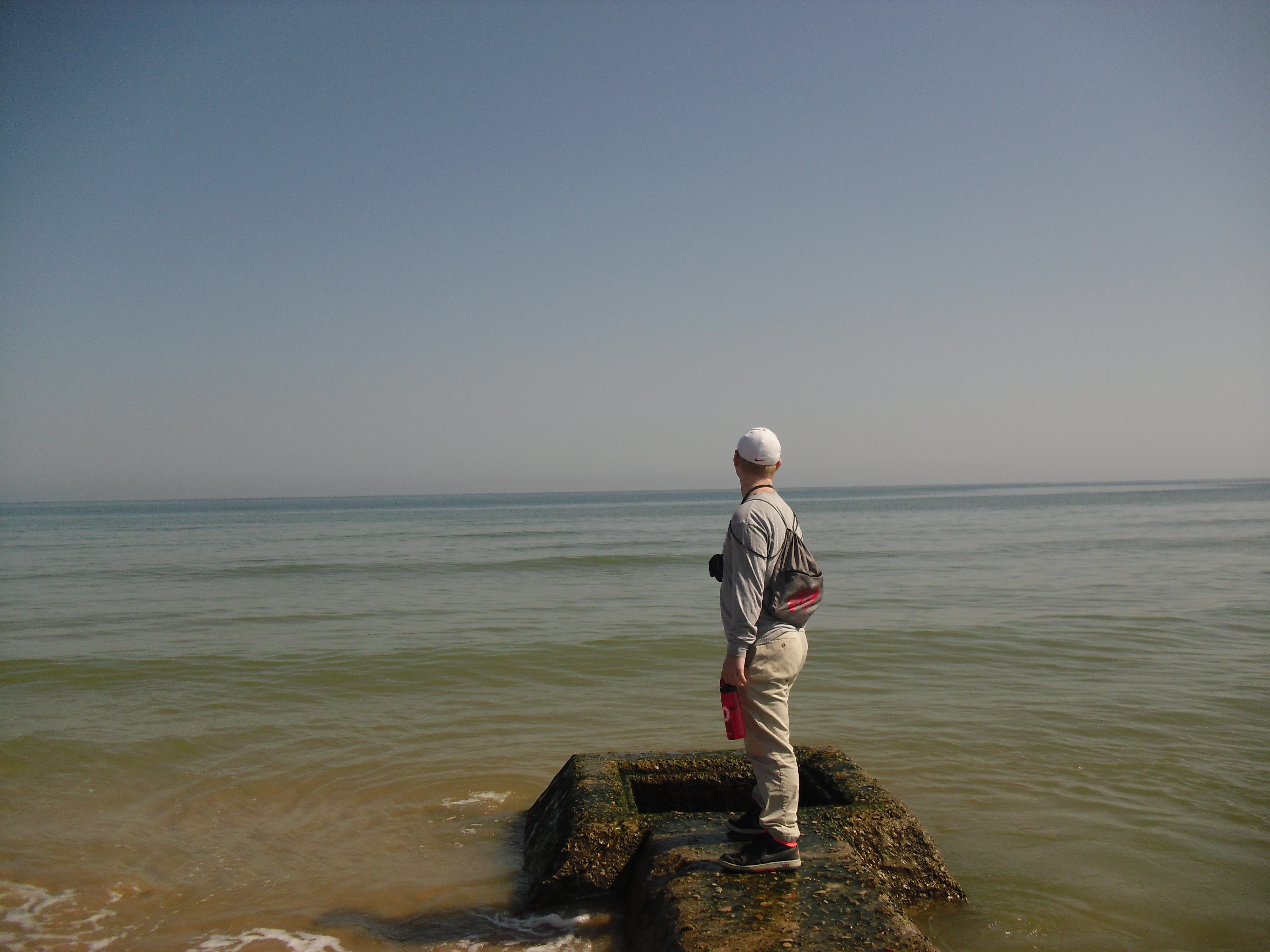
Me standing on a stone walkway on Omaha Beach, looking into the distance and trying to imagine what the seas looked like on June 6, 1944.

Me standing on a stone walkway on Omaha Beach, looking into the distance and trying to imagine what the seas looked like on June 6, 1944.

While my study abroad trip was in Normandy, we visited Utah Beach, Omaha Beach, and Pont-du-Hoc. It was quite an experience. For one thing, except for the memorials at Utah Beach to fallen soldiers and the museum next to the memorials, each beach looked like an ordinary beach. You had to really look for vestiges of the war that had raged on the sands nearly 70 years ago. Whether it was the structure in the water meant to obstruct the D-Day boats, or the preserved (I assume preserved) anti-aircraft gun standing on a pedestal, or the set of stairs leading up to a bunker in the mountain, there were hints at what had happened there.

It was really weird. You stand there, and you’d think it was just an ordinary beach. It’s hard to believe that the things that happened there really happened. I wonder how it was for the veterans who were still alive and able to make the trip to the commemoration ceremonies (like this badass Ohio former paratrooper), to come back to the beaches all these years later and seeing bare vestiges of the war left. Must have been disorientating, to say the least.

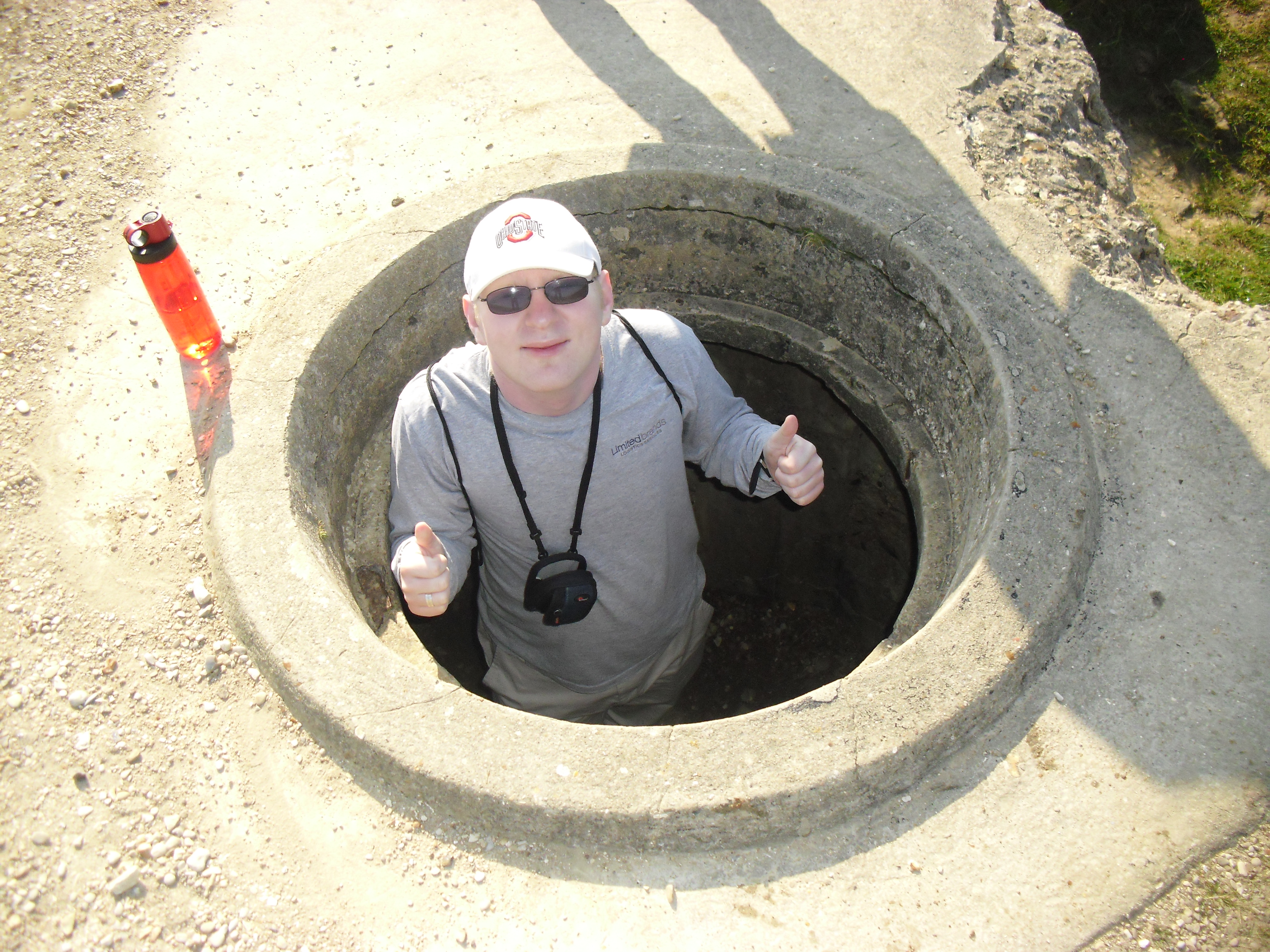
At Pont-du-Hoc though, you could totally hear the echoes of the past. Pont-du-Hoc, if I remember correctly, is not too far from Omaha Beach. Scattered all throughout the area are rubble, the remains of German bunkers and weapons, and dozens of craters, varying in size from six feet across to twenty feet across or more. Don’t even get me started on how deep those things went! I was scared to go down into the deeper ones lest I be unable to get out again without assistance.

CIMG2417

My friend David Corrigan in one of the deeper pits. This one was maybe twenty feet deep and twenty-five across. It was quite the shock to see it for the first time.

It was easier there to get an idea of what the war was like. You could see evidence in the craters, from the huge blocks of concrete, and from the gun pits and passageways, that war had been waged in this area. And what an area it was! You get the impression from movies and TV shows that a battle, no matter the size of the army, is maybe contained to a place the size of a football field. Pont-du-Hoc was probably several football fields long and wide. It really redefined my belief on what a battle was like.

And when I closed my eyes, I could almost hear the sounds of the battle, echoing across the stream of time from seventy years ago. And I was awed by it all, by the magnitude of what had happened and the horrors the soldiers must’ve witnessed in the spots I stood on. It was so hard to fathom. Thank God I have a writer’s imagination, which made it a little easier, but what I saw in my mind’s eye was probably nothing like it really was back then.

Now, veterans, their families, and world dignitaries such as Obama and Putin and so many others are there to remember the fallen and the battles waged just as I did a few weeks before. It’s right that they should, because it was D-Day and Operation Overlord which began the destruction of the Nazi regime and helped to free so many people from the horrors of fascism and racism. And while technically it was the Soviets who really ended Nazi Germany’s reign of terror, D-Day had a large role in ending it as well. D-Day and everything after.

Me in an anti-aircraft gun pit. Trust me, I had to struggle to get in there.

Me in an anti-aircraft gun pit. Trust me, I had to struggle to get in there.

And I’m so glad I’m at least able to contribute something, even if it’s only some musings and a couple of memories and photos, to the celebrations and commemorations. I’m so happy to say that I was there and that I have more knowledge than I did of the invasion on this auspicious day. And I’m happy that I was able to reach back across time like that and get some sense, even if it was just a small one, of what happened on those beaches and in the surrounding countryside.

Thanks to all those who served in the war, who helped to liberate Europe from Nazi tyranny, and who still today serve to protect the ideals of freedom and peace. It’s all because of you that I’m able to write this. And I and so many others will never forget it.