Posts Tagged ‘television shows’

It’s Friday again, so you know what that means. It’s #FirstLineFriday! And if this is your first time joining us for this most fun of traditions, here are the rules.

  1. On Friday, write a post on your blog titled #FirstLineFriday, hashtag and all.
  2. You explain the rules like I’m doing now.
  3. You post the first one or two lines of a potential story, a story-in-progress, or a completed or published story.
  4. You ask your readers for feedback, and then encourage them to try #FirstLineFriday on their own blogs.

So this week’s entry comes from an idea I had for a novel about two weeks ago, inspired by the season premiere of Ghost Adventures (people can trash that show all they want, I don’t care. I love it, I believe in what Zak Bagans and his team are doing, and I get so many ideas from it. How can that be bad?). It’s definitely a weird and creepy story, to say the least. Enjoy:

The house didn’t seem to have changed a bit since she was last here. Indeed, Anna almost expected to hear Pinocchio come running up to greet her with his wagging tail, and Miss Myrtle to call to her from the kitchen and ask her how her day at school was.

Thoughts? Too wordy? Does the story intrigue you? Let me know in the comments below.

And if you enjoyed reading this post, why not give #FirstLineFriday a try on your own blog? It’s fun coming up with new lines every week, and you get such great feedback from your readers. Plus as an author it gives you an idea of how people might respond to certain story ideas, which is always nice.

Anyway, that’s all for now. If anything comes up–and knowing my life, that’s a definite possibility–you’ll probably hear about it pretty quickly. Have a great weekend, my Followers of Fear!

I’ve been watching a lot of Supernatural on Netflix lately, and something in the most recent episode I watched got me thinking. It was stated at the beginning of the season that the main villain of the season, the demon Lilith, is breaking magical seals to raise the demon Lucifer out of Hell, and she needs to destroy sixty-six seals to do so. Based on that, I thought there were sixty-six seals in total, which seemed reasonable. According to the episode I watched yesterday though, there are over six-hundred possible seals, and Lilith needs to only destroy sixty-six to get Lucifer out of Hell.

Now I’ll admit that I’m still working my way through the season, so there may be more to these seals than what I know right now, but based on just the description I have above, that’s a pretty poor security system. You’re keeping the ultimate evil bound by six-hundred seals, but only sixty-six need to be destroyed to let him out? That’s like only needing an eleven percent passing score on a lie detector test to get access to Top Secret national security files. You’re just acting for trouble.

With that in mind, as well as my thoughts on the movie The Boy that I reviewed earlier this week,* I got to thinking. Sometimes creators do things in fiction that make absolutely no sense when the fans get to them. Obviously, there are things in fiction that are most likely impossible–the magic of Harry Potter, actual giant lizards like Godzilla, TARDISes and Time Lords (sadly)–but we forget that so we can enjoy the story. This is called suspension of belief, and it’s how we can enjoy these stories. However sometimes a creator–whether it’s a book, a movie, a comic, or a TV show–is just too hard for us to believe. When that happens, the story, and our enjoyment of the story, suffers horribly.

With that in mind, here are some things every storyteller can do to make it easier to tell a story without dong something that will make a reader/viewer say, “What the hell? That’s so stupid!”

  • Avoid the unnecessary or stupid twists. Back to The Boy again, which, if you haven’t read my review, singled out the twist that the boy Brahms was alive and a full adult as the movie’s biggest fault. I get that they were trying to distinguish the movie from others like it with a unique twist, but besides feeling kind of lame, the twist made the whole concept of the movie nonsensical (see my review for full details on that). If you plan to include a twist in your work, ask yourself a few questions before you use one, such as: is this twist necessary to make a good story? Is it predictable? Does it make the story seem silly or even make the events of the story make no sense? I’m convinced if the filmmakers of The Boy had asked these questions, they might have had a better movie on their hands.
  • What brought people to your work in the first place? I love bashing 2009’s Friday the 13th remake, because it is such a terrible film. In fact, the filmmakers even seemed to think that the movie was crap, or that they were unable to really make a great Friday the 13th film, so they packed in as much swearing, sex and nudity, drugs, alcohol, and raunchy or childish humor as possible. The result was a film that felt like it was trying to be one of those dirty teen camping trip comedies that had to remind itself every few minutes it was about a serial killer living on a lake.
    If you’re going to tell a certain type of story, keep in mind at every step what sort of story it is and don’t focus unnecessarily on elements that are only a small part of the story or even unnecessary. In the case of Friday the 13th, people watch those movies to see Jason go on a rampage. The sex and drugs and all that other stuff are just added bonuses as well as what causes Jason to target his victims, not why we pay nine dollars at the box office. And the fact that the filmmakers felt those elements were more important is why I’ll always enjoy bashing this piece of crap out of Michael Bay’s bum.
  • Could this happen in the real world? I have a lot of problems with the Hunger Games books.** One of my biggest problems is how the series ends: Katniss finds out President Coin ordered the bombing that killed her sister, so she kills Coin in revenge as Coin takes control of the nation. The new government of Panem hushes up Coin’s treachery to preserve the new order, so for all intents and purposes Katniss just assassinated the new President unprovoked. And Katniss…is portrayed as a girl gone mad with grief over the loss of her sister, she gets exiled to District 12 with weekly phone conferences with a shrink, and lives happily ever after?
    I don’t care if you’re the face of a movement, if a similar revolution occurred in America, and the face of that revolution killed the new leader, you bet that person would at least get locked up in a prison or psych ward so they couldn’t tell anyone what they’d done. Exile and getting to raise a family? Nothing bad happens to her? I don’t care if she has nightmares a lot and never tells us her kids’ names because she’s afraid of losing them, that still would never happen in real life!
    So when you’re telling your own story, ask yourself if a situation is so unbelievable, even in the wackiest of fiction, that people can’t suspend their disbelief anymore. If it is, you might want to consider tweaking it so that guys like me don’t go on a rant about it on the Internet.
  • If it needs a lengthy explanation for why it happens, you might want to rethink the why. This one comes from personal experience. When I was writing Reborn City, I had this really complicated reason as to why my protagonist Zahara Bakur had to join the Hydras. That, and another situation later in the book had really complicated reasons why those things had to happen. It wasn’t until later drafts that I realized how overly complicated those situations were and found simpler explanations for why Zahara had to join the Hydras or the other thing had to happen, explanations that were so simple but worked so perfectly I wondered why I tried to use the run-around logic that a smart reader could easily poke a hole in.
    So if you want a specific event in your story to happen for the sake of the story but the way you get it to happen is really overly-complicated, requires a lot of explanation, and from certain angles makes no sense, perhaps you should reconsider either the event or why it happens. It beats having two unnecessary pages of dialogue explaining why something needs to happen when a much simpler explanation is at hand, at any rate.
  • And finally, don’t forget what is obvious or necessary. This kind of fits into my third point, but I’m making it separate because I feel that’s the best way to present it. Anyway, in one of my fiction workshops in college, a classmate turned in a story that took place in a post-apocalyptic setting. It was a good first draft, but a major problem I had was that the protagonist apparently forgot his bow and arrow at home. I said to her, “This is a world where people dumb enough to leave their weapons at home while on a trip are likely to get killed a hundred different ways. No seasoned hunter like this guy forgets his source of food and protection.” In the same way, make sure that you avoid moves like that, where a character does something that makes no sense for someone in their position or the setting has some part of it that also makes little sense when you think about it. Trust me, it will improve the story if you avoid those problems.

In the end, the thing you want to tell is a good story. Avoiding anything that strains the credulity of your audience can be very difficult, but with trial and effort, you can get very good at it. This is also why I recommend having your stories looked at by editors or beta readers who won’t spare good advice because they’re afraid of hurting your feelings or risking your friendship. They can help you avoid these traps and improve the overall product of the story.

What tricks do you have for avoiding situations that strain the credulity of your audience?

What are some stories where they did something that really took you out of the story?

*By the way, it’s been nearly a week since I published that post, but an average of 36 people a day have been checking that post out since. I guess I’m not the only one who found that twist completely stupid.

**Especially the trilogy’s very backstory. A nation in the far-flung future had a massive civil war, and the Capitol decided that to stop future rebellions, the entire country should revolve politically, economically, and socially around an annual death game involving youth from the Districts? If Panem can genetically engineer scary monsters, they can synthesize a drug that takes out aggression and dump it into the Districts’ water supply. Problem solved, and all those seventeen-hundred and twenty people who died for the Capitol’s perverse pleasure instead grow up to be contributors to society. Yes, that is diabolical and I know I’d make a great dictator. My mother informed me of this fact when I pointed out this problem with the books.

If you are as big a nerd as I am (and if continuing trends are accurate, you probably are, because the meek are inheriting the Earth and all that), you’ve probably heard a bunch of news about Doctor Who over the past week or so that has made fans of the show and just people in general who are friends of those fans freak out. These pieces of news boil down to three main points:

  1. Steven Moffat, showrunner for the show since Series 5 and writer since Series 1, will be stepping down from his position at the end of Series 10. The showrunner position will be taken over by Broadchurch creator Chris Chibnall.
  2. Because of the Olympics and everything else happening in 2016 this year, we won’t get any new episodes of Doctor Who till the Christmas Special at the end of the year. Series 10 will start up in the Spring of 2017.
  3. Peter Capaldi, who play’s the Doctor’s 12th incarnation, may also be leaving the show at the end of Series 10, so as to let Chibnall start fresh with a new Doctor.

Okay, the first piece of news isn’t that big a shock. Moffat’s retirement has been rumored for a while now, and we can see that he’s leaving the show in good hands, seeing as Chibnall has written some pretty well-known episodes of both DW and its spin-off Torchwood. The second piece…annoying, to say the least, but considering that this year is going to be pretty crazy, perhaps a good call by the BBC.

As for Capaldi leaving…I know that the average Doctor stays around three series. That’s how it’s been since DW came back in 2005. But oh my God, doesn’t it feel a little too soon?! Even my dad is a little amazed that Capaldi’s leaving, and he only knows the show as that thing his kids are obsessed with and that he’ll have to check out if he ever has the time for Netflix. And yeah, it’s been too soon, and Capaldi’s Doctor has only had so much time! And let’s face it, while I liked Jenna Coleman’s Clara, she did at times overshadow the Doctor. I was really looking forward to seeing the Doctor grow and have adventures without having an appendage that took up so much of the story (there, I said it, are you happy?!).

But I’ve had time to calm down, and I have to say that if Capaldi does want to leave, then so be it. I’m not going to be too happy about it, but I’ll accept it if I have to. I just hope that Capaldi decides to stick around for two more series instead of one, or at the very least Series 10 is just the most awesome thing ever.

And now I’m thinking, “Who’s going to replace Capaldi?” Trust me, you’re all probably thinking it by this point as well. And I know that they won’t be announcing it until probably a few months before we see this new Doctor. Still, I thought I’d jump the gun and give my predictions for who would make a great 13th Doctor (technically 14th, but let’s not get crazy here). Heck, my Predictions post for Batman vs. Superman actually hit the mark a little, so maybe I could actually get this right.

And let me just say before I start that I will not be putting Benedict Cumberbatch on this list. Yeah I know, lots of his fans would love him as the Doctor, but seriously, the guy’s already playing a Doctor and Sherlock Holmes! He’s got enough iconic roles to fill up an IMDb page!

So here it is. The actors and actresses who I think would not only make great Doctors, but maybe take Doctor Who in an interesting new direction for a whole new era.

Hayley Atwell

Hayley Atwell

Not just my top choice, but the top choice of a lot of people. Her name’s come up several times already as a possible successor for Capaldi. Not surprising, considering she’s got quite the resume, most notably as bad-ass, takes-no-shit 1940’s secret agent Peggy Carter in Marvel’s Cinematic Universe. Atwell’s also done two DW radio dramas, so she’s definitely familiar with the franchise already. She would have no trouble taking the TARDIS key in hand, and Atwell’s already expressed interest in playing the Doctor, so why not?

Plus if the BBC decides to listen to the fans and give us our first female Doctor, Atwell would be a great actress to set the bar with.

Chiwetel Ejiofor

Chiwetel Ejiofor

12 Years A Slave‘s star was a name brought up back in 2013 when speculation about who Matt Smith’s replacement would be was at its height. Not surprising, considering the depth and strength he gave in that movie and in many other roles. Eijiofor would make a very great Doctor. And not only does he do dramatic roles very well, he can do funny and quirky (he played Lola in the movie Kinky Boots, if you need proof of that), so he could probably do some fun one-liners every now and then.

And in a show where the lead has always been a white actor, this could also be a very interesting and welcome change.

Rebecca Hall

Rebecca Hall

In 2011 the BBC made a horror movie called The Awakening, which I thought was a weird little flick that tried to get into our heads and failed miserably. However, I thought the lead actress in that film, Rebecca Hall, did absolutely great. And Rebecca Hall has a great list of films to back her up: Frost/Nixon, The Town, Iron Man 3, Transcendence. She can do a lot of different roles, and I think a versatile actor is important for anyone who wants to play the Doctor.

And if she’s the only part I really enjoyed in a horror film, then you know she should be seriously considered.

Ace Bhatti

If that name sounds at all familiar to you, that’s because he played Principal Haresh Chandra in the DW spin-off The Sarah Jane Adventures, being both comic and serious at the same time in many different episodes of the series. Honestly, he was one of my favorite characters from that show (which I’m surprised that more DW fans haven’t seen). And apparently he’s got a very long resume outside of SJA, including a very big role on the show EastEnders (which I haven’t seen but I’ve heard good things about). He could make a very good Doctor, and considering that plenty of actors who had smaller roles in Doctor Who later went on to play bigger roles (including Capaldi and Sixth Doctor Colin Baker), this would be only continuing a well-known tradition.

Naomie Harris

Naomie Harris

Plenty of people know her as “oh, the actress who plays Moneypenny in James Bond, right?” but she’s done a lot more roles than that. In addition to Skyfall and Spectre, Harris has done 28 Days Later, Pirates of the Caribbean, and Mandela: Long Walk to Freedom as Winnie Mandela, for which the actual Winnie Mandela basically said that it was the best portrayal on film of her person.

With that sort of resume and endorsements, Harris might make a very good Doctor. I sort of imagine a warm and kind Doctor, who really hates getting violent but if she gets angry even Daleks will run away from her. Kind of like the Tenth Doctor with a mix of Third’s mentor-like charms.

Jon Oliver

Jon Oliver

Enough said. I know he probably won’t leave making fun of society while at the same time improving it on HBO, but the guy’s great. I’d love to see him as the Doctor.

And my final choice:

Mads Mikkelsen

Mads Mikkelsen

I know, I know. He’s not British. He’s not even Irish! He’s Danish! He’s practically not allowed to play the Doctor! But come on! Have you seen his resume? He was amazing as Hannibal Lecter in Hannibal, as Le Chiffre in Casino Royale, and he’ll be in Doctor Strange and Rogue One: A Star Wars Story later this year. And he actually does a pretty good British accent. Can you imagine him in some fancy 19th-century garb with a side of futuristic tech? He’d make a great Doctor, and I would love to see him in the role.

And I’m not afraid to say it!


So those are my choices for who should be the 13th Doctor. But tell me, who do you think would be a good fit for everybody’s favorite Time Lord? Do you think I’m on to something? Do you think I’m totally off? Is there a name I missed? Do you hope Peter Capaldi will stay a bit longer as well? Let’s discuss, my fellow Whovians.

And Steven Moffat and/or Chris Chibnall: if you happen to read this and you’re looking for some new blood to help you write kick-ass episodes of Doctor Who, give me a call. I’ve been keeping a long list of ideas for stories with the Doctor and I would love to write them for you. And these ideas could also work as novels, which I’ve plenty of experience writing, so I could do my stories that way as well if you want.

Like I said, give me a call. I’d be more than happy to head over to Wales to discuss the matter further.

Norman Bates, a prime example of a man with a mental illness in horror fiction.

I’ve been wanting to do a post for a while now that examines horror or literature but wasn’t my usual Reflections or Writing post. And then I read this article not too long ago on how mental illness is portrayed in anime (surprisingly anime takes a very honest and powerful take on the subject) and it got me thinking. It’s no secret that mental illness—or its more common designation, “insanity”—has been a huge part in horror fiction since the earliest days. The problem is, most of it tends to be pretty negative portrayals.

This is actually pretty sad, to say the least. Approximately one in three people worldwide will show enough symptoms to qualify as having a mental disorder at some point in their lives. In the United States alone, that number is nearly is nearly one in two. And a majority of these people are nonviolent. I should know. I’ve known various people throughout my life with some form of mental illness, both family and friends, and I have been open in the past about being on the autism spectrum myself. None of these people I know would hurt a fly, and I could never hurt anyone outside of one of my own stories.

This is quite different from horror fiction, where we have a variety of characters with all sorts of mental illness–Annie Wilkes, Norman Bates, Jason Voorhees, etc.–who are as violent and dangerous as they come. What gives?

So I’m going to do a series of posts, over the many months, about how mental illness is portrayed within horror fiction. Now, I’m not a psychologist or psychiatrist. I’m a horror novelist. And God knows I haven’t seen or read every horror story out there. Not even some of the classics. But like I said, I will try my best to go over this subject with the respect and care it deserves. I will do case studies, maybe make some recommendations, and maybe even ask the question: is the portrayal of mental illness in horror fiction good or bad.

And if one can write characters, particularly villains, with mental illnesses. And by one, I might mean me.

In the meantime, if you, my Followers of Fear, can give me any recommendations to help me write this series of posts–whether it’s films or books to check out, articles that have already gone over the subject, etc.–let me know. I could use all the help I can get for this massive undertaking.

Heck, if you’d like to write a guest post, I’d be more than willing to consider it.

That’s all for now. In addition to this series, I’ve got a bunch of posts I plan to put out over the coming days and weeks, so keep an eye out for them! Have a good week, my Followers of Fear.

I reviewed the premiere episode, and I reviewed the previous two seasons after the season finales. I’m reviewing this season, and speculating on the sixth season. And here’s what I have to say: Hotel has replaced Asylum as my favorite season of American Horror Story. And given my high standards, that means something.

Honestly, it’s hard to pin down a favorite part or moment to Hotel, so I’ll try to get in as much as possible. First, there’s the story. With AHS, it’s really hard to pin down where the story will go or how things will play out, who will live or die at the end (though I kind of saw how the first season was going to end at a certain point), and Hotel continues that, keeping me guessing right up until the last episode. I couldn’t even tell who the Ten Commandments Killer was until the show decided to scream it at us right before John Lowe finds out, at which point I was like, “I should’ve seen that twist coming! They’re really that good.” Not only that, but the writers manage to keep things interesting even in slower moments. Okay, not all the slower moments, there were a few moments in some early episodes where I got a little bored with the pace, but other than that, the writers told the story well, kept our interest, and even scared us a bit.

The show also managed to get across its main theme to us the viewers very well. Whereas Freak Show hit us over the head with its theme of “the other”, this year’s theme, “addiction” is given to us with a bit more finesse. Yes, there are lots of shots of needles and all that, but you also see it in the interaction of the characters, how certain characters cling to each other like a lifeboat in the middle of the ocean, and how other characters act as merciless and heartless as drug dealers to the people who need them. Besides the actual shots of heroin, the closest they ever get with giving us the addiction theme overtly is in episode 6, where one character reams out another about how she uses men, but that’s it. You really get multiple layers of the theme throughout the season, all done with a skill and complexity that I hope I can someday do with my stories.

Absolutely loved this character.

And then there are the characters. Oh my God, these characters are just so great. My favorite is Evan Peters as James Patrick March, the Hotel Cortez’s founder. He’s such a fun character, like a twisted, murderous Walt Disney, and he steals every scene he’s in. Not only that, but Peters looks like he’s having so much fun every time he’s on screen. Not surprising, considering this is such a different role than anything he’s handled on the show (or maybe in anything he’s ever been in). I also adored Lady Gaga as the Countess. I’ve said it a million times by now, but you forget that you’re watching Lady Gaga when she’s on that screen. She becomes her character, and it’s a magical spell that doesn’t break after the credits roll. I really hope she comes back next season, because she is so talented and fun to watch.

The rest of the cast is also a ton of fun. Denis O’Hare as transgender Liz Taylor is just divine, and totally a woman I would invite out with me on a night of wild partying. Wes Bentley (call me!) does a great job embodying John Lowe, who is a little flat as a character until the big twist about him is revealed, and then he’s just amazing fun. And the hotel itself is a character all on its own (how can it not be, when the word”Hotel” is part of the title?), with the most beautiful sets and an atmosphere all its own. It’s like meeting someone at a party, someone with looks and personality that everyone is drawn to, but if you get too close you see an all-consuming darkness.

Okay, that’s a good description of a lot of serial killers, but you get the idea. I like the hotel. The one character I disliked was Dr. Alex Lowe. Now her actress, Chloe Sevigny, was in Asylum as Shelley the nymphomaniac, and she had such a personality in that season, but here she plays her character like she’s bored most of the time. I know she’s going for frustration and depression at life’s injustices, but it feels more like boredom here. So yeah, not a fan of Alex.

I do have some complaints about this season, as much as I did love it. One was that the entity of the Addiction Demon was so underutilized in the story that if you got rid of it the entire season would be unaffected. I mean really, that thing was scary, so why wasn’t it used more? Not enough actors to play it? Too much time in the make-up chair?

I also could have used a bit more Finn Wittrock in the show (please marry me). I mean he’s such a great actor, he played two separate characters in the same season, and I was willing to forgive him for a bad accent on one of them. But hey, that might just be my problem. I do like handsome actors. Hopefully he’s around a lot next season.

On a scale of 1 to 5, I’m giving American Horror Story: Hotel a 4.9 out of 5. It’s near perfect as a season as AHS has produced yet, and I cannot wait to see how they try to top it next season.

Seriously hope she’s coming back!

And speaking of next season, what could it be? We’ve had Murder House, Asylum, Coven, Freak Show, and Hotel. Where could they go next? If I were a betting man (and I only occasionally buy lottery tickets), I’d say we might see something set at a private school. Schools are great places to portray a horror story, a lot of the regular actors look like they could be high schoolers, and I could imagine Gaga, who may come back next season, as an English teacher who has an affair with a student. I somehow doubt it’ll be anything involving a prison or a camp: the former is too similar to Asylum, and the latter is being done by the guys behind Once Upon a Time. Perhaps we’ll get something with a political bent, or maybe they’ll try to do a period piece in the 19th or 18th century (plenty of untapped potential there). Or maybe something involving a trial, that would be interesting new territory. In any case, a story set at a school, particularly a private one, is my bet.

Well, we’ll find out soon enough. Possibly very soon, if they release a promo like they did after Freak Show. In any case, I cannot wait.

What did you think about AHS: Hotel? Enjoy it or hate it?

What are your guesses for Season 6?

Recently I read an article about eleven recent novels that Stephen King apparently found scary. Being the fan of His Royal Scariness that I am, I checked out the article and found this book at the top of the list. The premise sounded interesting, so the next time I had a credit for an Audible audio book, I got A Head Full of Ghosts by Paul Tremblay, which is about a young woman who tells us her memories of when her elder sister started showing symptoms of schizophrenia, but when treatment after treatment seems to fail, the family comes to the conclusion that the sister is possessed, and somehow a reality show documenting the family’s attempts to exorcise their daughter evolves.

Like I said, it sounded interesting, and it was, though I wouldn’t call it scary. I mean, there are a few moments that can be terrifying, but even imagining them as a horror movie in my head, I didn’t really feel that it was as scary as King hyped it up to be.

Still, A Head Full of Ghosts is definitely not a dull read. In fact, it’s quite entertaining. The main character and narrator, Meredith “Merry” Barrett, is one of the most enjoyable types of narrators, the unreliable kind (see my post on unreliable narrators). Eight years old at the time of the events of the novel, she tells them anew to a writer for a new book in the year 2030 (which apparently still values paperbacks and blogs. I find that reassuring). As she tells us early in the novel, she misremembers a lot of what happened, due to the passage of time and of course what everyone has told her has happened.

To a certain extent, most of the characters in this novel is unreliable to a degree. We can’t tell what’s up with the older sister: is she possessed, is she schizophrenic, is she something we don’t have a word for? The things she says and does, you get a lot of conflicting signals. I have my guesses, but you really don’t know at all, right up to the end. The father is struggling because of unemployment (I sympathize) and has recently rediscovered God and begins to see everything through a religious lens with disastrous results. The mother seems to be perpetually grumpy and wavering between trying to be in control and trying to be responsible as her life unravels. The priest from the Catholic Church seems priestly, but underneath that you get a sense that he’s milking this situation for his own reasons. It’s amazing how little you can actually trust these characters.

My favorite parts of the novel involve segues into a blog by a horror fan (a woman after my own heart) where she gives us an idea of what watching the reality show was like, as well some good ol’ scholarly examination of some of the show’s deeper meanings. And all with a snarky voice too. These segments are hilarious and fun, but they also help us as readers put the story and characters into context and prepare us for future events in the novel.

Another part I enjoyed about the novel is just seeing Merry and her family experience her sister’s illness/possession/whatever and then the craziness that is being the subject of a reality show, how fame has its downsides, how the show and the ordeal brings out the worst in her family, how her relationship with her sister becomes strained by all these events. It’s a very engrossing evolution.

One problem I do have with this novel (besides the fact that I never really found it scary) is that we never really see Merry outside of the context of her family or the show. Not even when we see her as an adult, because it’s fairly obvious that her family and the show has affected the adult she’s become. I would’ve liked to see Mary outside of the context of the family or the show, maybe in the company of friends or her soccer program. Those aspects of her life are mentioned, but they’re not really delved into, and I think she would’ve been a fuller character if we saw that her family and what’s going on around it isn’t entirely what defines her.

Oh, that and I didn’t particularly care for the audio book’s narrator. I mean she was good, especially when she was voicing the older sister, but when she does male voices, especially the father character’s voice, it sounds like every daughter’s impression of her embarrassing father or teacher. Just not convincing at all, more comical than anything.

All in all, I give A Head Full of Ghosts a 3.9 out of 5. It’s not as scary as I’d hoped it would be (or maybe I just listened to it wrong), but it’s psychological, it’s entertaining, and you want to see it through to the end. If you’re looking for a book that’s like The Exorcist with a modern twist, this might not be for you. But if you want to read something with dark subjects but you’d like to sleep at night, I think you’ll find this book fits the bill.

Smile Dog, a creepypasta character.

Recently I’ve been delving into a genre of horror that’s grown up on the Internet, and I have to say some of it is quite impressive. I’m talking, of course, about creepypastas.

Now, for those of you who’ve never heard of this and think I’m talking about a Halloween treat, a creepypasta is actually kind of like an Internet campfire ghost story, scary stories designed to shock and terrify and that originate online.  They’re sometimes accompanied with images, audio or videos, usually distorted or featuring or gore or creepy imagery, in order to intensify the effect. The name “creepypasta” comes from “copypasta”, a slang term for text that is copied and pasted around the Internet multiple times.

And even if you’re not familiar with creepypastas in general, you may have heard of some. Slender Man, whom I’ve written about on this blog before, has been the subject of numerous creepypastas in the past, to the point where some creepypasta-devoted websites no longer upload new literature about ol’ Slendy. There’s also the novel Penpal, which started out as a series of creepypastas, and Candle Cove, a story that’s reportedly being adapted to television by the Syfy channel.

Slender Man has been featured in a variety of creepypasta.

Now while the length and quality of creepypastas, like every other type of fiction, vary from one to the other, there are some ways to categorize them:

  • Anecdotes: as far as I can tell, these are the most popular of the creepypasta story form. The narrator(s), often anonymous, talks about a scary legend, a new story, or something from their past. The anecdote stories are often told in the epistolary format, or in the form of a letter or journal entry, though this being an Internet phenomena they’re more often told as blog posts or Reddit threads. They’re certainly my favorite form of the genre.
  • Rituals: As the name suggests, these are things you can do to make something terrifying happen to you or someone you know. Examples include the Midnight Game or Bloody Mary (which I’ve tried on numerous occasions, and I’ve never seen any results). Sometimes these rituals have a short backstory, but they can vary, like with the Bloody Mary game. And as you can guess, these are quite fun at parties.
  • Lost Episodes: This form has kind of fallen out of favor but it has some pretty famous creepypastas. Lost episodes usually describe a missing scene or episode from a famous TV show, usually a comedy or children’s show, that depicts a character acting very strangely and violently, usually ending in that character killing themselves or the other cast members. Often times the episodes, when they are supposedly found, feature strange or distorted audio and video, and occasionally are rumored to cause violent behavior in viewers. As you can guess from the description, these are pretty formulaic and repetitive, which is why they’ve lost popularity, though some are quite well known among creepypasta devotees.

Squidward Tentacles from Spongebob Squarepants has been the subject of a Lost Episode creepypasta. You can probably guess the rest.

As I said above, there are entire websites devoted to the creepypasta genre and droves of fans, some of whom create their own stories and upload them online. What makes this genre so popular? Well, I’m still pretty new to the genre, but I think that there are several factors that may explain this popularity. One is that creepypastas tend to be a bit more extreme than mainstream horror. They’re often accompanied by scary imagery or some other strangeness, and that adds to the creep factor. There’s also the very subject matter of creepypastas: with some stories, you can take elements from them and create your own stories. Slender Man is a character who’s been featured in a variety of media, and plenty of people have made creepypasta based on him. And then there’s the virality of creepypastas: you’re encouraged, by their very nature, to keep sending them around and around the Internet. There’s a certain power in that very concept that’s exciting, and encourages creators as well as readers.

It’s especially interesting when you consider that this is a genre born on the Internet, which has the reputation of having content geared towards people with short attention spans, and also is sometimes considered the gathering place of creators who couldn’t make it in the “real world” (eye roll please?).

Personally, I think creepypastas are quite entertaining. Some of the stories are very good, very creepy, and I enjoy listening to readings of popular creepypasta by YouTube artists. I know some people find them too extreme or that they lead to violent behavior (a subject for another time, not going into it here), but I see it as no different than enjoying a Stephen King story or going to see the latest scary movie. Just a different format with different rules that I would like to learn (though not write; by the very nature of creepypasta, I wouldn’t have as much creative control or make some side income off my work. Maybe I’ll try writing in the style though for a novel someday).

If you’d like to try some creepypasta, here are some good ones I’ve come across. If you check them out, let me know what you think:

Are you a fan of creepypasta? What is it about them that you like or dislike?

What are some creepypastas that you’d recommend trying?


You know what there are a lot of these days? Fictional universes where characters from a variety of diverse works are all brought together into a single work or series of works where they interact with one another in various ways. From HP Lovecraft’s Cthulhu Mythos, to the many different iterations of DC and Marvel comic book worlds and their film and television counterparts, to the shared elements of Anne Rice’s vampire and witch series and Stephen King’s interconnected multiverse and then some, there are a lot of these shared universes these days. Heck, there’s even theories from everyday people about how different works by certain creators are all secretly part of the same story (examples include this Pixar theory and this theory on the majority of Joss Whedon’s work).

So I’m wondering, what is the reason behind all of these interconnected story worlds? What makes storytellers and creators of all different mediums want to have such expansive universes where everything is secretly connected and you have to create a huge conspiracy layout on your wall with tape and string and stuff?

Well, I think some part of it is money. At the end of the day, most storytelling is a business (except for maybe some of what appears on YouTube), and if two characters in separate stories are making profits for a creator or their business, they may try to bring the characters together if it’s feasible and if the fans want to see it. Heck, that’s kind of the reason for most comic book crossovers and the movies based around those crossovers. Fans enjoy seeing Superman and Batman work together or Tony Stark mentor Spider-Man or whatever, so the companies give them what they want and get a profit back.

That’s not to say that all of it is money or that money’s the biggest motivator (unless you’re a Hollywood studio, of course). Another big part of it is the creators. They love their characters, and many would like to see those characters they’ve invested time and effort in come together in an awesome story. How would they play off each other? What sort of trouble would they get into with each other and how would they pull themselves out of it? And how would they grow after meeting each other? I think a lot of writers create these crossovers just so they can answer these questions. They may make multiple volumes to continue asking those questions, adding new characters or situations to continue creating exciting new stories and dynamics. It can be pretty enticing to do that with characters you love so much, and I bet audiences enjoy it as well.

In fact, I’ve imagined doing that with Snake and Laura Horn. Yeah, I have. I’ve mentioned before that I’ve wanted the story of the Snake to continue, and I’ve planned sequels not just for Snake, but for LH as well, including one where the two characters meet and get into a crazy adventure together. And I may be a few books and several years from that crossover, but it’s there if I want to write it, and eventually I will write it. It just sounds like too much fun to pass up.

snake front cover

I really have to get around to that sequel someday soon.

Another reason that creators may do crossover works is just because it makes things easier. Now, I hear you typing in the comments already “How the heck does a crossover or shared universe make things easier?” I know it seems counter-intuitive, but let me give an example: Anne Rice introduced in Queen of the Damned, the third book in her Vampire Chronicles, the Talamasca, an international organization of scholars interested in studying the paranormal. Now, try as I might I could not find any information on why, but when Rice wrote her Mayfair Witches trilogy, she brought in the Talamasca society. Why? Because at some point in the first book she details the entire family history of the Mayfair family and its dozen-plus matriarchs and I guess it made sense to just bring in the Talamasca as an explanation as to why there was an entire history of the family when the family itself isn’t very interested in its history. And it helped with the later books in certain ways to have the Talamasca. See? It was easier to bring in an existing fictional organization concerned with the paranormal than make up an entirely new reason for a third party to document an entire mystical family’s history.

I’ve also heard that’s why HP Lovecraft created the Cthulhu Mythos. He didn’t intend to create an entire cosmology, he just decided it might be easier to work with some familiar characteristics when creating all-powerful monsters, and from there it wasn’t too hard to make the jump to connecting Cthulhu to Yog-Sothoth and any of the other Old Ones. Now, I’m no Lovecraft expert, but I’d buy that explanation.

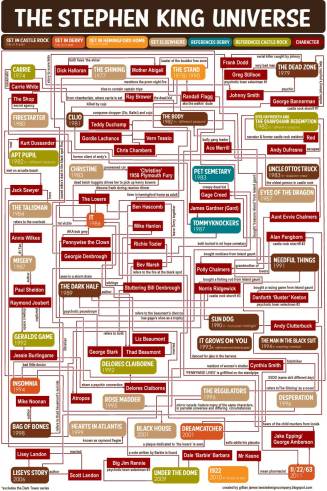
King’s references are so crazy! Check out this chart!

Of course, some authors do it because it’s fun to have a shared universe, for a variety of reasons. You can return to familiar characters and locations by doing so. You can make your readers marvel and go back to another story to say, “Hey, that matches up with so-and-so.” You can create a cosmology or a special reason why a character or characters or place or places appears in so many stories (I’ve got a character or two like that, I just haven’t been able to put them into any works yet. I tried with the human Barbie story and Evil Began in a Bar, but I couldn’t fit them into the former and I haven’t figured out how best to edit the latter yet, so…). And sometimes, it’s just fun to mess with your readers and make them wonder what the heck it all means (I’m pretty sure that’s the reason Stephen King references his other works so much, and the Dark Tower books simply grew out of a desire to create a complex story out of all that messing about).

Whatever the reason someone creates a shared universe, it’s pretty clear that there are plenty of reasons to do so, and that shared universes are here to stay. And whatever the reason behind them, as long as they’re done with love and people enjoy them, I see no reason not to keep doing them. Besides, I may have one or two I’d like to create someday.

Do you have a shared universe in your fiction? Why’d you create it? What has been the result of that?


Raymond Esposito, a horror writer and acquaintance of mine (check out his website here), recently started a video series with romance writer SK Anthony (check out her website here), Writers After Dark. The purpose of this series (besides a fun excuse to drink, that is), is to discuss the various qualities of their respective genres. The topic of their first video was which of their genres was the more like life. Or not.

And because it’s fun to watch them just go at each other in a good-natured way. I’ve posted the video below. Enjoy:


Okay, if you didn’t have a half-hour to watch the entire video (too bad, because you’re missing out), here’s the conclusion: both of them think that their genre is the one that’s more realistic, though I think they both poke a lot of holes in each other’s arguments. And maybe spend a bit too much time on if love is real.

Anyway, after watching this video I thought I’d give my own opinion on this subject. I actually think I’m in a unique position to talk about this subject. Yes, I write and read mainly horror, but I also read a lot of romance mangas, read a book series that went from prehistorical fiction to prehistorical romance fiction in the later volumes, and watched one or two movies (10 Things I Hate About You is still considered romance, right?). Plus a lot of my stories, even ones that I haven’t written yet, have heavy romance elements. Snake is a horror-thriller with such an emphasis on romance, and my thesis/novel project Rose is a horror story about a really twisted love story (among other things). I kind of live in both worlds (though I prefer the one with deadly hotels and evil spirits and Lady Gaga in a leading role).


So which is more realistic and which is totally out there? Well, I think that’s kind of a trick question. In terms of horror, I’ve seen evidence of the supernatural and I’m well aware of the evil mankind is capable of (check out current events of the world to see what I mean). However, last I checked zombies were still a fiction and when a serial killer dies, they usually stay dead. And we still haven’t discovered any mummies that have come to life once unearthed or come across any pizzerias with killer animatronic bears.

At the same time, I’ve seen my fair share of long-lasting and happy relationships, and I’m sure you have too. Still, I’m not sure I believe in the concept of unconditional love. All relationships, especially loving ones, are built on give and take, on trust and communication. No two people ever say to each other, “I will love you no matter what and you never have to do a thing for that to continue”. All relationships take work, and romantic ones most of all. And true love? Same answer: all relationships are based on work. I don’t think you can meet a person and within minutes know they’re the one for you. Maybe after thirty years and you still care deeply for them, then maybe we have something there.


So which is real or unreal?

I think, in the end, both fear and love, the bases of horror and romance, derive from the need to survive. Horror is the result of the fight or flight response, and romance is the result of our desire to find the mate who will give us the best offspring. Neither one is truly realistic or unrealistic, because both speak to the human experience. Sure, some cliches and tropes are pretty silly and unrealistic (the virgin girl is most likely to survive, the couple overcome all and live happily ever after, etc.), but it’s the stories themselves that speak to us and keep us coming back for more, not the various elements that may or may not be realistic.

But what do you guys think? Is there one genre that’s more real than the other? Did I or the folks in the video miss something? Let’s discuss.

And let’s discuss it fast, I and six other people are being chased by a killer who died twenty years ago and we can’t seem to escape this haunted mansion no matter how hard we try! And in the meantime three of the people I’m with–one the crown princess of a kingdom of succubi, one a young woman with big dreams and a curse that’s slowly killing her, and one a very handsome young man with a dark past–have confessed their love for me at a really inconvenient time. I’m kind of attracted to all three, and I have to choose one of them before we leave this house! Strangely the killer takes five-to-ten minute breaks so that I can deliberate over my romantic predicament and let it take center-stage in my life when I should be more worried about where the killer is, how he came back when he was electrocuted in 1995, and why for the love of God there’s a convenient object in every room that could become some sort of murder weapon!

What a weird world I live in.

Today is my last day in Germany. It’s hard to believe that I’ve only been here for four months; it feels more like I’ve been here for ages. The day I arrived, all the way back in July, feels like it happened years and years ago. Heading home to Columbus feels almost a little weird. Almost like I’m heading to a place that only exists in my memories. I know that sounds weird, but after being away from home for longer than I’ve ever been before (the record before this was five weeks in Israel back in high school), that’s what it feels like.

I am looking forward to coming home to Columbus.* It’s where my family is, and where I’ve spent a majority of my life. It’s familiar, it’s got a lot of people I know. And our football team is undefeated this season, which is always something to be proud of. Go Buckeyes!

Still, I will miss being here in Germany. I’ve become so used to this nation, it’s become something like a really nice foster home for me. Every day there was something new to learn or see, and I got to go to all these wonderful places while I was here. Germany is filled with such history, and I was lucky to be able to explore that history in so many ways, from traveling to the many WWII-related sites in Munich to a Roman wall in Wiesbaden and everything in-between. I even got to see a castle, something no trip Europe is complete without. No matter what the cost, it was worth going out to see all these things.

The Roman Wall. I'm going to miss seeing stuff like this.

The Roman Wall. I’m going to miss seeing stuff like this.

And the people here are very awesome as well: more than once when I got turned around trying to get somewhere, I was able to find someone who was able to point me in the right direction. Even at the grocery store, people were more courteous than I could imagine: yesterday a woman at the grocery store saw I had just the one item (a bottle of wine for my dad and his wife), and she let me go right in front of her. I usually don’t get that even in the States, so I was very grateful for her kindness. When I heard reports about how Germany was the only European country willingly accepting refugees while other countries closed their borders, I wasn’t at all surprised, because that’s just the sort of country Germany is, a kind and accepting place where you can feel as welcome as you might in your own home.

Plus I got to watch Doctor Who several hours before my Whovian comrades in the Western Hemisphere, seeing as the show airs in Europe before it does over there. That was nice. I will miss that.

But yeah, I will miss Germany. My time here was well-spent and I learned and experienced so much, and one day I would like to return, see old friends and do some more exploring of the country if possible. If I could do that, I’d be one very happy horror novelist.

Here's looking at you, Germany.

Here’s looking at you, Germany.

So thank you Germany, for being my home away from home. I’ve enjoyed every minute I’ve been here (even the more stressful minutes) and I can’t thank you enough for all you, your people, and the other guests who call your lands home have done for me. It has truly been a wonderful experience getting to know you firsthand. So auf wiedersehen, and I hope we can one day meet again.

Until that day comes though, you will be alive in my thoughts, my memories, and in my stories (horrifying as those are).

*And apparently Columbus is preparing for me to come home as well. Already the National Guard has been called out, people have been praying for salvation like mad. There’s even been strange activity reported amongst animals, like a bridge full of spiders (not kidding, it made the local news). I guess they know I plan on jumpstarting the Apocalypse, huh?