Posts Tagged ‘authors’

It’s Friday again, so you know what that means. It’s #FirstLineFriday!

So if you’re unfamiliar with what #FirstLineFriday is, let me lay it down for you. On Fridays, you:

  1. Write up a post on your blog entitled #FirstLineFriday, hashtag and all.
  2. Explain the rules like I’m doing.
  3. Post the first one or two lines of a potential story, a story-in-progress, or a completed or published story.
  4. Ask your readers for feedback, and encourage them to try #FirstLineFriday themselves (tagging is encouraged but not necessary).

This week, I’m doing things a little different. Because I have more ideas than time to write them into stories, I usually write the potential first couple of lines of  potential story. This week though, I finished editing the first chapter of Rose, and I think I’d like to post that. Speaking of which, I think after I get a bit further into the third draft, I’ll post more about the editing process. This draft is going to be radically different from previous ones, that’s for sure.

Anyway, enjoy:

I open my eyes, feeling as if I’ve been asleep for a long time. Light stings my eyes, and I close them again until the pain subsides.

This is the sort of story where the whole first paragraph is needed to be an effective hook (or maybe the first two), but whatever. Rules are rules (though really they can be changed if so desired. I just choose not to).

Anyway, what did you think? Anything you’d change? Does it sound like an interesting story? Let’s discuss.

And while you’re at it, why not try #FirstLineFriday yourself? It’s easy, it’s fun, and for novelists it’s great practice on openings, no matter what your level o experience is. In fact, I’m going to tag some. I choose Kat Impossible from Life and Other Disasters, who recently intimated to me that she could use some #FirstLineFriday tags these days. Hope this helps, Kat.

That’s all for now. I have a lot of blog posts I want to write over the weekend so I can release them later. Let’s all have a nice, relaxing weekend, shall we? Have a nice day, my Followers of Fear!

Never shall I forget that night, the first night in camp, which has turned my life into one long night, seven times cursed and seven times sealed. Never shall I forget that smoke. Never shall I forget the little faces of the children, whose bodies I saw turned into wreaths of smoke beneath a silent blue sky. Never shall I forget those flames which consumed my faith forever. Never shall I forget the nocturnal silence which deprived me, for all eternity, of the desire to live. Never shall I forget those moments which murdered my God and my soul and turned my dreams to dust. Never shall I forget these things, even if I am condemned to live long as God himself. Never.

Elie Wiesel, Night

This is really hard for me to write. I actually cried a little when I found out. It feels like I lost someone dear to me. A few minutes ago, a friend of mine sent me a message over Facebook. It was a New York Times article, telling me that Elie Wiesel had died. He was 87.

My only response was “No.”

Now if you’re unfamiliar with who Elie Wiesel was, he was a Holocaust survivor who was liberated from Buchenwald concentration camp in 1945, one of three survivors of his family. Ten years later, he wrote a 900-page account of his experiences in the camps, which was later shortened to the 127-page memoir La Nuit, later translated into English as Night. As time went on, and Night gained attention, Wiesel became a well-known speaker on the Holocaust, as well as other subjects, including Israel, genocides across time and the world, and human rights. He also wrote over 56 more books, helped to found the United States Holocaust Memorial Museum (where, on opening day, he famously interrupted one of the speakers, I think President Carter, by saying that all the niceties were meaningless when there were horrors being perpetrated in Yugoslavia), received the Nobel Peace Prize in 1986, started the Elie Wiesel Foundation with his wife, Marion, to fight intolerance and prejudice, and taught at Boston University as the Andrew Mellon Professor of the Humanities.

I first met Mr. Wiesel as a boy. Not in person, though I would do that when I was a teenager. My father had a copy of Night, along with his other books Day and Dawn, in his office in the synagogue. My dad gave it to me, though I can’t remember why. Perhaps I’d been asking questions about the Holocaust, or maybe he just thought I’d get something out of it. Either way, I did. I read Night several times over the many years, stealing to my dad’s office after services on Saturdays to read the story of a fifteen year old boy who had experienced so much at such a young age.

I only realize this now, but Wiesel became, in my mind, one of the older kids whom I looked up to and hung out when I saw them. There were plenty of guys and girls like that when I was a kid, teens who tried and became real role models for the rambunctious young me. I always looked up to those kids, and Wiesel became one of them, esteemed more than any of the others.

I later got to meet this hero in my mind, though he was not the young man I always imagined in my head. I think I was twelve or thirteen at the time. My synagogue has a yearly event where some big speaker is invited to speak to the congregation. That year, we were excited to have a huge coup in our speaker.

I think I remember seeing him for the first time, and remembering how small and old he was. At my age, I was around the same height as him. It was quite the contrast from my mental image. But he was so kind. And even though my vocabulary wasn’t that big at that age, I knew that, the moment I shook his hand, I was shaking the hand of a giant. He was like the titular character of my dad’s favorite Yiddish short story, “Bontsha the Silent” (you can read a full PDF in English here), in which the main character finds out that if he only opened his mouth to complain about the world, he would’ve shook the heavens, only in this case, Wiesel made use of his power, and it resonated.

Sadly, I only remember a little bit from that evening. It was ten years ago, and you don’t tend to remember much from that age, even when it’s from great men. I do remember, quite clearly, that he started with a story about how a woman and her friends thought they recognized him on the street, only to conclude that it couldn’t possibly be him. I think you can tell a lot about a titan when they begin a speech with a humorous story.

And that’s what Elie Wiesel was. A titan. A giant. A being that was more than what “man” could ever constitute. He spoke louder than Bontscha ever felt the need to, and the world shook in response. It took notice. He made the world notice Bosnia, Darfur, all the horrors of the many genocides over the years, and then some. Through his foundation and his many books and speaking engagements, he educated the world, molded minds to be more cognizant of both the great evils and the great goods that human beings were capable of, and encouraged them to take action.

And that night, I got to hear him speak, I got to enjoy desserts with him and the rest of the VIPs at the event that night, and I even got a photo with him. When he left and I got the chance to say goodbye (we were both leaving at the same time), it was like using a huge force go by.

He wasn’t the friend I had in my mind. That was the only encounter I had with him outside of the books he wrote. But he was so much more to me and to so many more people out there. Perhaps one could make the argument that he was the greatest Jew of our modern times (sorry, Jon Stewart), and one of the greatest living people to boot. Across the world, people will hear the news and they will feel his passing. They will cry, like I did. They may even tear their clothes, a tradition in Judaism on the passing of someone important. And that’s what’s happened. Someone important has left this world. A great titan, in a form that spoke of gentleness and tolerance, has gone onto the next life, and we have all suffered a great loss because of it.

In the Jewish tradition, we often put a special suffix after the names of people who have died: z”l. It means zichrono liv’racha, which means “may their memory be a blessing.” The Holocaust was a horrible event, a memory that mankind would rather forget, but it produced one of the greatest people I’ve ever had the pleasure of meeting. And we shall remember him, and his memory shall be a blessing, encouraging us to be better in all circumstances. And I shall definitely try to live up to those lessons, even more in Wiesel’s death as I did in life.

Goodbye, Mr. Wiesel, z”l. We shall miss you so.

Baruch Dayan Ha-emet.

I just got an interview published on BookGoodies.com. I got the chance to talk to them about the usual stuff, though I did enjoy that they took my author photo and put it horizontal. Definitely check it out.

Also, I’ve had eight ideas for stories today, starting with a dream I had this morning. Talk about a creative day.

See you Friday!

It’s Friday again, so you know what that means! It’s #FirstLineFriday! It’s also been a full week of work at my new job. I’ll have to blog about that at some point, if I’m allowed (government work, you need to be very careful when you talk about what you do with them).

Now if you don’t know what #FirstLineFriday is, let me explain. On Fridays, you:

  1. Create a post on a blog entitled #FirstLineFriday, hashtag and all.
  2. Explain the rules like I’m doing now.
  3. Post the first one or two lines of a potential short story, a story-in-progress, or a completed or published story.
  4. Ask your readers for feedback and encourage them to try #FirstLineFriday on their blogs as well (tagging is encouraged but not necessary).

Ever since I moved into my new apartment, I’ve been feeling more creative than I have in months. Oh, the number of new ideas I’ve had since I started living on my own! So picking just one story to do an entry on was a hard choice. In the end, I went with on I came up with last weekend, inspired partially by a story I read recently, about an online campaign of witches to cast a hex on that Stanford student who only got six months for rape (yes, both of those are a thing. Crazy, right?). Along with some recent events, I was able to come up with something original and strange and hopefully creepy. Enjoy:

Sometimes you can only take so much from the world before you just decide to strike back. And yesterday was the final straw.

Thoughts? Errors? Let’s discuss.

And while you’re at it, why not try #FirstLineFriday on your own blog? It’s easy, a lot of fun, and if you’re a writer, you get great practice for openings in your own stories. In fact, I’m going to tag someone. Let’s see…I pick Ryan M. Church of The Way of the Storyteller. Ryan, you’ve been tagged. You must do your own #FirstLineFriday either this week or next. Good luck!

That’s all for now. Packed weekend after work, so I hope I have time to check in with the latest. Until next time, my Followers of Fear!

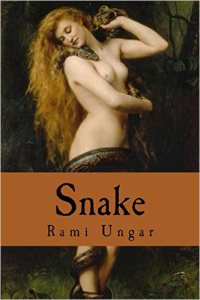
Cover of Snake by Rami Ungar

As I mentioned before, today is my twenty-third birthday. Wow, twenty-three. Technically, I’m still pretty young, but I feel old. I’m already paying bills and rent on my own apartment and starting a job. Ah, adulting. How you make me feel older than I am.

And as I mentioned in my last post, it’s also been two years since I published Snake, my second novel. This book, which was inspired by movies like Taken and eighties slasher films, as well as all the suspense novels I read in my first year or two of college, is the story of a serial killer who goes after members of a powerful New York mafia family, and the reasons why he does this.

It’s definitely one of my more “what the fuck?”-worthy stories, as well as one of the ones I had the most fun writing. At the time I wrote it, I just wanted to create a very thrilling, violent story involving a serial killer whom people would find themselves cheering for (like I said, “what the fuck?”-worthy). I did a lot of research into serial killers and psychopaths, even consulting with a forensic psychiatrist who helped me figure out what an actual criminal profiler would say about the crimes, as well as a lot of rewrites and reworking of the plot. The end result was one hell of a bloody, exciting thriller-horror novel.

True, there are some things I would’ve changed in the final product if I could go back (technically I could, but I don’t do rewrites after publication unless absolutely necessary), but yeah, it’s a good novel. And that’s not just my own ego telling me that. Here are some reviews, a few of which are by friends and other authors [WARNING! Some of these reviews do contain spoilers. Please be advised]:

Well, I took yet another vacation where I made my family “just wait until I finish this chapter.” This page-turning read was another great effort by Rami. He is not afraid to take risks in plot twists and turns, character development and he takes the reader on quite the journey in this book. So looking forward to his next creation!

–Michele K

This book is another awesome creation by Rami. This book is scary and brings the reader to the depths of how evil the human character can be and how anyone can be driven to commit acts of torture. The author does a wonderful job of developing the plot and characters and there are certainly twists and turns. I highly recommend reading this book if you love a good frightening thrill.

–ENJ

Rami Ungar makes a promise to (the reader) in all his writings: he WILL scare you, and if he does “his job is done.” Snake will scare you. I am a huge Stephen King fan, so this should give you some idea of my tolerance level for gore, death and mayhem – I was scared. Rami takes you into places you would never have believed possible, and manages to pull his hero (and eventually his heroine) out of them against all odds. If you like to be scared. If you LOVE to be scared. You should read this book.

–Angela Misri, author of No Matter How Improbable

I really enjoyed this book. When I selected “dark” for the mood, it was almost a toss up with suspenseful. You knew early on who the mafia killer was, but the question of how he was going to find his girlfriend and rescue her was suspenseful. I ended up choosing “dark” because of the level of violence our main character used in getting to the girlfriend. But he was a complex character. Even though he definitely had the dark side to him, there was a surprisingly good side to him, too. You don’t really see this until later on in the book. So early on, you might think this is an unredeemable character. But one of the most intriguing characters are those who aren’t what they initially seem, and for this reason, I enjoyed this character. The pacing was just right. It wasn’t rushed, and in no way did I ever feel it dragged, which is awesome for a book that was over 500 pages in paperback.

–Ruth Ann Nordin, author of The Mistaken Mail Order Bride

I guess people really like it. Which is good, because I have plans to someday write a sequel. I just have too much right now to devote time to one. Though considering the experience I had with the first book, I’d probably have a blast getting the second one written and going back down that creepy-as-hell rabbit hole.

So if you would like to read Snake and see if it’s as good and as scary as these lovely reviewers have made it out to be, I’ll include the links below. And if you do decide to read the book, please let me know what you think. Positive or negative, I love feedback from readers (and it makes me a better writer to boot).

That’s all for now. I’m off to have birthday celebrations with my family. I’ll see you around, my Followers of Fear. Have a great weekend.

Snake: AmazonCreatespace, Barnes & Noble,iBooksSmashwords, and Kobo

I was honored by my friend and colleague, Ruth Ann Nordin, to do a guest post on her blog in honor of the publication of Video Rage. The post is about building worlds in fiction, and has some tips I hope people find very useful. Check it out, and leave your thoughts in the comments.
And thanks again to Ruth for letting me do this. I hope we can work together again sometime.

Ruth Ann Nordin's avatarRuth Ann Nordin's Author Blog

Quick note from yours truly:

I’ve never had a post about world building before, so I’m really excited to feature someone who is excellent at this storytelling technique.  Rami Ungar is one of the nicest people you’ll ever meet, and if you enjoy thrillers and/or horror, why not check out one of the books listed below this post?

Thank you, Rami, for doing this post for this blog!

Now for Rami’s post:

Building a Fictional World

Setting is one of the most important aspects of writing any story, especially speculative fiction such as fantasy, science fiction, and horror. In many ways, the setting of a story is another character, because it interacts with the characters on almost every level of the story. Doesn’t matter whether it’s modern-day Columbus, Ohio, or Victorian England, or the moons of Jupiter, or the fantastical land across the waters that elves come from. One can’t…

View original post 1,288 more words

I found this on Netflix, and after I saw it got good reviews online, I decided to check it out. And I think I got what I asked for with a series called Slasher.

Now, a little background. Slasher is a Canadian-American TV series partially inspired by American Horror Story (and believe me, it shows), as well as Agatha Christie novels and classic slasher movies. The production company’s plan with this show is to do it anthology style with a new story every year, possibly with a similar cast each season (see? The AHS influence shows). The first season’s story follows Sarah Bennett (Kate McGrath), as she and her husband Dylan (Brandon Jay McLaren) move into the house where her parents were brutally murdered by a man dressed like a medieval executioner back in 1988. In traditional slasher fashion, someone copying the original killer’s MO starts killing people, and Sarah finds herself forced to work with the original killer (Patrick Garrow) to figure out who the new killer is.

So how does it stack up?

Well, the first season does have a bunch of problems. The biggest problem is that it’s really derivative. Like I said, you can see the inspiration from AHS. In fact, it feels like an AHS knockoff, and not exactly a stellar one. The killer is also very derivative, his whole MO a ripoff of the movie Se7en with every victim being killed because they committed one of the Seven Deadly Sins. And the killer’s design? It actually reminds me of the protagonist of my novel Snake. I’m actually wondering if that’s not a coincidence! There’s also a character that I’m told is similar to one iconic character from Twin Peaks, an incompetent police department out of just about every film ever, and a few other things I can’t mention without spoiling the story.

Did anyone ever tell you that you look like a character I created this one time?

Another problem is the protagonist, and the actress who plays her. Kate McGrath’s acting in this series is wooden and emotionless, to the point where I want to pull out my phone and find something a bit more animated. Not to mention McGrath’s Irish accent breaks through her attempts at whatever the Canadian equivalent of the General American accent is. As for her character, I find it hard to sympathize or connect with her. I get that her parents were brutally murdered, and that she’s got more than a few reasons to investigate these murders, but other than that there’s not much to her character besides her ability to make and act on connections the police can’t. She feels more like a construct or an idea of what the final girl in slasher stories can be than a real person.

So with all that, is there anything positive about Slasher? Actually, quite a bit.

For one thing, it’s interesting. Fault it for how derivative it is and for the wooden lead, but the show’s writers know how to set up an interesting story. Every character has secrets, and it’s fun to watch those secrets get opened up and divulged to the other characters and the audience. You’re also kept guessing on who the killer is until the final reveal, and there are a bunch of other twists that keep the story feeling fresh and exciting. And there are scenes that are both heartwarming and heart-wrenching. There was one scene in the seventh episode that particularly got to me, and the way it was done was just so artful and well-done. So despite it’s derivative nature, it’s good to see that they can keep an audience interested in the story. Especially an audience that goes through a lot of trash trying to find gold and therefore knows all the cliches.

And while the lead isn’t that great, some of the other characters are just a lot of fun. Dylan Bennett has an interesting character arc in relation to his job as a journalist, the events unfolding around him, and their effects on his marriage. And Christopher Jacot as gay real estate agent Robin is always a blast to have on screen. I think I fell a little in love with his character. Patick Garrow’s incarcerated killer Tom Winston is surprisingly likable and sympathetic. And Dean McDermott as Police Chief Iain Vaughn is also a nasty character I love to hate, and the twist his character takes in the show is thrilling, to say the least.

And this is just a small thing that I really liked, but there’s an interracial couple in this story that’s actually somewhat functional and doesn’t make race the focus of their drama. Whenever I see interracial relationships on American television, it’s always portrayed as something filled with drama, and the race thing comes up in a big way at least once. There’s none of that here. Even better, it’s a black man and a white woman. I’ve seen the reverse a couple of times on TV, but this might be the first time I’ve seen it in any medium. Props to the show for portraying diverse backgrounds and experiences and not making it a huge deal. That’s still something others are having trouble with, as the fact that I’m pointing it out makes evident.

So what’s my final verdict of Slasher? Well, I think a 3.0 out of 5 seems right. Yes, it’s not the best horror show out there, nor is it the best attempt to turn a slasher into a TV series (*cough* Scream was awesome, and I’m so excited for season 2 *cough*), but it keeps your attention and has more than a few things going for it. Assuming there’s a second season (no word at this time if there will be one), there’s a good chance that the people behind the show will learn from the problems of the first season and fix them for the next one.

Oh, and for those of you who’ve seen AHS: Hotel, you may notice more than a few similarities between this show and that season, enough to make you wonder if there was plagiarism involved. Turns out, both shows’ stories were conceived and filmed around the same time. It’s just that one aired after the other. It’s a weird coincidence, but a totally innocent one.

What’s better than one character interview in one day? Two! While Rip’s getting interviewed on the blog, Zahara’s getting interviewed by another fictional character on the blog Creative Barbwire, hosted by fellow novelist Barbara G. Tarn. Definitely check it out, especially if you haven’t read Reborn City yet.

Barb's avatarBarbara G.Tarn - writer

Hi guys,

I’m Samantha and I come from another world – the original, old Silvery Earth, where people are immortal and never grow up. When I’m not switching bodies at will, I travel to other universes, especially books or movies. That’s how I met Rajveer the vampire, for example!

So, I’m taking over the interviews on this blog! And here I am, meeting people from other books/universes/whatever!

RC coverWelcome, guest! Tell me a little about yourself!

Hi, my name is Zahara Bakur. I’m fifteen years old, and I’m from New York City. I’m a Sunni Muslim, and I’m supposed to be entering my senior year of high school, but…well, things are complicated right now.

I don’t know why, but things on Earth are always complicated… *snort* Describe your appearance in ten words or less.

Average height and weight, light-brown skin, blonde hair (it used to be brown). Sorry, that’s longer…

View original post 653 more words

The other day, I posted about my recent adulting experiences (how typical is it of the Internet era that the age and mode of responsibility is now a verb that I fully embrace as part of the English language?). Funnily enough, after I wrote the first draft of that post (yeah, there were a couple of drafts to that strange, slightly stream-of-consciousness post), I realized that during all the times I listed stuff I was doing that counted as “adulting”, I didn’t list writing. For some reason, writing doesn’t count as adulting.

This struck me as kind of odd. Why doesn’t writing, an activity that is essential to just about every business and so many different professions, not count as adulting? Well, actually it is. Typing up forms and reports, sending emails, writing a speech. Those are all adult activities, and they’re so important that the basics are taught to us from a very young age.

But creative writing–writing fiction, creating poetry, and maybe even journalism–are not treated as adulting activities. And I think that’s because, unless you’re making quite the income from these activities, people don’t treat them as a job or as an activity up there with paying your bills or making your own meals. I’ve talked about how people don’t see writing as a job before (too bad that post didn’t change as many minds as I would like), and a lot of the points I made in that post still hold true. People still don’t see writing as on par for a job.

There are a number of reasons for this. One is that people think of authors and see someone sitting in front of a notebook/typewriter/computer and magically bang out a story with little to no effort. Now, the reality is very different, but perceptions are hard to break, and the belief persists that writers are hardly expending any effort in their work. And as adulting kind of involves expending energy and doing hard work, the definition is at odds with the perception.

This isn’t considered an adulting activity.

Another reason that people might not see writing as adulting is because it’s filling a creative urge that most associate with our inner child. I know, this might be a bit of a stretch, but at least hear me out. At some point in your childhood, you likely sat at the table with a bunch of paper and paint or crayons and churned out picture after picture that your parents put on the fridge and treated it like a freaking Picasso. And after you learned to read and write and maybe understood some basic storytelling, you may have created short stories based on fairy tales or some giant robot anime (asking your parents on how to spell certain words) and then listened to them act like you’re the next F. Scott Fitzgerald after you told them those stories.

I think to some degree that urge to be an artist or storyteller when we were children stays with us as we grow older, and we creative types indulge in the urge, only we write/paint/create much better than we did as children (usually). So when writers are busy working on a story, people see it as partaking in a vestige of our childhood that’s somehow stayed with us through the years. And childhood is the exact opposite of adulthood, which means it’s has nothing to do with adulting.

Now considering all that, should writing be something we want considered as adulting? After all, adult things usually have some sort of prestige to them. Perhaps since so much goes into writing and publishing fiction, it should be an activity worthy of being called “adulting.”

My opinion: HELL NO! Why? Because of what constitutes as adulting already: paying your bills, handling moving into a new home, working a 9-5 job and enrolling your kid in that day camp so they aren’t cooped up with the Xbox all summer and you can go to that 9-5 job. These are activities that are either boring, or annoying as hell. You’d just rather not deal with them. So when writing isn’t considered an adulting activity, I treat that as a good thing. Because you know what? As difficult as writing can be, it should be fun! It should be something pursued for joy and for the sake of creation and connection, not because it’s a task that has to be taken care of at some point if we don’t want to upset our lives.

So let’s not call writing an activity worthy of being called adulting. Let’s just keep it as a fun, creative outlet that you can occasionally make some money off of, and leave it at that.

Do you think writing should be considered adulting? Why or why not?

What are some other activities that should or not be considered adulting, and why?

VR CS front cover

Hey all! How are you this fine weekend?

With Video Rage coming out in ten days, it’s time to do something I do every time I have a new book coming out: interview my characters. And who best to interview first than the protagonist, Zahara Bakur? After all, she was my first interviewee for Reborn City, so it makes sense that she would be the first for Video Rage as well. She’s also one of my favorite characters, which is even more reason for me to interview her first.

So without further ado, let’s get started!

Notes and Stats:
Sex: Female
Age: 15
Race/Ethnicity: Arab
Birthday: August 31
Eye color: Brown
Hair color: Brown (used to be dyed blonde, but she’s gone back to her natural color lately)
Religion: Sunni Muslim
Affiliation: West Reborn Hydras
Special Abilities/Powers: No special superpowers, but she is a prodigy when it comes to riding hoverbikes.
Notes from the Author: In the first book, Zahara was very timid and unsure of herself. She was also very adverse to violence. She’s still very adverse to violence, but having survived several violent events, she’s better able to keep it together when there’s trouble. Add in the fact that she’s a natural hoverbike rider, and she’s gained some confidence. I think part of the fun of Zahara is that you do get to see her grow in confidence throughout the series, and that affects her role in the story. At first she’s scared often and usually gets relegated to the sidelines, but as time goes on she becomes braver and takes center stage more and more. That, if you ask me, is my favorite type of protagonist.

RU: Hello again, Zahara. It’s been a while.

ZB: You again! Where am I now?

RU: Zahara, you left Reborn City a few weeks ago. Please tell us what’s happened to you since then.

ZB: Well, we’ve been screwed over, that’s what!

RU: Whoa, temper!

ZB: Well, sorry! I’m just upset, okay? Parthenon tried to have us all killed, and when their plans–and their building!–go kaboom, they turn us into terrorists! Just because I’m a Muslim, they make us into the new al-Qaida and send the whole world after us! Seriously!

RU: Oh yeah, the world you live in isn’t exactly nice to Muslims, is it?

ZB: No, it’s not. We thought before we could get to New York and find some safety, but with the whole “terrorist” label, that plan’s out. We’re just trying to find a safe place now. We don’t know where that is, so we’re just going, and hoping by the time we’ve put enough distance between us and Parthenon, we’ll know where a safe place is.

RU: What are you guys doing to keep yourselves from getting caught?

ZB: A lot. We’ve changed our appearances, for one thing. My hair’s back to its natural color for the first time in years–

RU: I’ve noticed. It’s very nice.

ZB: Thank you. Rip’s also changed his hair, he dyed it back to what he says was its original color. It looks very nice. And Owl wears sunglasses, and we’ve all stopped wearing black clothes, and we’ve even removed our tattoos! Those last two were huge giveaways, so they had to go. Still, it was a big deal for the other Hydras. The clothes and the tattoos were an important part of their identities.

RU: Not yours?

ZB: Well, I’m glad to be rid of the tattoo, and the clothes did make me warmer than is good during the summer. But…

RU: But?

ZB: I may not have the tattoos or the clothes, but I’m hunted. I’m hated. And people expect the worse of me without even knowing me. I’m just like the other Hydras, in that way. And I’m with them till the end, good or bad. Inshaallah, it’ll be a good one.

RU: I wish you the best of luck with that one.

Well, that’s all for now. Remember, Video Rage will be available June 1st from Amazon, Barnes & Noble, iBooks, Smashwords, and Kobo. You can also get the first book, Reborn City, from those same sites.

Join us next Sunday when we meet Rip again. I seriously hope he doesn’t try to kill me. He didn’t seem to like me the last time we met. But then again, if he does kill me, there goes the Anno Bombus universe, which means the end of his existence…and I’m thinking about this too much.

Have a good one, my Followers of Fear!