Posts Tagged ‘authors’

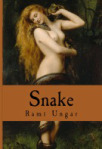
snake

How far would you go for love and revenge?

Well, I’ve been having a pretty good day today. Been having a pretty good week actually. Lots of wonderful things have been happening to me. I’d love to list them all for you guys, but that would be a pretty long list. And since I’m graduating, you can probably guess what some of those good things are. So I’ll just stick to the latest one. As you can see from the title of this post, Snake has a new review. This one comes from ENJ, who is a friend of mine and has read a lot of my work. Her five-star review, titled Must Read (wow, even the title’s a compliment), had this to say:

This book is another awesome creation by Rami. This book is scary and brings the reader to the depths of how evil the human character can be and how anyone can be driven to commit acts of torture. The author does a wonderful job of developing the plot and characters and there are certainly twists and turns. I highly recommend reading this book if you love a good frightening thrill.

Thanks ENJ. I’m glad you found it so frightening. And guess what? This review matches what others have been saying about Snake:

I really enjoyed this book. When I selected “dark” for the mood, it was almost a toss up with suspenseful. You knew early on who the mafia killer was, but the question of how he was going to find his girlfriend and rescue her was suspenseful. I ended up choosing “dark” because of the level of violence our main character used in getting to the girlfriend. But he was a complex character. Even though he definitely had the dark side to him, there was a surprisingly good side to him, too. You don’t really see this until later on in the book. So early on, you might think this is an unredeemable character. But one of the most intriguing characters are those who aren’t what they initially seem, and for this reason, I enjoyed this character. The pacing was just right. It wasn’t rushed, and in no way did I ever feel it dragged, which is awesome for a book that was over 500 pages in paperback.

This book is violent, and it contains sexual situations. Some of it can be cringeworthy. So I wouldn’t suggest this for young readers. I’d recommend this only to adults. If it was a movie, it would be a strong R. There’s also swearing. These things don’t bother me as a reader, but I know it bothers some, which is why I mention it. But if you don’t mind these elements, I think you will enjoy this book. It’s a great thriller.

Ruth Ann Nordin, author of Ruined by the Earl

Well, I took yet another vacation where I made my family “just wait until I finish this chapter.” This page-turning read was another great effort by Rami. He is not afraid to take risks in plot twists and turns, character development and he takes the reader on quite the journey in this book. So looking forward to his next creation!

Michele Kurland

Rami Ungar makes a promise to (the reader) in all his writings: he WILL scare you, and if he does “his job is done.” Snake will scare you. I am a huge Stephen King fan, so this should give you some idea of my tolerance level for gore, death and mayhem – I was scared. Rami takes you into places you would never have believed possible, and manages to pull his hero (and eventually his heroine) out of them against all odds. If you like to be scared. If you LOVE to be scared. You should read this book.

Angela Misri, author of Thrice Burned

If you would be interested in reading Snake and meeting the man who would do anything, even become a monster, in order to save the woman he loves, then you can check it out in print paperback and e-book from Amazon and Smashwords. You can also check out my other books, Reborn City and The Quiet Game, on these sites.

And if you do decide to read these works, please let me know what you think, whether it be in a comment or in a review. Good or bad, I love feedback, and I always love hearing what my readers think.

Well, that’s all for now. I’ve got some writing to do, so I’m going to get it done. Have a good one, my Followers of Fear. I know I’m having one!

Let me just say, it’s always a pleasure reading books by friends, especially because they’re usually really good. And this is no exception. Thrice Burned, the second book in Angela Misri’s Portia Adams Adventures series, has the young detective now living at 221B Baker Street taking on some twisty new cases, while at the same time adjusting to her growing social circle and trying to find the answers to her own deep and complex personal dilemmas.

As expected, the mysteries in this volume are hard to decipher and make you want to read late into the night just to find out the answers (I was able to make some guesses on one of the mysteries that turned out to be true, but that was about it). The resolutions are also fun to watch, and sometimes can be a little touching, usually coinciding with Portia finding something new about herself or making an important decision in her life. Praise should also go to the new characters of Annie Coleson, an energetic and free-spirited journalist, and Gavin Whitaker, an ambitious forensic pathologist with a mind to match Portia’s, who challenge our protagonist in so many fun ways.

And of course, there’s Portia. Honestly, I can see why so many readers identify with her. Her struggles feel more real than many YA heroines, most of whom have to deal with nothing bigger than which boy they like more. Portia Adams has to contend with so much in her life, including where she wants to go with her career, having to adjust to the presence of new people in her life who take her out of her comfort zone in so many ways, earning the respect of her peers in law enforcement, how to be an introvert when society doesn’t always allow for that, the travails of having a mind unlike anyone else’s, and so much more. It’s good to see such a well-rounded character, and I think the character of Portia is going to grow in popularity as more people find her and feel like they they’ve gone through what she’s going through at some point in their lives.

My one complaint would be that at times it feels like the story emphasizes Portia’s personal problems more than the mysteries she’s supposed to be solving, but then again this is technically a YA novel, and they’re supposed to be big on character development, so I can see why.

In any case, this is a great second installment to a series I can see going on for several books, and I can’t wait for March 2016, when the third book in the series comes out (okay, I can wait, but it’ll be agonizing). For great storytelling, characters you feel can come off the pages, and for mysteries that will leave you on the edge of your seat, I rate Thrice Burned a 4.3 out of 5. If you can, definitely check this series out, especially if you like yourself a good mystery.

For more on Portia Adams and her adventures, read my interview with the author, as well as my review of the first book Jewel of the Thames and the interview I had with Angela prior to that one’s release.

Wasn’t really expecting to be doing a new article this morning, but the opportunity showed itself and I had to take it. My latest article from Self-Published Authors Helping Other Authors is about KDP’s new age and grade range features. These are new tools that KDP Amazon says will help people market their books using age ranges. I go over the possibilities of these new features in the article.

If you get a chance, you should check it out. Might be helpful. And if you’re a self-published author, you should consider checking out the rest of the site. Self-Pub Authors is by indie authors, for indie authors and is all about doing articles on writing, editing, publishing and marketing efficiently and cost-effectively. There’s an article on almost everything, and you can find plenty of great information for your own writing. I highly recommend it.

Well, that’s all for now. I’ve got to get going, so I’ll write to you guys later. Have a good one, my Followers of Fear!

I’ve two short stories, one that has had two drafts already and another that I’m trying to get through the last act of. Both stories involve the supernatural, and both focus on two characters, a man and a girl (though in each story the relationship dynamic is quite different). As I’m thinking of the different things I could do with each story in order to improve it, one thing comes to mind for both of them and it’s really got me thinking about the possibilities.

One story is State Fair, which I’ve mentioned here before and is about fairgrounds haunted by ghosts. The other is called Streghe (that’s Italian for “Witches”) and is based off a witch mythology I learned about in my History of Witchcraft (that class is already pretty useful). At their current stages, both short stories are told mostly from the male character’s point of view. So I’m thinking to myself, one of the ways to improve them might be to tell part of the story from the female character’s point of view.

Two narrators in a single story isn’t unusual. I’ve read a couple of well-known short stories that were told in this manner, one of which immediately comes to mind is The Falls by George Saunders (boy, is that one a trip). And the Bartimaeus books, which I loved as a kid, often had two to four narrators, depending on which book you were reading. And most of my novels are told from multiple points of views (and people tend to like those). So I’m wondering why I haven’t tried that with my short stories. Heck, I’m wondering why I haven’t tried it with either of these short stories. I mean, State Fair‘s main character spends most of the story following a girl named Lizzy around the park, so why did I not get her POV on being followed around? And the events of Streghe happen as much as to my young female protagonist Sarah as it does to my nasty male antagonist Tom. Not sure why I’m saving her POV to the end.

Well, it’s something I’ll definitely try. Since I’m still working on the first draft of Streghe, I’ll see about getting Sarah’s POV in this thing, maybe heighten the mystery element of the story by including her. When I get around to another edit of State Fair, I’ll see where where I can put Lizzy’s point of view. It’d be interesting to see how she reacts to a ghost following her around.

But what do you guys think? Am I onto something? Do you use multiple narrators in your short stories? And if so, how does it usually work out for you? Let me know, I’d love to discuss.

The main fear of every fiction writer is whether or not they’re telling a good story, usually meaning they hope they have an interesting story or they’re telling it in the best way possible. After that those, there’s another fear that is just as important and just as scary: you fear your characters aren’t relatable, that they don’t feel real to the reader. The last thing any author wants to read in a review is that the characters seemed “artificial” or “their actions and words felt forced” or instead of seeming like real people, they were “more like robots.”

Unless all or most of your characters are actually robots, of course. Then those reviews might actually be compliments.

But in most other situations, you want to avoid getting these sort of reviews, and there are a number of ways to do that. One is to fill out a full character bio for each of your characters, even if you don’t plan on using everything on that bio in the story. I’m talking full educational history, childhood experiences and traumas, hobbies, likes and dislikes, dirty little secrets, all that good stuff. Having a full picture of your character can help you bring them to life. You can tell a lot about a person just by knowing the full story about them, and you can do the same by knowing everything about your characters, getting in their heads and figuring out everything from reactions to certain situations to their decision-making processes.

Some of these involve writing, which I think adds to the fun.

One of the best parts of some of these is you get to write them out. If you’re one of those types who write a certain amount of words a day, this may help fill it out on a bad day.

Another thing you can do, if you’re wondering if something your character says or does seems believable or not, is to do what I call split-mind writing. I forget where I got this (it might have been a Stephen King novel), but it’s a pretty interesting way to work out problems, if rather schizophrenic. What you do is take a piece of paper, and pretend to have a conversation with someone on that piece of paper. Basically it’s a game of question-and-answer where you bounce ideas off of the person you’re writing to, see if you can work out what’s bothering you about your character and find a solution through this process.

There’s also acting it out, which is as the name implies (and with the perfect partner, is as fun as it sounds). If you have someone to act it out with, fill the in on a scenario in the story and act it out. If you or your partner’s reactions and words are different than what you’d expect or thought might happen, examine why. There might be something in that difference that can help you in your work.

A fourth one, and one that I feel is always worth a try, is to look at your favorite characters in literature. Examine them and ask yourself why those characters feel so real to you, or what about these characters that you identified with. Often we’re inspired by these sort of characters and the stories they’re in. We want to write stories that are just as inspirational as those ones that inspired us. Going back and figuring out why can be very helpful with putting those same qualities into your stories.

And of course, there’s my favorite option: would I do that in the same situation? I find asking myself this sort of question of myself actually helps. Often our characters have a bit of ourselves in them (as they should, seeing as we created them). Asking if we would do the same thing as them, and then exploring the answer, may help you make these characters seem real. After all, if you consider yourself at least fifty-percent normal and your reactions too, then maybe those thoughts and reactions should apply to your characters as well.

Sometimes it’s just a matter of thinking and puzzling it out.

Sometimes it’s just a matter of thinking and puzzling it out.

While making characters seem real to your audience can seem daunting, it’s not impossible to do. We all start out having trouble making our characters seem real, but with time we improve, make them real not just to us, but to our readers. And part of that is just asking a question: why or why does this character not work? The answers you get can be the key to writing something–and maybe even someone–truly awesome.

So today was the day. The day I’ve kind of been working towards since Fall Semester started back in August. My thesis discussion, where I would discuss with my advisor and one or two other people about the finished product of the novel I’ve been working on.

Well, finished product is a bit of a misnomer. But you get the idea.

Early this morning I met in my advisor Manny’s office for the big meeting. My second reader for the discussion was Maura, a teacher I’ve taken classes with, whose company I enjoy, and who is a huge sci-fi enthusiast (can you see why I asked her to join us?). For about an hour and a half we sat and discussed Rose, how I got the idea for it (actually in one of Maura’s classes), how it grew in my head and became the novel I wanted to write for my thesis, and how all that went (you know the process of that from my many posts on the subject). We also discussed changes I could make for the third draft (which I will do, in time) and what they liked and disliked about the story.

I won’t do a transcript of the entire hour and a half, but I will go over the salient points. As you probably already know, Rose is about a young woman brought back from the dead by a man claiming to be her boyfriend and begins to turn into a plant-like creature (when Manny told the subject of my thesis to some of his writing friends, they were rather impressed by the originality of the idea). It’s about forty-nine thousand words as of the second draft, and still needs some work.

Maura and Manny definitely enjoyed the symbolism and thematic elements of the story, as well as how Rose’s character developed over the course of the story. However, there were some things that could be changed. The first third of the book or so could stand to have quite a few things changed around, including the portrayal of Rose’s amnesia and how she first interacts with the antagonist, the man who brought her back. They also thought that how certain revelations of both characters could be spaced out a bit more evenly and maybe change how the antagonist’s dad is characterized or used. There were some other elements that they touched upon, but I can’t mention them here because they would reveal too much. In any case, they’ve got my brain churning in all the best ways and when they’ve emailed me their notes I’ll take down some notes of my own and put the story away for the third draft.

In between this draft and the next though, I plan to finish a couple of short stories and then dive right back into editing Video Rage, the sequel to Reborn City. Yes, I know I’m overdo for that one and it might take a little while longer to get it ready, but I promise you, I’ll get it done as fast as I can. And after that…well, I don’t know. Maybe I’ll work on the third draft of Rose. Maybe I’ll have enough material to do that rewrite of Laura Horn I’ve been meaning to work on. Or I’ll work on some short stories and maybe an entirely new project. Anything’s possible.

You know, it’s been quite the crazy journey for this story. It’s gone through so many changes, more than most of the stories I’ve had the pleasure of writing. And it’s journey is not over yet. No, it’s just at rest, waiting for the next transformation, the next polish. And what a polish it will be when it happens. I think that when the third draft is done, even if it’s not the final draft, Rose will definitely be much closer to publication than it is now.

In the meantime, I’ve got a paper to research and a few other things to do, so I’m going to get on that. You have a great rest of your day, my Followers of Fear. I know I will.

I just published my latest post on Self-Published Authors Helping Other Authors. This one is “Hey, That’s My Idea!”: When Works of Fiction are so Similar You Want to Sue. It’s about what happens when you find a work that’s so similar to yours that you fear someone’s stolen your idea, infringed on your copyright. The post was inspired by a story I read this morning, how Joss Whedon–yes, that Joss Whedon, creator of Buffy and director of both Avengers movies–has been hit by a lawsuit by an author who claims Cabin in the Woods is taken directly from his own 2006 novel. It’s interesting, and I wanted to explore the issue a bit more deeply.

If you get the chance, please check out the article. And if you like what you read, please check out and subscribe to the blog. Self-Published Authors Helping Other Authors is written by authors, for authors, and to authors so that they can write, edit, market, and publish not only cost-efficiently, but produce the best work they can while they do it. It’s worth a read.

That’s all for now. I’ve got a lot to do, so I’m going to get it done. Have a good one, my Followers of Fear.

Long ago, when college was still a faraway possibility in my preteen mind, I got my first exposure to college writing courses via Stephen King’s IT, which my mother had bought for me during a family vacation to visit our relatives in Delaware. My first Stephen King book and still one of my favorites, I remember during one of the early chapters one of the protagonists Bill Denbrough, who in his adult years is a successful horror novelist, flashbacks to a honors’ creative writing class he took.

To say the least, the class he took scared me almost as much as the clown: it was a bunch of hippies talking about everything wrong with society sexually, culturally, racially, politically, economically, etc. The professor was a weed-smoker who saw fiction as inseparable from politics and revolution. Suggest that if writing stories for the sake of writing stories in this class, as Bill did, and everyone would turn and see you as a sexist death merchant or something. He later dropped the class (smart move) and did more than fine on his own.

For twelve-year-old me, I sincerely hoped that I wouldn’t find this sort of experience when I got to college. I did tell myself that Bill’s college years took place in the middle of the Vietnam War, and everyone was a little politics crazy then. But for a twelve-year-old, you don’t really understand what college is except maybe images of grassy lawns and old buildings and people between adolescence and adulthood going to classes during the day and going to wild frat parties at night. And of course there was that slightly hippie reputation, you can’t shake that off no matter what you do.

About seven years later, I enroll in my first creative writing class. And no, they’re not a bunch of hippies looking to protest the wrongs of the world and turn any guy wanting to write a simple horror story into a pariah. Our teacher was a grad student who swore like a sailor despite emphasizing a Southern upbringing, and she tasked us to write one short story that was literary that could incorporate genre themes. That was one of my first lessons in avoiding giant plot holes, because the first draft of my story, a girl freed from being a sex slave, had some issues. My second draft was a bit better, but only so much. Still, learned a bit from that, and the students were a cool group. Some were English majors, others were looking to fill credit requirements for other majors. We wrote, we critiqued each other’s work, it was fun.

The second creative writing class I took was an advanced course, and was taught by this professor who was such a great guy. He told us flat that he wanted only literary stories, that he thought genre was often unimaginative, and that he hated James Patterson. But he always had a smile on his face, and he always brought a little wind-up toy to amuse us. I got a lot of training in characterization and looking for new angles and perspectives from that class. One of the short stories I turned in was part of the finished collection of works for The Quiet Game, “Addict”. That class definitely helped bring it up to scratch.

My final, and possibly my favorite, creative writing class was last semester, with a professor who retired at the end of our class. Every week we would read an average of two or three short stories from our peers, as well as stories gathered in a course packet (some of those left a deep impression on me). Another advanced creative writing class, each of the students here had a lot of experience and brought a lot to the table. At times I felt I had trouble measuring up, that’s how good they were. But I worked hard, and in addition to the lessons I was getting from writing my thesis, I was growing as a writer, learning all sorts of things on relating to the audience, on storytelling and how not to rush it or stuff too much into ten-thousand words. It was excellent, and I know that class is definitely going to stick with me the most, because I was never bored and I got so much out of it.

In a month and four days (yes, I’m keeping count), I’ll be walking down the aisle in Ohio Stadium in a cap and gown and receive my diploma. If someone were to ask me right before I go up to get my diploma if I became a writer because of my time at Ohio State, I would say “Yes” and point to these classes. They did wonders for my writing, and I’m so glad I took them. And while the likelihood will be that I won’t be taking any formal classes again for a number of years, I know that as I go on and get plenty of informal training, these classes will stick with me through life.

So if you’re reading one of my stories some day in the future and suddenly you’re afraid and want to bolt the door, you can go ahead and blame my classes for that.

Did you take creative writing courses when you were in college? Did they help you at all?

What’s one lesson from those classes that has stuck to you even up till today?

By the way, remember my Secrets of Ohio State University article and its sequel? Well, there’s a third secret I wanted to share, but I didn’t want to make a whole article about it. So instead, I’ll just share it here: there’s an urban legend on campus that if you’re hit by one of the school’s buses you’ll receive various benefits as compensation, including free tuition for a semester. I’ve never heard anyone test this theory, but once I got hit by a car passing through campus while I was on the way to a psychology exam. The person who hit me, as far as I’m aware, wasn’t affiliated with Ohio State. But not too long after the incident, I got a small refund from OSU. Coincidence? Or maybe some form of restitution? The world may never know.

People from outside the horror genre think it’s pretty easy to scare people. Just add a monster/ghost/serial killer, people running in terror, and a creepy forest that is called “creepy” by the author, and it’s terrifying.

Bullshit. It’s actually really tough to make things scary. It takes more than a bunch of scary words, a dark forest, and a monster to make something scary. I should know, every time I get on the laptop to write I’m struggling to set atmosphere and arrange words and try to make something old new and terrifying again.

That last bit is one of the toughest things to do. Horror is a genre that’s full of cliches, and we enthusiasts and creators are both proud of it and trying to subvert or get around them while writing. Part of that is trying to make an old monster–a ghost, a serial killer, an evil house, etc.–seem different, seem new, seem like it hasn’t been done before. Remember my review of It Follows? That movie had taken an old concept in horror (sex equals death) and had found a brilliant way to reinvent it. To some degree, all authors of horror are trying to create that, a story that takes an old concept or monster and make it scary in a brand new way.

Sounds easy, right? Wrong. You have to look at all these other works dealing with the concept and wonder to yourself, what can I do that hasn’t been done? And sometimes the idea you’re running with has been done hundreds of times over already. Vampires, werewolves, zombies, witches, aliens, serial killers, ghosts, etc. They’ve all been done and you’re trying to find some new angle, something that hasn’t been tried or done before with them. It’s made even more difficult when you consider that there are probably piles and piles and piles of other novels that you haven’t read and they might have done the same things you’re considering doing. With all that, looking for something old to make new and scary again is quite the challenge.

It’s even more difficult to make entirely new things scary. Every writer wants to do a Cell or a Night of the Living Dead or a Paranormal Activity, to make something scary for the first time. It’s even better than taking something old and making it scary again, because you’re making a mark, you’re doing something that all those afterwards will have to measure themselves by. It’s just about any novelist’s dream, but in genres like horror where you see a lot of the same stuff over and over again (and a lot of it is trash), it’s only a few degrees away from striving for the Holy Grail.

Yesterday I had an idea for a novel involving a small town in Texas and a secret surrounding flooded rivers. As far as I’m aware, the particular angle I’d be going with this novel has not been done before. I’d like to think it’ll make for some interesting fiction, make some people wish they could do something similar. Honestly, I don’t know. But I’m excited that I have something like Night of the Living Dead or Cell or Paranormal Activity, something that hasn’t been done before and others might have to measure up to someday. That’s how big a deal it is to me and to other authors in my position. And when I finally begin to write this story, I’ll do it so that not only will I strive not to disappoint my readers, but I won’t disappoint myself.

How do we come up with these ideas? There’s no set way. We just read a lot, write a lo. We go to the films and watch the TV shows, we look at what’s been done, what hasn’t and what could be done. Is it easy? Not in the least. This is a genre where the road is well worn most of the time, where many have trod before. We’re looking for new ways to trod and for a path hidden behind foliage that we can cut a path through with our pens like machetes. And we don’t stop looking, no matter what. That’s just how we are as writers of all things dark and creepy.

Ultimately, we are not doing what we do because it’s easy to do. We’re doing it because we love it and because we love it we want to make it good. To do that we have to try to make our stories fresh, new, unpredictable, something we haven’t seen done before. It’s a difficult job, but if we do it right, then we’re doing something right as horror writers.

Do you have tips for making something old seem new and scary again?

What’s something you’ve seen not done before? What stuck you about it that made it seem original?

snake

How far would you go for love and revenge?

(Warning! This review has some spoilers. Proceed with caution if you haven’t read the book and might read it in the future.)

I’m super-excited to announce that my novel Snake has gotten it’s fifth review, and it’s second five-star review. For those of you who are unfamiliar with this book, Snake is the story of a young man whose girlfriend is kidnapped and becomes a serial killer to find her (yes, I wrote that sort of story. It is awesome). This latest review comes from Ruth Ann Nordin, fellow author, contributor and administrator on Self-Published Authors Helping Other Authors (psst! Check out her blog. It’s got good stuff).

Her review, titled Good Thriller, was uploaded onto Amazon earlier today. Here’s what Ruth had to say:

I really enjoyed this book. When I selected “dark” for the mood, it was almost a toss up with suspenseful. You knew early on who the mafia killer was, but the question of how he was going to find his girlfriend and rescue her was suspenseful. I ended up choosing “dark” because of the level of violence our main character used in getting to the girlfriend. But he was a complex character. Even though he definitely had the dark side to him, there was a surprisingly good side to him, too. You don’t really see this until later on in the book. So early on, you might think this is an unredeemable character. But one of the most intriguing characters are those who aren’t what they initially seem, and for this reason, I enjoyed this character. The pacing was just right. It wasn’t rushed, and in no way did I ever feel it dragged, which is awesome for a book that was over 500 pages in paperback.

This book is violent, and it contains sexual situations. Some of it can be cringeworthy. So I wouldn’t suggest this for young readers. I’d recommend this only to adults. If it was a movie, it would be a strong R. There’s also swearing. These things don’t bother me as a reader, but I know it bothers some, which is why I mention it. But if you don’t mind these elements, I think you will enjoy this book. It’s a great thriller.

Wow, this is one of the best reviews I’ve ever received. And you’re probably right, it would get an R rating if this were ever made into a movie (I wish! If it does happen though, I’d like Dylan O’Brien to play the Snake and Molly C. Quinn to play Allison). And I got to say, the other critics agree:

Rami Ungar makes a promise to (the reader) in all his writings: he WILL scare you, and if he does “his job is done.” Snake will scare you. I am a huge Stephen King fan, so this should give you some idea of my tolerance level for gore, death and mayhem – I was scared. Rami takes you into places you would never have believed possible, and manages to pull his hero (and eventually his heroine) out of them against all odds. If you like to be scared. If you LOVE to be scared. You should read this book.

Angela Misri, author of Jewel of the Thames and Thrice-Burned

Well, I took yet another vacation where I made my family “just wait until I finish this chapter.” This page-turning read was another great effort by Rami. He is not afraid to take risks in plot twists and turns, character development and he takes the reader on quite the journey in this book. So looking forward to his next creation!

Michele Kurland

Anyway, I have to say thanks to Ruth for this wonderful review. I really appreciate it and I look forward to continuing to work with you. And I hope maybe we’ll be able to read each other’s works in the future (if there’s something up my alley that you wrote, I’d really be interested in reading it). Also Ruth, thanks for the private email with the suggestions on how to better sell and market Snake. Please know I am considering your ideas and if I decide to use them, I’ll let you know.

And if any readers here are interested in reading Snake, you can check it out on Amazon and Smashwords. And if you do decide to read it, please let me know what you think, either in a comment or a review. Positive or negative, I love feedback and always use it to improve my writing.

Also make sure to check out Reborn City or The Quiet Game if you haven’t already. Both have also gotten some pretty good reviews and I think you might find them very enjoyable.

Well, that’s all for now. Got a phone interview in the morning so I’m going to get ready for bed. Goodnight, my Followers of Fear. Pleasant nightmares.