Posts Tagged ‘Harry Potter’

I’ve been watching a lot of Supernatural on Netflix lately, and something in the most recent episode I watched got me thinking. It was stated at the beginning of the season that the main villain of the season, the demon Lilith, is breaking magical seals to raise the demon Lucifer out of Hell, and she needs to destroy sixty-six seals to do so. Based on that, I thought there were sixty-six seals in total, which seemed reasonable. According to the episode I watched yesterday though, there are over six-hundred possible seals, and Lilith needs to only destroy sixty-six to get Lucifer out of Hell.

Now I’ll admit that I’m still working my way through the season, so there may be more to these seals than what I know right now, but based on just the description I have above, that’s a pretty poor security system. You’re keeping the ultimate evil bound by six-hundred seals, but only sixty-six need to be destroyed to let him out? That’s like only needing an eleven percent passing score on a lie detector test to get access to Top Secret national security files. You’re just acting for trouble.

With that in mind, as well as my thoughts on the movie The Boy that I reviewed earlier this week,* I got to thinking. Sometimes creators do things in fiction that make absolutely no sense when the fans get to them. Obviously, there are things in fiction that are most likely impossible–the magic of Harry Potter, actual giant lizards like Godzilla, TARDISes and Time Lords (sadly)–but we forget that so we can enjoy the story. This is called suspension of belief, and it’s how we can enjoy these stories. However sometimes a creator–whether it’s a book, a movie, a comic, or a TV show–is just too hard for us to believe. When that happens, the story, and our enjoyment of the story, suffers horribly.

With that in mind, here are some things every storyteller can do to make it easier to tell a story without dong something that will make a reader/viewer say, “What the hell? That’s so stupid!”

  • Avoid the unnecessary or stupid twists. Back to The Boy again, which, if you haven’t read my review, singled out the twist that the boy Brahms was alive and a full adult as the movie’s biggest fault. I get that they were trying to distinguish the movie from others like it with a unique twist, but besides feeling kind of lame, the twist made the whole concept of the movie nonsensical (see my review for full details on that). If you plan to include a twist in your work, ask yourself a few questions before you use one, such as: is this twist necessary to make a good story? Is it predictable? Does it make the story seem silly or even make the events of the story make no sense? I’m convinced if the filmmakers of The Boy had asked these questions, they might have had a better movie on their hands.
  • What brought people to your work in the first place? I love bashing 2009’s Friday the 13th remake, because it is such a terrible film. In fact, the filmmakers even seemed to think that the movie was crap, or that they were unable to really make a great Friday the 13th film, so they packed in as much swearing, sex and nudity, drugs, alcohol, and raunchy or childish humor as possible. The result was a film that felt like it was trying to be one of those dirty teen camping trip comedies that had to remind itself every few minutes it was about a serial killer living on a lake.
    If you’re going to tell a certain type of story, keep in mind at every step what sort of story it is and don’t focus unnecessarily on elements that are only a small part of the story or even unnecessary. In the case of Friday the 13th, people watch those movies to see Jason go on a rampage. The sex and drugs and all that other stuff are just added bonuses as well as what causes Jason to target his victims, not why we pay nine dollars at the box office. And the fact that the filmmakers felt those elements were more important is why I’ll always enjoy bashing this piece of crap out of Michael Bay’s bum.
  • Could this happen in the real world? I have a lot of problems with the Hunger Games books.** One of my biggest problems is how the series ends: Katniss finds out President Coin ordered the bombing that killed her sister, so she kills Coin in revenge as Coin takes control of the nation. The new government of Panem hushes up Coin’s treachery to preserve the new order, so for all intents and purposes Katniss just assassinated the new President unprovoked. And Katniss…is portrayed as a girl gone mad with grief over the loss of her sister, she gets exiled to District 12 with weekly phone conferences with a shrink, and lives happily ever after?
    I don’t care if you’re the face of a movement, if a similar revolution occurred in America, and the face of that revolution killed the new leader, you bet that person would at least get locked up in a prison or psych ward so they couldn’t tell anyone what they’d done. Exile and getting to raise a family? Nothing bad happens to her? I don’t care if she has nightmares a lot and never tells us her kids’ names because she’s afraid of losing them, that still would never happen in real life!
    So when you’re telling your own story, ask yourself if a situation is so unbelievable, even in the wackiest of fiction, that people can’t suspend their disbelief anymore. If it is, you might want to consider tweaking it so that guys like me don’t go on a rant about it on the Internet.
  • If it needs a lengthy explanation for why it happens, you might want to rethink the why. This one comes from personal experience. When I was writing Reborn City, I had this really complicated reason as to why my protagonist Zahara Bakur had to join the Hydras. That, and another situation later in the book had really complicated reasons why those things had to happen. It wasn’t until later drafts that I realized how overly complicated those situations were and found simpler explanations for why Zahara had to join the Hydras or the other thing had to happen, explanations that were so simple but worked so perfectly I wondered why I tried to use the run-around logic that a smart reader could easily poke a hole in.
    So if you want a specific event in your story to happen for the sake of the story but the way you get it to happen is really overly-complicated, requires a lot of explanation, and from certain angles makes no sense, perhaps you should reconsider either the event or why it happens. It beats having two unnecessary pages of dialogue explaining why something needs to happen when a much simpler explanation is at hand, at any rate.
  • And finally, don’t forget what is obvious or necessary. This kind of fits into my third point, but I’m making it separate because I feel that’s the best way to present it. Anyway, in one of my fiction workshops in college, a classmate turned in a story that took place in a post-apocalyptic setting. It was a good first draft, but a major problem I had was that the protagonist apparently forgot his bow and arrow at home. I said to her, “This is a world where people dumb enough to leave their weapons at home while on a trip are likely to get killed a hundred different ways. No seasoned hunter like this guy forgets his source of food and protection.” In the same way, make sure that you avoid moves like that, where a character does something that makes no sense for someone in their position or the setting has some part of it that also makes little sense when you think about it. Trust me, it will improve the story if you avoid those problems.

In the end, the thing you want to tell is a good story. Avoiding anything that strains the credulity of your audience can be very difficult, but with trial and effort, you can get very good at it. This is also why I recommend having your stories looked at by editors or beta readers who won’t spare good advice because they’re afraid of hurting your feelings or risking your friendship. They can help you avoid these traps and improve the overall product of the story.

What tricks do you have for avoiding situations that strain the credulity of your audience?

What are some stories where they did something that really took you out of the story?

*By the way, it’s been nearly a week since I published that post, but an average of 36 people a day have been checking that post out since. I guess I’m not the only one who found that twist completely stupid.

**Especially the trilogy’s very backstory. A nation in the far-flung future had a massive civil war, and the Capitol decided that to stop future rebellions, the entire country should revolve politically, economically, and socially around an annual death game involving youth from the Districts? If Panem can genetically engineer scary monsters, they can synthesize a drug that takes out aggression and dump it into the Districts’ water supply. Problem solved, and all those seventeen-hundred and twenty people who died for the Capitol’s perverse pleasure instead grow up to be contributors to society. Yes, that is diabolical and I know I’d make a great dictator. My mother informed me of this fact when I pointed out this problem with the books.
If you’ve known me for a while, I’m big on trying to correct injustices and inequalities. Racism is a big one for me, and when I hear people say “Racism’s dead” or “It’s not as big a deal as people make it out to be”, I’m among those pointing out why those folks are so wrong. In my own fiction I try to create casts that are very diverse, using characters with different sexual orientations, religions, genders, gender identities, ages, and races, among others.

Which brings me to why I’m writing this post. The past couple of days I’ve been working on a new short story that will probably turn into a novelette, based on how many words I’ve written so far. In it, four of the main characters are white, while one of them is black (and in a relationship with another male character, but I digress). While writing the first scene in the story, I was trying to point out the that Fred, my black character, is black. Why? Because I worry that unless I point it out, they’re going to assume he’s white.

Realizing that I was thinking this made me stop and think about my other works. Why do I take the time to point out a character’s race? Do I do the same thing for my white characters? And why do I assume that they’ll think I’m white in the first place?

On that last question, my roommate here in Germany, who has a background in psychology, was able to provide the answer to this question of mine one morning while waiting for the bus: “Most people tend to transfer their own qualities to others, including characters in stories.” That makes sense to me, and I’ve got a personal anecdote to back it up (I know anecdotes don’t count as scientific data, but bear with me): when I was 17 I spent five weeks in Israel and at one point we passed by a bookstore with some books in English. Having already read through the two books I’d brought with me (no surprise there), I went in, browsed the titles, and bought I, Alex Cross by James Patterson. This was my first Alex Cross book, but sixteenth in the series overall, and at first I didn’t find any indications to clue me into the fact that the protagonist was black. It wasn’t till midway through the book that I realized from the conversation between Cross and his grandma that they were black! Had to really adjust my image of the guy in my head right there, as well as several other characters.

Funny what reading out of order and a few misconceptions can do.

But in this line of thinking, wouldn’t this mean I assume all my readers are white? Well, I know for a fact that’s not the case: while I still have a relatively small readership (both in terms of books and blogging), they come from a variety of backgrounds. Some I know personally and off the Internet, and can attest is that they’re not white. What I worry about is that they’re going to transfer my race, which is white, to my characters. And it’s not a crazy concept: if you had never read or seen Harry Potter and heard about it and then saw a picture of JK Rowling, what would you assume the protagonist’s race was? I’d say you’d guess white.

And in a strange way, I’m helping my readers come to these assumptions. Unless I’m noting how pale a characters’s skin is, I generally don’t do anything to indicate a character is white. In Snake, where a majority of the characters were white, I did very little in terms of description when it came to skin color, and yet I’m pretty sure everyone who read the book was able to figure out my characters’ races just fine. The same in Reborn City: except for noting that Ilse has very pale skin, my white characters didn’t get any indications to clue the readers into their whiteness, while every character of another race did get indicators.

So why is there this collaboration between my readers and I? And do other authors do this?

For the second question, I’d say yes. I’ve seen plenty of other authors do this, including idols of mine like JK Rowling and Stephen King. And for the first, I think it might have something to do not just with the transference thing my roommate mentioned, but also with the society I live in. Think about it: while America may have a black president now and there are more people-of-color in the media than ever before, it’s still a very white-centric society. Because of this, I think that means, along with transference, I don’t feel the need to give indicators for white characters because in America, whiteness is still considered “the norm”, and my readers won’t imagine my characters a different color unless told otherwise because they’ve been conditioned to feel that whiteness is still “the norm.”

And I’m sure that if I were of a different race in a different country or culture, the same concept would apply. If I were Middle Eastern writing in Israel, probably all my characters would be Israeli Jews or Palestinians and I’d give indicators for tourists or Ethiopian or Russian Jews. If I lived in China and was Chinese, I’d probably only give indicators for non-Chinese Asians or Americans or something along those lines.

So to wrap this whole post up, the way my mind works, plus the way my readers’ minds work and the society we were raised in all collaborate in this strange need I have to mark my characters so as not to give my readers a false impression. Funny how that works. Even weirder that it makes sense to me as I write about it, and that I’m not sure whether or not I feel anything about it other than it being strange. Maybe that’s just how one should feel about something like this. Not liking or disliking it, but accepting it as one of those weird facts of life.

Well, I’ve gone on and on about this subject for a while now. Now I’d like your opinion on it. Do you think what I’m doing with non-white characters here is strange? Why or why not? And do you ever do the same thing in your writing? Why? Let me know, I’d love to hear your thoughts, Followers of Fear.

Well, latest estimates suggest that I’ll be getting Wi-Fi at my apartment back up tomorrow or Thursday, which caused me to turn into an angry gorilla and go on a rampage in downtown Wiesbaden last night (please send all complaints and bills to Donald Trump’s Campaign Headquarters). So I’m writing this on a Word document so that I can copy and paste it onto a blog post during my lunch break, when I’m allowed on blogging websites. At the moment, it’s the best I can do.

Now what did I come here to write about? Oh yes, the wonderful news for all you fans of Reborn City. Last night I completed the second draft of Video Rage, RC’s sequel, thanks to a lack of Wi-Fi and plenty of time on my hands yesterday evening (remind me to write about the benefits and problems of not having Wi-Fi after I get it back). For those of you who might be unfamiliar with the RC series, Reborn City is about street gangs in a dystopian future, told mostly from the point-of-view of Zahara Bakur, a Muslim teenager who is forced to join one of the gangs when her parents are murdered. It’s probably my most popular work, and I hope people enjoy VR as much as they liked RC.

All told, VR is a bit shorter than RC (but then again, RC had several chapters devoted to flashbacks, so that might explain a few things). The second draft is about 297 pages (8.5” x 11”, double spaced, twelve-point Times New Roman), two pages shorter than the first draft, and 82,441 words (about fifteen-hundred shorter than the first draft). I think this might be shorter than the first Harry Potter book, but I wouldn’t vouch for it. I can say for sure though that it reads better than the first draft, and that it sets up for the third and final book very well.

Now what’ll happen now that the second draft is finished? Well, I have a friend who is looking at the manuscript (he looked at RC prior to its publication) and once I get some feedback from him, I’ll do some more editing. After that, depending on how I feel, I could do a fourth draft, or I could get ready for some publication (I can hear most of my family, especially my sister, already shouting that it should go straight to publication). We’ll see what happens.

In the meantime, there’s a short story I have to rewrite, another one I want to write a first draft of, and maybe I’ll do a third short story because I am finally getting good at writing these things. After that, I have to rewrite my thriller Laura Horn, and after that I have to do a third draft of Rose, and I’m also planning a trip to Munich for either this or next weekend, and also…you know, I think it’s safe just to say I’m going to be very busy on a bunch of other projects but as committed as ever to writing and publishing quality stories while at the same time exploring as much of Germany as possible while I’m here (speaking of which, if you have any suggestions for places to visit in Munich, particularly scenic or historic locations, please let me know).

All for now. I’ve still got a long and busy day ahead of me, so I’m going to get right on it. I’ll write again when I have the chance. Let’s hope the Wi-Fi returns at home sooner than later, right?

Bis spatter, mein Anhanger der Angst! (Translation: See you later, my Followers of Fear!)

I’ve mentioned this a couple of times, but I’ve rewritten a number of stories, especially short stories, over the course of my writing career. It’s annoying to a certain degree, to have to start from scratch while writing the same story over and over again. It’s easier to just edit a single story, but when things need to be changed to such a degree that rewriting the story is either simpler or the same as editing the story.

I’ve rewritten What Happened Saturday Night more than once (especially the last third of it), still have to rewrite Evil Began in a Bar (as soon as I figure out how to go about it) and I’m in the process of doing a major revision of Miranda’s Tempest that was inspired by one of my History of Witchcraft classes. Plus I plan to rewrite Laura Horn as soon as I have a moment. And you remember when I had to writ a new outline of Rose because the story was getting way too crazy for my advisor Manny (finally asked if I could name him here on my blog) and he told me to rethink where it was going? That was basically an outline rewrite. And it was after I had to rewrite the first four chapters because they were too light and campy for a horror novel.

Oy vey! That’s a lot of rewrites!

Still, as much as I hate having to do it, I know that a rewrite is ultimately beneficial. It makes the story much, much better. The difference between the first draft of What Happened Saturday Night, “Frauwolf” and the second draft was immense. And the third and fourth drafts showed even greater improvement. The Murderer’s Legacy improved a great deal once it became Miranda’s Tempest, though it still had its flaws. And now I’m doing another version of Miranda’s Tempest, though I’ve renamed it Strong’s Trial due to the new content and theme. It resembles Harry Potter a bit, though I think it’ll end up much removed from that. The rewrites of Rose have vastly improved it and I’m sure when I get to rewriting Laura Horn it’ll be much, much better.

And a lot of great works have been rewritten before publication. The Book Thief was apparently written 200 times before being published, and that’s a famous work. And I hear every script that gets turned into a movie in Hollywood goes through several rewrites before finally going into production. So perhaps my constant rewriting of my stories might make for a famous story someday. We’ll see someday.

Well, that’s all for now. I’m going to spend some time relaxing this evening before going to bed. I’ve done a lot of (re)writing today, so I’m going to take a break and try to relax. I’m setting up an account on my roommate’s PS4 and I’m going to play my first survival-horror game, Outlast. I’ve heard good things about it. Should be very exciting (and if I don’t like it, I’ll rewrite it!). Wish me luck!

About a week and a half ago, Variety reported that the Ghost in the Shell live-action film, which had been in development hell for years, was underway and had Scarlett Johanssen in the lead after Margot Robbie turned it down. Not only did this impress upon me to actually read the manga, but it excited and angered GitS fans across the world. The former is understandable, but the latter is a bit more complex. Why? Well, the main character of GitS is named Major Motoko Kusanagi, and she’s Japanese. Johanssen, while a great actress, is white. Why didn’t Touchstone Pictures ask any Japanese actresses?

And this isn’t the only live-action adaptation based on a Japanese franchise where Hollywood has looked at only white actors. The Akira film, which once again is in development after many years in and out of development hell, has been notorious for its producers trying to get white actors in the roles of Japanese characters. Justin Timberlake, Robert Pattinson, and Andrew Garfield are the latest names to come up. George Takei has been vocal about this, warning producers they will upset fans and have a repeat of The Last Airbender (an adaptation of the American anime Avatar: The Last Airbender) if they don’t cast Asian actors. Remember the latter film had a mostly white cast, and, although the film was problematic on a number of levels, the fact that the very diverse characters were all played by white actors upset many fans.

And it’s not just films based on anime that has had this problem. Biblical films such as Noah and Exodus: Gods and Kings have received a lot of criticism not just for the liberties taken with their stories, but the fact that while the characters being portrayed would have most likely have been from the Middle East and Africa, the principle actors were all white. And in Pan, an upcoming movie based on Peter Pan, Tiger Lily is played by Rooney Mara, who is white while her character is Native American. Surprisingly, the Peter Pan live musical on NBC last month actually had a Native American actress and tried not to be so stereotypical with their portrayal of Native Americans, which was one of the few good things about that disaster. The 2003 Peter Pan film also cast a Native American actress in the role of Tiger Lily, and that film rocked! Why can’t Pan do the same thing?

And here’s something interesting I’m not sure if other people have noticed: when the Harry Potter films were still being made, the first couple of films had two different actresses, both black, playing Lavender Brown. At that point she was a background character for the films, but once the sixth book came out she had a much bigger role. When we see her in the sixth movie, she’s played by Jessie Cave, who was white. I mean really. The HP universe has already shown that the main basis for discrimination is how pure your blood is. JK Rowling has already stated that gender isn’t a big deal in the Wizarding world, and I don’t think race would be a big deal either. What’s wrong with Ron dating a black girl, even if the relationship doesn’t work out in the end? Heck, Fred went to the Yule Ball with Angelina Johnson, who in the books was black, and after the series she married and had kids with George Weasley.

And why the heck wasn’t Selma in the Oscars this year? I mean, I don’t really care about the Oscars, but apparently this year has only white nominees, and of those most are male. I don’t know why. I saw Selma, and it was powerful and beautiful. Why can’t it get a nomination or two?

I’ve been vocal about how, almost 47 years after Martin Luther King Jr.’s death, this nation is still full of racial inequality, most illustrated this past year in the deaths of Eric Garner, Michael Brown, and quite a few others, the trials that seem to have lead to nowhere, and the protests that have followed them. The many roles where white actors have played characters of non-white nationalities may seem like a small thing, but it’s actually pretty big. The media has a great power to influence millions and millions of people. What does it say when the people who go to movies don’t see themselves in the movies that they go to see? Even in roles where they should be seeing themselves?

I’m not sure what Hollywood’s reasoning for doing all this white-washing. Maybe they like to bank on star power or something. But I think that studio execs are making a big mistake by not including more diverse casts in their films.  TV execs are catching on much faster: TV shows like Sleepy Hollow,  Scandal and How to Get Away With Murder, which pride themselves on their diversity, are tearing up the prime time landscape, Black-ish and Jane the Virgin, which feature mostly black or Hispanic casts, are some of the year’s best new comedies, and SNL has made it a point to diversify their cast members.

And while I’m still working on getting that sort of reach with my books, I like to use diverse casts in my stories when I can, and I think that that’s some of the best parts of my books. In my thesis novel Rose, half the main cast, including antagonist Akira, are Japanese. In Laura Horn, many of the characters are black or Hispanic, and I plan to keep that in the rewrite. And in the Reborn City series, most of my characters aren’t white. In fact, Zahara Bakur, my protagonist, is an Arab Muslim. And if in an adaptation of any of my works, the white-washing I’ve described above was used in the casting process, I’d be very, very upset.

Because that’s not how the characters should be. We want to see characters who look like us. I’m lucky that I see a lot of white characters. Occasionally I see a Jewish character, though they’re either secular or ultra-Orthodox Jews. But what about others? There have only been two black superheroes in the movies these past couple of years, and they’ve been sidekicks to the white superhero. And what about Hispanic or Asian heroes? Where are the Native American characters?

I think Hollywood is making a great mistake in not diversifying their casts and insisting on the big actors. I’m not saying that white actors no longer have roles in movies. But I do think that there needs to be more roles for blacks, Hispanics, Asians, Native Americans, and other groups and ethnicities in Hollywood movies. It’s not a moral thing. It’s because the world is becoming more diverse every day. The media we consume should reflect that. After all, the media reflects the world, doesn’t it? So reflect the world as it is, Hollywood. And that’s a beautifully diverse landscape of many different groups and peoples with a thousand different stories to tell.

Boy, do I owe her so much. Even today, I’m getting so much from her books. I’ve got to read her new novel one of these days.

It’s been a good day for me. Classes have been fun (I almost wish they’d last longer), work’s been going well, and I’ve already finished one chapter of Rose (six more to go!). And I’ve recently gotten another lesson in writing.

I’ve been listening to the Harry Potter audiobooks lately and I’m currently on Book 4 (Harry’s currently dealing with most of the school and his best friend hating him for being the fourth champion. Hang in there, Harry!). This was the series that made me want to be a writer in the first place. And you can get something out of the HP books at any age, I find. But I also remembered something that I’d forgotten about JK Rowling’s famous series: she can build such amazing images in our heads and do them with such few words.

I forgot about that, how every word is picked to be useful and poetic and not a single one seems wasteful. That sort of economic use of words is hard to come by, and she wields words so well in her books. I used to try to imitate that style when I was first starting out (I also was trying to write my own version of the Harry Potter series with a female protagonist, but that’s another story). Sometimes I didn’t use enough words! Though in my defense, most writers under the age of thirteen are very visual and we don’t always consider that our readers might need a few more words to visualize the story in their heads when we can see it just fine in ours.

As I grew up though, as I got better and I started getting published occasionally, I started using more, bigger words. I think that’s common with plenty of writers at many different ages. We want to sound smart, intelligent, eloquent with words. I’ve done it just now! Eloquent. That’s a word a lot of people know, but wouldn’t it just be fine to use “good with words”? And I used “economic” in the last paragraph. How about frugal? Or choosy? Or maybe even thrifty?

And we do it just to make ourselves look educated and verbose (there it is again). Sometimes we worry that our readers will get lost along the way, but we’re too afraid to stop! We’re afraid we won’t live up to people’s images of writers. Is it our vanity or our fears of how people look at us? Is there a difference? I’m not sure.

But I’m listening to the HP books, and it’s so precise with the words. And it’s a good story. Scratch that. It’s a great story (my mother would kill me with Avada Kedavra if I didn’t make that distinction). Maybe because JK Rowling wrote the HP books with kids rather than adults in mind, but she’s never worried about the words she’s using, about sounding intelligent or loqacious (again!). She just puts down the words as is needed.

Have to stop using words like I’m pulling them out of a thesaurus just because they’re big and fancy. It might be detrimental–darn it!

In my Business and Professional Writing class, we’ve been looking at how businesses and corporations and even school districts use lots of big words in order to sound like they’re qualified for their jobs. What it really does is sound like a robot has produced a lot of inpersonal and indecipherable terms (again) and let’s be honest, nobody likes an inpersonal robot, whether in real life or on the page.

It’s a crazy coincidence that it’s all happening at the same time, but JK Rowling and my class are teaching me something: that perhaps all those words are unnecessary, that instead of making me sound intelligent and articulate (trying to stop) they’re making me sound less like a person and more like a machine. And even though I do a great impression of a Cyberman, I’d rather not be mistaken for a robot.

So I’m going to try being less long-winded, switch to simpler words and get my point across in half the time. Heck, it might help me finally get a short story written in less than forty-five hundred words, something I’ve been trying to do for ages. And maybe it’ll make for a better story overall. We’ll see what happens.

For the present though, I’m certainly exhausted my patience for the overuse of ample language in the pursuit of resplendent storytelling and will henceforth cease such unreasonable actions for the betterment of my vocation and for the beneficial enhancement of my readership.

I’m done.

A while back I posted on character tropes and cliches that needed to be retired from literature. Some of my Followers of Fear thought that maybe the trope of “The Chosen One” could stand to be retired. I’ve been thinking about this since I wrote that post, and I thought I’d discuss it in contrast to what I call “Someone Who Grows Into a Hero.” If I had another name for that character trope, something a bit shorter, I would use it. Maybe I’ll think of one in the course of this post. Or maybe you’ll give me one (please?).

So, let’s talk tropes. The Chosen One is, in essence, a character who is basically chosen by some higher power–God, Fate, some powerful wizard, the President, the Force, that kooky neighbor down the street, etc.–to take on some great evil and defeat it. Sometimes this choosing takes place pretty early in life, sometimes years or ages before the Chosen One’s birth. A good example is Harry Potter being chosen to defeat Lord Voldemort (funnily enough, I’ve been listening to Harry Potter audiobooks while I’ve been working lately. Already on Book 3. You can always get something new from these books no matter your age, I find). It’s been used hundreds and hundreds of times throughout history, since possibly before the Greeks and Romans started telling stories involving oracles.

Now, this trope has a good reason for being used so much. The character who is the Chosen One–usually the protagonist–is usually a good person, selfless, kind, somewhat charismatic. They’re often presented with insurmountable odds, but through their own ingenuity, goodness, and the help of their allies they overcome and become victorious. We want to be that person, who is good and destined to be great as well, to save everyone and to have the best group of friends around them. To be a messianic or godlike figure.

However, there are some problems with this trope. For one, it’s been used so much that we know it by heart. Harry Potter, Eragon, Mila Kunis’s character in Jupiter Ascending, Gregor the Overlander, Emma Swan, Anakin Skywalker/Darth Vader (with Luke’s help, I guess), Neo, Buffy, Po the Panda, Thomas from The Maze Runner and many, many more. These characters are everywhere. And they seem to all have similar personal stories. They grow up in simple circumstances–programmer, abused nephew, farmer, teenage girl, etc.–but are thrust into extraordinary circumstances that change their lives and center events on them. They’re told they’re special, that there are things that only they can do. At first they might be reluctant, or not have the confidence to do what they are told to do. But as time goes on and they somehow make it through the most dire circumstances, they become confident and settled in their roles, and they do end up destroying the ultimate evil (except if you’re the Slayer, in which case it never ends) once all is said and done.

trelawney 1

These sort of stories also say something about how the universe works, namely fate vs. free will. In some circumstances, the way these stories work is that no matter what, the Chosen One is to win against the ultimate evil. So personal choice isn’t a factor. The universe must work to get the Chosen One to win. Remember when I said I was listening to the HP audiobooks? In the 2nd, when Harry stabs the diary, and I remember this clearly, Harry doesn’t think when he sees the fang and the diary. He just acts. Perhaps the universe intervened so that Harry could someday take on the full mantle of his destiny? And in the case of Buffy, no matter how much she tries, the duties of a Slayer force her back into the world of darkness and away from anything resembling a normal life. The universe (or the writers) seem to have no care for Buffy’s choices, apparently.

So the problems of this trope is not only that it’s overused, but that it’s predictable, and that it takes the freedom of choice out of the equation to a great extent, sometimes even totally. There are ways to change up the trope, but it’s rarely done. Katniss Everdeen could be considered a slight variation on the theme, as she kind of stumbled into the role of Chosen One by an act of defiance, but from that point on her life is controlled by others. Heck, even Peeta manipulates her by forcing her into the relationship and pregnancy ruses. Still, I’ve been open about my disdain for the Hunger Games trilogy, so I’ll say it’s not the best example. I’m trying to think up a better one, even if I write it myself, so I’ll let you know if I think of (or write) something.

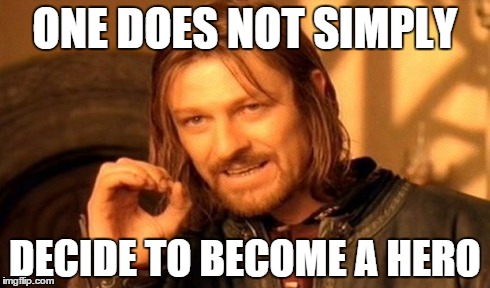
The other trope is the Accidental Hero trope (I did find another title for this trope). This is one I like a bit more, because you can do so much more with it and there’s a growing number of examples of this kind of character. This is a character who, rather than by fate, is made a hero through circumstances and their own choices. They may not be hero material, they may not want to be heroes, they may rather go home, but they rise to become heroes by their own merits. For example, Nathaniel from the Bartimaeus books wasn’t chosen to be a hero, and never set out to be a hero. In the first book, he was seeking revenge for personal reasons, the second book he did it because of his job and because of political reasons. In the third book he does it after a lot of self examination and because he’s scared of the demon uprising.

one does not simply 1

Another example is Teen Wolf (the awesome TV series, not the very bad 80’s movie). Scott McCall became a werewolf by accident, and because of the threats to his family, friends and his town, he has to rise to become a hero and save the day. No fate, no gods, no prophecies. He becomes a hero (and later a very special form of werewolf) because his personality, the events in his town, and his love for the people close to him mold him into a hero.

And there are many more examples. Chuck from the titular series never asked for the Intersect, and he wasn’t supposed to have it. It could’ve been taken out ages ago. But he chose to keep it, use it for his friends, and save the people he cared about. Through that he becomes a spy and a hero. In Doctor Who, the Doctor only wanted to travel and see the universe. He is a hero of his own choice. Lelouch Lamperouge from the anime Code Geass received his powers through luck, and later chose to use them for his own ends and to get his revenge (more antihero I guess, but whatever). It’s a trope with a lot of wriggle room in it, and even better, it’s still underused, unlike the Chosen One trope. So perhaps many more authors should write less Chosen One stories and more Accidental Hero stories.

Of course, there’s no way that this post will cause less Chosen One stories to be written. For better or worse, that trope is popular and will stick around for a long while. Still, I’m hoping for more Accidental Hero stories. I figure most of my stories will feature them. Reborn City and Snake‘s protagonists become heroes (or in the latter’s case, antiheroes) through choice and circumstance. Heck, I might try and find ways to subvert the Chosen One trope while writing Accidental Heroes. We’ll see what I can do.

Which trope do you prefer? What’s your favorite example?

What is a way that one could change either trope so that either one could be a bit more original?

As a Jew, Christmas isn’t really my thing. In fact, I’ve been referring to it in a half-joking manner as my month-long headache. But sometimes Christmas surprises me, as it did last night.

After watching The Interview on Christmas Eve and sleeping in much later than I had meant to, I’d pretty much been a couch potato all day, catching up on the shows I’d missed out on this semester. Since I was planning on watching the Doctor Who Christmas special, I went out for a walk and stretch my legs. And what a walk it was! The air was actually much warmer than last year, there wasn’t any rain or snow, and there was hardly any traffic! Hardly any at all! You could walk right into the middle of what would normally be a very busy street and just dance! Which I did, by the way. Several times! And nobody gave me a weird look at all…not that there was anyone really around to look. And I probably wouldn’t care what anyone thought if there was someone there, anyway.

After stopping off at the local donut shop for an after-dinner snack (and for what became this morning’s breakfast), I decided to go for a walk on campus. And it was unlike anything I’d ever experienced before. Everything was so quiet, so empty, and there was a slight mist in the air. It gave everything a strange, magical air, and I kept expecting to see something magical pop out at me (more than usual anyway). With my earbuds popped in, I ended up dancing on the Oval to some of my favorite uplifting party songs, just because I could. I then stopped by Mirror Lake, which at this time of year is lit up with Christmas lights. I don’t normally care for all the lights, but tonight it was enchanting and I really enjoyed myself.

It was at that point that I decided to head home, especially if I wanted to take a shower before the Christmas special began. And it was also at that point that something that I’d been waiting for finally happened: if you recall back in May during my study abroad trip, I began a short story called The Murderer’s Legacy that was inspired by some of the things I’d seen and read about while in London. The story was about a nobleman living in a version of Victorian England where magic is commonplace. The nobleman is being sentenced to death (or at least a very horrific version of it) for the murder of his wife, whom he did not murder. At the end of the story it’s revealed who actually murdered her and why, but by then it’s too late for the nobleman.

Something like I saw last night. You can see how inspiring it is, can’t you?


I thought at the time that it was a pretty good story, and that it had a lot of potential. I still do. But I felt that the version I had in the first draft wasn’t sufficient, and I had to do some major editing and rewriting in order to make the story work. This became more apparent to me as time went on, especially as some of the lessons from all the creative writing I did this last semester began to sink in, namely don’t plunge the reader into a fantastic world with a million different parts and pieces to it if you have only ten-thousand words to do it and tell a story set in that world. My first draft felt like starting Harry Potter in Book 4 or 5 and being plunged into this great big established universe, rather than being slowly introduced to that world in Book 1.

The problem was, I didn’t know how to fix this story so that it was not only simpler, but flowed better and actually told a story rather than introducing the reader to a complicated world they couldn’t take in slowly. Try as I might, I couldn’t think of a way to approach this story and edit it. Until last night, that is, when standing by Mirror Lake, something just clicked and inspiration flowed. I finally figured out how to make this story work, how to tell it in a creepy way while keeping the basic idea behind it alive. Not only that, but I had all the research materials I needed at home, so looking up what I needed for this story would be a cinch.

You can imagine the size of the smile on my face as I walked home that evening. I had all the inspiration I needed to rewrite The Murderer’s Legacy into a good story. Then I realized I have no time to work on it, with a thesis and classes to deal with. Oy vey, the life of a writer in college. It’s never easy.

Well, who knows? There may be a chance for me to still work on this story before May. I’ll have an easier workload this coming semester and that means more time for homework and writing. Maybe I’ll be able to finish Rose early and work on this and all my other projects. We can hope, right?

Well, that’s all for now. I’ve got plenty of work ahead of me, so I’m going to try and get that done. Have a good weekend and (if I don’t post again before December 31st) Happy New Year, my Followers of Fear.

I come from a family where it’s typical for most of us to obsess over certain TV shows, books or movies. One of those things that we love is Harry Potter. Around my mother’s house you will find copies of each book (sometimes more than one), the movies on DVD or VHS, a couple of wands and my mother’s acceptance letter to Hogwarts (apparently you can get those), and a few other knickknacks. Plus two very strange cats. When I told my mom that on Pottermore I’d been sorted into Slytherin, she considered not talking to me for a while (but does that choice surprise any of you?). And at some point soon, my mom and her partner, my stepmom, will be heading down to Florida, where my mom plans to visit Harry Potter World.

But that doesn’t mean that we’re above poking fun at the thing we love or pointing out the flaws. For example, my family is pretty much in agreement that the fact that Harry grew up with the Dursleys and was such a good person despite the abuse and isolation he suffered is very improbable. As I finished the conversation one evening after a long car-ride discussing HP, “At the very least he should have some self-esteem and trust issues. At the very worst he should be a full-on sociopath to rival Voldemort in evil.”

“I grew up in a broken home. Don’t mess with me, baldy.”

One of these days I’ll have to revisit the trope of the righteous orphan in literature, but now is not the time or the place.

The point is, this small flaw is one of a few that people could point out and make a big deal about in the HP series. In fact, if you look at many different works of literature, TV shows, and movies, you’re bound to find something that doesn’t make sense if you really think about it. Even if you don’t count the prequels, there’s some stuff about the Star Wars films that don’t add up (*cough* Princess Leia’s adoption and royal status *cough*). All of Frozen could’ve been avoided if the King and Queen had actually tried to help their daughter instead of trying to shut up her growing powers (but where would the fun in that be?). And don’t get me started on some of the stuff that happens in some comic books and superhero films. Or Hunger Games.

And there are people who LOVE pointing out these flaws to audience, sometimes making it difficult to enjoy these things ever again. How It Should Have Ended, CinemaSins, Nostalgia Critic, so many more. These guys love deconstructing these things and pointing out their flaws. It’s enough to make you want to root out every plot hole you can find in your story so that you don’t get caught in the web of these guys. Or you might just be too afraid to write at all.

The thing is, no story is perfect. Harry Potter is one of the bestselling franchises in the world, yet it’s not free of flaws. And look at Doctor Who! I’m a huge Whovian, yet I’ll admit that it sometimes  falters in the stories it tells (honestly, I thought I’d throw a shoe at the TV after I saw Kill the Moon. What an awful story that makes no sense!). Heck, I’ll admit I have stories that aren’t problem-free. The latter half of Snake has been criticized in the past of being slightly a little hard to justify (though not outside the realm of possibility). And if I learned one thing from my creative writing class, my short stories “Evil Began in a Bar” and “What Happened Saturday Night/Frauwolf”, will need several drafts. Heck, the latter is going to need one more draft before I can even think about submitting it somewhere. Don’t even get me started on the former.

What you have to keep in mind is that you can’t stress over the teeniest, tiniest detail and hoping there’s not something some blogger or YouTube producer or whatever is going to seize upon and make it into a reason to destroy the book. First worry about the big stuff. For example, if you have a plot that basically goes “In a world everyone has a gun but no one uses them, until someone does”, people are going to definitely look at that one and be like, “Say what?” Hash out the big details first. Then worry about the smaller ones. And know that you won’t get them all. Just try and make sure the ones you don’t get are ones that won’t really matter in the end.

“You are of questionable royal lineage and you will need to undergo a blood test. Take her away!”

Sure, Princess Leia’s adoption would probably draw some questions, maybe even the attention of the Empire. Doesn’t mean that it has to draw the attention of the Empire and Leia’s real father Vader. Or that Star Wars isn’t still one of the most awesome stories in the universe (and I count even the prequels, though I’m a little iffy on Episode III).

Keep that in mind for your own work as well. Nothing’s ever perfect, but it can still be great.

That’s all for now, my Followers of Fear. Hope you enjoyed this slightly-rambling post. I’m taking the rest of the night off. You have a good one, and remember to check out my big holiday sale. All books are marked down till December 31st, so check them out now while you got the chance.

Pleasant nightmares.

Catalyst: like a line of dominoes.

According to Wiktionary.org, a catalyst is, when used in literature, “an inciting incident which that sets the successive conflict into motion.” In other words, fiction, which is reliant on a conflict of some sort for the story to occur, cannot exist without the catalyst that starts it all.

I’ve been thinking about the catalyst for a while now, and I’ve come to believe that the catalyst is actually a pretty interesting and underappreciated element in fiction writing. Imagine what would happen if Katniss Everdeen had never volunteered to take her sister’s place in the 74th Annual Hunger Games and instead of Peeta, Gale had gone to the Capitol? There would be no story. Katniss would somehow go on with her life after a period of depression, and maybe even still get together with Peeta at some point, but would anyone really want to read that? That single catalyst, Katniss volunteering to save her sister and Peeta being selected to go with her to the Capitol, is what makes the story interesting, that draws us in and makes us want to see how events unfold.

And the catalyst for a story can take many forms. It’s usually the first thing you learn in writing any story. In a romance story, it’s usually boy and girl meet for the first time. In a mystery, it’s the occurence of a crime that needs to be solved. In stories like The Adventures of Huckleberry Finn or The Hobbit, where a journey is prevalent in the story, it’s that inciting incident that causes the need to go on a journey that gets things going. In a zombie novel, the catalyst is (obviously) the appearance of zombies.

You look at any story, you’ll identify a catalyst. Heck, my own stories all rely on the catalyst. In my WIP Laura Horn, the catalyst is the titular character recieving a particular item that causes her to be the target of a government conspiracy. In Snake, the loss of something important to the main character is what causes him to beocme the Snake. And in Reborn City, events that happen to the founders of the Hydras about a year and a half before the story even starts serve as the catalyst.

And speaking of RC‘s catalyst occuring a year and a half before the story starts, you can find plenty of stories where the catalyst to the story occurs a long time before the story starts. For example, for years Harry Potter fans couldn’t identify why Voldemort wanted to kill Harry, thus causing the whole story that would be Harry’s life, but after Book Five, they realized the catalyst for all of Harry’s life was Professor Trelawney’s prophecy being leaked to Voldemort, thus setting his sights on killing Harry.

“Freud was half-right: the causes of all problems are mothers and prophecies.”

Of course if you want to get technical with it, the story began in 1925 when Voldemort’s mother used love potion on Tom Riddle Sr, leading to their elopement, Voldemort’s conception, and his birth. But I digress. The point is, a story can rely on events that occurred years, decades, or in some cases centuries before the start of the actual story to act as the catalyst (I’m thinking of The Lord of the Rings trilogy when I say centuries, by the way). It’s actually a little mind-boggling, if you think about it.

So what more can be said about literary catalysts? Probably a lot more than I could probably come up with, especailly in a blog post. But to finish this post, I’d like to say that without the catalyst, the fictional stories we love so much, despise so much, debate so much, examine so much, and write fanfics to so much, just wouldn’t exist, and I think our world would be a lot less interesting to be in.