Posts Tagged ‘ideas’

I’ve been thinking a lot about what’ll happen after Rose comes out. Specifically, what sort of stories I’ll work on once I’m done with Rose.

I know that’s a crazy thing to think about at this point. I’m still doing revisions on Rose for the publisher, and likely they’ll have me do more revisions before we get to publication, and then there’s the publication, and then a whole ton of marketing and other work just to make sure the book is read and sold and reviewed and whatnot. Thinking about future projects should be the last thing on my mind.

But of course, being “logical” has never been one of my strong suits, and dreaming about the future has been what’s helped me get to this point anyway. So why not wax on about what might happen after Rose?

Well, there are a number of short stories I’ve been thinking about working on. I very much want to edit Hannah, the ghost story I wrote back in January, and I want to write a few stories that have been circulating in my head for a while. I also want to eventually get back to the novelette I was working on that was giving me so many challenges, and see if I can get a bit further in that, if not finish it up entirely. It may end up becoming one of those stories where I revisit it every now and then to see if time has given me a clearer vision of how to improve and/or finish it (I’ve got a few of those). And I’d like a few months to spend on all of those, just to see what I can come up with, and if any of it is publishable.

And of course, I’ve been thinking about what sort of novel I’d like to write next, when I’m ready to write a novel. Probably, that won’t be immediately: Rose has challenged me in ways I’ve never been challenged by a story, and I want some time to refresh my mind before I make a commitment to a project that I could end up working on for years and years. But I have some ideas on what sort of novel I’d like to write next, when I am ready to make that sort of commitment.

For one thing, it won’t be a sequel to Rose. I could write one, and I have ideas I could develop into a sequel for Rose, but I don’t want to return to the world of Rose just yet. Especially when I can’t guarantee I can make the story better or on par with the original so soon after finishing the original.

For another, I’m not yet ready to return to the world of Reborn City. Yeah, I know there are a couple of big fans of that trilogy who want the final book, Full Circle, already (I know a few of you are probably out there), but I’m just not ready to get back to that yet.

And finally, I want to do something that’s different. Think of it like houses: I don’t want to try selling Castrum on a house that’s basically the same one they bought, just on a different block and with a different coat of paint. I want to sell them a house that’s just as good as the first one, but an entirely different design, while still retaining the Rami Ungar architecture (is this metaphor getting too weird/complicated, or does it still work?).
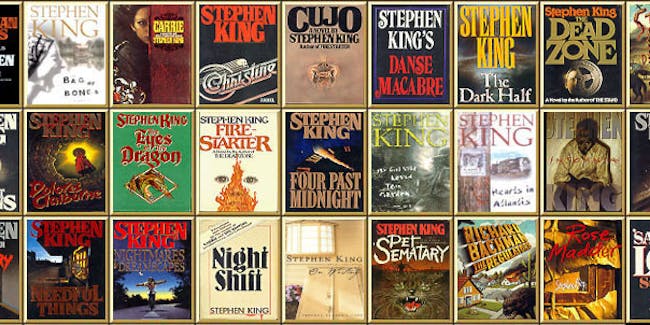
All these books are different from one another. I want to do the same with my books as well.

I mean, look at Stephen King: he followed Carrie (a psychic girl who gets revenge on her psychotic religious mother and the bullies at her high school) with Salem’s Lot (vampires invade a small Maine town, and a writer and his allies have to stop them), and then went on to write The Shining (a family that includes a psychic four-year-old becomes the winter caretakers at an isolated hotel haunted by something dark and evil) before creating The Stand (a super-disease causes most of Earth’s population to die off, leaving the survivors to engage in an apocalyptic war between the forces of good and evil). None of those are carbon copies of the other, so I want to do something very distinct from Rose.

And I have a few novels I can choose from. I have more ideas than I know what to do with, so I have plenty of options, but there are a few stories I can think of that would make great projects. There’s one in particular I’d like to work on when the time comes, but it’ll depend on a number of factors, including if I have to pitch something to the publisher (I’m not sure if that’s something I have to do, but it’s something I’ve thought about).

Still, there’s plenty of time to think about all that. I just know that when the time does come to think about all that, I’ll have plenty of ideas to work with and consider. Hopefully whatever I choose, it’ll make for some good reading.

In the meantime, I’m off to work on Rose for a little bit. Here’s hoping I can make some good progress before I have to hit the hay tonight. Until next time, my Followers of Fear, pleasant nightmares!

I’m really not sure where to start with this one. I mean, how do you tell people about the realization of your childhood dream in one blog post, let alone be coherent? I feel like going in fifty different directions with this post, that’s how excited I am!

Well, I guess I’ll start at the beginning. Or what I think makes a good beginning, anyway: back in March of last year, my friend and fellow novelist Matt Williams (check out his blog HERE) announced that his novel, The Cronian Incident (which I recommend if you’re into science fiction and detective stories, by the way)  had been accepted for publication by Castrum Press, a company based out of Belfast in North Ireland which, in the year since Matt’s been accepted, has gained a bit of a reputation for publishing great speculative fiction and treating its authors very well. Later that year I did an interview with Matt and then received an eARC copy of Incident from Castrum to read and review. After hearing how Matt liked the company and seeing how well his book was doing, I asked if he’d make an introduction for me to the company’s editor. He said yes.

I talked with Castrum’s owner, Paul, and he asked to see some of Rose. This was after the third draft had been finished, if I remember correctly. I sent him the first ten pages, letting him know I planned to do one more draft after the beta readers were done with the manuscript. He sent back some notes and asked to see more of the book when it was done. One draft later, I sent him the fourth draft of Rose, hoping against hope that they’d like it enough to publish it.

Cut to last Friday, and I receive an email when I get home from work. It was Castrum: they wanted to discuss publishing Rose. After jumping up and down like a kangaroo and screaming high enough to break glass, I replied saying I’d be happy to work with them. Paul sent a contract yesterday, and after having some of my questions answered, I signed the contract and sent it back to him this afternoon, with the realization that my dream has been accomplished. A novel of mine is getting published by a company.

To which there’s only one thing to say:

By the way, if you’re unfamiliar with Rose, this is a novel I first wrote as my college thesis during senior year. It follows a young, amnesiac woman who starts turning into a plant woman. And that’s just the events of Chapter One. And trust me, it’s a full-on horror novel from there, complete with psychological and supernatural terrors galore. I tried editing it again in 2016 and couldn’t make it work, tried again in 2017, and after that things kind of just snowballed from there. And now it’s getting published.

Obviously, I’m feeling a number of emotions right now. Excitement about the publication process and seeing Rose out in print, nervousness about how it will be received by the book-reading public, satisfaction that this dream has been achieved, hope for the future, and a feeling of goodwill about things to come. Especially that last one. Since at some point during the third draft of Rose, I had a feeling that things were about to change, that something big was about to start. And since the New Year, I’ve had this very strong feeling that not only was 2018 going to go slower than 2017 did, but that 2018 was going to be my year. And so far, it seems I was right on both counts. And I hope I can continue to be right on both counts.

Rose will appear in this medium very soon.

There’s so many people to thank for this wonderful event. Firstly, my friend Matt Williams for connecting me to the company, my beta readers Joleene Naylor and Dr. Black (my chiropractor, believe it or not), as well as Paul Camper, Maura Heaphy, and Manny Martinez for looking at the book back in college, and of course to Castrum for taking a chance on this indie author from Ohio. But most of all, I’d like to thank you, my Followers of Fear. For nearly seven years, you’ve stood by me and supported me through my various writing endeavors, my college experience, finding and getting a job, my ups and my downs, and so much more. You’ve all supported me and helped me get this far, and I can’t thank you enough for that. I hope you continue to support me (and maybe even read Rose when it comes out) as I continue down this road and try to make sure Rose is a huge success.

So what happens next? Well, I’ll work with Castrum to produce a fifth and hopefully final draft of the novel. We’ll get to talking about cover art and at some point we’ll set a release date (I’m hoping before Halloween, but we’ll see). And of course, I’ll make sure to let you know of any major developments.

Until next time, my Followers of Fear, I wish you pleasant nightmares (I’ll, of course, be having nothing but pleasant dreams)!

I have not been blogging much in the last week or so, though I’ve read just about every blog post that shows up in my inbox. This is partly because I haven’t had anything I’ve felt passionate enough to blog about and because of time constraints, but it’s mostly because of the story I’ve been working on lately. You see, this story is challenging me as a writer, and the challenge has me engrossed, more so than a test engrosses Hermione Granger around exam time (oh Harry Potter, you always give me something when I ask). It’s so engrossing, that it’s taking up all my creative energies, leaving me unable to blog or even come up with new ideas for stories (though I already have more ideas than I know what to do with, so that’s not a huge problem).

Some of you may remember that I started working on a story I thought might become a novelette or novella in between drafts of Rose back in October or November. After finishing the short story Do-Over the other day, I started working on this story again, and as I said, it’s been challenging. On a number of levels, actually: for one thing, there’s an anthology I’ve heard about that’s looking for stories of a certain word length, so I’m trying to write this story to keep it within the anthology’s word limits. Yeah, I know I should let the story be whatever length it’s meant to be, but after expanding Rose to twice its word length last year because it was suggested I do just that, I feel like I can aim for a certain word count and still get a good story out of it.

Another reason it’s challenging is because of the narrator. Like Rose, I’m telling this story through the eyes of a first-person narrator, which means I’m reliant on her as a narrator to tell the story and to create a good horror ambiance. But at the same time, she’s got a history, a personality, and observations that she’s putting into her story. It’s less like I’m writing the story and I’m channeling my narrator as she’s telling the story, though I do have the power to go in and make changes as needed. And creating that horror ambiance while balancing my narrator’s voice and what she feels is necessary to put into her story, such as her interactions with her husband, isn’t that easy.

Did I mention that this story also takes place over thirty years before I was born, in a state I’ve only visited once? Well, it does, so in addition to being a horror story, it’s also historical fiction, and I’m working hard to recreate an age and place I’ve never experienced, with all the fashions, technology, and attitudes in place. It’s a lot of work, to say the least.

And on top of that, you have all the normal challenges of storytelling: making a story interesting, pacing, showing vs. telling, dialogue, word choice, et cetera, et cetera. I’ve got my work cut out for me.

But honestly, I think it’s all worth it. Because in my experience, if a novel challenges the writer, it’s going to be a better story in the end. Look at Rose: that novel challenged me every time I worked on it. The first draft alone, I had to go back to the very beginning and start over again because I had to totally reroute the path the story was taking. During the third draft, I added forty-thousand words, a whole new plot line, and even a character or two just to make the story not only longer, but better. And in the end, I created one hell of a story that I feel has a great chance of publication. Hopefully with this story I can get a similar outcome.

Stories can be challenging to write sometimes. It may be difficult to get the words on the page, but in the end, with a lot of work, I think it can lead to a really compelling story. And I’m looking forward to seeing if, after a lot of blood, sweat and tears, I can wrangle out a good story here.

I did not finish watching the Netflix show 13 Reasons Why, owing to how depressing it was (I like dark stuff, but that show just took the joy out of living!). But in recent weeks, one scene from that show, a surprisingly not-sad scene, has been coming back to me. In a flashback, the main character Clay is critiquing another kid’s essay, and notices the latter uses the word “unique” several times. When the other kid asks why that’s an issue, Clay says that if everything is unique, it means nothing is unique. And on the surface I agreed with that sentiment, but I didn’t realize how it applied to my own writing until almost a year later.

As many of you know, I recently finished a fourth draft of my college thesis Rose, and that I had the novel beta read by a couple of people, including my colleague and good friend Joleene Naylor. One of the things she pointed out was a problem throughout the novel, and which I’ve been trying to avoid in subsequent stories, is repeating words, especially adjectives. Apparently I’ve been using the word “unique” several times in a single chapter or paragraph, though “unique” wasn’t usually the word I used.

Actually, it tended to look something like this (not an actual line from the novel, but I think you’ll get the idea):

Rose stood in place, refusing to show her fear. Angrily, Paris placed the book on the table.

See how I used “place” twice? A better way to write this might have been:

Rose held her ground, refusing to show her fear. Angrily, Paris placed the book on the table.

See the difference? And I had to do this throughout the fourth draft, identifying where I repeated words in close proximity to one another, and then coming up with a better way to say it.

And I feel like this is a really common issue that writers have to deal with at some point, or possibly at several points, in their careers. Despite our reputations for loving really big words (verbose, callipygian, penultimate, etc), when it comes to fiction, we tend to just use everyday words. After all, we’re normally writing for everyday people, not for a small niche of scholars or people associated with a small religious movement. So if a simple word, like “unique” or “place,” fits the bill for telling the story, we’re likely going to use it. And we’ll use it again and again, if it’s the first word that comes to mind.

But as the above points show, you have to vary what words you use in order to tell a story and not distract the reader. And that’s something I’m trying to learn how to do as a writer. You know, along with learning how to write good short stories. And writing good stories in general. Again, I leave that up to the feedback of my readers. But this is getting a lot of emphasis as well. Because as great as a story is, the language it’s told through can determine how successful it may be. Imagine if Harry Potter had been published and it read like a sixth grader had written it. I guarantee it wouldn’t be the phenomenon it is today and I might not have been inspired to be a writer (unless JK Rowling was in the sixth grade when it was published. Then she’d be the Mozart of literature).

So while I may never actually need to know twelve different ways to say “unique,” hopefully in the future I can avoid making mistakes like the ones above. And if I do (because let’s face it, no author is perfect), I hope I have a good group of editors and beta readers around me to point out those mistakes.

And if you’re an author who makes this mistake, the only way I can think of to avoid it is to do what you’re already doing: think about the words you use. Just do it a bit harder when it comes to the individual words themselves. At least, that’s what I’ve been doing. And I think it’s been working.

That’s all for now, my Followers of Fear. Expect another post from me (or maybe even two) very soon. Until next time, pleasant nightmares.

Well, I got another story done this evening. And I honestly didn’t think I’d get it done that quickly tonight. I thought it’d take an hour and forty-five minutes to finish off this story. Somehow I got it done in half an hour. But who cares about that? I got a short story done!

Yeah, I use Bitmoji on occasion. In case you forgot.

Anyway, if you skipped the title the story is called “Do-Over,” and is about the lengths one girl goes to fix her life after she sends out a tweet she doesn’t realize is really offensive, ruining her life. Yeah, pretty relevant, isn’t it? In fact, this story was partially inspired by the story of Justine Sacco, the woman who sent a tweet making a joke how she hoped she wouldn’t get AIDS in South Africa, then saying it wouldn’t happen because she was white. When she finally landed in Cape Town, she was a trending subject on Twitter, had received a lot of hate over the Internet, and had even lost her job! However, I decided to make my protagonist a teenager rather than a thirty-year-old woman, because teenagers are still learning what is considered appropriate and what isn’t (actually, a lot of adults are still learning that, but let’s ignore that for a moment, shall we?), and I felt that would make her more relatable.

At least, it did to me. One thing I’m afraid of is that something I’ve said or done will come back to haunt me, especially if it’s on the Internet where nothing dies. I’ve even had friends and family members look over blog posts and stories just to make sure that nothing offensive was said when I wrote about a sensitive topic (my Aokigahara post is a prime example of that). Tapping into that fear and what it might be like to face that sort of hatred and rejection for making what you thought was just a stupid joke online really allowed me to tap into the character and relay things from her point of view.

And speaking of inappropriate tweets, coming up with what my protagonist tweeted was really the hardest part of writing the story. It actually held me up for about three days while I tried to figure out what my character would tweet. Obviously, coming up with offensive garbage is pretty easy. You only need to look at what makes the headlines to realize that. But coming up with something that a teenager would think is a joke was actually pretty difficult. Eventually I took the suggestion of someone in one of my online writer’s groups to do something close to me and, as I’m bisexual, came up with something that would upset me and my fellow LGBT individuals. After that, the story was fairly easy to write.

This also happens to be the shortest story I’ve written in years, a mere thirty-six hundred words. I can’t remember the last time I wrote a short story that short! And honestly, I wasn’t trying to truncate it that much. I knew it would be short, and I just wrote it. It just became short on its own, I guess.

Still, I know it’s far from perfect, and there may be issues I don’t see at this moment. I’ll probably get it beta read before I submit it anywhere.

Even so, I’m happy with the story I wrote and I’m glad I got it done this evening. Next time I sit down to write, I’m getting back to a certain story that I left unfinished and tackles themes of prejudice. Surprisingly, it’s not the last Reborn City book.

Goodnight, Followers of Fear! Pleasant nightmares!

I’ve mentioned it before, but short stories are often hard for me. And one aspect of writing those that I often have trouble with is the very first part of any short story. Openings. They give me grief.

With novels, I have a lot of room to maneuver around. After all, even a short novel is around sixty-thousand words (and mine are never that short). With all those words, I can take a lot of time and space just setting up the scenario of the story. Take my novel Rose, for example: if we count Chapter One as the opening, that’s sixteen pages and nearly five-thousand words just devoted to setting up the story. And I’m very used to writing this way. I like long, expansive stories. I grew up on a diet of Harry Potter, and in my teens delved into the novels of Anne Rice, Stephen King, and Dan Brown. No one could accuse those guys of being short.

But if I’m writing a short story, the highest word count to still count as a short story is ten-thousand. And if I want to get published in most magazines, the limit is usually around six-thousand. So while I’m used to opening a story with about five-thousand words, or half the length of the longest short story, I now have to try to contain my openings into a much shorter length.

The struggle is real.

Because of this need for brevity, one of the things I sometimes end up doing when I write a short story, at least in the beginning, is to use a lot of exposition. And in some stories, exposition is good. It helps fill in essential information. But in other cases, exposition is just…bad. Instead of actually presenting the story,  the author is just explaining things. Telling you stuff. It’d be like if instead of actually showing Harry Potter growing up, learning about his heritage, and going to Hogwarts, it’d be like JK Rowling wrote, “There was a boy named Harry Potter. One day he found out he was a wizard, his parents died saving him from an evil wizard, who disappeared and gave him a scar in a process, and then he went off to wizard school.”

I often worry that when I do exposition in short stories, it’s the latter kind. Which probably means it is the latter kind. That may be cynicism on my part, but when you’re still inexperienced at something, you’re prone to making mistakes. So perhaps I really am using exposition, and in all the wrong ways too.

Luckily, there are a few things I’m trying to remedy that. One is that I’m keeping in mind something important: I’m writing first drafts. And first drafts are always terrible. Even if they contain intriguing stories, they’re rife with issues that require lots of fixing. This is why we writers edit, multiple times if necessary, before we publish. Heck, Rose had to go through four drafts before I felt it was ready to be sent out to a publisher. And likely if a publisher does like it, they’ll probably have me do a fifth or even a sixth draft before they’re ready to publish.

So if I feel an opening needs work, I can edit it in the next draft, and remove any bad exposition or other problems with the opening I spot.

Hopefully I can improve this part of short stories.

And sometimes, I don’t even need to wait (and this is my second method, by the way). Sometimes a way to fix a short story’s opening comes to you just while you’re writing it. On Friday, I started a new short story that I think has potential. I think I got four hundred words in before I stopped, but then I was like, “Is this really the opening I want?” And as I thought about it, it wasn’t. But how to fix it? And yesterday at some point–I think it was right before I saw Winchester–a way to change the opening occurred to me.  I think this is the right way to open the story without going into exposition. So the next time I work on the story, I’m going go back and rewrite the opening, see if this produces better results. And if it doesn’t, there’s always something new to try. Or I can go back to my original opening. After all, it’s a first draft. I can make as many adjustments as needed.

And finally, I’m reading a lot more short stories than I’m used to. I learned how to write novels partly from reading novels, so reading short stories should help me get an idea on how to write them. I’ve already listened to two anthologies on audio book, and I just started reading the Stephen King collection Night Shift on Friday. So far, they’ve been very helpful, but I’ll need to read a lot more to get a better sense of short story writing.

And finally, I just need more practice. After all, you become a writer by writing in the first place, and continuing to write no matter what. With any luck, more practice with short stories will lead to better ones. Hopefully, anyway.

I’m still trying to be a better short story writer, and openings are still hard for me. But with practice and exposure to good ones, I can hopefully make some progress on that. And who knows? Maybe even produce some stories that a magazine will be proud to publish. Anything’s possible, right?


That’s all for now, my Followers of Fear. I’ve been looking at a screen for most of the day, so I’m going to take a break and read something. Until next time, pleasant nightmares!

Well, after the fourth draft of Rose, I knew that I didn’t want to go into another novel too soon. I wanted to do some short stories. And I somehow managed to get my first short story of the year out in five days. Impressive. These usually take about two weeks to a month. On a good day.

Hannah is a ghost story about a team of paranormal investigators that explore an elementary school that’s reportedly haunted, and what they encounter in there. And for a Rami Ungar short story, it’s actually shorter than most I’ve written, just under fifty-nine hundred words. Usually they end up between seven-thousand and nine-thousand words. I wonder how that worked out?

And for the record, the Hannah in the title of this story is not based on any Hannah I actually know. And that’s a few: it’s a popular girl’s name in the Jewish community, so of course I’ve met and made friends with several. The titular character’s name actually has to do with a famous urban legend from another country, which I can’t name or go into without giving too much away about the story. I can’t even go into details of the legend, lest I give too much away. However, the name Hannah is a clue, if you want to try to figure it out. Let’s just say, it’s an Americanization.

Anyway, I’m hoping this short story is some good. I’ve been listening to a lot of horror anthologies on audio book lately, so I think I’ve absorbed some of what those had to teach me on short story writing. I also learned a lot from the fourth draft of Rose on concise language and strong writing (thanks Joleene), which probably contributed to its shorter length. And at the very least, if the story is terrible, at least it’ll be well-written.

Of course, there’s still things that can be improved. I think the middle and ending are pretty good, but I’m worried the beginning has too much exposition and telling, and not enough dialogue and showing. I’ve seen short stories do that well, of course, but I’m not sure if it’s done well here. Well, I suppose that’s what second drafts and beta readers are for. And hopefully once those are done, I can get this story published somewhere (I have a few ideas of where I would like that to happen).

Now that Hannah is done, there’s another short story I’d like to get to work on as soon as possible. Maybe even tomorrow, if my schedule allows. I’m looking forward to this one: it’s a story with a wonderfully relevant topic to today’s world.

For now though, I’m headed to bed. After all, I’ve got work in the morning. Goodnight Followers of Fear, and until next time, pleasant nightmares!

Well, it’s been a year since I last had a Lovecraft binge (see Parts 1, 2, and 3 for my previous binges). And while I didn’t read any actual Lovecraft stories in the year (holy cow, that long?) since my last binge, he was certainly never far from my mind. I read a lot of fiction influenced or modeled after his work, including the Lovecraft/YA novel Awoken* (read my review here), shopped around my own Lovecraft-themed story The Red Bursts (still working on that), and wrote an article about why there’s not more adaptations or even a cinematic universe based on his work. No, surprise, after all that I was ready for another dive into his work. And boy, did I enjoy the eldritch swim.

So if you’re not familiar with HP Lovecraft (and I’d bet good money that you’re not), he was an early 20th-century author whose ideas and stories proved very influential on storytellers like Stephen King, Guillermo del Toro, and Allan Moore, among others. He’s considered the father of cosmic horror, the idea that humans are basically ants in our universe, that there are beings and truths so great and terrible that even glimpsing them can cause madness and death. It’s pretty bleak stuff, if you think about too much about it (which I have).

So this time around, I read “The Case of Charles Dexter Ward,” Lovecraft’s only finished novel, “The Colour Out of Space,” “The Dunwich Horror,” “History of the Neconomicon” and “The Whisperer in Darkness,” as well as several fragments, one letter excerpt, and one parody story, but I won’t go over those. And I got to say, these were definitely some of the most enjoyable of Lovecraft’s stories. They were consistently creepy and kept me engrossed in the story, as well as with the most accessible language (dude liked to pretend he was a contemporary of Poe, rather than a contemporary of Ernest Hemingway). Or am I just used to his style now?

The interesting thing about these highlighted stories is, they also mark Lovecraft’s shift from pure horror to science-horror. Sure, he’s done that before–“Herbert West: Reanimator” is the story of two men trying to discover the key to bringing back the dead using science, a theme also explored in “Charles Dexter Ward,” but more thriller and magical than science-fiction–but here there was definitely a more sci-fi element in his work. “The Colour Out of Space” and “The Whisperer in Darkness” both involved aliens, with the former involving a sort of alien infection and the latter involving aliens that have been visiting Earth for centuries.

Why did Lovecraft make this shift? Well, around the time these stories were written–late 1920’s and early 1930’s–was also the birth of science fiction as a proper genre. Pulp magazines like Amazing Stories and Astounding Stories were huge sellers, and since pulp rags like these were where Lovecraft normally published his work, he would’ve been aware of the young genre and its exploration of humanity’s possibilities through space exploration, technology, and aliens. It’s no surprise that he’d take elements from those stories and give them a freaky twist. And lo and behold, it led to Lovecraft writing some of my favorite works by him (especially “Colour Out of Space.” God, that was freaky, considering that what happened in that story could maybe happen in real life).

Honestly, I’m glad I decided to check out HP Lovecraft two-and-a-half years ago. Sure, his early works can be hit-and-miss, but as time went on, he got better. And by this point in his bibliography, he was very good at writing stories that stayed in your mind. It’s a shame he didn’t achieve more of a following during this time, because maybe then we’d have more works by him (sadly, he died in 1937 at barely forty years of age), and he’d be more well-known today.

And while I’m done with my latest binge, I’m looking forward to my next one, whenever that is. Especially if the stories from this point on are as good as the ones I read this time around. And seeing as At the Mountain of Madness is the next story in my collection, I’d say that’s a definite possibility.

Have you read these stories or others by Lovecraft? What are your thoughts on them?

*Funny story about Awoken: so I follow this woman named Lindsay Ellis on YouTube (check out her channel here) who does a lot of videos on our media and culture. Yesterday she uploaded a video about whether or not the hate over the Twilight franchise was warranted. During said video, she mentions she and friend/frequent collaborator Antonella “Nella” Inserra wrote Awoken as a parody of Twilight, only with Lovecraft characters instead of vampires. My mouth hit the floor. I had no idea that the novel was a parody of Twilight, let alone written by those two women under a pen name. Though now that I think about it, it explains quite a bit.

I reached out to both women on YouTube and Twitter, letting them know that I read the novel, my ignorance of its authorship, how much I actually liked it, and that I reviewed it on this blog. They asked for a link, and I sent it to them. Since then, I’ve gotten hundreds of views from their readers/viewers on that one review, and the number of reads is still growing. Wow. Didn’t expect that. Pretty cool. Probably won’t last a week, but it’s still cool.

Also, I learned about Poe’s Rule: if you write a parody of something, unless you ad a healthy dose of comedy, people will think it’s serious fiction in a particular style. Which is apparently what happened to me, as these readers are telling me. Good to know.

I’m far from perfect. And there are lots of areas I can be better (especially my impulse control when it comes to sweets). However, this post will be focused on the writing aspects I can improve upon.

There are a couple of reasons why I want to talk about that here. One is that for personal things I want to improve upon (damn you, sweet tooth! Damn you to hell!), I only talk about those sort of things here when it’s really important. Like if I’m really struggling with my choices in life, or if I want to talk about being on the spectrum. And at the moment, there’s nothing in my life I feel like talking about here at the moment. Second, this is a blog for a writer, so it makes sense that if I’m going to talk about improving stuff, it’ll be about improving my writing. And finally, while a lot of people I know in real life and even a few people online treat me as THE writing expert, especially when it comes to fiction writing, I’m far from an expert. If I were an expert, I’m pretty sure I’d have several bestsellers out by now, a few of them would have been made into movies already, and I’d be writing full-time in a nice three-bedroom, one-and-a-half bath house (I have goals that I aim for).

Point is, as a writer there are areas I’d like to improve in, so I thought I’d list some of those and ask for your feedback. Many of you who follow this blog are writers, and have much more experience than I do. Perhaps you’ve dealt with some of the issues I’ve dealt with, and have some tips on how to deal with them. Anything’s possible, right?

1. I’m addicted to adverbs and gerunds. Now if you don’t remember most of the fancy terms from grammar class, adverbs are words that end in “ly” (wildly, musically, horribly) and gerunds are words ending in “ing” (ending, writing, killing). And I overuse them in my writing (see? Did it right there). One of the biggest criticisms I got from Rose, truth be told, is that I overuse them. In fact, I almost used “actually” instead of “truth be told” in that last sentence. And in the one before this, I started writing “nearly” before I switched to “almost.” And in that last one, “I switched” started as “switching.” And before that–oh, you get the idea!

A couple of years ago, I wrote a post about how I had a similar problem with semicolons. I overused them, especially when they weren’t needed. Once I recognized the problem, I was able to correct it. But I have a feeling correcting these issues won’t come so naturally (see?). For one thing, while the semicolon issue was about fixing incorrect uses of punctuation, what I’m doing here isn’t technically wrong. These are speech patterns used everyday, you just don’t see them in a lot of fiction to the extent I use them. At least, not really good fiction. So one thing I’d like to do is know when to use adverbs and gerunds, and when not to use them.

2. Passive vs. active voice. I have a lot of trouble telling those two apart. Which is bad, because editors and publishers tend to prefer active voices in fiction, and I somehow always end up writing in passive voice. What’s the difference? Is there a video I need to watch or something that explains this? Help!

3. Writing snappier action. This is something I’ve taken steps to improve, but it’s still a work in progress. I tend to write these long sentences that illustrate a character taking a certain action. Example: “She stood, walked to the kitchen, and placed the glass in the dishwasher.” It’s a good sentence, but for fiction, this is better: “She put the glass in the dishwasher.” Boom! And if I’ve already established that the character is on the couch, it works even better. It shows the same amount of action with less words.

I’m trying to implement this sort of snappy action into my stories. Editors and publishers seem to like it, and when there are limits to how many words a submitted story can have, it’s helpful in reducing the word count. Still, it’s going to take some work. This, like the adverbs and gerunds and possibly the passive voice thing, are deeply ingrained habits.

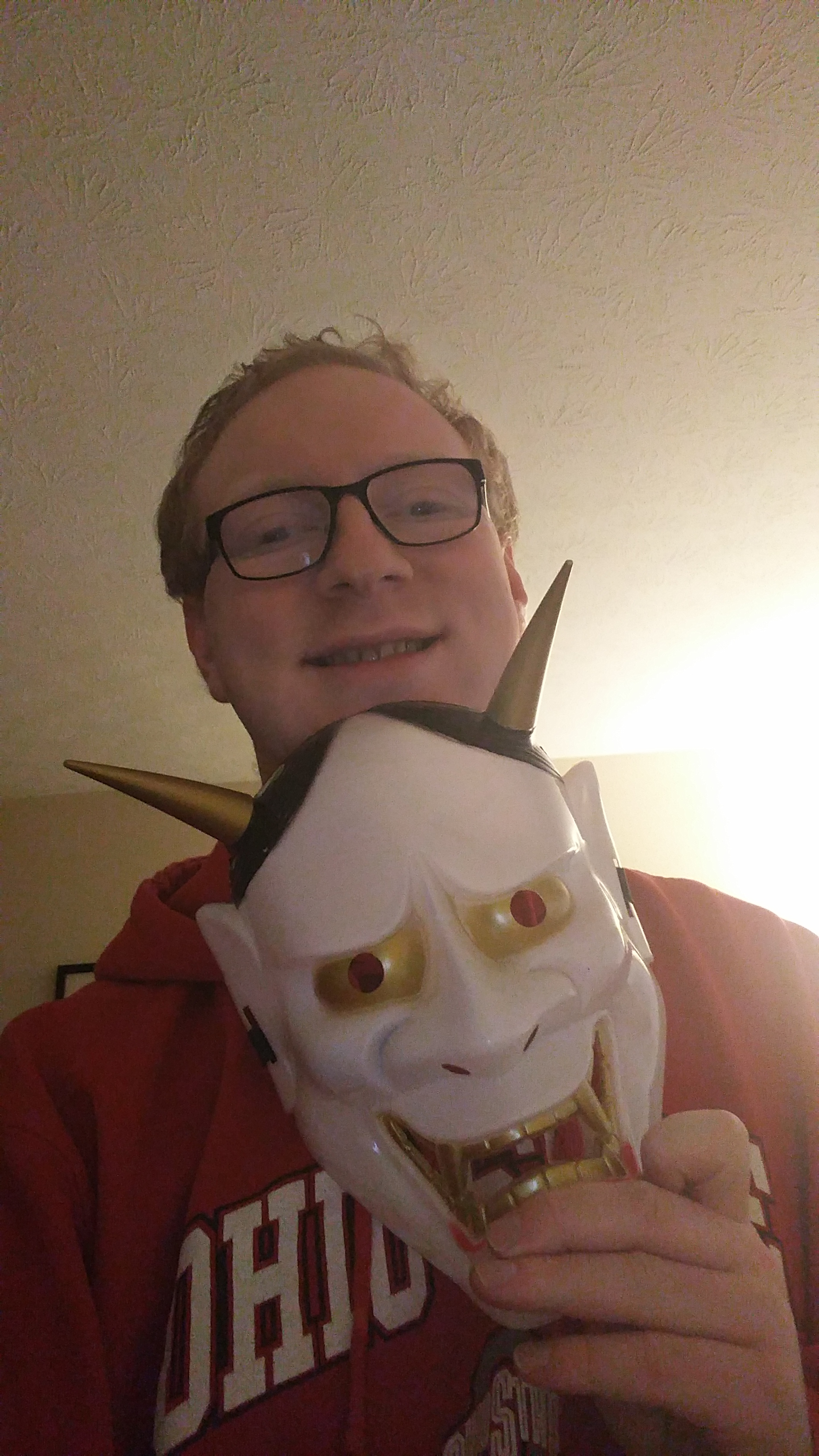
No reason to add this photo. I just want to show you my new author profile pic.

4. Short story writing. I’ve written novels or works meant to be novels for most of my life. That’s what I mostly read, so that’s what I mostly wrote. I’ve learned how to write short stories and read plenty of them since high school and college, but I’m still not as good at them as I am at novels. Which is sad, because I’ve had many, many ideas for short stories and novelettes over the years. And since I’ve spent most of my time on novels, I’ve written only a few short stories, and not many of those have been published.

What I want to do is write more short stories and novelettes, get better at writing them, and get a few of those published. Is it necessary, especially since I prefer novels? No, but a lot of authors I like do great short fiction, so I’d like to do great short fiction too. Good news is, I’ve been reading a lot of anthologies lately, and I should have a bit of time after I finish the fourth draft of Rose. That should give me time to practice.

5. Not listening to my anxieties. All writers deal with anxieties, especially with how their work will be received. Sometimes I let them have too much control of my mind, and I start freaking out Just yesterday, I got panicky over whether certain characters in Rose might be called tacky stereotypes. After a lot of discussion online with friends and colleagues, I don’t believe they are, but the worry ate at me for a while.

The important thing for me is just to be a bit more confident in myself, and the stories I write. And I should work on techniques to combat those anxieties when they try to tear at me. Because at the end of the day, I’ve still written some decent fiction. And I won’t let doubt or fear keep me from improving it and making it into possibly publishable fiction.


Well, those are the things I want to improve on with my writing. What are your suggestions on fixing those issues? Let me know in the comments below.

That’s all for now, my Followers of Fear. I’ve only six chapters of Rose left to edit, so I’ll hopefully get started on the next one tonight. Until next time, pleasant nightmares!

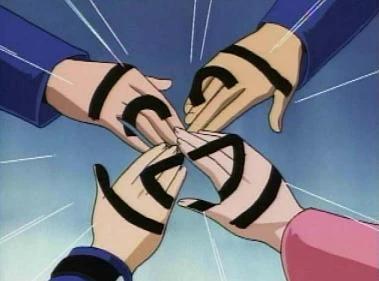
“The Power of Friendship!” as symbolized in Yu-Gi-Oh’s famous hand smiley face.

So yesterday I watched a YouTube video about a common trope in fiction (you can check it out HERE), which is (say it in your heads with a big, echo-y voice) “The Power of Friendship!” Now, if you aren’t familiar with the trope and you didn’t have time to watch the video, “The Power of Friendship” is a trope in which the bonds of friends is so powerful, it becomes a power in and of itself, capable of cosmic-like acts such as giving heroes power ups, stopping psychic mind readings, snapping people out of brainwashed states, and occasionally even defying gods. This power shows up in a ton of popular media, including a ton of anime and manga (the Fairy Tail series  practically is nicknamed “The Power of Friendship” manga).

Now the video I linked to goes into much more detail about the various intricacies of this trope (go watch it if you do have the time, the channel that produced it is awesome), but I wanted to focus on one particular aspect of “The Power of Friendship” trope that the video didn’t go into: how it surfaces in the horror genre. Or rather, how it doesn’t surface in the horror genre. At least, not all that much.

So if you didn’t watch the video (and you’re missing out!), the trope works like this: you have friends, and those friends can help you out of a bad situation, whether that be isolation or a powerful demon overlord is about to destroy the Earth and your power alone is not enough to destroy the demon’s power. It can be a metaphorical power to help a character out during a bad patch, like the former situation, or it can be a literal power and the equivalent of taking one of those mushrooms in a Mario game, like the latter situation. Thus, “The Power of Friendship!” And you can kind of see why it shows up so much: we all wish we have that power, or believe our relationships are that powerful.

But horror doesn’t feature this power as much as other genres, and there’s a reason for that. Horror is horror. It incorporates the darker aspects of the world around us and sometimes amplifies them for maximum effect. And in real life, friendships aren’t as powerful and as lovely as in fiction. In the stories, friendship is powerful and unyielding. It can overcome all sorts of obstacles, and the more you try to destroy it, the more it bounces back and kicks bad guys in the ass. But in reality, friendships grow, cool, and break all the time. It can take only a little bit to destroy a friendship, and a lot to repair it once it’s broken. Horror writers not only recognize that, but incorporate that into their stories. And it’s such a well-known fact about life, writers don’t draw attention to it, because it’s so well known among readers.

That’s not to say that “The Power of Friendship!” doesn’t show up in horror fiction at all. For example, Stephen King’s It pretty much says that the friendship of the seven main characters is what allows them to fight the malevolent entity in their town.* It just doesn’t say it as loudly as other media does, and also tells the reader that the characters’ friendship, while powerful, can be broken or is less effective if they aren’t all in sync or allow their fear to divide them. This is what leads to that one infamous scene in the novel, and is also shown in the new movie after the first fight with It.

Weirdly enough, the power of love or family is shown more than the power of friendship in horror, and I’m not quite sure why. Perhaps it’s because love and family, unlike friendship, has a more powerful evolutionary purpose, and therefore is given more power in fiction in general. If you’re willing to do more to save your perfect partner for creating offspring or the lives of your offspring, it’s going to show up more in stories than the grouping of creatures of the same species to ensure survival.** Hell, a lot more of my stories revolve around romance and family than friendship. One of my stories even involves a friendship gone bad, but that’s about it.

If “The Power of Friendship!” can be portrayed as it was in It, you can include it in horror stories more effectively.

That doesn’t mean we can’t include “The Power of Friendship” in horror stories. It can be used, but it’s more effective if used as it was in It: not overstated and a bit more realistic.  Showing a friendship form, grow, and overcome obstacles in a story, without drawing too much attention to it and showing how fragile the friendship can be under certain pressures, will work fine for the horror audience. If you go for overblown storytelling and basically say, “The Power of Friendship can overcome anything,” it will take the audience out of the story. Let the friendship’s strength demonstrate itself, rather than shoving it in through dialogue or just outright stating it. In other words, show, don’t tell.

While still not that common a trope in horror, “The Power of Friendship” can be part of horror. It may require being handled differently than in other genres, and with a bit more realism (weird for “realism” to show up in horror, but there you go), but it’s not impossible. You just need the right touch, and “The Power of Friendship” can best even shapeshifting entities that take the form of clowns.

That’s all, Followers of Fear. I’m in a bit of a blogging mood right now, so expect more posts from me soon. Until then, pleasant nightmares!

*There’s also some sort of power up thanks to a turtle from another universe, but let’s not get into it, shall we.

**Best explanation I can come up with given my aromantic nature and already jaded worldview.