Posts Tagged ‘IT (novel)’

I first read IT by Stephen King when I was eleven or twelve: the same age as the characters in the flashbacks. And while I had been reading The Vampire Chronicles and most of Anne Rice’s books up till that point, I didn’t exactly classify it as horror (Anne Rice herself preferred the term “Gothic saga”). So, for me, IT was my first jump into horror since outgrowing Goosebumps.

And it expanded my world. Not only did the novel terrify me, but it showed me just what great, mature horror storytelling looked like. From the terrifying and insidious nature of Pennywise and It’s many forms, to how the novel took the time to let us get to know characters both major and minor. I was entranced and enthralled, even as I was terrified, diving deep into the book every opportunity I could get and learning as much as I could.

By the time I finished the book that summer, I knew what sort of stories I wanted to write in the future.
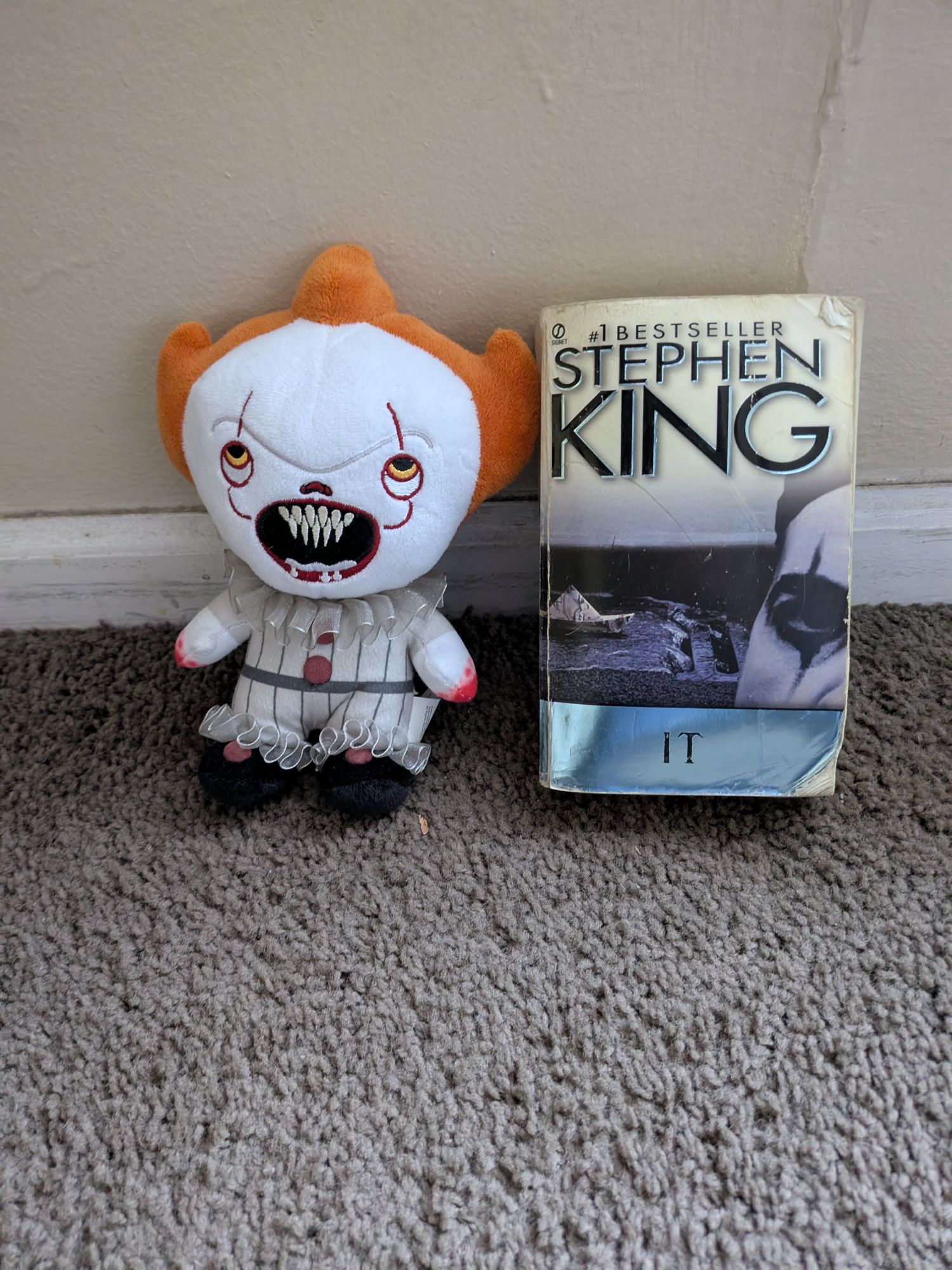
Without IT, I would not be the writer I am today. Or the person. I might not even be blogging to you right now, now that I think about it!

I bring this all up because, if you weren’t aware, there’s a TV show airing on HBO Max called Welcome to Derry. Taking place in the same universe as the movies, the show goes into events during the 1962 cycle, which was the cycle before the first movie. And unlike the movies, which focused on a core group of characters first during their early teenage years and then during their adult years, Welcome to Derry focuses on a wide variety of characters, including school kids, military personnel at the local Air Force base, and the nearby Native American population.

It’s very Stranger Things in its character development and methods of storytelling. And since the creators of Stranger Things were heavily influenced by IT, among other things, I guess it’s coming full circle?

Well, it feels full circle to me, because while watching the show, I feel like I’m getting a reintroduction to the horror genre. Just like I did when I was a preteen and dove into King’s book. It feels like I’m getting lessons in how to do creative and powerful scares, storytelling with large casts, and character development every time I sit down to watch the show.

Which, while being told through a visual medium instead of a literary one, I’m grateful for. While I’ve made strides in becoming a horror author, I still feel like I have a long way to go before I can be at the same level as the authors I admire and regularly read. And while I learn something about good storytelling every time I enjoy a good book, show, or movie, I feel I’m getting a Master Class in the subject from this show.

Hell, I think in the short story I wrote most recently, some of what I gleaned from Welcome to Derry made it into the story. I wasn’t originally going to apply what I learned, but it occurred to me while I was writing, and I was like, “Oh. That’s good. That’s very good. Let’s try it.” And while I haven’t heard back from the alpha reader yet (I only sent them the story last night, after all), I feel like adding those elements gave the story an extra bit of excitement and terror.

So, with only four episodes of the show left (I have my doubts they’ll do a second season, though I would likely welcome one), I’m looking forward to seeing what happens next. And to seeing what I can glean for use in my own storytelling.

In the meantime, I’m going to get to work on some of that storytelling. I have stories to edit and send to the beta readers, after all. Wish me luck!

And in the meantime, good night and pleasant nightmares.
Me writing and editing under the influences of good storytelling teachers.
Photo by cottonbro on Pexels.com

I was watching the movie adaptation of My Best Friend’s Exorcism with my sister the other day. And, right before they’re about to do the exorcism, the exorcist asks the main character if she’s been baptized. And the main character, a high school senior at a Catholic school, taking catechism classes and attending evangelical events at school, says in a deadpan voice, “I’m Jewish.”

My sister and I, as well as her roommates (it was movie night at her place), burst out laughing, because it was great comedic timing. Plus, it wasn’t something about the character that was in the book, so I hadn’t seen it coming. But looking back on it now, I can’t help but feel like it’s the latest example of an issue of Jewish portrayal in media.

I said in a previous post that I might be talking about problems of portrayal I see in media, thanks to the panel I was on last month. And I’ve noticed that portrayal of Jews in the media–at least the media I’ve been consuming–has been problematic. This is because, generally speaking, I have noticed Jews tend to be portrayed in one of three different groups:

  • The religious types. They’re Orthodox, with black coats and beards. At least one of the men is a rabbi, and if the story is speculative in nature, Kabbalah shows up somewhere. I’m not too upset about this portrayal, because I have seen some good and nuanced portrayals of this group since Fiddler of the Roof. I’ve even used it myself. Still, it’s done A LOT.
  • The barely-Jewish portrayal. They say they’re Jewish, but the characters eat bacon, have barely any connection to their ancestry, and their religious affiliation is only used as a joke or a quirk of their character. Examples include Howard Wolowitz from The Big Bang Theory, Rachel Berry from Glee, and, most recently, Abby Rivers in My Best Friend’s Exorcism. There are Jews like this, but it’s nuts that this is the biggest alternative to the religious types I see in media.
  • Jewish equals some weird behavior or stereotype. The fact that they’re Jewish usually translates to some silly behavior or conglomeration of behavior or traits that defines their entire character and is equated with their Jewishness. Maybe they’re clownish wimpy goofs that are always going “Oy vey” and speaking in funny voices, like Krusty the Clown in The Simpsons or Mort Goldman in Family Guy. Or they’re hypochondriacs, like Stan Uris in IT. Usually satirical, but sometimes it’s meant to be taken seriously or realistic, like in IT.*
Ziva David. So far, the most unique portrayal of Jew I’ve come across.

Honestly, the only character I’ve seen buck this trend is Ziva David from NCIS, a former Mossad agent from Israel who was tough, somewhat religious, and very connected to her Jewish heritage and faith. When I watched NCIS, I absolutely loved her, and was so sad when she left the series for good. That was a great and different portrayal of a Jew on media. (As for her being portrayed by a Catholic actress…well, she’s still a great character.)

But that’s the only one. And honestly, I think that’s a damn shame. There are so many different kinds of Jews out there: Jews who are religious but enjoy listening to the Ramones and going out for drinks and bowling with friends; non-religious Jews who are connected to their heritage and use it to make art; Jews who are both Israeli, Jewish, and Arab (just read about him yesterday in an article a friend sent to me); and the disabled Jewish horror writer who lights Shabbat candles on Friday night and keeps kosher while also seeing plays on Saturday afternoons or getting tattoos of Tarot cards all over his body.

Me, if you couldn’t tell.

This is why I’m not just writing an increasing amount of Jewish characters in my work, but also a wider variety of Jewish characters. There’s the married and heavily connected Jewish gay couple in “The Red Bursts,” one of the stories in Hannah and Other Stories; the rabbi, his less-religious but still Jewish best friend and his secular daughter in “The House on Lafayette Square” in Symphony for Walpurgis; and in The Shape of Evil, a Jewish teen on the spectrum (who’s only partially based on me). And I hope to write many, many more.

It may be only a drop in the water. But mentioning those stereotypes at StokerCon did make one or two writers consider how they were writing their Jewish characters. Perhaps mentioning them here, and writing all those characters, might cause some positive ripples. Which, in these scary times, would be most welcome.

I very much prefer this version of Stan than the one in the book.

*In all honestly, I hate Stan Uris. At least Stan in the book. I love King and I love IT. Hell, I’m a horror writer because of them both. But Stan was barely connected to his Jewishness, except in how it made him different, and he was more defined by his clean-freak nature and his almost worshipful adherence to logic and a normal world. In fact, it’s stated in the book that Stan’s suicide was because he wanted to “stay clean,” rather than get “dirty” and jump into a world completely outside of normal. I hated that.

This is why I prefer Stan’s portrayal in the movies. In the first movie, he’s the son of a rabbi studying for his bar mitzvah (I can relate) and, while being religious and connected to his heritage, is still pretty much a normal kid. And as an adult, his suicide is portrayed as him ensuring that the others are able to defeat It. A true sacrifice for the greater good. No wonder I prefer that version.

Took a little longer than I expected, but I finally finished this book tonight and, as promised, I’m writing a review.

Jumping back and forth between the late 1990s and 2019, The Dissonance follows Hal, Athena, and Erin, who, along with their friend Peter, discover that they have mysterious powers. Powers that, according to Peter’s grandfather, stems from the Dissonance, a magical energy that stems from the gap between our broken world and the world as it should be. They start learning how to harness their powers, but tragedy strikes during their senior year of high school. Twenty years later, they return to their old stomping grounds as forces begin to throw the world out of whack. And in the midst of it all, a great evil descends on their hometown, dragging a closeted gay teen in tow…

I’ve heard this book called a cross between The Magicians and IT, and while I’m only vaguely familiar with the first one, I have to say, the comparison to IT is apt. Not only does it hop back and forth between past and present, but Hamill does a great job showing the characters as hormonal teens trying to navigate friendship and their lives in the past, and trying to deal with cosmic shift and their broken lives and relationships in the present.

As for the story, it’s definitely more in line with dark fantasy than horror. For example, the Dissonants conference feels more Harry Potter than The Craft. Still, it’s got some horror elements. The magic itself, which requires tapping into the pain and misery of life, is pretty dark in and of itself, and plenty of aspects of the novel are of the cosmic horror vein.

If there’s one thing I would have liked to see more of, it might have been more of the character Owen. I get that the focus was more on Athena, Hal, and Erin, but Owen was a relatable character and I would have liked to see the kid have a bigger role.

Well, if there’s a sequel, that might be a possibility. The book does present the possibility of being the jumping off point for a shared universe, like The Hobbit was for Lord of the Rings, but with more in common with the Cthulhu Mythos than Tolkien.

But getting back to the review, I award The Dissonance by Shaun Hamill a 4.5 out of 5. It’s an engaging dark fantasy novel with great characters and worldbuilding and a magic system that feels right for this wrong world. Grab a copy, tap into your deep well of inner pain, and prepare for a twisty, magical ride through hell.

That’s all for now, my Followers of Fear. Until next time, good night, pleasant nightmares, and only 61 days and one hour till Halloween!

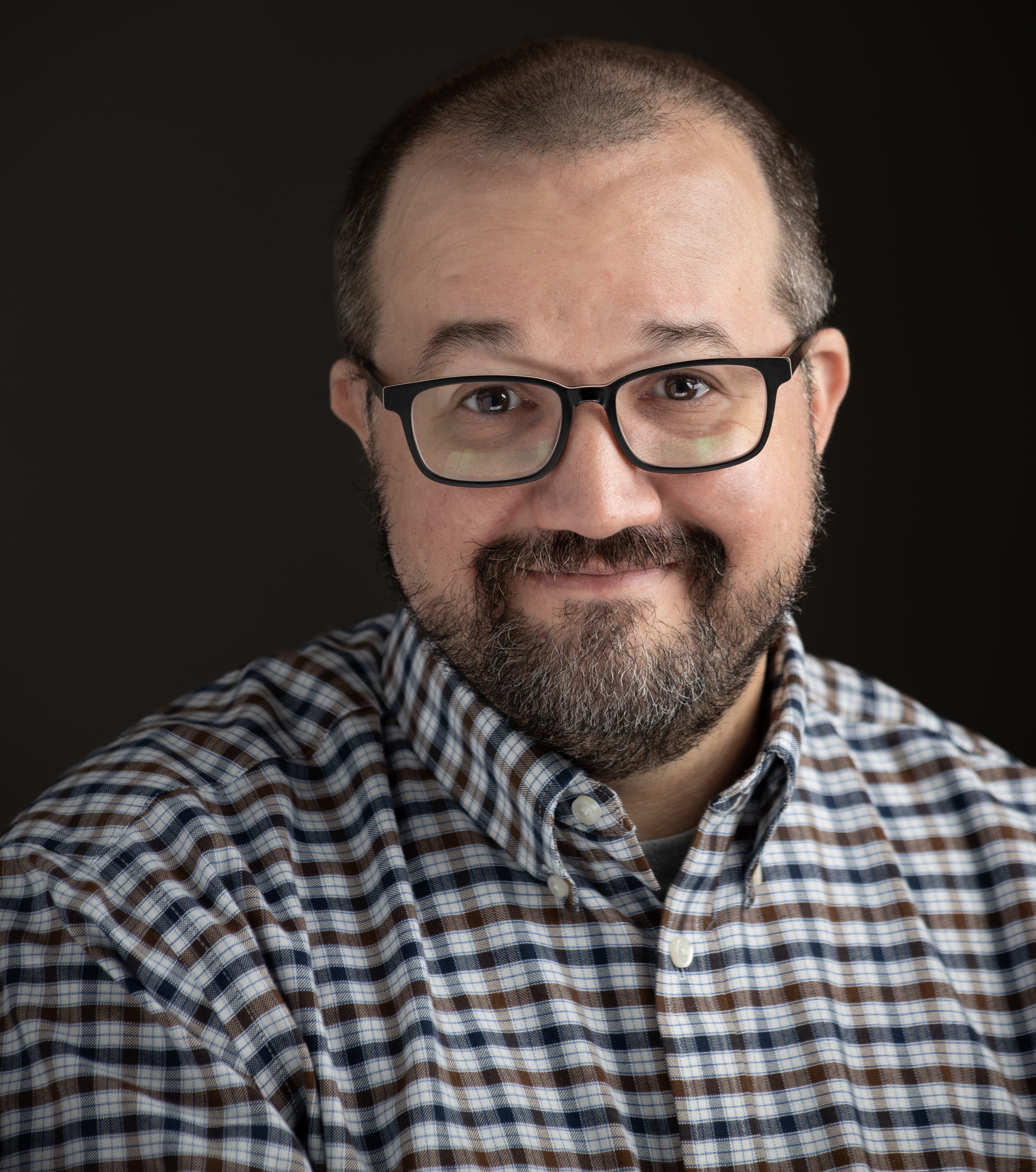
Some of you may remember prior to COVID a rather unusual novel called A Cosmology of Monsters, about a family in the business of haunted attractions and the entities that seem to haunt them through the generations (see my review here). You may also remember my interview with the author, Shaun Hamill (which you can read here). Well, Shaun’s got a new novel called The Dissonance coming out soon, and I got him to sit down with me to discuss the new book and what went into writing it.

So, without further ado, let’s do an interview!

Rami Ungar: Welcome back to the blog, Shaun. Can you tell us what you’ve been up to in the past five years since Cosmology came out?

Shaun Hamill: Like everyone else, I’ve had a crazy few years! I’ve moved from Alabama to Texas (and then moved three more times to different living situations in the last 3 years). I haven’t written as much as I would have liked, but I managed to write The Dissonance, and I have just turned in another novel I can’t talk about yet.

RU: Tell us about The Dissonance. What’s it about, and what inspired it?

SH: The Dissonance is a dark fantasy novel (with a dash of horror), about a type of magic that feeds on negative emotions: pain, depression, and the like. The only people who can use it are usually “broken” in some way—traumatized or mentally ill or the like. The story focuses on a group of friends who discover this power as teenagers, and how it shapes their lives in good and bad ways. It was inspired during COVID, when I couldn’t see any of my friends in person. I missed them terribly, so I wrote a novel about friendship.

RU: Can you tell us a bit more about the novel’s themes and influences?

SH; As previously mentioned, friendship is a huge theme of The Dissonance. So is trauma, and pain, and regret. It was influenced mainly by Susanna Clarke’s Jonathan Strange & Mr. Norrell and Lev Grossman’s The Magicians. Some reviewers are also comparing the novel to IT (it deals with a group of friends and has a split timeline between their adolescent and adult lives), so that’s in the mix, too!

RU: Nothing wrong about being compared to IT, especially when it’s favorable. So, do you think your writing style has changed at all since Cosmology?

SH: I’m not sure. When I started The Dissonance, I set out to write a more accessible book, with characters who were a little easier to love and root for. I also wanted there to be more action and excitement. Whether that means a change in style? I couldn’t say. Maybe I’ve gotten a little less pretentious? I’ll be curious to see what readers of Cosmology think.

RU: I’ll be sure to let you know. Now, I’ve noticed based on Cosmology and on the description for The Dissonance, but you seem to have a thing for cosmic horror. Can you tell us your thoughts on cosmic horror and what about it you like?

SH: Yeah, I’m a cosmic horror nerd for sure. I think it stems from growing up religious (although I’m not a believer anymore). I was always fascinated by the awe and wonder that came with believing in something bigger than myself, and when I discovered cosmic horror (relatively late, in my early 30s), I found something more in tune with my personal feelings about the universe: a dark wonder, and the sense that reality is bigger and more complex and strange than any of us can ever comprehend. The best we can hope for in this life is a peek behind the curtain. Weird fiction is all about that curtain.

RU: It also seems this book will be delving quite a bit into witchcraft and the occult. Do you have experience with magic and witchcraft, or did you do a bunch of research and then make up the rest?

SH: I have an ex who practiced a bit of witchcraft. I’ve partaken in a couple of rituals (which I found as boring as church), and have spent my fair share of time in wiccan shops, browsing books of spells and baskets full of crystals and whatnot. In The Dissonance I employ a little bit of that knowledge, but mostly stick to made-up stuff, where I get to make the rules. My novel doesn’t discount the idea that pagan beliefs are valid, but it doesn’t engage with them much, either.

RU: Changing gears a bit, in our last interview, you mentioned at one point cutting down Cosmology from 250,000 words to about 100,00. Did you have to do something similar with The Dissonance?

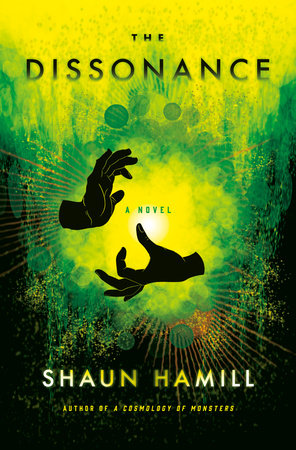
The cover for The Dissonance.

SH: Actually, it’s the opposite! I worked hard to turn in a draft of The Dissonance at about 100,000 words. When my editor bought the book, she encouraged me to open up the world and story, and we ended up adding almost 50,000 words to the novel. Just like the cuts were appropriate for Cosmology, I think the additions ended up helping The Dissonance. The early drafts of the novel were very fast-paced—a little too fast. We needed to slow down (just a little) and give the characters time to breathe and feel between the action beats. We needed to show them having fun in addition to getting into trouble. The resulting novel is almost 50% longer than Cosmology but I have yet to hear anyone complain about the word count, so I think we got it right!

RU: Before we wrap up, are you working on anything new and spooky right now? And do you have any exciting future plans?

SH: I just turned in my third novel (which I can’t really talk about yet). It’s definitely on the spooky end of the spectrum. I’m also in talks for a fourth book (which I also can’t talk about), and have given my agent outlines for two possible other novels. So I’m going to be quite busy for the next few years! Hopefully I’ll be publishing more than once every half-decade from now on.

RU: Final question: what are some horror stories you’ve read recently that you’ve enjoyed?

SH: I loved Rachel Harrison’s latest novel, Black Sheep, and Clay McCloud Chapman’s What Kind of Mother. I’m really excited for Gabino Iglesias’s House of Bone and Rain. I haven’t been reading as much horror recently (because of the fantasy edge of The Dissonance, that’s been most of my reading), but I need to get back into it!

RU: I hope you do! It’s an amazing genre, after all. And thank you again for joining us once more.

If you’re interested in checking out The Dissonance, it comes out July 23, 2024 and is available for preorder from most retailers. And if you want to follow Shaun Hamill, you can follow him using the links listed below.

I hope you’re as excited as I am to read this book, my Followers of Fear. And until next time, good night and pleasant nightmares!

In horror, it’s often about the monsters.

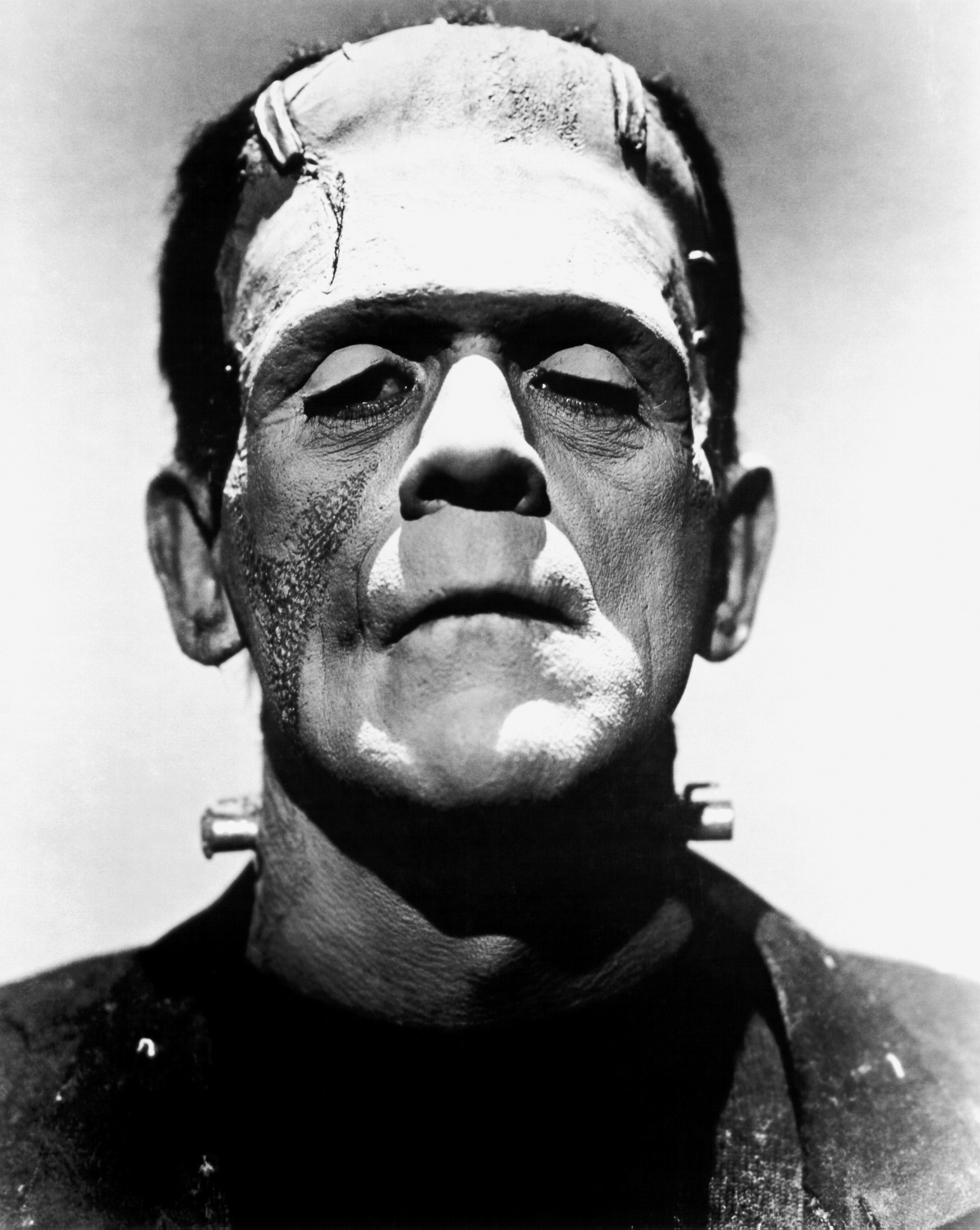
Obviously, horror often centers around the monsters. Saying that is like saying in economics, it’s often about the supply and demand. But still, it needs to be stated. Whether they be demons from Hell, ghosts haunting an old house, a serial killer stalking a young woman during a holiday, a collection of corpse parts stitched together and brought to life through high levels of electricity, or ancient entities from the stars whose forms are difficult to describe, horror is often about the monsters.

And as horror creators, it’s up to us to make each monster we create different from all who came before.

Let’s face it, the people who consume our work expect a little variety (unless you’re working on a series like Supernatural or the Sookie Stackhouse books, in which case your readers would hope there would be some internal consistency in the monster design from episode to episode and season to season). They don’t want the same story every time, and neither do we. So, we write new stories and try to make them distinct from previous works.

Same goes with the monsters we design. Unless we have a special reason for doing so, like a series, it’s important to make our monsters different from story to story. Sure, there may be common characteristics. HP Lovecraft’s monsters were always covered in tentacles and eyes and gloopy fluids (when he could describe them), but you could tell Cthulhu from Yog-Sothoth from Azathoth. And in James Wan’s more supernatural horror movies, the ghosts and demons do share some characteristics, but how they work in the Conjuring franchise is different from how they work in the Insidious franchise.

But the point is, you do have to try to ensure the monsters don’t closely resemble one another too much from story to story. Otherwise, you have people confusing what happened in one story with what happened in another story and being like, “Can you blame me? They’re so similar, they just kind of blend in after a while!”

I was reminded of that this weekend while working on the climax of a killer fairy story (yes, that’s what I’m writing, and it’s probably going to be a novella when it’s done). I was making great progress yesterday, heading towards the climax, and then I realized that the monster the protagonist encounters during this scene resembles one appearing in a different novella. Thus, I had to redesign the monster for the killer fairy story, which I only finalized today.

So, how do you ensure that your monsters are different every time? For the first time in forever on this blog, here are some tips:

  • Look to mythology for inspiration. Mythologies from around the world are rife with monsters. You have the Hekatonkeries and Typhon from Greek mythology; the Jorogumo and the Onryo from Japan; the Chupacabra from Latin America; and more (did you know some Amazon tribes believe in furry cyclops creatures that protect the forest?). If you look deeply enough, and keep it varied, you’ll find all sorts of interesting monsters you can use in your stories.
    Just be careful that you don’t do anything that might be considered exploitative or offensive by certain cultures. Nobody needs that kind of bad karma.
  • Draw from the works of your favorite authors. I’m not saying copy your favorite authors, because that’s plagiarism and is generally frowned upon. But look at the monsters in your favorite novels. What about that monster scared for you? Draw on that and see if you can create something terrifying.
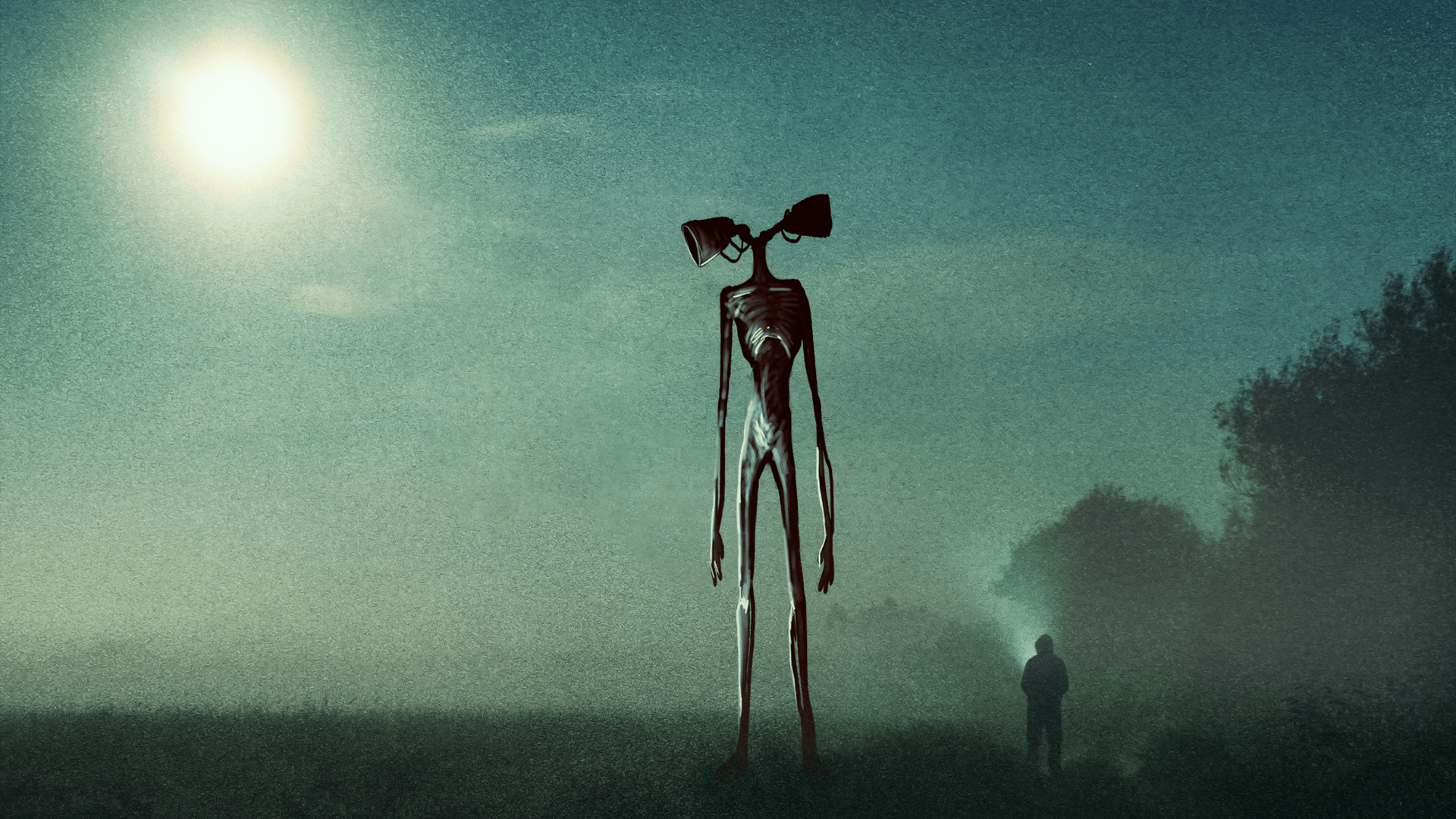
  • Take something ordinary and make it scary. This is something I see a lot more in horror fiction these days, where writers find a way to make something ordinary and make it terrifying. If you are familiar with the works of Junji Ito and Bentley Little, you know what I’m talking about. Uzumaki by Junji Ito makes spiral shapes terrifying, and I never thought a resort could be scary until I read Little’s Resort. And what about Siren Head, a giant humanoid with two giant megaphones full of teeth for a head? I wonder where that came from?
  • Look to your own fears and anxieties. Plenty of times, it’s easy to draw on those to create a monster. Have a phobia around rats, snakes, spiders, lightning, death, or your grandfather? Maybe something you remember from childhood struck you as creepy but no one else seemed to think so, like a character in a children’s movie or a toy you were given at Christmas? Use that to form something new and horrifying. You’d be surprised how often that works.
  • Keep track of your monsters. Nobody knows your stories better than you do, and that includes the monsters. If you’re having trouble coming up with a good monster, look what you’ve come up with before. Go through them like a catalog. Perhaps seeing what came before will help you come up with something new that you’ll enjoy writing.
Siren Head is a great example of taking something ordinary and turning it horrifying.

Coming up with new monsters each and every time isn’t easy, even if you work in multiple genres and subgenres. Still, as creators, it’s our job, and it can be a lot of fun. And when you hear people praising your monsters for how clever the idea is or how terrifying they are to think about, it makes the work worth it.

And hey, don’t get bummed if one monster is too similar to another and you only realize after the fact. The antagonist in The Library Policeman by Stephen King bears some similarities to It, but they’re both still great stories. So, it happens. Nothing to get worked up over.

That’s all for now, my Followers of Fear. Good night, pleasant nightmares, and RUN! THERE’S SOMETHING RESEMBLING A MURDER HORNET AND THE SIZE OF A SMALL DOG BEHIND YOU!!!

What are your tips for coming up with monsters for your stories? Let’s discuss in the comments below.

Recently, I tried to read Goblin by Josh Malerman. For those of you who don’t know, Goblin is a collection of six novellas that all take place in the small Michigan town of Goblin, where it rains sixty percent more than anywhere else in the US, the police resemble shuffling zombies, and you don’t enter the woods if you want to come out again.

I liked the idea of it and finally got around to reading it recently. And…I was unimpressed. I got through pages quickly every time I picked it up, but the stories within were just not drawing me in. By the time I got to the fourth novella (I know, I’m a trooper), I was lagging. And finally, by the first night in Marietta, I just couldn’t finish it. I put it down, never to pick it up again.

What was the issue? Well, it was the focus on the titular town. There was too much time spent on it and not enough on the stories. On the storytelling. On the horror.

Way too many words are spent on the town’s history and geography. It feels more like a history lesson at times. In fact, the second novella is focused on a former high school history teacher who knows the town history like the back of his hand. And you get that there’s a lot of interesting history there. And you can feel Malerman’s love for the fictional town.

But all that isn’t what we picked up the book for. We came for a book with six interconnected novellas centered around a single town that will hopefully scare the shit out of us. And this emphasis on worldbuilding by the author comes at the expense of the scaring the shit out of us.

Now, every story, regardless of genre, requires some degree of worldbuilding. The horror genre is no exception. You have to establish the setting, the people, the vernacular, and all that. Sometimes this can be done with having a date at the beginning of the story or just a few hints. Other times, like with stories set in historical eras, you have to do a ton of work to build the setting, bringing to life the clothes and manners and whatnot. And in the fantasy and sci-fi genres, authors will have all sorts of complicated compendiums and charts and maps to make their made up worlds feel as real as possible.

That being said, in the horror genre, the emphasis has to be on scaring readers. So, while you can spend time building those worlds, you have to remember it’s all in subservience of telling your story and scaring those readers. Look at Alma Katsu’s historical horror novels, or my own novel The Pure World Comes. We put so much research into the eras our stories take place and spend so much time building those locations, you can almost feel the winter chill killing the Donner Party, or smell the offal in the street of Victorian London.

The Hunger is a great example of a story where the worldbuilding doesn’t overwhelm the storytelling.

But neither of us forget that this is all for the story. We never think that the location, while interesting, is more important than telling the story. And it feels like with Goblin, Malerman, for all his strengths as a writer, got those priorities mixed up. And the result were six subpar novellas that might have been decent if more time was spent trying to frighten us readers.

Honestly, I wish the book had approached Goblin’s history like King approached the history of Derry in IT. In that book, the town history, which has several chapters devoted to it, doesn’t detract for the story. For one thing, most of those chapters take place in-between the action, which doesn’t detract from the story. Second, most of those history-building chapters are presented as Mike Hanlon doing research on the town and on It, so these sections are not only part of the main story, but they add context and help us realize just how ingrained It is to Derry. In Goblin, the history is rarely related to the events of any of the novellas, which only detracts from the stories.

And finally, It always has a hand in the history of the town. Whether appearing as Pennywise or causing some disaster at the end of Its active period, It is always there, making the history of Derry the history of It.

As for Goblin…the history could be cut out of most of the novellas I read and it wouldn’t matter. In fact, it might make the stories scarier. Especially since those stories I read don’t really have anything to do with Goblin history.

This is something important to keep in mind when writing horror in a location that requires extensive worldbuilding. Yes, it’s important to bring the location to life. Yes, the history can be interesting and can be talked about throughout the story. However, that must all be done as part of the story. In service to the story. Otherwise, you’re just going to get an ode to a fictional town, and not anything really scary.

Personally, I think I would rather read IT or The Hunger again and use those lessons in my own writing.


One more thing, Followers of Fear: The Solar Press Horror Anthology Volume I, which contains my story “The Dedication of the High Priestess,” is going to be released on December 1st. Not only is this an exciting short story anthology, it also contains one of my favorite short pieces, in print for the first time (before this, it was only available in audio).

If you would like to preorder a copy, you can do so using the links below. If you like in the UK and EU, order directly from the website. If you live in the US, use Orbit DVD.

That’s all for now, my Followers of Fear. Until next time, good night and pleasant nightmares!

So, I’m reading Every Woman Knows This: A Horror Collection by Laurel Hightower, a collection of horror short stories I won in a Twitter giveaway. Not very fast, because I get through print books so much more slowly these days than I used to, but I’m making my way through it. And I am in awe that some of these short stories appear to be shorter than five thousand words. Hell, some of the earlier stories in the collection appear less than four thousand.

And I’m sitting there, reading the stories, and I’m like, “How does she do that and make them still so damn good?”

I actually posted that question on my personal Facebook and my Twitter feed. Laurel responded to the Facebook post (we’re friends there), thanking me for posting about the book and being glad that I’m enjoying it. Did not share her secrets with me, though.

I wish she had, because I would love to be able to write stories that short and still be effective. After all, I grew up on Harry Potter and the Bartimaeus Trilogy, followed by books like Interview with the Vampire and IT. The shortest of those books is seventy-seven thousand words. By the time I started regularly reading and writing short stories, my brain was already primed for sprawling plots with deep twists, multiple layers of themes and secrets, and complex character relationships that are explored through multiple pages, chapters and books.

Taking all that out and trying to tell an entire story in less than seventy-five hundred words (what the Horror Writer Association says is the maximum word count for a short story) was a huge switch for me. And honestly, I’ve had varying success. Occasionally, I manage to get a story less than seventy-five hundred words, and sometimes those stories get published, but more often short for me is a novelette between 7,500 and 17,500 words. Not as long as a novel, not by far, but allows me more room to work with those plot elements I like.

Still, I do try to come up with and write those shorter stories, what Stephen King calls “a quick kiss in the dark from a stranger.”* Yeah, it’s difficult to do, but most publications are looking for stories of that range, and I want to get my work into them. And, I like the challenge. It’s another hill for me to climb on my journey as an author. And, occasionally, something I write in this vein is really good.

That being said, if it looks like a short story is destined to be a novelette, or even a novella or novel, I will let it be the length it’s going to be. No sense trying to maim a good story so it can fit somewhere, right?

But I still try. And I’ve gleaned some things in my attempts, like instead of big plots or huge happenings, you focus on small instances or events that may happen to one or two people. Rather than the big moments, like the destruction of It in the sewers of Derry or the fallout of four writers visiting a haunted house on Kansas during Halloween for a publicity stunt (Kill Creek by Scott Thomas, if you don’t know), I should focus on maybe a ghost at the Ohio State Reformatory trying to get information on what happened after he died, or a young man dealing with something evil that’s appeared intermittently in his life. Those might manage to become the kisses given in the dark by a stranger.

Actually, one of those was a kiss in the dark, and some of you may remember it. It’s “Is Anyone There,” which was published last year in That Which Cannot Be Undone, and got mentioned in several reviews as a highlight of the anthology. So maybe I might be closer to my goals than I think.

Just don’t kiss me in the dark. I’m more likely to punch you for that than enjoy it or put it into a story.

What are your tips for writing short stories, Followers of Fear? Do you struggle with keeping them under 7,000 or 5,000 words? Let’s discuss.

Also, be sure to check out Every Woman Knows This by Laurel Hightower. So far, it’s a great collection, and I hope I’ve learned some things by the time I’m done.

*Which, by the way, is a weird idea, isn’t it? You walk down an alley or into a room and it’s really dark and suddenly someone plants one on your mouth before disappearing? Actually, the scenario with the room is the plot of an Anton Chekhov short story, and the character who gets the kiss does have an impression left on him. So, I guess it’s a good metaphor.

What are some of the first things you think of when it comes to Stephen King’s IT? Is it Georgie being dragged down the drain by Pennywise the clown? The fortune cookies filled with eyeballs and mutated bugs? The final battle with Pennywise in his lair? That one scene that dare not be spoken?

I’m sure all these and more occur to you, because they’re significant plot points and they carry a whole lot of scares.* What you might not think about are the quieter moments in the story: the building of the dam in the Barrens, or Ben, Beverly and Richie going to see a movie together, or Bill going for a ride on his old bike Silver after not having seen it for over a quarter of a century. They’re the quieter moments of the story, the moments that allow you to get to know the characters better and see them about their daily lives. And they’re just as important as the scarier parts of the story.

I’ve been thinking of these moments more and more lately, because I just wrote an entire chapter for Crawler, my mummy novel-in-progress, that was a quiet moment. In it, two of the characters, one of whom is in mourning over a sudden loss, bond with each other over the course of a lazy afternoon. Nothing scary happens, no mentions of the horrors driving the plot take place, and there’s no ground laying or foreshadowing for future scares. It’s just a sweet, quiet scene where two characters form a relationship.

Honestly, I’m not used to writing those sorts of scenes. In shorter works, every word has to be necessary so the story can fit within a word count. There’s no room for quiet scenes showing the creation or deepening of bonds, getting to know a character better, or seeing them grow. You need that room to create a short story that packs a punch, especially for horror stories. And with my novels, every chapter and scene was necessary to the plot in some way, furthering the story, foreshadowing future plot points, or scaring the shit out of the reader in some way. Writing a scene over the course of two or three days that was just exploring the budding relationship between two characters, was new for me. And I feel like I learned a lot while doing it.

Which is good, because other writers, not just King, include those quieter moments throughout the books. Ever wonder why Harry Potter includes Quidditch matches in the books? Because they’re fun, normal things a wizard would learn in school and serve as breaks from the intrigue of whatever was happening any year at Hogwarts.

Now, having these scenes aren’t always necessary for every story. But it can be a good idea to include them if you need an organic way to flesh out your characters, deepen their relationships, or show them growing. Especially you can’t think of any way to insert such moments into the more essential scenes, like Georgie getting dragged into the sewers or whatever.

In any case, I’ll probably write a few more of these scenes in Crawler, as it’s a very character-focused story, so I’ll get plenty of opportunities to practice. Perhaps afterwards, I’ll be able to write a post about writing quiet scenes and writing them well. And maybe when I do, I’ll write it with a quiet satisfaction.

*Except that one scene, I know, but we’re not going to talk about it, are we?


One more thing, my Followers of Fear: this Wednesday at 4-6 PM EST, I’ll be joining fellow horror writers Heather Miller and Daemon Manx on the podcast “What’s Write For Me” with Dellani Oakes. We’ll be recording live, so you’re encouraged to join us live by following this link, and we’ll be discussing and even reading from our scariest works, so I hope you’ll join us. See you there!

That’s all for now, my Followers of Fear. It’ll be a busy week leading up to Halloween, but I hope it’ll be a fun and memorable one. Until next time, good night, pleasant nightmares, and eight days till Halloween! Have you carved a Jack-o-Lantern yet? I have, and for the first one in my own home, I don’t think it turned out half-bad. What say you?

A handy graphic for understanding the three act structure, courtesy of Wikipedia.

The other day, I was talking with some other writers about how to write a decent short story (an eternal question among writers, including the ones who’ve gotten them published). And I noticed that, with a lot of my recent short stories, most of them fall into a decent three act structure. And then I said, “I know the existence of the three act structure is dubious, but it’s the truth.”

And, like many odd things, that little exchange has stuck in my head.

So for those of you who don’t know, the theory of the three act structure states that all stories, especially longer ones, can be divided into three separate acts or sections: the setup, the confrontation, and the resolution. The acts may then be divided into smaller scenes or subsections, but they all fit into those categories. Some examples given of stories with the three act structure are Star Wars, Die Hard, and Avengers: Endgame (though I sometimes think everything before the five-year jump is its own separate act or prologue).

While many of us are taught this structure in school, most of our teachers will let us know that not everyone believes in the three act structure, let alone say they use it. Some prefer using a five act structure. Others say storytelling is too complicated and diverse to say a story can be divided into a formulaic structure. And nearly all playwrights will agree that if it can’t be told in one act, tell it in two.

Good example of a story in three acts (supposedly).

That last one might be a joke.

I’m usually of the camp that believes storytelling is too complicated and diverse to boil down into a structure. Look at Stephen King stories. Most of his shorts, like Graveyard Shift, Night Surf or The Boogeyman, are simple one-scene stories with maybe a twist at the end, and I dare you to try to fit books like IT or Salem’s Lot into three acts. Then there are stories like Kill Creek by Scott Thomas or Interview with the Vampire by Anne Rice, which feel like they fit into four acts.

As for my own books, Snake is in multiple sections, much like the books I was reading up to and during the writing process, and I see Rose as in-the-apartment and after-leaving-the-apartment (if you read the book, you know what I mean). I can’t see the stories in The Quiet Game as anything but a progression of events. And I wouldn’t even know where to start with The Pure World Comes or the stories in Hannah.

So, is the three act structure a real thing? Well, yes and no. I feel like it’s more of a framework for people to examine fiction, both others and their own. You don’t have to use it if you feel it doesn’t work for you or if you feel a story has too much happening in it to divide the plot into three separate sections.

But if you do find it helpful, use it to your heart’s content. I’m sure many writers, especially plotters like myself, find the three act structure helpful for planning their stories. And as I said above, many of my recent short stories, including the ones that have been published, fall into three acts. Though I think of them less as acts and more like beats, scenes, settings, or occurrences. And if I’m trying to keep a story within a certain word count, I can see using this structure to my advantage.

So what is the three act structure? It’s a prism to understand some fiction stories through, as well as an actual tool for writing. It’s not perfect, and most stories don’t fit into it that well, but that doesn’t mean the idea isn’t useful. Hell, it might even help you hone your craft and get a few more short stories out there. And that is never a bad thing.

Unless you’re trying to write an award-winning musical. Then you might want to keep it to two or maybe just one act.

That’s all for now, my Followers of Fear. March has just started and it’s already looking a lot better than January and February is (world events notwithstanding). I hope I can update you on exciting developments in the near future. And until next time, pleasant nightmares.

Fairy tales have been on my mind a lot lately. Granted, that’s nothing new. When writing Toyland, I knew fairy tales and children’s stories were going to play a part in the story, since it was about a school haunted by a ghost obsessed with a children’s fairy tale. And yes, I still hope to get that book published.

But recently, I took a class offered by the Horror Writers Association on fairy tales, which got my imagination working. And then I watched a couple of TED talks on YouTube on the subject. And last week, I wrote my own twisted, dark fantasy version of Cinderella in just one sitting while everyone else was watching the Super Bowl. This was at the same time I spent two weeks coming up with an idea for a novel involving fairy tale elements, the idea finally crystallizing on Saturday before going to see Giselle. A ballet, by the way, that could be considered a fairy tale. It certainly has enough fairy tale elements to qualify as one.

All this has made me hyper-aware of just how much fairy tales have permeated our society. Not just as stories or elements of our favorite stories, but in advertising, fashion, music, art, and even our expressions (“Cinderella story,” anyone?). They are freaking everywhere, and used/enjoyed not just by children, but by teens and adults too.

“But wait,” you’re probably asking, “aren’t fairy tales just kid stuff?”

Not exactly. In fact, fairy tales were often for adults as much as children. Early written versions of Little Red Riding Hood were told as parables to warn young ladies about getting into bed with the wrong sort of man, or as metaphors about entering womanhood (especially if cannibalism is kept in the story). In fact, that is still the case in some places: in Ireland, many still believe in fairies and tell stories, or “tales,” about them and what places to avoid. And in parts of Scandinavia and Iceland, beliefs in trolls and elves are still popular. Many countries in Asia, especially in southeast Asia, still believe in many types of spirits (and according to the classical definition of fairies, just about any supernatural entity can be considered a fairy, so it counts), and use stories to warn new generations of the dangers of pissing them off.

This adaptation of “The Tale of the Bamboo Cutter” is a prime example of how fairy tales can be recontextualized for new eras.

But beyond warnings, fairy tales, like many other kind of stories, are reflections of how we look at our world. Hansel and Gretel, for example, was probably told in an age of famine, poverty and witch hunts, given its elements and the lessons imparted in it. Even better, fairy tales can be recontextualized for new ages. Cinderella tales are increasingly told to make the lead less passive and more in control of her own life, and the Studio Ghibli film The Tale of Princess Kaguya, based on the Japanese fairy tale The Story of the Bamboo Cutter, retells the story with the theme of how Kaguya wants none of the finery her foster parents gift her, only to be surrounded by people who love her. This feels relevant in an age with rising consumerism, online image-building, and social isolation.

And that’s the cool thing about fairy tales, too. You can retell them in so many different ways. Hell, you can even come up with new ones. Plenty of writers are creating their own fairy tales, such as Diana Wynne Jones did with Howl’s Moving Castle, Melissa Albert with The Hazel Wood and many more. And many stories today use elements of fairy tales. The inclusion of “The Three Billy Goats Gruff” in Stephen King’s IT isn’t just a fun choice by King, after all: King originally started plotting that story as a modern interpretation of “The Three Billy Goats Gruff.”

Makes you wonder what elements of fairy tales and legends you’re putting into your stories, doesn’t it?

And that’s the thing. Even you can make up your own original fairy tales or retellings. In fact, plenty of writers are, and will as the world changes. I wouldn’t be surprised if we get an updated version of Anansi and the introduction of stories to the world in the wake of so many states attempting to rewrite history or schools attempting to ban books. And I wouldn’t be surprised if this pandemic, or any of the major conflicts we’ve experienced in the past several years, make their way into a new or an old fairy tale. I’ve already come up with a few ideas for some, and might write one or two in the near future.

And I bet, no matter who’s telling the stories, they’ll continue to influence society for years to come. From the “Once upon a time” beginnings to the optional “they all lived happily ever after.”

That’s all for now, my Followers of Fear. I spent most of President’s Day writing, so I’ll take the rest of the night off. I’ll be back soon, as I’m expecting to share some good news very soon. Until then, my Followers of Fear, good night, pleasant nightmares, and don’t try to wake me up with a kiss. I bite.

Also, here are some of the videos I watched while researching fairy tales. Give them a watch. They’re quite edifying:

Transforming our Understanding of Fairy Tales by Anne Dugan

Why We Absolutely Need Fairy Tales by Jason Link

Myths, Folklore & Legends: We Still Need Our Fairy Tales by Heidi Shamsuddin